Introduction to GIS & RS
1
8/12/2021
Lecture # 01 Dated:8/10/2020
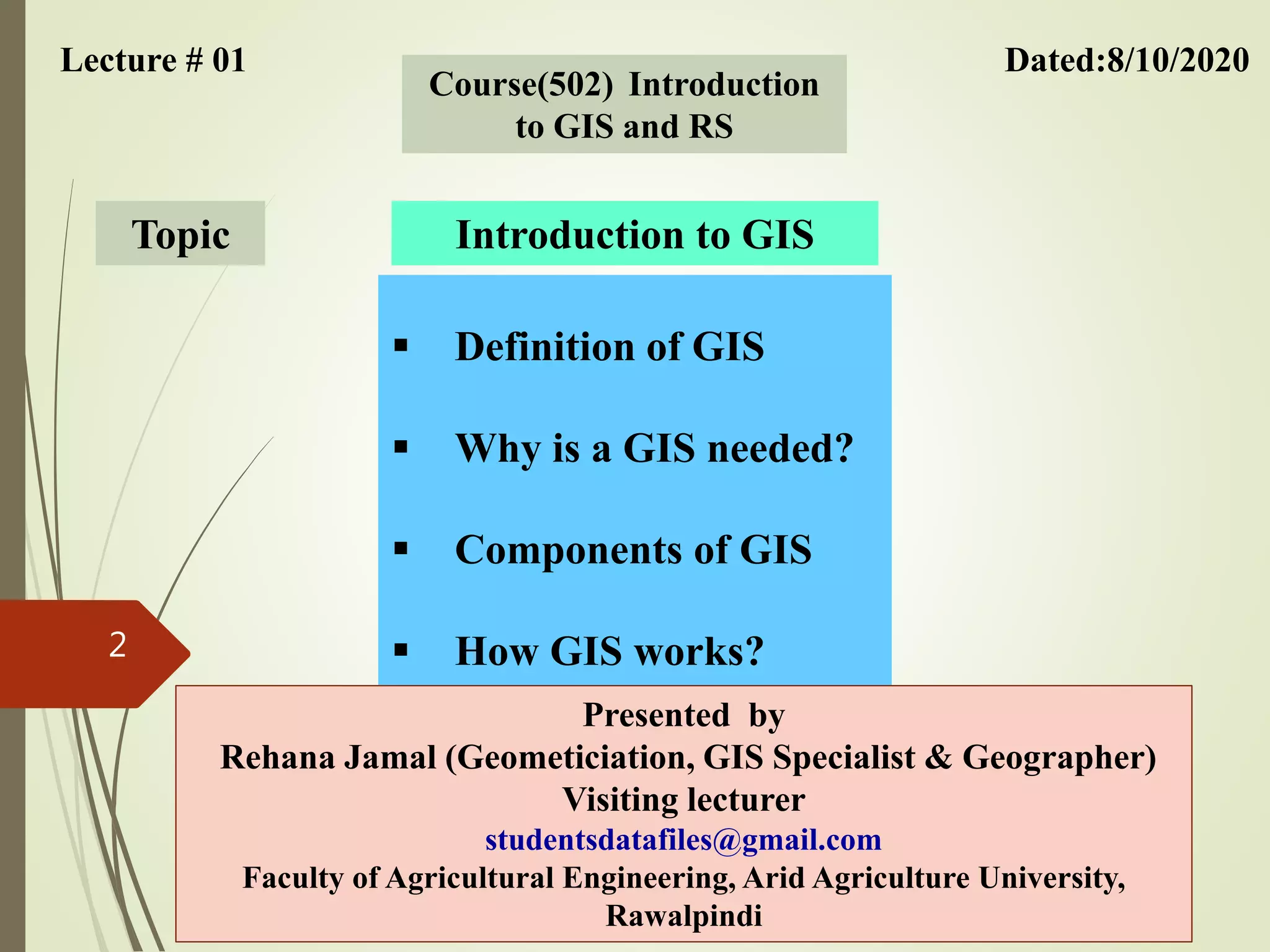
Course(502) Introduction
to GIS and RS
Introduction to GIS
Topic
 Definition of GIS
 Why is a GIS needed?
 Components of GIS
 How GIS works?
Presented by
Rehana Jamal (Geometiciation, GIS Specialist & Geographer)
Visiting lecturer
studentsdatafiles@gmail.com
Faculty of Agricultural Engineering, Arid Agriculture University,
Rawalpindi
2
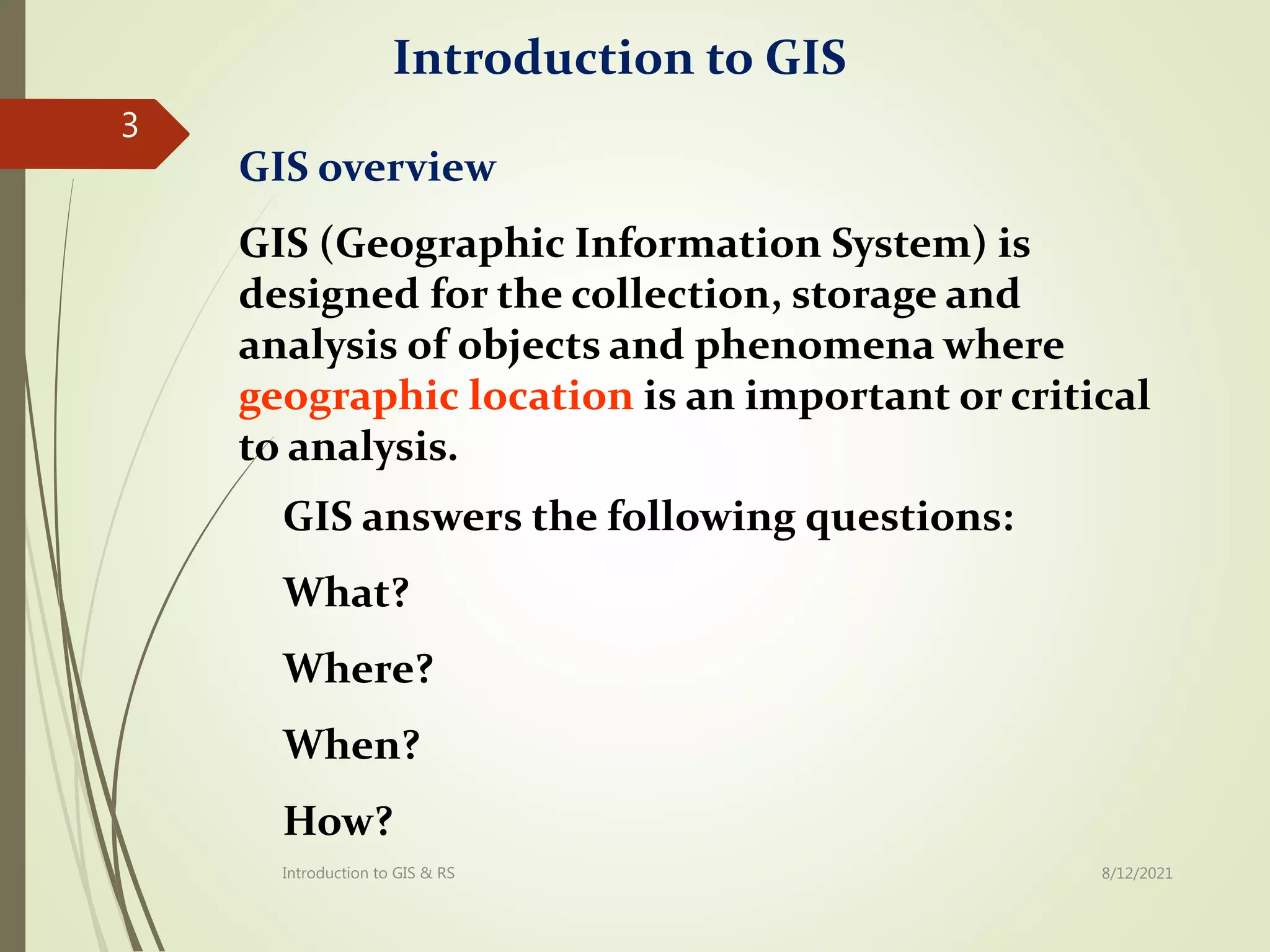
Introduction to GIS
GIS overview
GIS (Geographic Information System) is
designed for the collection, storage and
analysis of objects and phenomena where
geographic location is an important or critical
to analysis.
GIS answers the following questions:
What?
Where?
When?
How?
8/12/2021
Introduction to GIS & RS
3
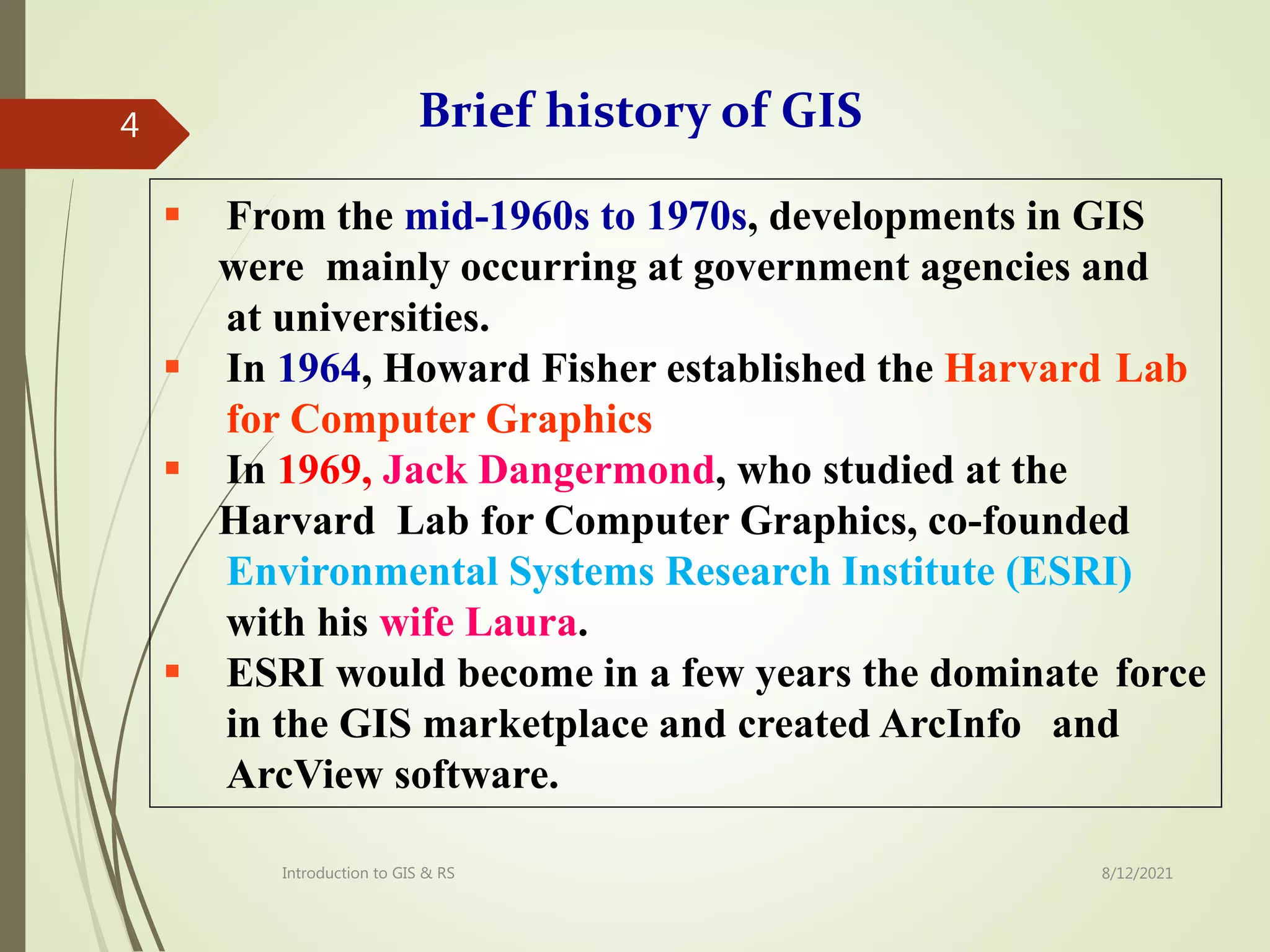
 From the mid-1960s to 1970s, developments in GIS
were mainly occurring at government agencies and
at universities.
 In 1964, Howard Fisher established the Harvard Lab
for Computer Graphics
 In 1969, Jack Dangermond, who studied at the
Harvard Lab for Computer Graphics, co-founded
Environmental Systems Research Institute (ESRI)
with his wife Laura.
 ESRI would become in a few years the dominate force
in the GIS marketplace and created ArcInfo and
ArcView software.
Brief history of GIS
8/12/2021
Introduction to GIS & RS
4
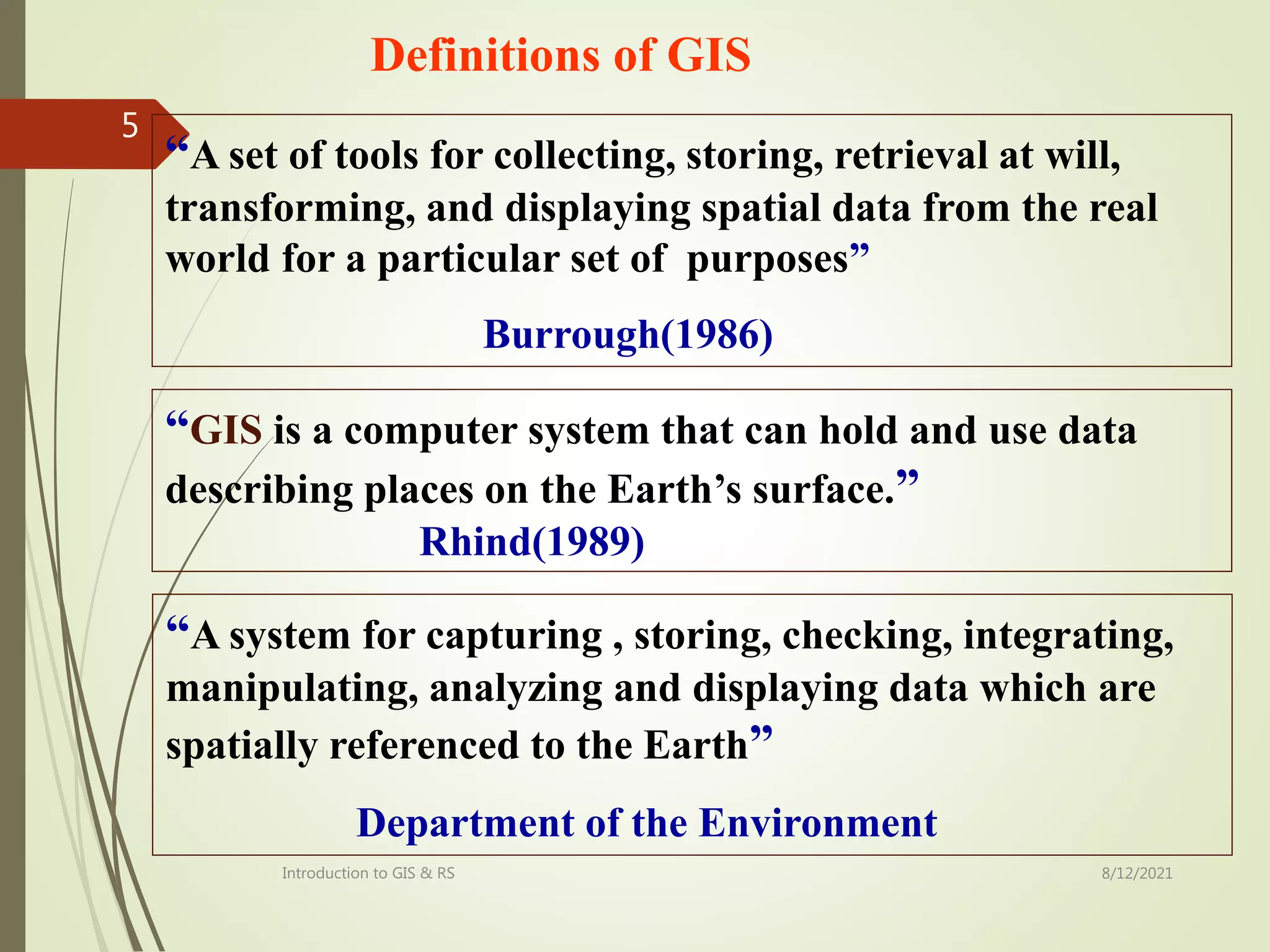
Definitions of GIS
“GIS is a computer system that can hold and use data
describing places on the Earth’s surface.”
Rhind(1989)
“A set of tools for collecting, storing, retrieval at will,
transforming, and displaying spatial data from the real
world for a particular set of purposes”
Burrough(1986)
“A system for capturing , storing, checking, integrating,
manipulating, analyzing and displaying data which are
spatially referenced to the Earth”
Department of the Environment
8/12/2021
Introduction to GIS & RS
5
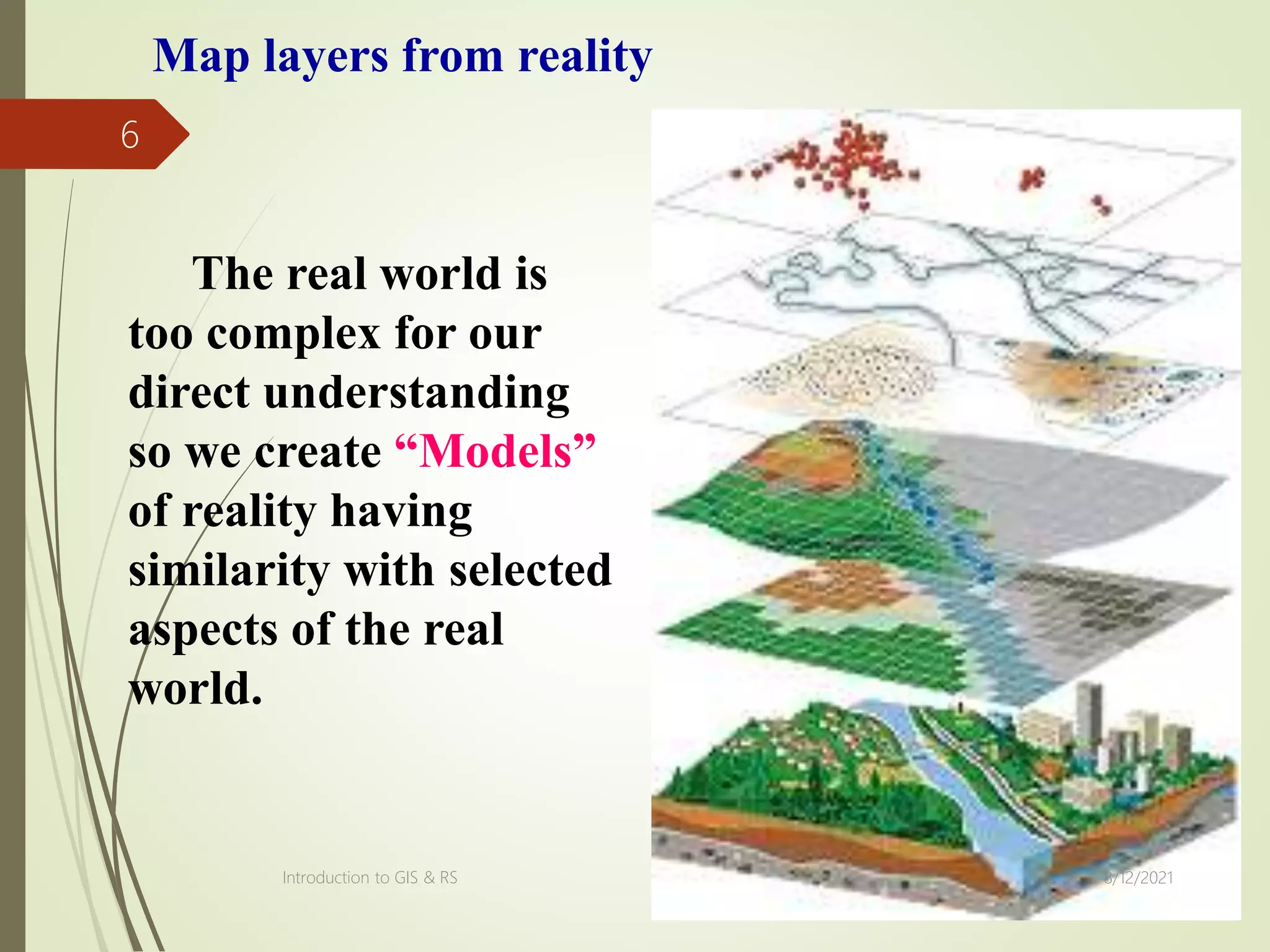
The real world is
too complex for our
direct understanding
so we create “Models”
of reality having
similarity with selected
aspects of the real
world.
Map layers from reality
8/12/2021
Introduction to GIS & RS
6
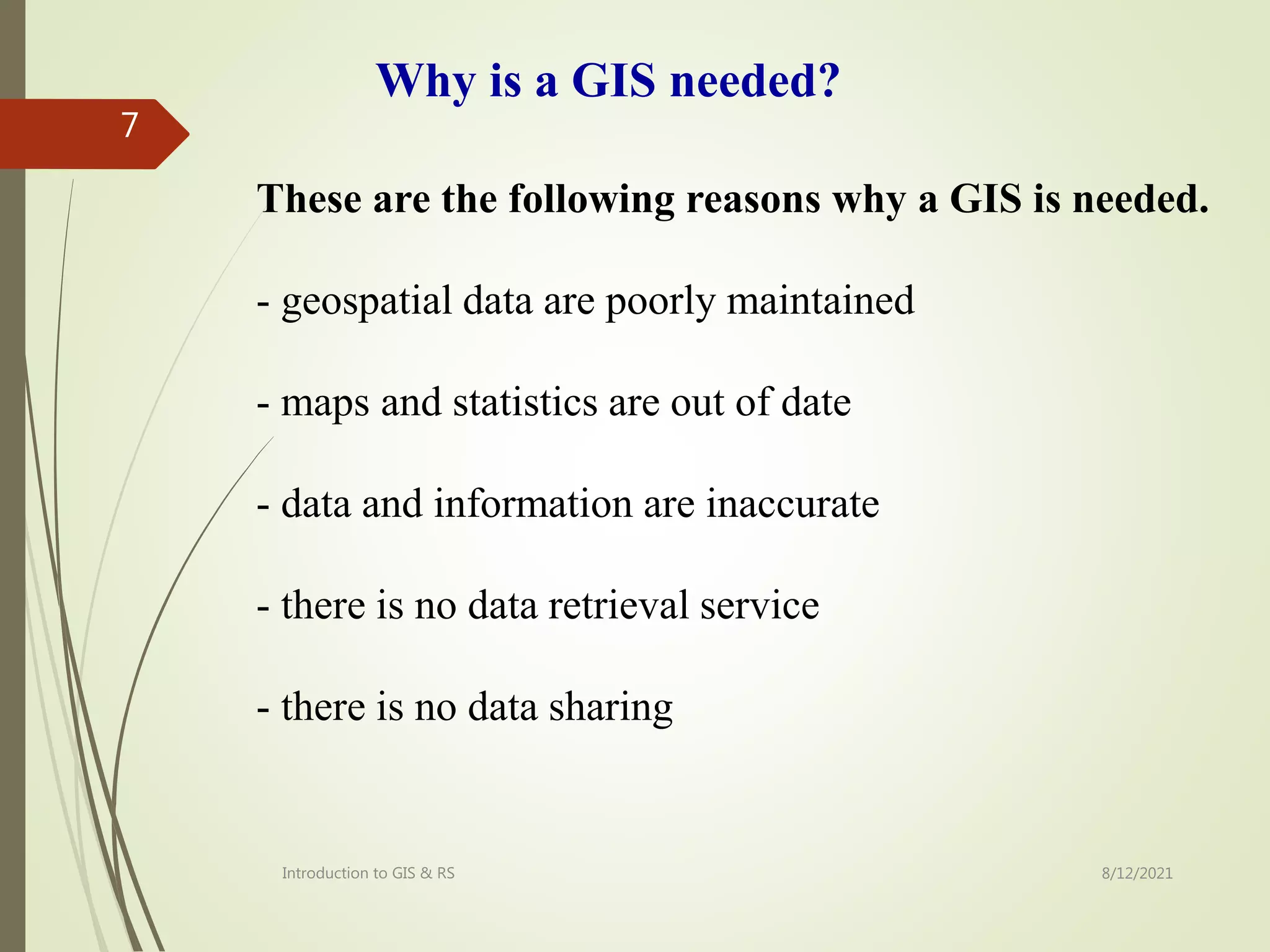
Why is a GIS needed?
These are the following reasons why a GIS is needed.
- geospatial data are poorly maintained
- maps and statistics are out of date
- data and information are inaccurate
- there is no data retrieval service
- there is no data sharing
8/12/2021
Introduction to GIS & RS
7
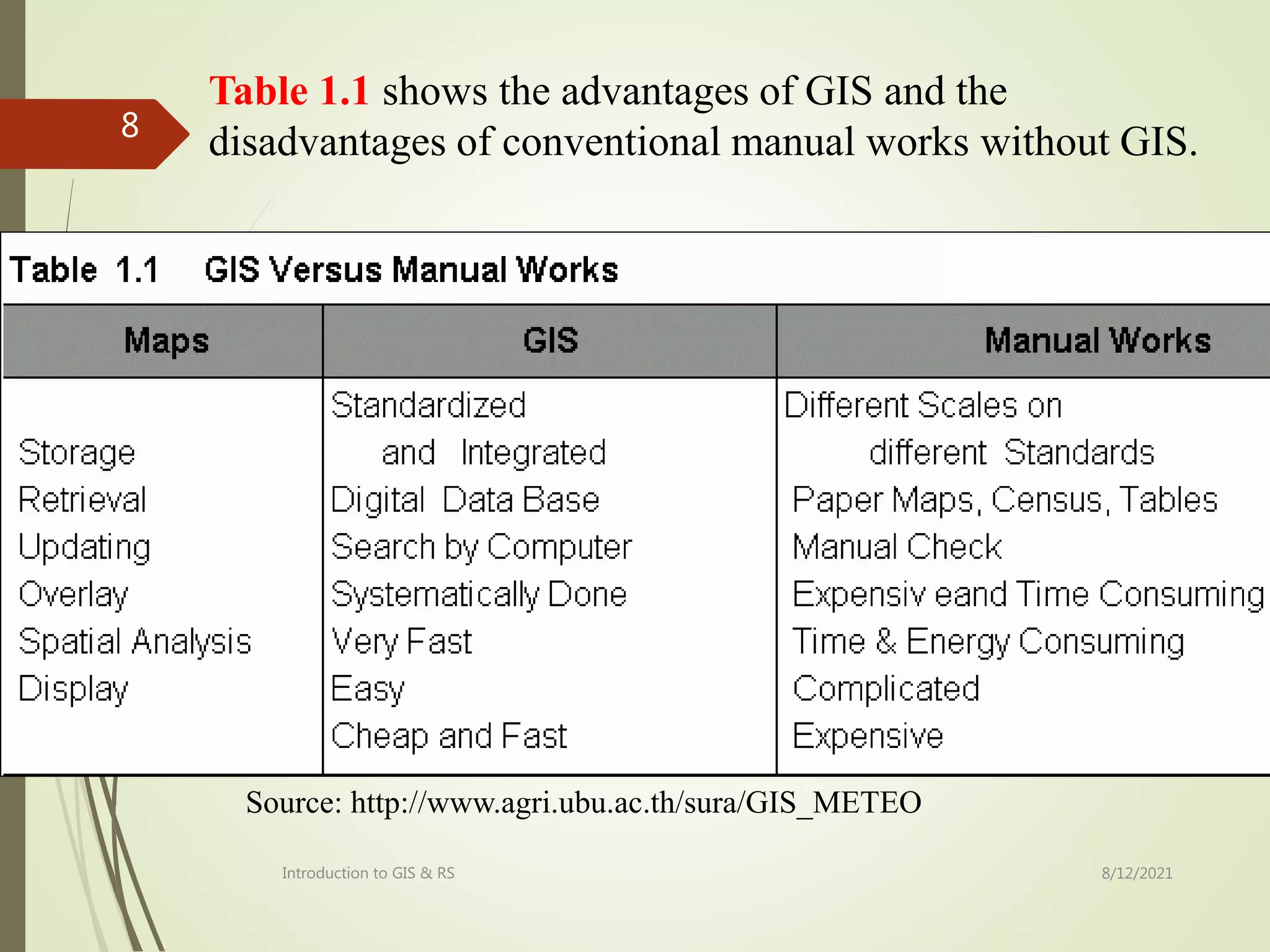
Table 1.1 shows the advantages of GIS and the
disadvantages of conventional manual works without GIS.
8/12/2021
Introduction to GIS & RS
8
Source: http://www.agri.ubu.ac.th/sura/GIS_METEO
8/12/2021
Introduction to GIS & RS
9
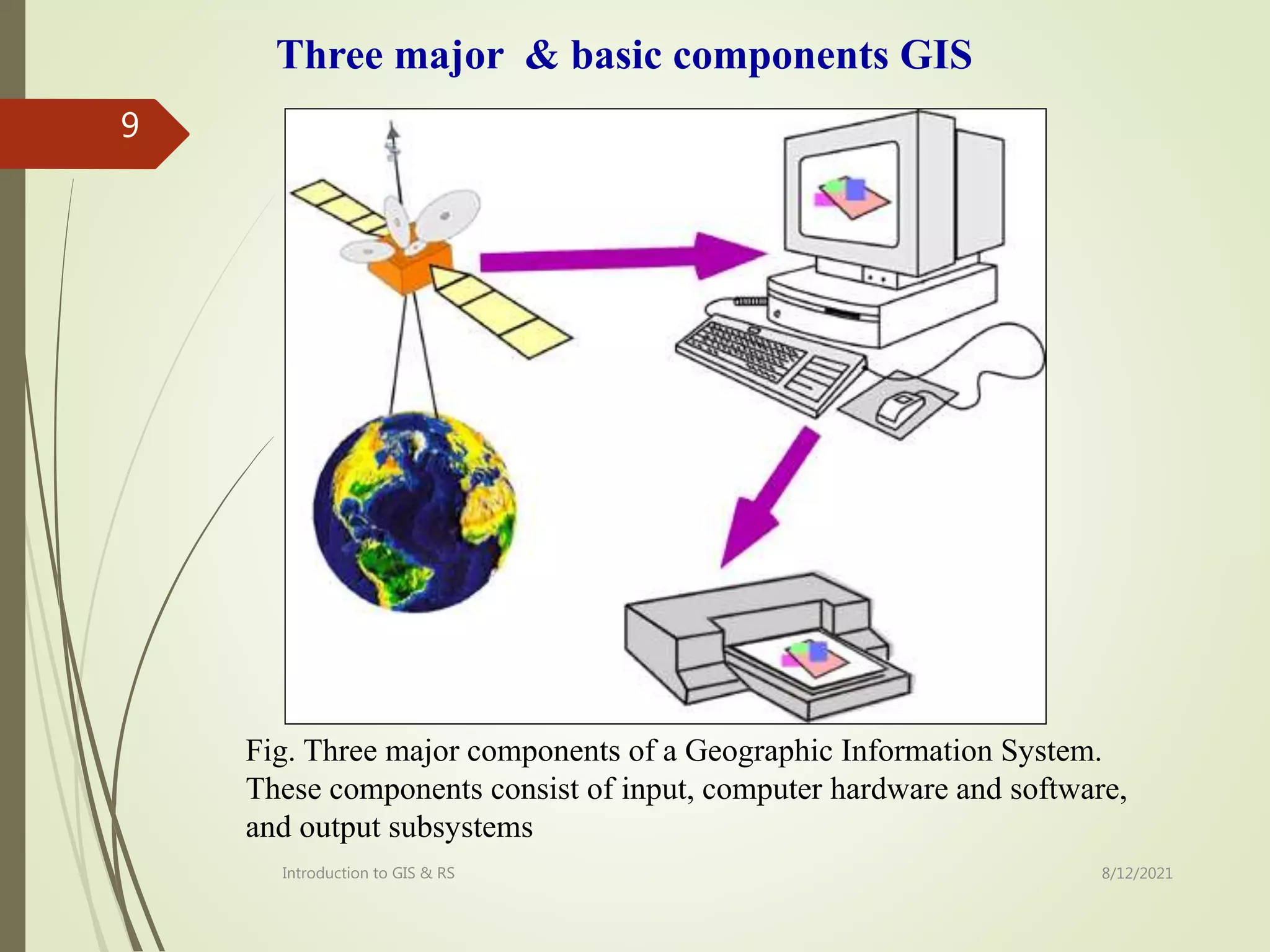
Three major & basic components GIS
Fig. Three major components of a Geographic Information System.
These components consist of input, computer hardware and software,
and output subsystems
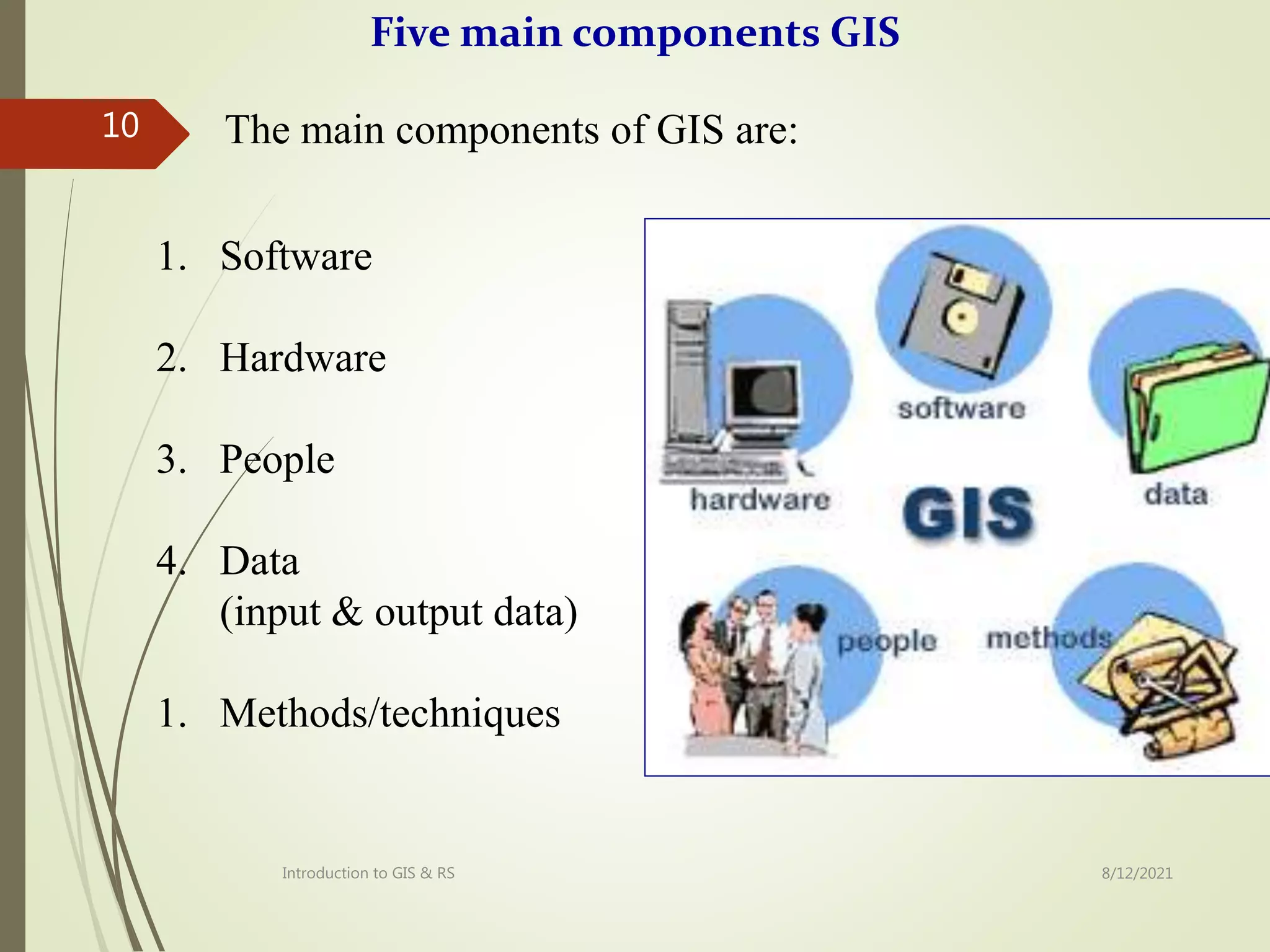
1. Software
2. Hardware
3. People
4. Data
(input & output data)
1. Methods/techniques
Five main components GIS
8/12/2021
Introduction to GIS & RS
10 The main components of GIS are:
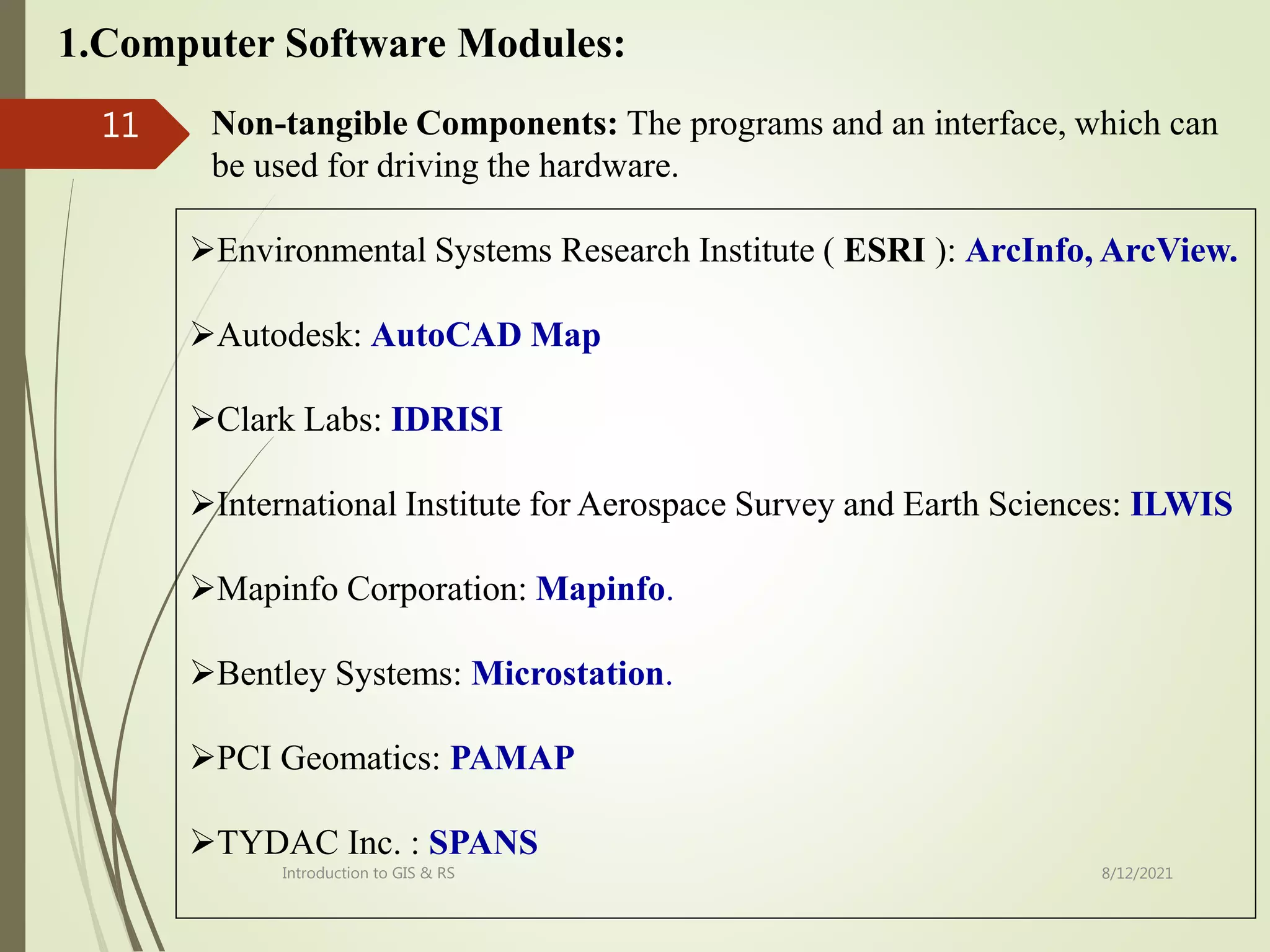
1.Computer Software Modules:
Environmental Systems Research Institute ( ESRI ): ArcInfo, ArcView.
Autodesk: AutoCAD Map
Clark Labs: IDRISI
International Institute for Aerospace Survey and Earth Sciences: ILWIS
Mapinfo Corporation: Mapinfo.
Bentley Systems: Microstation.
PCI Geomatics: PAMAP
TYDAC Inc. : SPANS
Non-tangible Components: The programs and an interface, which can
be used for driving the hardware.
8/12/2021
Introduction to GIS & RS
11
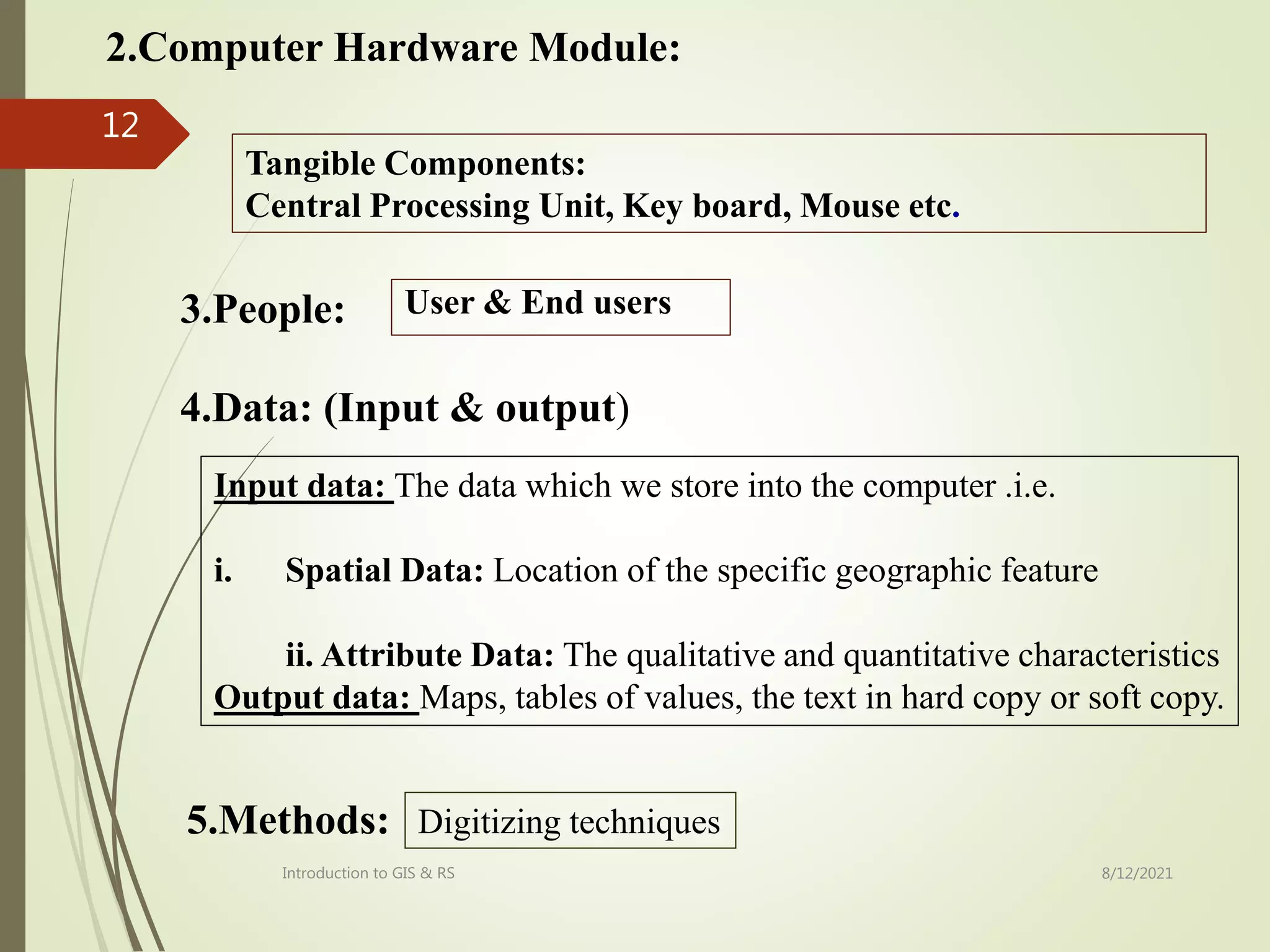
2.Computer Hardware Module:
Tangible Components:
Central Processing Unit, Key board, Mouse etc.
3.People: User & End users
4.Data: (Input & output)
Input data: The data which we store into the computer .i.e.
i. Spatial Data: Location of the specific geographic feature
ii. Attribute Data: The qualitative and quantitative characteristics
Output data: Maps, tables of values, the text in hard copy or soft copy.
5.Methods: Digitizing techniques
8/12/2021
Introduction to GIS & RS
12
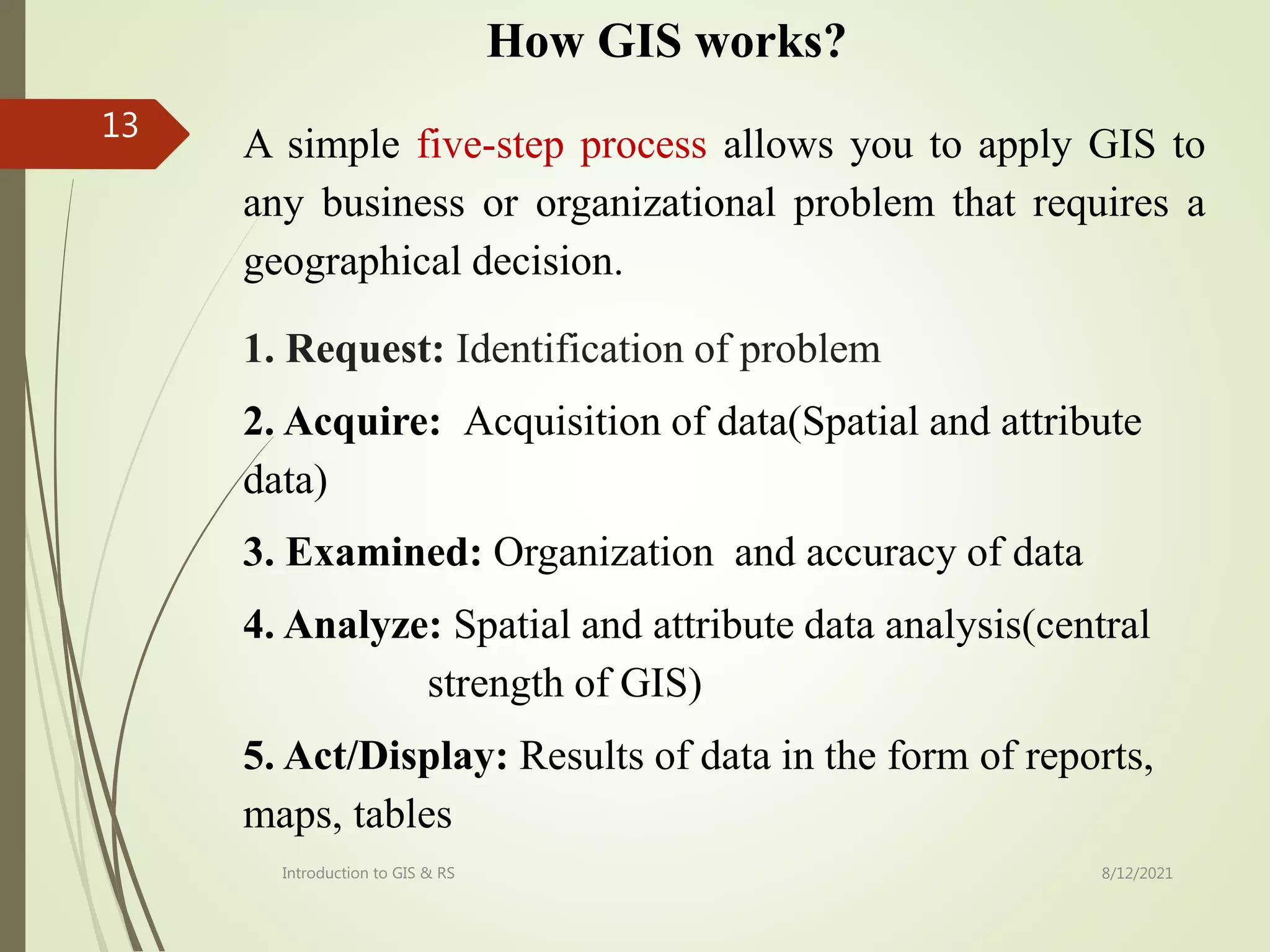
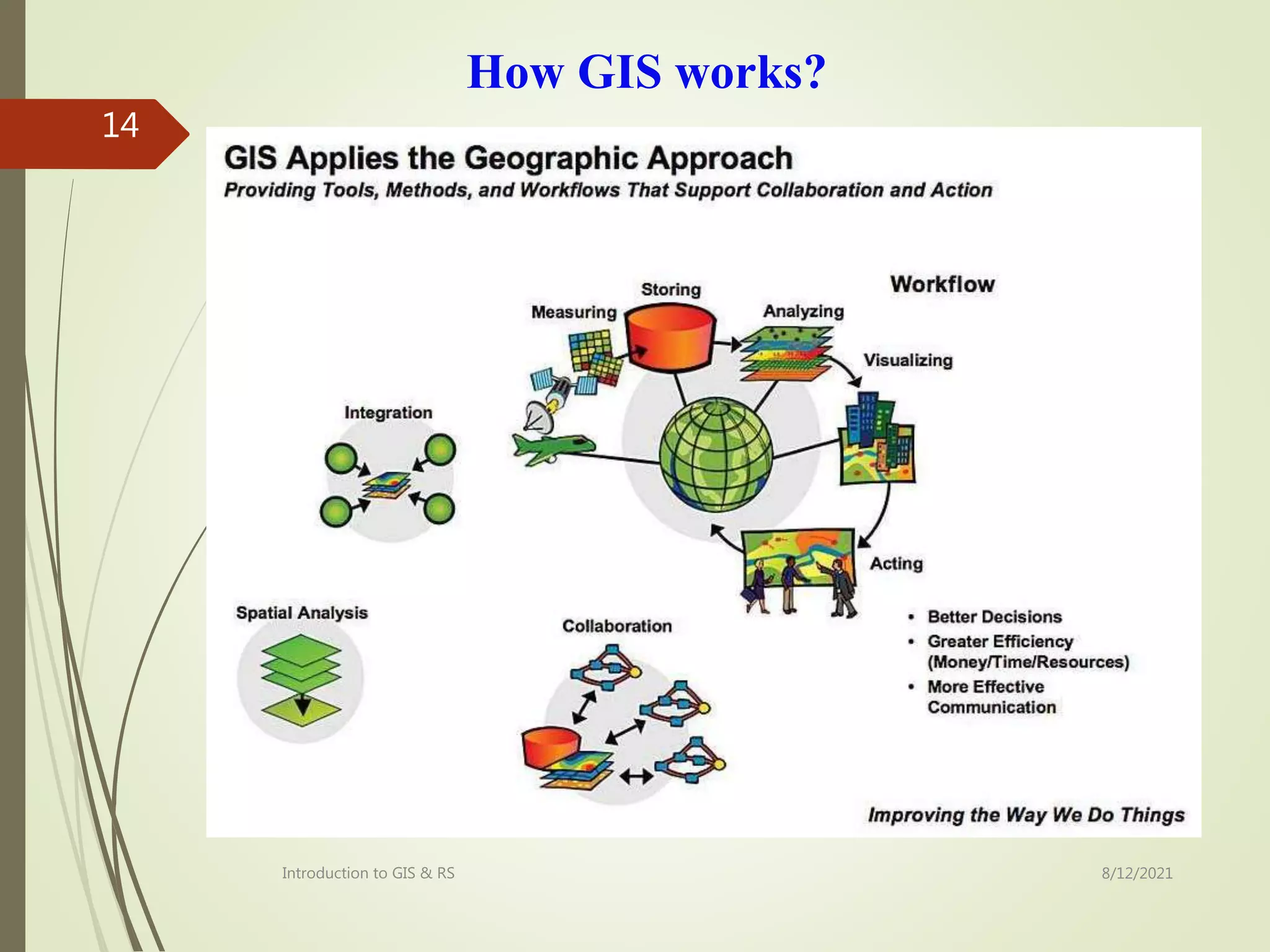
How GIS works?
1. Request: Identification of problem
2. Acquire: Acquisition of data(Spatial and attribute
data)
3. Examined: Organization and accuracy of data
4. Analyze: Spatial and attribute data analysis(central
strength of GIS)
5. Act/Display: Results of data in the form of reports,
maps, tables
A simple five-step process allows you to apply GIS to
any business or organizational problem that requires a
geographical decision.
Introduction to GIS & RS
13
8/12/2021
How GIS works?
Introduction to GIS & RS
14
8/12/2021
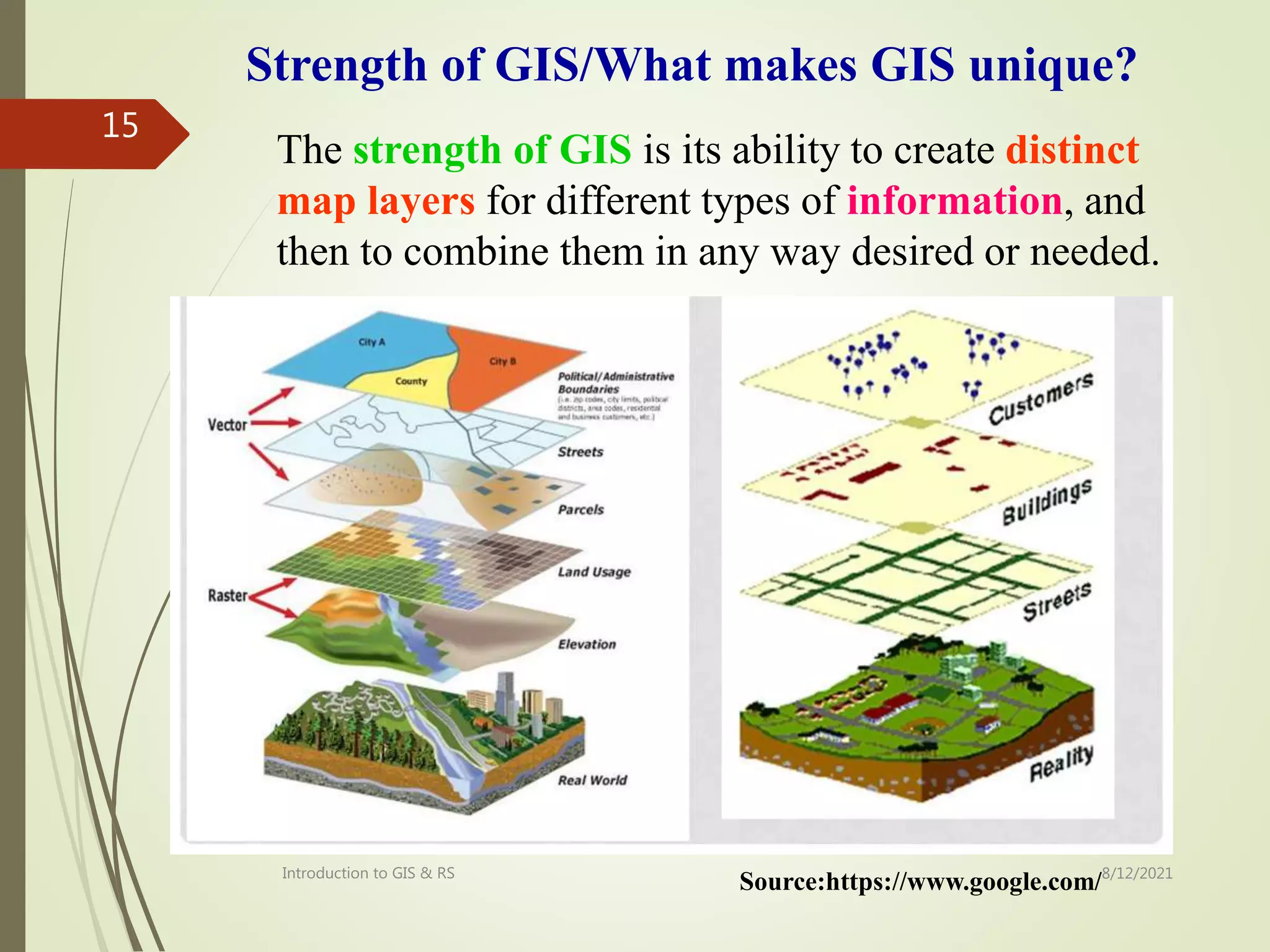
The strength of GIS is its ability to create distinct
map layers for different types of information, and
then to combine them in any way desired or needed.
Strength of GIS/What makes GIS unique?
Source:https://www.google.com/
Introduction to GIS & RS
15
8/12/2021
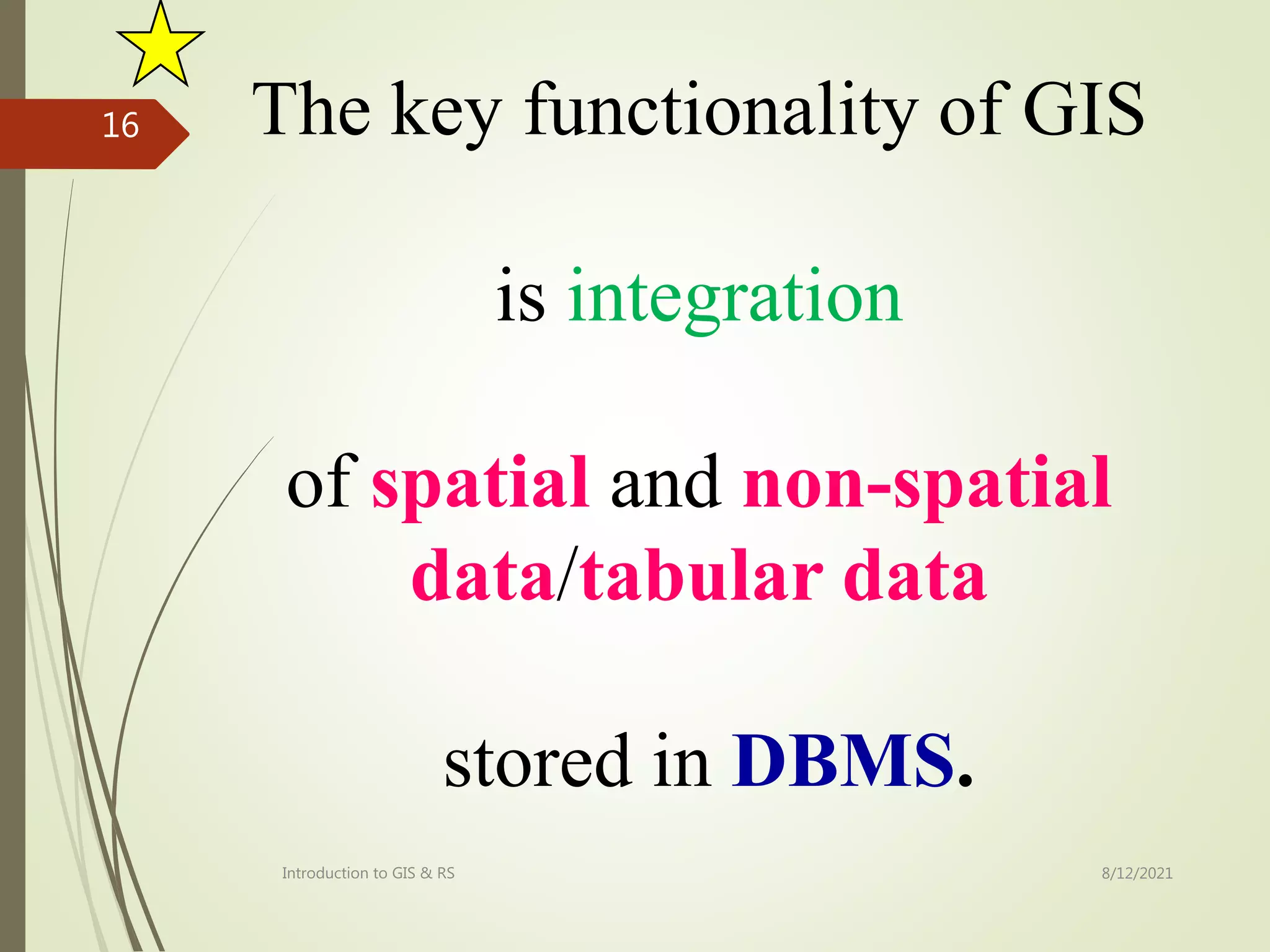
The key functionality of GIS
is integration
of spatial and non-spatial
data/tabular data
stored in DBMS.
8/12/2021
Introduction to GIS & RS
16
 ArcInfo , ArcView by ESRI
 AutoCAD Map BY Autodesk
 IDRISI by Clarklabs
 ILWIS by II for AS & ES
 Mapinfo by Mapinfo Carporation
 Microstation by Bentley Systems
 PAMAP by PCI Geomatics
 SPANS by TYDAC Inc.
Popular commercial applications launched during 1980-90
8/12/2021
Introduction to GIS & RS
17
 ARCGIS ( ArcView 10.1 and +)
ArcView: ESRI, the producer of
ArcView, has been an industry leader in the
production of GIS software and in the support of
GIS education.
Present Major GIS soft wares
 Google Map
 Google Earth
 QGIS
 GRASS GIS
Introduction to GIS & RS
18
8/12/2021
 Definition of GIS
 Why is a GIS needed?
 Components of GIS
 How GIS works?
Summary
8/12/2021
Introduction to GIS & RS
19
 www.yahoo.com
 www.google.com----------------(Maps)
 http://www.pasda.psu.edu/tutorials/gisbasics/components.asp
 http://www.mapcruzin.com/what-is-gis.htm
 Book: An Introduction to geographical information system by Hay
Wood I, Carnelius, S & Carver, S
 Book: Geographic Information System:
 A Management Perspective by Stan Aronoff
 Book: Principles of Geographic Information Systems
 By Otto Huisman and Rolf A.de By
8/12/2021
Introduction to GIS & RS
20
References:
Lecture # 02 Dated:8/10/2020
Course(502) Introduction
to GIS and RS
Introduction to RS
Topic
Presented by
Rehana Jamal (Geometiciation, GIS Specialist & Geographer)
Visiting lecturer
studentsdatafiles@gmail.com
Faculty of Agricultural Engineering, Arid Agriculture University,
21
21
 What is Remote sensing(RS)?
 History of Remote sensing
 RS is a spatial data acquisition technique
 Sources of Remote sensing data
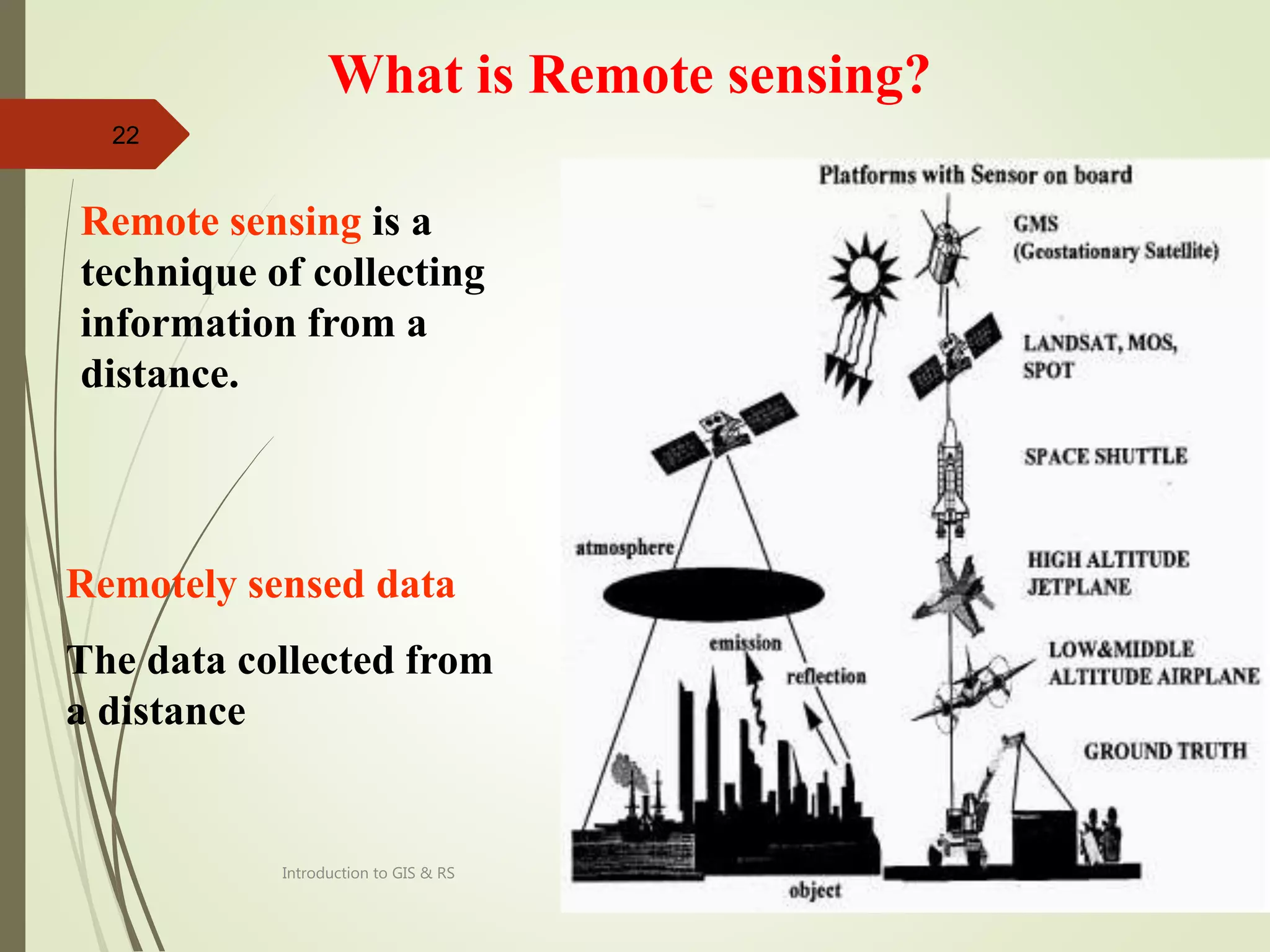
What is Remote sensing?
Remote sensing is a
technique of collecting
information from a
distance.
Remotely sensed data
The data collected from
a distance
8/12/2
021
22
Introduction to GIS & RS
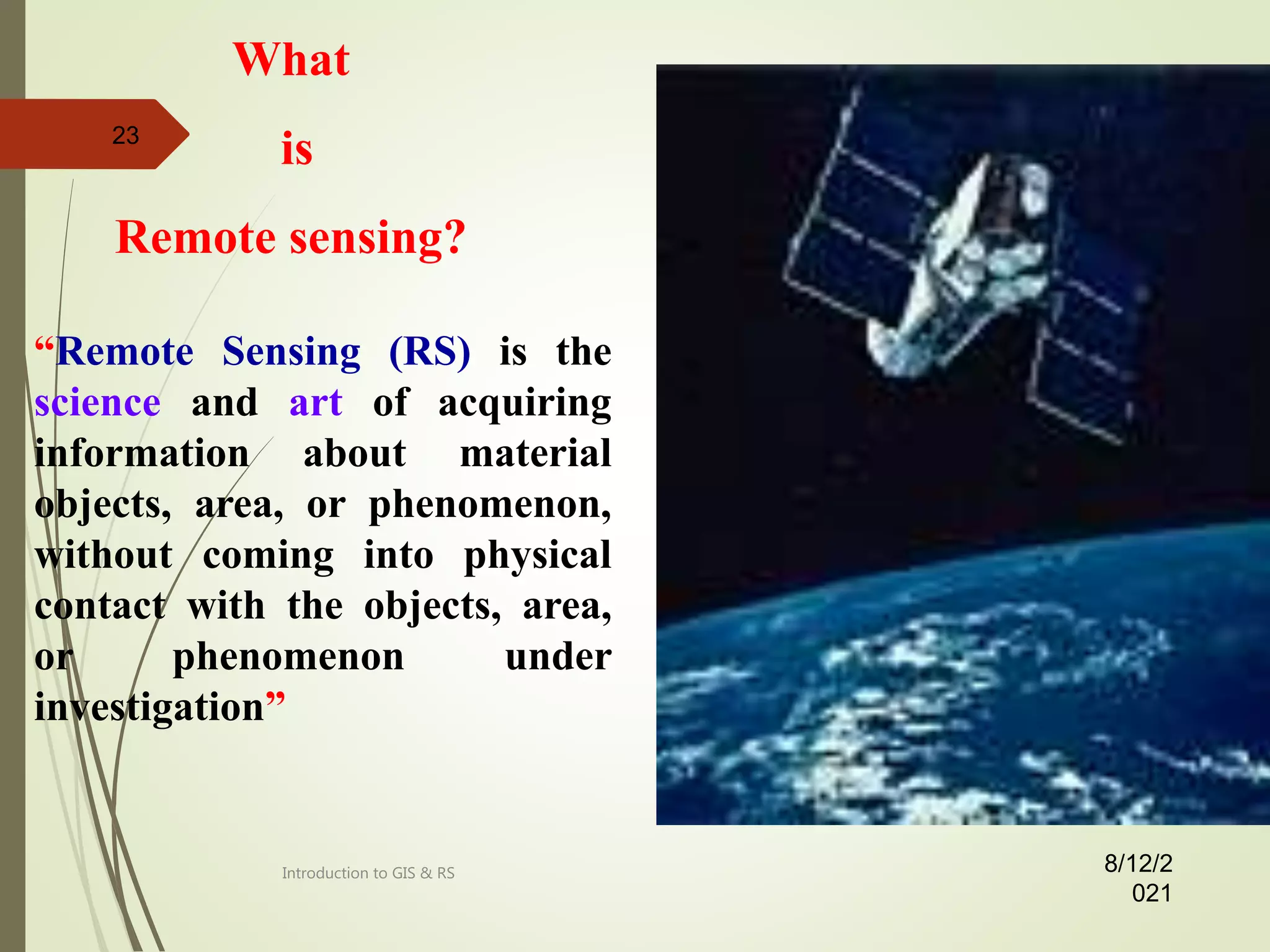
“Remote Sensing (RS) is the
science and art of acquiring
information about material
objects, area, or phenomenon,
without coming into physical
contact with the objects, area,
or phenomenon under
investigation”
What
is
Remote sensing?
8/12/2
021
23
Introduction to GIS & RS
8/12/2021
Introduction to GIS & RS
24  First aerial photograph was taken from a balloon suspended over Paris
by the French photographer and balloonist Gaspard-Felix Tournachon, known as
“Nadar”, in 1858
 Aerial photographs by balloons in 1860
 1st Military use of photograph in American Civil War to analyze the
defence in1862
 Balloons, Aerophile i & ii by French Richards Brothers in1893
 Leon P.Teisserenc de Bort, a French meteorologist founded two parts
of atmosphere in 1899
 TROPOSPHERE up to 700 miles
 STRATOSPHERE above 700 miles
 Weather kites were after balloons up to 11000-12000 ft.
 Small cameras & faster lenses and films were available by early 1900.
 Wilber Wright took 1st photograph from airplane in 1909
 At the end of 1918: 56000prints of aerial photographs were taken
 Aerial photography 1st used in the 2nd World War
 In 1920-1930s Amphibious bush plane used in Canada
 Space ships :Sputnik i-(1957) & ii-(1958)
 Satellite imagery presently used started from 1972
Brief history of Remote sensing
8/12/2021
Introduction to GIS & RS
25
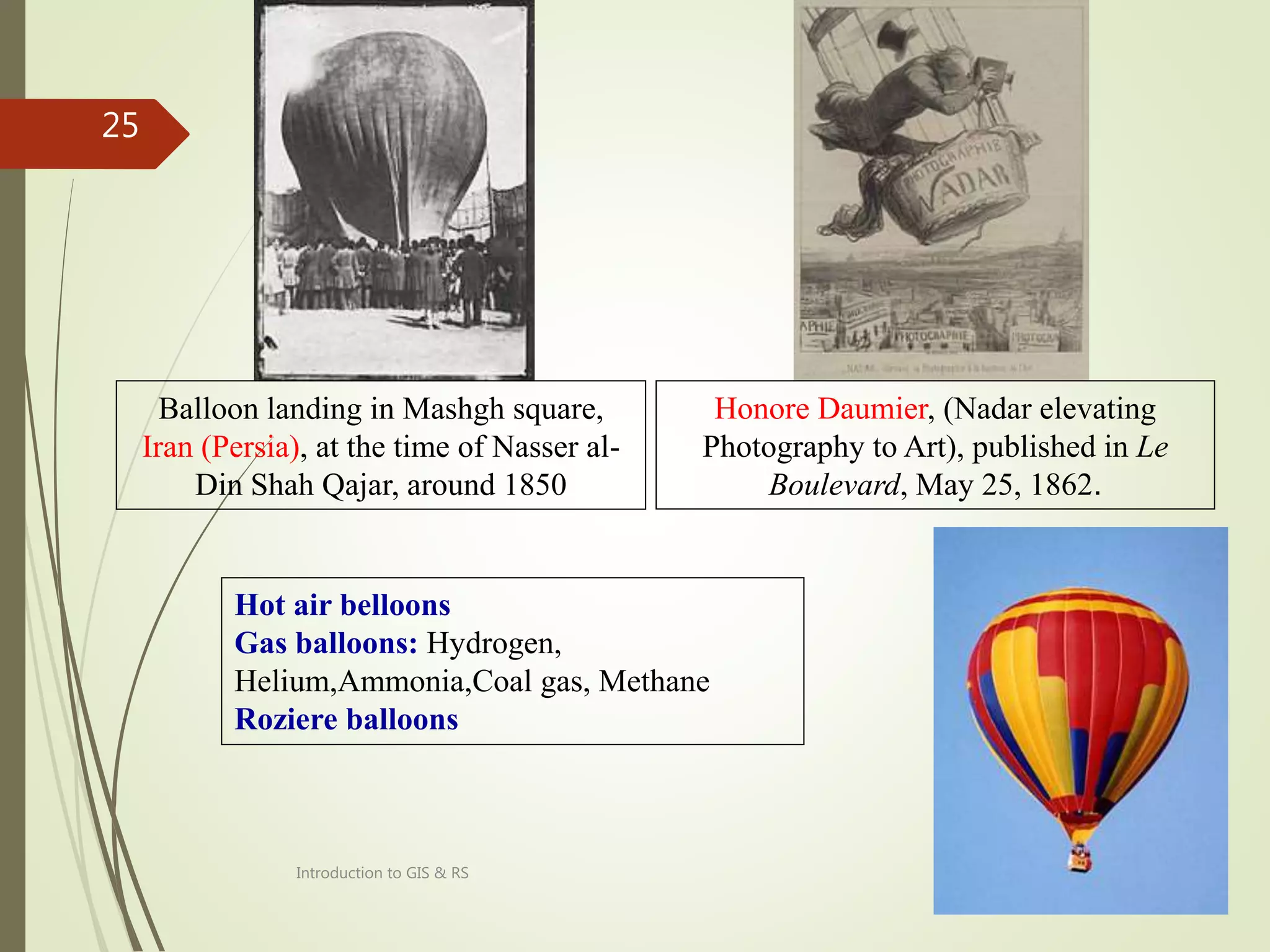
Honore Daumier, (Nadar elevating
Photography to Art), published in Le
Boulevard, May 25, 1862.
Hot air belloons
Gas balloons: Hydrogen,
Helium,Ammonia,Coal gas, Methane
Roziere balloons
Balloon landing in Mashgh square,
Iran (Persia), at the time of Nasser al-
Din Shah Qajar, around 1850
8/12/2021
Introduction to GIS & RS
26
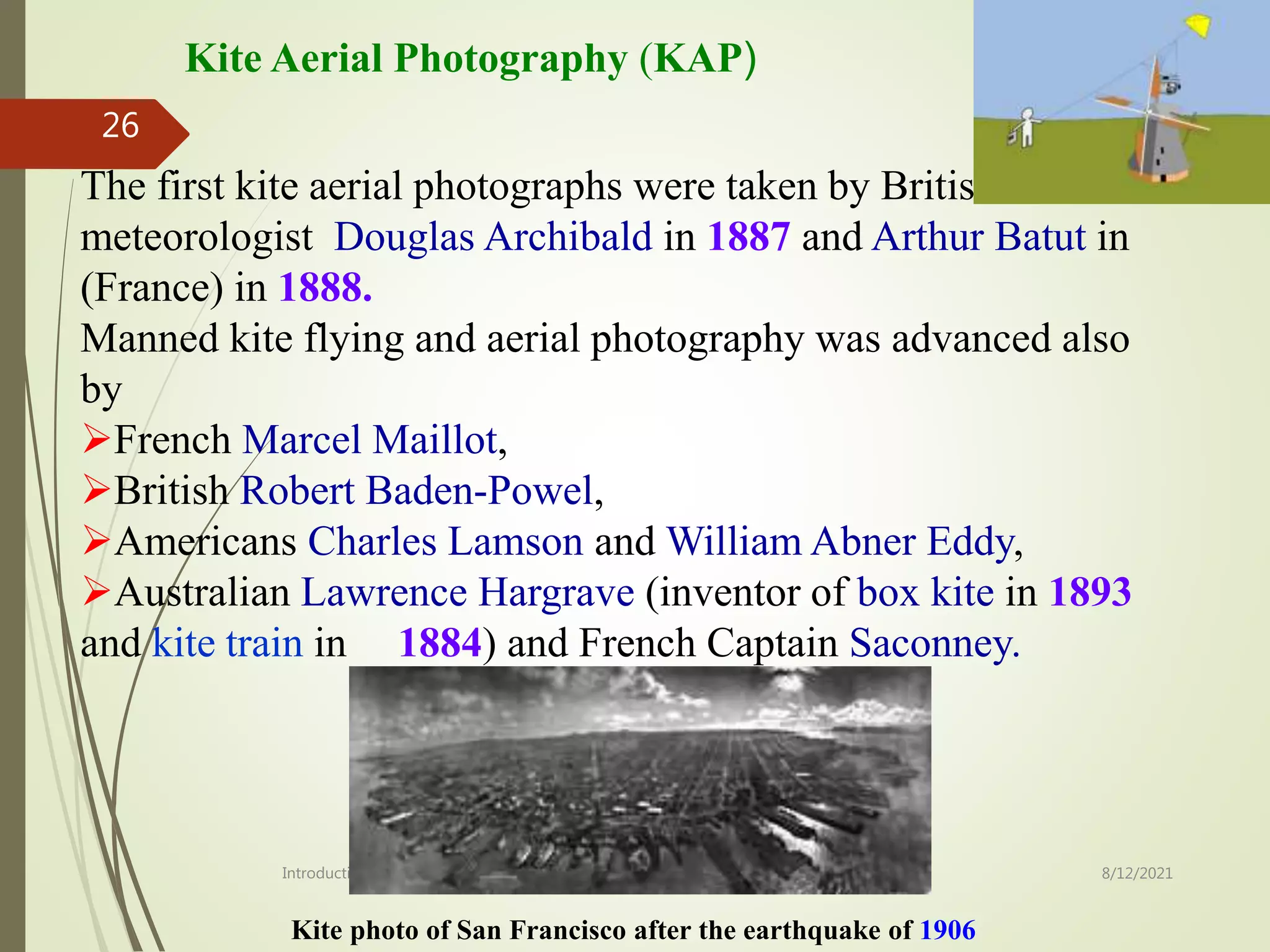
Kite photo of San Francisco after the earthquake of 1906
The first kite aerial photographs were taken by British
meteorologist Douglas Archibald in 1887 and Arthur Batut in
(France) in 1888.
Manned kite flying and aerial photography was advanced also
by
French Marcel Maillot,
British Robert Baden-Powel,
Americans Charles Lamson and William Abner Eddy,
Australian Lawrence Hargrave (inventor of box kite in 1893
and kite train in 1884) and French Captain Saconney.
Kite Aerial Photography (KAP)
8/12/2021
Introduction to GIS & RS
27
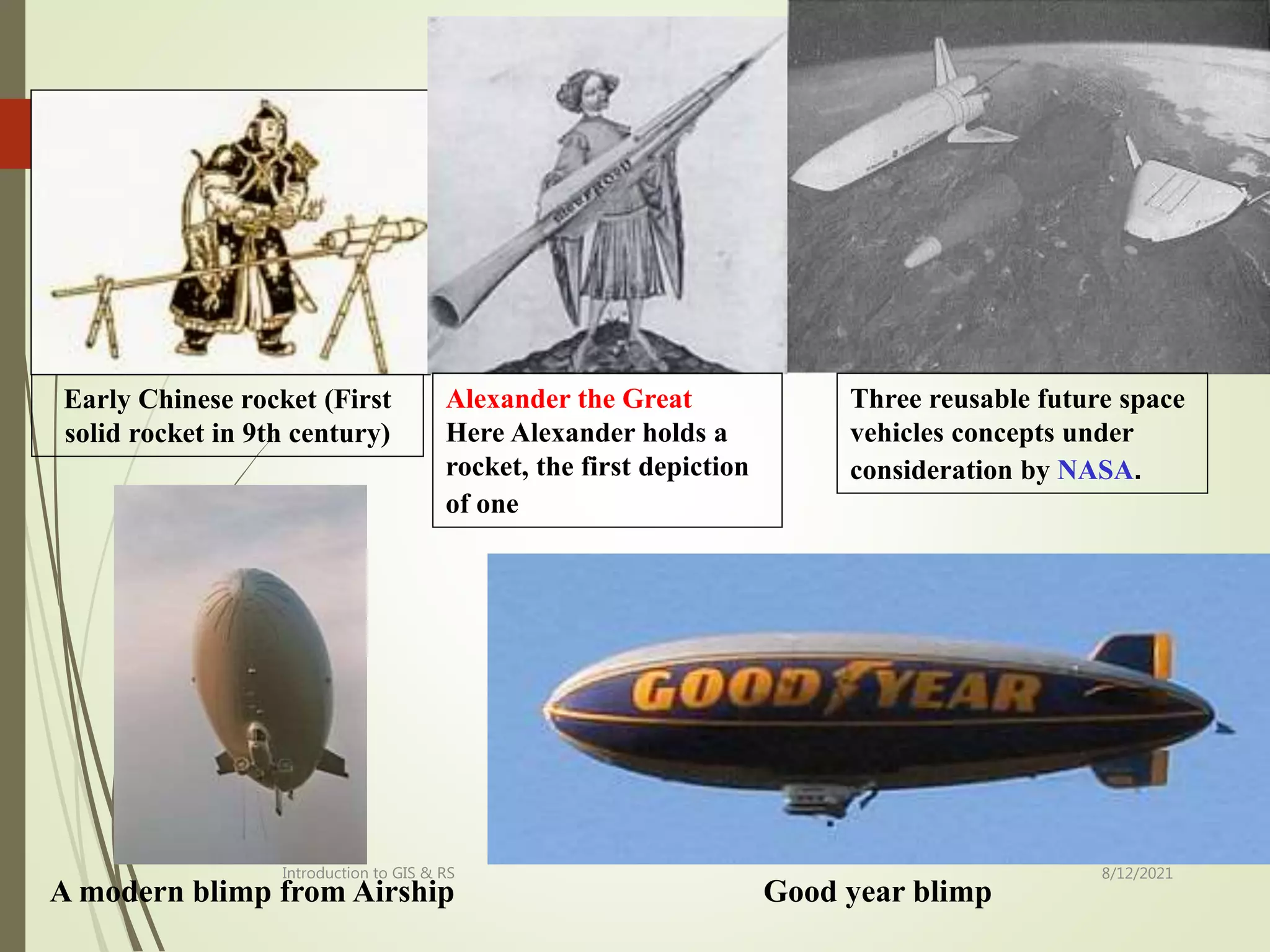
A modern blimp from Airship Good year blimp
Early Chinese rocket (First
solid rocket in 9th century)
Alexander the Great
Here Alexander holds a
rocket, the first depiction
of one
Three reusable future space
vehicles concepts under
consideration by NASA.
8/12/2021
Introduction to GIS & RS
28
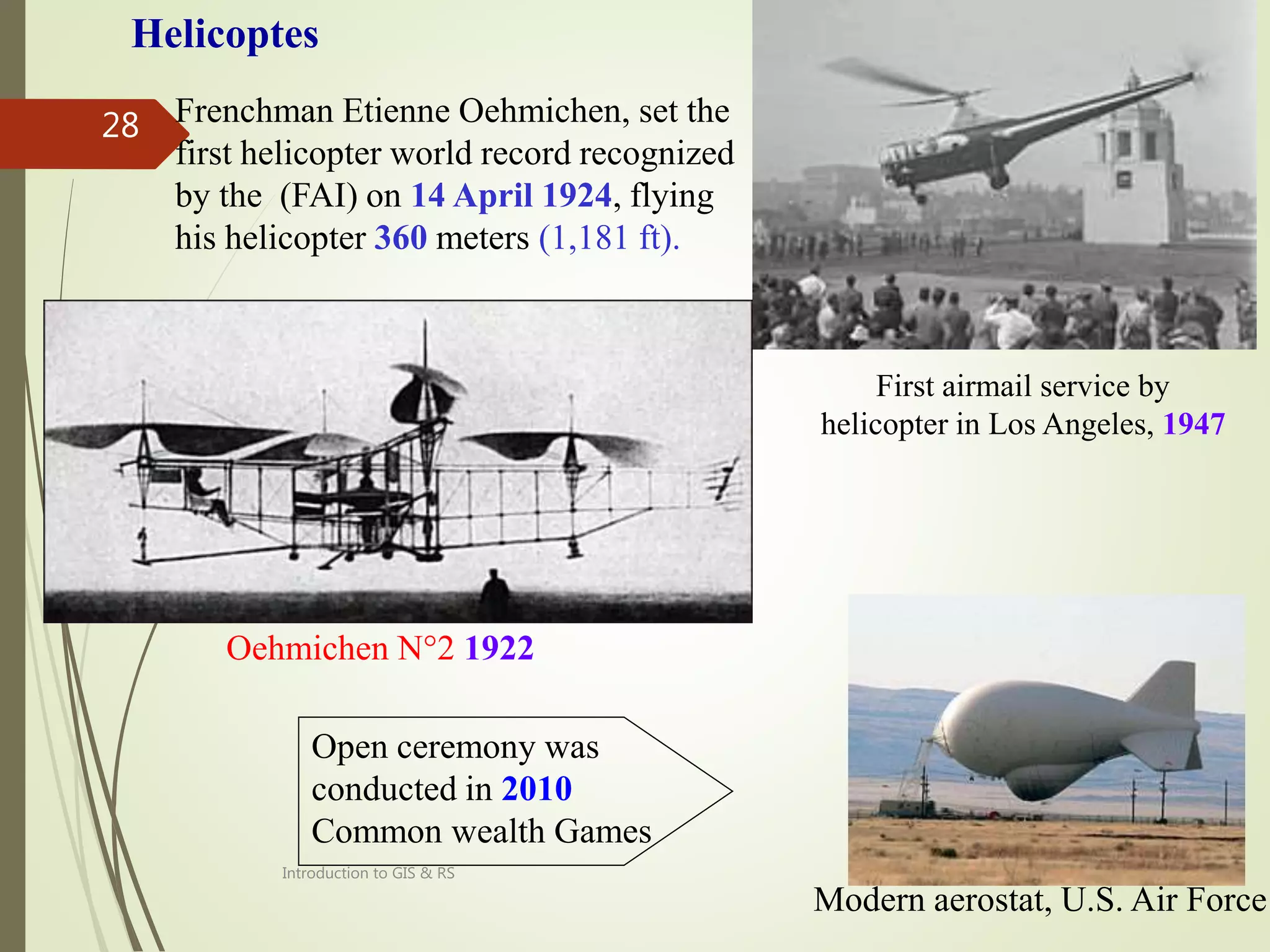
First airmail service by
helicopter in Los Angeles, 1947
Frenchman Etienne Oehmichen, set the
first helicopter world record recognized
by the (FAI) on 14 April 1924, flying
his helicopter 360 meters (1,181 ft).
Oehmichen N°2 1922
Modern aerostat, U.S. Air Force
Helicoptes
Open ceremony was
conducted in 2010
Common wealth Games
8/12/2021
Introduction to GIS & RS
29
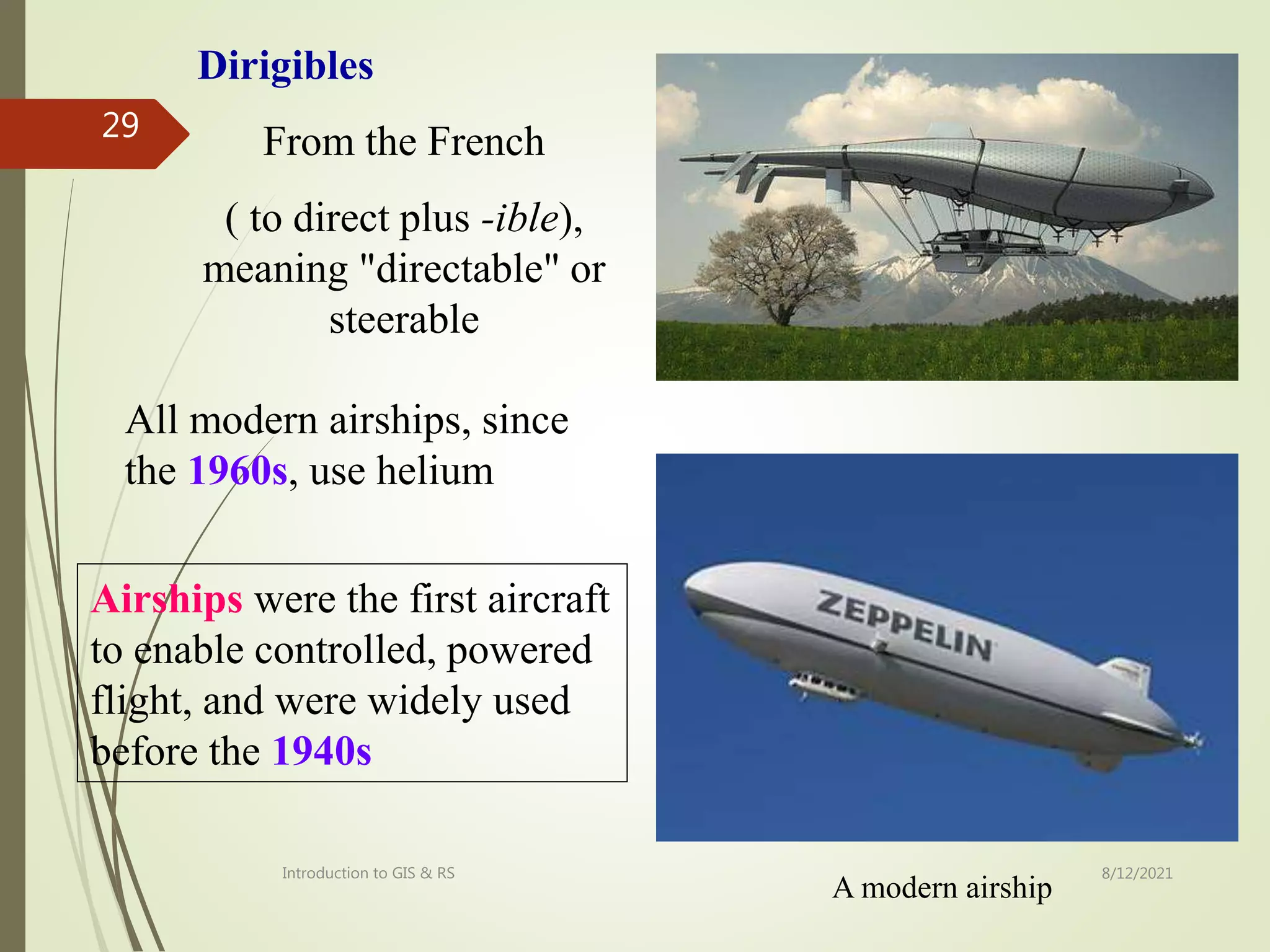
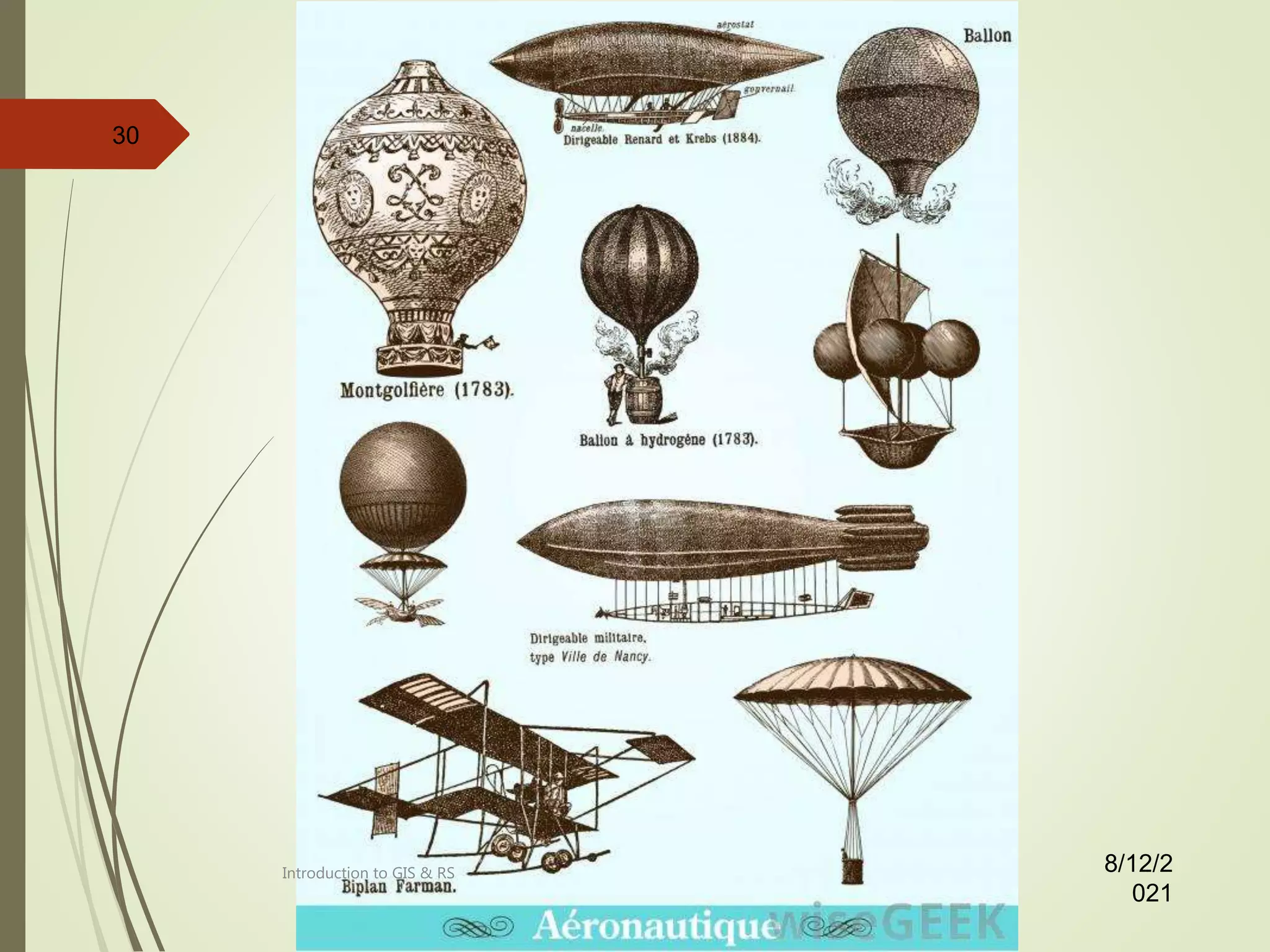
A modern airship
Airships were the first aircraft
to enable controlled, powered
flight, and were widely used
before the 1940s
Dirigibles
From the French
( to direct plus -ible),
meaning "directable" or
steerable
All modern airships, since
the 1960s, use helium
8/12/2
021
30
Introduction to GIS & RS
8/12/2
021
31
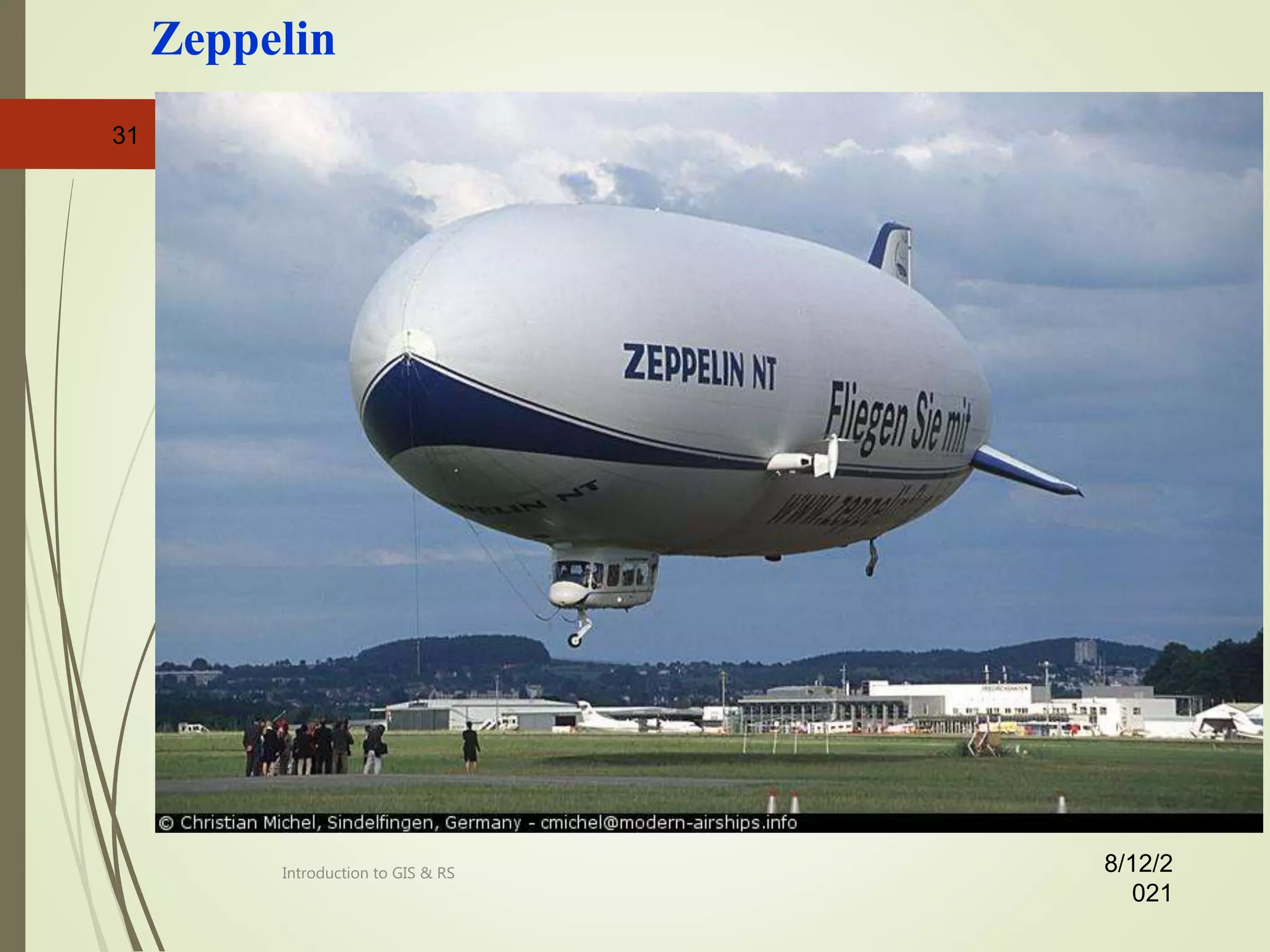
Zeppelin
Introduction to GIS & RS
8/12/2021
Introduction to GIS & RS
32
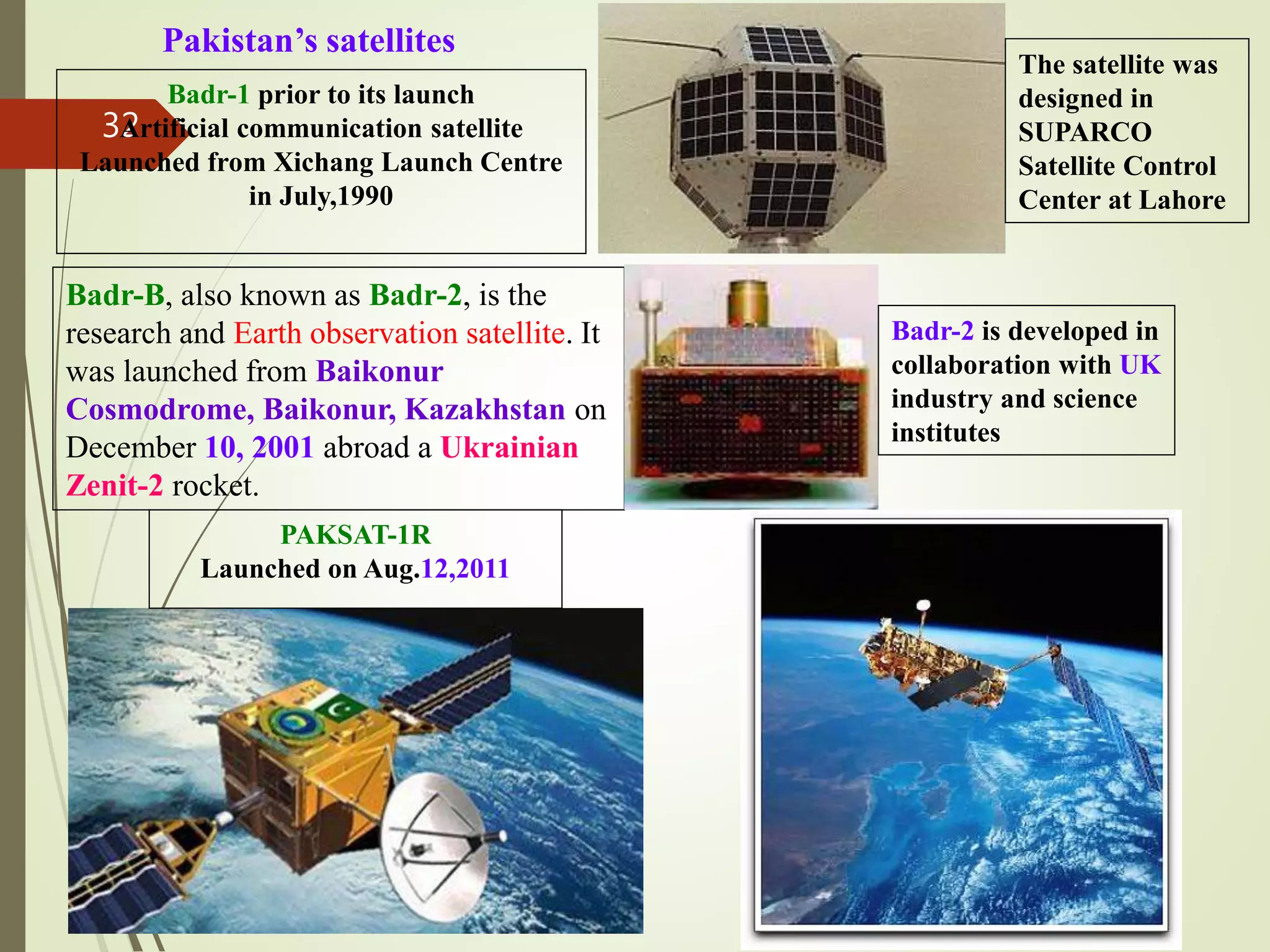
Pakistan’s satellites
Badr-1 prior to its launch
Artificial communication satellite
Launched from Xichang Launch Centre
in July,1990
The satellite was
designed in
SUPARCO
Satellite Control
Center at Lahore
Badr-B, also known as Badr-2, is the
research and Earth observation satellite. It
was launched from Baikonur
Cosmodrome, Baikonur, Kazakhstan on
December 10, 2001 abroad a Ukrainian
Zenit-2 rocket.
Badr-2 is developed in
collaboration with UK
industry and science
institutes
PAKSAT-1R
Launched on Aug.12,2011
8/12/2021
Introduction to GIS & RS
33
Agronomist: forecast the agricultural period
An urban planner: identify areas illegally built
An Engineer: determine optical configuration( terrain
obstacles of buildings) for siting relay stations for
Telecommunication companies
Mining Engineer: explore the area to map the surface
mineralogy
Environenlist:do future planning, air pollution & control,
disaster management, forest fires management, managing
natural resources, wastewater management, oil spills and its
remedial actions etc.
Climatologist: identify the parameters including sea
currents, meteorology, energy interactions between the land
and water
Remote sensing is a spatial data acquisition technique
8/12/2021
Introduction to GIS & RS
34
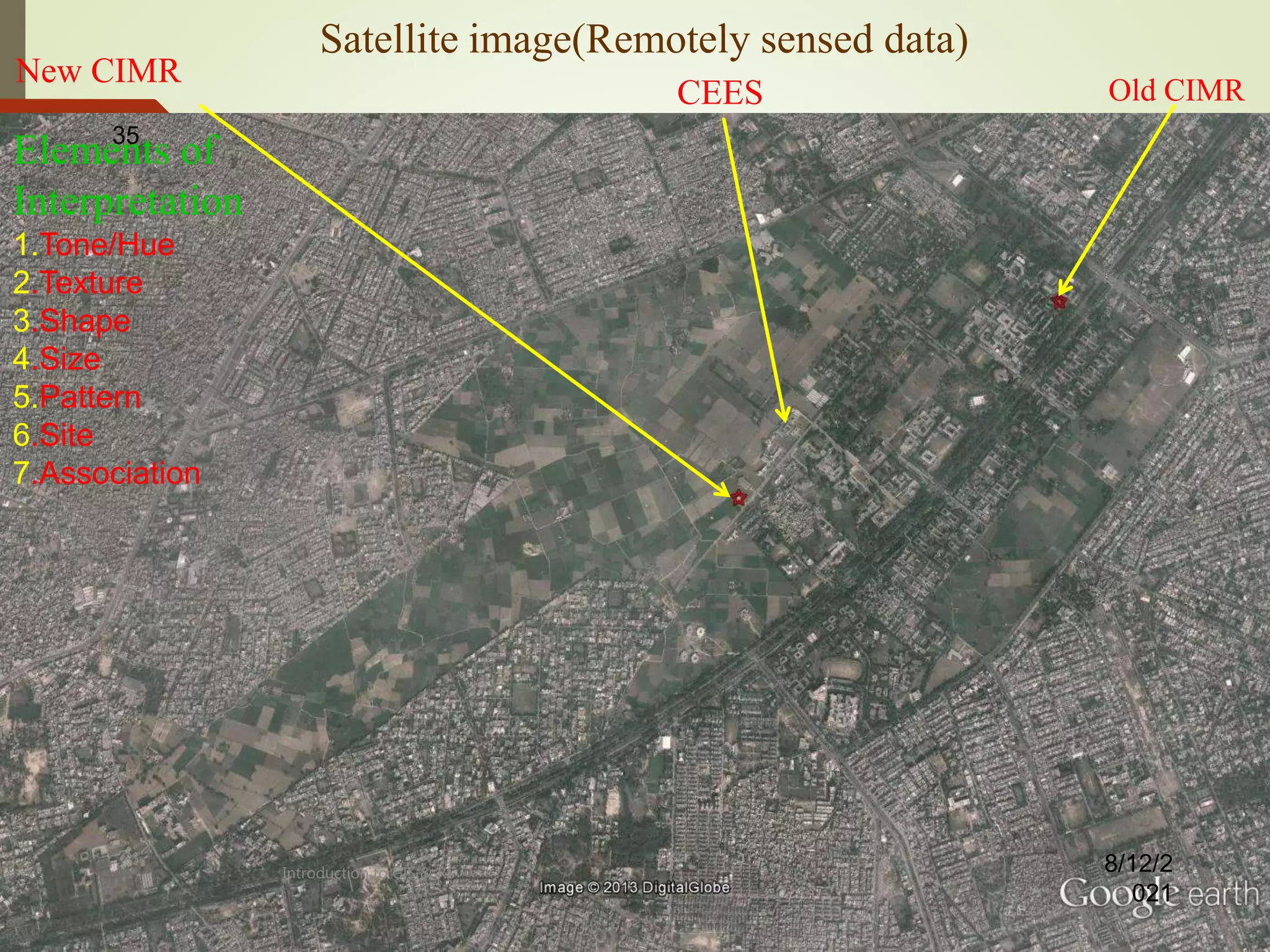
Sources of Remote sensing data
Aerial photography
Airborne radar
Scanner data
Satellite imagery
DEM data
Satellite image(Remotely sensed data)
New CIMR
Old CIMR
Elements of
Interpretation
1.Tone/Hue
2.Texture
3.Shape
4.Size
5.Pattern
6.Site
7.Association
8/12/2
021
35
CEES
Introduction to GIS & RS
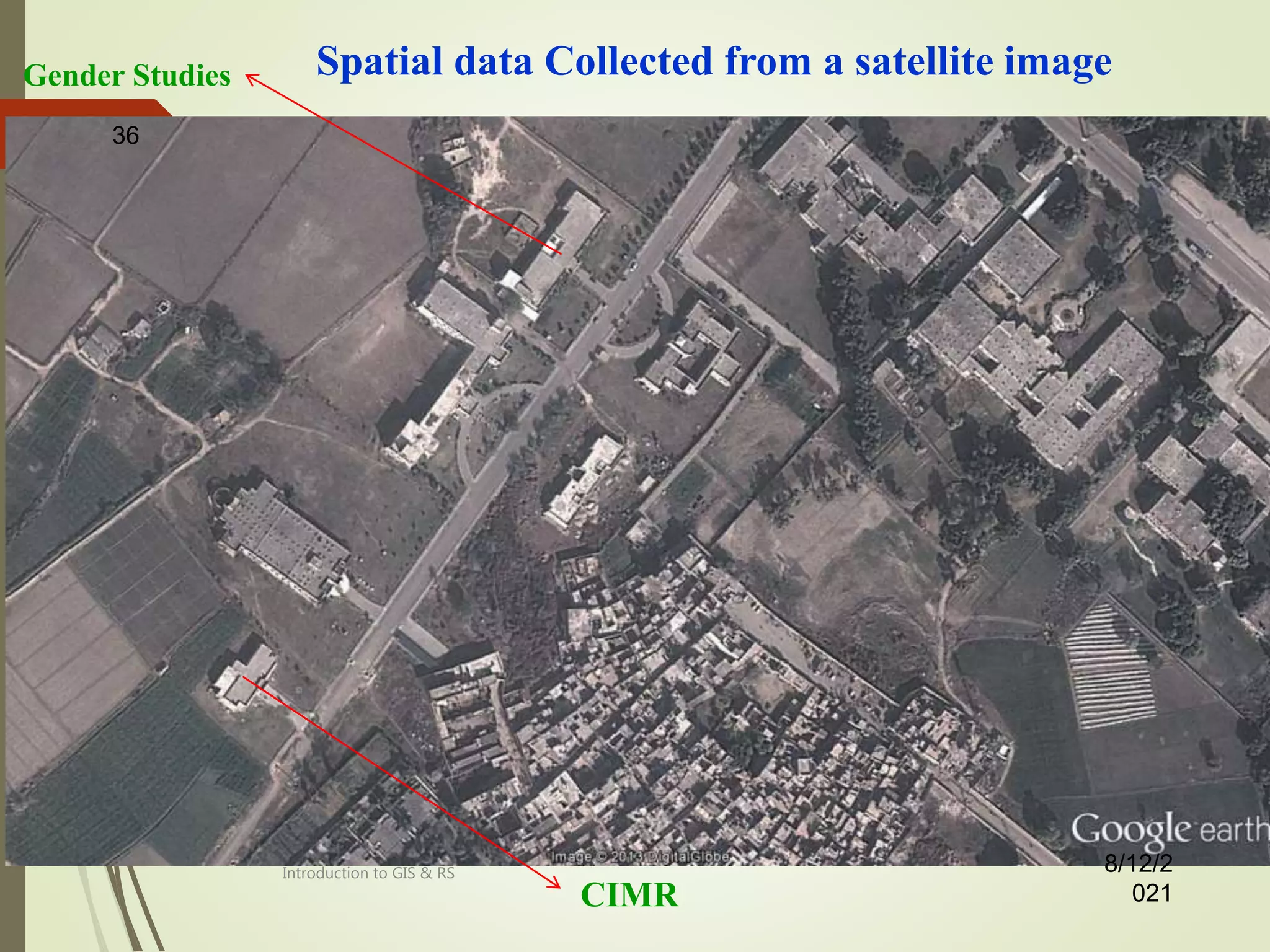
Spatial data Collected from a satellite image
CIMR
8/12/2
021
36
Gender Studies
Introduction to GIS & RS
 www.google.com
 http://en.wikipedia.org/wiki/Aerial_photography
 Book:” Principles of Remote sensing” edited by Lucas L.F. Janssen(Ch#1)
http://quest.arc.nasa.gov/space/teachers/rockets/history.html
 Important site for History of Remote sensing
 http://www.geog.ucsb.edu/~jeff/115a/remotesensinghistory.html
37
8/12/2021
Introduction to GIS & RS
References:

Lect 1 & 2 introduction to gis & rs

  • 1.
    Introduction to GIS& RS 1 8/12/2021
  • 2.
    Lecture # 01Dated:8/10/2020 Course(502) Introduction to GIS and RS Introduction to GIS Topic  Definition of GIS  Why is a GIS needed?  Components of GIS  How GIS works? Presented by Rehana Jamal (Geometiciation, GIS Specialist & Geographer) Visiting lecturer studentsdatafiles@gmail.com Faculty of Agricultural Engineering, Arid Agriculture University, Rawalpindi 2
  • 3.
    Introduction to GIS GISoverview GIS (Geographic Information System) is designed for the collection, storage and analysis of objects and phenomena where geographic location is an important or critical to analysis. GIS answers the following questions: What? Where? When? How? 8/12/2021 Introduction to GIS & RS 3
  • 4.
     From themid-1960s to 1970s, developments in GIS were mainly occurring at government agencies and at universities.  In 1964, Howard Fisher established the Harvard Lab for Computer Graphics  In 1969, Jack Dangermond, who studied at the Harvard Lab for Computer Graphics, co-founded Environmental Systems Research Institute (ESRI) with his wife Laura.  ESRI would become in a few years the dominate force in the GIS marketplace and created ArcInfo and ArcView software. Brief history of GIS 8/12/2021 Introduction to GIS & RS 4
  • 5.
    Definitions of GIS “GISis a computer system that can hold and use data describing places on the Earth’s surface.” Rhind(1989) “A set of tools for collecting, storing, retrieval at will, transforming, and displaying spatial data from the real world for a particular set of purposes” Burrough(1986) “A system for capturing , storing, checking, integrating, manipulating, analyzing and displaying data which are spatially referenced to the Earth” Department of the Environment 8/12/2021 Introduction to GIS & RS 5
  • 6.
    The real worldis too complex for our direct understanding so we create “Models” of reality having similarity with selected aspects of the real world. Map layers from reality 8/12/2021 Introduction to GIS & RS 6
  • 7.
    Why is aGIS needed? These are the following reasons why a GIS is needed. - geospatial data are poorly maintained - maps and statistics are out of date - data and information are inaccurate - there is no data retrieval service - there is no data sharing 8/12/2021 Introduction to GIS & RS 7
  • 8.
    Table 1.1 showsthe advantages of GIS and the disadvantages of conventional manual works without GIS. 8/12/2021 Introduction to GIS & RS 8 Source: http://www.agri.ubu.ac.th/sura/GIS_METEO
  • 9.
    8/12/2021 Introduction to GIS& RS 9 Three major & basic components GIS Fig. Three major components of a Geographic Information System. These components consist of input, computer hardware and software, and output subsystems
  • 10.
    1. Software 2. Hardware 3.People 4. Data (input & output data) 1. Methods/techniques Five main components GIS 8/12/2021 Introduction to GIS & RS 10 The main components of GIS are:
  • 11.
    1.Computer Software Modules: EnvironmentalSystems Research Institute ( ESRI ): ArcInfo, ArcView. Autodesk: AutoCAD Map Clark Labs: IDRISI International Institute for Aerospace Survey and Earth Sciences: ILWIS Mapinfo Corporation: Mapinfo. Bentley Systems: Microstation. PCI Geomatics: PAMAP TYDAC Inc. : SPANS Non-tangible Components: The programs and an interface, which can be used for driving the hardware. 8/12/2021 Introduction to GIS & RS 11
  • 12.
    2.Computer Hardware Module: TangibleComponents: Central Processing Unit, Key board, Mouse etc. 3.People: User & End users 4.Data: (Input & output) Input data: The data which we store into the computer .i.e. i. Spatial Data: Location of the specific geographic feature ii. Attribute Data: The qualitative and quantitative characteristics Output data: Maps, tables of values, the text in hard copy or soft copy. 5.Methods: Digitizing techniques 8/12/2021 Introduction to GIS & RS 12
  • 13.
    How GIS works? 1.Request: Identification of problem 2. Acquire: Acquisition of data(Spatial and attribute data) 3. Examined: Organization and accuracy of data 4. Analyze: Spatial and attribute data analysis(central strength of GIS) 5. Act/Display: Results of data in the form of reports, maps, tables A simple five-step process allows you to apply GIS to any business or organizational problem that requires a geographical decision. Introduction to GIS & RS 13 8/12/2021
  • 14.
    How GIS works? Introductionto GIS & RS 14 8/12/2021
  • 15.
    The strength ofGIS is its ability to create distinct map layers for different types of information, and then to combine them in any way desired or needed. Strength of GIS/What makes GIS unique? Source:https://www.google.com/ Introduction to GIS & RS 15 8/12/2021
  • 16.
    The key functionalityof GIS is integration of spatial and non-spatial data/tabular data stored in DBMS. 8/12/2021 Introduction to GIS & RS 16
  • 17.
     ArcInfo ,ArcView by ESRI  AutoCAD Map BY Autodesk  IDRISI by Clarklabs  ILWIS by II for AS & ES  Mapinfo by Mapinfo Carporation  Microstation by Bentley Systems  PAMAP by PCI Geomatics  SPANS by TYDAC Inc. Popular commercial applications launched during 1980-90 8/12/2021 Introduction to GIS & RS 17
  • 18.
     ARCGIS (ArcView 10.1 and +) ArcView: ESRI, the producer of ArcView, has been an industry leader in the production of GIS software and in the support of GIS education. Present Major GIS soft wares  Google Map  Google Earth  QGIS  GRASS GIS Introduction to GIS & RS 18 8/12/2021
  • 19.
     Definition ofGIS  Why is a GIS needed?  Components of GIS  How GIS works? Summary 8/12/2021 Introduction to GIS & RS 19
  • 20.
     www.yahoo.com  www.google.com----------------(Maps) http://www.pasda.psu.edu/tutorials/gisbasics/components.asp  http://www.mapcruzin.com/what-is-gis.htm  Book: An Introduction to geographical information system by Hay Wood I, Carnelius, S & Carver, S  Book: Geographic Information System:  A Management Perspective by Stan Aronoff  Book: Principles of Geographic Information Systems  By Otto Huisman and Rolf A.de By 8/12/2021 Introduction to GIS & RS 20 References:
  • 21.
    Lecture # 02Dated:8/10/2020 Course(502) Introduction to GIS and RS Introduction to RS Topic Presented by Rehana Jamal (Geometiciation, GIS Specialist & Geographer) Visiting lecturer studentsdatafiles@gmail.com Faculty of Agricultural Engineering, Arid Agriculture University, 21 21  What is Remote sensing(RS)?  History of Remote sensing  RS is a spatial data acquisition technique  Sources of Remote sensing data
  • 22.
    What is Remotesensing? Remote sensing is a technique of collecting information from a distance. Remotely sensed data The data collected from a distance 8/12/2 021 22 Introduction to GIS & RS
  • 23.
    “Remote Sensing (RS)is the science and art of acquiring information about material objects, area, or phenomenon, without coming into physical contact with the objects, area, or phenomenon under investigation” What is Remote sensing? 8/12/2 021 23 Introduction to GIS & RS
  • 24.
    8/12/2021 Introduction to GIS& RS 24  First aerial photograph was taken from a balloon suspended over Paris by the French photographer and balloonist Gaspard-Felix Tournachon, known as “Nadar”, in 1858  Aerial photographs by balloons in 1860  1st Military use of photograph in American Civil War to analyze the defence in1862  Balloons, Aerophile i & ii by French Richards Brothers in1893  Leon P.Teisserenc de Bort, a French meteorologist founded two parts of atmosphere in 1899  TROPOSPHERE up to 700 miles  STRATOSPHERE above 700 miles  Weather kites were after balloons up to 11000-12000 ft.  Small cameras & faster lenses and films were available by early 1900.  Wilber Wright took 1st photograph from airplane in 1909  At the end of 1918: 56000prints of aerial photographs were taken  Aerial photography 1st used in the 2nd World War  In 1920-1930s Amphibious bush plane used in Canada  Space ships :Sputnik i-(1957) & ii-(1958)  Satellite imagery presently used started from 1972 Brief history of Remote sensing
  • 25.
    8/12/2021 Introduction to GIS& RS 25 Honore Daumier, (Nadar elevating Photography to Art), published in Le Boulevard, May 25, 1862. Hot air belloons Gas balloons: Hydrogen, Helium,Ammonia,Coal gas, Methane Roziere balloons Balloon landing in Mashgh square, Iran (Persia), at the time of Nasser al- Din Shah Qajar, around 1850
  • 26.
    8/12/2021 Introduction to GIS& RS 26 Kite photo of San Francisco after the earthquake of 1906 The first kite aerial photographs were taken by British meteorologist Douglas Archibald in 1887 and Arthur Batut in (France) in 1888. Manned kite flying and aerial photography was advanced also by French Marcel Maillot, British Robert Baden-Powel, Americans Charles Lamson and William Abner Eddy, Australian Lawrence Hargrave (inventor of box kite in 1893 and kite train in 1884) and French Captain Saconney. Kite Aerial Photography (KAP)
  • 27.
    8/12/2021 Introduction to GIS& RS 27 A modern blimp from Airship Good year blimp Early Chinese rocket (First solid rocket in 9th century) Alexander the Great Here Alexander holds a rocket, the first depiction of one Three reusable future space vehicles concepts under consideration by NASA.
  • 28.
    8/12/2021 Introduction to GIS& RS 28 First airmail service by helicopter in Los Angeles, 1947 Frenchman Etienne Oehmichen, set the first helicopter world record recognized by the (FAI) on 14 April 1924, flying his helicopter 360 meters (1,181 ft). Oehmichen N°2 1922 Modern aerostat, U.S. Air Force Helicoptes Open ceremony was conducted in 2010 Common wealth Games
  • 29.
    8/12/2021 Introduction to GIS& RS 29 A modern airship Airships were the first aircraft to enable controlled, powered flight, and were widely used before the 1940s Dirigibles From the French ( to direct plus -ible), meaning "directable" or steerable All modern airships, since the 1960s, use helium
  • 30.
  • 31.
  • 32.
    8/12/2021 Introduction to GIS& RS 32 Pakistan’s satellites Badr-1 prior to its launch Artificial communication satellite Launched from Xichang Launch Centre in July,1990 The satellite was designed in SUPARCO Satellite Control Center at Lahore Badr-B, also known as Badr-2, is the research and Earth observation satellite. It was launched from Baikonur Cosmodrome, Baikonur, Kazakhstan on December 10, 2001 abroad a Ukrainian Zenit-2 rocket. Badr-2 is developed in collaboration with UK industry and science institutes PAKSAT-1R Launched on Aug.12,2011
  • 33.
    8/12/2021 Introduction to GIS& RS 33 Agronomist: forecast the agricultural period An urban planner: identify areas illegally built An Engineer: determine optical configuration( terrain obstacles of buildings) for siting relay stations for Telecommunication companies Mining Engineer: explore the area to map the surface mineralogy Environenlist:do future planning, air pollution & control, disaster management, forest fires management, managing natural resources, wastewater management, oil spills and its remedial actions etc. Climatologist: identify the parameters including sea currents, meteorology, energy interactions between the land and water Remote sensing is a spatial data acquisition technique
  • 34.
    8/12/2021 Introduction to GIS& RS 34 Sources of Remote sensing data Aerial photography Airborne radar Scanner data Satellite imagery DEM data
  • 35.
    Satellite image(Remotely senseddata) New CIMR Old CIMR Elements of Interpretation 1.Tone/Hue 2.Texture 3.Shape 4.Size 5.Pattern 6.Site 7.Association 8/12/2 021 35 CEES Introduction to GIS & RS
  • 36.
    Spatial data Collectedfrom a satellite image CIMR 8/12/2 021 36 Gender Studies Introduction to GIS & RS
  • 37.
     www.google.com  http://en.wikipedia.org/wiki/Aerial_photography Book:” Principles of Remote sensing” edited by Lucas L.F. Janssen(Ch#1) http://quest.arc.nasa.gov/space/teachers/rockets/history.html  Important site for History of Remote sensing  http://www.geog.ucsb.edu/~jeff/115a/remotesensinghistory.html 37 8/12/2021 Introduction to GIS & RS References: