NPTEL – Physics – Mathematical Physics - 1
Lecture 40
Summary
Complex Analysis
𝑧 = 𝑥 + 𝑖𝑦
= 𝑟𝑒𝑖𝜃
= 𝑟 (𝑐𝑜𝑠𝜃 + 𝑠𝑖𝑛𝜃)
𝑥, 𝑦 are real
polar form
Cauchy Riemann Condition (CR condition)
Let a complex function be 𝑓(𝑧) = 𝑢(𝑥, 𝑦) + 𝑖𝑣(𝑥, 𝑦). The derivative 𝑓(𝑧) to exist at
a particular point z demands that,
𝑢𝑦 = −𝑣𝑥
} CR condition
Polar representation of the CR condition
𝑢𝑥 = 𝑣𝑦
𝑟𝑢𝑟 = 𝑣𝜃
𝑢𝜃 = −𝑟𝑣𝑟
}
Analytic functions
A function 𝑓(𝑧) is said to be analytic in a region if (a) it is defined, (b) and is
differentiable at every point in the region.
Example. 𝑓(𝑧) = 𝑒𝑧 is analytic in the entire finite z plane, whereas 𝑓(𝑧) = 𝑧̅ is
analytic nowhere.
𝑓(𝑧) = 𝑥 – 𝑖𝑦 𝑢 = 𝑥, 𝑣 = −𝑦
CR conditions are not satisfied.
Thus CR conditions are equivalent to analyticity
Branch cut
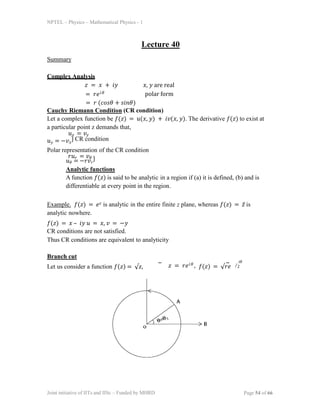
Let us consider a function 𝑓(𝑧) = √𝑧, 𝑧 = 𝑟𝑒𝑖𝜃 ,
𝑖𝜃
𝑓(𝑧) = √𝑟𝑒 ⁄2
Joint initiative of IITs and IISc – Funded by MHRD Page 54 of 66
NPTEL – Physics – Mathematical Physics - 1
The value of the function at A is 𝑓(𝑧) = √𝑟𝑒𝑖 𝜃1⁄2. After a complete revolution,
𝑓(𝑧) = √𝑟𝑒
𝑖(𝜃1+2𝜋⁄2
= −√𝑟𝑒𝑖 𝜃1⁄2
So it does not return to the same value. So the function is multivalued and √𝑟𝑒
𝑖𝜃1⁄2 is a
value on one of the branches and between 2𝜋 ≤ 𝜃 ≤ 4𝜋, the function assumes another
branch. The line OB is called the branch cut.
Complex integration Cauchy – Goursat Theorem
If 𝑓(𝑧) is analytic in a region R and on it’s boundary 𝐶, then ∮ 𝑓(𝑧)𝑑𝑧 = 0 Also known as
cauchy’s integral theorem.
Cauchy’s Integral formula
𝑓(𝑎) =
1 𝑓(𝑧)
∮ 𝑑𝑧
2𝜋𝑖 𝑧 𝑧−𝑎
𝑓(𝑧) is analytic inside and on the boundary c of a simply connected region R, excepting
at a point a.
Residue theorem
If 𝑓(𝑧) is analytic inside and on a simple closed curve c except for a pole of order m at 𝑧
= 𝑎, inside c, prove that
1 1
2𝜋𝑖
∮ 𝑓(𝑧)𝑑𝑧 = 𝐿𝑖𝑚
𝑧→𝑎 (𝑚 − 1)! 𝑑𝑧𝑚−1
𝑑𝑚−1
[(𝑧 − 𝑎)𝑚𝑓(𝑧)]
𝑐
If there are two different poles of order 𝑚1and 𝑚2
1 1
2𝜋𝑖
∮ 𝑓(𝑧)𝑑𝑧 = 𝐿𝑖𝑚
𝑧→𝑎1 (𝑚1−1)! 𝑑𝑧𝑚1−1
𝑐
𝑑𝑚1−1
[(𝑧 − 𝑎1)𝑚1 𝑓(𝑧)] +
𝐿𝑖𝑚
𝑧→𝑎2 (𝑚2−1)! 𝑑𝑧𝑚2−1
Joint initiative of IITs and IISc – Funded by MHRD Page 55 of 66
1 𝑑𝑚2−1
[(𝑧 − 𝑎 )𝑚2 𝑓(𝑧)]
2
Example
Integrate,
∞ 𝑑𝑥
𝐼 =
∫
0 1+𝑥3
The integrand I is not even so we cannot extend it up to -∞.
NPTEL – Physics – Mathematical Physics - 1
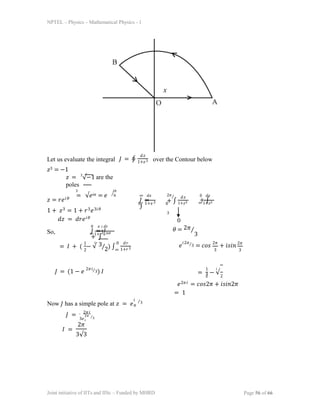
Let us evaluate the integral
𝑧3 = −1
𝐽 = ∮
𝑑𝑧
1+𝑧3 over the Contour below
𝑧 = 3
√−1 are the
poles
3 𝑖𝜋
= √𝑒𝑖𝜋 = 𝑒 ⁄6
0 0
𝑧 = 𝑟𝑒𝑖𝜃
1 + 𝑧3 = 1 + 𝑟3𝑒3𝑖𝜃
𝑑𝑧 = 𝑑𝑟𝑒𝑖𝜃
∞ 𝑑𝑥
𝐽 =
∫
1+𝑥3
2𝜋⁄
+ ∫
3
𝑑𝑧
1+𝑧3 ∞ 1+𝑧3
0 𝑑𝑧
+ ∫
0
So,
0 𝑒 𝑑𝑟
𝐽 = 𝐼
+ ∫
𝑖
𝜃
∞ 1+𝑟3𝑒3𝑖𝜃
𝜃 = 2𝜋⁄
3
= 𝐼 + ( − √
1
2
3
2 ∞
⁄ ) ∫
𝑖 0 𝑑𝑟
1+𝑟3
𝑒 ⁄3 = 𝑐𝑜𝑠 + 𝑖𝑠𝑖𝑛
𝑖2𝜋 2𝜋
3
2𝜋
3
𝐽 = (1 − 𝑒 ⁄3) 𝐼
2𝜋𝑖
= − √
1 𝑖
3
2 2
𝑒2𝜋𝑖 = 𝑐𝑜𝑠2𝜋 + 𝑖𝑠𝑖𝑛2𝜋
= 1
Now 𝐽 has a simple pole at 𝑧 = 𝑒
𝑖
𝜋
⁄3
𝐽 = 2𝜋𝑖
3𝑒
2𝜋
𝑖
⁄3
𝐼 =
2𝜋
3√3
Joint initiative of IITs and IISc – Funded by MHRD Page 56 of 66

lec40.ppt

  • 1.
    NPTEL – Physics– Mathematical Physics - 1 Lecture 40 Summary Complex Analysis 𝑧 = 𝑥 + 𝑖𝑦 = 𝑟𝑒𝑖𝜃 = 𝑟 (𝑐𝑜𝑠𝜃 + 𝑠𝑖𝑛𝜃) 𝑥, 𝑦 are real polar form Cauchy Riemann Condition (CR condition) Let a complex function be 𝑓(𝑧) = 𝑢(𝑥, 𝑦) + 𝑖𝑣(𝑥, 𝑦). The derivative 𝑓(𝑧) to exist at a particular point z demands that, 𝑢𝑦 = −𝑣𝑥 } CR condition Polar representation of the CR condition 𝑢𝑥 = 𝑣𝑦 𝑟𝑢𝑟 = 𝑣𝜃 𝑢𝜃 = −𝑟𝑣𝑟 } Analytic functions A function 𝑓(𝑧) is said to be analytic in a region if (a) it is defined, (b) and is differentiable at every point in the region. Example. 𝑓(𝑧) = 𝑒𝑧 is analytic in the entire finite z plane, whereas 𝑓(𝑧) = 𝑧̅ is analytic nowhere. 𝑓(𝑧) = 𝑥 – 𝑖𝑦 𝑢 = 𝑥, 𝑣 = −𝑦 CR conditions are not satisfied. Thus CR conditions are equivalent to analyticity Branch cut Let us consider a function 𝑓(𝑧) = √𝑧, 𝑧 = 𝑟𝑒𝑖𝜃 , 𝑖𝜃 𝑓(𝑧) = √𝑟𝑒 ⁄2 Joint initiative of IITs and IISc – Funded by MHRD Page 54 of 66
  • 2.
    NPTEL – Physics– Mathematical Physics - 1 The value of the function at A is 𝑓(𝑧) = √𝑟𝑒𝑖 𝜃1⁄2. After a complete revolution, 𝑓(𝑧) = √𝑟𝑒 𝑖(𝜃1+2𝜋⁄2 = −√𝑟𝑒𝑖 𝜃1⁄2 So it does not return to the same value. So the function is multivalued and √𝑟𝑒 𝑖𝜃1⁄2 is a value on one of the branches and between 2𝜋 ≤ 𝜃 ≤ 4𝜋, the function assumes another branch. The line OB is called the branch cut. Complex integration Cauchy – Goursat Theorem If 𝑓(𝑧) is analytic in a region R and on it’s boundary 𝐶, then ∮ 𝑓(𝑧)𝑑𝑧 = 0 Also known as cauchy’s integral theorem. Cauchy’s Integral formula 𝑓(𝑎) = 1 𝑓(𝑧) ∮ 𝑑𝑧 2𝜋𝑖 𝑧 𝑧−𝑎 𝑓(𝑧) is analytic inside and on the boundary c of a simply connected region R, excepting at a point a. Residue theorem If 𝑓(𝑧) is analytic inside and on a simple closed curve c except for a pole of order m at 𝑧 = 𝑎, inside c, prove that 1 1 2𝜋𝑖 ∮ 𝑓(𝑧)𝑑𝑧 = 𝐿𝑖𝑚 𝑧→𝑎 (𝑚 − 1)! 𝑑𝑧𝑚−1 𝑑𝑚−1 [(𝑧 − 𝑎)𝑚𝑓(𝑧)] 𝑐 If there are two different poles of order 𝑚1and 𝑚2 1 1 2𝜋𝑖 ∮ 𝑓(𝑧)𝑑𝑧 = 𝐿𝑖𝑚 𝑧→𝑎1 (𝑚1−1)! 𝑑𝑧𝑚1−1 𝑐 𝑑𝑚1−1 [(𝑧 − 𝑎1)𝑚1 𝑓(𝑧)] + 𝐿𝑖𝑚 𝑧→𝑎2 (𝑚2−1)! 𝑑𝑧𝑚2−1 Joint initiative of IITs and IISc – Funded by MHRD Page 55 of 66 1 𝑑𝑚2−1 [(𝑧 − 𝑎 )𝑚2 𝑓(𝑧)] 2 Example Integrate, ∞ 𝑑𝑥 𝐼 = ∫ 0 1+𝑥3 The integrand I is not even so we cannot extend it up to -∞.
  • 3.
    NPTEL – Physics– Mathematical Physics - 1 Let us evaluate the integral 𝑧3 = −1 𝐽 = ∮ 𝑑𝑧 1+𝑧3 over the Contour below 𝑧 = 3 √−1 are the poles 3 𝑖𝜋 = √𝑒𝑖𝜋 = 𝑒 ⁄6 0 0 𝑧 = 𝑟𝑒𝑖𝜃 1 + 𝑧3 = 1 + 𝑟3𝑒3𝑖𝜃 𝑑𝑧 = 𝑑𝑟𝑒𝑖𝜃 ∞ 𝑑𝑥 𝐽 = ∫ 1+𝑥3 2𝜋⁄ + ∫ 3 𝑑𝑧 1+𝑧3 ∞ 1+𝑧3 0 𝑑𝑧 + ∫ 0 So, 0 𝑒 𝑑𝑟 𝐽 = 𝐼 + ∫ 𝑖 𝜃 ∞ 1+𝑟3𝑒3𝑖𝜃 𝜃 = 2𝜋⁄ 3 = 𝐼 + ( − √ 1 2 3 2 ∞ ⁄ ) ∫ 𝑖 0 𝑑𝑟 1+𝑟3 𝑒 ⁄3 = 𝑐𝑜𝑠 + 𝑖𝑠𝑖𝑛 𝑖2𝜋 2𝜋 3 2𝜋 3 𝐽 = (1 − 𝑒 ⁄3) 𝐼 2𝜋𝑖 = − √ 1 𝑖 3 2 2 𝑒2𝜋𝑖 = 𝑐𝑜𝑠2𝜋 + 𝑖𝑠𝑖𝑛2𝜋 = 1 Now 𝐽 has a simple pole at 𝑧 = 𝑒 𝑖 𝜋 ⁄3 𝐽 = 2𝜋𝑖 3𝑒 2𝜋 𝑖 ⁄3 𝐼 = 2𝜋 3√3 Joint initiative of IITs and IISc – Funded by MHRD Page 56 of 66