NCU Math, Spring 2014: Complex Analysis Homework Solution 5
Text Book: An Introduction to Complex Analysis
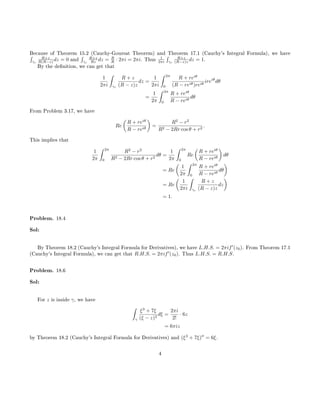
Problem. 16.3
Sol:
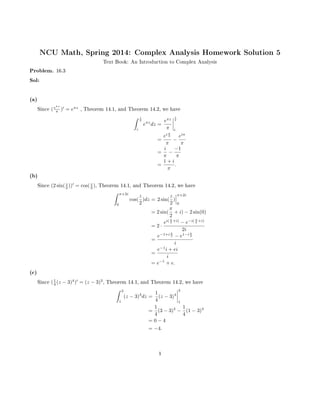
(a)
Since (eπz
π ) = eπz
, Theorem 14.1, and Theorem 14.2, we have
ˆ i
2
i
eπz
dz =
eπz
π
i
2
i
=
ei π
2
π
−
eiπ
π
=
i
π
−
−1
π
=
1 + i
π
.
(b)
Since (2 sin(z
2 )) = cos(z
2 ), Theorem 14.1, and Theorem 14.2, we have
ˆ π+2i
0
cos(
z
2
)dz = 2 sin(
z
2
)
π+2i
0
= 2 sin(
π
2
+ i) − 2 sin(0)
= 2 ·
ei( π
2 +i)
− e−i( π
2 +i)
2i
=
e−1+i π
2 − e1−i π
2
i
=
e−1
i + ei
i
= e−1
+ e.
(c)
Since (1
4 (z − 3)4
) = (z − 3)3
, Theorem 14.1, and Theorem 14.2, we have
ˆ 3
1
(z − 3)3
dz =
1
4
(z − 3)4
3
1
=
1
4
(3 − 3)4
−
1
4
(1 − 3)4
= 0 − 4
= −4.
1
Problem. 16.8
Sol:
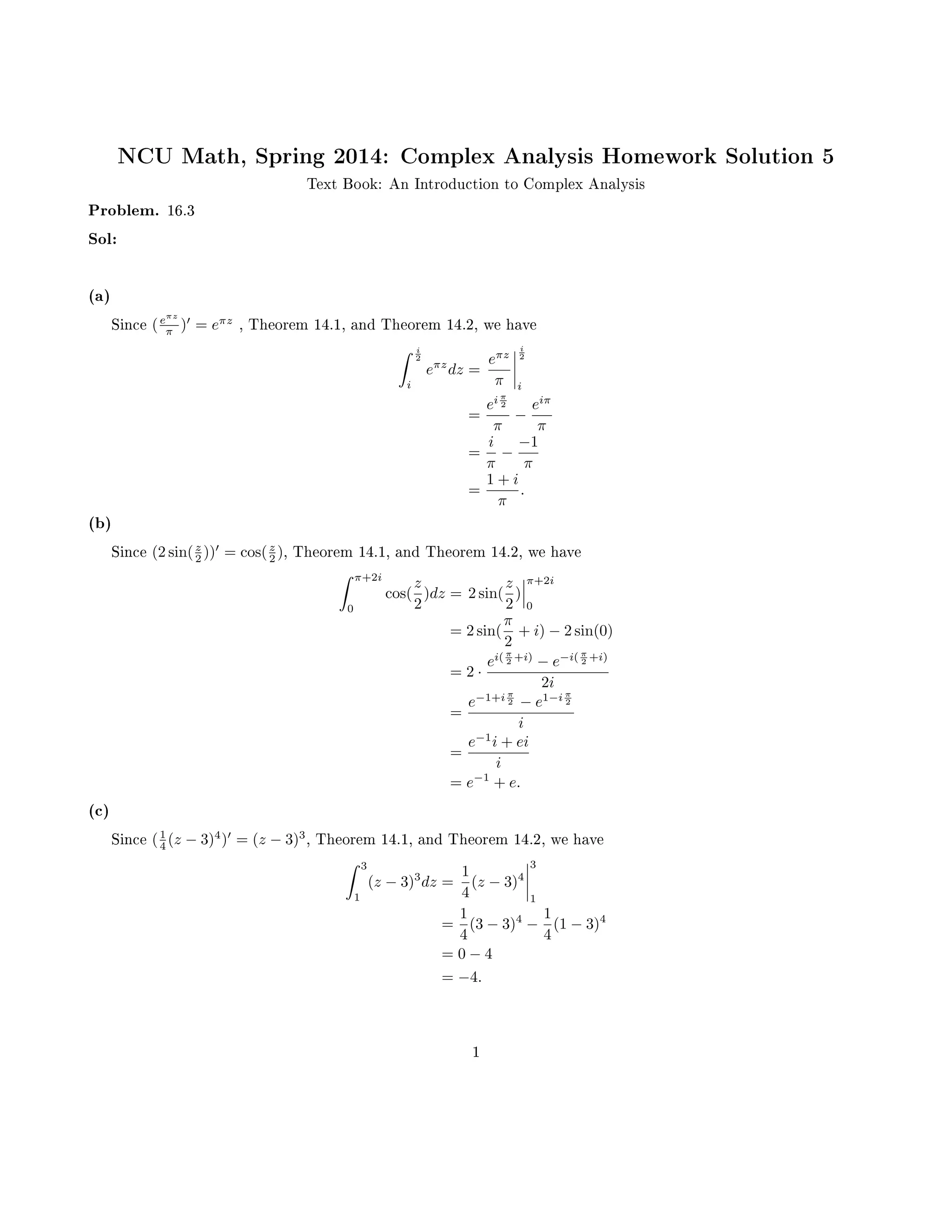
(a)
Since
f(z) =
1
z2 + 2z + 2
=
1
(z + 1)2 + 1
=
1
(z + 1 + i)(z + 1 − i)
,
we can get that f(z) is analytic if z = −1 ± i. Because −1 ± i are not in closed disc |z| ≤ 1, we have
´
γ
f(z)dz = 0
by Theorem 15.2 (Cauchy-Goursat Theorem).
(b)
It is easy to see that f(z) is analytic in C by virtue of z and e−z
are analytic in C. So by Theorem 15.2
(Cauchy-Goursat Theorem), we have
´
γ
f(z)dz = 0 .
(c)
Since f(z) = 1
(2z−i)2 , we can get that f(z) is analytic if z = i
2 . Because i
2 are in closed disc |z| ≤ 1, we can
not use Theorem 15.2 (Cauchy-Goursat Theorem). But from Theorem 16.1, we have
´
γ
f(z)dz =
´
|z− i
2 |= 1
4
f(z)dz.
This implies that
ˆ
γ
f(z)dz =
ˆ
|z− i
2 |= 1
4
1
4(z − i
2 )2
dz
=
ˆ 2π
0
1
4(1
4 eiθ)2
1
4
ieiθ
dθ
=
ˆ 2π
0
ie−iθ
dθ
= −eiθ 2π
0
= 0.
Problem. 16.9
Sol:
2
(b)
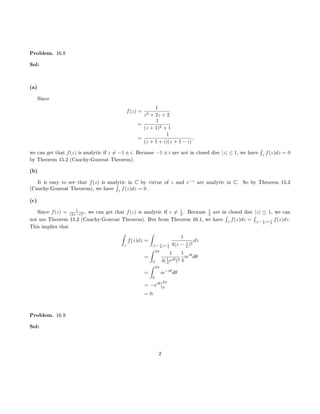
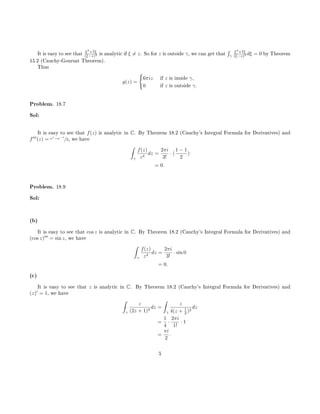
It is easy to see that z
1−ez is analytic if z = 2kπi for all k ∈ Z. Because for all k ∈ Z, 2kπi is not in the domain
between the circle |z| = 4 and the square whose sides lie along the lines x = ±1, y = ±1, we have
´
γ
f(z)dz = 0 by
Theorem 15.2 (Cauchy-Goursat Theorem).
Problem. 16.10
Sol:
(a)
Since f(z) = ez
(z+3i)(z−3i) , we can get that f(z) is analytic if z = ±3i. Because f(z) is analytic in the domain
between the circles |z| = 1 − δ and |z| = 2 + δ for δ > 0 small, we have
´
γ
f(z)dz = 0 by Theorem 15.2 (Cauchy-
Goursat Theorem).
Problem. 16.11
Sol:
(b)
Since 1
3z2+1 = 1
3(z+ i√
3
)(z− i√
3
)
, we can get that f(z) is analytic if z = ± i√
3
. So
ˆ
γ
1
3z2 + 1
dz =
ˆ
γ
1
2
√
3i(z − i√
3
)
dz −
ˆ
γ
1
2
√
3i(z + i√
3
)
dz
= 2
ˆ
|z|=1
1
2
√
3i(z − i√
3
)
dz − 2
ˆ
|z|=1
1
2
√
3i(z + i√
3
)
dz
But we can have that
´
|z|=1
1
2
√
3i(z− i√
3
)
dz = 2πi
2
√
3i
= π√
3
and
´
|z|=1
1
2
√
3i(z+ i√
3
)
dz = 2πi
2
√
3i
= π√
3
by virtue of Example
16.1. Thus
´
γ
1
3z2+1 dz = 0.
Problem. 16.12
Sol:
It is easy to see that R+z
(R−z)z is analytic if z = R and z = 0. Then
ˆ
γr
R + z
(R − z)z
dz =
ˆ
γr
R + z
R(R − z)
dz +
ˆ
γr
R + z
Rz
dz.
3
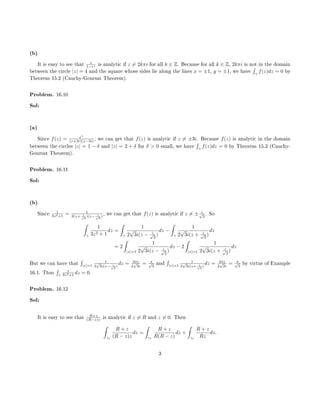
Because of Theorem 15.2 (Cauchy-Goursat Theorem) and Theorem 17.1 (Cauchy's Integral Formula), we have´
γr
R+z
R(R−z) dz = 0 and
´
γr
R+z
Rz dz = R
R · 2πi = 2πi. Thus 1
2πi
´
γr
R+z
(R−z)z dz = 1.
By the denition, we can get that
1
2πi
ˆ
γr
R + z
(R − z)z
dz =
1
2πi
ˆ 2π
0
R + reiθ
(R − reiθ)reiθ
ireiθ
dθ
=
1
2π
ˆ 2π
0
R + reiθ
R − reiθ
dθ
From Problem 3.17, we have
Re
R + reiθ
R − reiθ
=
R2
− r2
R2 − 2Rr cos θ + r2
.
This implies that
1
2π
ˆ 2π
0
R2
− r2
R2 − 2Rr cos θ + r2
dθ =
1
2π
ˆ 2π
0
Re
R + reiθ
R − reiθ
dθ
= Re
1
2π
ˆ 2π
0
R + reiθ
R − reiθ
dθ
= Re
1
2πi
ˆ
γr
R + z
(R − z)z
dz
= 1.
Problem. 18.4
Sol:
By Theorem 18.2 (Cauchy's Integral Formula for Derivatives), we have L.H.S. = 2πif (z0). From Theorem 17.1
(Cauchy's Integral Formula), we can get that R.H.S. = 2πif (z0). Thus L.H.S. = R.H.S.
Problem. 18.6
Sol:
For z is inside γ, we have
ˆ
γ
ξ3
+ 7ξ
(ξ − z)3
dξ =
2πi
2!
· 6z
= 6πiz
by Theorem 18.2 (Cauchy's Integral Formula for Derivatives) and (ξ3
+ 7ξ) = 6ξ.
4
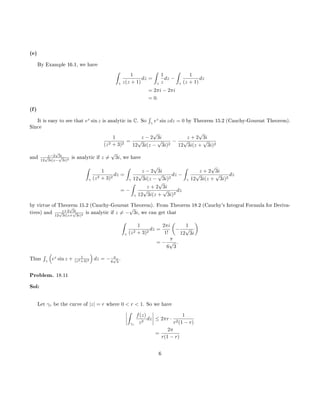
It is easy to see that ξ3
+7ξ
(ξ−z)3 is analytic if ξ = z. So for z is outside γ, we can get that
´
γ
ξ3
+7ξ
(ξ−z)3 dξ = 0 by Theorem
15.2 (Cauchy-Goursat Theorem).
Thus
g(z) =
6πiz if z is inside γ,
0 if z is outside γ.
Problem. 18.7
Sol:
It is easy to see that f(z) is analytic in C. By Theorem 18.2 (Cauchy's Integral Formula for Derivatives) and
f (z) = ez
−e−z
/2, we have
ˆ
γ
f(z)
z4
dz =
2πi
3!
· (
1 − 1
2
)
= 0.
Problem. 18.9
Sol:
(b)
It is easy to see that cos z is analytic in C. By Theorem 18.2 (Cauchy's Integral Formula for Derivatives) and
(cos z) = sin z, we have
ˆ
γ
f(z)
z4
dz =
2πi
3!
· sin 0
= 0.
(c)
It is easy to see that z is analytic in C. By Theorem 18.2 (Cauchy's Integral Formula for Derivatives) and
(z) = 1, we have
ˆ
γ
z
(2z + 1)2
dz =
ˆ
γ
z
4(z + 1
2 )2
dz
=
1
4
·
2πi
1!
· 1
=
πi
2
.
5
(e)
By Example 16.1, we have
ˆ
γ
1
z(z + 1)
dz =
ˆ
γ
1
z
dz −
ˆ
γ
1
(z + 1)
dz
= 2πi − 2πi
= 0.
(f)
It is easy to see that ez
sin z is analytic in C. So
´
γ
ez
sin zdz = 0 by Theorem 15.2 (Cauchy-Goursat Theorem).
Since
1
(z2 + 3)2
=
z − 2
√
3i
12
√
3i(z −
√
3i)2
−
z + 2
√
3i
12
√
3i(z +
√
3i)2
and z−2
√
3i
12
√
3i(z−
√
3i)2
is analytic if z =
√
3i, we have
ˆ
γ
1
(z2 + 3)2
dz =
ˆ
γ
z − 2
√
3i
12
√
3i(z −
√
3i)2
dz −
ˆ
γ
z + 2
√
3i
12
√
3i(z +
√
3i)2
dz
= −
ˆ
γ
z + 2
√
3i
12
√
3i(z +
√
3i)2
dz
by virtue of Theorem 15.2 (Cauchy-Goursat Theorem). From Theorem 18.2 (Cauchy's Integral Formula for Deriva-
tives) and z+2
√
3i
12
√
3i(z+
√
3i)2
is analytic if z = −
√
3i, we can get that
ˆ
γ
1
(z2 + 3)2
dz =
2πi
1!
−
1
12
√
3i
= −
π
6
√
3
.
Thus
´
γ
ez
sin z + 1
(z2+3)2 dz = − π
6
√
3
.
Problem. 18.11
Sol:
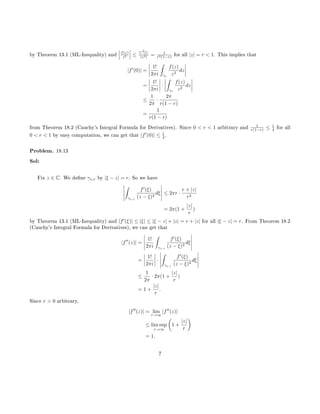
Let γr be the curve of |z| = r where 0  r  1. So we have
ˆ
γr
f(z)
z2
dz ≤ 2πr ·
1
r2(1 − r)
=
2π
r(1 − r)
6
by Theorem 13.1 (ML-Inequality) and f(z)
z2 ≤
1
1−|z|
|z2| = 1
r2(1−r) for all |z| = r  1. This implies that
|f (0)| =
1!
2πi
ˆ
γr
f(z)
z2
dz
=
1!
2πi
·
ˆ
γr
f(z)
z2
dz
≤
1
2π
·
2π
r(1 − r)
=
1
r(1 − r)
from Theorem 18.2 (Cauchy's Integral Formula for Derivatives). Since 0  r  1 arbitrary and 1
r(1−r) ≤ 1
4 for all
0  r  1 by easy computation, we can get that |f (0)| ≤ 1
4 .
Problem. 18.13
Sol:
Fix z ∈ C. We dene γz,r by |ξ − z| = r. So we have
ˆ
γz,r
f (ξ)
(z − ξ)2
dξ ≤ 2πr ·
r + |z|
r2
= 2π(1 +
|z|
r
)
by Theorem 13.1 (ML-Inequality) and |f (ξ)| ≤ |ξ| ≤ |ξ − z| + |z| = r + |z| for all |ξ − z| = r. From Theorem 18.2
(Cauchy's Integral Formula for Derivatives), we can get that
|f (z)| =
1!
2πi
ˆ
γz,r
f (ξ)
(z − ξ)2
dξ
=
1!
2πi
·
ˆ
γz,r
f (ξ)
(z − ξ)2
dξ
≤
1
2π
· 2π(1 +
|z|
r
)
= 1 +
|z|
r
.
Since r  0 arbitrary,
|f (z)| = lim
r→∞
|f (z)|
≤ lim sup
r→∞
1 +
|z|
r
= 1.
7
So we have |f (z)| ≤ 1 for all z ∈ C. This implies that f (z) = c for some constant c ∈ C by Theorem 18.6
(Liouville's Theorem). Because |f (z)| ≤ 1 for all z ∈ C, we can get that |c| ≤ 1.
From Theorem 14.1, we have f (z) − f (0) =
´ z
0
f (ξ)dξ = bz. Similarly, we can get that f(z) = f(0) + f (0)z +
c
2 z2
. Because |f (z)| ≤ |z|, we have |f (0)| ≤ |0| = 0. So f (0) = 0. We dene a = f(0) ∈ C and b = c
2 ∈ C. Then
f(z) = a + bz2
where a, b ∈ C and |b| ≤ 1.
Problem. 18.15
Sol:
We dene h(z) = f(z)
g(z) . Since g(z) = 0 and f, g are entire functions, we can get that h(z) is an entire function.
Because |h(z)| = f(z)
g(z) ≤ 1 and h(z) is an entire function, we have h(z) ≡ c for some constant c ∈ C by Theorem
18.6 (Liouville's Theorem). Thus f(z) = cg(z) for some constant c ∈ C.
8

Hw5sol

  • 1.
    NCU Math, Spring2014: Complex Analysis Homework Solution 5 Text Book: An Introduction to Complex Analysis Problem. 16.3 Sol: (a) Since (eπz π ) = eπz , Theorem 14.1, and Theorem 14.2, we have ˆ i 2 i eπz dz = eπz π i 2 i = ei π 2 π − eiπ π = i π − −1 π = 1 + i π . (b) Since (2 sin(z 2 )) = cos(z 2 ), Theorem 14.1, and Theorem 14.2, we have ˆ π+2i 0 cos( z 2 )dz = 2 sin( z 2 ) π+2i 0 = 2 sin( π 2 + i) − 2 sin(0) = 2 · ei( π 2 +i) − e−i( π 2 +i) 2i = e−1+i π 2 − e1−i π 2 i = e−1 i + ei i = e−1 + e. (c) Since (1 4 (z − 3)4 ) = (z − 3)3 , Theorem 14.1, and Theorem 14.2, we have ˆ 3 1 (z − 3)3 dz = 1 4 (z − 3)4 3 1 = 1 4 (3 − 3)4 − 1 4 (1 − 3)4 = 0 − 4 = −4. 1
  • 2.
    Problem. 16.8 Sol: (a) Since f(z) = 1 z2+ 2z + 2 = 1 (z + 1)2 + 1 = 1 (z + 1 + i)(z + 1 − i) , we can get that f(z) is analytic if z = −1 ± i. Because −1 ± i are not in closed disc |z| ≤ 1, we have ´ γ f(z)dz = 0 by Theorem 15.2 (Cauchy-Goursat Theorem). (b) It is easy to see that f(z) is analytic in C by virtue of z and e−z are analytic in C. So by Theorem 15.2 (Cauchy-Goursat Theorem), we have ´ γ f(z)dz = 0 . (c) Since f(z) = 1 (2z−i)2 , we can get that f(z) is analytic if z = i 2 . Because i 2 are in closed disc |z| ≤ 1, we can not use Theorem 15.2 (Cauchy-Goursat Theorem). But from Theorem 16.1, we have ´ γ f(z)dz = ´ |z− i 2 |= 1 4 f(z)dz. This implies that ˆ γ f(z)dz = ˆ |z− i 2 |= 1 4 1 4(z − i 2 )2 dz = ˆ 2π 0 1 4(1 4 eiθ)2 1 4 ieiθ dθ = ˆ 2π 0 ie−iθ dθ = −eiθ 2π 0 = 0. Problem. 16.9 Sol: 2
  • 3.
    (b) It is easyto see that z 1−ez is analytic if z = 2kπi for all k ∈ Z. Because for all k ∈ Z, 2kπi is not in the domain between the circle |z| = 4 and the square whose sides lie along the lines x = ±1, y = ±1, we have ´ γ f(z)dz = 0 by Theorem 15.2 (Cauchy-Goursat Theorem). Problem. 16.10 Sol: (a) Since f(z) = ez (z+3i)(z−3i) , we can get that f(z) is analytic if z = ±3i. Because f(z) is analytic in the domain between the circles |z| = 1 − δ and |z| = 2 + δ for δ > 0 small, we have ´ γ f(z)dz = 0 by Theorem 15.2 (Cauchy- Goursat Theorem). Problem. 16.11 Sol: (b) Since 1 3z2+1 = 1 3(z+ i√ 3 )(z− i√ 3 ) , we can get that f(z) is analytic if z = ± i√ 3 . So ˆ γ 1 3z2 + 1 dz = ˆ γ 1 2 √ 3i(z − i√ 3 ) dz − ˆ γ 1 2 √ 3i(z + i√ 3 ) dz = 2 ˆ |z|=1 1 2 √ 3i(z − i√ 3 ) dz − 2 ˆ |z|=1 1 2 √ 3i(z + i√ 3 ) dz But we can have that ´ |z|=1 1 2 √ 3i(z− i√ 3 ) dz = 2πi 2 √ 3i = π√ 3 and ´ |z|=1 1 2 √ 3i(z+ i√ 3 ) dz = 2πi 2 √ 3i = π√ 3 by virtue of Example 16.1. Thus ´ γ 1 3z2+1 dz = 0. Problem. 16.12 Sol: It is easy to see that R+z (R−z)z is analytic if z = R and z = 0. Then ˆ γr R + z (R − z)z dz = ˆ γr R + z R(R − z) dz + ˆ γr R + z Rz dz. 3
  • 4.
    Because of Theorem15.2 (Cauchy-Goursat Theorem) and Theorem 17.1 (Cauchy's Integral Formula), we have´ γr R+z R(R−z) dz = 0 and ´ γr R+z Rz dz = R R · 2πi = 2πi. Thus 1 2πi ´ γr R+z (R−z)z dz = 1. By the denition, we can get that 1 2πi ˆ γr R + z (R − z)z dz = 1 2πi ˆ 2π 0 R + reiθ (R − reiθ)reiθ ireiθ dθ = 1 2π ˆ 2π 0 R + reiθ R − reiθ dθ From Problem 3.17, we have Re R + reiθ R − reiθ = R2 − r2 R2 − 2Rr cos θ + r2 . This implies that 1 2π ˆ 2π 0 R2 − r2 R2 − 2Rr cos θ + r2 dθ = 1 2π ˆ 2π 0 Re R + reiθ R − reiθ dθ = Re 1 2π ˆ 2π 0 R + reiθ R − reiθ dθ = Re 1 2πi ˆ γr R + z (R − z)z dz = 1. Problem. 18.4 Sol: By Theorem 18.2 (Cauchy's Integral Formula for Derivatives), we have L.H.S. = 2πif (z0). From Theorem 17.1 (Cauchy's Integral Formula), we can get that R.H.S. = 2πif (z0). Thus L.H.S. = R.H.S. Problem. 18.6 Sol: For z is inside γ, we have ˆ γ ξ3 + 7ξ (ξ − z)3 dξ = 2πi 2! · 6z = 6πiz by Theorem 18.2 (Cauchy's Integral Formula for Derivatives) and (ξ3 + 7ξ) = 6ξ. 4
  • 5.
    It is easyto see that ξ3 +7ξ (ξ−z)3 is analytic if ξ = z. So for z is outside γ, we can get that ´ γ ξ3 +7ξ (ξ−z)3 dξ = 0 by Theorem 15.2 (Cauchy-Goursat Theorem). Thus g(z) = 6πiz if z is inside γ, 0 if z is outside γ. Problem. 18.7 Sol: It is easy to see that f(z) is analytic in C. By Theorem 18.2 (Cauchy's Integral Formula for Derivatives) and f (z) = ez −e−z /2, we have ˆ γ f(z) z4 dz = 2πi 3! · ( 1 − 1 2 ) = 0. Problem. 18.9 Sol: (b) It is easy to see that cos z is analytic in C. By Theorem 18.2 (Cauchy's Integral Formula for Derivatives) and (cos z) = sin z, we have ˆ γ f(z) z4 dz = 2πi 3! · sin 0 = 0. (c) It is easy to see that z is analytic in C. By Theorem 18.2 (Cauchy's Integral Formula for Derivatives) and (z) = 1, we have ˆ γ z (2z + 1)2 dz = ˆ γ z 4(z + 1 2 )2 dz = 1 4 · 2πi 1! · 1 = πi 2 . 5
  • 6.
    (e) By Example 16.1,we have ˆ γ 1 z(z + 1) dz = ˆ γ 1 z dz − ˆ γ 1 (z + 1) dz = 2πi − 2πi = 0. (f) It is easy to see that ez sin z is analytic in C. So ´ γ ez sin zdz = 0 by Theorem 15.2 (Cauchy-Goursat Theorem). Since 1 (z2 + 3)2 = z − 2 √ 3i 12 √ 3i(z − √ 3i)2 − z + 2 √ 3i 12 √ 3i(z + √ 3i)2 and z−2 √ 3i 12 √ 3i(z− √ 3i)2 is analytic if z = √ 3i, we have ˆ γ 1 (z2 + 3)2 dz = ˆ γ z − 2 √ 3i 12 √ 3i(z − √ 3i)2 dz − ˆ γ z + 2 √ 3i 12 √ 3i(z + √ 3i)2 dz = − ˆ γ z + 2 √ 3i 12 √ 3i(z + √ 3i)2 dz by virtue of Theorem 15.2 (Cauchy-Goursat Theorem). From Theorem 18.2 (Cauchy's Integral Formula for Deriva- tives) and z+2 √ 3i 12 √ 3i(z+ √ 3i)2 is analytic if z = − √ 3i, we can get that ˆ γ 1 (z2 + 3)2 dz = 2πi 1! − 1 12 √ 3i = − π 6 √ 3 . Thus ´ γ ez sin z + 1 (z2+3)2 dz = − π 6 √ 3 . Problem. 18.11 Sol: Let γr be the curve of |z| = r where 0 r 1. So we have ˆ γr f(z) z2 dz ≤ 2πr · 1 r2(1 − r) = 2π r(1 − r) 6
  • 7.
    by Theorem 13.1(ML-Inequality) and f(z) z2 ≤ 1 1−|z| |z2| = 1 r2(1−r) for all |z| = r 1. This implies that |f (0)| = 1! 2πi ˆ γr f(z) z2 dz = 1! 2πi · ˆ γr f(z) z2 dz ≤ 1 2π · 2π r(1 − r) = 1 r(1 − r) from Theorem 18.2 (Cauchy's Integral Formula for Derivatives). Since 0 r 1 arbitrary and 1 r(1−r) ≤ 1 4 for all 0 r 1 by easy computation, we can get that |f (0)| ≤ 1 4 . Problem. 18.13 Sol: Fix z ∈ C. We dene γz,r by |ξ − z| = r. So we have ˆ γz,r f (ξ) (z − ξ)2 dξ ≤ 2πr · r + |z| r2 = 2π(1 + |z| r ) by Theorem 13.1 (ML-Inequality) and |f (ξ)| ≤ |ξ| ≤ |ξ − z| + |z| = r + |z| for all |ξ − z| = r. From Theorem 18.2 (Cauchy's Integral Formula for Derivatives), we can get that |f (z)| = 1! 2πi ˆ γz,r f (ξ) (z − ξ)2 dξ = 1! 2πi · ˆ γz,r f (ξ) (z − ξ)2 dξ ≤ 1 2π · 2π(1 + |z| r ) = 1 + |z| r . Since r 0 arbitrary, |f (z)| = lim r→∞ |f (z)| ≤ lim sup r→∞ 1 + |z| r = 1. 7
  • 8.
    So we have|f (z)| ≤ 1 for all z ∈ C. This implies that f (z) = c for some constant c ∈ C by Theorem 18.6 (Liouville's Theorem). Because |f (z)| ≤ 1 for all z ∈ C, we can get that |c| ≤ 1. From Theorem 14.1, we have f (z) − f (0) = ´ z 0 f (ξ)dξ = bz. Similarly, we can get that f(z) = f(0) + f (0)z + c 2 z2 . Because |f (z)| ≤ |z|, we have |f (0)| ≤ |0| = 0. So f (0) = 0. We dene a = f(0) ∈ C and b = c 2 ∈ C. Then f(z) = a + bz2 where a, b ∈ C and |b| ≤ 1. Problem. 18.15 Sol: We dene h(z) = f(z) g(z) . Since g(z) = 0 and f, g are entire functions, we can get that h(z) is an entire function. Because |h(z)| = f(z) g(z) ≤ 1 and h(z) is an entire function, we have h(z) ≡ c for some constant c ∈ C by Theorem 18.6 (Liouville's Theorem). Thus f(z) = cg(z) for some constant c ∈ C. 8