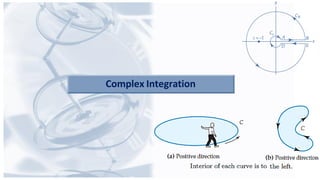
Complex Integration
Book: A First Course in Complex Analysis with Applications by Dennis G. Zill
and Patrick D. Shanahan.
• Chapter: 5
• Sections: 5.2, 5.3, 5.4
Book: Advanced Engineering Mathematics (9th Edition) by Ervin Kreyszig
• Chapter: 14
• Sections: 14.1, 14.2, 14.3
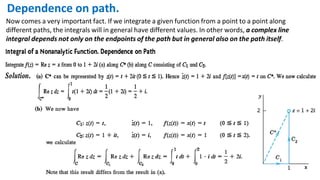
Dependence on path.
Now comes a very important fact. If we integrate a given function from a point to a point along
different paths, the integrals will in general have different values. In other words, a complex line
integral depends not only on the endpoints of the path but in general also on the path itself.
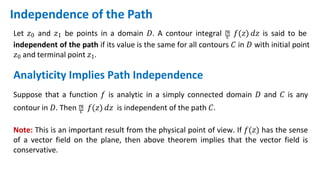
Independence of the Path
Let 𝑧0 and 𝑧1 be points in a domain 𝐷. A contour integral ‫׬‬
𝑐 𝑓(𝑧) 𝑑𝑧 is said to be
independent of the path if its value is the same for all contours 𝐶 in 𝐷 with initial point
𝑧0 and terminal point 𝑧1.
Analyticity Implies Path Independence
Suppose that a function 𝑓 is analytic in a simply connected domain 𝐷 and 𝐶 is any
contour in 𝐷. Then ‫׬‬
𝑐 𝑓(𝑧) 𝑑𝑧 is independent of the path 𝐶.
Note: This is an important result from the physical point of view. If 𝑓(𝑧) has the sense
of a vector field on the plane, then above theorem implies that the vector field is
conservative.
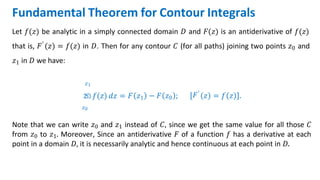
Fundamental Theorem for Contour Integrals
Let 𝑓(𝑧) be analytic in a simply connected domain 𝐷 and 𝐹(𝑧) is an antiderivative of 𝑓(𝑧)
that is, 𝐹′ 𝑧 = 𝑓(𝑧) in 𝐷. Then for any contour 𝐶 (for all paths) joining two points 𝑧0 and
𝑧1 in 𝐷 we have:
𝑧1
න 𝑓(𝑧) 𝑑𝑧 = 𝐹 𝑧1
𝑧0
− 𝐹 𝑧0 ; 𝐹′
𝑧 = 𝑓 𝑧 .
Note that we can write 𝑧0 and 𝑧1 instead of 𝐶, since we get the same value for all those 𝐶
from 𝑧0 to 𝑧1. Moreover, Since an antiderivative 𝐹 of a function 𝑓 has a derivative at each
point in a domain 𝐷, it is necessarily analytic and hence continuous at each point in 𝐷.
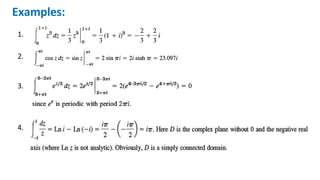
Examples:
1.
2.
3.
4.
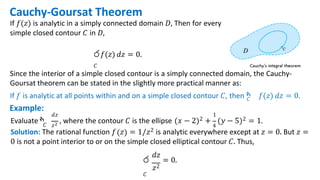
Cauchy-Goursat Theorem
If 𝑓(𝑧) is analytic in a simply connected domain 𝐷, Then for every
simple closed contour 𝐶 in 𝐷,
ර𝑓(𝑧) 𝑑𝑧 = 0.
𝐶
Since the interior of a simple closed contour is a simply connected domain, the Cauchy-
Goursat theorem can be stated in the slightly more practical manner as:
If 𝑓 is analytic at all points within and on a simple closed contour 𝐶, then ‫ׯ‬
𝐶 𝑓(𝑧) 𝑑𝑧 = 0.
Example:
𝐶 𝑧2 4
𝑑𝑧 1
Evaluate ‫ׯ‬ , where the contour 𝐶 is the ellipse 𝑥 − 2 2 + 𝑦 − 5 2 = 1.
Solution: The rational function 𝑓 𝑧 = 1/𝑧2 is analytic everywhere except at 𝑧 = 0. But 𝑧 =
0 is not a point interior to or on the simple closed elliptical contour 𝐶. Thus,
𝑑𝑧
ර = 0.
𝑧2
𝐶
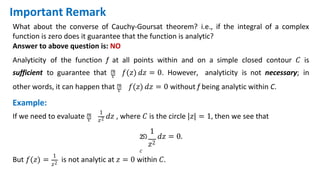
What about the converse of Cauchy-Goursat theorem? i.e., if the integral of a complex
function is zero does it guarantee that the function is analytic?
Answer to above question is: NO
Analyticity of the function f at all points within and on a simple closed contour 𝐶 is
sufficient to guarantee that ‫׬‬
𝑐 𝑓(𝑧) 𝑑𝑧 = 0. However, analyticity is not necessary; in
1
other words, it can happen that ‫׬‬
𝑐 𝑓(𝑧) 𝑑𝑧 = 0 without f being analytic within C.
Example:
If we need to evaluate ‫׬‬
𝑐 𝑧2 𝑑𝑧 , where 𝐶 is the circle |𝑧| = 1, then we see that
1
න 𝑑𝑧 = 0.
𝑧2
𝑐
But 𝑓(𝑧) =
1
𝑧2
is not analytic at 𝑧 = 0 within 𝐶.
Important Remark
Note: The point of above example is that: ‫ׯ‬𝐶
𝑒𝑧 𝑑𝑧 = 0, for any simple closed contour in the
complex plane. Indeed, it follows that for any simple closed contour 𝐶 and any entire function
𝑓(𝑧), such as the trigonometric functions: 𝑓 𝑧 = sin 𝑧, 𝑓 𝑧 = cos 𝑧 , and the polynomial
function: 𝑝 𝑧 = 𝑎𝑛𝑧𝑛 + 𝑎𝑛−1𝑧𝑛−1 + ⋯ + 𝑎1𝑧 + 𝑎0; 𝑛 = 0, 1, 2, . . . , that:
රsin 𝑧 𝑑𝑧 = 0,
𝐶
රcos 𝑧 𝑑𝑧 = 0,
𝐶
ර𝑝(𝑧) 𝑑𝑧 = 0,
𝐶
and so on.
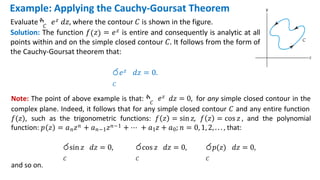
Example: Applying the Cauchy-Goursat Theorem
𝐶
Evaluate ‫ׯ‬ 𝑒𝑧 𝑑𝑧, where the contour 𝐶 is shown in the figure.
Solution: The function 𝑓 𝑧 = 𝑒𝑧 is entire and consequently is analytic at all
points within and on the simple closed contour 𝐶. It follows from the form of
the Cauchy-Goursat theorem that:
ර𝑒𝑧 𝑑𝑧 = 0.
𝐶
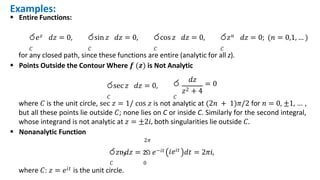
Examples:
 Entire Functions:
ර𝑒𝑧 𝑑𝑧 = 0,
𝐶
රsin 𝑧 𝑑𝑧 = 0,
𝐶
රcos 𝑧 𝑑𝑧 = 0,
𝐶
ර𝑧𝑛 𝑑𝑧 = 0; (𝑛 = 0,1, … )
𝐶
රsec 𝑧 𝑑𝑧 = 0,
𝐶 𝐶
for any closed path, since these functions are entire (analytic for all z).
 Points Outside the Contour Where 𝒇 (𝒛) is Not Analytic
𝑑𝑧
ර = 0
𝑧2 + 4
where 𝐶 is the unit circle, sec 𝑧 = 1/ cos 𝑧 is not analytic at (2𝑛 + 1)𝜋/2 for 𝑛 = 0, ±1, … ,
but all these points lie outside 𝐶; none lies on C or inside C. Similarly for the second integral,
whose integrand is not analytic at 𝑧 = ±2𝑖, both singularities lie outside 𝐶.
 Nonanalytic Function
2𝜋
𝐶 0
where 𝐶: 𝑧 = 𝑒𝑖𝑡 is the unit circle.
𝑖𝑒𝑖𝑡
ර𝑧ҧ𝑑𝑧 = න 𝑒−𝑖𝑡 𝑑𝑡 = 2𝜋𝑖,
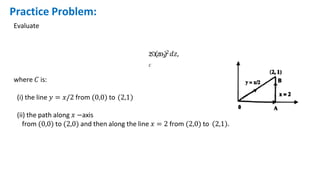
Practice Problem:
Evaluate
න(𝑧ҧ)2𝑑𝑧,
𝑐
where 𝐶 is:
(i) the line 𝑦 = 𝑥/2 from (0,0) to 2,1
(ii) the path along 𝑥 −axis
from (0,0) to (2,0) and then along the line 𝑥 = 2 from (2,0) to 2,1 .
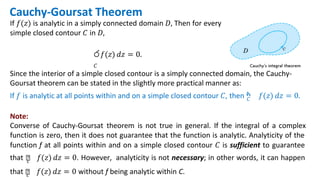
Cauchy-Goursat Theorem
If 𝑓(𝑧) is analytic in a simply connected domain 𝐷, Then for every
simple closed contour 𝐶 in 𝐷,
ර𝑓(𝑧) 𝑑𝑧 = 0.
𝐶
Since the interior of a simple closed contour is a simply connected domain, the Cauchy-
Goursat theorem can be stated in the slightly more practical manner as:
If 𝑓 is analytic at all points within and on a simple closed contour 𝐶, then ‫ׯ‬
𝐶 𝑓(𝑧) 𝑑𝑧 = 0.
Note:
Converse of Cauchy-Goursat theorem is not true in general. If the integral of a complex
function is zero, then it does not guarantee that the function is analytic. Analyticity of the
function f at all points within and on a simple closed contour 𝐶 is sufficient to guarantee
that ‫׬‬
𝑐 𝑓(𝑧) 𝑑𝑧 = 0. However, analyticity is not necessary; in other words, it can happen
that ‫׬‬
𝑐 𝑓(𝑧) 𝑑𝑧 = 0 without f being analytic within C.
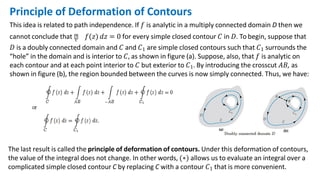
Principle of Deformation of Contours
This idea is related to path independence. If 𝑓 is analytic in a multiply connected domain D then we
cannot conclude that ‫׬‬
𝑐 𝑓(𝑧) 𝑑𝑧 = 0 for every simple closed contour 𝐶 in 𝐷. To begin, suppose that
𝐷 is a doubly connected domain and 𝐶 and 𝐶1 are simple closed contours such that 𝐶1 surrounds the
“hole” in the domain and is interior to 𝐶, as shown in figure (a). Suppose, also, that 𝑓 is analytic on
each contour and at each point interior to 𝐶 but exterior to 𝐶1. By introducing the crosscut 𝐴𝐵, as
shown in figure (b), the region bounded between the curves is now simply connected. Thus, we have:
The last result is called the principle of deformation of contours. Under this deformation of contours,
the value of the integral does not change. In other words, (∗) allows us to evaluate an integral over a
complicated simple closed contour C by replacing C with a contour 𝐶1 that is more convenient.
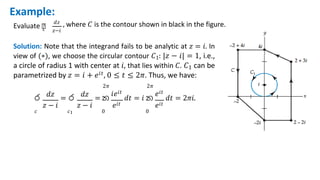
Evaluate ‫׬‬
𝑐
𝑑𝑧 , where 𝐶 is the contour shown in black in the figure.
𝑧−𝑖
Example:
Solution: Note that the integrand fails to be analytic at 𝑧 = 𝑖. In
view of (∗), we choose the circular contour 𝐶1: |𝑧 − 𝑖| = 1, i.e.,
a circle of radius 1 with center at 𝑖, that lies within 𝐶. 𝐶1 can be
parametrized by 𝑧 = 𝑖 + 𝑒𝑖𝑡, 0 ≤ 𝑡 ≤ 2𝜋. Thus, we have:
𝑑𝑧 𝑑𝑧
2𝜋
𝑖𝑒𝑖𝑡
𝑐 𝑐1 0 0
2𝜋
𝑒𝑖𝑡
ර = ර = න 𝑑𝑡 = 𝑖 න 𝑑𝑡 = 2𝜋𝑖.
𝑧 − 𝑖 𝑧 − 𝑖 𝑒𝑖𝑡 𝑒𝑖𝑡
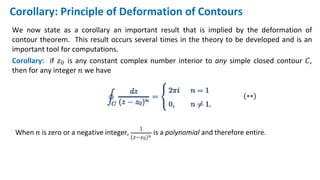
We now state as a corollary an important result that is implied by the deformation of
contour theorem. This result occurs several times in the theory to be developed and is an
important tool for computations.
Corollary: if 𝑧0 is any constant complex number interior to any simple closed contour 𝐶,
then for any integer 𝑛 we have
(∗∗)
Corollary: Principle of Deformation of Contours
When 𝑛 is zero or a negative integer,
1
(𝑧−𝑧0)𝑛
is a polynomial and therefore entire.
Evaluate ‫ׯ‬
𝑐
5𝑧+7
𝑧2+2𝑧−3
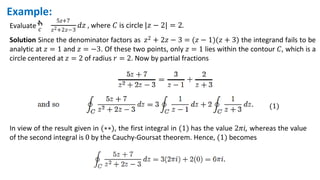
𝑑𝑧 , where 𝐶 is circle |𝑧 − 2| = 2.
Example:
Solution Since the denominator factors as 𝑧2 + 2𝑧 − 3 = (𝑧 − 1)(𝑧 + 3) the integrand fails to be
analytic at 𝑧 = 1 and 𝑧 = −3. Of these two points, only 𝑧 = 1 lies within the contour 𝐶, which is a
circle centered at 𝑧 = 2 of radius 𝑟 = 2. Now by partial fractions
(1)
In view of the result given in (∗∗), the first integral in (1) has the value 2𝜋𝑖, whereas the value
of the second integral is 0 by the Cauchy-Goursat theorem. Hence, (1) becomes
Practice Questions
Book: A First Course in Complex Analysis with Applications by Dennis
G. Zill and Patrick D. Shanahan.
Chapter: 5
Exercise: 5.2
Q # 1 – 24.
Exercise: 5.3
Q # 1 –24.
Exercise: 5.4
Q # 1 – 26.

Lecture # 11a(Complex Integrals).....pdf

  • 2.
  • 3.
    Book: A FirstCourse in Complex Analysis with Applications by Dennis G. Zill and Patrick D. Shanahan. • Chapter: 5 • Sections: 5.2, 5.3, 5.4 Book: Advanced Engineering Mathematics (9th Edition) by Ervin Kreyszig • Chapter: 14 • Sections: 14.1, 14.2, 14.3
  • 4.
    Dependence on path. Nowcomes a very important fact. If we integrate a given function from a point to a point along different paths, the integrals will in general have different values. In other words, a complex line integral depends not only on the endpoints of the path but in general also on the path itself.
  • 5.
    Independence of thePath Let 𝑧0 and 𝑧1 be points in a domain 𝐷. A contour integral ‫׬‬ 𝑐 𝑓(𝑧) 𝑑𝑧 is said to be independent of the path if its value is the same for all contours 𝐶 in 𝐷 with initial point 𝑧0 and terminal point 𝑧1. Analyticity Implies Path Independence Suppose that a function 𝑓 is analytic in a simply connected domain 𝐷 and 𝐶 is any contour in 𝐷. Then ‫׬‬ 𝑐 𝑓(𝑧) 𝑑𝑧 is independent of the path 𝐶. Note: This is an important result from the physical point of view. If 𝑓(𝑧) has the sense of a vector field on the plane, then above theorem implies that the vector field is conservative.
  • 6.
    Fundamental Theorem forContour Integrals Let 𝑓(𝑧) be analytic in a simply connected domain 𝐷 and 𝐹(𝑧) is an antiderivative of 𝑓(𝑧) that is, 𝐹′ 𝑧 = 𝑓(𝑧) in 𝐷. Then for any contour 𝐶 (for all paths) joining two points 𝑧0 and 𝑧1 in 𝐷 we have: 𝑧1 න 𝑓(𝑧) 𝑑𝑧 = 𝐹 𝑧1 𝑧0 − 𝐹 𝑧0 ; 𝐹′ 𝑧 = 𝑓 𝑧 . Note that we can write 𝑧0 and 𝑧1 instead of 𝐶, since we get the same value for all those 𝐶 from 𝑧0 to 𝑧1. Moreover, Since an antiderivative 𝐹 of a function 𝑓 has a derivative at each point in a domain 𝐷, it is necessarily analytic and hence continuous at each point in 𝐷.
  • 7.
  • 8.
    Cauchy-Goursat Theorem If 𝑓(𝑧)is analytic in a simply connected domain 𝐷, Then for every simple closed contour 𝐶 in 𝐷, ර𝑓(𝑧) 𝑑𝑧 = 0. 𝐶 Since the interior of a simple closed contour is a simply connected domain, the Cauchy- Goursat theorem can be stated in the slightly more practical manner as: If 𝑓 is analytic at all points within and on a simple closed contour 𝐶, then ‫ׯ‬ 𝐶 𝑓(𝑧) 𝑑𝑧 = 0. Example: 𝐶 𝑧2 4 𝑑𝑧 1 Evaluate ‫ׯ‬ , where the contour 𝐶 is the ellipse 𝑥 − 2 2 + 𝑦 − 5 2 = 1. Solution: The rational function 𝑓 𝑧 = 1/𝑧2 is analytic everywhere except at 𝑧 = 0. But 𝑧 = 0 is not a point interior to or on the simple closed elliptical contour 𝐶. Thus, 𝑑𝑧 ර = 0. 𝑧2 𝐶
  • 9.
    What about theconverse of Cauchy-Goursat theorem? i.e., if the integral of a complex function is zero does it guarantee that the function is analytic? Answer to above question is: NO Analyticity of the function f at all points within and on a simple closed contour 𝐶 is sufficient to guarantee that ‫׬‬ 𝑐 𝑓(𝑧) 𝑑𝑧 = 0. However, analyticity is not necessary; in 1 other words, it can happen that ‫׬‬ 𝑐 𝑓(𝑧) 𝑑𝑧 = 0 without f being analytic within C. Example: If we need to evaluate ‫׬‬ 𝑐 𝑧2 𝑑𝑧 , where 𝐶 is the circle |𝑧| = 1, then we see that 1 න 𝑑𝑧 = 0. 𝑧2 𝑐 But 𝑓(𝑧) = 1 𝑧2 is not analytic at 𝑧 = 0 within 𝐶. Important Remark
  • 10.
    Note: The pointof above example is that: ‫ׯ‬𝐶 𝑒𝑧 𝑑𝑧 = 0, for any simple closed contour in the complex plane. Indeed, it follows that for any simple closed contour 𝐶 and any entire function 𝑓(𝑧), such as the trigonometric functions: 𝑓 𝑧 = sin 𝑧, 𝑓 𝑧 = cos 𝑧 , and the polynomial function: 𝑝 𝑧 = 𝑎𝑛𝑧𝑛 + 𝑎𝑛−1𝑧𝑛−1 + ⋯ + 𝑎1𝑧 + 𝑎0; 𝑛 = 0, 1, 2, . . . , that: රsin 𝑧 𝑑𝑧 = 0, 𝐶 රcos 𝑧 𝑑𝑧 = 0, 𝐶 ර𝑝(𝑧) 𝑑𝑧 = 0, 𝐶 and so on. Example: Applying the Cauchy-Goursat Theorem 𝐶 Evaluate ‫ׯ‬ 𝑒𝑧 𝑑𝑧, where the contour 𝐶 is shown in the figure. Solution: The function 𝑓 𝑧 = 𝑒𝑧 is entire and consequently is analytic at all points within and on the simple closed contour 𝐶. It follows from the form of the Cauchy-Goursat theorem that: ර𝑒𝑧 𝑑𝑧 = 0. 𝐶
  • 11.
    Examples:  Entire Functions: ර𝑒𝑧𝑑𝑧 = 0, 𝐶 රsin 𝑧 𝑑𝑧 = 0, 𝐶 රcos 𝑧 𝑑𝑧 = 0, 𝐶 ර𝑧𝑛 𝑑𝑧 = 0; (𝑛 = 0,1, … ) 𝐶 රsec 𝑧 𝑑𝑧 = 0, 𝐶 𝐶 for any closed path, since these functions are entire (analytic for all z).  Points Outside the Contour Where 𝒇 (𝒛) is Not Analytic 𝑑𝑧 ර = 0 𝑧2 + 4 where 𝐶 is the unit circle, sec 𝑧 = 1/ cos 𝑧 is not analytic at (2𝑛 + 1)𝜋/2 for 𝑛 = 0, ±1, … , but all these points lie outside 𝐶; none lies on C or inside C. Similarly for the second integral, whose integrand is not analytic at 𝑧 = ±2𝑖, both singularities lie outside 𝐶.  Nonanalytic Function 2𝜋 𝐶 0 where 𝐶: 𝑧 = 𝑒𝑖𝑡 is the unit circle. 𝑖𝑒𝑖𝑡 ර𝑧ҧ𝑑𝑧 = න 𝑒−𝑖𝑡 𝑑𝑡 = 2𝜋𝑖,
  • 12.
    Practice Problem: Evaluate න(𝑧ҧ)2𝑑𝑧, 𝑐 where 𝐶is: (i) the line 𝑦 = 𝑥/2 from (0,0) to 2,1 (ii) the path along 𝑥 −axis from (0,0) to (2,0) and then along the line 𝑥 = 2 from (2,0) to 2,1 .
  • 13.
    Cauchy-Goursat Theorem If 𝑓(𝑧)is analytic in a simply connected domain 𝐷, Then for every simple closed contour 𝐶 in 𝐷, ර𝑓(𝑧) 𝑑𝑧 = 0. 𝐶 Since the interior of a simple closed contour is a simply connected domain, the Cauchy- Goursat theorem can be stated in the slightly more practical manner as: If 𝑓 is analytic at all points within and on a simple closed contour 𝐶, then ‫ׯ‬ 𝐶 𝑓(𝑧) 𝑑𝑧 = 0. Note: Converse of Cauchy-Goursat theorem is not true in general. If the integral of a complex function is zero, then it does not guarantee that the function is analytic. Analyticity of the function f at all points within and on a simple closed contour 𝐶 is sufficient to guarantee that ‫׬‬ 𝑐 𝑓(𝑧) 𝑑𝑧 = 0. However, analyticity is not necessary; in other words, it can happen that ‫׬‬ 𝑐 𝑓(𝑧) 𝑑𝑧 = 0 without f being analytic within C.
  • 14.
    Principle of Deformationof Contours This idea is related to path independence. If 𝑓 is analytic in a multiply connected domain D then we cannot conclude that ‫׬‬ 𝑐 𝑓(𝑧) 𝑑𝑧 = 0 for every simple closed contour 𝐶 in 𝐷. To begin, suppose that 𝐷 is a doubly connected domain and 𝐶 and 𝐶1 are simple closed contours such that 𝐶1 surrounds the “hole” in the domain and is interior to 𝐶, as shown in figure (a). Suppose, also, that 𝑓 is analytic on each contour and at each point interior to 𝐶 but exterior to 𝐶1. By introducing the crosscut 𝐴𝐵, as shown in figure (b), the region bounded between the curves is now simply connected. Thus, we have: The last result is called the principle of deformation of contours. Under this deformation of contours, the value of the integral does not change. In other words, (∗) allows us to evaluate an integral over a complicated simple closed contour C by replacing C with a contour 𝐶1 that is more convenient.
  • 15.
    Evaluate ‫׬‬ 𝑐 𝑑𝑧 ,where 𝐶 is the contour shown in black in the figure. 𝑧−𝑖 Example: Solution: Note that the integrand fails to be analytic at 𝑧 = 𝑖. In view of (∗), we choose the circular contour 𝐶1: |𝑧 − 𝑖| = 1, i.e., a circle of radius 1 with center at 𝑖, that lies within 𝐶. 𝐶1 can be parametrized by 𝑧 = 𝑖 + 𝑒𝑖𝑡, 0 ≤ 𝑡 ≤ 2𝜋. Thus, we have: 𝑑𝑧 𝑑𝑧 2𝜋 𝑖𝑒𝑖𝑡 𝑐 𝑐1 0 0 2𝜋 𝑒𝑖𝑡 ර = ර = න 𝑑𝑡 = 𝑖 න 𝑑𝑡 = 2𝜋𝑖. 𝑧 − 𝑖 𝑧 − 𝑖 𝑒𝑖𝑡 𝑒𝑖𝑡
  • 16.
    We now stateas a corollary an important result that is implied by the deformation of contour theorem. This result occurs several times in the theory to be developed and is an important tool for computations. Corollary: if 𝑧0 is any constant complex number interior to any simple closed contour 𝐶, then for any integer 𝑛 we have (∗∗) Corollary: Principle of Deformation of Contours When 𝑛 is zero or a negative integer, 1 (𝑧−𝑧0)𝑛 is a polynomial and therefore entire.
  • 17.
    Evaluate ‫ׯ‬ 𝑐 5𝑧+7 𝑧2+2𝑧−3 𝑑𝑧 ,where 𝐶 is circle |𝑧 − 2| = 2. Example: Solution Since the denominator factors as 𝑧2 + 2𝑧 − 3 = (𝑧 − 1)(𝑧 + 3) the integrand fails to be analytic at 𝑧 = 1 and 𝑧 = −3. Of these two points, only 𝑧 = 1 lies within the contour 𝐶, which is a circle centered at 𝑧 = 2 of radius 𝑟 = 2. Now by partial fractions (1) In view of the result given in (∗∗), the first integral in (1) has the value 2𝜋𝑖, whereas the value of the second integral is 0 by the Cauchy-Goursat theorem. Hence, (1) becomes
  • 18.
    Practice Questions Book: AFirst Course in Complex Analysis with Applications by Dennis G. Zill and Patrick D. Shanahan. Chapter: 5 Exercise: 5.2 Q # 1 – 24. Exercise: 5.3 Q # 1 –24. Exercise: 5.4 Q # 1 – 26.