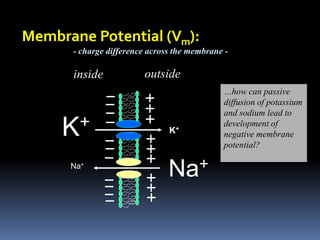
Membrane Potential (Vm):
- charge difference across the membrane -
K+
Na+
K+
Na+
inside outside
…how can passive
diffusion of potassium
and sodium lead to
development of
negative membrane
potential?
Simplest Case
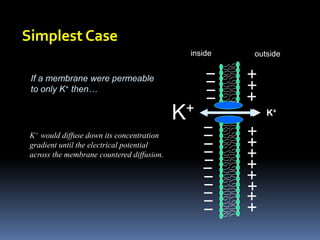
If a membrane were permeable
to only K+ then…
inside outside
K+ K+
K+ would diffuse down its concentration
gradient until the electrical potential
across the membrane countered diffusion.
Simplest Case
K+ K+
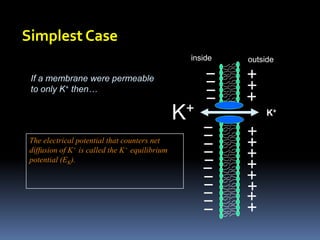
If a membrane were permeable
to only K+ then…
The electrical potential that counters net
diffusion of K+ is called the K+ equilibrium
potential (EK).
inside outside
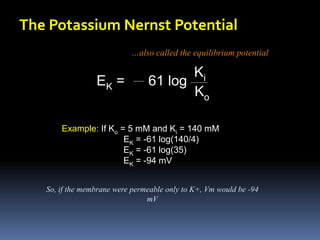
The Potassium Nernst Potential
Example: If Ko = 5 mM and Ki = 140 mM
EK = -61 log(140/4)
EK = -61 log(35)
EK = -94 mV
EK = 61 log
Ki
Ko
So, if the membrane were permeable only to K+, Vm would be -94
mV
…also called the equilibrium potential
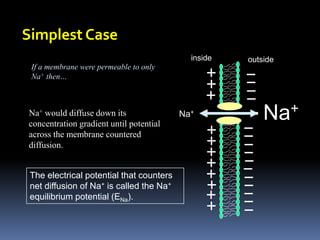
Simplest Case
Na+
Na+
If a membrane were permeable to only
Na+ then…
The electrical potential that counters
net diffusion of Na+ is called the Na+
equilibrium potential (ENa).
inside outside
Na+ would diffuse down its
concentration gradient until potential
across the membrane countered
diffusion.
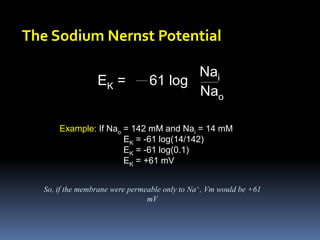
The Sodium Nernst Potential
Example: If Nao = 142 mM and Nai = 14 mM
EK = -61 log(14/142)
EK = -61 log(0.1)
EK = +61 mV
EK = 61 log
Nai
Nao
So, if the membrane were permeable only to Na+, Vm would be +61
mV
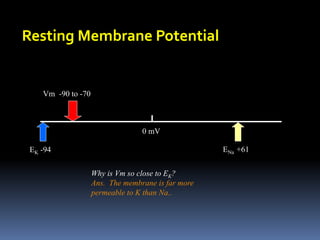
Resting Membrane Potential
0 mV
EK -94 ENa +61
Vm -90 to -70
Why is Vm so close to EK?
Ans. The membrane is far more
permeable to K than Na..
The Goldman-Hodgkin-Katz Equation
(also called the Goldman Field Equation)
Calculates Vm when more than one ion is involved.
o
Cl
i
Na
i
K
i
Cl
o
Na
o
K
m
Cl
p
Na
p
K
p
Cl
p
Na
p
K
p
V
]
[
'
]
[
'
]
[
'
]
[
'
]
[
'
]
[
'
log
. -
+
+
-
+
+
+
+
+
+
= 61
NOTE:
P’ = permeability
i
Cl
o
Na
o
K
o
Cl
i
Na
i
K
m
Cl
p
Na
p
K
p
Cl
p
Na
p
K
p
V
]
[
'
]
[
'
]
[
'
]
[
'
]
[
'
]
[
'
log
. -
+
+
-
+
+
+
+
+
+
= -61
or
The Goldman-Hodgkin-Katz Equation
The resting membrane potential is closest to the equilibrium
potential for the ion with the highest permeability!
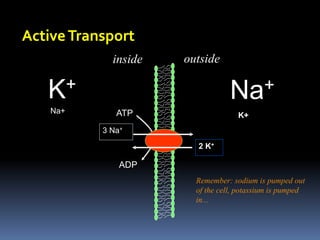
ATP
3 Na+
2 K+
ADP
ActiveTransport
K+ Na+
Na+
K+
inside outside
Remember: sodium is pumped out
of the cell, potassium is pumped
in...
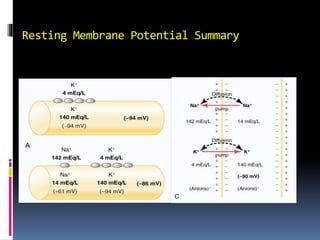
Resting Membrane Potential Summary
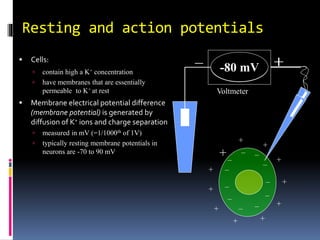
 Cells:
 contain high a K+ concentration
 have membranes that are essentially
permeable to K+ at rest
 Membrane electrical potential difference
(membrane potential) is generated by
diffusion of K+ ions and charge separation
 measured in mV (=1/1000th of 1V)
 typically resting membrane potentials in
neurons are -70 to 90 mV
Resting and action potentials
+
+
+
+
+ +
+
+
+
+
+
–
–
–
– –
–
–
–
–
–
–
Voltmeter
– +
0 mV
-80 mV +
Nerve Action Potential
 Nerve signals are transmitted by action
potentials, which are rapid changes in the
membrane potential that spread rapidly
along the nerve fiber membrane
 Action potential begins with a sudden change
from the normal resting negative membrane
potential to a positive potential and then
ends with an almost equally rapid change
back to the negative potential
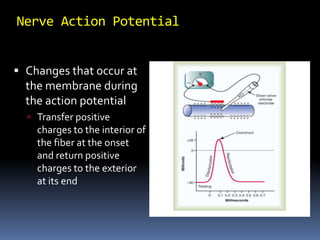
 Changes that occur at
the membrane during
the action potential
 Transfer positive
charges to the interior of
the fiber at the onset
and return positive
charges to the exterior
at its end
Nerve Action Potential
Stages of action potential
 Resting Stage.This is the resting membrane
potential before the action potential begins.
The membrane is said to be "polarized"
during this stage because of the -90 millivolts
negative membrane potential that is present
Depolarization Stage
 The membrane suddenly becomes very
permeable to sodium ions, allowing
tremendous numbers of positively charged
sodium ions to diffuse to the interior of the
axon.
 The normal "polarized" state is neutralized by
the inflowing positively charged sodium ions,
with the potential rising rapidly in the positive
direction
 This is called depolarization
Repolarization Stage
 After the membrane becomes highly
permeable to sodium ions, the sodium
channels begin to close and the potassium
channels open more than normal
 Rapid diffusion of potassium ions to the
exterior re-establishes the normal negative
resting membrane potential
 This is called repolarization of the membrane
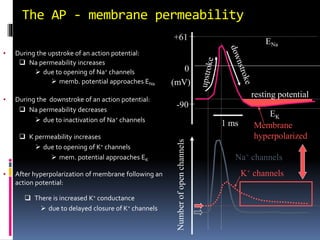
The AP - membrane permeability
• During the upstroke of an action potential:
 Na permeability increases
 due to opening of Na+ channels
 memb. potential approaches ENa
Na+ channels
 K permeability increases
 due to opening of K+ channels
 mem. potential approaches EK
• After hyperpolarization of membrane following an
action potential:
Membrane
hyperpolarized
resting potential
K+ channels
 There is increased K+ conductance
 due to delayed closure of K+ channels
• During the downstroke of an action potential:
 Na permeability decreases
 due to inactivation of Na+ channels
1 ms
+61
0
(mV)
-90
ENa
EK
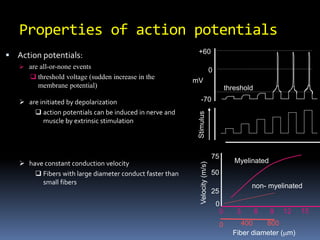
Properties of action potentials
 Action potentials:
 are all-or-none events
 threshold voltage (sudden increase in the
membrane potential) threshold
-70
+60
mV
0
non- myelinated
0 800
400
 have constant conduction velocity
 Fibers with large diameter conduct faster than
small fibers
Fiber diameter (mm)
0 3 6 9
Myelinated
12
75
15
50
25
0
 are initiated by depolarization
 action potentials can be induced in nerve and
muscle by extrinsic stimulation
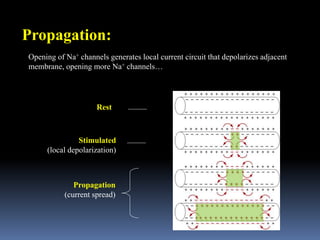
Propagation:
Rest
Opening of Na+ channels generates local current circuit that depolarizes adjacent
membrane, opening more Na+ channels…
Stimulated
(local depolarization)
Propagation
(current spread)
Signal Transmission:
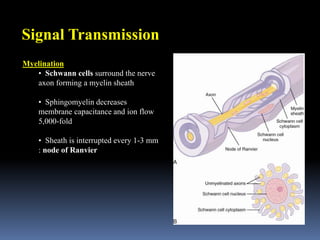
Myelination
• Schwann cells surround the nerve
axon forming a myelin sheath
• Sphingomyelin decreases
membrane capacitance and ion flow
5,000-fold
• Sheath is interrupted every 1-3 mm
: node of Ranvier
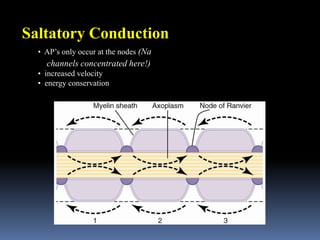
Saltatory Conduction
• AP’s only occur at the nodes (Na
channels concentrated here!)
• increased velocity
• energy conservation
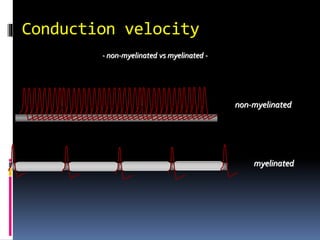
Conduction velocity
non-myelinated
myelinated
- non-myelinated vs myelinated -

Lec2

  • 1.
    Membrane Potential (Vm): -charge difference across the membrane - K+ Na+ K+ Na+ inside outside …how can passive diffusion of potassium and sodium lead to development of negative membrane potential?
  • 2.
    Simplest Case If amembrane were permeable to only K+ then… inside outside K+ K+ K+ would diffuse down its concentration gradient until the electrical potential across the membrane countered diffusion.
  • 3.
    Simplest Case K+ K+ Ifa membrane were permeable to only K+ then… The electrical potential that counters net diffusion of K+ is called the K+ equilibrium potential (EK). inside outside
  • 4.
    The Potassium NernstPotential Example: If Ko = 5 mM and Ki = 140 mM EK = -61 log(140/4) EK = -61 log(35) EK = -94 mV EK = 61 log Ki Ko So, if the membrane were permeable only to K+, Vm would be -94 mV …also called the equilibrium potential
  • 5.
    Simplest Case Na+ Na+ If amembrane were permeable to only Na+ then… The electrical potential that counters net diffusion of Na+ is called the Na+ equilibrium potential (ENa). inside outside Na+ would diffuse down its concentration gradient until potential across the membrane countered diffusion.
  • 6.
    The Sodium NernstPotential Example: If Nao = 142 mM and Nai = 14 mM EK = -61 log(14/142) EK = -61 log(0.1) EK = +61 mV EK = 61 log Nai Nao So, if the membrane were permeable only to Na+, Vm would be +61 mV
  • 7.
    Resting Membrane Potential 0mV EK -94 ENa +61 Vm -90 to -70 Why is Vm so close to EK? Ans. The membrane is far more permeable to K than Na..
  • 8.
    The Goldman-Hodgkin-Katz Equation (alsocalled the Goldman Field Equation) Calculates Vm when more than one ion is involved. o Cl i Na i K i Cl o Na o K m Cl p Na p K p Cl p Na p K p V ] [ ' ] [ ' ] [ ' ] [ ' ] [ ' ] [ ' log . - + + - + + + + + + = 61 NOTE: P’ = permeability i Cl o Na o K o Cl i Na i K m Cl p Na p K p Cl p Na p K p V ] [ ' ] [ ' ] [ ' ] [ ' ] [ ' ] [ ' log . - + + - + + + + + + = -61 or
  • 9.
    The Goldman-Hodgkin-Katz Equation Theresting membrane potential is closest to the equilibrium potential for the ion with the highest permeability!
  • 10.
    ATP 3 Na+ 2 K+ ADP ActiveTransport K+Na+ Na+ K+ inside outside Remember: sodium is pumped out of the cell, potassium is pumped in...
  • 11.
  • 12.
     Cells:  containhigh a K+ concentration  have membranes that are essentially permeable to K+ at rest  Membrane electrical potential difference (membrane potential) is generated by diffusion of K+ ions and charge separation  measured in mV (=1/1000th of 1V)  typically resting membrane potentials in neurons are -70 to 90 mV Resting and action potentials + + + + + + + + + + + – – – – – – – – – – – Voltmeter – + 0 mV -80 mV +
  • 13.
    Nerve Action Potential Nerve signals are transmitted by action potentials, which are rapid changes in the membrane potential that spread rapidly along the nerve fiber membrane  Action potential begins with a sudden change from the normal resting negative membrane potential to a positive potential and then ends with an almost equally rapid change back to the negative potential
  • 14.
     Changes thatoccur at the membrane during the action potential  Transfer positive charges to the interior of the fiber at the onset and return positive charges to the exterior at its end Nerve Action Potential
  • 15.
    Stages of actionpotential  Resting Stage.This is the resting membrane potential before the action potential begins. The membrane is said to be "polarized" during this stage because of the -90 millivolts negative membrane potential that is present
  • 16.
    Depolarization Stage  Themembrane suddenly becomes very permeable to sodium ions, allowing tremendous numbers of positively charged sodium ions to diffuse to the interior of the axon.  The normal "polarized" state is neutralized by the inflowing positively charged sodium ions, with the potential rising rapidly in the positive direction  This is called depolarization
  • 17.
    Repolarization Stage  Afterthe membrane becomes highly permeable to sodium ions, the sodium channels begin to close and the potassium channels open more than normal  Rapid diffusion of potassium ions to the exterior re-establishes the normal negative resting membrane potential  This is called repolarization of the membrane
  • 18.
    The AP -membrane permeability • During the upstroke of an action potential:  Na permeability increases  due to opening of Na+ channels  memb. potential approaches ENa Na+ channels  K permeability increases  due to opening of K+ channels  mem. potential approaches EK • After hyperpolarization of membrane following an action potential: Membrane hyperpolarized resting potential K+ channels  There is increased K+ conductance  due to delayed closure of K+ channels • During the downstroke of an action potential:  Na permeability decreases  due to inactivation of Na+ channels 1 ms +61 0 (mV) -90 ENa EK
  • 19.
    Properties of actionpotentials  Action potentials:  are all-or-none events  threshold voltage (sudden increase in the membrane potential) threshold -70 +60 mV 0 non- myelinated 0 800 400  have constant conduction velocity  Fibers with large diameter conduct faster than small fibers Fiber diameter (mm) 0 3 6 9 Myelinated 12 75 15 50 25 0  are initiated by depolarization  action potentials can be induced in nerve and muscle by extrinsic stimulation
  • 20.
    Propagation: Rest Opening of Na+channels generates local current circuit that depolarizes adjacent membrane, opening more Na+ channels… Stimulated (local depolarization) Propagation (current spread)
  • 21.
    Signal Transmission: Myelination • Schwanncells surround the nerve axon forming a myelin sheath • Sphingomyelin decreases membrane capacitance and ion flow 5,000-fold • Sheath is interrupted every 1-3 mm : node of Ranvier
  • 22.
    Saltatory Conduction • AP’sonly occur at the nodes (Na channels concentrated here!) • increased velocity • energy conservation
  • 23.