Paraxial and
Intermediate
Paraxial Mesoderm
• Forms the back of the embryo, along
the spine
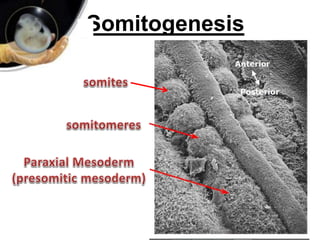
• Somites - a series of dorsal paired
segments occurring along the
notochord in vertebrate embryos.
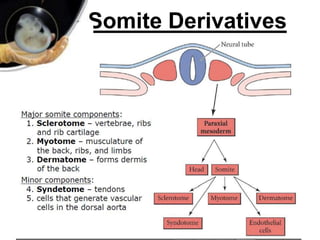
Somite Derivatives
Somitogenesis
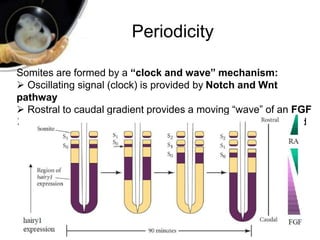
Periodicity
Somites are formed by a “clock and wave” mechanism:
 Oscillating signal (clock) is provided by Notch and Wnt
pathway
 Rostral to caudal gradient provides a moving “wave” of an FGF
 With each wave of gene expression, another somite is formed
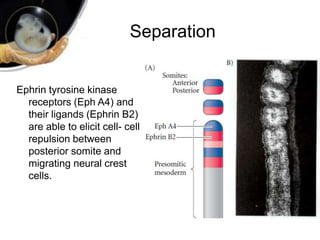
Separation
Ephrin tyrosine kinase
receptors (Eph A4) and
their ligands (Ephrin B2)
are able to elicit cell- cell
repulsion between
posterior somite and
migrating neural crest
cells.
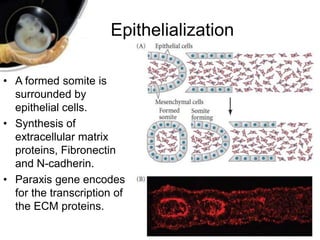
Epithelialization
• A formed somite is
surrounded by
epithelial cells.
• Synthesis of
extracellular matrix
proteins, Fibronectin
and N-cadherin.
• Paraxis gene encodes
for the transcription of
the ECM proteins.
Specification
• Each somite forms a specific type of
vertebrae
• Tissue specified by:
– notochord (Shh)
– neural tube floor plate (Shh)
– neural tube roof plate (Wnts)
– lateral plate mesoderm (Fgfs)
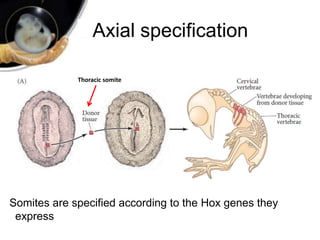
Axial specification
Somites are specified according to the Hox genes they
express
Thoracic somite
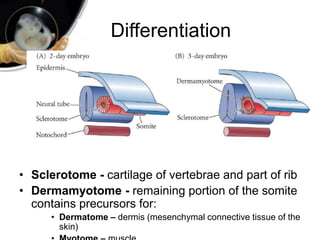
Differentiation
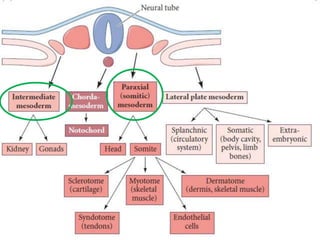
• Sclerotome - cartilage of vertebrae and part of rib
• Dermamyotome - remaining portion of the somite
contains precursors for:
• Dermatome – dermis (mesenchymal connective tissue of the
skin)
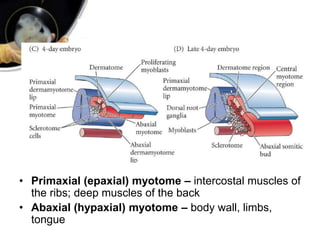
• Primaxial (epaxial) myotome – intercostal muscles of
the ribs; deep muscles of the back
• Abaxial (hypaxial) myotome – body wall, limbs,
tongue
Determination of Somites
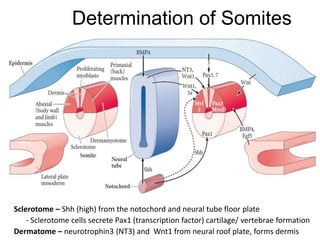
Sclerotome – Shh (high) from the notochord and neural tube floor plate
- Sclerotome cells secrete Pax1 (transcription factor) cartilage/ vertebrae formation
Dermatome – neurotrophin3 (NT3) and Wnt1 from neural roof plate, forms dermis
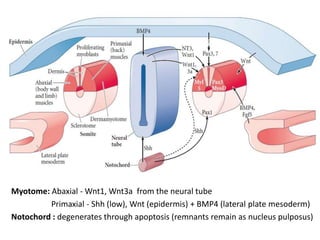
Myotome: Abaxial - Wnt1, Wnt3a from the neural tube
Primaxial - Shh (low), Wnt (epidermis) + BMP4 (lateral plate mesoderm)
Notochord : degenerates through apoptosis (remnants remain as nucleus pulposus)
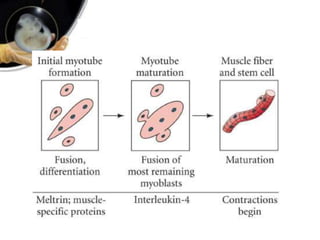
Myogenesis
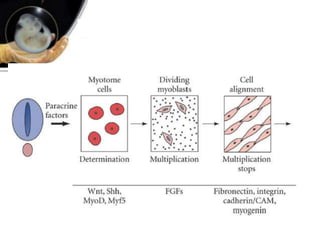
• Specification and differentiation of
myogenic BHLH (basic helix-loop-helix)
proteins: MyoD and Myf5
• Muscle cells come from primaxial and
abaxial lineages in the somite
Osteogenesis
Bones
– The skeleton is generated from:
• Somites→ vertebrae
• Lateral plate mesoderm → limb bones
• Neural crest cells → brachial arch, craniofacial
bones
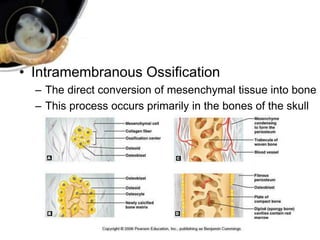
• Intramembranous Ossification
– The direct conversion of mesenchymal tissue into bone
– This process occurs primarily in the bones of the skull
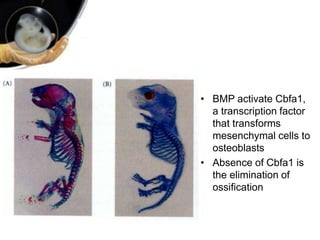
• BMP activate Cbfa1,
a transcription factor
that transforms
mesenchymal cells to
osteoblasts
• Absence of Cbfa1 is
the elimination of
ossification
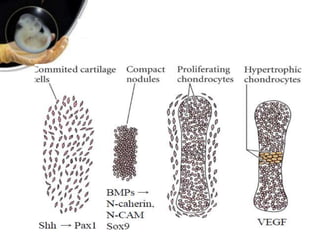
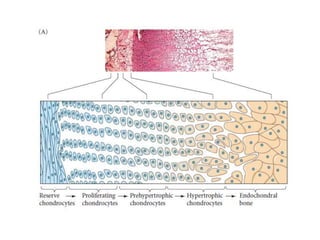
• Endochondral Ossification
– Mesenchymal cells differentiate into cartilage,
and this cartilage is later replaced by bone.
– Bone formation characteristic of the
vertebrae, limbs, and ribs.
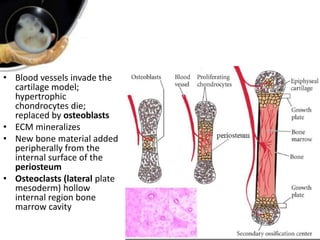
• Blood vessels invade the
cartilage model;
hypertrophic
chondrocytes die;
replaced by osteoblasts
• ECM mineralizes
• New bone material added
peripherally from the
internal surface of the
periosteum
• Osteoclasts (lateral plate
mesoderm) hollow
internal region bone
marrow cavity
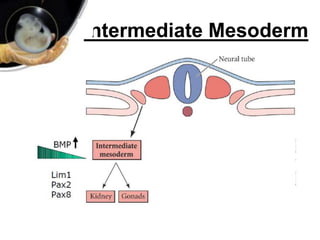
Intermediate Mesoderm
Kidney
• Nephron – functional unit, contains over
10,000 cells with at least 12 different cell
types
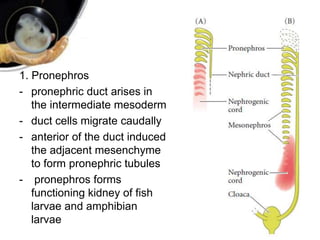
1. Pronephros
- pronephric duct arises in
the intermediate mesoderm
- duct cells migrate caudally
- anterior of the duct induced
the adjacent mesenchyme
to form pronephric tubules
- pronephros forms
functioning kidney of fish
larvae and amphibian
larvae
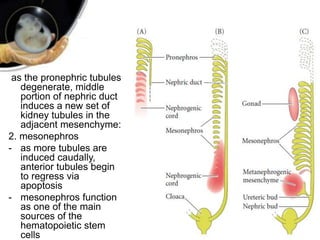
as the pronephric tubules
degenerate, middle
portion of nephric duct
induces a new set of
kidney tubules in the
adjacent mesenchyme:
2. mesonephros
- as more tubules are
induced caudally,
anterior tubules begin
to regress via
apoptosis
- mesonephros function
as one of the main
sources of the
hematopoietic stem
cells
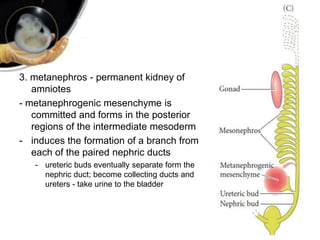
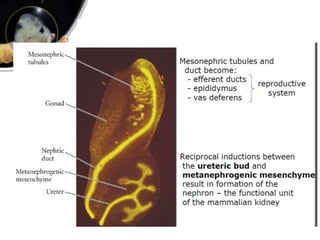
3. metanephros - permanent kidney of
amniotes
- metanephrogenic mesenchyme is
committed and forms in the posterior
regions of the intermediate mesoderm
- induces the formation of a branch from
each of the paired nephric ducts
- ureteric buds eventually separate form the
nephric duct; become collecting ducts and
ureters - take urine to the bladder
Paraxial and intermediate mesoderm

Paraxial and intermediate mesoderm

  • 1.
  • 3.
    Paraxial Mesoderm • Formsthe back of the embryo, along the spine • Somites - a series of dorsal paired segments occurring along the notochord in vertebrate embryos.
  • 4.
  • 5.
  • 6.
    Periodicity Somites are formedby a “clock and wave” mechanism:  Oscillating signal (clock) is provided by Notch and Wnt pathway  Rostral to caudal gradient provides a moving “wave” of an FGF  With each wave of gene expression, another somite is formed
  • 7.
    Separation Ephrin tyrosine kinase receptors(Eph A4) and their ligands (Ephrin B2) are able to elicit cell- cell repulsion between posterior somite and migrating neural crest cells.
  • 8.
    Epithelialization • A formedsomite is surrounded by epithelial cells. • Synthesis of extracellular matrix proteins, Fibronectin and N-cadherin. • Paraxis gene encodes for the transcription of the ECM proteins.
  • 9.
    Specification • Each somiteforms a specific type of vertebrae • Tissue specified by: – notochord (Shh) – neural tube floor plate (Shh) – neural tube roof plate (Wnts) – lateral plate mesoderm (Fgfs)
  • 10.
    Axial specification Somites arespecified according to the Hox genes they express Thoracic somite
  • 11.
    Differentiation • Sclerotome -cartilage of vertebrae and part of rib • Dermamyotome - remaining portion of the somite contains precursors for: • Dermatome – dermis (mesenchymal connective tissue of the skin)
  • 12.
    • Primaxial (epaxial)myotome – intercostal muscles of the ribs; deep muscles of the back • Abaxial (hypaxial) myotome – body wall, limbs, tongue
  • 13.
    Determination of Somites Sclerotome– Shh (high) from the notochord and neural tube floor plate - Sclerotome cells secrete Pax1 (transcription factor) cartilage/ vertebrae formation Dermatome – neurotrophin3 (NT3) and Wnt1 from neural roof plate, forms dermis
  • 14.
    Myotome: Abaxial -Wnt1, Wnt3a from the neural tube Primaxial - Shh (low), Wnt (epidermis) + BMP4 (lateral plate mesoderm) Notochord : degenerates through apoptosis (remnants remain as nucleus pulposus)
  • 15.
    Myogenesis • Specification anddifferentiation of myogenic BHLH (basic helix-loop-helix) proteins: MyoD and Myf5 • Muscle cells come from primaxial and abaxial lineages in the somite
  • 18.
    Osteogenesis Bones – The skeletonis generated from: • Somites→ vertebrae • Lateral plate mesoderm → limb bones • Neural crest cells → brachial arch, craniofacial bones
  • 19.
    • Intramembranous Ossification –The direct conversion of mesenchymal tissue into bone – This process occurs primarily in the bones of the skull
  • 20.
    • BMP activateCbfa1, a transcription factor that transforms mesenchymal cells to osteoblasts • Absence of Cbfa1 is the elimination of ossification
  • 21.
    • Endochondral Ossification –Mesenchymal cells differentiate into cartilage, and this cartilage is later replaced by bone. – Bone formation characteristic of the vertebrae, limbs, and ribs.
  • 23.
    • Blood vesselsinvade the cartilage model; hypertrophic chondrocytes die; replaced by osteoblasts • ECM mineralizes • New bone material added peripherally from the internal surface of the periosteum • Osteoclasts (lateral plate mesoderm) hollow internal region bone marrow cavity
  • 25.
  • 26.
    Kidney • Nephron –functional unit, contains over 10,000 cells with at least 12 different cell types
  • 27.
    1. Pronephros - pronephricduct arises in the intermediate mesoderm - duct cells migrate caudally - anterior of the duct induced the adjacent mesenchyme to form pronephric tubules - pronephros forms functioning kidney of fish larvae and amphibian larvae
  • 28.
    as the pronephrictubules degenerate, middle portion of nephric duct induces a new set of kidney tubules in the adjacent mesenchyme: 2. mesonephros - as more tubules are induced caudally, anterior tubules begin to regress via apoptosis - mesonephros function as one of the main sources of the hematopoietic stem cells
  • 29.
    3. metanephros -permanent kidney of amniotes - metanephrogenic mesenchyme is committed and forms in the posterior regions of the intermediate mesoderm - induces the formation of a branch from each of the paired nephric ducts - ureteric buds eventually separate form the nephric duct; become collecting ducts and ureters - take urine to the bladder