Patch-clamp
technique
HOVSEP GHAZARYAN
Introduction
 The patch clamp technique is a laboratory
technique in electrophysiology that allows the
study of single or multiple ion channels in cells.
 The patch clamp technique is a refinement of
the voltage clamp. Erwin Neher and Bert
Sakmann developed the patch clamp in the
late 1970s and early 1980s.
 Neher and Sakmann received the Nobel Prize in
Physiology or Medicine in 1991 for this work.
Applications
Neurons
Cardiomyocytes
Muscle fibers
Panceratic betta cells
Bacteria
Kidney cells
Applications
For evaluation of antiarrythmics
agents
To study a cardio selective
inhibition of ATP sensitive
potassium channel
To identify multiple types of
calcium channels
Applications
To measure the effect of potassium
channel openers
Voltage clamp studies on sodium
channels
To investigate wide range of
electropysiological cell properties
Measurement of cell membrane
conductance
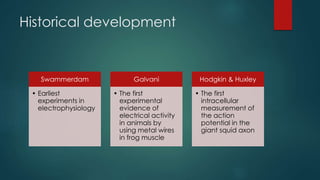
Historical development
Swammerdam
• Earliest
experiments in
electrophysiology
Galvani
• The first
experimental
evidence of
electrical activity
in animals by
using metal wires
in frog muscle
Hodgkin & Huxley
• The first
intracellular
measurement of
the action
potential in the
giant squid axon
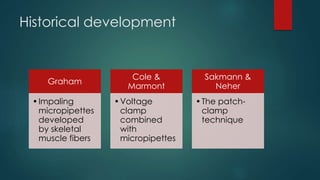
Historical development
Graham
•Impaling
micropipettes
developed
by skeletal
muscle fibers
Cole &
Marmont
•Voltage
clamp
combined
with
micropipettes
Sakmann &
Neher
•The patch-
clamp
technique
Need of patch-clamp
Patch-clamp is refinement of voltage clamp technique
Provides for low-noise recordings of currents
Provides access to the inside of cell
•Can insert an electrode into the cell
•Can change intracellular fluid
Creates a seal impermeable to ion flow
•High electrical resistance
Allows one to measure current through ion channels vs. voltage, time, temperature
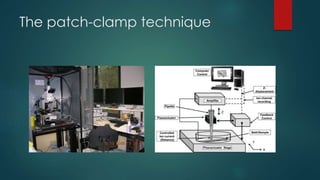
The patch-clamp technique
Basic principle
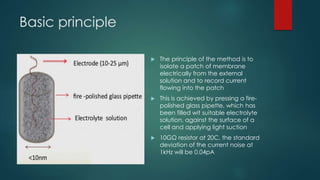
Basic principle
 The principle of the method is to isolate a patch of
membrane electrically from the external solution and to
record current flowing into the patch
 This is achieved by pressing a fire-polished glass pipette,
which has been filled wit suitable electrolyte solution,
against the surface of a cell and applying light suction
 10GΩ resistor at 20C, the standard deviation of the
current noise at 1kHz will be 0.04pA
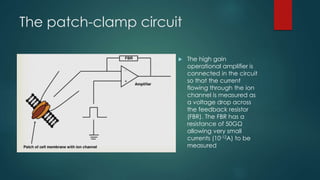
The patch-clamp circuit
 The high gain operational amplifier is
connected in the circuit so that the
current flowing through the ion channel is
measured as a voltage drop across the
feedback resistor (FBR). The FBR has a
resistance of 50GΩ allowing very small
currents (10-12A) to be measured
Cell
Patch-clamp
Suck a small piece of
membrane onto the
tip of a glass
micropipette
(~ 1 µm in diameter)
Cell
“Gigaohm-seal”
R > 1 GOhm
Patch-clamp
Cell
Sense voltage
here, inside the
electrode, and
use voltage clamp
to keep it
constant.
Patch-clamp
closed
open
Cell
+ +
Patch-clamp
Sense voltage
here, inside the
electrode, and
use voltage clamp
to keep it
constant.
closed closed
open
Cell
Turn on the aimed
potential the inside
part of the pipette
and keep it
constantly by
applying the voltage
clamp technique.
Patch-clamp
Recording
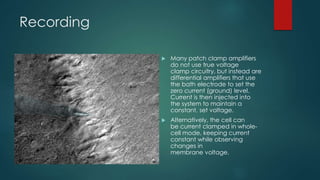
Recording
 Many patch clamp amplifiers do not use
true voltage clamp circuitry, but instead are
differential amplifiers that use the bath
electrode to set the zero current (ground) level.
Current is then injected into the system to
maintain a constant, set voltage.
 Alternatively, the cell can be current clamped in
whole-cell mode, keeping current constant
while observing changes in membrane voltage.
voltage command
10 msec
Properties of individual voltage-
dependent sodium channels
1. Individual channels are either open or closed
(no partial openings)
Properties of individual voltage-
dependent sodium channels
1. Individual channels are either open or closed
(no partial openings)
2. Each channel opening is only a brief event
compared to the total duration of the whole
cell voltage-dependent sodium current.
The macroscopic sodium
current
Properties of individual voltage-
dependent sodium channels
1. Individual channels are either open or closed
(no partial openings)
2. Each channel opening is only a brief event
compared to the total duration of the whole
cell voltage-dependent sodium current.
3. Channel opening and closing is variable in
duration and latency.
Properties of individual voltage-
dependent sodium channels
The macroscopic sodium
current
1. The channels are either in open or closed state.
2. The channel openings are short events when
compared with the macroscopic sodium
current.
3. The time duration and latency of the channel
openings are variable (case sensitive). Might
happen to not open at all.
4. The open probability of the channels
resembles with that of the macroscopic
current.
Properties of individual voltage-
dependent sodium channels
The macroscopic sodium
current
Summation of 300 recordings
1. Individual channels are either open or closed
(no partial openings)
2. Each channel opening is only a brief event
compared to the total duration of the whole
cell voltage-dependent sodium current.
3. Channel opening and closing is variable in
duration and latency.
4. The overall probability of channel opening is
similar to the total sodium current. Look at the
sum of the currents from 300 trials.
5. Sometimes an individual channel doesn’t open
even once.
Summation of 300 recordings
Properties of individual voltage-
dependent sodium channels
The macroscopic sodium
current
1. Individual channels are either open or closed
(no partial openings)
2. Each channel opening is only a brief event
compared to the total duration of the whole
cell voltage-dependent sodium current.
3. Channel opening and closing is variable in
duration and latency.
4. The overall probability of channel opening is
similar to the total sodium current. Look at the
sum of the currents from 300 trials.
5. Sometimes an individual channel doesn’t open
even once.
6. Second openings are rare (because of
inactivation)
Summation of 300 recordings
Properties of individual voltage-
dependent sodium channels
The macroscopic sodium
current
Slowly inactivating K current
channel
(Ram & Dagan, 1987)
1. Individual channels are either open or closed
(no partial openings). Sometimes more than
one channel is in a patch.
2. Each channel opening is only a brief event
compared to the total duration of the whole
cell current.
3. Channel opening and closing is variable in
duration and latency.
4. The overall probability of channel opening is
similar to the whole cell current
5. Second openings can happen if there’s no
inactivation.
Other channels
Variations of patch-clamp
 Cell-attached patch
 Inside-out patch
 Whole-cell recording or whole-cell patch
 Outside-out patch
 Perforated patch
 Loose patch
Cell-attached patch
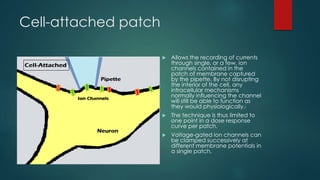
Cell-attached patch
 Allows the recording of currents through single, or a few, ion
channels contained in the patch of membrane captured by the
pipette. By not disrupting the interior of the cell, any intracellular
mechanisms normally influencing the channel will still be able to
function as they would physiologically.
 The technique is thus limited to one point in a dose response
curve per patch.
 Voltage-gated ion channels can be clamped successively at
different membrane potentials in a single patch.
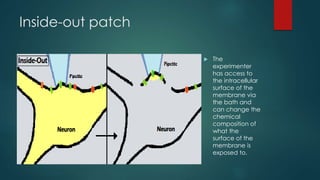
Inside-out patch
Inside-out patch
The experimenter has access to
the intracellular surface of the
membrane via the bath and can
change the chemical
composition of what the surface
of the membrane is exposed to.
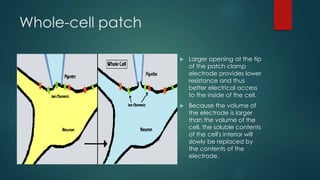
Whole-cell patch
Whole-cell patch
 Larger opening at the tip of the patch clamp
electrode provides lower resistance and thus
better electrical access to the inside of the cell.
 Because the volume of the electrode is larger
than the volume of the cell, the soluble contents
of the cell's interior will slowly be replaced by the
contents of the electrode.
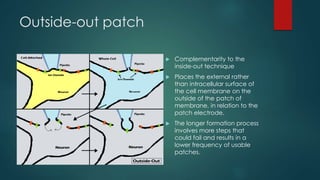
Outside-out patch
Outside-out patch
 Complementarity to the inside-out technique.
 Places the external rather than intracellular
surface of the cell membrane on the outside of
the patch of membrane, in relation to the patch
electrode.
 The longer formation process involves more steps
that could fail and results in a lower frequency of
usable patches.
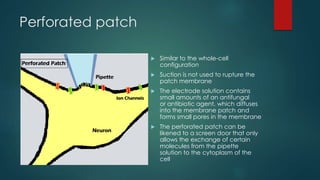
Perforated patch
Perforated patch
 Similar to the whole-cell configuration
 Suction is not used to rupture the patch membrane
 The electrode solution contains small amounts of an
antifungal or antibiotic agent, which diffuses into the
membrane patch and forms small pores in the
membrane
 The perforated patch can be likened to a screen door
that only allows the exchange of certain molecules from
the pipette solution to the cytoplasm of the cell
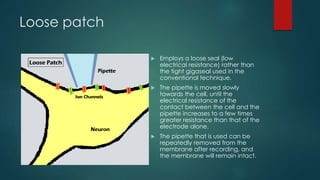
Loose patch
Loose patch
 Employs a loose seal (low electrical resistance) rather
than the tight gigaseal used in the conventional
technique.
 The pipette is moved slowly towards the cell, until the
electrical resistance of the contact between the cell.
and the pipette increases to a few times greater
resistance than that of the electrode alone.
 The pipette that is used can be repeatedly removed
from the membrane after recording, and the membrane
will remain intact.
Rs
CmRc
Whole-cell configuration
NaCl 144
NaH2PO4 0.4
KCl 4
MgSO4 0.53
CaCl2 1.8
Glucose 5.5
HEPES 5
+
ICa blocker
Intracellular solution (mM)
(for K currents)
Extracellular solution (mM)
(for K currents)
K-aspartate 100
KCl 25
K2HPO4 10
K2EGTA 5
K2ATP 3
MgCl2 1
HEPES 10
Extracellular
solution
Patch-clamp amplifier
IBM PC
Micropipette
+ _
_
+
+
+ +
+
_
_
_
_ _
++
_
_
+
+_
Cell
-40 mV
-20 mV ... +50 mV
10 ms ... 5000 ms
Intracellular
solution
Whole cell configuration
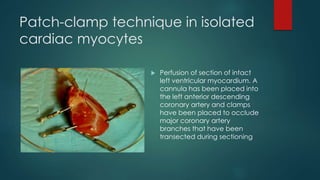
Patch-clamp technique in isolated
cardiac myocytes
 Perfusion of section of intact
left ventricular myocardium. A
cannula has been placed into
the left anterior descending
coronary artery and clamps
have been placed to occlude
major coronary artery
branches that have been
transected during sectioning
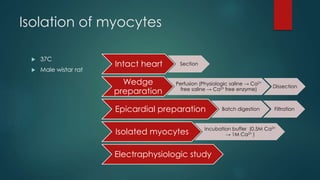
Isolation of myocytes
 37C
 Male wistar rat
Intact heart Section
Wedge
preparation
Perfusion (Physiologic saline → Ca2+
free saline → Ca2+ free enzyme)
Dissection
Epicardial preparation Batch digestion Filtration
Isolated myocytes Incubation buffer (0.5M Ca2+
→ 1M Ca2+ )
Electraphysiologic study
Principle & procedure
 The generation of an action potential in hearth
muscle cells depends on the opening and
closing of ion-selective channels in the plasma
membrane
 The patch-clamp technique enables the
investigation of drug interactions with ion-
channel
 The isolated cells are ready for experiments
 Glass micro-pipette - a tip opening of about 1
µm, is placed onto the cell
Principle & procedure
 The patch-pipette is filled with either NaCL or KCl
solution and is mounted on a micro manipulator
 A chlorided silver wire connects the pipette
solution to the head stage of an electrical
amplifier
 A second chlorided silver wire is inserted into the
bath and serves a ground electrode
 Whole cell patch clamping is done
Principle & procedure
 High input resistance enables the recording of
small electrical currents, which are flowing
through channel forming proteins in the
membrane patch
 The electrical current is driven by applying an
electrical potential across membrane patch,
and/or by establishing an appropriated
chemical gradient for the respective ion species
Principle & procedure
 It is important to investigate the interaction of
drugs with all ion channels involved in the
functioning of the heart muscle cell (K+, Na+,
Ca2+ and eventually Cl- channels)
Evaluation
 Concentration-response curves of drugs which
either inhibit or activate ion channels can be
recorded either on he single channel level or by
measuring the whole-cell current
 IC50 and EC50 values (50% inhibition or
activation, respectively) can be obtained
Limitations
 Requires strong background in ion channel
biophysics
 Imparting skillful training performance during
single channel recordings
 Cost of process is expensive
 Time consuming
 Number of samples required is more at times
 Chance of membrane distortion
Conclusion
Patch-clamp is highly modified and
successful technique
Development of this technique is
being done for newer approaches
to yield accurate and efficient
information which aids drug
discovery process.
Thank you

Patch clamp technique

  • 1.
  • 2.
    Introduction  The patchclamp technique is a laboratory technique in electrophysiology that allows the study of single or multiple ion channels in cells.  The patch clamp technique is a refinement of the voltage clamp. Erwin Neher and Bert Sakmann developed the patch clamp in the late 1970s and early 1980s.  Neher and Sakmann received the Nobel Prize in Physiology or Medicine in 1991 for this work.
  • 3.
  • 4.
    Applications For evaluation ofantiarrythmics agents To study a cardio selective inhibition of ATP sensitive potassium channel To identify multiple types of calcium channels
  • 5.
    Applications To measure theeffect of potassium channel openers Voltage clamp studies on sodium channels To investigate wide range of electropysiological cell properties Measurement of cell membrane conductance
  • 6.
    Historical development Swammerdam • Earliest experimentsin electrophysiology Galvani • The first experimental evidence of electrical activity in animals by using metal wires in frog muscle Hodgkin & Huxley • The first intracellular measurement of the action potential in the giant squid axon
  • 7.
    Historical development Graham •Impaling micropipettes developed by skeletal musclefibers Cole & Marmont •Voltage clamp combined with micropipettes Sakmann & Neher •The patch- clamp technique
  • 8.
    Need of patch-clamp Patch-clampis refinement of voltage clamp technique Provides for low-noise recordings of currents Provides access to the inside of cell •Can insert an electrode into the cell •Can change intracellular fluid Creates a seal impermeable to ion flow •High electrical resistance Allows one to measure current through ion channels vs. voltage, time, temperature
  • 9.
  • 10.
  • 11.
    Basic principle  Theprinciple of the method is to isolate a patch of membrane electrically from the external solution and to record current flowing into the patch  This is achieved by pressing a fire-polished glass pipette, which has been filled wit suitable electrolyte solution, against the surface of a cell and applying light suction  10GΩ resistor at 20C, the standard deviation of the current noise at 1kHz will be 0.04pA
  • 12.
  • 13.
    The patch-clamp circuit The high gain operational amplifier is connected in the circuit so that the current flowing through the ion channel is measured as a voltage drop across the feedback resistor (FBR). The FBR has a resistance of 50GΩ allowing very small currents (10-12A) to be measured
  • 14.
    Cell Patch-clamp Suck a smallpiece of membrane onto the tip of a glass micropipette (~ 1 µm in diameter)
  • 15.
  • 16.
    Cell Sense voltage here, insidethe electrode, and use voltage clamp to keep it constant. Patch-clamp
  • 17.
    closed open Cell + + Patch-clamp Sense voltage here,inside the electrode, and use voltage clamp to keep it constant.
  • 18.
    closed closed open Cell Turn onthe aimed potential the inside part of the pipette and keep it constantly by applying the voltage clamp technique. Patch-clamp
  • 19.
  • 20.
    Recording  Many patchclamp amplifiers do not use true voltage clamp circuitry, but instead are differential amplifiers that use the bath electrode to set the zero current (ground) level. Current is then injected into the system to maintain a constant, set voltage.  Alternatively, the cell can be current clamped in whole-cell mode, keeping current constant while observing changes in membrane voltage.
  • 21.
    voltage command 10 msec Propertiesof individual voltage- dependent sodium channels
  • 22.
    1. Individual channelsare either open or closed (no partial openings) Properties of individual voltage- dependent sodium channels
  • 23.
    1. Individual channelsare either open or closed (no partial openings) 2. Each channel opening is only a brief event compared to the total duration of the whole cell voltage-dependent sodium current. The macroscopic sodium current Properties of individual voltage- dependent sodium channels
  • 24.
    1. Individual channelsare either open or closed (no partial openings) 2. Each channel opening is only a brief event compared to the total duration of the whole cell voltage-dependent sodium current. 3. Channel opening and closing is variable in duration and latency. Properties of individual voltage- dependent sodium channels The macroscopic sodium current
  • 25.
    1. The channelsare either in open or closed state. 2. The channel openings are short events when compared with the macroscopic sodium current. 3. The time duration and latency of the channel openings are variable (case sensitive). Might happen to not open at all. 4. The open probability of the channels resembles with that of the macroscopic current. Properties of individual voltage- dependent sodium channels The macroscopic sodium current Summation of 300 recordings
  • 26.
    1. Individual channelsare either open or closed (no partial openings) 2. Each channel opening is only a brief event compared to the total duration of the whole cell voltage-dependent sodium current. 3. Channel opening and closing is variable in duration and latency. 4. The overall probability of channel opening is similar to the total sodium current. Look at the sum of the currents from 300 trials. 5. Sometimes an individual channel doesn’t open even once. Summation of 300 recordings Properties of individual voltage- dependent sodium channels The macroscopic sodium current
  • 27.
    1. Individual channelsare either open or closed (no partial openings) 2. Each channel opening is only a brief event compared to the total duration of the whole cell voltage-dependent sodium current. 3. Channel opening and closing is variable in duration and latency. 4. The overall probability of channel opening is similar to the total sodium current. Look at the sum of the currents from 300 trials. 5. Sometimes an individual channel doesn’t open even once. 6. Second openings are rare (because of inactivation) Summation of 300 recordings Properties of individual voltage- dependent sodium channels The macroscopic sodium current
  • 28.
    Slowly inactivating Kcurrent channel (Ram & Dagan, 1987) 1. Individual channels are either open or closed (no partial openings). Sometimes more than one channel is in a patch. 2. Each channel opening is only a brief event compared to the total duration of the whole cell current. 3. Channel opening and closing is variable in duration and latency. 4. The overall probability of channel opening is similar to the whole cell current 5. Second openings can happen if there’s no inactivation. Other channels
  • 29.
    Variations of patch-clamp Cell-attached patch  Inside-out patch  Whole-cell recording or whole-cell patch  Outside-out patch  Perforated patch  Loose patch
  • 30.
  • 31.
    Cell-attached patch  Allowsthe recording of currents through single, or a few, ion channels contained in the patch of membrane captured by the pipette. By not disrupting the interior of the cell, any intracellular mechanisms normally influencing the channel will still be able to function as they would physiologically.  The technique is thus limited to one point in a dose response curve per patch.  Voltage-gated ion channels can be clamped successively at different membrane potentials in a single patch.
  • 32.
  • 33.
    Inside-out patch The experimenterhas access to the intracellular surface of the membrane via the bath and can change the chemical composition of what the surface of the membrane is exposed to.
  • 34.
  • 35.
    Whole-cell patch  Largeropening at the tip of the patch clamp electrode provides lower resistance and thus better electrical access to the inside of the cell.  Because the volume of the electrode is larger than the volume of the cell, the soluble contents of the cell's interior will slowly be replaced by the contents of the electrode.
  • 36.
  • 37.
    Outside-out patch  Complementarityto the inside-out technique.  Places the external rather than intracellular surface of the cell membrane on the outside of the patch of membrane, in relation to the patch electrode.  The longer formation process involves more steps that could fail and results in a lower frequency of usable patches.
  • 38.
  • 39.
    Perforated patch  Similarto the whole-cell configuration  Suction is not used to rupture the patch membrane  The electrode solution contains small amounts of an antifungal or antibiotic agent, which diffuses into the membrane patch and forms small pores in the membrane  The perforated patch can be likened to a screen door that only allows the exchange of certain molecules from the pipette solution to the cytoplasm of the cell
  • 40.
  • 41.
    Loose patch  Employsa loose seal (low electrical resistance) rather than the tight gigaseal used in the conventional technique.  The pipette is moved slowly towards the cell, until the electrical resistance of the contact between the cell. and the pipette increases to a few times greater resistance than that of the electrode alone.  The pipette that is used can be repeatedly removed from the membrane after recording, and the membrane will remain intact.
  • 42.
  • 43.
    NaCl 144 NaH2PO4 0.4 KCl4 MgSO4 0.53 CaCl2 1.8 Glucose 5.5 HEPES 5 + ICa blocker Intracellular solution (mM) (for K currents) Extracellular solution (mM) (for K currents) K-aspartate 100 KCl 25 K2HPO4 10 K2EGTA 5 K2ATP 3 MgCl2 1 HEPES 10
  • 44.
    Extracellular solution Patch-clamp amplifier IBM PC Micropipette +_ _ + + + + + _ _ _ _ _ ++ _ _ + +_ Cell -40 mV -20 mV ... +50 mV 10 ms ... 5000 ms Intracellular solution Whole cell configuration
  • 45.
    Patch-clamp technique inisolated cardiac myocytes  Perfusion of section of intact left ventricular myocardium. A cannula has been placed into the left anterior descending coronary artery and clamps have been placed to occlude major coronary artery branches that have been transected during sectioning
  • 46.
    Isolation of myocytes 37C  Male wistar rat Intact heart Section Wedge preparation Perfusion (Physiologic saline → Ca2+ free saline → Ca2+ free enzyme) Dissection Epicardial preparation Batch digestion Filtration Isolated myocytes Incubation buffer (0.5M Ca2+ → 1M Ca2+ ) Electraphysiologic study
  • 47.
    Principle & procedure The generation of an action potential in hearth muscle cells depends on the opening and closing of ion-selective channels in the plasma membrane  The patch-clamp technique enables the investigation of drug interactions with ion- channel  The isolated cells are ready for experiments  Glass micro-pipette - a tip opening of about 1 µm, is placed onto the cell
  • 48.
    Principle & procedure The patch-pipette is filled with either NaCL or KCl solution and is mounted on a micro manipulator  A chlorided silver wire connects the pipette solution to the head stage of an electrical amplifier  A second chlorided silver wire is inserted into the bath and serves a ground electrode  Whole cell patch clamping is done
  • 49.
    Principle & procedure High input resistance enables the recording of small electrical currents, which are flowing through channel forming proteins in the membrane patch  The electrical current is driven by applying an electrical potential across membrane patch, and/or by establishing an appropriated chemical gradient for the respective ion species
  • 50.
    Principle & procedure It is important to investigate the interaction of drugs with all ion channels involved in the functioning of the heart muscle cell (K+, Na+, Ca2+ and eventually Cl- channels)
  • 51.
    Evaluation  Concentration-response curvesof drugs which either inhibit or activate ion channels can be recorded either on he single channel level or by measuring the whole-cell current  IC50 and EC50 values (50% inhibition or activation, respectively) can be obtained
  • 52.
    Limitations  Requires strongbackground in ion channel biophysics  Imparting skillful training performance during single channel recordings  Cost of process is expensive  Time consuming  Number of samples required is more at times  Chance of membrane distortion
  • 53.
    Conclusion Patch-clamp is highlymodified and successful technique Development of this technique is being done for newer approaches to yield accurate and efficient information which aids drug discovery process.
  • 54.