Lect 2
polymorphism
by dr Manal AL Soub
Definition Of Polymorphs
• Polymorphs are different crystalline forms
of the same pure substance in which
molecules have different arrangements
and/or different molecular conformation.
Types of Polymorphism
• Packing polymorphism - polymorphism existing as a
result of difference in crystal packing
– An example of an organic polymorph is glycine which is
able to form monoclinic and hexagonal crystals.
• Conformational polymorphism - Polymorphism resulting
from the existence of different conformers of the same
molecule
• Pseudopolymorphism - the different crystal types are the
result of hydration or solvation.
Types of polymorphism
• Two types of polymorphism have been identified:
• Monotropic polymorphism – Those for which only
one form is stable, irrespective of temperature and
pressure and the metastable form would revert to
the stable form with time.
Enatiotropic polymorphism – Different forms are stable
under different external conditions:
–change in temperature and pressure
determine the form that is stable
Monotropic polymorphs
• Different monotropic polymorphs
–often have different melting points with the most
stable form having the highest melting point.
–They also exhibit different x-ray diffraction
patterns and IR spectra and dissolution rate.
–In some cases, these differences in properties
may affect the –
• handling characteristics of the material,
• the stability of formulated preparations
• bioavailability.
Occurence
• Occurrence of polymorphism can not be
predicted because it can be induced in
many materials at appropriate conditions.
• Moreover, its absence is difficult to
demonstrate by a single specific test.
• The metastable forms usually have:
–faster dissolution rate
–apparently greater equilibrium
solubility
–considerably greater bioavailability.
Polymorphic transition
– Metastable form is not stable and will revert to
the stable form.
– Transition in polymorphic form can be gradual and
time-dependent and can be accelerated by
increase in temperature, humidity or energetic
treatment as in processing of powder.
– Therefore, unit processes such as mixing, milling
and tabletting can induce changes in crystal type
and, hence, change the physical and potential
biopharmaceutical properties of the drug.
Need for control of morphic forms
• Necessary during processing of –
–active ingredients
–excipients
–during production of formulated products
• to ensure the correct physical and
biopharmaceutical characteristics of the
product.
Control of morphic forms ..
• Great care is needed to determine –
–which polymorph is present,
–under what condition
–how long it will be stable.
– A useful stress test for a drug substance is to –
• ball-mill it for a defined time
• check for any change in polymorphic form
through DSC analysis.
Pseudopolymorphism
• Caused by changes in crystallization process which results in
inclusion of solvent molecules in the crystal thereby producing
solvates or hydrates.
• The crystals differ in properties from the non-solvated sample
just like the different polymorphic forms.
– referred to as ‘Pseudopolymorphs’
• Different solvates of the same drug can produce different blood
concentrations from administered solid oral dosage form.
• Unlike polymorphs in which morphic forms with the lowest
melting point usually produce the highest blood concentration,
– solvates or anhydrous forms may produce higher
concentrations depending on the particular drug.
Polymorphism in pharmaceuticals Case
Studies
• GlaxoSmithKline defended its patent for
the polymorph type II of Ranitidine
(Zantac).
• For Medicine administered orally as a
crystalline solid, dissolution rates
depend on the exact crystal form of a
polymorph.11
Polymorphism in pharmaceuticals ….
• Polymorphism is not always well understood.
In 2006 a new crystal form was discovered of
maleic acid 124 years after the first crystal
structure determination
–Maleic acid is a chemical manufactured on
a very large scale in the chemical industry
and is a salt forming component of drug
molecules.
transformations
• The transformation between polymorphic
forms can lead to formulation problems.
• Phase transformations can cause changes in
crystal size in suspensions and their eventual
caking.
• Crystal growth in creams as a result of phase
transformation can cause the cream to
become gritty.
• We can determine which of two polymorphs is the more stable by
a simple experiment in which the polymorphs are placed in a drop
of saturated solution under the microscope.
• The crystals of the less stable form will dissolve and those of the
more stable form will grow until only this form remains.
• Figure shows this process occurring with the two polymorphs of
paracetamol Figure (A) shows the presence of
• both forms of paracetamol at room temperature in saturated
benzyl alcohol.
• Over a time interval of 30 min the less stable of the two forms,
the orthorhombic Form 2, has completely converted to the more
stable monoclinic Form 1 (B).
• For drugs with more than two polymorphs we need to carry out
this experiment on successive pairs of the polymorphs of the drug
until we eventually arrive at their rank order of stability.
A B
• The most stable Lowest solubility and
slowest dissolution rate Lower
bioavailabiity than Metastable polymorph
• Small difference in energy between two
polymoph leads to insignificant differ
biopharmaceutical behaviour measured by
blood conc.
17
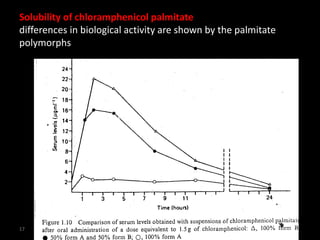
Solubility of chloramphenicol palmitate
differences in biological activity are shown by the palmitate
polymorphs
Form B
Form A
1: 1
Polymorphism in pharmaceuticals ….
– The new crystal type is produced when a caffeine - maleic
acid co-crystal (2:1) is dissolved in chloroform and the
solvent is allowed to evaporate slowly.
– Both polymorphs consist of sheets of molecules connected
through hydrogen bonding of the carboxylic acid groups
• in form I the sheets alternate with respect of the net
dipole moment
• in form II the sheets are oriented in the same direction.
19
Crystal Habits
• Variation in size
• Number of faces
• Kind of faces
• Habits describe the overall shape of the crystal
e.g. acicular (needle), prismatic, pyramidal,
tabular, equant, columnar & lamellar types.
Factors affecting types of habits
• Temperature
• Solvent
• Crystal growth rate
e.g. at high rate, acicular form of phenylsalicylate is formed
• Viscosity
e.g. less viscous media favours coarse
• Addition of impurities
e.g.sulfonic acid dyes alter habits of ammonium, sodium and
potassium nitrates
• Presence of surfactants
e.g. anionic & cationic surfactants on adipic acid crystals
Crystal hydrates
• Crystals that contain solvent of
crystallisation are called crystal solvates,
• crystal hydrates when water is the
solvent of crystallisation.
• Crystals that contain no water of
crystallisation are termed anhydrates.
• Crystal solvates depend on the interaction between the
solvent and the crystal structure.
• solvent plays a keyrole in holding the crystal together;
for example, it may be part of a hydrogen-bonded
network within the crystal structure. These solvates are
very stable and are difficult to desolvate.
• When these crystals lose their solvent they collapse and
recrystallise in a new crystal form. polymorphic solvates.
• the solvent is not part of the crystal bonding These
solvates lose their solvent more readily and desolvation
does not destroy the crystal lattice. This type of solvate
has been called a pseudopolymorphic solvate.
30
Amorphous Solids
• E.g. silica gel, synthetic plastics/polymers
• Irregular shape
- molecules are arranged in a random manner
• No definite melting point
- no crystal lattice to break
• Exhibit characteristic glass transition temperature, Tg
• Flow when subject to pressure over time
• Isotropic i.e. same properties in all direction
• Affect therapeutic activity e.g. amorphous antibiotic
novobiocin is readily absorbed and therapeutically active
compared to the crystalline form
Lec 2 polymorphism

Lec 2 polymorphism

  • 1.
  • 2.
    Definition Of Polymorphs •Polymorphs are different crystalline forms of the same pure substance in which molecules have different arrangements and/or different molecular conformation.
  • 3.
    Types of Polymorphism •Packing polymorphism - polymorphism existing as a result of difference in crystal packing – An example of an organic polymorph is glycine which is able to form monoclinic and hexagonal crystals. • Conformational polymorphism - Polymorphism resulting from the existence of different conformers of the same molecule • Pseudopolymorphism - the different crystal types are the result of hydration or solvation.
  • 4.
    Types of polymorphism •Two types of polymorphism have been identified: • Monotropic polymorphism – Those for which only one form is stable, irrespective of temperature and pressure and the metastable form would revert to the stable form with time. Enatiotropic polymorphism – Different forms are stable under different external conditions: –change in temperature and pressure determine the form that is stable
  • 5.
    Monotropic polymorphs • Differentmonotropic polymorphs –often have different melting points with the most stable form having the highest melting point. –They also exhibit different x-ray diffraction patterns and IR spectra and dissolution rate. –In some cases, these differences in properties may affect the – • handling characteristics of the material, • the stability of formulated preparations • bioavailability.
  • 6.
    Occurence • Occurrence ofpolymorphism can not be predicted because it can be induced in many materials at appropriate conditions. • Moreover, its absence is difficult to demonstrate by a single specific test. • The metastable forms usually have: –faster dissolution rate –apparently greater equilibrium solubility –considerably greater bioavailability.
  • 7.
    Polymorphic transition – Metastableform is not stable and will revert to the stable form. – Transition in polymorphic form can be gradual and time-dependent and can be accelerated by increase in temperature, humidity or energetic treatment as in processing of powder. – Therefore, unit processes such as mixing, milling and tabletting can induce changes in crystal type and, hence, change the physical and potential biopharmaceutical properties of the drug.
  • 8.
    Need for controlof morphic forms • Necessary during processing of – –active ingredients –excipients –during production of formulated products • to ensure the correct physical and biopharmaceutical characteristics of the product.
  • 9.
    Control of morphicforms .. • Great care is needed to determine – –which polymorph is present, –under what condition –how long it will be stable. – A useful stress test for a drug substance is to – • ball-mill it for a defined time • check for any change in polymorphic form through DSC analysis.
  • 10.
    Pseudopolymorphism • Caused bychanges in crystallization process which results in inclusion of solvent molecules in the crystal thereby producing solvates or hydrates. • The crystals differ in properties from the non-solvated sample just like the different polymorphic forms. – referred to as ‘Pseudopolymorphs’ • Different solvates of the same drug can produce different blood concentrations from administered solid oral dosage form. • Unlike polymorphs in which morphic forms with the lowest melting point usually produce the highest blood concentration, – solvates or anhydrous forms may produce higher concentrations depending on the particular drug.
  • 11.
    Polymorphism in pharmaceuticalsCase Studies • GlaxoSmithKline defended its patent for the polymorph type II of Ranitidine (Zantac). • For Medicine administered orally as a crystalline solid, dissolution rates depend on the exact crystal form of a polymorph.11
  • 12.
    Polymorphism in pharmaceuticals…. • Polymorphism is not always well understood. In 2006 a new crystal form was discovered of maleic acid 124 years after the first crystal structure determination –Maleic acid is a chemical manufactured on a very large scale in the chemical industry and is a salt forming component of drug molecules.
  • 13.
    transformations • The transformationbetween polymorphic forms can lead to formulation problems. • Phase transformations can cause changes in crystal size in suspensions and their eventual caking. • Crystal growth in creams as a result of phase transformation can cause the cream to become gritty.
  • 14.
    • We candetermine which of two polymorphs is the more stable by a simple experiment in which the polymorphs are placed in a drop of saturated solution under the microscope. • The crystals of the less stable form will dissolve and those of the more stable form will grow until only this form remains. • Figure shows this process occurring with the two polymorphs of paracetamol Figure (A) shows the presence of • both forms of paracetamol at room temperature in saturated benzyl alcohol. • Over a time interval of 30 min the less stable of the two forms, the orthorhombic Form 2, has completely converted to the more stable monoclinic Form 1 (B). • For drugs with more than two polymorphs we need to carry out this experiment on successive pairs of the polymorphs of the drug until we eventually arrive at their rank order of stability.
  • 15.
  • 16.
    • The moststable Lowest solubility and slowest dissolution rate Lower bioavailabiity than Metastable polymorph • Small difference in energy between two polymoph leads to insignificant differ biopharmaceutical behaviour measured by blood conc.
  • 17.
    17 Solubility of chloramphenicolpalmitate differences in biological activity are shown by the palmitate polymorphs Form B Form A 1: 1
  • 18.
    Polymorphism in pharmaceuticals…. – The new crystal type is produced when a caffeine - maleic acid co-crystal (2:1) is dissolved in chloroform and the solvent is allowed to evaporate slowly. – Both polymorphs consist of sheets of molecules connected through hydrogen bonding of the carboxylic acid groups • in form I the sheets alternate with respect of the net dipole moment • in form II the sheets are oriented in the same direction.
  • 19.
    19 Crystal Habits • Variationin size • Number of faces • Kind of faces • Habits describe the overall shape of the crystal e.g. acicular (needle), prismatic, pyramidal, tabular, equant, columnar & lamellar types.
  • 20.
    Factors affecting typesof habits • Temperature • Solvent • Crystal growth rate e.g. at high rate, acicular form of phenylsalicylate is formed • Viscosity e.g. less viscous media favours coarse • Addition of impurities e.g.sulfonic acid dyes alter habits of ammonium, sodium and potassium nitrates • Presence of surfactants e.g. anionic & cationic surfactants on adipic acid crystals
  • 21.
    Crystal hydrates • Crystalsthat contain solvent of crystallisation are called crystal solvates, • crystal hydrates when water is the solvent of crystallisation. • Crystals that contain no water of crystallisation are termed anhydrates.
  • 22.
    • Crystal solvatesdepend on the interaction between the solvent and the crystal structure. • solvent plays a keyrole in holding the crystal together; for example, it may be part of a hydrogen-bonded network within the crystal structure. These solvates are very stable and are difficult to desolvate. • When these crystals lose their solvent they collapse and recrystallise in a new crystal form. polymorphic solvates. • the solvent is not part of the crystal bonding These solvates lose their solvent more readily and desolvation does not destroy the crystal lattice. This type of solvate has been called a pseudopolymorphic solvate.
  • 30.
    30 Amorphous Solids • E.g.silica gel, synthetic plastics/polymers • Irregular shape - molecules are arranged in a random manner • No definite melting point - no crystal lattice to break • Exhibit characteristic glass transition temperature, Tg • Flow when subject to pressure over time • Isotropic i.e. same properties in all direction • Affect therapeutic activity e.g. amorphous antibiotic novobiocin is readily absorbed and therapeutically active compared to the crystalline form