Physical Pharmaceutics I
Polymorphism.
Presented by Professor Sudipta Roy
• When crystal exist in more than one internal
structure i.e. packing pattern.
• The various crystalline forms are called polymorphs
and the phenomenon is known as polymorphism.
• Polymorphs are divided into three categories :
stable, metastable and unstable.
• Unstable form has a tendency to transform in to
stable form.
• Metastable form in dry state will remain stable but
if melted or dissolved will form stable polymorph.
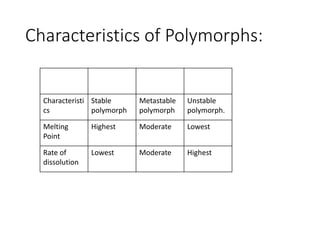
Characteristics of Polymorphs:
Characteristi
cs
Stable
polymorph
Metastable
polymorph
Unstable
polymorph.
Melting
Point
Highest Moderate Lowest
Rate of
dissolution
Lowest Moderate Highest
Polymorphism and Bioavailability.
• Many drugs are hydrophobic .
• Hydrphobic drugs are low soluble in water.
• Drug in several polymorphic forms, the stable one
will produce the slowest rate of dissolution that
may show minimum bioavailability.
• For highly soluble drugs, polymorphism does not
show any problem in dissolution rate.
• Example :
• Chloramphenicol palmitate has three polymorphs ɑ
(stable), β (metastable), ɣ (unstable).
• When chloramphenicol palmitate suspension is
prepared from ɑ (stable) or β (metastable)
polymorph , it is found that bioavailability is higher
with the metastable form.
• Two polymorphs of aspirin can be obtained by
recrystallization of aspirin from 95% ethanol or n-
hexane.
• The polymorph obtained from n-hexane is found to
have greater solubility in water than the polymorph
obtained from ethanol.
Effects of Amorphous or
crystalline Nature on stability :
• Stability and pharmacological activity of drug
substance greatly depends on its amorphous or
crystalline form.
• During the various stages of processing and storage
, they tend to change more stable form.
• Crystals are characterized by repetitious
arrangements of the constituent atoms in regular
three dimensional structure.
• Crystalline is more preferable than amorphous form
for its stability.
• eg. sodium salt of crystalline forms of Penicillin G is
more stable having better therapeutic activity than
corresponding amorphous form.
Characterisation of polymorphic
forms.
• X-ray diffraction:
• Absolute characterization of physical form requires
determinatio of thev dimensions and positions of
molecules in unit cell that can be achieved only
with single crystal X-ray diffraction.
Differential scanning
calorimetry.(DSC)
• DSC is also a very useful instrument for characterizing
polymorphic forms.
• other analytical tools to give supplementary data :
• Near Infrared (NIR)
• Fourier transform infrared (FT-IR) or Raman
spectroscopy.
• Dynamic vapour sorption (DVS).
• Thermogravimetry (TGA)
• Imagine techniques, such as hot stage and scanning
electron microscopy (SEM).
Amorphous Form.
• Amorphous form materials are high energy materials
without a crystal lattice.
• Amorphous forms are in thermdynamically unstable state.
• Amorphous structure materials will change structure with
time first by relaxation and ultimately by crystalllization.
• Amorphous forms usually have higher solubilities and faster
dissolution rates than their crystalline equivalents.
• Amorphous form is alternative way to improve solubility of
poorly soluble compounds.
Eg. of amorphous form.
• Sugar cubes and candy floss are both forms of
sugar. Sugar cubes need to be stirred to aid
dissolution, even into a hot liquid such as tea, while
candy floss immediately melts in the mouth.
• In sugar cubes , there is an ordered crystalline
arrangement of sugar molecule.
• While the candy floss, the molecules are randomly
oriented.
Characterization of Amorphous
Materials.
• Confirmation of amorphous material is achieved by
XRPD, in this case there is no seen of specific peaks
but there is diffraction known as halo.
• If crystalline parts give sharp narrow diffraction
peaks and amorphous component gives a very
broad peak (halo).
• The ration between these intensities can be used to
calculate the amount of crystallinity in the material.
Properties of solvates/hydrates:
• 1. Generally , the anhydrous form of a drug has greater
aqueous solubility than its hydrates.
• This is because the hydrates are already in equillibrium
with water and therefore have less demand of water
eg. anhydrous forms of theophylline and ampicillin
have higher aqueous solubility than hydrates.
2. Non aqueous solvates have greater aqueous soluility
than the non solvates.
eg. chloroform solvates of griseofulvin are more water
soluble than their non solvate form.

Polymorphism PP I-WPS Office (3).pptx

  • 1.
  • 2.
    • When crystalexist in more than one internal structure i.e. packing pattern. • The various crystalline forms are called polymorphs and the phenomenon is known as polymorphism.
  • 3.
    • Polymorphs aredivided into three categories : stable, metastable and unstable. • Unstable form has a tendency to transform in to stable form. • Metastable form in dry state will remain stable but if melted or dissolved will form stable polymorph.
  • 4.
  • 5.
    Polymorphism and Bioavailability. •Many drugs are hydrophobic . • Hydrphobic drugs are low soluble in water. • Drug in several polymorphic forms, the stable one will produce the slowest rate of dissolution that may show minimum bioavailability. • For highly soluble drugs, polymorphism does not show any problem in dissolution rate.
  • 6.
    • Example : •Chloramphenicol palmitate has three polymorphs ɑ (stable), β (metastable), ɣ (unstable). • When chloramphenicol palmitate suspension is prepared from ɑ (stable) or β (metastable) polymorph , it is found that bioavailability is higher with the metastable form.
  • 7.
    • Two polymorphsof aspirin can be obtained by recrystallization of aspirin from 95% ethanol or n- hexane. • The polymorph obtained from n-hexane is found to have greater solubility in water than the polymorph obtained from ethanol.
  • 8.
    Effects of Amorphousor crystalline Nature on stability : • Stability and pharmacological activity of drug substance greatly depends on its amorphous or crystalline form. • During the various stages of processing and storage , they tend to change more stable form.
  • 9.
    • Crystals arecharacterized by repetitious arrangements of the constituent atoms in regular three dimensional structure. • Crystalline is more preferable than amorphous form for its stability. • eg. sodium salt of crystalline forms of Penicillin G is more stable having better therapeutic activity than corresponding amorphous form.
  • 10.
    Characterisation of polymorphic forms. •X-ray diffraction: • Absolute characterization of physical form requires determinatio of thev dimensions and positions of molecules in unit cell that can be achieved only with single crystal X-ray diffraction.
  • 11.
    Differential scanning calorimetry.(DSC) • DSCis also a very useful instrument for characterizing polymorphic forms. • other analytical tools to give supplementary data : • Near Infrared (NIR) • Fourier transform infrared (FT-IR) or Raman spectroscopy. • Dynamic vapour sorption (DVS). • Thermogravimetry (TGA) • Imagine techniques, such as hot stage and scanning electron microscopy (SEM).
  • 12.
    Amorphous Form. • Amorphousform materials are high energy materials without a crystal lattice. • Amorphous forms are in thermdynamically unstable state. • Amorphous structure materials will change structure with time first by relaxation and ultimately by crystalllization. • Amorphous forms usually have higher solubilities and faster dissolution rates than their crystalline equivalents. • Amorphous form is alternative way to improve solubility of poorly soluble compounds.
  • 13.
    Eg. of amorphousform. • Sugar cubes and candy floss are both forms of sugar. Sugar cubes need to be stirred to aid dissolution, even into a hot liquid such as tea, while candy floss immediately melts in the mouth. • In sugar cubes , there is an ordered crystalline arrangement of sugar molecule. • While the candy floss, the molecules are randomly oriented.
  • 14.
    Characterization of Amorphous Materials. •Confirmation of amorphous material is achieved by XRPD, in this case there is no seen of specific peaks but there is diffraction known as halo.
  • 15.
    • If crystallineparts give sharp narrow diffraction peaks and amorphous component gives a very broad peak (halo). • The ration between these intensities can be used to calculate the amount of crystallinity in the material.
  • 16.
    Properties of solvates/hydrates: •1. Generally , the anhydrous form of a drug has greater aqueous solubility than its hydrates. • This is because the hydrates are already in equillibrium with water and therefore have less demand of water eg. anhydrous forms of theophylline and ampicillin have higher aqueous solubility than hydrates. 2. Non aqueous solvates have greater aqueous soluility than the non solvates. eg. chloroform solvates of griseofulvin are more water soluble than their non solvate form.