The document discusses polymorphism, a phenomenon where a substance can exist in multiple crystalline forms, impacting pharmacological properties such as solubility and bioavailability. It covers the need to study polymorphism, types (enantiotropy and monotropy), methods for preparation, characterization techniques, and regulatory considerations in drug development. Case studies on specific drugs highlight the significance of polymorphism on drug performance and stability.
Path for Presentation
➢Introduction
➢ Need to study polymorphism (rational for selecting polymorph)
➢ Structural aspects of polymorphs
➢ Properties of polymorphs
➢ Types of polymorphism
➢ Methods of preparation of polymorph
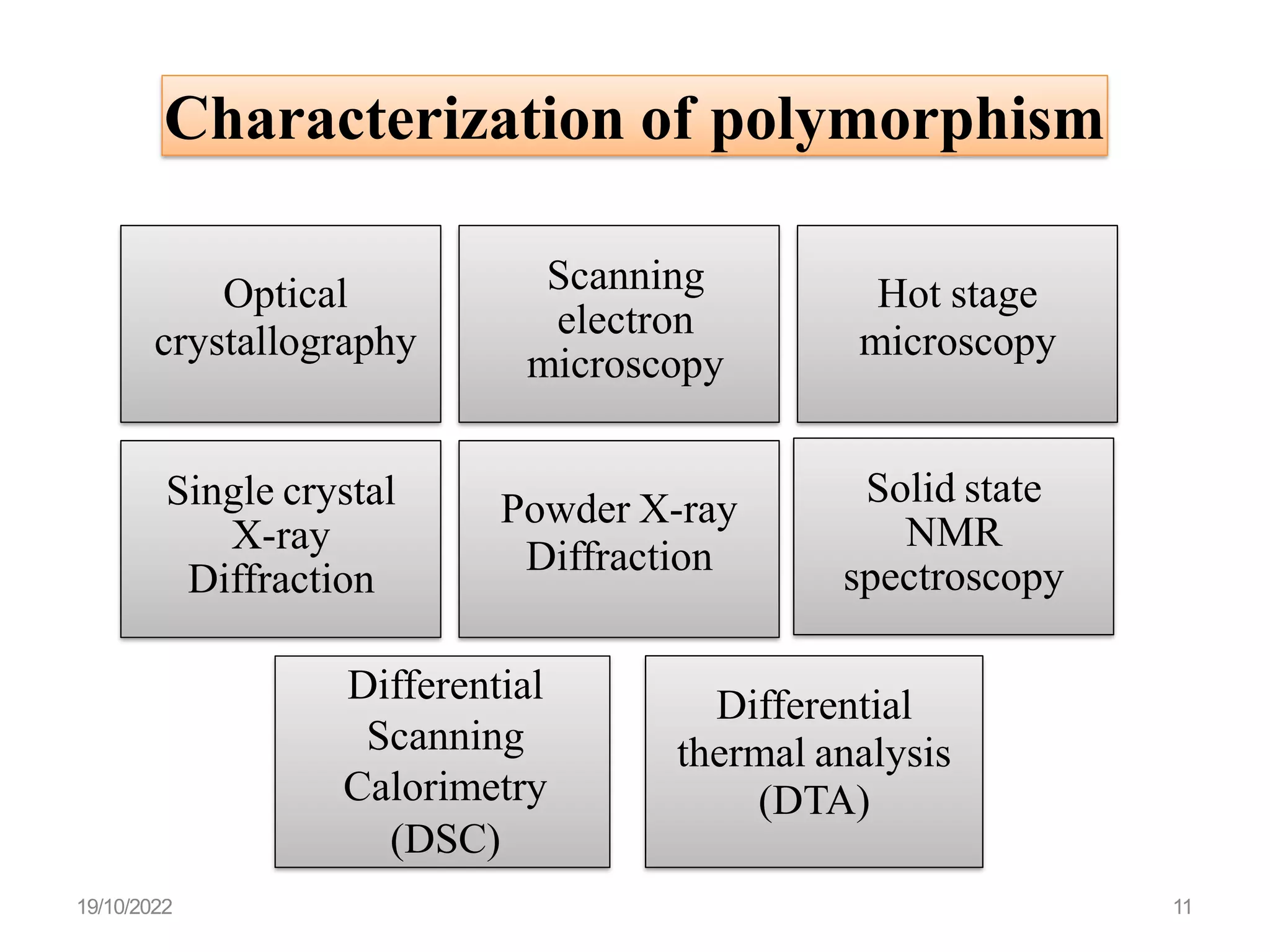
➢ Characterization of polymorphism
➢ Pharmaceutical applications of polymorphism
➢ Regulatory considerations
➢ Polymorphism of several drugs
➢ Conclusion
➢ References
19/10/2022 3
4.
Introduction
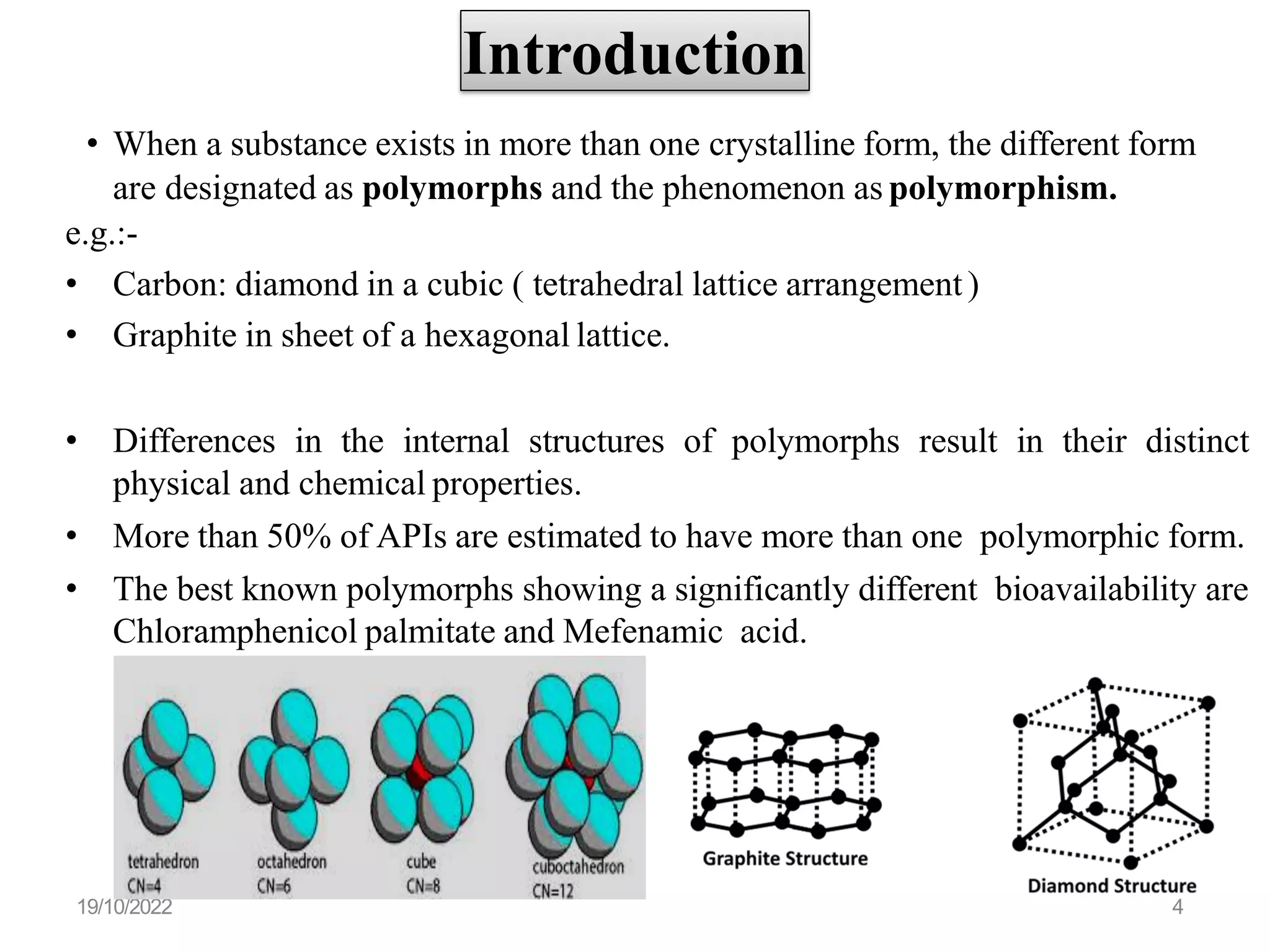
• When asubstance exists in more than one crystalline form, the different form
are designated as polymorphs and the phenomenon as polymorphism.
e.g.:-
• Carbon: diamond in a cubic ( tetrahedral lattice arrangement)
• Graphite in sheet of a hexagonal lattice.
• Differences in the internal structures of polymorphs result in their distinct
physical and chemical properties.
• More than 50% of APIs are estimated to have more than one polymorphic form.
• The best known polymorphs showing a significantly different bioavailability are
Chloramphenicol palmitate and Mefenamic acid.
19/10/2022 4
19/10/2022 6
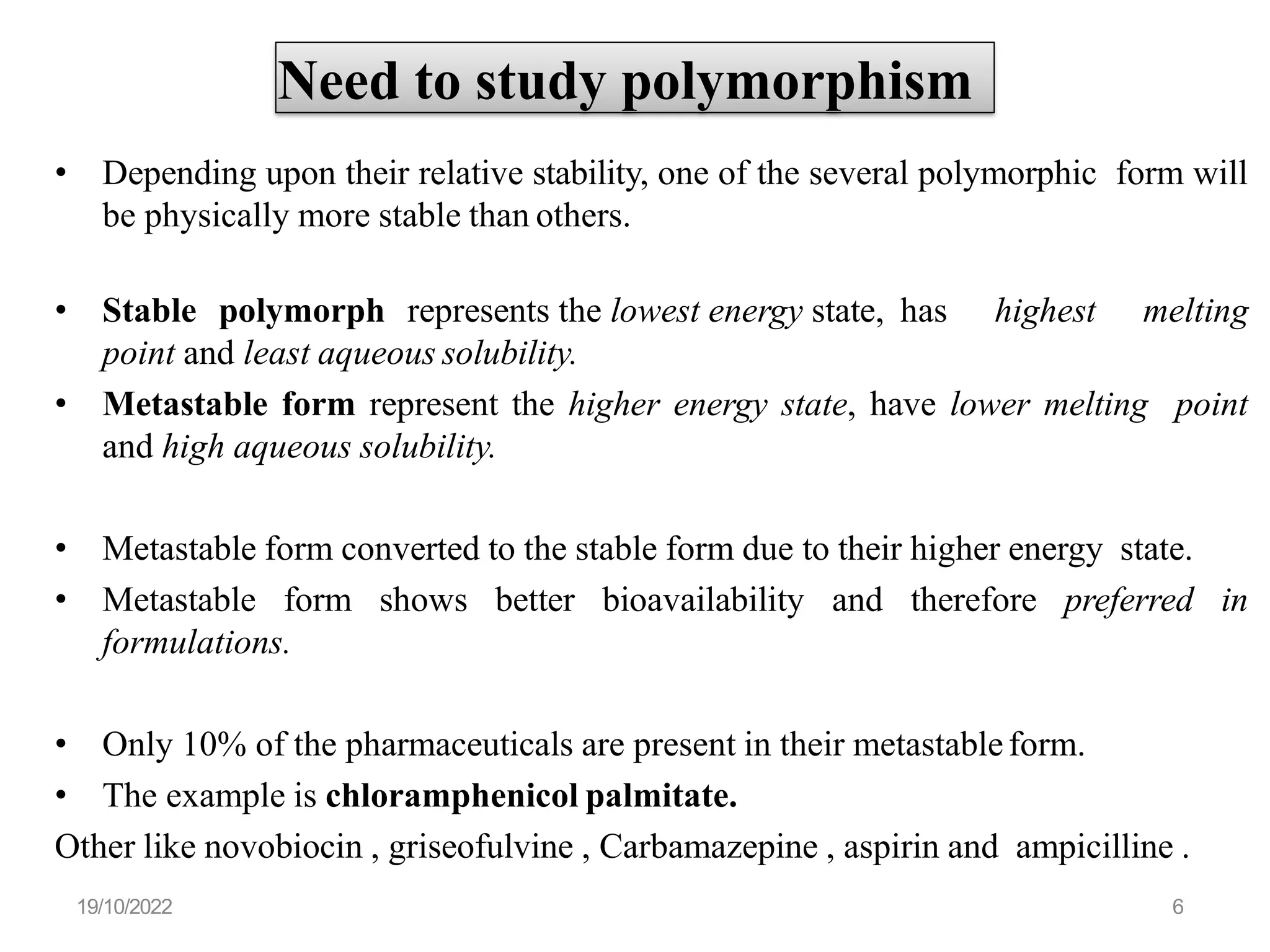
Need tostudy polymorphism
• Depending upon their relative stability, one of the several polymorphic form will
be physically more stable than others.
• Stable polymorph represents the lowest energy state, has highest melting
point and least aqueous solubility.
• Metastable form represent the higher energy state, have lower melting point
and high aqueous solubility.
• Metastable form converted to the stable form due to their higher energy state.
• Metastable form shows better bioavailability and therefore preferred in
formulations.
• Only 10% of the pharmaceuticals are present in their metastableform.
• The example is chloramphenicol palmitate.
Other like novobiocin , griseofulvine , Carbamazepine , aspirin and ampicilline .
7.
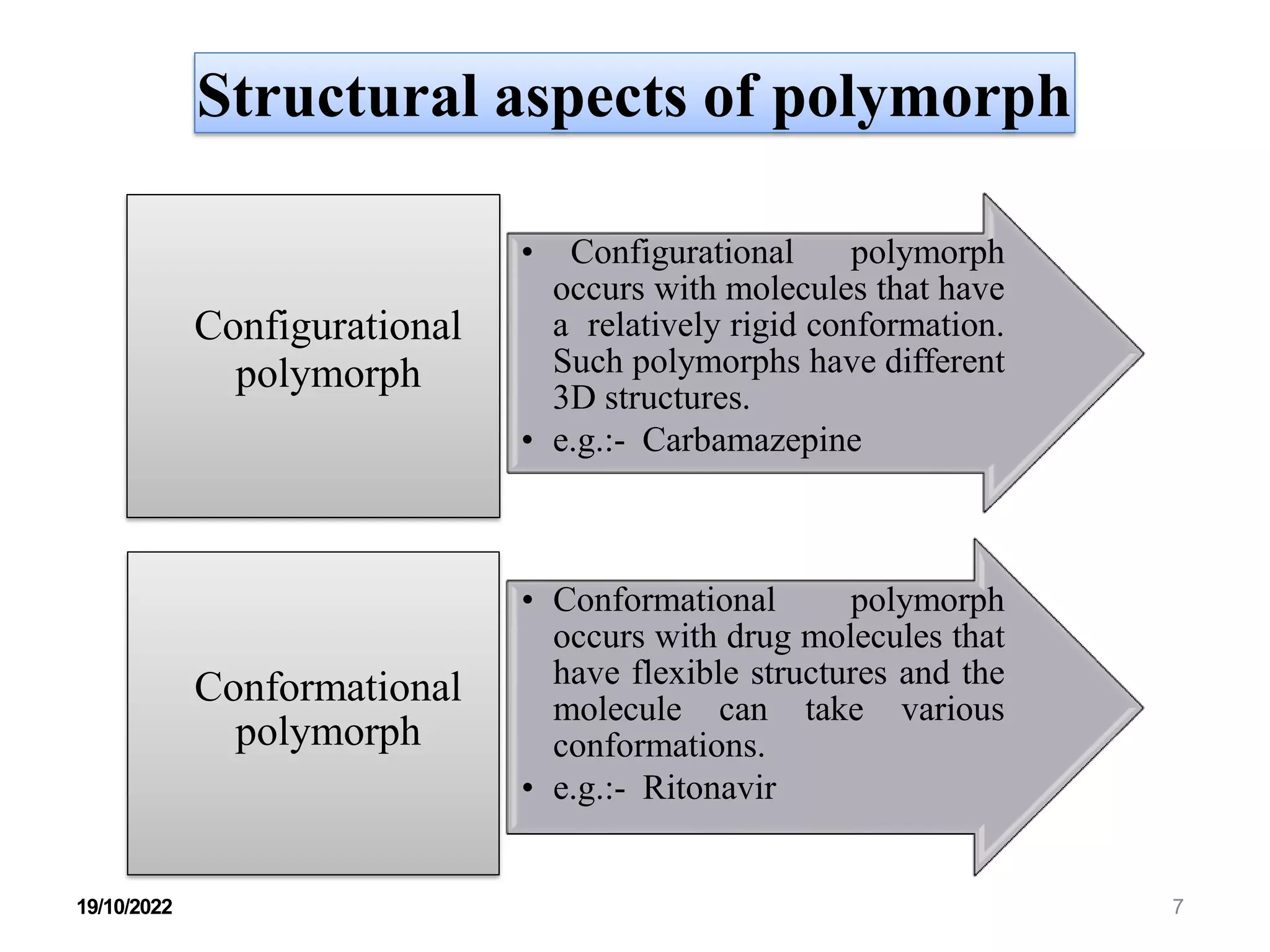
Structural aspects ofpolymorph
• Configurational polymorph
occurs with molecules that have
a relatively rigid conformation.
Such polymorphs have different
3D structures.
• e.g.:- Carbamazepine
Configurational
polymorph
• Conformational polymorph
occurs with drug molecules that
have flexible structures and the
molecule can take various
conformations.
• e.g.:- Ritonavir
Conformational
polymorph
19/10/2022 7
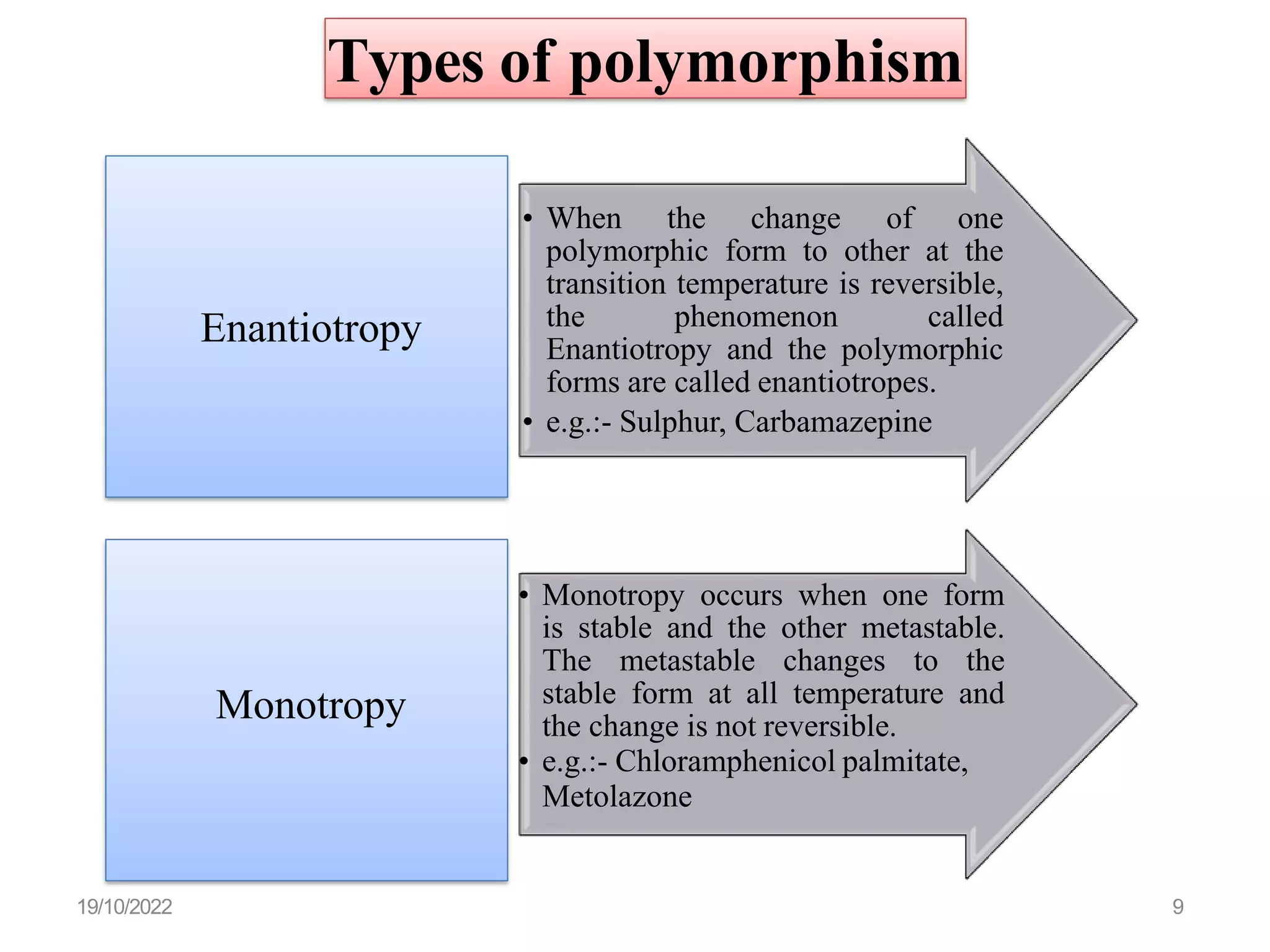
Types of polymorphism
•When the change of one
polymorphic form to other at the
transition temperature is reversible,
the phenomenon called
Enantiotropy and the polymorphic
forms are called enantiotropes.
• e.g.:- Sulphur, Carbamazepine
Enantiotropy
• Monotropy occurs when one form
is stable and the other metastable.
The metastable changes to the
stable form at all temperature and
the change is not reversible.
• e.g.:- Chloramphenicol palmitate,
Metolazone
Monotropy
19/10/2022 9
Pharmaceutical applications
Preparation ofphysically
stable dosage form
Influence on solubility,
dissolution and
bioavailability
Influence on drug
product
manufacturability
Influence on
stability
Effect on tableting
Miscellaneous
application
19/10/2022 12
13.
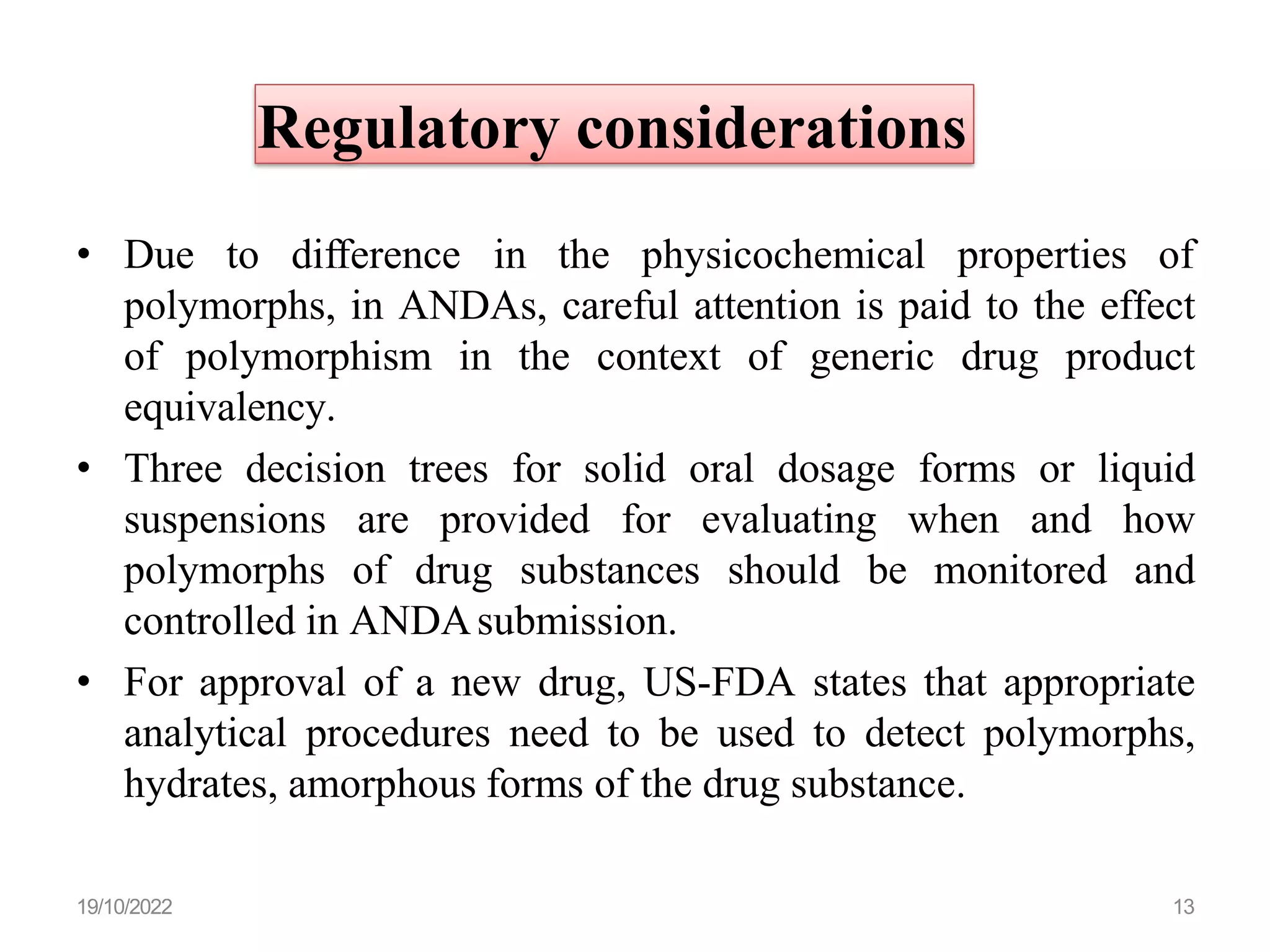
Regulatory considerations
• Dueto difference in the physicochemical properties of
polymorphs, in ANDAs, careful attention is paid to the effect
of polymorphism in the context of generic drug product
equivalency.
• Three decision trees for solid oral dosage forms or liquid
suspensions are provided for evaluating when and how
polymorphs of drug substances should be monitored and
controlled in ANDAsubmission.
• For approval of a new drug, US-FDA states that appropriate
analytical procedures need to be used to detect polymorphs,
hydrates, amorphous forms of the drug substance.
19/10/2022 13
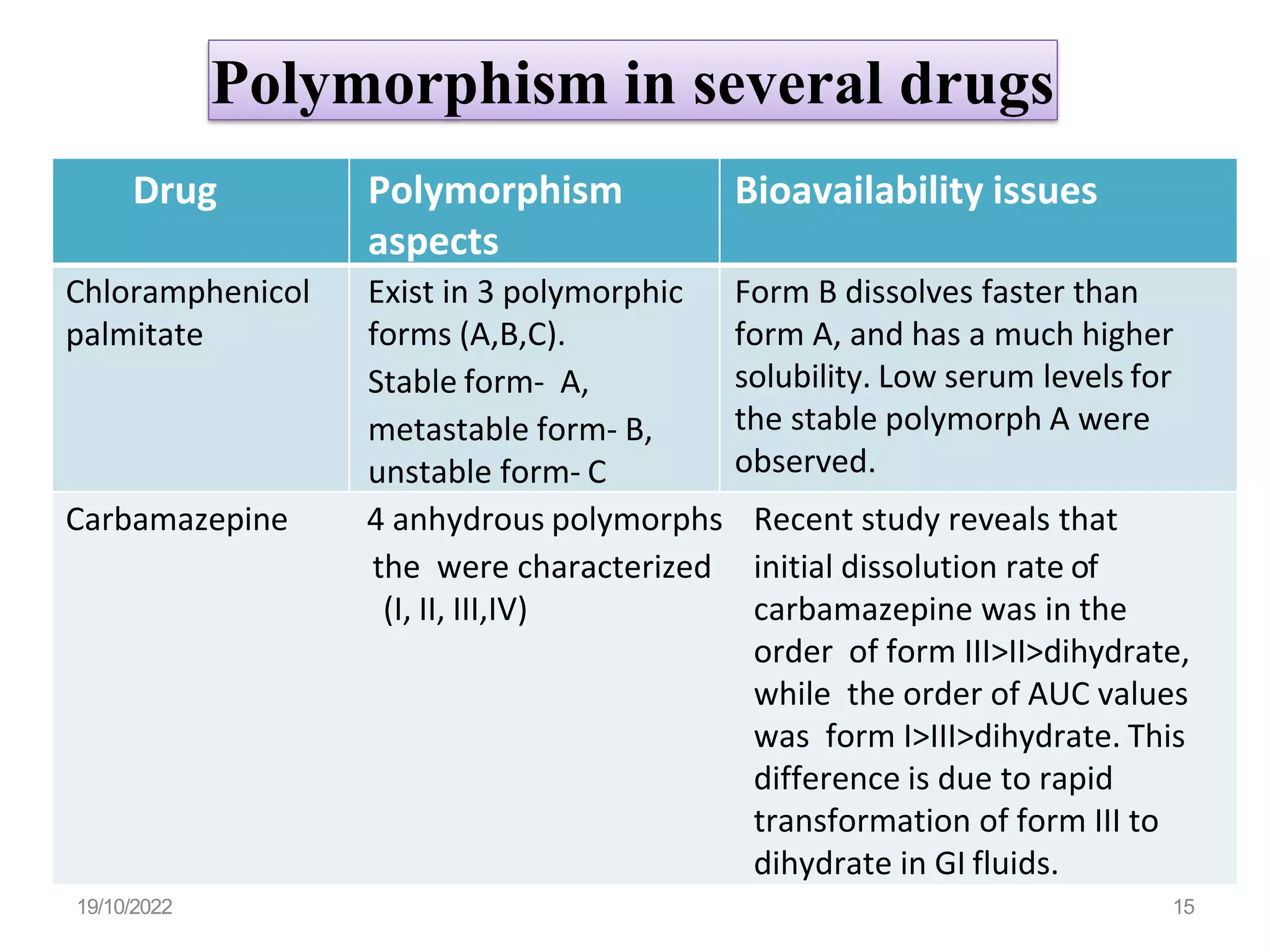
Polymorphism in severaldrugs
Drug Polymorphism
aspects
Bioavailability issues
Chloramphenicol
palmitate
Exist in 3 polymorphic
forms (A,B,C).
Stable form- A,
metastable form- B,
unstable form- C
Form B dissolves faster than
form A, and has a much higher
solubility. Low serum levels for
the stable polymorph A were
observed.
Carbamazepine 4 anhydrous polymorphs Recent study reveals that
the were characterized initial dissolution rate of
(I, II, III,IV) carbamazepine was in the
order of form III>II>dihydrate,
while the order of AUC values
was form I>III>dihydrate. This
difference is due to rapid
transformation of form III to
dihydrate in GI fluids.
19/10/2022 15
16.
Conclusion
• Differences inthe solubility and melting point must also be assessed and then a
decision can be made to determine which form to progress through to the next
stage.
• Metastable form may lead to a preferential choice of a polymorph other than
stable form .
• The lowest energy polymorph is almost always the most chemically stable form,
and will not convert to another polymorph during storage as drug product.
• Metastable crystalline polymorphs may be less chemically stable crystalline
form but is often possible to improve chemical stability of such forms through
judicious choice of excipients and formulation process as metastable form has
relatively higher solubility.
• As polymorphism can have such serious consequences for the bioavailability of
drugs with low aqueous solubility.
19/10/2022 16
17.
References
1. Kadam K.P.and Chavan R.P., “ Evaluation of Various Polymorphs by Different
Techniques and Their Characterization -A Review”, The International Journal Of
Engineering And Science (IJES), Volume 5, Issue 6, Pages-29-34, 2016.
2. Ethiraj T. and Ganeshan V., “Polymorphism in pharmaceutical ingredients- A
review”, World Journal of Pharmacy and Pharmaceutical sciences, Volume 3,
Issue 3,621-633, 2014.
3. Saurabh G. and Kaushal C. “Pharmaceutical Solid Polymorphism in
Abbreviated New Drug Application (ANDA) – A Regulatory Perspective”, Journal
of Chemical and Pharmaceutical Research, 2011, 3(3):6-17.
4. Brittain H. G.., Polymorphism in Pharmaceutical Solids, Marcel Dekker, Inc, Special
Indian edition, pp. 7-19,2008.
19/10/2022 17
18.
5. Bauer J.F. , “Polymorphism—A Critical Consideration in Pharmaceutical Development,
Manufacturing, andStability,” J.Valid.Technol.,pp. 15–23,2008.
6 KarpinskiP.. H.,“Polymorphism of Active Pharmaceutical Ingredients,” Chem.Eng.Technol.,
vol. 29,no. 2, pp. 233–237,2006.
7 Singhal D. and Curatolo W., “Drug polymorphism and dosage form design: a practical
perspective,” Adv.DrugDeliv.Rev.,vol. 56,no. 3, pp. 335–347,2004.
8 Aguiar J. and Zelmer, J. E. “Dissolution behavior of polymorphs of Chloramphenicol
palmitate andMefenamic acid,” J.Pharm.Sci.,vol. 58,no. 8, pp. 983–987,1969.
19/10/2022 18