Presented to:
Prof. (Dr.) Saima Amin
Department of Pharmaceutics
SPER, Jamia Hamdard
New Delhi-110062
Process Development and Technology Transfer
Presented by:
MOHD SAMEER
M.Pharm Pharmaceutical
Quality Assurance 1st Sem
“Crystallinity & Polymorphism”
Crystallinity & Polymorphism
Crystalline state: In this state of matter atoms or molecules are arranged in highly well-ordered form and is
associated with three-dimensional periodicity to organize themselves into their most favorable thermodynamic state,
which under certain conditions results in their appearance as crystals.
The repeating three-dimensional patterns are called crystal lattices. The crystal lattice can be analyzed from its X-ray
diffraction pattern.
Characteristics of the Crystalline State
1.Long-Range Order: Crystals have a repeating arrangement of particles over large distances.
2.Definite Geometry: Crystals have a specific and predictable geometric shape based on their internal arrangement.
3.Sharp Melting Point: Crystalline solids exhibit a distinct melting point, transitioning sharply from solid to liquid.
4.Anisotropy: Physical properties like refractive index, conductivity, and tensile strength vary with direction in the
crystal.
5.Lattice Structure: The particles are arranged in a lattice, which can be visualized as a three-dimensional grid.
6.Unit Cell: The smallest repeating unit of a crystal that retains the overall symmetry of the entire crystal lattice.
Crystallinity & Polymorphism
Amorphous State:
Amorphous solids are the ones in which the atoms or molecules are arranged in a random manner (as in a liquid).
In these solids, different bonds have different strength, there is no regularity in their external structure, and also
they do not have sharp meltin g points (due to the variable strength of bonds present between the molecules, ions,
or atoms).
General Preparation: Amorphous forms are prepared by rapid precipitation, lyophillization or rapid cooling of
molten liquids e.g. glass.
Bonds having low strength break at once when exposed to heat; however, the strong bonds take some time to
break. Amorphous solids are isotropic in nature, i.e ., their physical properties will remain the same in all the
directions.
The stability of amorphous compounds increases on storage. The major disadvantage that occurs during the
development of an amorphous form is the thermodynamic instability occurring during bulk-processing or within
the dosage forms.
Crystallinity & Polymorphism
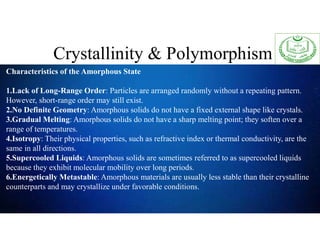
Characteristics of the Amorphous State
1.Lack of Long-Range Order: Particles are arranged randomly without a repeating pattern.
However, short-range order may still exist.
2.No Definite Geometry: Amorphous solids do not have a fixed external shape like crystals.
3.Gradual Melting: Amorphous solids do not have a sharp melting point; they soften over a
range of temperatures.
4.Isotropy: Their physical properties, such as refractive index or thermal conductivity, are the
same in all directions.
5.Supercooled Liquids: Amorphous solids are sometimes referred to as supercooled liquids
because they exhibit molecular mobility over long periods.
6.Energetically Metastable: Amorphous materials are usually less stable than their crystalline
counterparts and may crystallize under favorable conditions.
Crystallinity & Polymorphism
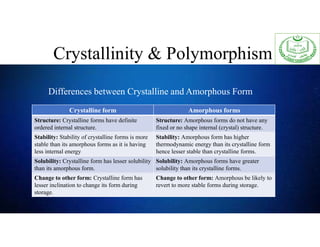
Differences between Crystalline and Amorphous Form
Amorphous forms
Crystalline form
Structure: Amorphous forms do not have any
fixed or no shape internal (crystal) structure.
Structure: Crystalline forms have definite
ordered internal structure.
Stability: Amorphous form has higher
thermodynamic energy than its crystalline form
hence lesser stable than crystalline forms.
Stability: Stability of crystalline forms is more
stable than its amorphous forms as it is having
less internal energy
Solubility: Amorphous forms have greater
solubility than its crystalline forms.
Solubility: Crystalline form has lesser solubility
than its amorphous form.
Change to other form: Amorphous be likely to
revert to more stable forms during storage.
Change to other form: Crystalline form has
lesser inclination to change its form during
storage.
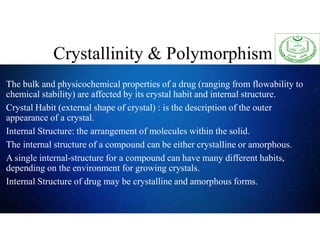
The bulk and physicochemical properties of a drug (ranging from flowability to
chemical stability) are affected by its crystal habit and internal structure.
Crystal Habit (external shape of crystal) : is the description of the outer
appearance of a crystal.
Internal Structure: the arrangement of molecules within the solid.
The internal structure of a compound can be either crystalline or amorphous.
A single internal-structure for a compound can have many different habits,
depending on the environment for growing crystals.
Internal Structure of drug may be crystalline and amorphous forms.
Crystallinity & Polymorphism
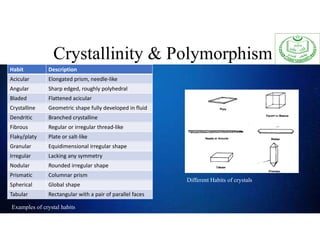
Description
Habit
Elongated prism, needle-like
Acicular
Sharp edged, roughly polyhedral
Angular
Flattened acicular
Bladed
Geometric shape fully developed in fluid
Crystalline
Branched crystalline
Dendritic
Regular or irregular thread-like
Fibrous
Plate or salt-like
Flaky/platy
Equidimensional irregular shape
Granular
Lacking any symmetry
Irregular
Rounded irregular shape
Nodular
Columnar prism
Prismatic
Global shape
Spherical
Rectangular with a pair of parallel faces
Tabular
Examples of crystal habits
Different Habits of crystals
Crystallinity & Polymorphism
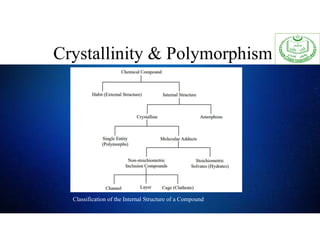
Classification of the Internal Structure of a Compound
Crystallinity & Polymorphism
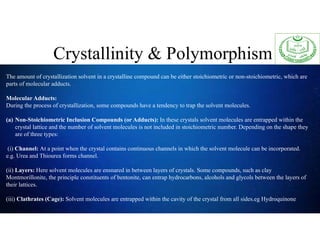
The amount of crystallization solvent in a crystalline compound can be either stoichiometric or non-stoichiometric, which are
parts of molecular adducts.
Molecular Adducts:
During the process of crystallization, some compounds have a tendency to trap the solvent molecules.
(a) Non-Stoichiometric Inclusion Compounds (or Adducts): In these crystals solvent molecules are entrapped within the
crystal lattice and the number of solvent molecules is not included in stoichiometric number. Depending on the shape they
are of three types:
(i) Channel: At a point when the crystal contains continuous channels in which the solvent molecule can be incorporated.
e.g. Urea and Thiourea forms channel.
(ii) Layers: Here solvent molecules are ensnared in between layers of crystals. Some compounds, such as clay
Montmorillonite, the principle constituents of bentonite, can entrap hydrocarbons, alcohols and glycols between the layers of
their lattices.
(iii) Clathrates (Cage): Solvent molecules are entrapped within the cavity of the crystal from all sides.eg Hydroquinone
Crystallinity & Polymorphism
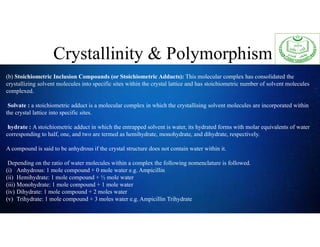
(b) Stoichiometric Inclusion Compounds (or Stoichiometric Adducts): This molecular complex has consolidated the
crystallizing solvent molecules into specific sites within the crystal lattice and has stoichiometric number of solvent molecules
complexed.
Solvate : a stoichiometric adduct is a molecular complex in which the crystallising solvent molecules are incorporated within
the crystal lattice into specific sites.
hydrate : A stoichiometric adduct in which the entrapped solvent is water, its hydrated forms with molar equivalents of water
corresponding to half, one, and two are termed as hemihydrate, monohydrate, and dihydrate, respectively.
A compound is said to be anhydrous if the crystal structure does not contain water within it.
Depending on the ratio of water molecules within a complex the following nomenclature is followed.
(i) Anhydrous: 1 mole compound + 0 mole water e.g. Ampicillin
(ii) Hemihydrate: 1 mole compound + ½ mole water
(iii) Monohydrate: 1 mole compound + 1 mole water
(iv) Dihydrate: 1 mole compound + 2 moles water
(v) Trihydrate: 1 mole compound + 3 moles water e.g. Ampicillin Trihydrate
Crystallinity & Polymorphism
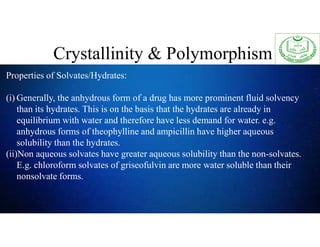
Properties of Solvates/Hydrates:
(i) Generally, the anhydrous form of a drug has more prominent fluid solvency
than its hydrates. This is on the basis that the hydrates are already in
equilibrium with water and therefore have less demand for water. e.g.
anhydrous forms of theophylline and ampicillin have higher aqueous
solubility than the hydrates.
(ii)Non aqueous solvates have greater aqueous solubility than the non-solvates.
E.g. chloroform solvates of griseofulvin are more water soluble than their
nonsolvate forms.
Crystallinity & Polymorphism
Polymorphs: When a substance is in more than one crystalline form, the various forms are called polymorphs and the
phenomenon as polymorphism.
Chemical stability and solubility changes due to polymorphism can have an impact on a drug's bioavailability and its
development program.
Various polymorphs can be prepared by crystallizing the drug from different drugs under various conditions.
Depending on their relative stability, one of the different polymorphic forms will be physically more stable than the others.
Such a stable polymorph represents the lowest thermodynamic energy state, has highest melting point and least solubility.
The representing polymorphs are called metastable forms which represent higher thermodynamic energy state; the metastable
forms have a thermodynamic tendency to convert to the stable form.
A metastable form cannot be called unstable because if it is kept dry, it will remain stable for years.
Crystallinity & Polymorphism
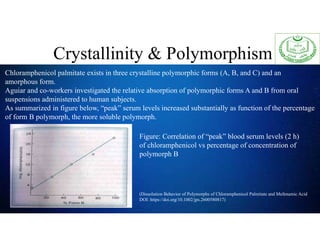
Chloramphenicol palmitate exists in three crystalline polymorphic forms (A, B, and C) and an
amorphous form.
Aguiar and co-workers investigated the relative absorption of polymorphic forms A and B from oral
suspensions administered to human subjects.
As summarized in figure below, “peak” serum levels increased substantially as function of the percentage
of form B polymorph, the more soluble polymorph.
(Dissolution Behavior of Polymorphs of Chloramphenicol Palmitate and Mefenamic Acid
DOI: https://doi.org/10.1002/jps.2600580817)
Figure: Correlation of “peak” blood serum levels (2 h)
of chloramphenicol vs percentage of concentration of
polymorph B
Crystallinity & Polymorphism
There are two types of polymorphs:
1) Enantiotropic Polymorphs: By altering the temperature or pressure, the enantiotropic
polymorph s can be changed into another in a reversible manner, e.g., sulphur.
2) Monotropic Polymorphs: Under all the conditions of temperature and pressure, the
monotropic polymorphs remain unstable, e.g., glyceryl stearate.
The polymorph with lower free energy which corresponds to lower solubility or vapor pressure
is thermodynamically stable below the melting point of the solid.
It is essential that during the pre-formulation studies, the polymorphs which are stable at room
temperature should be identified. Determination of whether or not polymorphic transitions may
occur within the temperature range used for stability studies and during processing (drying,
milling, etc.) is also important.
Crystallinity & Polymorphism
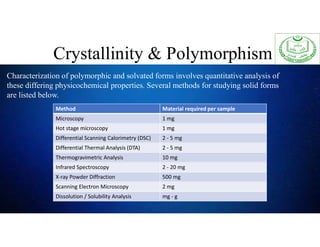
Characterization of polymorphic and solvated forms involves quantitative analysis of
these differing physicochemical properties. Several methods for studying solid forms
are listed below.
Material required per sample
Method
1 mg
Microscopy
1 mg
Hot stage microscopy
2 - 5 mg
Differential Scanning Calorimetry (DSC)
2 - 5 mg
Differential Thermal Analysis (DTA)
10 mg
Thermogravimetric Analysis
2 - 20 mg
Infrared Spectroscopy
500 mg
X-ray Powder Diffraction
2 mg
Scanning Electron Microscopy
mg - g
Dissolution / Solubility Analysis
Crystallinity & Polymorphism
(1)Microscopy: Amorphous substances (e.g. super-cooled glass and non-crystalline organic
compounds or substances with cubic crystal lattices e.g. NaCl) have single refractive index.
Through this type of microscope, the amorphous substances do not transmit light, and they
appear black. They are called isotropic substances.
(2)Hot-stage Microscopy: In this case, the polarizing microscope is fitted with a hot plate to
investigate polymorphism, melting points, transition temperatures and rates of transition at
controlled rates. It facilitates in explaining the thermal behavior of a substance from the DSC
and TGA curves. Problem: A problem often encountered during thermal microscopy is that
organic molecules can degrade during the melting process, and recrystallization of the melt
may not occur, because of the presence of contaminant degradation products.
Crystallinity & Polymorphism
(3) Thermal Analysis:
(a) Differential Scanning Calorimetry (DSC): In DSC method the difference in energy exothermic and
endothermic (∆H) into a sample and reference material is measured as a function of temperature as the
specimens are subjected to an identically steady rise in temperature.
(b) Differential Thermal Analysis (DTA): In DTA instrument a record is formed where temperature difference
(∆T) (between the sample and reference material) is plotted against temperature (T) when two specimens are
subjected to an identically steady rise in temperature. The reference material is alumina, kieselguhr. Samples
that may be studied by DSC or DTA are:
(i) Powders (ii) Fibres (iii) single crystals (iv) polymer films (v) Semi-solids or liquids.
Applications of DTA/DSC in preformulation studies:
(i) To find out the purity of a sample
(ii) To find out the number of polymorphs and to determine the ratio of each polymorph.
(iii)To determine the heat of solvation
(iv)To find out the thermal degradation of a drug or excipients.
(v) To determine the glass-transition temperature (tg) of a polymer
Crystallinity & Polymorphism
(4) Thermogravimetric Analysis (TGA): TGA measures the changes in sample weight as a function of time
(isothermal changes) or temperature.
Applications of TGA in Preformulation Study:
(i) Desolvation and decomposition processes are monitored.
(ii) Comparing TGA and DSC data recorded under identical conditions can greatly aid in the interpretation of
thermal processes.
(5) X-Ray Powder Diffraction: When an X-ray beam falls on a powder the beam is diffracted and peaks are
observed. Interpretation of x – ray diffraction: The peaks or finger prints are observed which indicates
crystalline powder. No peaks are observed which indicate amorphous forms.
Applications of X-ray Powder Diffraction:
(i) Each diffraction pattern is characteristic of a specific crystalline lattice for a given compound. So in
admixture different crystalline forms can be analyzed using normalized intensities at exact angles.
(ii) Identification of crystalline materials by using their diffraction pattern as a ‘finger print’. First, the powder
diffraction photograph or diffractometer trace is taken and matched with a standard photograph. All the lines
and peaks must match in position and relative intensity.
Crystallinity & Polymorphism
Case Studies
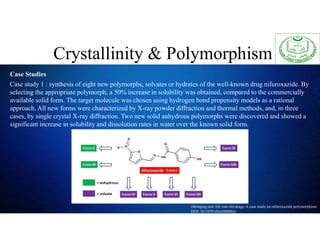
Case study 1 : synthesis of eight new polymorphs, solvates or hydrates of the well-known drug nifuroxazide. By
selecting the appropriate polymorph, a 50% increase in solubility was obtained, compared to the commercially
available solid form. The target molecule was chosen using hydrogen bond propensity models as a rational
approach. All new forms were characterized by X-ray powder diffraction and thermal methods, and, in three
cases, by single crystal X-ray diffraction. Two new solid anhydrous polymorphs were discovered and showed a
significant increase in solubility and dissolution rates in water over the known solid form.
(Bringing new life into old drugs. A case study on nifuroxazide polymorphism
DOI: 10.1039/x0xx00000x)
Crystallinity & Polymorphism
Case study 2 : case study on polymorphism in spirotetramat, discovering a new
polymorph (form II) with improved solubility and pesticide release compared to
form I, highlighting the importance of crystal form screening in pesticide
formulation development.
•Form II has higher solubility than form I.
•Form II maintains stability for over 3 months
Methods Used :
Melt crystallization for discovering form II.
Solution crystallization for uniform particle size distribution.
(Polymorphic Development Strategy for Rapid Pesticide Release: A Case Study of Spirotetramat
DOI: https://pubs.acs.org/doi/10.1021/acs.cgd.3c01306)
Crystallinity & Polymorphism
Case study 3 : a case study on the polymorphism of theophylline and benzamide
cocrystals, detailing the influence of solvent choice on crystallinity and the
formation pathways of polymorphic products through mechanochemical
synthesis and in situ investigations.
•Two polymorphs of theophylline:benzamide cocrystal were synthesized.
•Form II is thermodynamically more stable than form I.
Methods Used
•Liquid-assisted grinding (LAG) for cocrystallization.
•In situ investigations using synchrotron X-ray diffraction and Raman
spectroscopy.
(Polymorphism of Mechanochemically Synthesized Cocrystals: A Case Study
DOI: https://pubs.acs.org/doi/10.1021/acs.cgd.5b01776)
References:
• Lachman/Lieberman’s Industrial Pharmacy
• Google Scholar.
• (Bringing new life into old drugs. A case study on nifuroxazide polymorphism.
DOI: 10.1039/x0xx00000x)
• (Polymorphic Development Strategy for Rapid Pesticide Release: A Case Study of
Spirotetramat. DOI: https://pubs.acs.org/doi/10.1021/acs.cgd.3c01306)
• (Polymorphism of Mechanochemically Synthesized Cocrystals: A Case Study
DOI: https://pubs.acs.org/doi/10.1021/acs.cgd.5b01776
• (Dissolution Behavior of Polymorphs of Chloramphenicol Palmitate and Mefenamic Acid
DOI: https://doi.org/10.1002/jps.2600580817)
Crystallinity & Polymorphism

preformulation : Crystallinity & Polymorphism.pdf

  • 1.
    Presented to: Prof. (Dr.)Saima Amin Department of Pharmaceutics SPER, Jamia Hamdard New Delhi-110062 Process Development and Technology Transfer Presented by: MOHD SAMEER M.Pharm Pharmaceutical Quality Assurance 1st Sem “Crystallinity & Polymorphism”
  • 2.
    Crystallinity & Polymorphism Crystallinestate: In this state of matter atoms or molecules are arranged in highly well-ordered form and is associated with three-dimensional periodicity to organize themselves into their most favorable thermodynamic state, which under certain conditions results in their appearance as crystals. The repeating three-dimensional patterns are called crystal lattices. The crystal lattice can be analyzed from its X-ray diffraction pattern. Characteristics of the Crystalline State 1.Long-Range Order: Crystals have a repeating arrangement of particles over large distances. 2.Definite Geometry: Crystals have a specific and predictable geometric shape based on their internal arrangement. 3.Sharp Melting Point: Crystalline solids exhibit a distinct melting point, transitioning sharply from solid to liquid. 4.Anisotropy: Physical properties like refractive index, conductivity, and tensile strength vary with direction in the crystal. 5.Lattice Structure: The particles are arranged in a lattice, which can be visualized as a three-dimensional grid. 6.Unit Cell: The smallest repeating unit of a crystal that retains the overall symmetry of the entire crystal lattice.
  • 3.
    Crystallinity & Polymorphism AmorphousState: Amorphous solids are the ones in which the atoms or molecules are arranged in a random manner (as in a liquid). In these solids, different bonds have different strength, there is no regularity in their external structure, and also they do not have sharp meltin g points (due to the variable strength of bonds present between the molecules, ions, or atoms). General Preparation: Amorphous forms are prepared by rapid precipitation, lyophillization or rapid cooling of molten liquids e.g. glass. Bonds having low strength break at once when exposed to heat; however, the strong bonds take some time to break. Amorphous solids are isotropic in nature, i.e ., their physical properties will remain the same in all the directions. The stability of amorphous compounds increases on storage. The major disadvantage that occurs during the development of an amorphous form is the thermodynamic instability occurring during bulk-processing or within the dosage forms.
  • 4.
    Crystallinity & Polymorphism Characteristicsof the Amorphous State 1.Lack of Long-Range Order: Particles are arranged randomly without a repeating pattern. However, short-range order may still exist. 2.No Definite Geometry: Amorphous solids do not have a fixed external shape like crystals. 3.Gradual Melting: Amorphous solids do not have a sharp melting point; they soften over a range of temperatures. 4.Isotropy: Their physical properties, such as refractive index or thermal conductivity, are the same in all directions. 5.Supercooled Liquids: Amorphous solids are sometimes referred to as supercooled liquids because they exhibit molecular mobility over long periods. 6.Energetically Metastable: Amorphous materials are usually less stable than their crystalline counterparts and may crystallize under favorable conditions.
  • 5.
    Crystallinity & Polymorphism Differencesbetween Crystalline and Amorphous Form Amorphous forms Crystalline form Structure: Amorphous forms do not have any fixed or no shape internal (crystal) structure. Structure: Crystalline forms have definite ordered internal structure. Stability: Amorphous form has higher thermodynamic energy than its crystalline form hence lesser stable than crystalline forms. Stability: Stability of crystalline forms is more stable than its amorphous forms as it is having less internal energy Solubility: Amorphous forms have greater solubility than its crystalline forms. Solubility: Crystalline form has lesser solubility than its amorphous form. Change to other form: Amorphous be likely to revert to more stable forms during storage. Change to other form: Crystalline form has lesser inclination to change its form during storage.
  • 6.
    The bulk andphysicochemical properties of a drug (ranging from flowability to chemical stability) are affected by its crystal habit and internal structure. Crystal Habit (external shape of crystal) : is the description of the outer appearance of a crystal. Internal Structure: the arrangement of molecules within the solid. The internal structure of a compound can be either crystalline or amorphous. A single internal-structure for a compound can have many different habits, depending on the environment for growing crystals. Internal Structure of drug may be crystalline and amorphous forms. Crystallinity & Polymorphism
  • 7.
    Crystallinity & Polymorphism Description Habit Elongatedprism, needle-like Acicular Sharp edged, roughly polyhedral Angular Flattened acicular Bladed Geometric shape fully developed in fluid Crystalline Branched crystalline Dendritic Regular or irregular thread-like Fibrous Plate or salt-like Flaky/platy Equidimensional irregular shape Granular Lacking any symmetry Irregular Rounded irregular shape Nodular Columnar prism Prismatic Global shape Spherical Rectangular with a pair of parallel faces Tabular Examples of crystal habits Different Habits of crystals
  • 8.
    Crystallinity & Polymorphism Classificationof the Internal Structure of a Compound
  • 9.
    Crystallinity & Polymorphism Theamount of crystallization solvent in a crystalline compound can be either stoichiometric or non-stoichiometric, which are parts of molecular adducts. Molecular Adducts: During the process of crystallization, some compounds have a tendency to trap the solvent molecules. (a) Non-Stoichiometric Inclusion Compounds (or Adducts): In these crystals solvent molecules are entrapped within the crystal lattice and the number of solvent molecules is not included in stoichiometric number. Depending on the shape they are of three types: (i) Channel: At a point when the crystal contains continuous channels in which the solvent molecule can be incorporated. e.g. Urea and Thiourea forms channel. (ii) Layers: Here solvent molecules are ensnared in between layers of crystals. Some compounds, such as clay Montmorillonite, the principle constituents of bentonite, can entrap hydrocarbons, alcohols and glycols between the layers of their lattices. (iii) Clathrates (Cage): Solvent molecules are entrapped within the cavity of the crystal from all sides.eg Hydroquinone
  • 10.
    Crystallinity & Polymorphism (b)Stoichiometric Inclusion Compounds (or Stoichiometric Adducts): This molecular complex has consolidated the crystallizing solvent molecules into specific sites within the crystal lattice and has stoichiometric number of solvent molecules complexed. Solvate : a stoichiometric adduct is a molecular complex in which the crystallising solvent molecules are incorporated within the crystal lattice into specific sites. hydrate : A stoichiometric adduct in which the entrapped solvent is water, its hydrated forms with molar equivalents of water corresponding to half, one, and two are termed as hemihydrate, monohydrate, and dihydrate, respectively. A compound is said to be anhydrous if the crystal structure does not contain water within it. Depending on the ratio of water molecules within a complex the following nomenclature is followed. (i) Anhydrous: 1 mole compound + 0 mole water e.g. Ampicillin (ii) Hemihydrate: 1 mole compound + ½ mole water (iii) Monohydrate: 1 mole compound + 1 mole water (iv) Dihydrate: 1 mole compound + 2 moles water (v) Trihydrate: 1 mole compound + 3 moles water e.g. Ampicillin Trihydrate
  • 11.
    Crystallinity & Polymorphism Propertiesof Solvates/Hydrates: (i) Generally, the anhydrous form of a drug has more prominent fluid solvency than its hydrates. This is on the basis that the hydrates are already in equilibrium with water and therefore have less demand for water. e.g. anhydrous forms of theophylline and ampicillin have higher aqueous solubility than the hydrates. (ii)Non aqueous solvates have greater aqueous solubility than the non-solvates. E.g. chloroform solvates of griseofulvin are more water soluble than their nonsolvate forms.
  • 12.
    Crystallinity & Polymorphism Polymorphs:When a substance is in more than one crystalline form, the various forms are called polymorphs and the phenomenon as polymorphism. Chemical stability and solubility changes due to polymorphism can have an impact on a drug's bioavailability and its development program. Various polymorphs can be prepared by crystallizing the drug from different drugs under various conditions. Depending on their relative stability, one of the different polymorphic forms will be physically more stable than the others. Such a stable polymorph represents the lowest thermodynamic energy state, has highest melting point and least solubility. The representing polymorphs are called metastable forms which represent higher thermodynamic energy state; the metastable forms have a thermodynamic tendency to convert to the stable form. A metastable form cannot be called unstable because if it is kept dry, it will remain stable for years.
  • 13.
    Crystallinity & Polymorphism Chloramphenicolpalmitate exists in three crystalline polymorphic forms (A, B, and C) and an amorphous form. Aguiar and co-workers investigated the relative absorption of polymorphic forms A and B from oral suspensions administered to human subjects. As summarized in figure below, “peak” serum levels increased substantially as function of the percentage of form B polymorph, the more soluble polymorph. (Dissolution Behavior of Polymorphs of Chloramphenicol Palmitate and Mefenamic Acid DOI: https://doi.org/10.1002/jps.2600580817) Figure: Correlation of “peak” blood serum levels (2 h) of chloramphenicol vs percentage of concentration of polymorph B
  • 14.
    Crystallinity & Polymorphism Thereare two types of polymorphs: 1) Enantiotropic Polymorphs: By altering the temperature or pressure, the enantiotropic polymorph s can be changed into another in a reversible manner, e.g., sulphur. 2) Monotropic Polymorphs: Under all the conditions of temperature and pressure, the monotropic polymorphs remain unstable, e.g., glyceryl stearate. The polymorph with lower free energy which corresponds to lower solubility or vapor pressure is thermodynamically stable below the melting point of the solid. It is essential that during the pre-formulation studies, the polymorphs which are stable at room temperature should be identified. Determination of whether or not polymorphic transitions may occur within the temperature range used for stability studies and during processing (drying, milling, etc.) is also important.
  • 15.
    Crystallinity & Polymorphism Characterizationof polymorphic and solvated forms involves quantitative analysis of these differing physicochemical properties. Several methods for studying solid forms are listed below. Material required per sample Method 1 mg Microscopy 1 mg Hot stage microscopy 2 - 5 mg Differential Scanning Calorimetry (DSC) 2 - 5 mg Differential Thermal Analysis (DTA) 10 mg Thermogravimetric Analysis 2 - 20 mg Infrared Spectroscopy 500 mg X-ray Powder Diffraction 2 mg Scanning Electron Microscopy mg - g Dissolution / Solubility Analysis
  • 16.
    Crystallinity & Polymorphism (1)Microscopy:Amorphous substances (e.g. super-cooled glass and non-crystalline organic compounds or substances with cubic crystal lattices e.g. NaCl) have single refractive index. Through this type of microscope, the amorphous substances do not transmit light, and they appear black. They are called isotropic substances. (2)Hot-stage Microscopy: In this case, the polarizing microscope is fitted with a hot plate to investigate polymorphism, melting points, transition temperatures and rates of transition at controlled rates. It facilitates in explaining the thermal behavior of a substance from the DSC and TGA curves. Problem: A problem often encountered during thermal microscopy is that organic molecules can degrade during the melting process, and recrystallization of the melt may not occur, because of the presence of contaminant degradation products.
  • 17.
    Crystallinity & Polymorphism (3)Thermal Analysis: (a) Differential Scanning Calorimetry (DSC): In DSC method the difference in energy exothermic and endothermic (∆H) into a sample and reference material is measured as a function of temperature as the specimens are subjected to an identically steady rise in temperature. (b) Differential Thermal Analysis (DTA): In DTA instrument a record is formed where temperature difference (∆T) (between the sample and reference material) is plotted against temperature (T) when two specimens are subjected to an identically steady rise in temperature. The reference material is alumina, kieselguhr. Samples that may be studied by DSC or DTA are: (i) Powders (ii) Fibres (iii) single crystals (iv) polymer films (v) Semi-solids or liquids. Applications of DTA/DSC in preformulation studies: (i) To find out the purity of a sample (ii) To find out the number of polymorphs and to determine the ratio of each polymorph. (iii)To determine the heat of solvation (iv)To find out the thermal degradation of a drug or excipients. (v) To determine the glass-transition temperature (tg) of a polymer
  • 18.
    Crystallinity & Polymorphism (4)Thermogravimetric Analysis (TGA): TGA measures the changes in sample weight as a function of time (isothermal changes) or temperature. Applications of TGA in Preformulation Study: (i) Desolvation and decomposition processes are monitored. (ii) Comparing TGA and DSC data recorded under identical conditions can greatly aid in the interpretation of thermal processes. (5) X-Ray Powder Diffraction: When an X-ray beam falls on a powder the beam is diffracted and peaks are observed. Interpretation of x – ray diffraction: The peaks or finger prints are observed which indicates crystalline powder. No peaks are observed which indicate amorphous forms. Applications of X-ray Powder Diffraction: (i) Each diffraction pattern is characteristic of a specific crystalline lattice for a given compound. So in admixture different crystalline forms can be analyzed using normalized intensities at exact angles. (ii) Identification of crystalline materials by using their diffraction pattern as a ‘finger print’. First, the powder diffraction photograph or diffractometer trace is taken and matched with a standard photograph. All the lines and peaks must match in position and relative intensity.
  • 19.
    Crystallinity & Polymorphism CaseStudies Case study 1 : synthesis of eight new polymorphs, solvates or hydrates of the well-known drug nifuroxazide. By selecting the appropriate polymorph, a 50% increase in solubility was obtained, compared to the commercially available solid form. The target molecule was chosen using hydrogen bond propensity models as a rational approach. All new forms were characterized by X-ray powder diffraction and thermal methods, and, in three cases, by single crystal X-ray diffraction. Two new solid anhydrous polymorphs were discovered and showed a significant increase in solubility and dissolution rates in water over the known solid form. (Bringing new life into old drugs. A case study on nifuroxazide polymorphism DOI: 10.1039/x0xx00000x)
  • 20.
    Crystallinity & Polymorphism Casestudy 2 : case study on polymorphism in spirotetramat, discovering a new polymorph (form II) with improved solubility and pesticide release compared to form I, highlighting the importance of crystal form screening in pesticide formulation development. •Form II has higher solubility than form I. •Form II maintains stability for over 3 months Methods Used : Melt crystallization for discovering form II. Solution crystallization for uniform particle size distribution. (Polymorphic Development Strategy for Rapid Pesticide Release: A Case Study of Spirotetramat DOI: https://pubs.acs.org/doi/10.1021/acs.cgd.3c01306)
  • 21.
    Crystallinity & Polymorphism Casestudy 3 : a case study on the polymorphism of theophylline and benzamide cocrystals, detailing the influence of solvent choice on crystallinity and the formation pathways of polymorphic products through mechanochemical synthesis and in situ investigations. •Two polymorphs of theophylline:benzamide cocrystal were synthesized. •Form II is thermodynamically more stable than form I. Methods Used •Liquid-assisted grinding (LAG) for cocrystallization. •In situ investigations using synchrotron X-ray diffraction and Raman spectroscopy. (Polymorphism of Mechanochemically Synthesized Cocrystals: A Case Study DOI: https://pubs.acs.org/doi/10.1021/acs.cgd.5b01776)
  • 22.
    References: • Lachman/Lieberman’s IndustrialPharmacy • Google Scholar. • (Bringing new life into old drugs. A case study on nifuroxazide polymorphism. DOI: 10.1039/x0xx00000x) • (Polymorphic Development Strategy for Rapid Pesticide Release: A Case Study of Spirotetramat. DOI: https://pubs.acs.org/doi/10.1021/acs.cgd.3c01306) • (Polymorphism of Mechanochemically Synthesized Cocrystals: A Case Study DOI: https://pubs.acs.org/doi/10.1021/acs.cgd.5b01776 • (Dissolution Behavior of Polymorphs of Chloramphenicol Palmitate and Mefenamic Acid DOI: https://doi.org/10.1002/jps.2600580817) Crystallinity & Polymorphism