UNIT -3
MIXING
4/12/2020
1
UNIT III
2
INTRODUCTION
3
• MIXING is defined as the unit operation that combines two or
more components together by agitation, shear or mixers. The
final product of mixture contains uniform distribution of both
components of mixture.
OBJECTIVE MIXING
4
oTo obtain uniform composition of the mixed
components.
o To enhance physical & chemical reaction of mixed
components.
o To improve dissolution & diffusion of mixture.
oMixing critical process quality of final product depends
upon the nature of mixing in mixing lead to non-
homogeneous product
oProper mixing leads to decrease batch cycle time and
operational cost
oTo increase the dissolution or diffusion rate
oTo achieve a physical mixture.
o To bring a physical change.
oTo achieve a dispersion.
oTo promote a chemical reaction.
APPLICATION MIXING
5
•
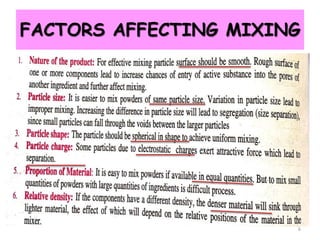
FACTORS AFFECTING MIXING
6
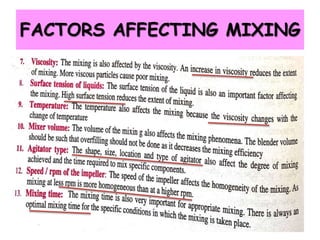
FACTORS AFFECTING MIXING
7
EVALUATION OF DEGREE OF
MIXING
8
TYPES OF MIXING
9
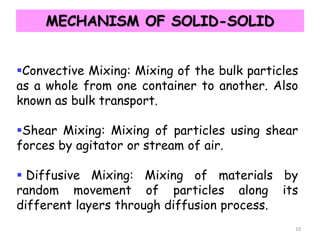
MECHANISM OF SOLID-SOLID
10
Convective Mixing: Mixing of the bulk particles
as a whole from one container to another. Also
known as bulk transport.
Shear Mixing: Mixing of particles using shear
forces by agitator or stream of air.
 Diffusive Mixing: Mixing of materials by
random movement of particles along its
different layers through diffusion process.
MECHANISM OF LIQUID-LIQUID
11
Mixing mechanisms fall essentially into four categories:
1. Bulk Transport – movement of a relatively large portion of material
being mixed from one location in the system to another.
2. Turbulent flow – Characterized by the fluid having different
instantaneous velocities at the same instant of time.
3. Laminar Flow – Streamline flow that is encountered most commonly
in highly viscous liquids.
4. Molecular diffusion – Primary mechanism responsible for mixing at
the molecular level which results from the thermal motion of
molecules. Governed by Fick's fist law of diffusion,
dm/dt = - DA dc/dx
Where,
dm/dt – rate of transport of mass across a surface area
D – Diffusion Co-efficient
A – Area across which diffusion is occurring
dc/dx – Concentration gradient
MECHANISM SEMIISOLID
12
The mechanisms involved in mixing semi solids depend on
the character of the material which may show
considerable variation.
Many semi solids form neutral mixtures having no
tendency to segregate although sedimentation may
occur.
Double cone blender
13
14
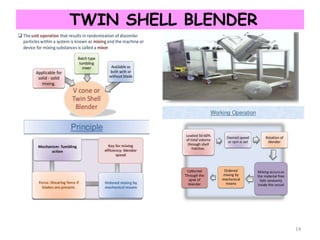
TWIN SHELL BLENDER
15
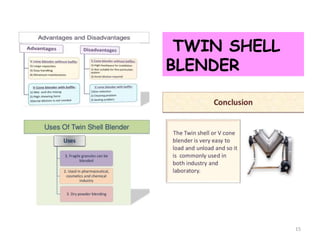
TWIN SHELL
BLENDER
THANK YOU
16

Mixing

  • 1.
  • 2.
  • 3.
    INTRODUCTION 3 • MIXING isdefined as the unit operation that combines two or more components together by agitation, shear or mixers. The final product of mixture contains uniform distribution of both components of mixture.
  • 4.
    OBJECTIVE MIXING 4 oTo obtainuniform composition of the mixed components. o To enhance physical & chemical reaction of mixed components. o To improve dissolution & diffusion of mixture. oMixing critical process quality of final product depends upon the nature of mixing in mixing lead to non- homogeneous product oProper mixing leads to decrease batch cycle time and operational cost oTo increase the dissolution or diffusion rate oTo achieve a physical mixture. o To bring a physical change. oTo achieve a dispersion. oTo promote a chemical reaction.
  • 5.
  • 6.
  • 7.
  • 8.
  • 9.
  • 10.
    MECHANISM OF SOLID-SOLID 10 ConvectiveMixing: Mixing of the bulk particles as a whole from one container to another. Also known as bulk transport. Shear Mixing: Mixing of particles using shear forces by agitator or stream of air.  Diffusive Mixing: Mixing of materials by random movement of particles along its different layers through diffusion process.
  • 11.
    MECHANISM OF LIQUID-LIQUID 11 Mixingmechanisms fall essentially into four categories: 1. Bulk Transport – movement of a relatively large portion of material being mixed from one location in the system to another. 2. Turbulent flow – Characterized by the fluid having different instantaneous velocities at the same instant of time. 3. Laminar Flow – Streamline flow that is encountered most commonly in highly viscous liquids. 4. Molecular diffusion – Primary mechanism responsible for mixing at the molecular level which results from the thermal motion of molecules. Governed by Fick's fist law of diffusion, dm/dt = - DA dc/dx Where, dm/dt – rate of transport of mass across a surface area D – Diffusion Co-efficient A – Area across which diffusion is occurring dc/dx – Concentration gradient
  • 12.
    MECHANISM SEMIISOLID 12 The mechanismsinvolved in mixing semi solids depend on the character of the material which may show considerable variation. Many semi solids form neutral mixtures having no tendency to segregate although sedimentation may occur.
  • 13.
  • 14.
  • 15.
  • 16.