PRE-FORMULATION
Part 1
Dr. Vijay Sharma
Assistant Professor
Content
 Introduction to the Industrial Pharmacy.
 Introduction to Preformulation.
 Goals and objectives (Major area of preformulation
research)
 Study of Physico – Chemical Characteristics of Drug
Substances
BP502T/ Unit-I 29/30/2020
INTRODUCTION
Prior to development of a formulation or dosage form, it is essential
that certain properties of a drug molecule are to be determined.
This information decides many of the subsequent events and
approaches in formulation development.
Preformulation is the phase of research and development in which
the physical and chemical properties of a drug molecule is studied in
order to develop safe, effective and stable dosage form.
Preformulation commences when a newly synthesized drug shows a
sufficient pharmacological promise in animal model to warrant
evaluation in man.
It is the First step in rational development of a dosage form of a drug
substance.
3
3BP502T/ Unit-I9/30/2020
GOALS & OBJECTIVES
To generate information useful to the formulation in developing most
stable and bioavailable dosage form that can be produced.
To Establish necessary physico - chemical parameters of new drug
substance that can affect the drug performance and development of an
efficacious stable and safe dosage form.
Establish physical characteristics.
Establish compatibility with common excipients.
Provide insights into how drug products should beprocessed and
stored to ensure their quality.
To develop an optimal drug delivery system.
4
4BP502T/ Unit-I9/30/2020
BP502T/ Unit-I 5
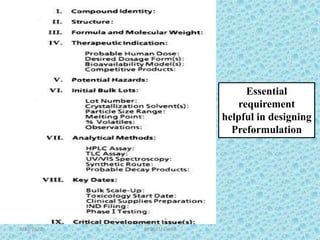
Essential
requirement
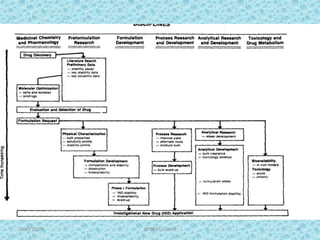
helpful in designing
Preformulation
9/30/2020
BP502T/ Unit-I 69/30/2020
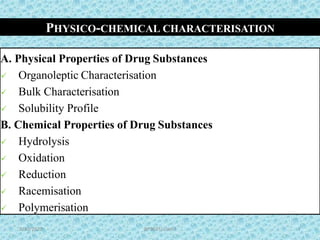
PHYSICO-CHEMICAL CHARACTERISATION
A. Physical Properties of Drug Substances
 Organoleptic Characterisation
 Bulk Characterisation
 Solubility Profile
B. Chemical Properties of Drug Substances
 Hydrolysis
 Oxidation
 Reduction
 Racemisation
 Polymerisation 5
7BP502T/ Unit-I9/30/2020
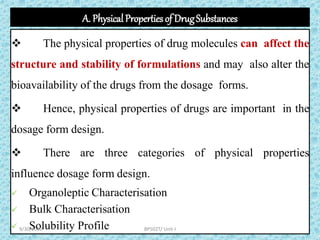
 The physical properties of drug molecules can affect the
structure and stability of formulations and may also alter the
bioavailability of the drugs from the dosage forms.
 Hence, physical properties of drugs are important in the
dosage form design.
 There are three categories of physical properties
influence dosage form design.
 Organoleptic Characterisation
 Bulk Characterisation
 Solubility Profile
6
BP502T/ Unit-I9/30/2020
A. Physical Propertiesof DrugSubstances
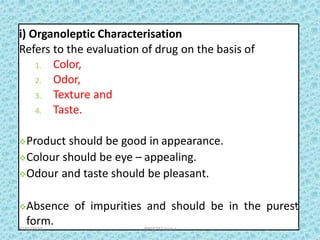
i) Organoleptic Characterisation
Refers to the evaluation of drug on the basis of
1. Color,
2. Odor,
3. Texture and
4. Taste.
Product should be good in appearance.
Colour should be eye – appealing.
Odour and taste should be pleasant.
Absence of impurities and should be in the purest
form.
6
9BP502T/ Unit-I9/30/2020
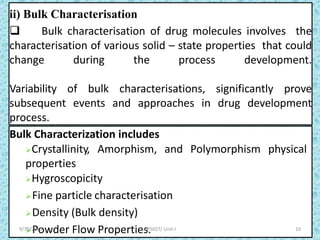
ii) Bulk Characterisation
 Bulk characterisation of drug molecules involves the
characterisation of various solid – state properties that could
change during the process development.
Variability of bulk characterisations, significantly prove
subsequent events and approaches in drug development
process.
Bulk Characterization includes
Crystallinity, Amorphism, and Polymorphism physical
properties
Hygroscopicity
Fine particle characterisation
Density (Bulk density)
Powder Flow Properties.
7
10BP502T/ Unit-I9/30/2020
Crystallinity, Amorphism, and Polymorphism – Physical
properties
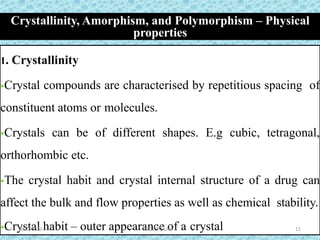
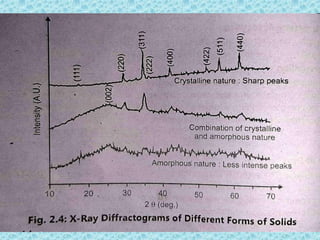
1. Crystallinity
Crystal compounds are characterised by repetitious spacing of
constituent atoms or molecules.
Crystals can be of different shapes. E.g cubic, tetragonal,
orthorhombic etc.
The crystal habit and crystal internal structure of a drug can
affect the bulk and flow properties as well as chemical stability.
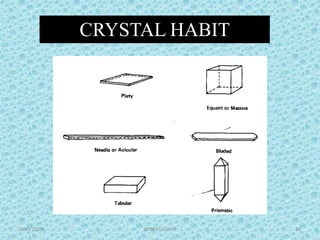
Crystal habit – outer appearance of a crystal
8
11BP502T/ Unit-I9/30/2020
CRYSTAL HABIT
BP502T/ Unit-I 129/30/2020
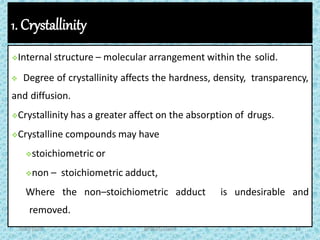
1. Crystallinity
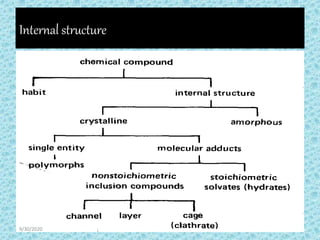
Internal structure – molecular arrangement within the solid.
 Degree of crystallinity affects the hardness, density, transparency,
and diffusion.
Crystallinity has a greater affect on the absorption of drugs.
Crystalline compounds may have
stoichiometric or
non – stoichiometric adduct,
Where the non–stoichiometric adduct is undesirable and
removed.
BP502T/ Unit-I 139/30/2020
Internal structure
BP502T/ Unit-I 149/30/2020
2.Amorphism
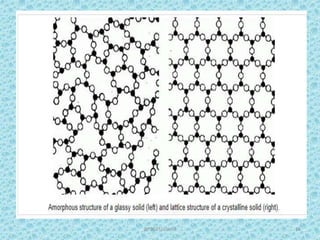
Amorphous compounds are those whose atoms or
molecules are randomly placed.
Internal structure shows a major distinction whether the solid
is crystalline or amorphous.
Some drugs can exist in amorphous state. They are
typically prepared by rapid precipitation, lyophilization.
Such drugs represent highest energy state, or higher
thermodynamic energy than the crystalline state.
Amorphous form are less stable than its crystalline state.
The solubility of amorphous form is greater than its crystalline
state.
Upon storage, amorphous solids tend to revert to more stable
forms. Thermodynamic instability is a major disadvantage for
developing a dosage form.
9
15BP502T/ Unit-I
BP502T/ Unit-I 16
3. PolymorphismWhen a substance exists in more than one crystalline form
– The different forms are designated as Polymorphs and theis
phenomenon is known as Polymorphism.
Polymorphs are of two types
Enantiotropicpolymorphs – is the one which can be reversibly
changed into another form by altering the temperature or pressure.
Monotropic polymorphs – is the one which is unstable at all
temperatures and pressures.
Polymorphs differ from each other respect to their physical
properties like solubility, melting point, density etc.
Depending on the stability on enantiotrops will be more stable than the other.
Such stable forms have lower energy state, high melting point, least aqueous
stability.
Other forms are called metastable forms with the opposite properties.
Determined by Differential Scanning Calorimetry, X –Ray Diffraction
methods.
10
17BP502T/ Unit-I
2.Poly-morphism
BP502T/ Unit-I 18
Pseudo-polymorphs (Hydrate/ Solvates)
BP502T/ Unit-I 19
• Pseudo-polymorphism is also a known
phenomenon in which two compounds exhibit
different crystalline structures, of which one is
the host of solvent molecules.
• A hydrate is a substance that contains water or its
constituent elements.
• The chemical state of the water varies widely
between different classes of hydrates, some of
which were so labeled before their chemical
structure was understood.
References
Reference Books
 Leon Lachman, Liberman. The theory and practice of Industrial
pharmacy, Edn 4. CBS publishing house, New Delhi.2013
p:217-307.
Banker GS, Rhodes CT. Modern pharmaceutics, Edn 4. Marcel
Dekker, New York. 2002 p:167-184.
Loyd V. Allen, Nicholas G.popovich, Howard C. Ansel. Ansel’s
pharmaceutical Dosage forms & Drug delivery systems, Edn 8.
B.I.Publication pvt. Ltd, p:187-193,42 & 43,126-133.
Text Books
Leon Lachman, Liberman. The theory and practice of Industrial
pharmacy, Edn 4. CBS publishing house, New Delhi.2013
p:217-307.
Brahmankar D.M., Jaiswal S.B., First edition, “Absorption of
Drugs” Biopharmaceutics and Pharmacokinetics – A treatise,
Vallabh Prakashan, Delhi 1995.
BP502T/ Unit-I 209/30/2020
BP502T/ Unit-I 21
Thank You
9/30/2020

Preformulation part 1- Preformulation- Crystal, Amorphous, Polymorphism, Pseudo Polymorphism

  • 1.
    PRE-FORMULATION Part 1 Dr. VijaySharma Assistant Professor
  • 2.
    Content  Introduction tothe Industrial Pharmacy.  Introduction to Preformulation.  Goals and objectives (Major area of preformulation research)  Study of Physico – Chemical Characteristics of Drug Substances BP502T/ Unit-I 29/30/2020
  • 3.
    INTRODUCTION Prior to developmentof a formulation or dosage form, it is essential that certain properties of a drug molecule are to be determined. This information decides many of the subsequent events and approaches in formulation development. Preformulation is the phase of research and development in which the physical and chemical properties of a drug molecule is studied in order to develop safe, effective and stable dosage form. Preformulation commences when a newly synthesized drug shows a sufficient pharmacological promise in animal model to warrant evaluation in man. It is the First step in rational development of a dosage form of a drug substance. 3 3BP502T/ Unit-I9/30/2020
  • 4.
    GOALS & OBJECTIVES Togenerate information useful to the formulation in developing most stable and bioavailable dosage form that can be produced. To Establish necessary physico - chemical parameters of new drug substance that can affect the drug performance and development of an efficacious stable and safe dosage form. Establish physical characteristics. Establish compatibility with common excipients. Provide insights into how drug products should beprocessed and stored to ensure their quality. To develop an optimal drug delivery system. 4 4BP502T/ Unit-I9/30/2020
  • 5.
    BP502T/ Unit-I 5 Essential requirement helpfulin designing Preformulation 9/30/2020
  • 6.
  • 7.
    PHYSICO-CHEMICAL CHARACTERISATION A. PhysicalProperties of Drug Substances  Organoleptic Characterisation  Bulk Characterisation  Solubility Profile B. Chemical Properties of Drug Substances  Hydrolysis  Oxidation  Reduction  Racemisation  Polymerisation 5 7BP502T/ Unit-I9/30/2020
  • 8.
     The physicalproperties of drug molecules can affect the structure and stability of formulations and may also alter the bioavailability of the drugs from the dosage forms.  Hence, physical properties of drugs are important in the dosage form design.  There are three categories of physical properties influence dosage form design.  Organoleptic Characterisation  Bulk Characterisation  Solubility Profile 6 BP502T/ Unit-I9/30/2020 A. Physical Propertiesof DrugSubstances
  • 9.
    i) Organoleptic Characterisation Refersto the evaluation of drug on the basis of 1. Color, 2. Odor, 3. Texture and 4. Taste. Product should be good in appearance. Colour should be eye – appealing. Odour and taste should be pleasant. Absence of impurities and should be in the purest form. 6 9BP502T/ Unit-I9/30/2020
  • 10.
    ii) Bulk Characterisation Bulk characterisation of drug molecules involves the characterisation of various solid – state properties that could change during the process development. Variability of bulk characterisations, significantly prove subsequent events and approaches in drug development process. Bulk Characterization includes Crystallinity, Amorphism, and Polymorphism physical properties Hygroscopicity Fine particle characterisation Density (Bulk density) Powder Flow Properties. 7 10BP502T/ Unit-I9/30/2020
  • 11.
    Crystallinity, Amorphism, andPolymorphism – Physical properties 1. Crystallinity Crystal compounds are characterised by repetitious spacing of constituent atoms or molecules. Crystals can be of different shapes. E.g cubic, tetragonal, orthorhombic etc. The crystal habit and crystal internal structure of a drug can affect the bulk and flow properties as well as chemical stability. Crystal habit – outer appearance of a crystal 8 11BP502T/ Unit-I9/30/2020
  • 12.
  • 13.
    1. Crystallinity Internal structure– molecular arrangement within the solid.  Degree of crystallinity affects the hardness, density, transparency, and diffusion. Crystallinity has a greater affect on the absorption of drugs. Crystalline compounds may have stoichiometric or non – stoichiometric adduct, Where the non–stoichiometric adduct is undesirable and removed. BP502T/ Unit-I 139/30/2020
  • 14.
  • 15.
    2.Amorphism Amorphous compounds arethose whose atoms or molecules are randomly placed. Internal structure shows a major distinction whether the solid is crystalline or amorphous. Some drugs can exist in amorphous state. They are typically prepared by rapid precipitation, lyophilization. Such drugs represent highest energy state, or higher thermodynamic energy than the crystalline state. Amorphous form are less stable than its crystalline state. The solubility of amorphous form is greater than its crystalline state. Upon storage, amorphous solids tend to revert to more stable forms. Thermodynamic instability is a major disadvantage for developing a dosage form. 9 15BP502T/ Unit-I
  • 16.
  • 17.
    3. PolymorphismWhen asubstance exists in more than one crystalline form – The different forms are designated as Polymorphs and theis phenomenon is known as Polymorphism. Polymorphs are of two types Enantiotropicpolymorphs – is the one which can be reversibly changed into another form by altering the temperature or pressure. Monotropic polymorphs – is the one which is unstable at all temperatures and pressures. Polymorphs differ from each other respect to their physical properties like solubility, melting point, density etc. Depending on the stability on enantiotrops will be more stable than the other. Such stable forms have lower energy state, high melting point, least aqueous stability. Other forms are called metastable forms with the opposite properties. Determined by Differential Scanning Calorimetry, X –Ray Diffraction methods. 10 17BP502T/ Unit-I 2.Poly-morphism
  • 18.
  • 19.
    Pseudo-polymorphs (Hydrate/ Solvates) BP502T/Unit-I 19 • Pseudo-polymorphism is also a known phenomenon in which two compounds exhibit different crystalline structures, of which one is the host of solvent molecules. • A hydrate is a substance that contains water or its constituent elements. • The chemical state of the water varies widely between different classes of hydrates, some of which were so labeled before their chemical structure was understood.
  • 20.
    References Reference Books  LeonLachman, Liberman. The theory and practice of Industrial pharmacy, Edn 4. CBS publishing house, New Delhi.2013 p:217-307. Banker GS, Rhodes CT. Modern pharmaceutics, Edn 4. Marcel Dekker, New York. 2002 p:167-184. Loyd V. Allen, Nicholas G.popovich, Howard C. Ansel. Ansel’s pharmaceutical Dosage forms & Drug delivery systems, Edn 8. B.I.Publication pvt. Ltd, p:187-193,42 & 43,126-133. Text Books Leon Lachman, Liberman. The theory and practice of Industrial pharmacy, Edn 4. CBS publishing house, New Delhi.2013 p:217-307. Brahmankar D.M., Jaiswal S.B., First edition, “Absorption of Drugs” Biopharmaceutics and Pharmacokinetics – A treatise, Vallabh Prakashan, Delhi 1995. BP502T/ Unit-I 209/30/2020
  • 21.