Polymorphism


       Poly → many

Morph → shapes (“behaviors”)


        Copyright 2008 -- Walter Wesley   1
Advanced Polymorphism
•   You should already have a basic
    understanding of polymorphism.
•   But do you really understand how
    polymorphism works?
•   How does the compiler actually implement
    polymorphism?


                 Copyright 2008 -- Walter Wesley   2
Polymorphism in C++
•   Suppose you have a C++ class. It has a
    few methods, and some instance variables
    (fields).
•   In your program, you instantiate an object
    and you get and display the size in bytes of
    the object (C++ has a sizeof operator that
    provides the size of its operand).
•   You record the number of bytes.
                  Copyright 2008 -- Walter Wesley   3
•   You now change your class by placing the
Polymorphism in C++
               (continued)

•   Even though all you did was introduce the “virtual”
    keyword (in C++ the virtual keyword is used to
    specify that you want that method to behave
    polymorphically), your object has increased in size by
    4 bytes.
•   It is as if a pointer has been added to your object (4
    bytes is exactly the size of a pointer instance
    variable).
                      Copyright 2008 -- Walter Wesley        4
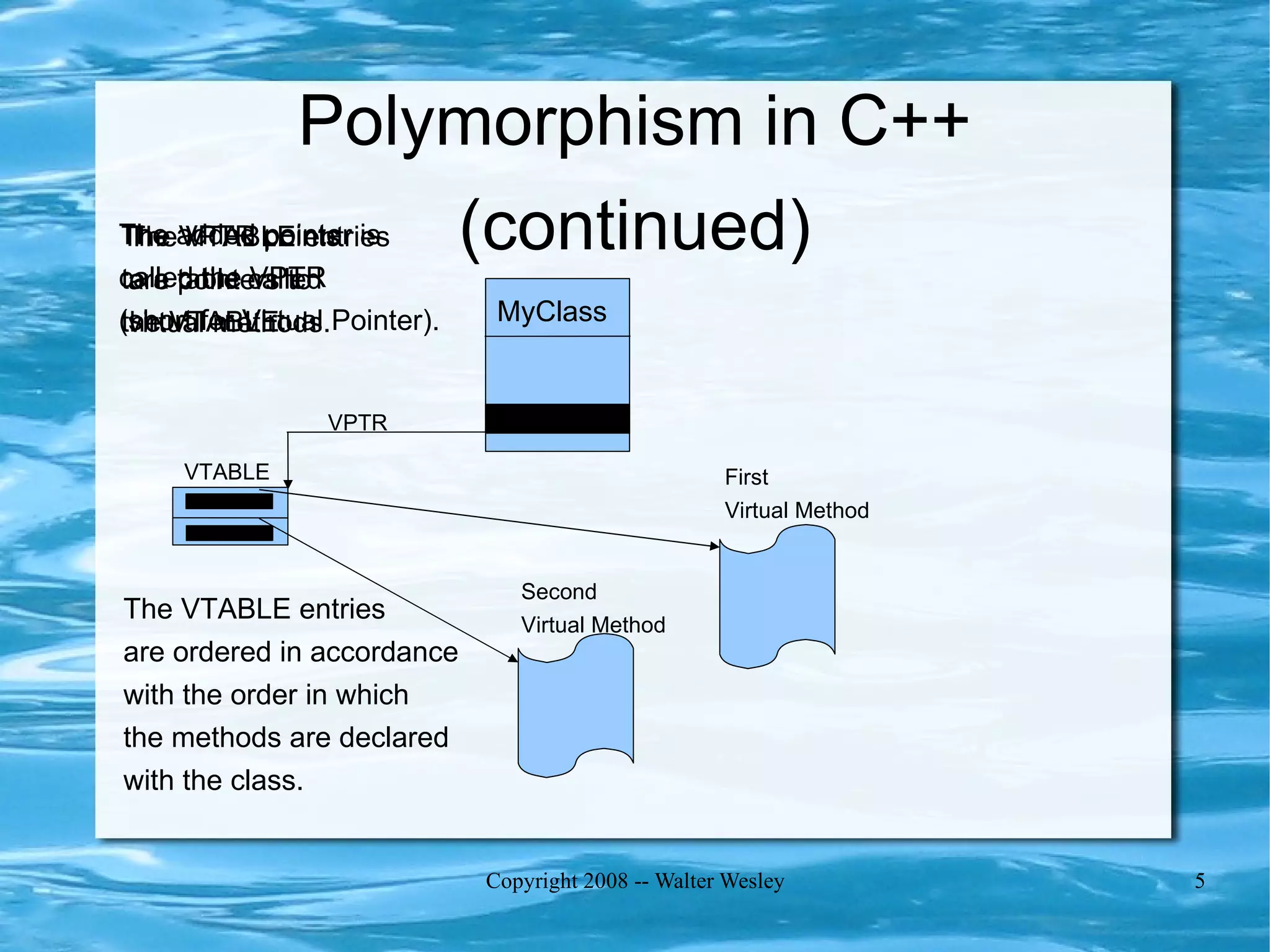
•   In fact, this is exactly what has occurred.
Polymorphism in C++
The added points is
 The VPTR pointer
     VTABLE entries (continued)
called the called
to a table VPTR
 are pointers to
(short for Virtual Pointer).
the VTABLE
 virtual methods.               MyClass


                  VPTR

     VTABLE                                            First
                                                       Virtual Method


                                  Second
The VTABLE entries                Virtual Method
are ordered in accordance
with the order in which
the methods are declared
with the class.


                               Copyright 2008 -- Walter Wesley          5
Polymorphism in Java
•   Polymorphism in Java is implemented in
    exactly the same way as in C++ (except for
    some minor differences).
•   One difference between the two languages
    is that the virtual keyword is not a part of
    Java. This is because in Java all methods
    are potentially virtual, and the virtual
    keyword is therefore unnecessary.
                  Copyright 2008 -- Walter Wesley   6

•   The technique of using a pointer (VPTR) to
How to Draw Polymorphically
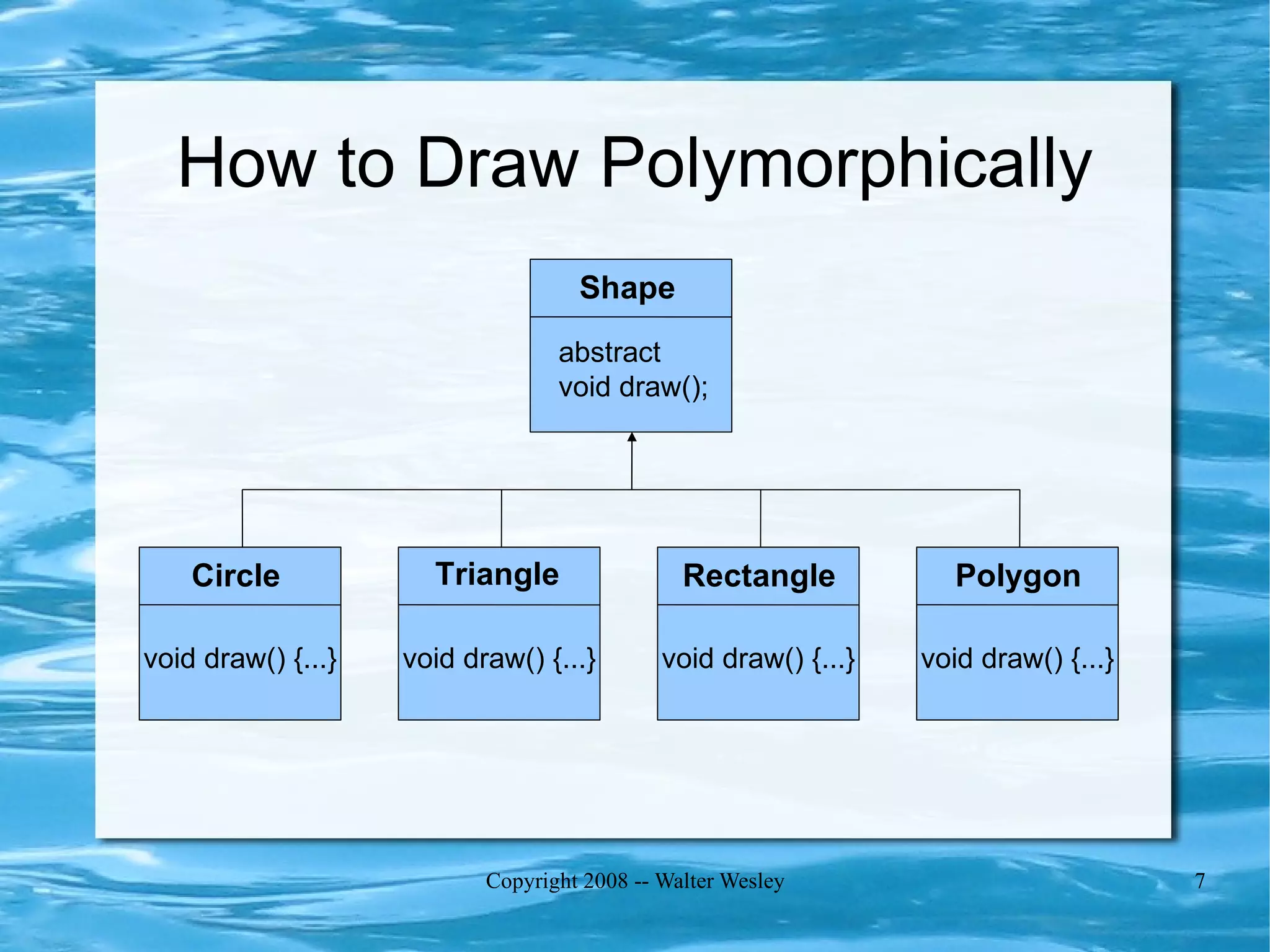
                                    Shape
                                  abstract
                                  void draw();


    Circle            Triangle                 Rectangle            Polygon

void draw() {...}   void draw() {...}        void draw() {...}   void draw() {...}


                           Copyright 2008 -- Walter Wesley                           7
How to Draw Polymorphically
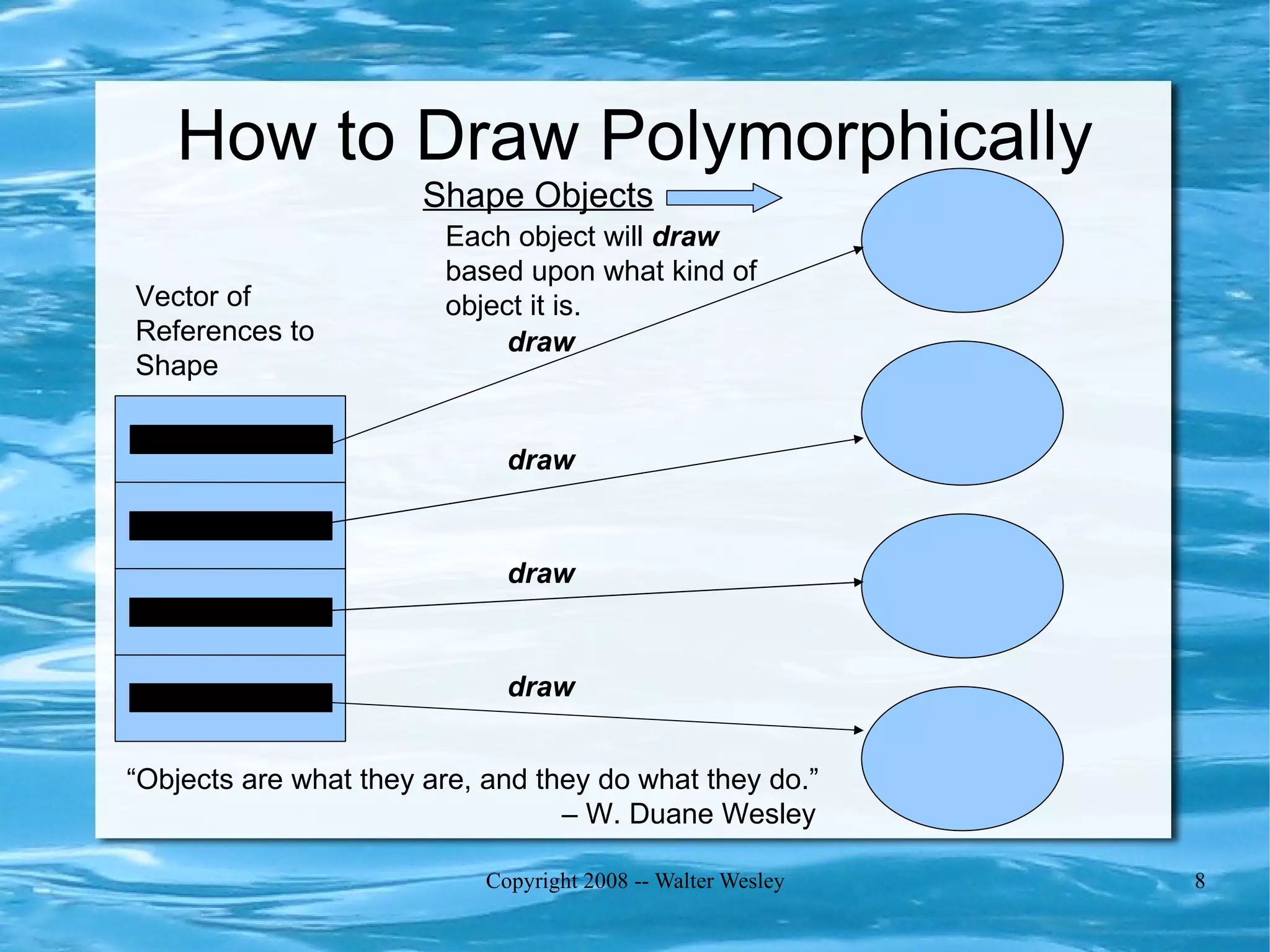
                       Shape Objects
                        Each object will draw
                        based upon what kind of
Vector of               object it is.
References to                draw
Shape


                              draw


                              draw


                              draw


“Objects are what they are, and they do what they do.”
                                  – W. Duane Wesley

                            Copyright 2008 -- Walter Wesley   8

Polymorphism

  • 1.
    Polymorphism Poly → many Morph → shapes (“behaviors”) Copyright 2008 -- Walter Wesley 1
  • 2.
    Advanced Polymorphism • You should already have a basic understanding of polymorphism. • But do you really understand how polymorphism works? • How does the compiler actually implement polymorphism? Copyright 2008 -- Walter Wesley 2
  • 3.
    Polymorphism in C++ • Suppose you have a C++ class. It has a few methods, and some instance variables (fields). • In your program, you instantiate an object and you get and display the size in bytes of the object (C++ has a sizeof operator that provides the size of its operand). • You record the number of bytes. Copyright 2008 -- Walter Wesley 3 • You now change your class by placing the
  • 4.
    Polymorphism in C++ (continued) • Even though all you did was introduce the “virtual” keyword (in C++ the virtual keyword is used to specify that you want that method to behave polymorphically), your object has increased in size by 4 bytes. • It is as if a pointer has been added to your object (4 bytes is exactly the size of a pointer instance variable). Copyright 2008 -- Walter Wesley 4 • In fact, this is exactly what has occurred.
  • 5.
    Polymorphism in C++ Theadded points is The VPTR pointer VTABLE entries (continued) called the called to a table VPTR are pointers to (short for Virtual Pointer). the VTABLE virtual methods. MyClass VPTR VTABLE First Virtual Method Second The VTABLE entries Virtual Method are ordered in accordance with the order in which the methods are declared with the class. Copyright 2008 -- Walter Wesley 5
  • 6.
    Polymorphism in Java • Polymorphism in Java is implemented in exactly the same way as in C++ (except for some minor differences). • One difference between the two languages is that the virtual keyword is not a part of Java. This is because in Java all methods are potentially virtual, and the virtual keyword is therefore unnecessary. Copyright 2008 -- Walter Wesley 6 • The technique of using a pointer (VPTR) to
  • 7.
    How to DrawPolymorphically Shape abstract void draw(); Circle Triangle Rectangle Polygon void draw() {...} void draw() {...} void draw() {...} void draw() {...} Copyright 2008 -- Walter Wesley 7
  • 8.
    How to DrawPolymorphically Shape Objects Each object will draw based upon what kind of Vector of object it is. References to draw Shape draw draw draw “Objects are what they are, and they do what they do.” – W. Duane Wesley Copyright 2008 -- Walter Wesley 8