Learning:
•Learning refers to the acquisition or internalization of
knowledge, skills, behaviors, or information over time.
•It is a relatively permanent change in an individual's knowledge
or behavior as a result of experiences, practice, or study.
•Learning is not always immediately observable or measurable, as
it can involve cognitive processes, memory consolidation, and
skill development that may not be immediately apparent in one's
performance.
•Learning can occur through various means, including formal
education, personal experiences, observation, and
5.3.1 Distinguish between learning and performance
Learning and performance are two related but distinct concepts in the context of
psychology and education. They are often used to describe different aspects of
acquiring and demonstrating knowledge or skills. Here’s a distinction between the
two:
PERFORMANCE:
Performance refers to the actual demonstration
or execution of knowledge, skills, behaviors, or
actions in a specific context or situation.
It is the observable and measurable output or
behavior that can be assessed or evaluated.
Performance can vary based on various factors,
including the individual's level of learning,
motivation, external conditions, and stress
levels.
Performance may not always reflect an
individual's true level of learning, as factors
such as anxiety, pressure, or distractions can
affect how well one performs in a given
5.3.2 DESCRIBE THE PHASES (STAGES)
OF LEARNING.
Phases of learning are often associated with skill acquisition and are commonly
referred to as the stages of skill development. These stages are frequently used to
describe how individuals progress as they learn and master new skills or tasks.
Cognitive/Verbal (Early Phase):
 In this initial stage, learners are primarily focused on understanding the
theoretical or conceptual aspects of the skill or task. They may rely
heavily on verbal instructions, demonstrations, and cognitive
processing.
 Key characteristics include a high level of conscious thought, frequent
errors, and a lack of fluidity or automaticity in performing the skill.
 Learners often require clear and detailed explanations, step-by-step
guidance, and feedback to build a foundational understanding of the
skill.
5.3.2 DESCRIBE THE PHASES (STAGES)
OF LEARNING.
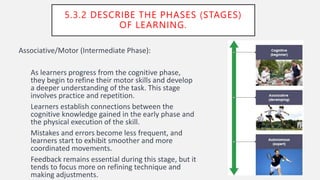
Associative/Motor (Intermediate Phase):
As learners progress from the cognitive phase,
they begin to refine their motor skills and develop
a deeper understanding of the task. This stage
involves practice and repetition.
Learners establish connections between the
cognitive knowledge gained in the early phase and
the physical execution of the skill.
Mistakes and errors become less frequent, and
learners start to exhibit smoother and more
coordinated movements.
Feedback remains essential during this stage, but it
tends to focus more on refining technique and
making adjustments.
5.3.2 DESCRIBE THE PHASES (STAGES)
OF LEARNING.
1.Autonomous (Final Phase):
1. In the autonomous phase, learners have achieved a high level of proficiency and can
perform the skill almost automatically, with minimal conscious thought or effort.
2. Actions become highly efficient, and movements are fluid and precise.
3. Learners can adapt to varying conditions or contexts without significant difficulty.
4. Feedback may still be beneficial for continued improvement, but it is less crucial than
in earlier stages.
5. This stage often represents mastery, where individuals can perform the skill
consistently and effectively.
5.3.2 DESCRIBE THE PHASES (STAGES)
OF LEARNING.
It's important to note that not all skills progress through these stages at the same rate, and
individuals may move through them at different speeds depending on factors like their prior
experience, motivation, and the complexity of the skill. Additionally, some skills may never reach
the autonomous phase, especially if they are rarely practiced or not relevant to a person's daily
life.
These stages of learning serve as a framework to understand the journey of skill development,
helping educators and learners alike tailor their approaches and expectations based on the current
stage of learning.
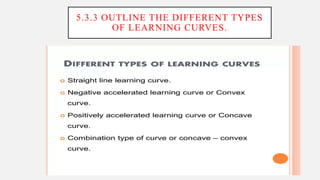
5.3.3 OUTLINE THE DIFFERENT TYPES
OF LEARNING CURVES.
5.3.3 OUTLINE THE DIFFERENT TYPES
OF LEARNING CURVES.
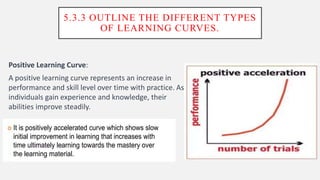
Positive Learning Curve:
A positive learning curve represents an increase in
performance and skill level over time with practice. As
individuals gain experience and knowledge, their
abilities improve steadily.
Negative Learning Curve:
A negative learning curve represents a decrease in
performance initially as individuals start learning a new
skill or activity. This may be due to the initial challenges
and difficulties faced when trying something new.
However, with continued effort and learning,
performance eventually improves.
5.3.3 OUTLINE THE DIFFERENT TYPES
OF LEARNING CURVES.
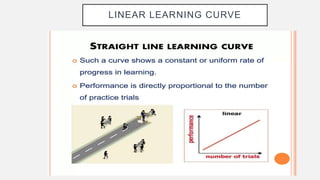
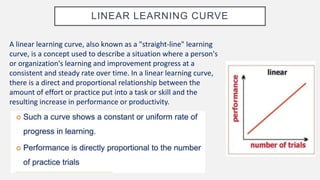
LINEAR LEARNING CURVE
A linear learning curve, also known as a "straight-line" learning
curve, is a concept used to describe a situation where a person's
or organization's learning and improvement progress at a
consistent and steady rate over time. In a linear learning curve,
there is a direct and proportional relationship between the
amount of effort or practice put into a task or skill and the
resulting increase in performance or productivity.
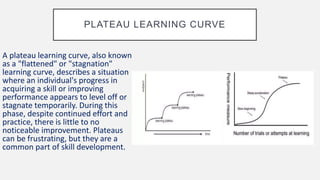
PLATEAU LEARNING CURVE
A plateau learning curve, also known
as a "flattened" or "stagnation"
learning curve, describes a situation
where an individual's progress in
acquiring a skill or improving
performance appears to level off or
stagnate temporarily. During this
phase, despite continued effort and
practice, there is little to no
noticeable improvement. Plateaus
can be frustrating, but they are a
common part of skill development.
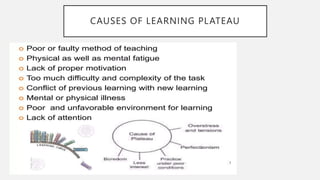
CAUSES OF LEARNING PLATEAU
5.3.4 DISCUSS FACTORS THAT CONTRIBUTE TO THE
DIFFERENT RATES OF LEARNING.
physical maturation
physical fitness
individual differences of
coaches
age
difficulty of task
teaching environment
motivation.
Learning curve.pptx
Learning curve.pptx

Learning curve.pptx

  • 1.
    Learning: •Learning refers tothe acquisition or internalization of knowledge, skills, behaviors, or information over time. •It is a relatively permanent change in an individual's knowledge or behavior as a result of experiences, practice, or study. •Learning is not always immediately observable or measurable, as it can involve cognitive processes, memory consolidation, and skill development that may not be immediately apparent in one's performance. •Learning can occur through various means, including formal education, personal experiences, observation, and 5.3.1 Distinguish between learning and performance Learning and performance are two related but distinct concepts in the context of psychology and education. They are often used to describe different aspects of acquiring and demonstrating knowledge or skills. Here’s a distinction between the two:
  • 2.
    PERFORMANCE: Performance refers tothe actual demonstration or execution of knowledge, skills, behaviors, or actions in a specific context or situation. It is the observable and measurable output or behavior that can be assessed or evaluated. Performance can vary based on various factors, including the individual's level of learning, motivation, external conditions, and stress levels. Performance may not always reflect an individual's true level of learning, as factors such as anxiety, pressure, or distractions can affect how well one performs in a given
  • 3.
    5.3.2 DESCRIBE THEPHASES (STAGES) OF LEARNING. Phases of learning are often associated with skill acquisition and are commonly referred to as the stages of skill development. These stages are frequently used to describe how individuals progress as they learn and master new skills or tasks. Cognitive/Verbal (Early Phase):  In this initial stage, learners are primarily focused on understanding the theoretical or conceptual aspects of the skill or task. They may rely heavily on verbal instructions, demonstrations, and cognitive processing.  Key characteristics include a high level of conscious thought, frequent errors, and a lack of fluidity or automaticity in performing the skill.  Learners often require clear and detailed explanations, step-by-step guidance, and feedback to build a foundational understanding of the skill.
  • 4.
    5.3.2 DESCRIBE THEPHASES (STAGES) OF LEARNING. Associative/Motor (Intermediate Phase): As learners progress from the cognitive phase, they begin to refine their motor skills and develop a deeper understanding of the task. This stage involves practice and repetition. Learners establish connections between the cognitive knowledge gained in the early phase and the physical execution of the skill. Mistakes and errors become less frequent, and learners start to exhibit smoother and more coordinated movements. Feedback remains essential during this stage, but it tends to focus more on refining technique and making adjustments.
  • 5.
    5.3.2 DESCRIBE THEPHASES (STAGES) OF LEARNING. 1.Autonomous (Final Phase): 1. In the autonomous phase, learners have achieved a high level of proficiency and can perform the skill almost automatically, with minimal conscious thought or effort. 2. Actions become highly efficient, and movements are fluid and precise. 3. Learners can adapt to varying conditions or contexts without significant difficulty. 4. Feedback may still be beneficial for continued improvement, but it is less crucial than in earlier stages. 5. This stage often represents mastery, where individuals can perform the skill consistently and effectively.
  • 6.
    5.3.2 DESCRIBE THEPHASES (STAGES) OF LEARNING. It's important to note that not all skills progress through these stages at the same rate, and individuals may move through them at different speeds depending on factors like their prior experience, motivation, and the complexity of the skill. Additionally, some skills may never reach the autonomous phase, especially if they are rarely practiced or not relevant to a person's daily life. These stages of learning serve as a framework to understand the journey of skill development, helping educators and learners alike tailor their approaches and expectations based on the current stage of learning.
  • 7.
    5.3.3 OUTLINE THEDIFFERENT TYPES OF LEARNING CURVES.
  • 8.
    5.3.3 OUTLINE THEDIFFERENT TYPES OF LEARNING CURVES. Positive Learning Curve: A positive learning curve represents an increase in performance and skill level over time with practice. As individuals gain experience and knowledge, their abilities improve steadily.
  • 9.
    Negative Learning Curve: Anegative learning curve represents a decrease in performance initially as individuals start learning a new skill or activity. This may be due to the initial challenges and difficulties faced when trying something new. However, with continued effort and learning, performance eventually improves. 5.3.3 OUTLINE THE DIFFERENT TYPES OF LEARNING CURVES.
  • 10.
  • 11.
    LINEAR LEARNING CURVE Alinear learning curve, also known as a "straight-line" learning curve, is a concept used to describe a situation where a person's or organization's learning and improvement progress at a consistent and steady rate over time. In a linear learning curve, there is a direct and proportional relationship between the amount of effort or practice put into a task or skill and the resulting increase in performance or productivity.
  • 12.
    PLATEAU LEARNING CURVE Aplateau learning curve, also known as a "flattened" or "stagnation" learning curve, describes a situation where an individual's progress in acquiring a skill or improving performance appears to level off or stagnate temporarily. During this phase, despite continued effort and practice, there is little to no noticeable improvement. Plateaus can be frustrating, but they are a common part of skill development.
  • 13.
  • 14.
    5.3.4 DISCUSS FACTORSTHAT CONTRIBUTE TO THE DIFFERENT RATES OF LEARNING. physical maturation physical fitness individual differences of coaches age difficulty of task teaching environment motivation.