Learning Curves
Dr. Manju N. D
Assistant Professor
SVK National College of Education,
Kuvempu University, Shimoga
Learning Curves
• Learning process is not always similar.
• There is more progress in sometimes, sometimes
less and sometime absolutely nil.
• So, we cannot find out the rate of learning. But,
psychologists have attempted to measure the
progress in learning.
• They described the progress in learning by
drawing a line on the graph paper.
• This line is curve, and not straight. So, it is called
Learning curve.
• Learning curve is the representation in graph
form of the rate of learning something over
time or repeated experiences.
• Learning curves are a visualization of the
difficulty estimated in learning a subject over a
period of time as well as relative progress
throughout the process of learning. The learning
curve provides a way to show a subject’s
learnability.
• The first person to described and created the
concept of learning curve was created by
German psychologist Hermann Ebbinghaus in
1885 and introduced in his book Über das
Gedächtnis (About Memory).
• According to Skinner, a learning curve is a
progress representation of person’s
improvement or lack of improvement in a given
activity.
• Raimers et.al defined the learning curve as a
method of partial learning of a given activity.
• A learning curve is a graphical representation of
how learning takes place in a particular situation
– S.K.Mangal.
• Learning curve refers to the graphical
relationship between the amount of learning
and the time it takes to learn.
• Learning curves are used by psychologists,
students, teachers, employees and employers
to plot progress and set expectations on how
much time, training and study might be
required to attain competent knowledge of a
subject.
Scales of Learning Curve
• In the learning curve there are two scales:
horizontal and vertical.
• The horizontal scale is called x-axis and the
vertical scale is called y-axis. For drawing the
learning graphs we divided the horizontal scale
(x-axis) into units of time or the numbers of
trials required for learning and
• the vertical scale (y-axis) into units of
achievement, material studied or problem
solved, etc.
STAGES
Normally learning curve comprises of four stages.
• Initial stage- It is also called lag phase. In lag phase the
learning is merely zero for first few practices.
• Steep up stage- This is the second stage. It is also called
log or exponential phase. In this stage the learning is
suddenly increased and rate of improvement is
substantial.
• Intermediate stage- It is also called Stationary Phase.
Now, there is no progress in learning or improvement is
arrested. So, it is called Plateau.
• Skinner says ‘a plateau is a horizontal stretch indicative
of apparent progress’. It places an important role in
learning process because when such a stage is reached,
a learning curve becomes almost flat.
Reasons for plateau in learning-
• Poor or faulty method of learning.
• Physical and mental fatigue or boredom
• Too much difficulty or complexity of the learning
material
• Lack of proper motivation and loss of interest of the
learner
• Poor and unfavorable environment
• Distraction and inattention of the learner
• Satisfaction of the learner with moderate
achievement
• Final stage- This is the final stage. Here the learner
has reach the maximum limit of the improvement.
Types of Learning Curves:
• Learning is a complex process governed by so
many internals as well as external factors.
• Consequently we find a number of learning
curves depending upon the nature of the learner,
the nature of the task or the learning material
and the time available as well as the conditions
under which the learning takes place.
• It is difficult to classify these curves into some
definite types.
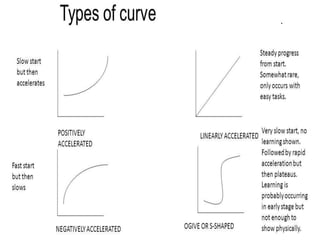
• The following three common types shown in the
diagram
1. Positively accelerated learning curve or
concave curve:
• Concave shaped curve is called a positively
accelerated learning curve or simply a concave
curve.
• It depicts slow initial improvement in learning that
increases with time leading towards the mastery of
learning materials.
• At the initial the rate of progress may be slower, but
at the final the learning rate increases noticeably.
• This learning curve is often occurring in the learning
situation.
• Here the task may be new one or difficult one to
the student at the beginning. But with the
increasing practice he is mastery over that at the
end.
2. Negatively accelerated learning curve or
convex curve:
• Convex shaped is called a negatively accelerated
learning curve or simply as a convex curve.
• It depicts rapid initial improvement in learning
that decreases with time.
• At the initial the rate of progress maybe faster,
but at the final the learning rate slows down
noticeably.
• This learning curve is occurring in the learning
situations where the task is simple or learner has
had previous practice on a similar task.
3. Combination type of curve or concave or
concave-convex curve:
• The third curve involves the combination of the
first two concave and convex curves, is known as
Concave-Convex Curve.
• It looks like an English letter ‘S’.
• So called S-shaped curve.
• In the beginning this is depending upon the
nature of the learner, learning material and the
learning environment.
• It is normally obtained where the situation the
learner study the entire learning from zero
performance to its mastery.
Characteristics of learning curve
• There is an initial improvement whether it is slow or
rapid.
• No stage learning progress is uniform. There are
various ups and downs (spurts) in the learning curve
even a general acceleration is recorded.
• In between the beginning and end of the learning
curve, there is no improvement in learning is called
plateau (flat or stationary stage).
• At the final stage in the learning curve, we can find
whether there is any little learning or no learning
takes place.
• After reaching the stationary stage or plateau the
learning curve again shows some improvement with
spurts.
Educational implications
• The teacher should keep in his mind the individual
differences of the learners.
• The teacher has to choose or use proper method of
teaching and techniques and environment by the
guidance of the learning curves of his students.
• The students may acquaint with their own progress
in learning. It can give them the opportunity of self-
appraisal.
• The unusual spurt reveals about the fatigue, poor
motivation, poor method of teaching and other
personality characters of the learner. The teacher
can make use of his knowledge in studying the
behaviour of the student and eliminate the plateau.
How do you eliminate plateau ?
• Efficient methods creating interest, making
aware of the goals, moving simple to complex,
providing motivation, minimizing the
distraction factors are used to eliminate the
plateau.

2. learning curves

  • 1.
    Learning Curves Dr. ManjuN. D Assistant Professor SVK National College of Education, Kuvempu University, Shimoga
  • 2.
    Learning Curves • Learningprocess is not always similar. • There is more progress in sometimes, sometimes less and sometime absolutely nil. • So, we cannot find out the rate of learning. But, psychologists have attempted to measure the progress in learning. • They described the progress in learning by drawing a line on the graph paper. • This line is curve, and not straight. So, it is called Learning curve.
  • 3.
    • Learning curveis the representation in graph form of the rate of learning something over time or repeated experiences. • Learning curves are a visualization of the difficulty estimated in learning a subject over a period of time as well as relative progress throughout the process of learning. The learning curve provides a way to show a subject’s learnability.
  • 4.
    • The firstperson to described and created the concept of learning curve was created by German psychologist Hermann Ebbinghaus in 1885 and introduced in his book Über das Gedächtnis (About Memory).
  • 5.
    • According toSkinner, a learning curve is a progress representation of person’s improvement or lack of improvement in a given activity. • Raimers et.al defined the learning curve as a method of partial learning of a given activity. • A learning curve is a graphical representation of how learning takes place in a particular situation – S.K.Mangal. • Learning curve refers to the graphical relationship between the amount of learning and the time it takes to learn.
  • 6.
    • Learning curvesare used by psychologists, students, teachers, employees and employers to plot progress and set expectations on how much time, training and study might be required to attain competent knowledge of a subject.
  • 7.
    Scales of LearningCurve • In the learning curve there are two scales: horizontal and vertical. • The horizontal scale is called x-axis and the vertical scale is called y-axis. For drawing the learning graphs we divided the horizontal scale (x-axis) into units of time or the numbers of trials required for learning and • the vertical scale (y-axis) into units of achievement, material studied or problem solved, etc.
  • 8.
    STAGES Normally learning curvecomprises of four stages. • Initial stage- It is also called lag phase. In lag phase the learning is merely zero for first few practices. • Steep up stage- This is the second stage. It is also called log or exponential phase. In this stage the learning is suddenly increased and rate of improvement is substantial. • Intermediate stage- It is also called Stationary Phase. Now, there is no progress in learning or improvement is arrested. So, it is called Plateau. • Skinner says ‘a plateau is a horizontal stretch indicative of apparent progress’. It places an important role in learning process because when such a stage is reached, a learning curve becomes almost flat.
  • 9.
    Reasons for plateauin learning- • Poor or faulty method of learning. • Physical and mental fatigue or boredom • Too much difficulty or complexity of the learning material • Lack of proper motivation and loss of interest of the learner • Poor and unfavorable environment • Distraction and inattention of the learner • Satisfaction of the learner with moderate achievement • Final stage- This is the final stage. Here the learner has reach the maximum limit of the improvement.
  • 10.
    Types of LearningCurves: • Learning is a complex process governed by so many internals as well as external factors. • Consequently we find a number of learning curves depending upon the nature of the learner, the nature of the task or the learning material and the time available as well as the conditions under which the learning takes place. • It is difficult to classify these curves into some definite types. • The following three common types shown in the diagram
  • 11.
    1. Positively acceleratedlearning curve or concave curve: • Concave shaped curve is called a positively accelerated learning curve or simply a concave curve. • It depicts slow initial improvement in learning that increases with time leading towards the mastery of learning materials. • At the initial the rate of progress may be slower, but at the final the learning rate increases noticeably. • This learning curve is often occurring in the learning situation. • Here the task may be new one or difficult one to the student at the beginning. But with the increasing practice he is mastery over that at the end.
  • 12.
    2. Negatively acceleratedlearning curve or convex curve: • Convex shaped is called a negatively accelerated learning curve or simply as a convex curve. • It depicts rapid initial improvement in learning that decreases with time. • At the initial the rate of progress maybe faster, but at the final the learning rate slows down noticeably. • This learning curve is occurring in the learning situations where the task is simple or learner has had previous practice on a similar task.
  • 13.
    3. Combination typeof curve or concave or concave-convex curve: • The third curve involves the combination of the first two concave and convex curves, is known as Concave-Convex Curve. • It looks like an English letter ‘S’. • So called S-shaped curve. • In the beginning this is depending upon the nature of the learner, learning material and the learning environment. • It is normally obtained where the situation the learner study the entire learning from zero performance to its mastery.
  • 15.
    Characteristics of learningcurve • There is an initial improvement whether it is slow or rapid. • No stage learning progress is uniform. There are various ups and downs (spurts) in the learning curve even a general acceleration is recorded. • In between the beginning and end of the learning curve, there is no improvement in learning is called plateau (flat or stationary stage). • At the final stage in the learning curve, we can find whether there is any little learning or no learning takes place. • After reaching the stationary stage or plateau the learning curve again shows some improvement with spurts.
  • 16.
    Educational implications • Theteacher should keep in his mind the individual differences of the learners. • The teacher has to choose or use proper method of teaching and techniques and environment by the guidance of the learning curves of his students. • The students may acquaint with their own progress in learning. It can give them the opportunity of self- appraisal. • The unusual spurt reveals about the fatigue, poor motivation, poor method of teaching and other personality characters of the learner. The teacher can make use of his knowledge in studying the behaviour of the student and eliminate the plateau.
  • 17.
    How do youeliminate plateau ? • Efficient methods creating interest, making aware of the goals, moving simple to complex, providing motivation, minimizing the distraction factors are used to eliminate the plateau.