Technical Note 4 Learning Curves
Underlying Principles of Learning Curves Learning Curve Example Types of Learning From Learning Curves to Performance Improvement OBJECTIVES
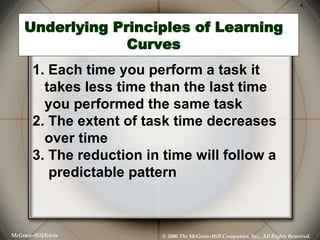
Underlying Principles of Learning Curves 1. Each time you perform a task it takes less time than the last time you performed the same task 2. The extent of task time decreases over time 3. The reduction in time will follow a  predictable pattern
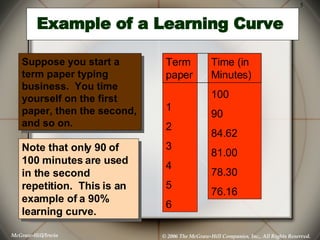
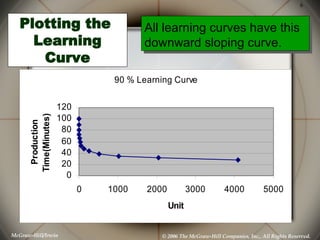
Example of a Learning Curve Suppose you start a term paper typing business.  You time yourself on the first paper, then the second, and so on.  Term paper  1 2 3 4 5 6 Time (in Minutes) 100 90 84.62 81.00 78.30 76.16 Note that only 90 of 100 minutes are used in the second repetition.  This is an example of a 90% learning curve.
Plotting the  Learning Curve All learning curves have this downward sloping curve.
Types of Learning Individual Learning Improvement when individuals gain a skill or efficiency by repetition of a job Organizational Learning Improvement from the groups of individuals from repetition and changes in administration, equipment, and product design
From Learning Curves to Performance Improvement (Part 1) Proper selection of workers  Proper training  Motivation  Work specialization  Do one or very few jobs at a time
From Learning Curves to Performance Improvement (Part 2) Use tools or equipment that assists or supports performance Provide quick and easy access for help Allow workers to help redesign their tasks
End of Technical Note 4

Chap004tn

  • 1.
  • 2.
    Technical Note 4Learning Curves
  • 3.
    Underlying Principles ofLearning Curves Learning Curve Example Types of Learning From Learning Curves to Performance Improvement OBJECTIVES
  • 4.
    Underlying Principles ofLearning Curves 1. Each time you perform a task it takes less time than the last time you performed the same task 2. The extent of task time decreases over time 3. The reduction in time will follow a predictable pattern
  • 5.
    Example of aLearning Curve Suppose you start a term paper typing business. You time yourself on the first paper, then the second, and so on. Term paper 1 2 3 4 5 6 Time (in Minutes) 100 90 84.62 81.00 78.30 76.16 Note that only 90 of 100 minutes are used in the second repetition. This is an example of a 90% learning curve.
  • 6.
    Plotting the Learning Curve All learning curves have this downward sloping curve.
  • 7.
    Types of LearningIndividual Learning Improvement when individuals gain a skill or efficiency by repetition of a job Organizational Learning Improvement from the groups of individuals from repetition and changes in administration, equipment, and product design
  • 8.
    From Learning Curvesto Performance Improvement (Part 1) Proper selection of workers Proper training Motivation Work specialization Do one or very few jobs at a time
  • 9.
    From Learning Curvesto Performance Improvement (Part 2) Use tools or equipment that assists or supports performance Provide quick and easy access for help Allow workers to help redesign their tasks
  • 10.