Individual Differences Among Learners
Suresh Babu G
Assistant Professor
CTE CPAS Paippad, Kottayam
S
c
h
o
o
l
Individual differences
No two individuals are alike, not even identical
twins. Individuals differ in their intelligence,
aptitude, interest, attitude and other personality
traits. These differences between individuals that
separate them from one another and make one
unique individual in one self are termed as
individual difference.
Definitions of Individual
Differences
According to Wintz, the variations in the psych-
physical formation of individuals that makes one
a unique person is called individual difference
Osbotne considers individual difference as
dissimilarity between person that distinguish
from one another
Nature of Individual differences
Individual difference are one of degree, not one
of kind : refers to quantitative difference found
among individuals in respect of a specific trait or
various traits.
Normal distribution of traits
There exist both inter-individual
and intra-individual difference
Type or Varieties or areas
of Individual differences
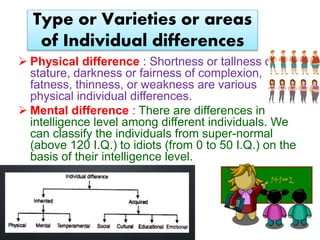
 Physical difference : Shortness or tallness of
stature, darkness or fairness of complexion,
fatness, thinness, or weakness are various
physical individual differences.
 Mental difference : There are differences in
intelligence level among different individuals. We
can classify the individuals from super-normal
(above 120 I.Q.) to idiots (from 0 to 50 I.Q.) on the
basis of their intelligence level.
 Difference in motor ability : There are
differences in motor ability. These
differences are visible at different ages.
Some people can perform mechanical
tasks easily, while others, even though
they are at the same level, feel much
difficulty in performing these tasks.
 Difference in achievements : It has
been found through achievement tests
that individuals differ in their
achievement abilities. These differences
are very much visible in reading, writing
and in learning mathematics.
Type or Varieties or areas of Individual differences
 Emotional difference : Individuals differ in their
emotional reactions to a particular situation.
Some are irritable and aggressive and they get
angry very soon. There are others who are of
peaceful nature and do not get angry easily. At a
particular thing an individual may be so much
enraged that he may be prepared for the worst
crime like murder, while another person may
only laugh at it.
Type or Varieties or areas of Individual differences
 Difference in interests and aptitudes : Some
take interest in meeting people, attending social
function, while others feel happy in solitude,
avoid social gathering. Some have mechanical
aptitude, while the others have scholastic,
musical or artistic aptitude.
 Difference in attitude, beliefs and opinions :
There will be difference in attitudes may be
positive, negative or of different nature toward
people , objects or ideas. Some believe in one
thing others does not. Some are conservative
and rigid while others are progressive, liberal
and dynamic.
Type or Varieties or areas of Individual differences
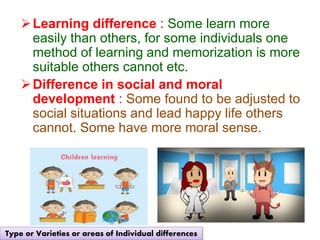
Learning difference : Some learn more
easily than others, for some individuals one
method of learning and memorization is more
suitable others cannot etc.
Difference in social and moral
development : Some found to be adjusted to
social situations and lead happy life others
cannot. Some have more moral sense.
Type or Varieties or areas of Individual differences
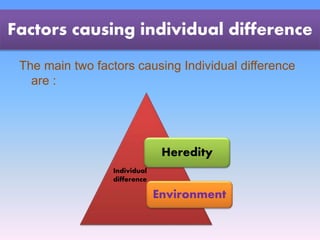
Factors causing individual difference
The main two factors causing Individual difference
are :
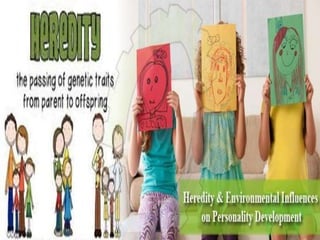
Heredity
Environment
Individual
difference
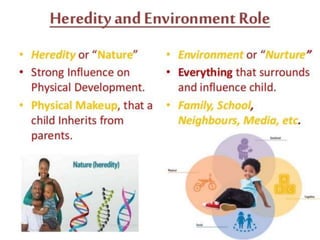
Heredity
Heredity is the sum total of the physical and mental
qualities that an individual inherits from his parents.
These qualities are transmitted to the person from
parents through genes in the chromosomes.
According to Peterson, heredity of an individual may be
defined as what he gets from his ancestral stock
through his parents.
People belong to different heredity stock and are thus
bound to differ in native endowments and
characteristics. These native endowments, abilities
and capacities provided by the heredity decide the
limit of one’s growth and development in various
dimensions and aspects of one’s personality.
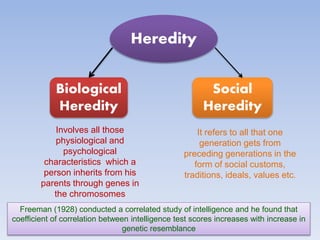
Heredity
Biological
Heredity
Social
Heredity
Involves all those
physiological and
psychological
characteristics which a
person inherits from his
parents through genes in
the chromosomes
It refers to all that one
generation gets from
preceding generations in the
form of social customs,
traditions, ideals, values etc.
Freeman (1928) conducted a correlated study of intelligence and he found that
coefficient of correlation between intelligence test scores increases with increase in
genetic resemblance
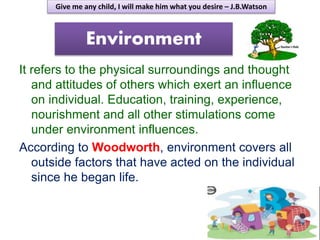
Environment
It refers to the physical surroundings and thought
and attitudes of others which exert an influence
on individual. Education, training, experience,
nourishment and all other stimulations come
under environment influences.
According to Woodworth, environment covers all
outside factors that have acted on the individual
since he began life.
Give me any child, I will make him what you desire – J.B.Watson
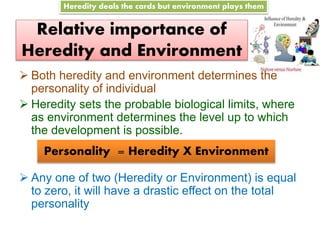
Relative importance of
Heredity and Environment
 Both heredity and environment determines the
personality of individual
 Heredity sets the probable biological limits, where
as environment determines the level up to which
the development is possible.
 Any one of two (Heredity or Environment) is equal
to zero, it will have a drastic effect on the total
personality
Heredity deals the cards but environment plays them
Personality = Heredity X Environment
General provisions for fostering
Individual Differences in the Classroom
 Proper Knowledge of the individual’s
potentialities : For this proper help from
intelligence tests, cumulative record card, interest
inventories, attitude scales , aptitude tests and
measures for assessing personality traits should
be taken.
 Ability Grouping : Based on various test the
students in a class or area of activity can be
divided into homogeneous groups. It is useful for
adjusting instruction.
General provisions for fostering
Individual Differences in the Classroom
 Adjusting curriculum : It should have the provision
for a number of diversified courses and co-
curricular experiences so that the pupils may get
opportunity to study and work in the areas of their
own interests and abilities.
 Adjusting the methods of teaching : Each teacher
should be free to formulate his own plan and
strategy and adopt instructional procedure, which
he finds most, suited to the particular types of
pupils under him. He should try to follow a different
procedure or methods of instruction according to
the requirements of students
General provisions for fostering
Individual Differences in the Classroom
 Adapting special programmes or methods for
individualizing instruction : Schools may also
adopt some special programme or methods of
teaching like Dalton plan, the Winnetka plan, the
project method or use programmed learning
material for enabling the students to learn at
their own individual rate.
 Other measures of individualized instruction :
For it a few practicable measures can also prove
beneficial
1. The size of the class should be
as small as possible
General provisions for fostering Individual Differences in the Classroom
2. The teacher should keep individualized
attention.
3. Teacher should keep in view the individual
difference of his students while encaging in class
works.
4. If ability grouping is not possible, Special
coaching and guidance programmes should be
conducted for both dull and gifted
General provisions for fostering Individual
Differences in the Classroom
Individual Differences in Learners

Individual Differences in Learners

  • 1.
    Individual Differences AmongLearners Suresh Babu G Assistant Professor CTE CPAS Paippad, Kottayam S c h o o l
  • 2.
    Individual differences No twoindividuals are alike, not even identical twins. Individuals differ in their intelligence, aptitude, interest, attitude and other personality traits. These differences between individuals that separate them from one another and make one unique individual in one self are termed as individual difference.
  • 3.
    Definitions of Individual Differences Accordingto Wintz, the variations in the psych- physical formation of individuals that makes one a unique person is called individual difference Osbotne considers individual difference as dissimilarity between person that distinguish from one another
  • 4.
    Nature of Individualdifferences Individual difference are one of degree, not one of kind : refers to quantitative difference found among individuals in respect of a specific trait or various traits. Normal distribution of traits There exist both inter-individual and intra-individual difference
  • 5.
    Type or Varietiesor areas of Individual differences  Physical difference : Shortness or tallness of stature, darkness or fairness of complexion, fatness, thinness, or weakness are various physical individual differences.  Mental difference : There are differences in intelligence level among different individuals. We can classify the individuals from super-normal (above 120 I.Q.) to idiots (from 0 to 50 I.Q.) on the basis of their intelligence level.
  • 6.
     Difference inmotor ability : There are differences in motor ability. These differences are visible at different ages. Some people can perform mechanical tasks easily, while others, even though they are at the same level, feel much difficulty in performing these tasks.  Difference in achievements : It has been found through achievement tests that individuals differ in their achievement abilities. These differences are very much visible in reading, writing and in learning mathematics. Type or Varieties or areas of Individual differences
  • 7.
     Emotional difference: Individuals differ in their emotional reactions to a particular situation. Some are irritable and aggressive and they get angry very soon. There are others who are of peaceful nature and do not get angry easily. At a particular thing an individual may be so much enraged that he may be prepared for the worst crime like murder, while another person may only laugh at it. Type or Varieties or areas of Individual differences
  • 8.
     Difference ininterests and aptitudes : Some take interest in meeting people, attending social function, while others feel happy in solitude, avoid social gathering. Some have mechanical aptitude, while the others have scholastic, musical or artistic aptitude.  Difference in attitude, beliefs and opinions : There will be difference in attitudes may be positive, negative or of different nature toward people , objects or ideas. Some believe in one thing others does not. Some are conservative and rigid while others are progressive, liberal and dynamic. Type or Varieties or areas of Individual differences
  • 9.
    Learning difference :Some learn more easily than others, for some individuals one method of learning and memorization is more suitable others cannot etc. Difference in social and moral development : Some found to be adjusted to social situations and lead happy life others cannot. Some have more moral sense. Type or Varieties or areas of Individual differences
  • 10.
    Factors causing individualdifference The main two factors causing Individual difference are : Heredity Environment Individual difference
  • 11.
    Heredity Heredity is thesum total of the physical and mental qualities that an individual inherits from his parents. These qualities are transmitted to the person from parents through genes in the chromosomes. According to Peterson, heredity of an individual may be defined as what he gets from his ancestral stock through his parents. People belong to different heredity stock and are thus bound to differ in native endowments and characteristics. These native endowments, abilities and capacities provided by the heredity decide the limit of one’s growth and development in various dimensions and aspects of one’s personality.
  • 12.
    Heredity Biological Heredity Social Heredity Involves all those physiologicaland psychological characteristics which a person inherits from his parents through genes in the chromosomes It refers to all that one generation gets from preceding generations in the form of social customs, traditions, ideals, values etc. Freeman (1928) conducted a correlated study of intelligence and he found that coefficient of correlation between intelligence test scores increases with increase in genetic resemblance
  • 13.
    Environment It refers tothe physical surroundings and thought and attitudes of others which exert an influence on individual. Education, training, experience, nourishment and all other stimulations come under environment influences. According to Woodworth, environment covers all outside factors that have acted on the individual since he began life. Give me any child, I will make him what you desire – J.B.Watson
  • 14.
    Relative importance of Heredityand Environment  Both heredity and environment determines the personality of individual  Heredity sets the probable biological limits, where as environment determines the level up to which the development is possible.  Any one of two (Heredity or Environment) is equal to zero, it will have a drastic effect on the total personality Heredity deals the cards but environment plays them Personality = Heredity X Environment
  • 16.
    General provisions forfostering Individual Differences in the Classroom  Proper Knowledge of the individual’s potentialities : For this proper help from intelligence tests, cumulative record card, interest inventories, attitude scales , aptitude tests and measures for assessing personality traits should be taken.  Ability Grouping : Based on various test the students in a class or area of activity can be divided into homogeneous groups. It is useful for adjusting instruction. General provisions for fostering Individual Differences in the Classroom
  • 17.
     Adjusting curriculum: It should have the provision for a number of diversified courses and co- curricular experiences so that the pupils may get opportunity to study and work in the areas of their own interests and abilities.  Adjusting the methods of teaching : Each teacher should be free to formulate his own plan and strategy and adopt instructional procedure, which he finds most, suited to the particular types of pupils under him. He should try to follow a different procedure or methods of instruction according to the requirements of students General provisions for fostering Individual Differences in the Classroom
  • 18.
     Adapting specialprogrammes or methods for individualizing instruction : Schools may also adopt some special programme or methods of teaching like Dalton plan, the Winnetka plan, the project method or use programmed learning material for enabling the students to learn at their own individual rate.  Other measures of individualized instruction : For it a few practicable measures can also prove beneficial 1. The size of the class should be as small as possible General provisions for fostering Individual Differences in the Classroom
  • 19.
    2. The teachershould keep individualized attention. 3. Teacher should keep in view the individual difference of his students while encaging in class works. 4. If ability grouping is not possible, Special coaching and guidance programmes should be conducted for both dull and gifted General provisions for fostering Individual Differences in the Classroom