Structured System and Analysis Design
Submitted to : Ms. Harleen Sahni Submitted by : Bittu Singh
Krishna Chandra
Radhe Kumar
Shubham Singh
Problem Statement
 With the advent of technology, life has become fast-paced. Most of the age-old systems are
being upgraded in sync with the latest technological assets. This is to facilitate better learning
and provide a hands-on experience.
 There is no point for Design colleges to lag behind in this evolution. For, systems must adapt
themselves according to the changing conditions to keep themselves ahead I this ever
demanding world.
 There is a dire need among the students of Indian Design Schools for a centralized learning
system. Such a system will help students gain an advantageous position by accessing
information from anywhere.
 The number of expert teachers in the field of Design is very less. This system will address this
shortcoming.
Background
 With the ever growing demand for Design professionals in diverse fields in a
growing economy like India, many colleges have come up in this sector.
 But, they must be prepared for keeping themselves well averse with the latest
know-how. They must also have a well-coordinated system to enhance learning
process which is easy to access.
 The proposed system will aim to deliver learning content to the users. It will also
have interactive feature for students such as discussion forums.
 The proposed system can be further improved by
alignment between features being offered and those
desired by the Campus community.
 This system can be accessed from anywhere as the user is
simply required to have only a Login ID. But, the level of
access will vary between a Student of a registered Design
College or any other Guest user.
 The Needs and Preferences of users will to be maintained,
and they will be notified about latest materials through mail.
Scope
 Learning depends on more and more interactions and
connections. This can be done by maintaining a large
collection of study materials.
 This system will have tools for distribution, i.e. tools to
upload documents and make them available.
 The system will also have various tools for
Communication such as :-
• Server to student – E-mail about latest notifications
• Reaction and Feedback – Discussion Boards and
Blogs.
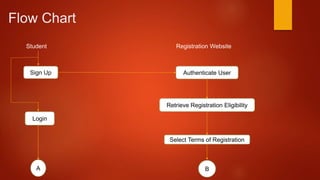
Flow Chart
Student
Sign Up
Registration Website
Authenticate User
Retrieve Registration Eligibility
Select Terms of Registration
Login
A B
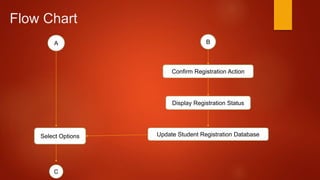
Flow Chart
B
Confirm Registration Action
Display Registration Status
Update Student Registration DatabaseSelect Options
C
A
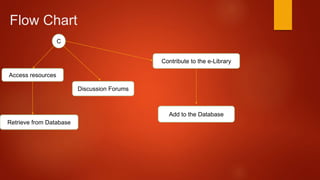
Flow Chart
C
Access resources
Discussion Forums
Contribute to the e-Library
Retrieve from Database
Add to the Database
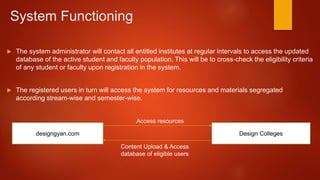
System Functioning
 The system administrator will contact all entitled institutes at regular intervals to access the updated
database of the active student and faculty population. This will be to cross-check the eligibility criteria
of any student or faculty upon registration in the system.
 The registered users in turn will access the system for resources and materials segregated
according stream-wise and semester-wise.
designgyan.com Design Colleges
Access resources
Content Upload & Access
database of eligible users
System Investigation
 The system will have login option for existing users and Sign Up option for new users. Upon
signing up of a new user, account is created only after it is cross-verified with the respective
institute.
 Registered users will have many options to choose from such as participating in Discussion
Forums, viewing study materials available, uploading content etc.
 The contents in the system are arranged in an ordered manner. For example, a user accessing
resources will have the option to choose from various streams and semesters. The system will
also have a Search option to look for the desired keywords among the existing resources.
 The system will also have a mailing system. Users will be sent automated mails about recent
arrivals from their preferences list. This will be supported by Feed Burner E-mail.
Requirements Specification
 Details of the system such as costs, features, web address/server, admin
account
 List of stream-wise materials
 Create Policy terms and link these to application forms
 Maintain details of Institutes who provide approval to students
 Maintain levels of membership provided by the system such as different forms for
students and faculties
 Create list of unit elements grouped by key area
 Addition of details and description to unit elements
 Maintain statistics of elements; ex. Number of times accessed
Operational Requirements
 Help Desk Support – System users will have access to a Complaint Mail for assistance
in questions such as :
o Technical in nature such as slow or sluggish system response time
o Incompatible browser features
o Application errors
o System downtime inquires
 Programmers and application developers will have access to address bugs or
enhancements
 System security and access levels are provided in the online system. There are varying
levels of system access and functional authority. Administrator will have access to all
registration records.
 Computer operations centre will handle hardware tasks such as data type back up,
hardware maintenance, fail over, scheduled system patches and maintenance.
Input Requirements
 Student identifier key and user access :
o Each student will be assigned a unique identifier upon registration in the system.
The students must know this.
o This identifying key will help in verifying all the registration
record information from the institutes.
o Thus, the identity of the users will be cross checked.
o Admitted and current students will have their accounts enabled.
o The account will be disabled after the student graduates from the institute.
Output Requirements
 Activity log : Every registered user will have a view of summary of actions
done for the previous two weeks. The database will display all the materials
accessed/uploaded by the user.
 Registration reports and summaries : System administrators will be able to
extract summarized and rolled up data into meaningful information. All
records will be archived and accessible on demand.
Hardware Requirements
 Network Infrastructure : Wired and Wireless
 Computers : Windows 2007 or above
 A Mainframe computer to host the database
 Production Support Systems
o Web server computer
o Hardware support – back-up tapes, redundant drives, UPS etc.
Software Requirements
 Operating system : Windows 2007 or above
 Application : Java and Java Script compatible browser
o Internet Explorer
o Opera
o Chrome
 Network software and protocols for system
o Transmission Control Protocol/Internet Protocol
o Hyper Text Transfer Protocol
o Hyper Text Transfer Protocol Secure
o File Transfer Protocol
Budgeting
 Group of Software Engineers - To develop the project - ₹ 40,00,000
 MS Office –For calculations, operations and creating database - ₹ 5,000
 Front and Back end softwares: For data maintenance and storage - ₹ 1,50,000
 Renewal of software(yearly) – For proper functioning of software - ₹ 10,000
 Electrical Engineer – For wiring maintaining appliances - ₹ 4,00,000
 Technical Engineer – For technical fault - ₹ 20,000
 5 staff per college – For maintaining and operating system - ₹ 7,500
 5 computer systems per college – For running the system - ₹ 3,50,000
 5 printers and scanners per college – For ease of use - ₹ 1,00,000
Feasibility Study
 It is the analysis of whether the proposed system can be developed or not within the available time and
resources.
Economic Feasibility
 For development of any system, capital is required. It can sourced from varied points. Colleges have an
active human resource in the form of students, who pay thousands of fees per year to the institute. So,
funding is not going to be a major problem as long as the institutes agree to spend money towards the
system development.
Major Industry players in the field of Design and Apparel can also be approached to
contribute in this endeavour.
The Alumni Associations of various colleges can contribute a lot to the cause.
The Union Government of India, Ministry of Textiles, philanthropists can also be of much help.
Technical Feasibility
 The available computer systems will not be enough for maintaining such a large and complex database.
So, new high capacity computer systems would have to be procured. Since finances is not going to be a
major problem, new systems can be procured. Software for system development can be bought from IT
companies. Operating these Software would require basic training of the college staff.
Fast broadband connections would be required which is already available in the form of
LAN connections.
Mail system can be procured from the Feed Burner of Internet.
Search option can be inducted by making the system in sync with Google Search.
Operational Feasibility
 This considers operational features and its limitations. This involves considering if manpower for the
project is enough or not. Since this system development is related directly to colleges, so manpower is
not going to pose a crisis. All these colleges already maintain trained working staff and this will be the
source of manpower for the system needs.
Behavioural Feasibility
 In general, people are resistant towards any changes in their working lifestyles. But, in this modern
world, most of the students and faculties are already well-averse with operating the latest gadgets
and features of the Internet. So, there will be very people who will be against such a system. Not to
forget, this system is highly desirable among the targeted community, so there is going to be least
opposition. Even if people are not comfortable with it in the beginning, they will adapt to it with time.
Schedule Feasibility
 Meeting the deadlines in any project development is always a tough job. For monitoring of the
development phase, a Committee will be formed of Principals of 10 different Design schools. With
active guidance and leadership from this committee, the project can be monitored and targets can
be met.
Constraints
 System use needs training in the initial phases
 User Interface is only in English
 High chances of Plagiarism which can be checked by
inducting Digital Water-Marking system.
 No facility for Guests
 Limited functionality, capabilities and options
 Students may not get exactly what they want
as they may have customized needs
 High dependence on electricity and Internet.
References
1. New York University . Retrieved from : www.nyu.edu/classes/jcf/CSCI-
GA.../Assignment1SampleSolution.pdf
2. IIT Bombay . Retrieved from :
http://www.it.iitb.ac.in/frg/wiki/images/6/6d/Grp2_Moodle_SRS_2013_06_26.pdf
Thank You!

Learning Management System

  • 1.
    Structured System andAnalysis Design Submitted to : Ms. Harleen Sahni Submitted by : Bittu Singh Krishna Chandra Radhe Kumar Shubham Singh
  • 2.
    Problem Statement  Withthe advent of technology, life has become fast-paced. Most of the age-old systems are being upgraded in sync with the latest technological assets. This is to facilitate better learning and provide a hands-on experience.  There is no point for Design colleges to lag behind in this evolution. For, systems must adapt themselves according to the changing conditions to keep themselves ahead I this ever demanding world.  There is a dire need among the students of Indian Design Schools for a centralized learning system. Such a system will help students gain an advantageous position by accessing information from anywhere.  The number of expert teachers in the field of Design is very less. This system will address this shortcoming.
  • 3.
    Background  With theever growing demand for Design professionals in diverse fields in a growing economy like India, many colleges have come up in this sector.  But, they must be prepared for keeping themselves well averse with the latest know-how. They must also have a well-coordinated system to enhance learning process which is easy to access.  The proposed system will aim to deliver learning content to the users. It will also have interactive feature for students such as discussion forums.
  • 4.
     The proposedsystem can be further improved by alignment between features being offered and those desired by the Campus community.  This system can be accessed from anywhere as the user is simply required to have only a Login ID. But, the level of access will vary between a Student of a registered Design College or any other Guest user.  The Needs and Preferences of users will to be maintained, and they will be notified about latest materials through mail.
  • 5.
    Scope  Learning dependson more and more interactions and connections. This can be done by maintaining a large collection of study materials.  This system will have tools for distribution, i.e. tools to upload documents and make them available.  The system will also have various tools for Communication such as :- • Server to student – E-mail about latest notifications • Reaction and Feedback – Discussion Boards and Blogs.
  • 6.
    Flow Chart Student Sign Up RegistrationWebsite Authenticate User Retrieve Registration Eligibility Select Terms of Registration Login A B
  • 7.
    Flow Chart B Confirm RegistrationAction Display Registration Status Update Student Registration DatabaseSelect Options C A
  • 8.
    Flow Chart C Access resources DiscussionForums Contribute to the e-Library Retrieve from Database Add to the Database
  • 9.
    System Functioning  Thesystem administrator will contact all entitled institutes at regular intervals to access the updated database of the active student and faculty population. This will be to cross-check the eligibility criteria of any student or faculty upon registration in the system.  The registered users in turn will access the system for resources and materials segregated according stream-wise and semester-wise. designgyan.com Design Colleges Access resources Content Upload & Access database of eligible users
  • 10.
    System Investigation  Thesystem will have login option for existing users and Sign Up option for new users. Upon signing up of a new user, account is created only after it is cross-verified with the respective institute.  Registered users will have many options to choose from such as participating in Discussion Forums, viewing study materials available, uploading content etc.  The contents in the system are arranged in an ordered manner. For example, a user accessing resources will have the option to choose from various streams and semesters. The system will also have a Search option to look for the desired keywords among the existing resources.  The system will also have a mailing system. Users will be sent automated mails about recent arrivals from their preferences list. This will be supported by Feed Burner E-mail.
  • 11.
    Requirements Specification  Detailsof the system such as costs, features, web address/server, admin account  List of stream-wise materials  Create Policy terms and link these to application forms  Maintain details of Institutes who provide approval to students  Maintain levels of membership provided by the system such as different forms for students and faculties  Create list of unit elements grouped by key area  Addition of details and description to unit elements  Maintain statistics of elements; ex. Number of times accessed
  • 12.
    Operational Requirements  HelpDesk Support – System users will have access to a Complaint Mail for assistance in questions such as : o Technical in nature such as slow or sluggish system response time o Incompatible browser features o Application errors o System downtime inquires  Programmers and application developers will have access to address bugs or enhancements  System security and access levels are provided in the online system. There are varying levels of system access and functional authority. Administrator will have access to all registration records.  Computer operations centre will handle hardware tasks such as data type back up, hardware maintenance, fail over, scheduled system patches and maintenance.
  • 13.
    Input Requirements  Studentidentifier key and user access : o Each student will be assigned a unique identifier upon registration in the system. The students must know this. o This identifying key will help in verifying all the registration record information from the institutes. o Thus, the identity of the users will be cross checked. o Admitted and current students will have their accounts enabled. o The account will be disabled after the student graduates from the institute.
  • 14.
    Output Requirements  Activitylog : Every registered user will have a view of summary of actions done for the previous two weeks. The database will display all the materials accessed/uploaded by the user.  Registration reports and summaries : System administrators will be able to extract summarized and rolled up data into meaningful information. All records will be archived and accessible on demand.
  • 15.
    Hardware Requirements  NetworkInfrastructure : Wired and Wireless  Computers : Windows 2007 or above  A Mainframe computer to host the database  Production Support Systems o Web server computer o Hardware support – back-up tapes, redundant drives, UPS etc.
  • 16.
    Software Requirements  Operatingsystem : Windows 2007 or above  Application : Java and Java Script compatible browser o Internet Explorer o Opera o Chrome  Network software and protocols for system o Transmission Control Protocol/Internet Protocol o Hyper Text Transfer Protocol o Hyper Text Transfer Protocol Secure o File Transfer Protocol
  • 17.
    Budgeting  Group ofSoftware Engineers - To develop the project - ₹ 40,00,000  MS Office –For calculations, operations and creating database - ₹ 5,000  Front and Back end softwares: For data maintenance and storage - ₹ 1,50,000  Renewal of software(yearly) – For proper functioning of software - ₹ 10,000  Electrical Engineer – For wiring maintaining appliances - ₹ 4,00,000  Technical Engineer – For technical fault - ₹ 20,000  5 staff per college – For maintaining and operating system - ₹ 7,500  5 computer systems per college – For running the system - ₹ 3,50,000  5 printers and scanners per college – For ease of use - ₹ 1,00,000
  • 18.
    Feasibility Study  Itis the analysis of whether the proposed system can be developed or not within the available time and resources. Economic Feasibility  For development of any system, capital is required. It can sourced from varied points. Colleges have an active human resource in the form of students, who pay thousands of fees per year to the institute. So, funding is not going to be a major problem as long as the institutes agree to spend money towards the system development. Major Industry players in the field of Design and Apparel can also be approached to contribute in this endeavour. The Alumni Associations of various colleges can contribute a lot to the cause. The Union Government of India, Ministry of Textiles, philanthropists can also be of much help.
  • 19.
    Technical Feasibility  Theavailable computer systems will not be enough for maintaining such a large and complex database. So, new high capacity computer systems would have to be procured. Since finances is not going to be a major problem, new systems can be procured. Software for system development can be bought from IT companies. Operating these Software would require basic training of the college staff. Fast broadband connections would be required which is already available in the form of LAN connections. Mail system can be procured from the Feed Burner of Internet. Search option can be inducted by making the system in sync with Google Search. Operational Feasibility  This considers operational features and its limitations. This involves considering if manpower for the project is enough or not. Since this system development is related directly to colleges, so manpower is not going to pose a crisis. All these colleges already maintain trained working staff and this will be the source of manpower for the system needs.
  • 20.
    Behavioural Feasibility  Ingeneral, people are resistant towards any changes in their working lifestyles. But, in this modern world, most of the students and faculties are already well-averse with operating the latest gadgets and features of the Internet. So, there will be very people who will be against such a system. Not to forget, this system is highly desirable among the targeted community, so there is going to be least opposition. Even if people are not comfortable with it in the beginning, they will adapt to it with time. Schedule Feasibility  Meeting the deadlines in any project development is always a tough job. For monitoring of the development phase, a Committee will be formed of Principals of 10 different Design schools. With active guidance and leadership from this committee, the project can be monitored and targets can be met.
  • 21.
    Constraints  System useneeds training in the initial phases  User Interface is only in English  High chances of Plagiarism which can be checked by inducting Digital Water-Marking system.  No facility for Guests  Limited functionality, capabilities and options  Students may not get exactly what they want as they may have customized needs  High dependence on electricity and Internet.
  • 22.
    References 1. New YorkUniversity . Retrieved from : www.nyu.edu/classes/jcf/CSCI- GA.../Assignment1SampleSolution.pdf 2. IIT Bombay . Retrieved from : http://www.it.iitb.ac.in/frg/wiki/images/6/6d/Grp2_Moodle_SRS_2013_06_26.pdf
  • 23.