Submitted By : Submitted To :
Rupam Priya Mr. Ankur Makhija
Sanvee Readlan Asstt. Professor
Shubham Kumar
Shubham Singh
Srishti Kumari
DFT - V
INTRODUCTION
 American industrialist
 Founder of Ford Motor Company
 Developed the assembly line technique for mass production
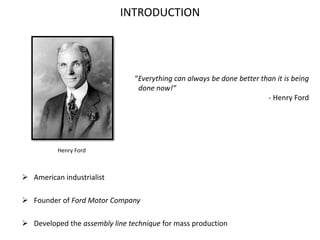
Henry Ford
“Everything can always be done better than it is being
done now!”
- Henry Ford
A YOUNG ENGINEER IN MAKING
 1891 to 1899 - worked as a mechanical engineer with the Edison Illuminating
Company in Detroit
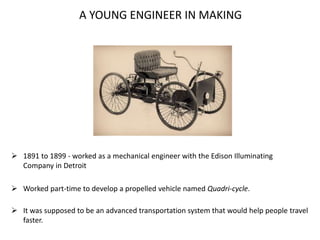
 Worked part-time to develop a propelled vehicle named Quadri-cycle.
 It was supposed to be an advanced transportation system that would help people travel
faster.
FORD MOTORS CO.
 Henry Ford - wanted to start his own factory to manufacture
automobiles
 Tasted failure twice at the beginning
 1903 - the Ford company was incorporated - stationed in
the Detroit area
 1908 - Henry Ford’s dream became reality - first Model T (Tin
Lizzie) was introduced
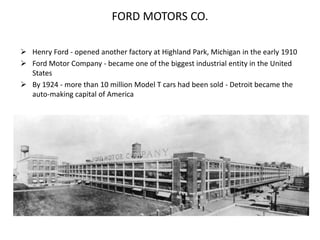
 Henry Ford - opened another factory at Highland Park, Michigan in the early 1910
 Ford Motor Company - became one of the biggest industrial entity in the United
States
 By 1924 - more than 10 million Model T cars had been sold - Detroit became the
auto-making capital of America
FORD MOTORS CO.
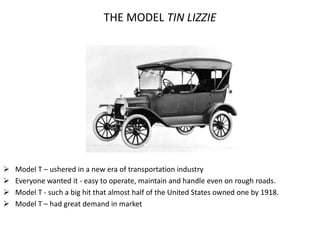
THE MODEL TIN LIZZIE
 Model T – ushered in a new era of transportation industry
 Everyone wanted it - easy to operate, maintain and handle even on rough roads.
 Model T - such a big hit that almost half of the United States owned one by 1918.
 Model T – had great demand in market
Assembly Line : The Idea
 Concept – From the overhead trolley which Chicago beef packers used
- Stock yard – butchers removed certain cuts as each carcass passed by until
nothing was left
- Ford reversed the process
 Complication – parts were made on sub-assembly lines – had to be fed accordingly into the
main process
 Timing – crucial to the concept
 Testing of 1st moving assembly line – showed a saving of 6 minutes & 50 seconds over the
old method
 Experimentation with work slides, rollways, conveyor belts etc.
 Endless chain driven conveyor – to move chassis from one work-station to another –
workers remained stationary
 Man-high line – all the parts and belts at waist level – workers could repeat their assigned
tasks with minimum movement of feet
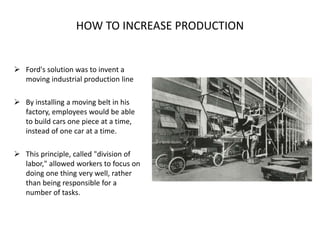
 Ford's solution was to invent a
moving industrial production line
 By installing a moving belt in his
factory, employees would be able
to build cars one piece at a time,
instead of one car at a time.
 This principle, called "division of
labor," allowed workers to focus on
doing one thing very well, rather
than being responsible for a
number of tasks.
HOW TO INCREASE PRODUCTION
THE ASSEMBLY LINE
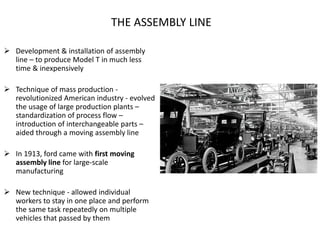
 Development & installation of assembly
line – to produce Model T in much less
time & inexpensively
 Technique of mass production -
revolutionized American industry - evolved
the usage of large production plants –
standardization of process flow –
introduction of interchangeable parts –
aided through a moving assembly line
 In 1913, ford came with first moving
assembly line for large-scale
manufacturing
 New technique - allowed individual
workers to stay in one place and perform
the same task repeatedly on multiple
vehicles that passed by them
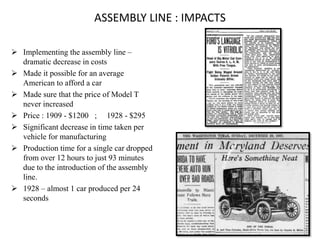
ASSEMBLY LINE : IMPACTS
 Implementing the assembly line –
dramatic decrease in costs
 Made it possible for an average
American to afford a car
 Made sure that the price of Model T
never increased
 Price : 1909 - $1200 ; 1928 - $295
 Significant decrease in time taken per
vehicle for manufacturing
 Production time for a single car dropped
from over 12 hours to just 93 minutes
due to the introduction of the assembly
line.
 1928 – almost 1 car produced per 24
seconds
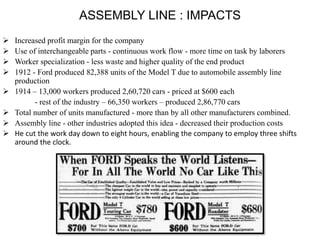
 Increased profit margin for the company
 Use of interchangeable parts - continuous work flow - more time on task by laborers
 Worker specialization - less waste and higher quality of the end product
 1912 - Ford produced 82,388 units of the Model T due to automobile assembly line
production
 1914 – 13,000 workers produced 2,60,720 cars - priced at $600 each
- rest of the industry – 66,350 workers – produced 2,86,770 cars
 Total number of units manufactured - more than by all other manufacturers combined.
 Assembly line - other industries adopted this idea - decreased their production costs
 He cut the work day down to eight hours, enabling the company to employ three shifts
around the clock.
ASSEMBLY LINE : IMPACTS
THE 5 DOLLAR DAY EXPERIMENT
 January 5, 1914 - Henry Ford announced a minimum 5 dollar salary for all eligible
employees working 8 hours per day
 Perceived as a profit-sharing plan - motivated employees to adopt efficient and
productive habits
 Workers - viewed Ford as a friend
 Businessmen - viewed Ford's idea as reckless
 Ford’s beliefs - proved his critics false
 Company's profits - doubled from $30 million to $60 million between 1914 and 1916
 Revolutionary - focused on worker morale to increase efficiency and productivity
References
 Henry Ford. Retrieved from U-S-History.com
 The Henry Ford Story. Retrieved from : Ford.co.uk
 Pioneers of Industrial Engineering. Retrieved from : Institute of Industrial & Systems
Engineers
 Henry Ford & Innovation. Retrieved from : TheHenryFord.org
 Henry Ford. Retrieved from : Michigan State University
 Greatest Business Stories of All Time. Retrieved from : John Wiley & Sons, Inc
 Henry Ford. May 2012. Retrieved from : American Society of Mechanical Engineers
 Henry Ford. Retrieved from : History.com
 York M.J. Henry Ford : Manufacturing Mogul. ABDO Publishers. Retrieved from Google
Books
Henry Ford

Henry Ford

  • 1.
    Submitted By :Submitted To : Rupam Priya Mr. Ankur Makhija Sanvee Readlan Asstt. Professor Shubham Kumar Shubham Singh Srishti Kumari DFT - V
  • 2.
    INTRODUCTION  American industrialist Founder of Ford Motor Company  Developed the assembly line technique for mass production Henry Ford “Everything can always be done better than it is being done now!” - Henry Ford
  • 3.
    A YOUNG ENGINEERIN MAKING  1891 to 1899 - worked as a mechanical engineer with the Edison Illuminating Company in Detroit  Worked part-time to develop a propelled vehicle named Quadri-cycle.  It was supposed to be an advanced transportation system that would help people travel faster.
  • 4.
    FORD MOTORS CO. Henry Ford - wanted to start his own factory to manufacture automobiles  Tasted failure twice at the beginning  1903 - the Ford company was incorporated - stationed in the Detroit area  1908 - Henry Ford’s dream became reality - first Model T (Tin Lizzie) was introduced
  • 5.
     Henry Ford- opened another factory at Highland Park, Michigan in the early 1910  Ford Motor Company - became one of the biggest industrial entity in the United States  By 1924 - more than 10 million Model T cars had been sold - Detroit became the auto-making capital of America FORD MOTORS CO.
  • 6.
    THE MODEL TINLIZZIE  Model T – ushered in a new era of transportation industry  Everyone wanted it - easy to operate, maintain and handle even on rough roads.  Model T - such a big hit that almost half of the United States owned one by 1918.  Model T – had great demand in market
  • 7.
    Assembly Line :The Idea  Concept – From the overhead trolley which Chicago beef packers used - Stock yard – butchers removed certain cuts as each carcass passed by until nothing was left - Ford reversed the process  Complication – parts were made on sub-assembly lines – had to be fed accordingly into the main process  Timing – crucial to the concept  Testing of 1st moving assembly line – showed a saving of 6 minutes & 50 seconds over the old method  Experimentation with work slides, rollways, conveyor belts etc.  Endless chain driven conveyor – to move chassis from one work-station to another – workers remained stationary  Man-high line – all the parts and belts at waist level – workers could repeat their assigned tasks with minimum movement of feet
  • 8.
     Ford's solutionwas to invent a moving industrial production line  By installing a moving belt in his factory, employees would be able to build cars one piece at a time, instead of one car at a time.  This principle, called "division of labor," allowed workers to focus on doing one thing very well, rather than being responsible for a number of tasks. HOW TO INCREASE PRODUCTION
  • 9.
    THE ASSEMBLY LINE Development & installation of assembly line – to produce Model T in much less time & inexpensively  Technique of mass production - revolutionized American industry - evolved the usage of large production plants – standardization of process flow – introduction of interchangeable parts – aided through a moving assembly line  In 1913, ford came with first moving assembly line for large-scale manufacturing  New technique - allowed individual workers to stay in one place and perform the same task repeatedly on multiple vehicles that passed by them
  • 10.
    ASSEMBLY LINE :IMPACTS  Implementing the assembly line – dramatic decrease in costs  Made it possible for an average American to afford a car  Made sure that the price of Model T never increased  Price : 1909 - $1200 ; 1928 - $295  Significant decrease in time taken per vehicle for manufacturing  Production time for a single car dropped from over 12 hours to just 93 minutes due to the introduction of the assembly line.  1928 – almost 1 car produced per 24 seconds
  • 11.
     Increased profitmargin for the company  Use of interchangeable parts - continuous work flow - more time on task by laborers  Worker specialization - less waste and higher quality of the end product  1912 - Ford produced 82,388 units of the Model T due to automobile assembly line production  1914 – 13,000 workers produced 2,60,720 cars - priced at $600 each - rest of the industry – 66,350 workers – produced 2,86,770 cars  Total number of units manufactured - more than by all other manufacturers combined.  Assembly line - other industries adopted this idea - decreased their production costs  He cut the work day down to eight hours, enabling the company to employ three shifts around the clock. ASSEMBLY LINE : IMPACTS
  • 12.
    THE 5 DOLLARDAY EXPERIMENT  January 5, 1914 - Henry Ford announced a minimum 5 dollar salary for all eligible employees working 8 hours per day  Perceived as a profit-sharing plan - motivated employees to adopt efficient and productive habits  Workers - viewed Ford as a friend  Businessmen - viewed Ford's idea as reckless  Ford’s beliefs - proved his critics false  Company's profits - doubled from $30 million to $60 million between 1914 and 1916  Revolutionary - focused on worker morale to increase efficiency and productivity
  • 13.
    References  Henry Ford.Retrieved from U-S-History.com  The Henry Ford Story. Retrieved from : Ford.co.uk  Pioneers of Industrial Engineering. Retrieved from : Institute of Industrial & Systems Engineers  Henry Ford & Innovation. Retrieved from : TheHenryFord.org  Henry Ford. Retrieved from : Michigan State University  Greatest Business Stories of All Time. Retrieved from : John Wiley & Sons, Inc  Henry Ford. May 2012. Retrieved from : American Society of Mechanical Engineers  Henry Ford. Retrieved from : History.com  York M.J. Henry Ford : Manufacturing Mogul. ABDO Publishers. Retrieved from Google Books