University of Burao
Motivation and Emotions
Copyright: Lecturer Basher M. Muhumud
October, 2019 1Copyright: Mr. Basher M. Muhumud
Motivation
What is Motivation?
• Motivation is a need or desire that energizes
behavior and directs it toward a goal.
• It is what either starts or stops behavior. It is
the internal and external forces that drive our
thoughts, moods, and behaviors.
October, 2019 2Copyright: Mr. Basher M. Muhumud
Importance of Motivation
• Directs activities towards the achievement of a
goal.
• Controls and directs human behavior.
• Inculcates spiritual and moral values in the
minds of the young.
• Gives satisfaction and happiness to the
individual.
October, 2019 3Copyright: Mr. Basher M. Muhumud
Types of Motivation
• Intrinsic Motivation: an internal stimulus that
arouses one to action.
• It is based on motive, which is always intrinsic.
A motive arouses one to do something.
• For instance, If a learner wants to solve a
mathematical problem however difficult it is, he
can solve it correctly. He feels elated and with
self-fulfillment.
4October, 2019 Copyright: Mr. Basher M. Muhumud
• Extrinsic Motivation: an external stimulus to
action.
• This type of motivation is based on incentive.
• It comes from the outside of the individual,
that is, from the external environment.
• It comes from the form of praise, social
approval, high grades, medals and the likes.
October, 2019 5Copyright: Mr. Basher M. Muhumud
6October, 2019
Theories of Motivation
• Different schools of thought look at motivation
(that power that either starts or stops behavior)
through different lenses.
• Instinct theory
• Drive Theory
• Incentive theory
• Cognitive theory
• Arousal Theory
• Maslow’s motivational theory
7October, 2019
Instinct Theory
• Instinct theory proposes that organisms are
motivated to engage in certain behaviors
because of their genetic programming and
because these behaviors lead to success in
terms of natural selection.
• For example, we pursue sex in order to
reproduce to propagate the human species.
• It is an innate biological need.
October, 2019 8Copyright: Mr. Basher M. Muhumud
Instinctual Behaviors
• Reproduction and social dominance
• Human beings are territorial “this is our
space” by nature.
• Some animals have instinctual behaviors, like
mating dances and nest building sequences.
October, 2019 9Copyright: Mr. Basher M. Muhumud
Drive Theory
• Drive theory also known as Drive-Reduction
theory or Homeostatic theory.
• This perspective views behavior as motivated
by the need to reduce internal tension caused
by unmet biological needs.
• This unmet need “drives” us to behave in a way
that causes the intensity of the drive to be
reduced.
10October, 2019 Copyright: Mr. Basher M. Muhumud
Cont.
• They work by “negative” feedback, that is one
experiences an unpleasant feeling (hunger,
thirst) until you meet the need.
• The brain makes sure the body is kept in
balance (body temperature, fluid levels, energy
supplies, need for rest).
• This balance or optimal state is called
homeostasis.
October, 2019 11Copyright: Mr. Basher M. Muhumud
Cont.
• This is our natural state. The body does its best to
stay balanced. (hunger, thirst, sex drive, sleep)
October, 2019 12Copyright: Mr. Basher M. Muhumud
Incentive Theory
• An incentive is the object we seek or the result
we are trying to achieve through our motivated
behavior.
• Incentives are also known as reinforcers, goals,
and rewards.
• Incentive theory states that behavior is
motivated by the pull of external (outside )
goals, such as rewards.
October, 2019 13Copyright: Mr. Basher M. Muhumud
Cont.
• Not all of human behavior has a direct reward
attached to it.
• For example, how about those who are
motivated to achieve just for the sake of
achieving or who do things for fun or personal
growth.
October, 2019 14Copyright: Mr. Basher M. Muhumud
15
Cognitive Theory
• Cognitive psychologists seek to explain
motivation by looking at forces inside and
outside of us that energize us to move.
• They propose that we act in particular ways at
particular times as a result of extrinsic and
intrinsic motivations.
October, 2019 16Copyright: Mr. Basher M. Muhumud
Cont.
• For example, if you spend hours playing
basketball because you wish to excel at the
sport, you are following intrinsic motivation.
• If you spend hours playing basketball because
your parents want you to excel at the sport, you
are following extrinsic motivation.
October, 2019 17Copyright: Mr. Basher M. Muhumud
Arousal Theory
• People are motivated
to maintain an
optimum level of
arousal—neither too
high nor too low
• Curiosity motive—
helps us to understand
our environment.
October, 2019 18Copyright: Mr. Basher M. Muhumud
Maslow’s Motivational Theory
• Abraham Maslow suggested that motives are
divided into several levels from basic survival
needs to psychological and self-fulfillment
needs.
• The more basic needs are at the bottom and the
higher level needs are at the top.
• Before higher ordered needs are satisfied in the
hierarchy, the primary needs must be satisfied.
October, 2019 19Copyright: Mr. Basher M. Muhumud
20
October, 2019
Motives
• Motive is generally defined as a state of
physiological or psychological arousal which
influences how we behave.
• It is a physiological arousal, such as hunger or
thirst, motivates us to eat or get something to
drink.
• For example, if you see someone buying food in a
shop, you may come to the conclusion that they
are hungry and so they must be driven by
physiological arousal.
21October, 2019 Copyright: Mr. Basher M. Muhumud
Types of Motives
1. Biological motives
• Biological motives are critical to our survival
and physical well-being.
• We have built in regulating systems that work
to maintain:
- Body temperature
- Blood sugar levels
- Production of hormones, etc.
October, 2019 22Copyright: Mr. Basher M. Muhumud
2. Social Motives
• Social motives are also known as acquired or
learned motives.
• These some complex forms of motives, which
result mainly from man’s interaction with his
social environment.
• These motives are called social, because they
learned in social groups.
October, 2019 23Copyright: Mr. Basher M. Muhumud
Emotions
October, 2019 24Copyright: Mr. Basher M. Muhumud
Emotions
• Emotion is defined as a state characterized by
physiological arousal, changes in facial
expression, gestures, posture and subjective
feelings.
• An example of physiological changes (or arousal)
are a pounding heart, sweating palms,
“butterflies in the stomach”, and other bodily
reactions.
October, 2019 25Copyright: Mr. Basher M. Muhumud
Eight Primary Emotions
• Fear
• Surprise
• Sadness
• Disgust
• Anger
• Anticipation
• Happy
• Trust
October, 2019 26Copyright: Mr. Basher M. Muhumud
Emotions include three things
• Conscious experience (feelings)
• Expressions which can be seen by others
• Actions of the body ('physiological arousal')
Emotion is associated with:
• Mood
• Temperament
• Personality
• Disposition
• Motivation
27October, 2019 Copyright: Mr. Basher M. Muhumud
Categories of Emotion
Emotions are divided into two categories:
1. Primary emotion: a primary human emotion
types are the one triggered in response to an event.
Examples of primary emotions:
• Love
• Joy
• Anger
• Sadness
• Surprise
• Fear
28Copyright: Mr. Basher M. Muhumud
2. Secondary emotion: If we experience fear, the
secondary emotions would be: feel threatened or
feel anger, depending on the situation we are
experiencing.
Examples of secondary emotions:
• Passion
• Optimism
• Irritation
• Disgust
• Shame
• Nervousness
29Copyright: Mr. Basher M. Muhumud
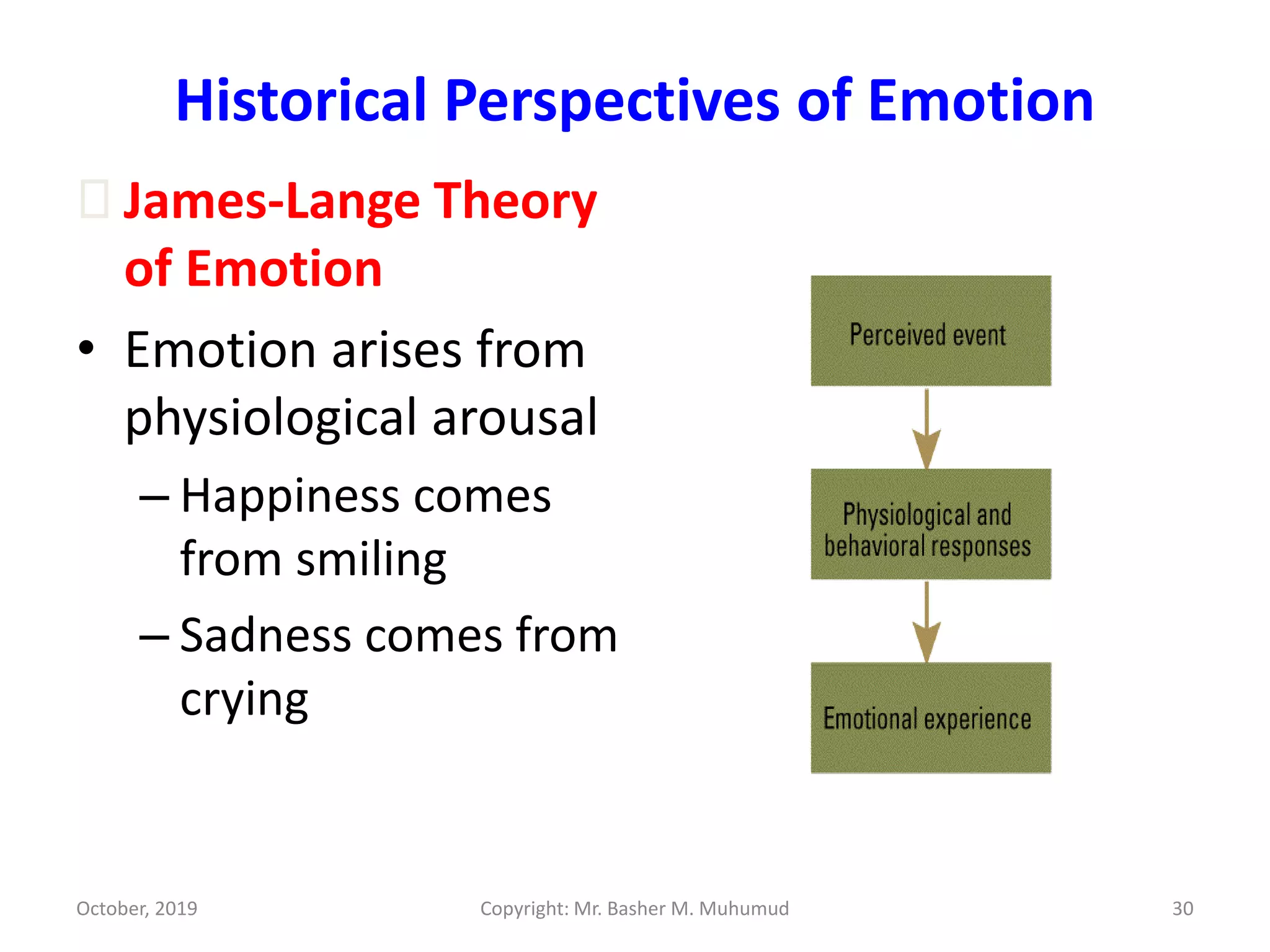
Historical Perspectives of Emotion
James-Lange Theory
of Emotion
• Emotion arises from
physiological arousal
– Happiness comes
from smiling
– Sadness comes from
crying
October, 2019 30Copyright: Mr. Basher M. Muhumud
Cont.
Cannon-Bard Theory of Emotion
• Emotion originates in the thalamus.
• “Body” (physiological systems) and “Mind”
(emotional experience) are independently
activated at the same time.
October, 2019 31
Human Emotion
• Human emotion is innate in all of us;
• It is something we are born with and something
we die with.
• Happiness, sadness, love, hatred, worries, and
indifference – these are things that constantly
occur in our daily lives.
October, 2019 32Copyright: Mr. Basher M. Muhumud
Variety of Emotions
• Positive emotions: positive emotions that lead
one to feel good about one’s self will lead to an
emotionally happy and satisfied result.
• Some of the positive emotions are:
- Hopeful
- Confident
- Peaceful, etc.
October, 2019 33Copyright: Mr. Basher M. Muhumud
• Negative emotions: negative emotions sap
your energy and undermine your effectiveness.
• In the negative emotional state, you find the
lack of desire to do anything.
• Some of the negative emotions are:
- Exhausted
- Panic
- Obnoxious
October, 2019 34Copyright: Mr. Basher M. Muhumud
Factors affecting Emotions
• Personality
• Culture
• Weather
• Stress
• Age
• Gender
• Environment
October, 2019 35Copyright: Mr. Basher M. Muhumud
The END
October, 2019 36Copyright: Mr. Basher M. Muhumud

Chapter 3: Motivation and Emotions

  • 1.
    University of Burao Motivationand Emotions Copyright: Lecturer Basher M. Muhumud October, 2019 1Copyright: Mr. Basher M. Muhumud
  • 2.
    Motivation What is Motivation? •Motivation is a need or desire that energizes behavior and directs it toward a goal. • It is what either starts or stops behavior. It is the internal and external forces that drive our thoughts, moods, and behaviors. October, 2019 2Copyright: Mr. Basher M. Muhumud
  • 3.
    Importance of Motivation •Directs activities towards the achievement of a goal. • Controls and directs human behavior. • Inculcates spiritual and moral values in the minds of the young. • Gives satisfaction and happiness to the individual. October, 2019 3Copyright: Mr. Basher M. Muhumud
  • 4.
    Types of Motivation •Intrinsic Motivation: an internal stimulus that arouses one to action. • It is based on motive, which is always intrinsic. A motive arouses one to do something. • For instance, If a learner wants to solve a mathematical problem however difficult it is, he can solve it correctly. He feels elated and with self-fulfillment. 4October, 2019 Copyright: Mr. Basher M. Muhumud
  • 5.
    • Extrinsic Motivation:an external stimulus to action. • This type of motivation is based on incentive. • It comes from the outside of the individual, that is, from the external environment. • It comes from the form of praise, social approval, high grades, medals and the likes. October, 2019 5Copyright: Mr. Basher M. Muhumud
  • 6.
  • 7.
    Theories of Motivation •Different schools of thought look at motivation (that power that either starts or stops behavior) through different lenses. • Instinct theory • Drive Theory • Incentive theory • Cognitive theory • Arousal Theory • Maslow’s motivational theory 7October, 2019
  • 8.
    Instinct Theory • Instincttheory proposes that organisms are motivated to engage in certain behaviors because of their genetic programming and because these behaviors lead to success in terms of natural selection. • For example, we pursue sex in order to reproduce to propagate the human species. • It is an innate biological need. October, 2019 8Copyright: Mr. Basher M. Muhumud
  • 9.
    Instinctual Behaviors • Reproductionand social dominance • Human beings are territorial “this is our space” by nature. • Some animals have instinctual behaviors, like mating dances and nest building sequences. October, 2019 9Copyright: Mr. Basher M. Muhumud
  • 10.
    Drive Theory • Drivetheory also known as Drive-Reduction theory or Homeostatic theory. • This perspective views behavior as motivated by the need to reduce internal tension caused by unmet biological needs. • This unmet need “drives” us to behave in a way that causes the intensity of the drive to be reduced. 10October, 2019 Copyright: Mr. Basher M. Muhumud
  • 11.
    Cont. • They workby “negative” feedback, that is one experiences an unpleasant feeling (hunger, thirst) until you meet the need. • The brain makes sure the body is kept in balance (body temperature, fluid levels, energy supplies, need for rest). • This balance or optimal state is called homeostasis. October, 2019 11Copyright: Mr. Basher M. Muhumud
  • 12.
    Cont. • This isour natural state. The body does its best to stay balanced. (hunger, thirst, sex drive, sleep) October, 2019 12Copyright: Mr. Basher M. Muhumud
  • 13.
    Incentive Theory • Anincentive is the object we seek or the result we are trying to achieve through our motivated behavior. • Incentives are also known as reinforcers, goals, and rewards. • Incentive theory states that behavior is motivated by the pull of external (outside ) goals, such as rewards. October, 2019 13Copyright: Mr. Basher M. Muhumud
  • 14.
    Cont. • Not allof human behavior has a direct reward attached to it. • For example, how about those who are motivated to achieve just for the sake of achieving or who do things for fun or personal growth. October, 2019 14Copyright: Mr. Basher M. Muhumud
  • 15.
  • 16.
    Cognitive Theory • Cognitivepsychologists seek to explain motivation by looking at forces inside and outside of us that energize us to move. • They propose that we act in particular ways at particular times as a result of extrinsic and intrinsic motivations. October, 2019 16Copyright: Mr. Basher M. Muhumud
  • 17.
    Cont. • For example,if you spend hours playing basketball because you wish to excel at the sport, you are following intrinsic motivation. • If you spend hours playing basketball because your parents want you to excel at the sport, you are following extrinsic motivation. October, 2019 17Copyright: Mr. Basher M. Muhumud
  • 18.
    Arousal Theory • Peopleare motivated to maintain an optimum level of arousal—neither too high nor too low • Curiosity motive— helps us to understand our environment. October, 2019 18Copyright: Mr. Basher M. Muhumud
  • 19.
    Maslow’s Motivational Theory •Abraham Maslow suggested that motives are divided into several levels from basic survival needs to psychological and self-fulfillment needs. • The more basic needs are at the bottom and the higher level needs are at the top. • Before higher ordered needs are satisfied in the hierarchy, the primary needs must be satisfied. October, 2019 19Copyright: Mr. Basher M. Muhumud
  • 20.
  • 21.
    Motives • Motive isgenerally defined as a state of physiological or psychological arousal which influences how we behave. • It is a physiological arousal, such as hunger or thirst, motivates us to eat or get something to drink. • For example, if you see someone buying food in a shop, you may come to the conclusion that they are hungry and so they must be driven by physiological arousal. 21October, 2019 Copyright: Mr. Basher M. Muhumud
  • 22.
    Types of Motives 1.Biological motives • Biological motives are critical to our survival and physical well-being. • We have built in regulating systems that work to maintain: - Body temperature - Blood sugar levels - Production of hormones, etc. October, 2019 22Copyright: Mr. Basher M. Muhumud
  • 23.
    2. Social Motives •Social motives are also known as acquired or learned motives. • These some complex forms of motives, which result mainly from man’s interaction with his social environment. • These motives are called social, because they learned in social groups. October, 2019 23Copyright: Mr. Basher M. Muhumud
  • 24.
  • 25.
    Emotions • Emotion isdefined as a state characterized by physiological arousal, changes in facial expression, gestures, posture and subjective feelings. • An example of physiological changes (or arousal) are a pounding heart, sweating palms, “butterflies in the stomach”, and other bodily reactions. October, 2019 25Copyright: Mr. Basher M. Muhumud
  • 26.
    Eight Primary Emotions •Fear • Surprise • Sadness • Disgust • Anger • Anticipation • Happy • Trust October, 2019 26Copyright: Mr. Basher M. Muhumud
  • 27.
    Emotions include threethings • Conscious experience (feelings) • Expressions which can be seen by others • Actions of the body ('physiological arousal') Emotion is associated with: • Mood • Temperament • Personality • Disposition • Motivation 27October, 2019 Copyright: Mr. Basher M. Muhumud
  • 28.
    Categories of Emotion Emotionsare divided into two categories: 1. Primary emotion: a primary human emotion types are the one triggered in response to an event. Examples of primary emotions: • Love • Joy • Anger • Sadness • Surprise • Fear 28Copyright: Mr. Basher M. Muhumud
  • 29.
    2. Secondary emotion:If we experience fear, the secondary emotions would be: feel threatened or feel anger, depending on the situation we are experiencing. Examples of secondary emotions: • Passion • Optimism • Irritation • Disgust • Shame • Nervousness 29Copyright: Mr. Basher M. Muhumud
  • 30.
    Historical Perspectives ofEmotion James-Lange Theory of Emotion • Emotion arises from physiological arousal – Happiness comes from smiling – Sadness comes from crying October, 2019 30Copyright: Mr. Basher M. Muhumud
  • 31.
    Cont. Cannon-Bard Theory ofEmotion • Emotion originates in the thalamus. • “Body” (physiological systems) and “Mind” (emotional experience) are independently activated at the same time. October, 2019 31
  • 32.
    Human Emotion • Humanemotion is innate in all of us; • It is something we are born with and something we die with. • Happiness, sadness, love, hatred, worries, and indifference – these are things that constantly occur in our daily lives. October, 2019 32Copyright: Mr. Basher M. Muhumud
  • 33.
    Variety of Emotions •Positive emotions: positive emotions that lead one to feel good about one’s self will lead to an emotionally happy and satisfied result. • Some of the positive emotions are: - Hopeful - Confident - Peaceful, etc. October, 2019 33Copyright: Mr. Basher M. Muhumud
  • 34.
    • Negative emotions:negative emotions sap your energy and undermine your effectiveness. • In the negative emotional state, you find the lack of desire to do anything. • Some of the negative emotions are: - Exhausted - Panic - Obnoxious October, 2019 34Copyright: Mr. Basher M. Muhumud
  • 35.
    Factors affecting Emotions •Personality • Culture • Weather • Stress • Age • Gender • Environment October, 2019 35Copyright: Mr. Basher M. Muhumud
  • 36.
    The END October, 201936Copyright: Mr. Basher M. Muhumud