DEPT OF MHN
 When our sense organs come in contact with
the world and are stimulated by external
stimuli and receive sensations, it results in
perception.
 Perception is the interpretation of sensory
stimuli.
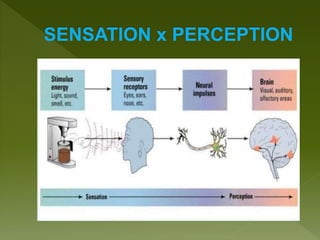
 Sensation refers to the basic sensory
experiences of environmental stimuli like
sounds, light, or odors.
 Perception occurs when we interpret the
sensory information received by sensory
organs.
“sensation precedes perception”
 Perception is defined as a process by which
individuals organize and interpret their
sensory impressions in order to give
meaning to their environment.
 Perception is the experience of objects,
events or relationships obtained by
extracting information from and interpreting
sensations.
- JH Jackson, O Desiderato & DB
Howieson
Individuals tend to organize environmental stimuli into some
meaningful patterns or whole according to certain principles.
Some of the important principles are:
1. Principle of Figure ground relationship
2. Principle of Closure
3. Principle of Grouping
4. Principle of Simplicity
5. Principle of Contour
6. Principle of Context
7. Principle of Contrast
8. Principle of Adaptability
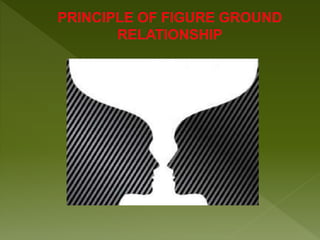
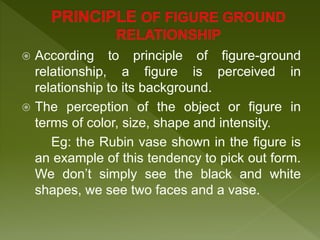
 According to principle of figure-ground
relationship, a figure is perceived in
relationship to its background.
 The perception of the object or figure in
terms of color, size, shape and intensity.
Eg: the Rubin vase shown in the figure is
an example of this tendency to pick out form.
We don’t simply see the black and white
shapes, we see two faces and a vase.
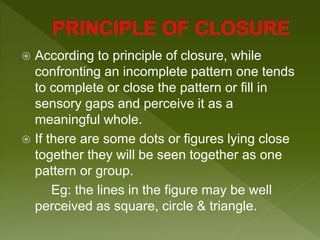
 According to principle of closure, while
confronting an incomplete pattern one tends
to complete or close the pattern or fill in
sensory gaps and perceive it as a
meaningful whole.
 If there are some dots or figures lying close
together they will be seen together as one
pattern or group.
Eg: the lines in the figure may be well
perceived as square, circle & triangle.
 It refers to a tendency to perceive stimuli in
some organized meaningful patterns by
grouping them on some solid basis.
 On the basis of
 similarity
 proximity
 continuity.
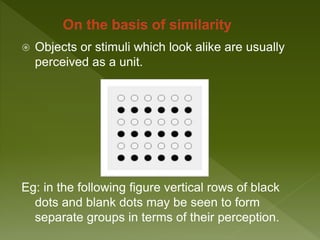
 Objects or stimuli which look alike are usually
perceived as a unit.
Eg: in the following figure vertical rows of black
dots and blank dots may be seen to form
separate groups in terms of their perception.
 Objects or stimuli which appear close to one
another are likely to be perceived as belonging to
the same group.
Eg: we see three sets of two lines each and not six
separate lines.
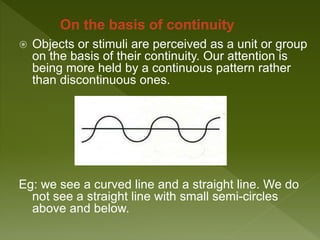
 Objects or stimuli are perceived as a unit or group
on the basis of their continuity. Our attention is
being more held by a continuous pattern rather
than discontinuous ones.
Eg: we see a curved line and a straight line. We do
not see a straight line with small semi-circles
above and below.
 We perceive the simplest possible pattern
because they enable the perceiver to
perceive the whole from some of its parts.
 A Contour is said to be a boundary between a
figure and its ground.
 The degree of the quality of this contour
separating the figure from the ground is
responsible for enabling us to organize stimuli
or objects into meaningful patterns.
 Perceptual organization is also governed by the
principle of context
 i.e. an examiner may award higher marks to the
same answer book in a pleasant context than in
an unpleasant one.
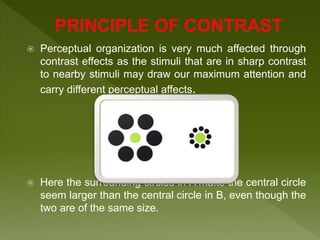
 Perceptual organization is very much affected through
contrast effects as the stimuli that are in sharp contrast
to nearby stimuli may draw our maximum attention and
carry different perceptual affects.
 Here the surrounding circles in A make the central circle
seem larger than the central circle in B, even though the
two are of the same size.
 The perceptual organization for some stimuli
depends upon the adaptability of the
perceiver to perceive similar stimuli.
 An individual who adapts himself to work
before an intense bright light will perceive
normal sunlight as quite dim.
 Sense organs - perception depends upon the sense organs or
receptors. Eg: if cones are not developed in the retina, color cannot
be perceived.
 Brain – perception depends upon the functioning capacity of
sensory area and the association areas of the brain. Eg: if the
auditory area is destroyed we cannot have auditory perception.
 Memory images of the past experience – memory images help
us in the comprehension of the object or stimulus before us. Eg: a
child has come in contact with a horse for the first time. He has
already seen a cow. When he is asked what it (horse) is, he may
say it is a cow or like a cow.
 Personal interests and Mind set- we perceive those things
quickly and clearly.
 Acquired Interests – it also determines the object or objects,
which we perceive. A person who has a hobby of collecting
stamps will quickly notice any new stamp on a letter.
 Needs & Desires – our needs or desires also modify our
perceptions. Besides these, our beliefs, opinions and cultural
ideals also modify our perception of things, situations and objects.
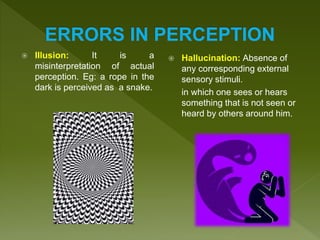
 Illusion: It is a
misinterpretation of actual
perception. Eg: a rope in the
dark is perceived as a snake.
 Hallucination: Absence of
any corresponding external
sensory stimuli.
in which one sees or hears
something that is not seen or
heard by others around him.
 Defective functioning of sense organs
 Inadequate stimulus
 Too many stimuli at one time.
 Poor health
 Limited attention
 Figure merges in the ground
 Guidance
Perception (Psychology for Nurses)

Perception (Psychology for Nurses)

  • 2.
  • 4.
     When oursense organs come in contact with the world and are stimulated by external stimuli and receive sensations, it results in perception.  Perception is the interpretation of sensory stimuli.
  • 5.
     Sensation refersto the basic sensory experiences of environmental stimuli like sounds, light, or odors.  Perception occurs when we interpret the sensory information received by sensory organs. “sensation precedes perception”
  • 7.
     Perception isdefined as a process by which individuals organize and interpret their sensory impressions in order to give meaning to their environment.  Perception is the experience of objects, events or relationships obtained by extracting information from and interpreting sensations. - JH Jackson, O Desiderato & DB Howieson
  • 8.
    Individuals tend toorganize environmental stimuli into some meaningful patterns or whole according to certain principles. Some of the important principles are: 1. Principle of Figure ground relationship 2. Principle of Closure 3. Principle of Grouping 4. Principle of Simplicity 5. Principle of Contour 6. Principle of Context 7. Principle of Contrast 8. Principle of Adaptability
  • 10.
     According toprinciple of figure-ground relationship, a figure is perceived in relationship to its background.  The perception of the object or figure in terms of color, size, shape and intensity. Eg: the Rubin vase shown in the figure is an example of this tendency to pick out form. We don’t simply see the black and white shapes, we see two faces and a vase.
  • 12.
     According toprinciple of closure, while confronting an incomplete pattern one tends to complete or close the pattern or fill in sensory gaps and perceive it as a meaningful whole.  If there are some dots or figures lying close together they will be seen together as one pattern or group. Eg: the lines in the figure may be well perceived as square, circle & triangle.
  • 13.
     It refersto a tendency to perceive stimuli in some organized meaningful patterns by grouping them on some solid basis.  On the basis of  similarity  proximity  continuity.
  • 14.
     Objects orstimuli which look alike are usually perceived as a unit. Eg: in the following figure vertical rows of black dots and blank dots may be seen to form separate groups in terms of their perception.
  • 15.
     Objects orstimuli which appear close to one another are likely to be perceived as belonging to the same group. Eg: we see three sets of two lines each and not six separate lines.
  • 16.
     Objects orstimuli are perceived as a unit or group on the basis of their continuity. Our attention is being more held by a continuous pattern rather than discontinuous ones. Eg: we see a curved line and a straight line. We do not see a straight line with small semi-circles above and below.
  • 17.
     We perceivethe simplest possible pattern because they enable the perceiver to perceive the whole from some of its parts.
  • 18.
     A Contouris said to be a boundary between a figure and its ground.  The degree of the quality of this contour separating the figure from the ground is responsible for enabling us to organize stimuli or objects into meaningful patterns.
  • 19.
     Perceptual organizationis also governed by the principle of context  i.e. an examiner may award higher marks to the same answer book in a pleasant context than in an unpleasant one.
  • 20.
     Perceptual organizationis very much affected through contrast effects as the stimuli that are in sharp contrast to nearby stimuli may draw our maximum attention and carry different perceptual affects.  Here the surrounding circles in A make the central circle seem larger than the central circle in B, even though the two are of the same size.
  • 21.
     The perceptualorganization for some stimuli depends upon the adaptability of the perceiver to perceive similar stimuli.  An individual who adapts himself to work before an intense bright light will perceive normal sunlight as quite dim.
  • 22.
     Sense organs- perception depends upon the sense organs or receptors. Eg: if cones are not developed in the retina, color cannot be perceived.  Brain – perception depends upon the functioning capacity of sensory area and the association areas of the brain. Eg: if the auditory area is destroyed we cannot have auditory perception.  Memory images of the past experience – memory images help us in the comprehension of the object or stimulus before us. Eg: a child has come in contact with a horse for the first time. He has already seen a cow. When he is asked what it (horse) is, he may say it is a cow or like a cow.
  • 23.
     Personal interestsand Mind set- we perceive those things quickly and clearly.  Acquired Interests – it also determines the object or objects, which we perceive. A person who has a hobby of collecting stamps will quickly notice any new stamp on a letter.  Needs & Desires – our needs or desires also modify our perceptions. Besides these, our beliefs, opinions and cultural ideals also modify our perception of things, situations and objects.
  • 24.
     Illusion: Itis a misinterpretation of actual perception. Eg: a rope in the dark is perceived as a snake.  Hallucination: Absence of any corresponding external sensory stimuli. in which one sees or hears something that is not seen or heard by others around him.
  • 25.
     Defective functioningof sense organs  Inadequate stimulus  Too many stimuli at one time.  Poor health  Limited attention  Figure merges in the ground  Guidance