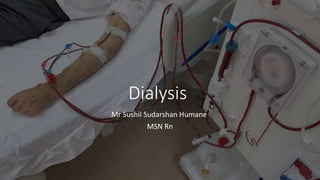
Dialysis
Mr Sushil Sudarshan Humane
MSN Rn
Introduction
• Dialysis is the procedure used to correct fluid and
electrolyte imbalances and to remove waste
products in renal failure.
• waste removal and fluid removal.
• Do Not Do not correct the endocrine functions of
the kidney. Hence , dialysis is not a cure for kidney
failure.
Hemodialysis
• How long does hemodialysis take?
• Hemodialysis usually is done three times a week.
• Each treatment lasts from 2 to 4 hours.
• During treatment, patient can read, write, sleep, talk, or watch TV.
Hemodialysis
• Dialyzer are hollow-fiber artificial kidneys that contain thousands
of tiny tubules that act as semipermeable membranes.
• The blood flows through the tubules, while a solution (the
dialysate) circulates around the tubules.
• The exchange of wastes from the blood to the dialysate occurs
through the semipermeable membrane of the tubules
• The blood flows in one direction and the dialysate flows in
the opposite.
hemodialysis
• Diffusion- movement of solutes from
an area of greater concentration to an
area of lower concentration.
• In renal failure urea, creatinine, uric
acid, and electrolytes( Potassium,
phosphate), move from the blood to
the dialysate with the net effect of
lowering their concentration in the
blood.
• But WBC’s, RBC’s and other contents
within the blood are too large to
diffuse across the membrane.
Hemodialysis
• The movement of fluid from an area of lesser to an area of greater
concentration of solutes.
• Glucose is added to the dialyzing solution and creates an osmotic
gradient across the membrane to remove excess fluid from the blood.
Hemodialysis
• Ultra filtration is defined as water
moving under high pressure to an
area of lower pressure. This process is
much more efficient at water removal
than osmosis.
• Ultra filtration is accomplished by
applying negative pressure or a
suctioning force to the dialysis
membrane.
Hemodialysis
• Access to the patient’s
vascular system must be
established to allow blood to
be removed, cleansed, and
returned to the patient’s
vascular system .
• Several types of access are
available.
• Fistula
• Graft
Hemodialysis
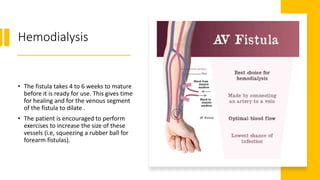
• FISTULA A more permanent access.
• Created surgically (usually in the
forearm) by joining an artery to a
vein, either side to side or end to
side.
• The arterial segment of the fistula is
used for arterial flow and the venous
segment for reinfusion of the dialyzed
blood.
Hemodialysis
• The fistula takes 4 to 6 weeks to mature
before it is ready for use. This gives time
for healing and for the venous segment
of the fistula to dilate .
• The patient is encouraged to perform
exercises to increase the size of these
vessels (i.e, squeezing a rubber ball for
forearm fistulas).
Hemodialysis
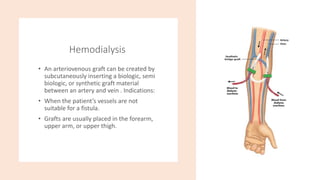
• An arteriovenous graft can be created by
subcutaneously inserting a biologic, semi
biologic, or synthetic graft material
between an artery and vein . Indications:
• When the patient’s vessels are not
suitable for a fistula.
• Grafts are usually placed in the forearm,
upper arm, or upper thigh.
Peritoneal dialysis
• Peritoneal membrane , serves as the
semi permeable membrane for
dialysis.
• It involves repeated cycle of instilling
dialyzing solution into the peritoneal
cavity through a catheter into it.
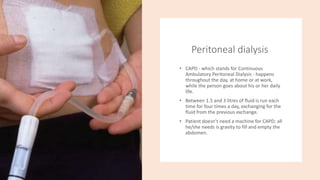
Peritoneal dialysis
• CAPD - which stands for Continuous
Ambulatory Peritoneal Dialysis - happens
throughout the day, at home or at work,
while the person goes about his or her daily
life.
• Between 1.5 and 3 litres of fluid is run each
time for four times a day, exchanging for the
fluid from the previous exchange.
• Patient doesn’t need a machine for CAPD; all
he/she needs is gravity to fill and empty the
abdomen.
Peritoneal Dialysis
• PD - Automated Peritoneal
Dialysis - in which the
dialysate solution is changed
by a machine, at night, while
you are asleep.
• The machine will exchange
8-12 litres over 8-10 hours
Complications
HEMODIALYSIS
• Hypotension
• Muscles cramps
• Clot formation
• Septicemia
• Hepatitis
• Disequilibrium syndrome
PERITONEAL DIALYSIS
• Exit site infection,
• peritonotis,
• abdominal pain
• Hernia
• Lowback pain
• Protein loss
• Atelactasis and pneumonia
Nursing responsibility
• Informed Consent
• Explanation
• Ask the patient to void.
• Check Wt., vitals ( BP ) at the beginning and at least every 30 minutes.
• Check for cannula and fistula for patency and palpate for the thrill and auscultation of bruits.
• Withhold antihypertensive on the day of HD.
• Assurance
Nursing responsibility
• Regular observation of complications.
• Check and record vitals X15 minutes.
• Serve foods as patient’s interest ( not for hypotensive prone patients)
• Each treatment lasts from 2 to 4 hours. During treatment, Pt. is allowed to read,
write, sleep, talk, or watch TV.
• Back care and divertional therapy
• Inform to Dr. if complications.
Nursing responsibility
• Check and record vital signs, Wt. after HD and total UF.
• Record the condition of the patient.
• Medications as ordered( if)
• Explain about the care necessary after HD.
• Inform the family and patient of date for next dialysis.
• Send the patient home or ward.
Nursing responsibility
• Make sure that nurses or Dr check the access before and after each treatment.
• Use the access site only for dialysis.
• Keep access clean at all the time.
• Do not let anyone put a BP cuff on access arm.
• Do not wear jewellory or tight clothes over access site.
• Do not sleep with your access arm under head or body.
• Do not lift heavy objects or put pressure on access arm.
Nursing responsibility
• Care of vascular access.
• Detection of complications.
• Diet : Tell the patient
• to eat animal proteins such as meat and chicken.
• to Avoid too much potassium diet.
• to limit fluid intake
• to avoid excess salt.
• to limit foods contain the mineral phosphorus such as milk, cheese, nuts, etc.
Thank you

Dialysis.pptx

  • 1.
  • 2.
    Introduction • Dialysis isthe procedure used to correct fluid and electrolyte imbalances and to remove waste products in renal failure. • waste removal and fluid removal. • Do Not Do not correct the endocrine functions of the kidney. Hence , dialysis is not a cure for kidney failure.
  • 6.
    Hemodialysis • How longdoes hemodialysis take? • Hemodialysis usually is done three times a week. • Each treatment lasts from 2 to 4 hours. • During treatment, patient can read, write, sleep, talk, or watch TV.
  • 7.
    Hemodialysis • Dialyzer arehollow-fiber artificial kidneys that contain thousands of tiny tubules that act as semipermeable membranes. • The blood flows through the tubules, while a solution (the dialysate) circulates around the tubules. • The exchange of wastes from the blood to the dialysate occurs through the semipermeable membrane of the tubules • The blood flows in one direction and the dialysate flows in the opposite.
  • 9.
    hemodialysis • Diffusion- movementof solutes from an area of greater concentration to an area of lower concentration. • In renal failure urea, creatinine, uric acid, and electrolytes( Potassium, phosphate), move from the blood to the dialysate with the net effect of lowering their concentration in the blood. • But WBC’s, RBC’s and other contents within the blood are too large to diffuse across the membrane.
  • 10.
    Hemodialysis • The movementof fluid from an area of lesser to an area of greater concentration of solutes. • Glucose is added to the dialyzing solution and creates an osmotic gradient across the membrane to remove excess fluid from the blood.
  • 11.
    Hemodialysis • Ultra filtrationis defined as water moving under high pressure to an area of lower pressure. This process is much more efficient at water removal than osmosis. • Ultra filtration is accomplished by applying negative pressure or a suctioning force to the dialysis membrane.
  • 12.
    Hemodialysis • Access tothe patient’s vascular system must be established to allow blood to be removed, cleansed, and returned to the patient’s vascular system . • Several types of access are available. • Fistula • Graft
  • 13.
    Hemodialysis • FISTULA Amore permanent access. • Created surgically (usually in the forearm) by joining an artery to a vein, either side to side or end to side. • The arterial segment of the fistula is used for arterial flow and the venous segment for reinfusion of the dialyzed blood.
  • 14.
    Hemodialysis • The fistulatakes 4 to 6 weeks to mature before it is ready for use. This gives time for healing and for the venous segment of the fistula to dilate . • The patient is encouraged to perform exercises to increase the size of these vessels (i.e, squeezing a rubber ball for forearm fistulas).
  • 15.
    Hemodialysis • An arteriovenousgraft can be created by subcutaneously inserting a biologic, semi biologic, or synthetic graft material between an artery and vein . Indications: • When the patient’s vessels are not suitable for a fistula. • Grafts are usually placed in the forearm, upper arm, or upper thigh.
  • 16.
    Peritoneal dialysis • Peritonealmembrane , serves as the semi permeable membrane for dialysis. • It involves repeated cycle of instilling dialyzing solution into the peritoneal cavity through a catheter into it.
  • 17.
    Peritoneal dialysis • CAPD- which stands for Continuous Ambulatory Peritoneal Dialysis - happens throughout the day, at home or at work, while the person goes about his or her daily life. • Between 1.5 and 3 litres of fluid is run each time for four times a day, exchanging for the fluid from the previous exchange. • Patient doesn’t need a machine for CAPD; all he/she needs is gravity to fill and empty the abdomen.
  • 18.
    Peritoneal Dialysis • PD- Automated Peritoneal Dialysis - in which the dialysate solution is changed by a machine, at night, while you are asleep. • The machine will exchange 8-12 litres over 8-10 hours
  • 19.
    Complications HEMODIALYSIS • Hypotension • Musclescramps • Clot formation • Septicemia • Hepatitis • Disequilibrium syndrome PERITONEAL DIALYSIS • Exit site infection, • peritonotis, • abdominal pain • Hernia • Lowback pain • Protein loss • Atelactasis and pneumonia
  • 20.
    Nursing responsibility • InformedConsent • Explanation • Ask the patient to void. • Check Wt., vitals ( BP ) at the beginning and at least every 30 minutes. • Check for cannula and fistula for patency and palpate for the thrill and auscultation of bruits. • Withhold antihypertensive on the day of HD. • Assurance
  • 21.
    Nursing responsibility • Regularobservation of complications. • Check and record vitals X15 minutes. • Serve foods as patient’s interest ( not for hypotensive prone patients) • Each treatment lasts from 2 to 4 hours. During treatment, Pt. is allowed to read, write, sleep, talk, or watch TV. • Back care and divertional therapy • Inform to Dr. if complications.
  • 22.
    Nursing responsibility • Checkand record vital signs, Wt. after HD and total UF. • Record the condition of the patient. • Medications as ordered( if) • Explain about the care necessary after HD. • Inform the family and patient of date for next dialysis. • Send the patient home or ward.
  • 23.
    Nursing responsibility • Makesure that nurses or Dr check the access before and after each treatment. • Use the access site only for dialysis. • Keep access clean at all the time. • Do not let anyone put a BP cuff on access arm. • Do not wear jewellory or tight clothes over access site. • Do not sleep with your access arm under head or body. • Do not lift heavy objects or put pressure on access arm.
  • 24.
    Nursing responsibility • Careof vascular access. • Detection of complications. • Diet : Tell the patient • to eat animal proteins such as meat and chicken. • to Avoid too much potassium diet. • to limit fluid intake • to avoid excess salt. • to limit foods contain the mineral phosphorus such as milk, cheese, nuts, etc.
  • 25.