

THINKING AND
REASONING
Mr. Sushil Humane MSN, RN
Introduction
โ€ข People think-thatโ€™s obvious.
โ€ข Human are rational beings & our
rationality consists in our ability to
think & reason.
โ€ข It is because of our capacity for
better thinking that we are superior
to other animals in learning & in
making adjustment.
โ€ข During most of our waking hours,
& even when we are asleep &
dreaming, we are thinking, What
are you thinking about right now.
Definition
โ€ข Thinking is an activity concerning ideas,
symbolic in character initiated by a
problem or task which the individual is
facing, involving some trial & error but
under the directing influence of that
problem & ultimately leading to a
conclusion or solution of the problem.
(Warren)
โ€ข Thinking is the organization &
reorganization of current learning in the
present circumstances with the help of
learning & past experiences. (Vinacke-
1968)
โ€ข Thinking is the perceptual relationship
which provides for the solution of the
problem. (Maier)
Nature of
thinking
โ€ข It is essentially a
cognitive activity.
โ€ข It is always directed to
achieve some end or
purpose.
โ€ข It is described as a
problem-solving
behavior.
โ€ข It is a symbolic
activity.
โ€ข It is mental
exploration instead of
motor exploration.
โ€ข It can shift very
rapidly.
โ€ข It is internal activity.
Types of thinking
1. Perceptual or concrete
thinking
2. Conceptual or abstract
thinking
3. Creative thinking
4. Logical thinking/
reasoning
5. Problem solving
6. Convergent Vs Divergent
thinking
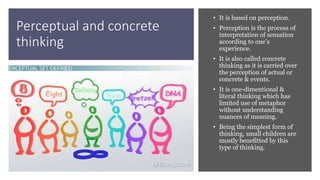
Perceptual and concrete
thinking
โ€ข It is based on perception.
โ€ข Perception is the process of
interpretation of sensation
according to oneโ€™s
experience.
โ€ข It is also called concrete
thinking as it is carried over
the perception of actual or
concrete & events.
โ€ข It is one-dimentional &
literal thinking which has
limited use of metaphor
without understanding
nuances of meaning.
โ€ข Being the simplest form of
thinking, small children are
mostly benefitted by this
type of thinking.
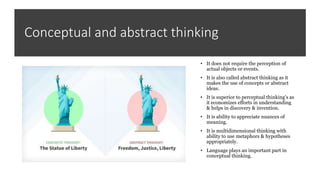
Conceptual and abstract thinking
โ€ข It does not require the perception of
actual objects or events.
โ€ข It is also called abstract thinking as it
makes the use of concepts or abstract
ideas.
โ€ข It is superior to perceptual thinking's as
it economizes efforts in understanding
& helps in discovery & invention.
โ€ข It is ability to appreciate nuances of
meaning.
โ€ข It is multidimensional thinking with
ability to use metaphors & hypotheses
appropriately.
โ€ข Language plays an important part in
conceptual thinking.
Creative thinking
โ€ข It refers to the ability for
original thinking, to create or
discover something new.
โ€ข It is the ability to integrate the
various elements of the
situation into a harmonious
whole to create something
novel.
โ€ข In other words, cognitive
activity directed towards some
creative work refers to creative
thinking.
โ€ข Creative thinkers are great
boons to the society as they
enrich the knowledge of
mankind.
โ€ข The creative thinker tries to
achieve something new, to
produce something original &
something unique
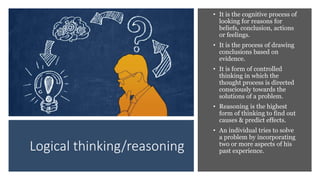
Logical thinking/reasoning
โ€ข It is the cognitive process of
looking for reasons for
beliefs, conclusion, actions
or feelings.
โ€ข It is the process of drawing
conclusions based on
evidence.
โ€ข It is form of controlled
thinking in which the
thought process is directed
consciously towards the
solutions of a problem.
โ€ข Reasoning is the highest
form of thinking to find out
causes & predict effects.
โ€ข An individual tries to solve
a problem by incorporating
two or more aspects of his
past experience.
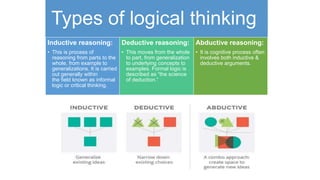
Types of logical thinking
Inductive reasoning:
โ€ข This is process of
reasoning from parts to the
whole, from example to
generalizations. It is carried
out generally within
the field known as informal
logic or critical thinking.
Deductive reasoning:
โ€ข This moves from the whole
to part, from generalization
to underlying concepts to
examples. Formal logic is
described as โ€œthe science
of deduction.โ€
Abductive reasoning:
โ€ข It is cognitive process often
involves both inductive &
deductive arguments.
Problem solving
โ€ข It is a tool, skill & a process.
โ€ข It is a tool because it can help you solve an immediate
problem or to achieve a goal.
โ€ข It is a skill because once you have learnt it you can use it
repeatedly, like the ability to ride a bicycle, add numbers
or speak a language.
โ€ข It is also a process because it involve taking a number of
steps.
โ€ข You can engage in problem solving if you want to reach a
goal & experience obstacles on the way.
โ€ข At the point at which you come up against a barrier you
can engage in a problem solving process to help you
achieve your goal.
Contiโ€ฆ
โ€ข Every time you use a problem
solving process, you are
increasing your problem solving
skill.
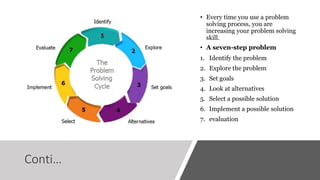
โ€ข A seven-step problem
1. Identify the problem
2. Explore the problem
3. Set goals
4. Look at alternatives
5. Select a possible solution
6. Implement a possible solution
7. evaluation
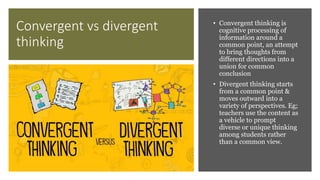
Convergent vs divergent
thinking
โ€ข Convergent thinking is
cognitive processing of
information around a
common point, an attempt
to bring thoughts from
different directions into a
union for common
conclusion
โ€ข Divergent thinking starts
from a common point &
moves outward into a
variety of perspectives. Eg;
teachers use the content as
a vehicle to prompt
diverse or unique thinking
among students rather
than a common view.
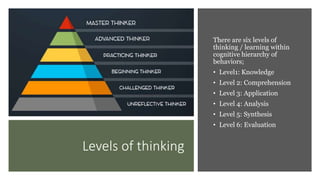
Levels of thinking
There are six levels of
thinking / learning within
cognitive hierarchy of
behaviors;
โ€ข Level1: Knowledge
โ€ข Level 2: Comprehension
โ€ข Level 3: Application
โ€ข Level 4: Analysis
โ€ข Level 5: Synthesis
โ€ข Level 6: Evaluation
Knowledge
โ€ข It involve recall of facts, principles &
terms in the forms in which they are
learned.
โ€ข Key words: who, what, when, omit,
where, which, choose, find, how,
define, label, show, spell, list, match,
name, relate, tell, recall, select.
โ€ข Eg; When did --------------------------
happen?
Which one -----------------------
----? 2
Comprehension
โ€ข It represent the lowest form of
understanding.
โ€ข The student knows what is being
communicated without relating it
to other material or seeing it in
its fullest meaning.
โ€ข It demonstrates understanding
of facts & ideas by organizing,
comparing, translating,
interpreting, giving descriptions
& stating main ideas.
โ€ข Key words: Compare, contrast,
demonstrate, interpret, explain,
extend, illustrate, infer, outline,
relate, rephrase, translate,
summarize, show, classify.
โ€ข Eg; What facts or ideas show-----
--------?
Which is the best answer-
---------?
Application
โ€ข It involve the use of
abstractions in concrete
situation such as nursing or
other specific situations.
โ€ข It is solving problems by
applying acquired
knowledge, facts,
techniques & rules in a
different way.
โ€ข Key words: apply, build,
choose, construct develop,
interview, make use of,
organize, experiment with
plan, select, solve, utilize,
model, identify.
โ€ข Eg; What would result if----
----------?
Can you make use of
the facts to--------?
Analysis
โ€ข It is examining & breaking
information into parts by
identifying motives or causes;
making inferences & finding
evidence to support
generalization.
โ€ข Key words: analyze,
compare, contrast, discover,
dissect, divide, examine,
inspect, simplify, survey, take
part in, test for, distinguish,
list, distinction, theme,
relationships, function, motive,
inferences, assumption,
conclusion.
โ€ข Eg; What are key parts or
features of-------------?
What motive is there----
-------------?
What evidence can you
find---------------?
Synthesis
โ€ข It is compiling information
together in a different way by
combining element in a new
pattern or proposing
alternative solution.
โ€ข Key words: build, choose,
combine, compile, compose,
construct, create, design,
develop, estimate, formulate,
imagine, invent, makeup,
originate, plan, predict,
propose, solve solution etc.
โ€ข Eg; Can you propose an
alternative-----------?
Can you formulate a
theory for-----------?
What facts can you
compile-----------?
Evaluation
โ€ข It is presenting & defending
opinion by making judgment
about information, validity of
ideas or quality of work based
on a set of criteria.
โ€ข Key words: award, choose,
conclude, criticize, decide,
defend, determine, evaluate,
judge, justify, measure,
compare, mark, rate,
recommend, prioritize, prove,
disprove etc.
โ€ข Eg; What is your opinion of----
----------?
Would it be better if-----
----------?
How would you rate
the-----------------?
Alterations in
thinking
โ€ข Psychosis
โ€ข Delusion
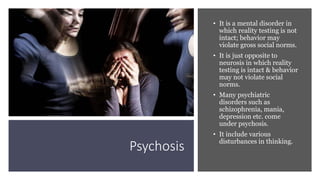
Psychosis
โ€ข It is a mental disorder in
which reality testing is not
intact; behavior may
violate gross social norms.
โ€ข It is just opposite to
neurosis in which reality
testing is intact & behavior
may not violate social
norms.
โ€ข Many psychiatric
disorders such as
schizophrenia, mania,
depression etc. come
under psychosis.
โ€ข It include various
disturbances in thinking.
Delusion
โ€ข It is false, persistent,
irrational belief not shared
by persons of same age,
race, education standard
which cannot be altered by
logical arguments.
Delusions are classified into:
โ€ข Persecutory delusion
โ€ข Delusion of reference
โ€ข Delusion of influence
โ€ข Delusion of guilt
โ€ข Hypochondrical delusion
โ€ข Nihilistic delusion
โ€ข Delusion of grandeur
Reasoning
Mr. Sushil Humane MSN, RN
Definition of
reasoning
โ€ข Reasoning is step-wise thinking with a purpose or goal in mind. -
(Garrett -1968)
โ€ข Reasoning is combining past experience in order to solve a
problem which cannot be solved by mere reproduction of earlier
solutions. -(Mann -1967)
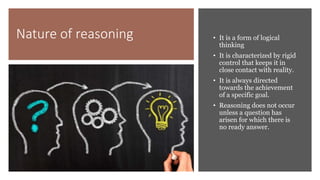
Nature of reasoning โ€ข It is a form of logical
thinking
โ€ข It is characterized by rigid
control that keeps it in
close contact with reality.
โ€ข It is always directed
towards the achievement
of a specific goal.
โ€ข Reasoning does not occur
unless a question has
arisen for which there is
no ready answer.
Types of reasoning
Inductive Reasoning
โ€ข (Proceed from specific facts
facts or observation to
general principles.)
โ€ข For example, iron expand
when heated
Deductive Reasoning
โ€ข (Proceed from general
principles to specific
situations)
โ€ข For examples, matter
expands when heated; iron
iron is a form of matter &
thus expands when heated.
References
โ€ข Anthikad, J. (2014). Psychology for graduate nurses: (general and educational
psychology) (5th ). Jaypee Brothers.
โ€ข Anand, N. K., & Goel, S. (2009). Psychology for nurses. A.I.T.B.S. Publishers.
โ€ข Shreevani, R. (2016). Psychology for nurses. Jaypee Brothers.
โ€ข Basawanthappa, B. T. (2010). Psychology for nurses. Jaypee Brothers.

Thinking and reasoning

  • 1.
  • 2.
    Introduction โ€ข People think-thatโ€™sobvious. โ€ข Human are rational beings & our rationality consists in our ability to think & reason. โ€ข It is because of our capacity for better thinking that we are superior to other animals in learning & in making adjustment. โ€ข During most of our waking hours, & even when we are asleep & dreaming, we are thinking, What are you thinking about right now.
  • 3.
    Definition โ€ข Thinking isan activity concerning ideas, symbolic in character initiated by a problem or task which the individual is facing, involving some trial & error but under the directing influence of that problem & ultimately leading to a conclusion or solution of the problem. (Warren) โ€ข Thinking is the organization & reorganization of current learning in the present circumstances with the help of learning & past experiences. (Vinacke- 1968) โ€ข Thinking is the perceptual relationship which provides for the solution of the problem. (Maier)
  • 4.
    Nature of thinking โ€ข Itis essentially a cognitive activity. โ€ข It is always directed to achieve some end or purpose. โ€ข It is described as a problem-solving behavior. โ€ข It is a symbolic activity. โ€ข It is mental exploration instead of motor exploration. โ€ข It can shift very rapidly. โ€ข It is internal activity.
  • 5.
    Types of thinking 1.Perceptual or concrete thinking 2. Conceptual or abstract thinking 3. Creative thinking 4. Logical thinking/ reasoning 5. Problem solving 6. Convergent Vs Divergent thinking
  • 6.
    Perceptual and concrete thinking โ€ขIt is based on perception. โ€ข Perception is the process of interpretation of sensation according to oneโ€™s experience. โ€ข It is also called concrete thinking as it is carried over the perception of actual or concrete & events. โ€ข It is one-dimentional & literal thinking which has limited use of metaphor without understanding nuances of meaning. โ€ข Being the simplest form of thinking, small children are mostly benefitted by this type of thinking.
  • 7.
    Conceptual and abstractthinking โ€ข It does not require the perception of actual objects or events. โ€ข It is also called abstract thinking as it makes the use of concepts or abstract ideas. โ€ข It is superior to perceptual thinking's as it economizes efforts in understanding & helps in discovery & invention. โ€ข It is ability to appreciate nuances of meaning. โ€ข It is multidimensional thinking with ability to use metaphors & hypotheses appropriately. โ€ข Language plays an important part in conceptual thinking.
  • 8.
    Creative thinking โ€ข Itrefers to the ability for original thinking, to create or discover something new. โ€ข It is the ability to integrate the various elements of the situation into a harmonious whole to create something novel. โ€ข In other words, cognitive activity directed towards some creative work refers to creative thinking. โ€ข Creative thinkers are great boons to the society as they enrich the knowledge of mankind. โ€ข The creative thinker tries to achieve something new, to produce something original & something unique
  • 9.
    Logical thinking/reasoning โ€ข Itis the cognitive process of looking for reasons for beliefs, conclusion, actions or feelings. โ€ข It is the process of drawing conclusions based on evidence. โ€ข It is form of controlled thinking in which the thought process is directed consciously towards the solutions of a problem. โ€ข Reasoning is the highest form of thinking to find out causes & predict effects. โ€ข An individual tries to solve a problem by incorporating two or more aspects of his past experience.
  • 10.
    Types of logicalthinking Inductive reasoning: โ€ข This is process of reasoning from parts to the whole, from example to generalizations. It is carried out generally within the field known as informal logic or critical thinking. Deductive reasoning: โ€ข This moves from the whole to part, from generalization to underlying concepts to examples. Formal logic is described as โ€œthe science of deduction.โ€ Abductive reasoning: โ€ข It is cognitive process often involves both inductive & deductive arguments.
  • 11.
    Problem solving โ€ข Itis a tool, skill & a process. โ€ข It is a tool because it can help you solve an immediate problem or to achieve a goal. โ€ข It is a skill because once you have learnt it you can use it repeatedly, like the ability to ride a bicycle, add numbers or speak a language. โ€ข It is also a process because it involve taking a number of steps. โ€ข You can engage in problem solving if you want to reach a goal & experience obstacles on the way. โ€ข At the point at which you come up against a barrier you can engage in a problem solving process to help you achieve your goal.
  • 12.
    Contiโ€ฆ โ€ข Every timeyou use a problem solving process, you are increasing your problem solving skill. โ€ข A seven-step problem 1. Identify the problem 2. Explore the problem 3. Set goals 4. Look at alternatives 5. Select a possible solution 6. Implement a possible solution 7. evaluation
  • 13.
    Convergent vs divergent thinking โ€ขConvergent thinking is cognitive processing of information around a common point, an attempt to bring thoughts from different directions into a union for common conclusion โ€ข Divergent thinking starts from a common point & moves outward into a variety of perspectives. Eg; teachers use the content as a vehicle to prompt diverse or unique thinking among students rather than a common view.
  • 14.
    Levels of thinking Thereare six levels of thinking / learning within cognitive hierarchy of behaviors; โ€ข Level1: Knowledge โ€ข Level 2: Comprehension โ€ข Level 3: Application โ€ข Level 4: Analysis โ€ข Level 5: Synthesis โ€ข Level 6: Evaluation
  • 15.
    Knowledge โ€ข It involverecall of facts, principles & terms in the forms in which they are learned. โ€ข Key words: who, what, when, omit, where, which, choose, find, how, define, label, show, spell, list, match, name, relate, tell, recall, select. โ€ข Eg; When did -------------------------- happen? Which one ----------------------- ----? 2
  • 16.
    Comprehension โ€ข It representthe lowest form of understanding. โ€ข The student knows what is being communicated without relating it to other material or seeing it in its fullest meaning. โ€ข It demonstrates understanding of facts & ideas by organizing, comparing, translating, interpreting, giving descriptions & stating main ideas. โ€ข Key words: Compare, contrast, demonstrate, interpret, explain, extend, illustrate, infer, outline, relate, rephrase, translate, summarize, show, classify. โ€ข Eg; What facts or ideas show----- --------? Which is the best answer- ---------?
  • 17.
    Application โ€ข It involvethe use of abstractions in concrete situation such as nursing or other specific situations. โ€ข It is solving problems by applying acquired knowledge, facts, techniques & rules in a different way. โ€ข Key words: apply, build, choose, construct develop, interview, make use of, organize, experiment with plan, select, solve, utilize, model, identify. โ€ข Eg; What would result if---- ----------? Can you make use of the facts to--------?
  • 18.
    Analysis โ€ข It isexamining & breaking information into parts by identifying motives or causes; making inferences & finding evidence to support generalization. โ€ข Key words: analyze, compare, contrast, discover, dissect, divide, examine, inspect, simplify, survey, take part in, test for, distinguish, list, distinction, theme, relationships, function, motive, inferences, assumption, conclusion. โ€ข Eg; What are key parts or features of-------------? What motive is there---- -------------? What evidence can you find---------------?
  • 19.
    Synthesis โ€ข It iscompiling information together in a different way by combining element in a new pattern or proposing alternative solution. โ€ข Key words: build, choose, combine, compile, compose, construct, create, design, develop, estimate, formulate, imagine, invent, makeup, originate, plan, predict, propose, solve solution etc. โ€ข Eg; Can you propose an alternative-----------? Can you formulate a theory for-----------? What facts can you compile-----------?
  • 20.
    Evaluation โ€ข It ispresenting & defending opinion by making judgment about information, validity of ideas or quality of work based on a set of criteria. โ€ข Key words: award, choose, conclude, criticize, decide, defend, determine, evaluate, judge, justify, measure, compare, mark, rate, recommend, prioritize, prove, disprove etc. โ€ข Eg; What is your opinion of---- ----------? Would it be better if----- ----------? How would you rate the-----------------?
  • 21.
  • 22.
    Psychosis โ€ข It isa mental disorder in which reality testing is not intact; behavior may violate gross social norms. โ€ข It is just opposite to neurosis in which reality testing is intact & behavior may not violate social norms. โ€ข Many psychiatric disorders such as schizophrenia, mania, depression etc. come under psychosis. โ€ข It include various disturbances in thinking.
  • 23.
    Delusion โ€ข It isfalse, persistent, irrational belief not shared by persons of same age, race, education standard which cannot be altered by logical arguments. Delusions are classified into: โ€ข Persecutory delusion โ€ข Delusion of reference โ€ข Delusion of influence โ€ข Delusion of guilt โ€ข Hypochondrical delusion โ€ข Nihilistic delusion โ€ข Delusion of grandeur
  • 24.
  • 25.
    Definition of reasoning โ€ข Reasoningis step-wise thinking with a purpose or goal in mind. - (Garrett -1968) โ€ข Reasoning is combining past experience in order to solve a problem which cannot be solved by mere reproduction of earlier solutions. -(Mann -1967)
  • 26.
    Nature of reasoningโ€ข It is a form of logical thinking โ€ข It is characterized by rigid control that keeps it in close contact with reality. โ€ข It is always directed towards the achievement of a specific goal. โ€ข Reasoning does not occur unless a question has arisen for which there is no ready answer.
  • 27.
    Types of reasoning InductiveReasoning โ€ข (Proceed from specific facts facts or observation to general principles.) โ€ข For example, iron expand when heated Deductive Reasoning โ€ข (Proceed from general principles to specific situations) โ€ข For examples, matter expands when heated; iron iron is a form of matter & thus expands when heated.
  • 28.
    References โ€ข Anthikad, J.(2014). Psychology for graduate nurses: (general and educational psychology) (5th ). Jaypee Brothers. โ€ข Anand, N. K., & Goel, S. (2009). Psychology for nurses. A.I.T.B.S. Publishers. โ€ข Shreevani, R. (2016). Psychology for nurses. Jaypee Brothers. โ€ข Basawanthappa, B. T. (2010). Psychology for nurses. Jaypee Brothers.