UNIT 3
PSYCHOLOGY OF HUMAN BEHAVIOR
• BEHAVIOR:
– the range of actions and mannerisms (way of
speaking and behaving) made by individuals,
organisms, systems in conjunction with
themselves or their environment.
– It is the response of the system of organism to
various stimuli or inputs, whether internal or
external, conscious or sub conscious, voluntary or
involuntary.
– External reaction to its environment.
• In this unit we are going to discuss about
– WHY
– WHEN
– HOW
– WHAT
– WHERE
Of the human behavior
BASIC HUMAN NEEDS
• Needs:
– Require something because it is essential or very
important rather than just desirable.
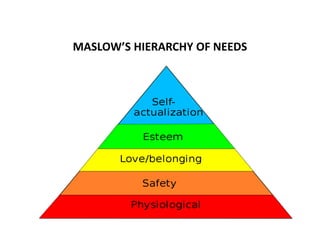
MASLOW’S HIERARCHY OF NEEDS
PHYSIOLOGICAL NEEDS
It is the biological requirements for human
survival e.g Air, food drink, shelter,
clothing , warmth, sex , sleep
If these needs are not satisfied the human
body cannot function optimally
Maslow considered physiological needs to
the most important
SAFETY NEEDS
Safety needs means need for protection
from elements, security , order, law,
stability, freedom from fear
Safety and security need are about keeping
us safe from harm
If a person does not feel safe in an
environment, they will seek to find before
they attempt to meet any higher level
needs
LOVE AND BELONGINGNESS NEED
Belongingness is a quality or state of being
an essential or important part of something
particularly to a group
Feelings of belongingness. The need for
interpersonal relationships motivations
behavior e.g friendship, intimacy , trust ,
acceptance, receiving and giving affection
Being a part of a group (family friend) work
etc.
ESTEEM NEEDS
Esteem means respect or admiration
Esteem needs are for a higher position within
a group and act to fosters pride in their work
and in themselves.
These needs include respect, achievement,
confident, recognition, and accomplishment
Maslow categorized it into 2:
Esteem of one self - achievement, mastery,
independent
Reputation or prestige
SELF ACTUALIZATION
Self actualization means realizaton
of potential
Self fulfillment
Seeking personal growth and
experience
It is the highest level of Maslow’s
hierarchy
 “What a man can be he must be”. Is
the basis of self actualization
Desire to become everything that one
is capable of becoming
DYNAMICS OF HUMAN BEHAVIOR
• HUMAN BEHAVIOR: is anything we do which
can be observed in someway
• Dynamics :
– forces or factors that produce movement or
change
– A force that stimulate change or progress within a
system or process
• Behavior includes:
– physical actions
– Verbal behavior
– Facial expressions or bodily gestures
• Dynamics of human behavior:
–These are the factors that
stimulate a change in human
behavior
–Are underlying causes of change
or determinants of human
behavior
–Human behavior can change
due to:
•New experience
•Learning
•Socio-cultural variation
•Biological and psychological
process
CATEGORIES OF HUMAN BEHAVIOR
–Biological/physiological dynamics
–Socio-cultural dynamics
–Psychological dynamics
• Biological / physiological
dynamics of human behavior:
–Genetic make – up
–Sex difference
–Physical growth
–Nutrition
–Illness and inborn disabilities
• Psychological dynamics of
human behavior:
–Cognition: mental action or process of
acquiring knowledge and understanding
through thought experience, and the
sense
–Perception: the ability to see, hear, or
become aware of something through the
senses
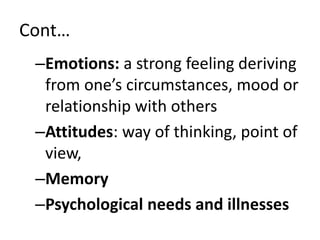
Cont…
–Emotions: a strong feeling deriving
from one’s circumstances, mood or
relationship with others
–Attitudes: way of thinking, point of
view,
–Memory
–Psychological needs and illnesses
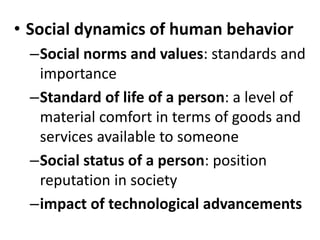
• Social dynamics of human behavior
–Social norms and values: standards and
importance
–Standard of life of a person: a level of
material comfort in terms of goods and
services available to someone
–Social status of a person: position
reputation in society
–impact of technological advancements
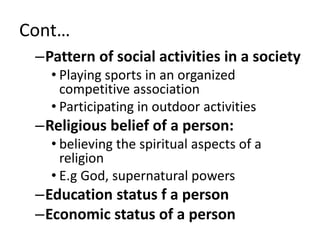
Cont…
–Pattern of social activities in a society
• Playing sports in an organized
competitive association
• Participating in outdoor activities
–Religious belief of a person:
• believing the spiritual aspects of a
religion
• E.g God, supernatural powers
–Education status f a person
–Economic status of a person
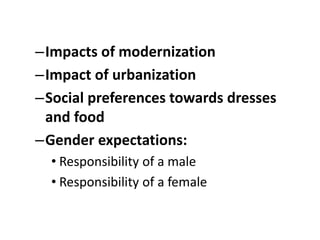
–Impacts of modernization
–Impact of urbanization
–Social preferences towards dresses
and food
–Gender expectations:
• Responsibility of a male
• Responsibility of a female
• Cultural dynamics of human
behavior
–Traditions:
• A custom or belief that existed for a long
time.
–Customs:
• Something you do usually, practices
• A usage or practice common to many or
to particular place or class or habitual
with an individual
Cont…
–Changes in language
–Cultural ceremonies
–Ethnocentrism:
• Act of judging another culture based on
preconceptions that are found in values
and standards of one’s own culture
– Xenocentrism :
• Preference of the products, styles, or ideas of
someone else’s culture rather than of one’s
own.
Cont…
– Changes in culture (the ideas, customs and
social behavior of a particular people or
society) across societies
– Material culture:
• Physical aspects of culture in the objects and
architecture that surround people
• Things that are created by human : cars,
building, clothing, and tools
– Non-materialistic culture
• The abstract ideas and ways of thinking that
make up a culture
• Traffic laws, words, dress codes etc
Cont…
–Cultural response towards social
innovations:
• Social innovations are new strategies,
concepts, ideas and organizations that
aim to meet social needs resulting
from working conditions, education,
community development, and health
–Cultural norms (standards) and values
(the importance or usefulness of
something)
Motivation and drives
• Why does an individual in the way
he does?
• What force is behind his behavior?
• What arouses or directs his
reactions?
• Why does a child get into temper?
• Why do some of us take pleasure
in bossing over others?
• Why do we dress well in a party?
• Why do you want to sleep or to
rest?
• What drives a person to steal and
to tell lies?
• Answer…………….
–MOTIVES
• What is motive?
–A force that determines the activity of
an individual.
–It is an inner force which moves a
person to certain action.
–Motives arouse TENSION
–In broad sense – it includes: needs,
basic drives, interests, likes and
dislikes, desires and attitudes because
all these move us to some action or
the other.
• Example:
–My hand has touched a hot stove. It
has been slightly burnt and in paining. I
see a pail of water and as soon as I see
it, I plunge my hand into it because I
was seeking and escape from pain. This
was my MOTIVE
• Motivation :
–Derived from the Latin word MOVERE
means to move or to activate
–A process which arouses energy or
drive in the individual to proceed in an
activity
• DRIVE:
–An aroused state of psychological
tension that typically arises from a
need.
–A drive such as hunger or thirst,
motivates the organism to act in ways
that will reduce the tension.
–When you become hungry (tension
caused by the need for food ) you are
motivated to eat (method of reducing
the tension).
• Nature of motivation:
–Based on motives
–Goal directed
–Related to satisfaction
–Person is motivated in totality
–Complex process
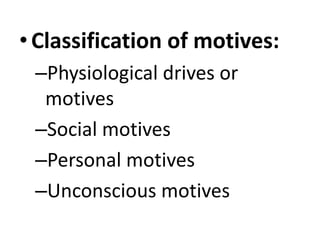
•Classification of motives:
–Physiological drives or
motives
–Social motives
–Personal motives
–Unconscious motives
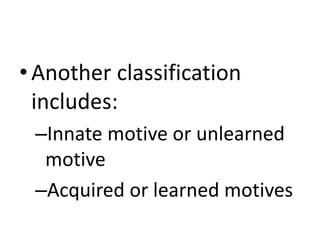
•Another classification
includes:
–Innate motive or unlearned
motive
–Acquired or learned motives
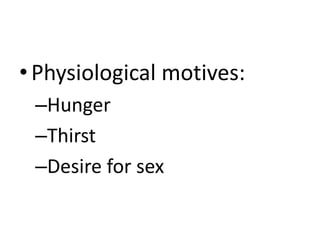
•Physiological motives:
–Hunger
–Thirst
–Desire for sex
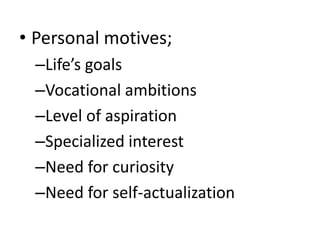
• Personal motives;
–Life’s goals
–Vocational ambitions
–Level of aspiration
–Specialized interest
–Need for curiosity
–Need for self-actualization
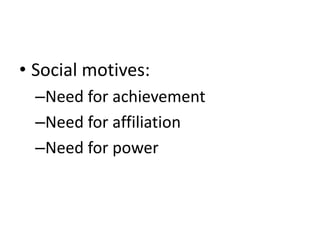
• Social motives:
–Need for achievement
–Need for affiliation
–Need for power
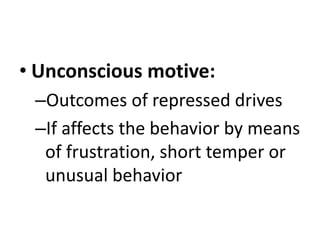
• Unconscious motive:
–Outcomes of repressed drives
–If affects the behavior by means
of frustration, short temper or
unusual behavior