Local Governments Thinking Lean: An Overview of Applying Lean Principles to Government Services Ben Thatcher
What is lean? Why implement lean in local government? How has Southlake implemented lean in local government? How can I learn more about lean?
“ The relentless pursuit of the elimination of  waste  from every process with the ultimate goal of providing  world-class  quality, delivery and service to our customers at the lowest possible cost.” What is Lean? “ It’s about the process – not the employee” Think about the “thing” going through the process – not “who” does it.
Lean Thinking is a cultural change, it’s a change in mind-set:  a continuous strive for perfection to eliminate all the waste. Cultural Change: A Change in Mind-set See Act Get To get the results, you have to act different. To act different, you have to see the difference. To see different, start with learning Lean Thinking . Change in mind-set
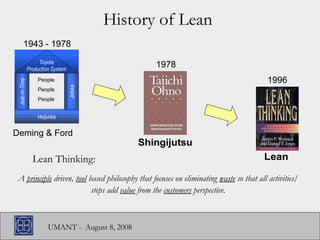
Jidoka Just - in - Time Toyota Production System Heijunka 1978 1996 1943 - 1978 History of Lean  A  principle  driven,  tool  based philosophy that focuses on eliminating  waste  so that all activities/steps add  value  from the  customers  perspective. Lean Thinking: People People People Deming & Ford
How Does Lean Work?
Lean Thinking Principles The continuous movement of    products, services and information from end to end through the process 3 Establish Flow Nothing is done by the upstream process until the downstream customer signals the need 4 Implement Pull The complete elimination of waste so all activities create value for the customer by continuous improvement. Use all principles again, and again. 5 Work to Perfection Define value from the customers perspective and express value in terms of a specific product 1 Specify Value 2  Map the  Value Stream Map all of the steps…value added &    non-value added…that bring a product    of service to the customer Lean  Thinking Lean Thinking Principles guide you through lean implementation
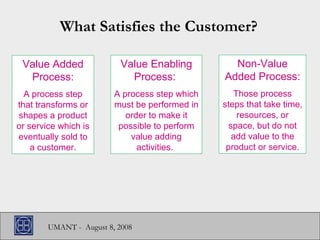
What Satisfies the Customer? Non-Value Added Process: Those process steps that take time, resources, or space, but do not add value to the product or service. Value Added Process: A process step that transforms or shapes a product or service which is eventually sold to a customer. Value Enabling Process:  A process step which must be performed in order to make it possible to perform value adding activities.
What is Waste? Activities that Create  No Value , but Add Cost and Time Focus: Find the Root Cause(s) and Eliminate Them Typical Process = 1-10% Activities Create Value
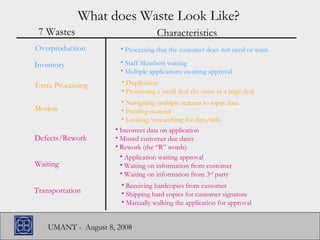
Overproduction Inventory Extra Processing Motion Defects/Rework Waiting Transportation Processing that the customer does not need or want Duplication Processing a small deal the same as a large deal Navigating multiple screens to input data Printing material Looking/researching for data/info Incorrect data on application Missed customer due dates Rework (the “R” words) Application waiting approval Waiting on information from customer Waiting on information from 3 rd  party Receiving hardcopies from customer Shipping hard copies for customer signature Manually walking the application for approval 7 Wastes Characteristics Staff Members waiting Multiple applications awaiting approval What does Waste Look Like?
Kaizen   \ Ki-zen \ a continual improvement mindset.  Everything that we do today can be improved.  Kaizen has no end. Kai =   Change Zen =  For the Better A Healthy Dissatisfaction with the Status Quo Definition of Kaizen
Toast Kaizen Video
Highly Skilled and Trained Empowered  Own their processes (improve them) Action oriented Boundary less/ Open Mindset Live Teamwork Creative Challenge Management Feel valued, rewarded and recognized for their accomplishments The journey starts with the People People People People At the start of the Journey It Is All the People !
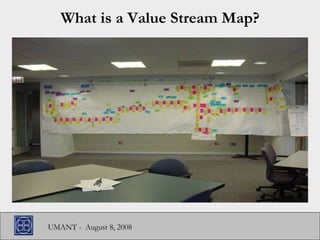
What is a Value Stream Map?
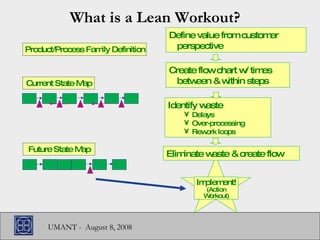
What is a Lean Workout? Product/Process Family Definition Current State Map Future State Map Implement! (Action Workout) Identify waste Delays Over-processing Rework loops Eliminate waste & create flow Create flow chart w/ times between & within steps Define value from customer  perspective
How can Municipalities Apply Lean? Building Application Approval Emergency Response Planning Utility Billing Payroll Field Maintenance Purchasing Budget Process Any process where time or customer satisfaction matters!
How has Southlake Utilized Lean? Development review process (entitlement phase to permitting phase) Total process time reduced by 323% (220 days to 68 days)
How has Southlake Utilized Lean? Budget development process (budget kickoff to submittal of proposed departmental budgets) Total process time reduced by 33% (3 months to 2 months)
Focus on the Future Things to Consider: Eliminate Queue’s & Stopping Points (Flow) Try to limit the waste designed into the new process Minimize “Rework/Review” Steps where possible
Focus on the Customer! Think about what the customer feels! Think outside the box! Think about growth while balancing risk. Have some fun!
How can I learn more about Lean? ICMA Public Management article; September 2006 Workshop: “Lean Thinking and Government: An Oxymoron?” ICMA consulting services – Craig Rapp www.icmaleanthinking.blogspot.com TechSolve – David Krings (past ICMA president) www.techsolve.org Lean Enterprise Institute  www.lean.org Celerity Consulting – David Baird [email_address]
Questions? Ben Thatcher [email_address] 817/748-8005

Lean Thinking in Government Services

  • 1.
    Local Governments ThinkingLean: An Overview of Applying Lean Principles to Government Services Ben Thatcher
  • 2.
    What is lean?Why implement lean in local government? How has Southlake implemented lean in local government? How can I learn more about lean?
  • 3.
    “ The relentlesspursuit of the elimination of waste from every process with the ultimate goal of providing world-class quality, delivery and service to our customers at the lowest possible cost.” What is Lean? “ It’s about the process – not the employee” Think about the “thing” going through the process – not “who” does it.
  • 4.
    Lean Thinking isa cultural change, it’s a change in mind-set: a continuous strive for perfection to eliminate all the waste. Cultural Change: A Change in Mind-set See Act Get To get the results, you have to act different. To act different, you have to see the difference. To see different, start with learning Lean Thinking . Change in mind-set
  • 5.
    Jidoka Just -in - Time Toyota Production System Heijunka 1978 1996 1943 - 1978 History of Lean A principle driven, tool based philosophy that focuses on eliminating waste so that all activities/steps add value from the customers perspective. Lean Thinking: People People People Deming & Ford
  • 6.
  • 7.
    Lean Thinking PrinciplesThe continuous movement of products, services and information from end to end through the process 3 Establish Flow Nothing is done by the upstream process until the downstream customer signals the need 4 Implement Pull The complete elimination of waste so all activities create value for the customer by continuous improvement. Use all principles again, and again. 5 Work to Perfection Define value from the customers perspective and express value in terms of a specific product 1 Specify Value 2 Map the Value Stream Map all of the steps…value added & non-value added…that bring a product of service to the customer Lean Thinking Lean Thinking Principles guide you through lean implementation
  • 8.
    What Satisfies theCustomer? Non-Value Added Process: Those process steps that take time, resources, or space, but do not add value to the product or service. Value Added Process: A process step that transforms or shapes a product or service which is eventually sold to a customer. Value Enabling Process: A process step which must be performed in order to make it possible to perform value adding activities.
  • 9.
    What is Waste?Activities that Create No Value , but Add Cost and Time Focus: Find the Root Cause(s) and Eliminate Them Typical Process = 1-10% Activities Create Value
  • 10.
    Overproduction Inventory ExtraProcessing Motion Defects/Rework Waiting Transportation Processing that the customer does not need or want Duplication Processing a small deal the same as a large deal Navigating multiple screens to input data Printing material Looking/researching for data/info Incorrect data on application Missed customer due dates Rework (the “R” words) Application waiting approval Waiting on information from customer Waiting on information from 3 rd party Receiving hardcopies from customer Shipping hard copies for customer signature Manually walking the application for approval 7 Wastes Characteristics Staff Members waiting Multiple applications awaiting approval What does Waste Look Like?
  • 11.
    Kaizen \ Ki-zen \ a continual improvement mindset. Everything that we do today can be improved. Kaizen has no end. Kai = Change Zen = For the Better A Healthy Dissatisfaction with the Status Quo Definition of Kaizen
  • 12.
  • 13.
    Highly Skilled andTrained Empowered Own their processes (improve them) Action oriented Boundary less/ Open Mindset Live Teamwork Creative Challenge Management Feel valued, rewarded and recognized for their accomplishments The journey starts with the People People People People At the start of the Journey It Is All the People !
  • 14.
    What is aValue Stream Map?
  • 15.
    What is aLean Workout? Product/Process Family Definition Current State Map Future State Map Implement! (Action Workout) Identify waste Delays Over-processing Rework loops Eliminate waste & create flow Create flow chart w/ times between & within steps Define value from customer perspective
  • 16.
    How can MunicipalitiesApply Lean? Building Application Approval Emergency Response Planning Utility Billing Payroll Field Maintenance Purchasing Budget Process Any process where time or customer satisfaction matters!
  • 17.
    How has SouthlakeUtilized Lean? Development review process (entitlement phase to permitting phase) Total process time reduced by 323% (220 days to 68 days)
  • 18.
    How has SouthlakeUtilized Lean? Budget development process (budget kickoff to submittal of proposed departmental budgets) Total process time reduced by 33% (3 months to 2 months)
  • 19.
    Focus on theFuture Things to Consider: Eliminate Queue’s & Stopping Points (Flow) Try to limit the waste designed into the new process Minimize “Rework/Review” Steps where possible
  • 20.
    Focus on theCustomer! Think about what the customer feels! Think outside the box! Think about growth while balancing risk. Have some fun!
  • 21.
    How can Ilearn more about Lean? ICMA Public Management article; September 2006 Workshop: “Lean Thinking and Government: An Oxymoron?” ICMA consulting services – Craig Rapp www.icmaleanthinking.blogspot.com TechSolve – David Krings (past ICMA president) www.techsolve.org Lean Enterprise Institute www.lean.org Celerity Consulting – David Baird [email_address]
  • 22.
    Questions? Ben Thatcher[email_address] 817/748-8005

Editor's Notes

  • #5 Additional Notes:
  • #6 Ohno refined the Toyota Production System throughout the 40’s, 50’s, 60’s and 70’s, but his work went largely unnoticed until the world oil crisis of 1973. Until that time, demand was so high that companies could control costs and sell what they built using the mass production method. Although many production methods can control costs effectively in periods of high demand, only the Toyota Production System proved to be flexible enough to adapt to periods of low demand. In 1978, Ohno decided to write a book about Toyota’s successes, called Toyota Production System . At the same time, people who had worked with Ohno established the Shingijutsu Company (Shingijutsu means “new technology” or “a better way”) to help other companies apply the principles, tools, and process that had been so successful at Toyota. GEMS is currently working with Shingijutsu consultants to learn the Toyota process improvement methodology. Shingijustu consulted with companies around the world, and by the 1990s had worked with companies in the United States. In 1996 Jim Womack wrote a book called Lean Thinking that describes the success these companies had achieved working with Danaher, Porsche, and other companies. Womack is a professor at MIT, so he also formulated a process that other companies could use to adopt Toyota system. As a result, many companies began referring to the Toyota principles by the term “Lean”.
  • #11 Defects – poor Q: part, information, poor service Overproduction: Inventory – not as prevalent in the office Transportation : movement of parts or information (parts that travel miles in a shop or paperwork that travels miles for approvals) Over processing: Features in a product or service that the customer doesn’t value & does not want to pay for Inventory : easy to see on the shop – more challenging in the office but it exists: inbox; e-mail; things waiting in queue Motion : unnecessary movement of employees to get work done – looking for tools or info. that should be readily available Waiting: for material, information , approvals In Administrative processes Waiting is often considered the biggest waste
  • #12 Were going to look for Kaizen ideas