Lean Introduction
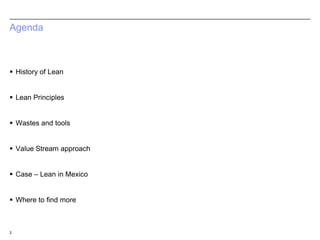
2AgendaHistory of LeanLean PrinciplesWastes and toolsValue Stream approachCase – Lean in MexicoWhere to find more
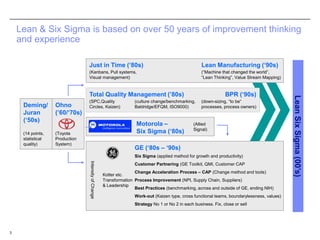
3Lean Six Sigma (00’s)Just in Time (‘80s)Lean Manufacturing (‘90s)(Kanbans, Pull systems, Visual management)(“Machine that changed the world”,“Lean Thinking”, Value Stream Mapping)Total Quality Management (’80s)BPR (‘90s)Deming/Juran(‘50s)Ohno(’60/‘70s)(culture change/benchmarking,Baldridge/EFQM, ISO9000)(SPC,QualityCircles, Kaizen)(down-sizing, “to be“processes, process owners)Motorola –Six Sigma (‘80s)(Allied Signal)(14 points,statisticalquality)(ToyotaProductionSystem)GE (‘80s – ‘90s)Intensity of ChangeKotter etc. Transformation & LeadershipSix Sigma(applied method for growth and productivity)Customer Partnering(GE Toolkit, QMI, Customer CAPChange Acceleration Process – CAP (Change method and tools) Process Improvement (NPI, Supply Chain, Suppliers) Best Practices(benchmarking, across and outside of GE, ending NIH)Work-out (Kaizen type, cross functional teams, boundarylessness, values)StrategyNo 1 or No 2 in each business. Fix, close or sellLean & Six Sigma is based on over 50 years of improvement thinking and experience
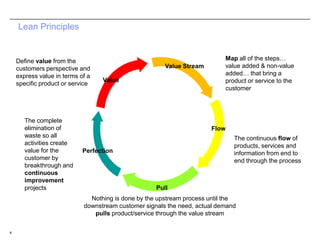
4Value StreamValueFlowPerfectionPullLean PrinciplesMap all of the steps… value added & non-value added… that bring a product or service to the customerDefine value from the customers perspective and express value in terms of a specific product or serviceThe complete elimination of waste so all activities create value for the customer by breakthrough and continuous improvement projectsThe continuous flow of products, services and information from end to end through the processNothing is done by the upstream process until the downstream customer signals the need, actual demand pulls product/service through the value stream
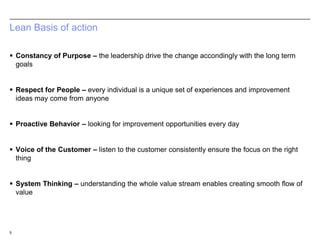
5Lean Basis of actionConstancy of Purpose – the leadership drive the change accondingly with the long term goalsRespect for People – every individual is a unique set of experiences and improvement ideas may come from anyoneProactive Behavior – looking for improvement opportunities every dayVoice of the Customer – listen to the customer consistently ensure the focus on the right thingSystem Thinking – understanding the whole value stream enables creating smooth flow of value
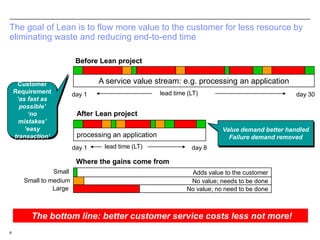
6The goal of Lean is to flow more value to the customer for less resource by eliminating waste and reducing end-to-end timeBefore Lean project A service value stream: e.g. processing an applicationCustomer Requirement‘as fast as possible’‘no mistakes’‘easy transaction’lead time (LT)day 1day 30After Lean project Value demand better handledFailure demand removedprocessing an applicationlead time (LT)day 1day 8Where the gains come fromSmallAdds value to the customerSmall to mediumNo value; needs to be doneLargeNo value; no need to be doneThe bottom line: better customer service costs less not more!
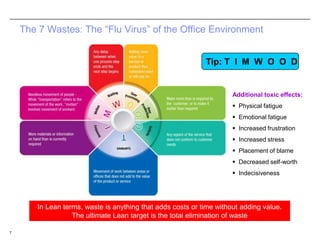
7The 7 Wastes: The “Flu Virus” of the Office EnvironmentTip: T  I  M  W  O  O  DAdditional toxic effects:Physical fatigue
Emotional fatigue
Increased frustration
Increased stress
Placement of blame
Decreased self-worth
IndecisivenessIn Lean terms, waste is anything that adds costs or time without adding value. The ultimate Lean target is the total elimination of waste
8Lean ToolsA3 ThinkingValue Stream MappingQuality at SourceStandardised Work5S: Sort; Set-in-order; Shine; Standardise; SustainVisual Control & ManagementCellular/Team ConceptsLevelling, Management Timeframe and Takt Time

Lean introduction

  • 1.
  • 2.
    2AgendaHistory of LeanLeanPrinciplesWastes and toolsValue Stream approachCase – Lean in MexicoWhere to find more
  • 3.
    3Lean Six Sigma(00’s)Just in Time (‘80s)Lean Manufacturing (‘90s)(Kanbans, Pull systems, Visual management)(“Machine that changed the world”,“Lean Thinking”, Value Stream Mapping)Total Quality Management (’80s)BPR (‘90s)Deming/Juran(‘50s)Ohno(’60/‘70s)(culture change/benchmarking,Baldridge/EFQM, ISO9000)(SPC,QualityCircles, Kaizen)(down-sizing, “to be“processes, process owners)Motorola –Six Sigma (‘80s)(Allied Signal)(14 points,statisticalquality)(ToyotaProductionSystem)GE (‘80s – ‘90s)Intensity of ChangeKotter etc. Transformation & LeadershipSix Sigma(applied method for growth and productivity)Customer Partnering(GE Toolkit, QMI, Customer CAPChange Acceleration Process – CAP (Change method and tools) Process Improvement (NPI, Supply Chain, Suppliers) Best Practices(benchmarking, across and outside of GE, ending NIH)Work-out (Kaizen type, cross functional teams, boundarylessness, values)StrategyNo 1 or No 2 in each business. Fix, close or sellLean & Six Sigma is based on over 50 years of improvement thinking and experience
  • 4.
    4Value StreamValueFlowPerfectionPullLean PrinciplesMapall of the steps… value added & non-value added… that bring a product or service to the customerDefine value from the customers perspective and express value in terms of a specific product or serviceThe complete elimination of waste so all activities create value for the customer by breakthrough and continuous improvement projectsThe continuous flow of products, services and information from end to end through the processNothing is done by the upstream process until the downstream customer signals the need, actual demand pulls product/service through the value stream
  • 5.
    5Lean Basis ofactionConstancy of Purpose – the leadership drive the change accondingly with the long term goalsRespect for People – every individual is a unique set of experiences and improvement ideas may come from anyoneProactive Behavior – looking for improvement opportunities every dayVoice of the Customer – listen to the customer consistently ensure the focus on the right thingSystem Thinking – understanding the whole value stream enables creating smooth flow of value
  • 6.
    6The goal ofLean is to flow more value to the customer for less resource by eliminating waste and reducing end-to-end timeBefore Lean project A service value stream: e.g. processing an applicationCustomer Requirement‘as fast as possible’‘no mistakes’‘easy transaction’lead time (LT)day 1day 30After Lean project Value demand better handledFailure demand removedprocessing an applicationlead time (LT)day 1day 8Where the gains come fromSmallAdds value to the customerSmall to mediumNo value; needs to be doneLargeNo value; no need to be doneThe bottom line: better customer service costs less not more!
  • 7.
    7The 7 Wastes:The “Flu Virus” of the Office EnvironmentTip: T I M W O O DAdditional toxic effects:Physical fatigue
  • 8.
  • 9.
  • 10.
  • 11.
  • 12.
  • 13.
    IndecisivenessIn Lean terms,waste is anything that adds costs or time without adding value. The ultimate Lean target is the total elimination of waste
  • 14.
    8Lean ToolsA3 ThinkingValueStream MappingQuality at SourceStandardised Work5S: Sort; Set-in-order; Shine; Standardise; SustainVisual Control & ManagementCellular/Team ConceptsLevelling, Management Timeframe and Takt Time