9/16/2014 
Lean IT Service Management 
1 © Lean IT Strategies, LLC All Rights Reserved 
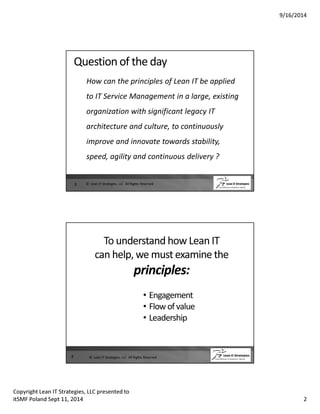
But you can’t tell a large 
2 
bank, insurance 
company, or airline to 
“just be like Google” 
Established 
Enterprises 
Must Disrupt 
Or Be 
Disrupted 
© Lean IT Strategies, LLC All Rights Reserved 
Copyright Lean IT Strategies, LLC presented to 
itSMF Poland Sept 11, 2014 1
9/16/2014 
Question of the day 
How can the principles of Lean IT be applied 
to IT Service Management in a large, existing 
organization with significant legacy IT 
architecture and culture, to continuously 
improve and innovate towards stability, 
speed, agility and continuous delivery ? 
3 © Lean IT Strategies, LLC All Rights Reserved 
To understand how Lean IT 
can help, we must examine the 
principles: 
• Engagement 
• Flow of value 
• Leadership 
4 © Lean IT Strategies, LLC All Rights Reserved 
Copyright Lean IT Strategies, LLC presented to 
itSMF Poland Sept 11, 2014 2
9/16/2014 
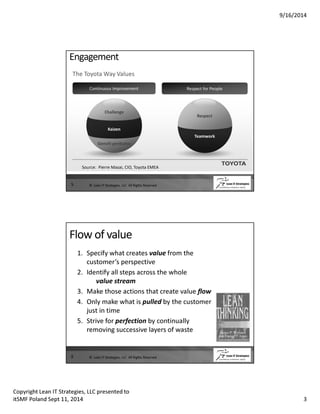
Engagement 
5 
Source: Pierre Masai, CIO, Toyota EMEA 
© Lean IT Strategies, LLC All Rights Reserved 
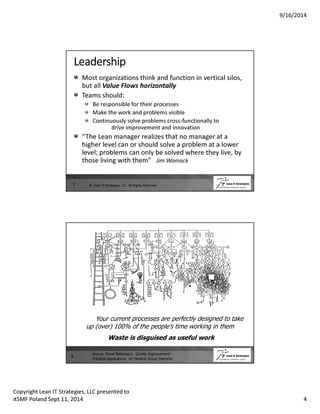
Flow of value 
6 
1. Specify what creates value from the 
customer’s perspective 
2. Identify all steps across the whole 
value stream 
3. Make those actions that create value flow 
4. Only make what is pulled by the customer 
just in time 
5. Strive for perfection by continually 
removing successive layers of waste 
© Lean IT Strategies, LLC All Rights Reserved 
Copyright Lean IT Strategies, LLC presented to 
itSMF Poland Sept 11, 2014 3
9/16/2014 
Leadership 
Most organizations think and function in vertical silos, 
but all Value Flows horizontally 
Teams should: 
Be responsible for their processes 
Make the work and problems visible 
Continuously solve problems cross-functionally to 
drive improvement and innovation 
“The Lean manager realizes that no manager at a 
higher level can or should solve a problem at a lower 
level; problems can only be solved where they live, by 
those living with them” Jim Womack 
7 © Lean IT Strategies, LLC All Rights Reserved 
8 
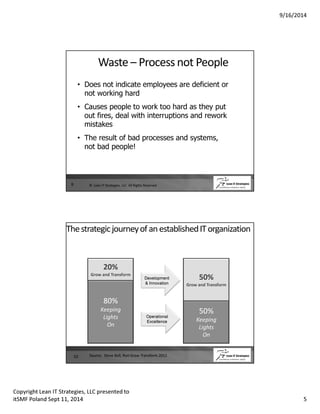
Your current processes are perfectly designed to take 
up (over) 100% of the people’s time working in them 
Waste is disguised as useful work 
Source: David Balestracci, Quality Improvement: 
Practical Applications for Medical Group Practices 
Copyright Lean IT Strategies, LLC presented to 
itSMF Poland Sept 11, 2014 4
9/16/2014 
9 
Waste – Process not People 
• Does not indicate employees are deficient or 
not working hard 
• Causes people to work too hard as they put 
out fires, deal with interruptions and rework 
mistakes 
• The result of bad processes and systems, 
not bad people! 
© Lean IT Strategies, LLC All Rights Reserved 
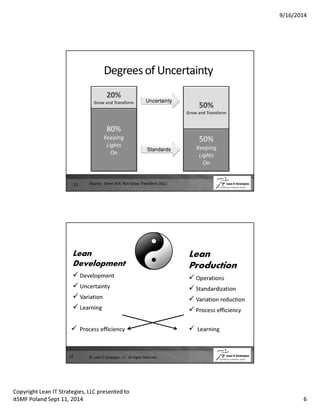
The strategic journey of an established IT organization 
20% 
Grow and Transform 
80% 
Keeping 
Lights 
On 
50% 
Grow and Transform 
50% 
Keeping 
Lights 
On 
Development 
& Innovation 
Operational 
Excellence 
10 
Source: Steve Bell, Run Grow Transform 2012 
Copyright Lean IT Strategies, LLC presented to 
itSMF Poland Sept 11, 2014 5
9/16/2014 
Degrees of Uncertainty 
20% 
Grow and Transform 
80% 
Keeping 
Lights 
On 
50% 
Grow and Transform 
50% 
Keeping 
Lights 
On 
Uncertainty 
Standards 
11 Source: Steve Bell, Run Grow Transform 2012 
Lean 
Development 
Development 
Uncertainty 
Variation 
Learning 
Lean 
Production 
Operations 
Standardization 
Variation reduction 
Process efficiency 
 Process efficiency  Learning 
12 © Lean IT Strategies, LLC All Rights Reserved 
Copyright Lean IT Strategies, LLC presented to 
itSMF Poland Sept 11, 2014 6
9/16/2014 
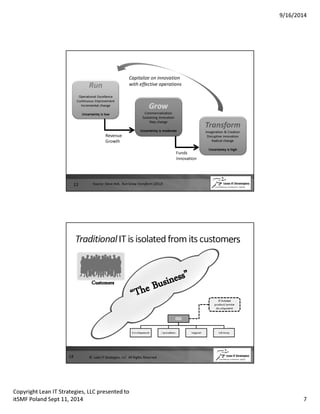
Run 
Operational Excellence 
Continuous Improvement 
Incremental change 
Uncertainty is low 
Transform 
Imagination  Creation 
Disruptive innovation 
Radical change 
Uncertainty is high 
Capitalize on innovation 
with effective operations 
Grow 
Commercialization 
Sustaining innovation 
Step change 
Uncertainty is moderate 
Revenue 
Growth 
Funds 
Innovation 
13 Source: Steve Bell, Run Grow Transform (2012) 
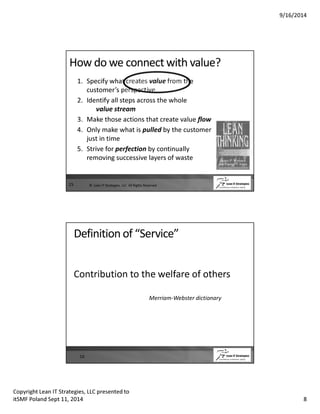
Traditional IT is isolated fromits customers 
CIO 
IT Related 
product/service 
development 
Development Operations Support Advisory 
14 © Lean IT Strategies, LLC All Rights Reserved 
Copyright Lean IT Strategies, LLC presented to 
itSMF Poland Sept 11, 2014 7
9/16/2014 
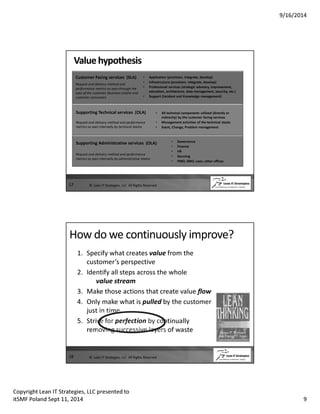
How do we connect with value? 
15 
1. Specify what creates value from the 
customer’s perspective 
2. Identify all steps across the whole 
value stream 
3. Make those actions that create value flow 
4. Only make what is pulled by the customer 
just in time 
5. Strive for perfection by continually 
removing successive layers of waste 
© Lean IT Strategies, LLC All Rights Reserved 
Definition of “Service” 
Contribution to the welfare of others 
Merriam-Webster dictionary 
16 
Copyright Lean IT Strategies, LLC presented to 
itSMF Poland Sept 11, 2014 8
9/16/2014 
17 
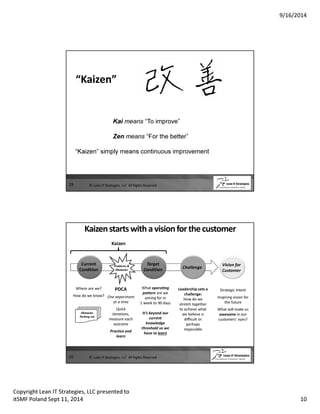
Value hypothesis 
Customer Facing services (SLA) 
Request and delivery method and 
performance metrics as seen through the 
eyes of the customer (business and/or end 
customer-consumer) 
• Application (provision, integrate, develop) 
• Infrastructure (provision, integrate, develop) 
• Professional services (strategic advisory, improvement, 
• Support (Incident and Knowledge management) 
Supporting Technical services (OLA) 
Request and delivery method and performance 
metrics as seen internally by technical teams 
education, architecture, data management, security, etc.) 
• All technical components utilized (directly or 
• Management activities of the technical stacks 
• Event, Change, Problem management 
Supporting Administrative services (OLA) 
Request and delivery method and performance 
metrics as seen internally by administrative teams 
indirectly) by the customer facing services 
• Governance 
• Finance 
• HR 
• Sourcing 
• PMO, SMO, Lean, other offices 
© Lean IT Strategies, LLC All Rights Reserved 
How do we continuously improve? 
18 
1. Specify what creates value from the 
customer’s perspective 
2. Identify all steps across the whole 
value stream 
3. Make those actions that create value flow 
4. Only make what is pulled by the customer 
just in time 
5. Strive for perfection by continually 
removing successive layers of waste 
© Lean IT Strategies, LLC All Rights Reserved 
Copyright Lean IT Strategies, LLC presented to 
itSMF Poland Sept 11, 2014 9
9/16/2014 
19 
“Kaizen” 
Kai means “To improve” 
Zen means “For the better” 
“Kaizen” simply means continuous improvement 
© Lean IT Strategies, LLC All Rights Reserved 
Kaizen starts with a vision for the customer 
Where are we? 
How do we know? 
20 
Current 
Condition 
Target 
Condition 
Challenge 
Vision for 
Customer 
Strategic Intent 
Inspiring vision for 
the future 
What will make us 
awesome in our 
customers’ eyes? 
Leadership sets a 
challenge: 
How do we 
stretch together 
to achieve what 
we believe is 
difficult or 
perhaps 
impossible 
What operating 
pattern are we 
aiming for in 
1 week to 90 days 
It’s beyond our 
current 
knowledge 
threshold so we 
have to learn 
Kaizen 
Problems  
Obstacles 
PDCA 
One experiment 
at a time 
Quick 
iterations, 
measure each 
outcome 
Practice and 
learn 
Obstacles 
Parking Lot 
© Lean IT Strategies, LLC All Rights Reserved 
Copyright Lean IT Strategies, LLC presented to 
itSMF Poland Sept 11, 2014 10
9/16/2014 
How do we integrate the enterprise? 
21 
1. Specify what creates value from the 
customer’s perspective 
2. Identify all steps across the whole 
value stream 
3. Make those actions that create value flow 
4. Only make what is pulled by the customer 
just in time 
5. Strive for perfection by continually 
removing successive layers of waste 
© Lean IT Strategies, LLC All Rights Reserved 
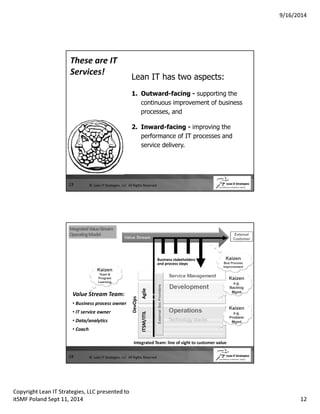
Are IT value streams a Black Box or Black Hole? 
22 © Lean IT Strategies, LLC All Rights Reserved 
Copyright Lean IT Strategies, LLC presented to 
itSMF Poland Sept 11, 2014 11
9/16/2014 
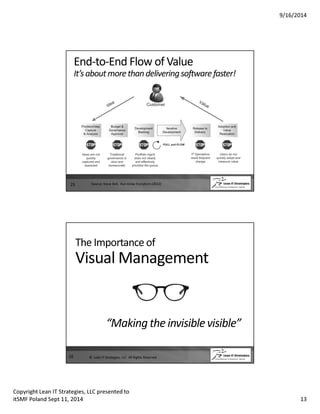
These are IT 
Services! 
23 
Lean IT has two aspects: 
1. Outward-facing - supporting the 
continuous improvement of business 
processes, and 
2. Inward-facing - improving the 
performance of IT processes and 
service delivery. 
© Lean IT Strategies, LLC All Rights Reserved 
Business stakeholders 
and process steps 
IT 
Service Management 
Integrated Value Stream 
Operating Model 
Kaizen 
Team  
Program 
Learning 
Value Stream Team: 
• Business process owner 
• IT service owner 
• Data/analytics 
• Coach 
24 
External 
Customer 
Value Stream 
Development 
Operations 
Technology stacks 
Kaizen 
Bus Process 
Improvement 
External Svc Providers 
DevOps 
ITSM/ITIL Agile 
Integrated Team: line of sight to customer value 
Kaizen 
e.g. 
Backlog 
Mgmt 
Kaizen 
e.g. 
Problem 
Mgmt 
© Lean IT Strategies, LLC All Rights Reserved 
Copyright Lean IT Strategies, LLC presented to 
itSMF Poland Sept 11, 2014 12
9/16/2014 
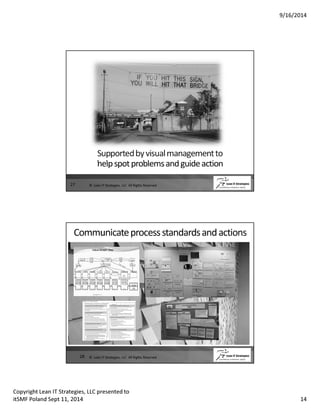
End-to-End Flow of Value 
It’s about more than delivering software faster! 
Source: Steve Bell, 25 Run Grow Transform (2012) 
The Importance of 
Visual Management 
26 
“Making the invisible visible” 
© Lean IT Strategies, LLC All Rights Reserved 
Copyright Lean IT Strategies, LLC presented to 
itSMF Poland Sept 11, 2014 13
9/16/2014 
Supported by visual management to 
help spot problems and guide action 
27 © Lean IT Strategies, LLC All Rights Reserved 
Communicate process standards and actions 
28 © Lean IT Strategies, LLC All Rights Reserved 
Copyright Lean IT Strategies, LLC presented to 
itSMF Poland Sept 11, 2014 14
9/16/2014 
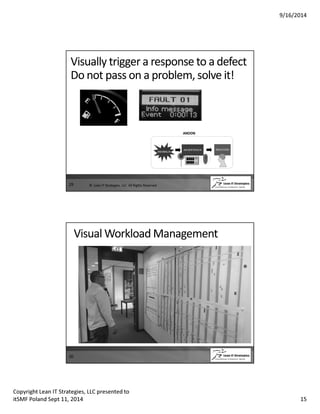
Visually trigger a response to a defect 
Do not pass on a problem, solve it! 
29 © Lean IT Strategies, LLC All Rights Reserved 
Visual Workload Management 
30 
Copyright Lean IT Strategies, LLC presented to 
itSMF Poland Sept 11, 2014 15
9/16/2014 
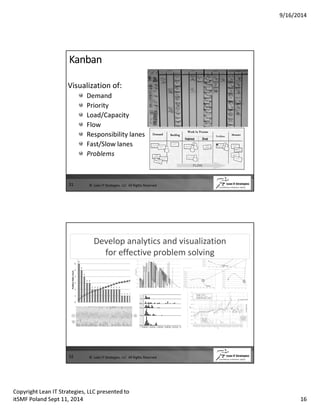
Kanban 
Visualization of: 
31 
Demand 
Priority 
Load/Capacity 
Flow 
Responsibility lanes 
Fast/Slow lanes 
Problems 
Demand Backlog 
Work In Process 
Problem 
Measure 
© Lean IT Strategies, LLC All Rights Reserved 
32 
Develop analytics and visualization 
for effective problem solving 
© Lean IT Strategies, LLC All Rights Reserved 
Copyright Lean IT Strategies, LLC presented to 
itSMF Poland Sept 11, 2014 16
9/16/2014 
Lean Leadership 
Behaviors 
33 
“Empowerment without alignment is chaos” 
Peter Senge, Fifth Discipline 
34 © Lean IT Strategies, LLC All Rights Reserved 
Copyright Lean IT Strategies, LLC presented to 
itSMF Poland Sept 11, 2014 17
9/16/2014 
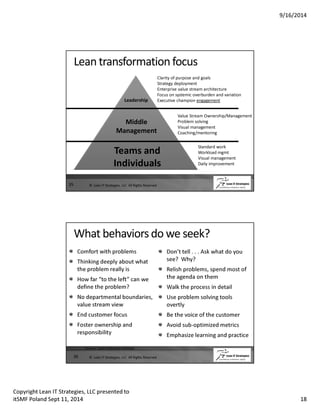
Lean transformation focus 
35 
Leadership 
Middle 
Management 
Clarity of purpose and goals 
Strategy deployment 
Enterprise value stream architecture 
Focus on systemic overburden and variation 
Executive champion engagement 
Teams and 
Individuals 
Value Stream Ownership/Management 
Problem solving 
Visual management 
Coaching/mentoring 
Standard work 
Workload mgmt 
Visual management 
Daily improvement 
© Lean IT Strategies, LLC All Rights Reserved 
What behaviors do we seek? 
Comfort with problems 
Thinking deeply about what 
the problem really is 
How far “to the left” can we 
define the problem? 
No departmental boundaries, 
value stream view 
End customer focus 
Foster ownership and 
responsibility 
36 
Don’t tell . . . Ask what do you 
see? Why? 
Relish problems, spend most of 
the agenda on them 
Walk the process in detail 
Use problem solving tools 
overtly 
Be the voice of the customer 
Avoid sub-optimized metrics 
Emphasize learning and practice 
Source: Lean Enterprise Institute 
© Lean IT Strategies, LLC All Rights Reserved 
Copyright Lean IT Strategies, LLC presented to 
itSMF Poland Sept 11, 2014 18
9/16/2014 
The Danger of Implementation Thinking 
Having an implementation orientation actually impedes our 
organization's progress and the development of people's 
capabilities. 
The way from where we are to where we want to be next is a 
gray zone full of unforseeable obstacles, problems and issues 
that we can only discover along the way. The best we can do is 
to know the approach, the means, we can utilize for dealing 
with the unclear path to a new desired condition [the lean 
problem solving approach] not what the content and steps of 
our actions- the solutions - will be. If someone claims certainty 
about the steps that will be implemented to reach the desired 
destination, that should be a red flag to us. 
Mike Rother, Toyota Kata 
37 © Lean IT Strategies, LLC All Rights Reserved 
The Risk of “Implementing” ITIL 
It’s possible to implement ITIL but not solve problems at 
their root causes and deliver little sustaining value 
It’s possible to implement ITIL without engaging people 
and the overall organization in an authentic cultural 
transformation 
IT organizations should start with Lean Thinking rather 
than leading with ITIL tools and techniques 
The ITIL toolbox provides good practices that should be 
viewed as potential target conditions to be 
experimented upon by the team 
38 38 © Lean IT Strategies, LLC All Rights Reserved 
Copyright Lean IT Strategies, LLC presented to 
itSMF Poland Sept 11, 2014 19
9/16/2014 
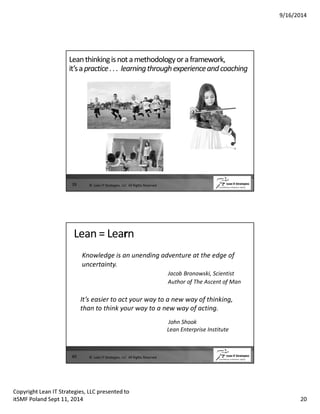
Lean thinking is not a methodology or a framework, 
it’s a practice . . . learning through experience and coaching 
39 © Lean IT Strategies, LLC All Rights Reserved 
Lean = Learn 
Knowledge is an unending adventure at the edge of 
uncertainty. 
Jacob Bronowski, Scientist 
Author of The Ascent of Man 
40 
It’s easier to act your way to a new way of thinking, 
than to think your way to a new way of acting. 
John Shook 
Lean Enterprise Institute 
© Lean IT Strategies, LLC All Rights Reserved 
Copyright Lean IT Strategies, LLC presented to 
itSMF Poland Sept 11, 2014 20
9/16/2014 
41 
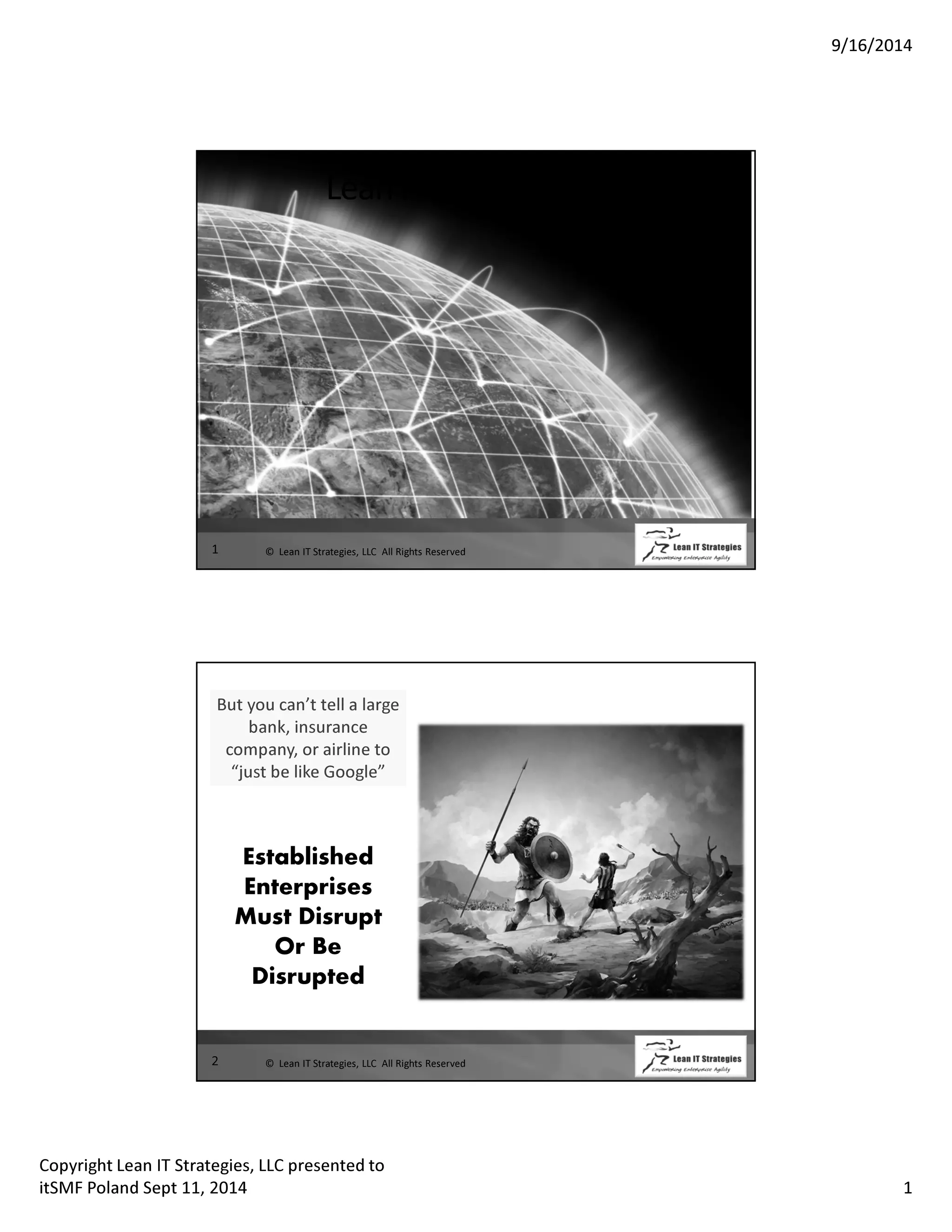
Next Master Class 
Lean IT Summit, Paris 
October 15, 2014 www.lean-it-summit.com 
© Lean IT Strategies, LLC All Rights Reserved 
SteveB@LeanITStrategies.com 
Copyright Lean IT Strategies, LLC presented to 
itSMF Poland Sept 11, 2014 21

Steve Bell - Lean IT @ 7. Kongres itSMF Polska 2014

  • 1.
    9/16/2014 Lean ITService Management 1 © Lean IT Strategies, LLC All Rights Reserved But you can’t tell a large 2 bank, insurance company, or airline to “just be like Google” Established Enterprises Must Disrupt Or Be Disrupted © Lean IT Strategies, LLC All Rights Reserved Copyright Lean IT Strategies, LLC presented to itSMF Poland Sept 11, 2014 1
  • 2.
    9/16/2014 Question ofthe day How can the principles of Lean IT be applied to IT Service Management in a large, existing organization with significant legacy IT architecture and culture, to continuously improve and innovate towards stability, speed, agility and continuous delivery ? 3 © Lean IT Strategies, LLC All Rights Reserved To understand how Lean IT can help, we must examine the principles: • Engagement • Flow of value • Leadership 4 © Lean IT Strategies, LLC All Rights Reserved Copyright Lean IT Strategies, LLC presented to itSMF Poland Sept 11, 2014 2
  • 3.
    9/16/2014 Engagement 5 Source: Pierre Masai, CIO, Toyota EMEA © Lean IT Strategies, LLC All Rights Reserved Flow of value 6 1. Specify what creates value from the customer’s perspective 2. Identify all steps across the whole value stream 3. Make those actions that create value flow 4. Only make what is pulled by the customer just in time 5. Strive for perfection by continually removing successive layers of waste © Lean IT Strategies, LLC All Rights Reserved Copyright Lean IT Strategies, LLC presented to itSMF Poland Sept 11, 2014 3
  • 4.
    9/16/2014 Leadership Mostorganizations think and function in vertical silos, but all Value Flows horizontally Teams should: Be responsible for their processes Make the work and problems visible Continuously solve problems cross-functionally to drive improvement and innovation “The Lean manager realizes that no manager at a higher level can or should solve a problem at a lower level; problems can only be solved where they live, by those living with them” Jim Womack 7 © Lean IT Strategies, LLC All Rights Reserved 8 Your current processes are perfectly designed to take up (over) 100% of the people’s time working in them Waste is disguised as useful work Source: David Balestracci, Quality Improvement: Practical Applications for Medical Group Practices Copyright Lean IT Strategies, LLC presented to itSMF Poland Sept 11, 2014 4
  • 5.
    9/16/2014 9 Waste– Process not People • Does not indicate employees are deficient or not working hard • Causes people to work too hard as they put out fires, deal with interruptions and rework mistakes • The result of bad processes and systems, not bad people! © Lean IT Strategies, LLC All Rights Reserved The strategic journey of an established IT organization 20% Grow and Transform 80% Keeping Lights On 50% Grow and Transform 50% Keeping Lights On Development & Innovation Operational Excellence 10 Source: Steve Bell, Run Grow Transform 2012 Copyright Lean IT Strategies, LLC presented to itSMF Poland Sept 11, 2014 5
  • 6.
    9/16/2014 Degrees ofUncertainty 20% Grow and Transform 80% Keeping Lights On 50% Grow and Transform 50% Keeping Lights On Uncertainty Standards 11 Source: Steve Bell, Run Grow Transform 2012 Lean Development Development Uncertainty Variation Learning Lean Production Operations Standardization Variation reduction Process efficiency Process efficiency Learning 12 © Lean IT Strategies, LLC All Rights Reserved Copyright Lean IT Strategies, LLC presented to itSMF Poland Sept 11, 2014 6
  • 7.
    9/16/2014 Run OperationalExcellence Continuous Improvement Incremental change Uncertainty is low Transform Imagination Creation Disruptive innovation Radical change Uncertainty is high Capitalize on innovation with effective operations Grow Commercialization Sustaining innovation Step change Uncertainty is moderate Revenue Growth Funds Innovation 13 Source: Steve Bell, Run Grow Transform (2012) Traditional IT is isolated fromits customers CIO IT Related product/service development Development Operations Support Advisory 14 © Lean IT Strategies, LLC All Rights Reserved Copyright Lean IT Strategies, LLC presented to itSMF Poland Sept 11, 2014 7
  • 8.
    9/16/2014 How dowe connect with value? 15 1. Specify what creates value from the customer’s perspective 2. Identify all steps across the whole value stream 3. Make those actions that create value flow 4. Only make what is pulled by the customer just in time 5. Strive for perfection by continually removing successive layers of waste © Lean IT Strategies, LLC All Rights Reserved Definition of “Service” Contribution to the welfare of others Merriam-Webster dictionary 16 Copyright Lean IT Strategies, LLC presented to itSMF Poland Sept 11, 2014 8
  • 9.
    9/16/2014 17 Valuehypothesis Customer Facing services (SLA) Request and delivery method and performance metrics as seen through the eyes of the customer (business and/or end customer-consumer) • Application (provision, integrate, develop) • Infrastructure (provision, integrate, develop) • Professional services (strategic advisory, improvement, • Support (Incident and Knowledge management) Supporting Technical services (OLA) Request and delivery method and performance metrics as seen internally by technical teams education, architecture, data management, security, etc.) • All technical components utilized (directly or • Management activities of the technical stacks • Event, Change, Problem management Supporting Administrative services (OLA) Request and delivery method and performance metrics as seen internally by administrative teams indirectly) by the customer facing services • Governance • Finance • HR • Sourcing • PMO, SMO, Lean, other offices © Lean IT Strategies, LLC All Rights Reserved How do we continuously improve? 18 1. Specify what creates value from the customer’s perspective 2. Identify all steps across the whole value stream 3. Make those actions that create value flow 4. Only make what is pulled by the customer just in time 5. Strive for perfection by continually removing successive layers of waste © Lean IT Strategies, LLC All Rights Reserved Copyright Lean IT Strategies, LLC presented to itSMF Poland Sept 11, 2014 9
  • 10.
    9/16/2014 19 “Kaizen” Kai means “To improve” Zen means “For the better” “Kaizen” simply means continuous improvement © Lean IT Strategies, LLC All Rights Reserved Kaizen starts with a vision for the customer Where are we? How do we know? 20 Current Condition Target Condition Challenge Vision for Customer Strategic Intent Inspiring vision for the future What will make us awesome in our customers’ eyes? Leadership sets a challenge: How do we stretch together to achieve what we believe is difficult or perhaps impossible What operating pattern are we aiming for in 1 week to 90 days It’s beyond our current knowledge threshold so we have to learn Kaizen Problems Obstacles PDCA One experiment at a time Quick iterations, measure each outcome Practice and learn Obstacles Parking Lot © Lean IT Strategies, LLC All Rights Reserved Copyright Lean IT Strategies, LLC presented to itSMF Poland Sept 11, 2014 10
  • 11.
    9/16/2014 How dowe integrate the enterprise? 21 1. Specify what creates value from the customer’s perspective 2. Identify all steps across the whole value stream 3. Make those actions that create value flow 4. Only make what is pulled by the customer just in time 5. Strive for perfection by continually removing successive layers of waste © Lean IT Strategies, LLC All Rights Reserved Are IT value streams a Black Box or Black Hole? 22 © Lean IT Strategies, LLC All Rights Reserved Copyright Lean IT Strategies, LLC presented to itSMF Poland Sept 11, 2014 11
  • 12.
    9/16/2014 These areIT Services! 23 Lean IT has two aspects: 1. Outward-facing - supporting the continuous improvement of business processes, and 2. Inward-facing - improving the performance of IT processes and service delivery. © Lean IT Strategies, LLC All Rights Reserved Business stakeholders and process steps IT Service Management Integrated Value Stream Operating Model Kaizen Team Program Learning Value Stream Team: • Business process owner • IT service owner • Data/analytics • Coach 24 External Customer Value Stream Development Operations Technology stacks Kaizen Bus Process Improvement External Svc Providers DevOps ITSM/ITIL Agile Integrated Team: line of sight to customer value Kaizen e.g. Backlog Mgmt Kaizen e.g. Problem Mgmt © Lean IT Strategies, LLC All Rights Reserved Copyright Lean IT Strategies, LLC presented to itSMF Poland Sept 11, 2014 12
  • 13.
    9/16/2014 End-to-End Flowof Value It’s about more than delivering software faster! Source: Steve Bell, 25 Run Grow Transform (2012) The Importance of Visual Management 26 “Making the invisible visible” © Lean IT Strategies, LLC All Rights Reserved Copyright Lean IT Strategies, LLC presented to itSMF Poland Sept 11, 2014 13
  • 14.
    9/16/2014 Supported byvisual management to help spot problems and guide action 27 © Lean IT Strategies, LLC All Rights Reserved Communicate process standards and actions 28 © Lean IT Strategies, LLC All Rights Reserved Copyright Lean IT Strategies, LLC presented to itSMF Poland Sept 11, 2014 14
  • 15.
    9/16/2014 Visually triggera response to a defect Do not pass on a problem, solve it! 29 © Lean IT Strategies, LLC All Rights Reserved Visual Workload Management 30 Copyright Lean IT Strategies, LLC presented to itSMF Poland Sept 11, 2014 15
  • 16.
    9/16/2014 Kanban Visualizationof: 31 Demand Priority Load/Capacity Flow Responsibility lanes Fast/Slow lanes Problems Demand Backlog Work In Process Problem Measure © Lean IT Strategies, LLC All Rights Reserved 32 Develop analytics and visualization for effective problem solving © Lean IT Strategies, LLC All Rights Reserved Copyright Lean IT Strategies, LLC presented to itSMF Poland Sept 11, 2014 16
  • 17.
    9/16/2014 Lean Leadership Behaviors 33 “Empowerment without alignment is chaos” Peter Senge, Fifth Discipline 34 © Lean IT Strategies, LLC All Rights Reserved Copyright Lean IT Strategies, LLC presented to itSMF Poland Sept 11, 2014 17
  • 18.
    9/16/2014 Lean transformationfocus 35 Leadership Middle Management Clarity of purpose and goals Strategy deployment Enterprise value stream architecture Focus on systemic overburden and variation Executive champion engagement Teams and Individuals Value Stream Ownership/Management Problem solving Visual management Coaching/mentoring Standard work Workload mgmt Visual management Daily improvement © Lean IT Strategies, LLC All Rights Reserved What behaviors do we seek? Comfort with problems Thinking deeply about what the problem really is How far “to the left” can we define the problem? No departmental boundaries, value stream view End customer focus Foster ownership and responsibility 36 Don’t tell . . . Ask what do you see? Why? Relish problems, spend most of the agenda on them Walk the process in detail Use problem solving tools overtly Be the voice of the customer Avoid sub-optimized metrics Emphasize learning and practice Source: Lean Enterprise Institute © Lean IT Strategies, LLC All Rights Reserved Copyright Lean IT Strategies, LLC presented to itSMF Poland Sept 11, 2014 18
  • 19.
    9/16/2014 The Dangerof Implementation Thinking Having an implementation orientation actually impedes our organization's progress and the development of people's capabilities. The way from where we are to where we want to be next is a gray zone full of unforseeable obstacles, problems and issues that we can only discover along the way. The best we can do is to know the approach, the means, we can utilize for dealing with the unclear path to a new desired condition [the lean problem solving approach] not what the content and steps of our actions- the solutions - will be. If someone claims certainty about the steps that will be implemented to reach the desired destination, that should be a red flag to us. Mike Rother, Toyota Kata 37 © Lean IT Strategies, LLC All Rights Reserved The Risk of “Implementing” ITIL It’s possible to implement ITIL but not solve problems at their root causes and deliver little sustaining value It’s possible to implement ITIL without engaging people and the overall organization in an authentic cultural transformation IT organizations should start with Lean Thinking rather than leading with ITIL tools and techniques The ITIL toolbox provides good practices that should be viewed as potential target conditions to be experimented upon by the team 38 38 © Lean IT Strategies, LLC All Rights Reserved Copyright Lean IT Strategies, LLC presented to itSMF Poland Sept 11, 2014 19
  • 20.
    9/16/2014 Lean thinkingis not a methodology or a framework, it’s a practice . . . learning through experience and coaching 39 © Lean IT Strategies, LLC All Rights Reserved Lean = Learn Knowledge is an unending adventure at the edge of uncertainty. Jacob Bronowski, Scientist Author of The Ascent of Man 40 It’s easier to act your way to a new way of thinking, than to think your way to a new way of acting. John Shook Lean Enterprise Institute © Lean IT Strategies, LLC All Rights Reserved Copyright Lean IT Strategies, LLC presented to itSMF Poland Sept 11, 2014 20
  • 21.
    9/16/2014 41 NextMaster Class Lean IT Summit, Paris October 15, 2014 www.lean-it-summit.com © Lean IT Strategies, LLC All Rights Reserved SteveB@LeanITStrategies.com Copyright Lean IT Strategies, LLC presented to itSMF Poland Sept 11, 2014 21