Quarterly Technology Briefing “Lean Times Require Lean Thinking” presented in partnership with
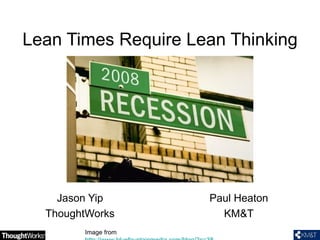
Lean Times Require Lean Thinking Jason Yip ThoughtWorks Paul Heaton KM&T Image from  http://www.bluefountainmedia.com/blog/?p=38
“ As the Japanese economy entered a  steep recession  in that year, the Toyota Motor Company ran  out of cash , which was tied up in inventory for products customers no longer wanted. The company fell under the control of bankers who chopped the company in two, creating separate firms to divide the marketing and sale functions from the product development and production functions. (These firms were only recombined in 1982 to create the current Toyota Motor Corporation.)  Founding president  Kiichiro Toyoda (new president Akio Toyoda’s grandfather) was  driven out in the process . The pursuit of what became the  Toyota Production System , along with the product development, supplier management, and customer support systems, was the  creative response to this crisis .” James Womack, Respect Science Especially in a Crisis,  http://www.manufacturingnews.com/news/09/0309/womack.html
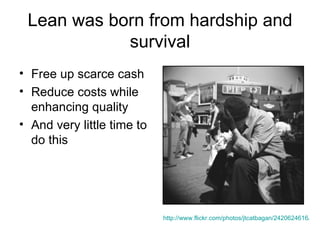
Lean was born from hardship and survival Free up scarce cash Reduce costs while enhancing quality And very little time to do this http://www.flickr.com/photos/jtcatbagan/2420624616/
What happened since then?
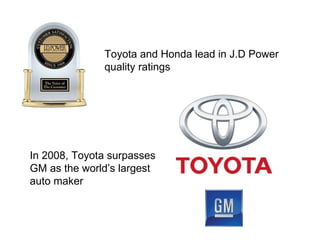
In 2008, Toyota surpasses GM as the world’s largest auto maker Toyota and Honda lead in J.D Power quality ratings
“ Our  recurring losses  from operations, stockholders' deficit and  inability to generate sufficient cash flow  to meet our obligations and sustain our operations raise  substantial doubt about our ability to continue  as a going concern ” General Motors SEC filing, 2009
Who would you rather be?
Is this really relevant to us?
 
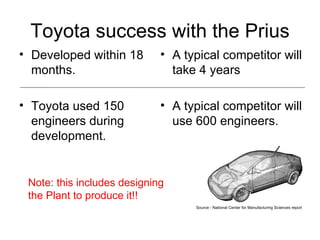
Toyota success with the Prius Developed within 18 months. Toyota used 150 engineers during development. A typical competitor will take 4 years A typical competitor will use 600 engineers. Source - National Center for Manufacturing Sciences report  Note: this includes designing the Plant to produce it!!
What message do I want to give? Lean Thinking is now becoming a recognised world wide business model in multiple sectors.  It is  not  just all about Toyota Cars..!
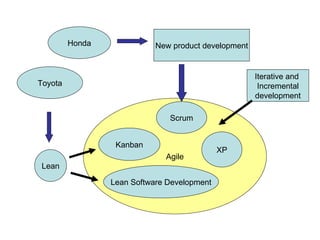
Agile Toyota Honda New product development Scrum XP Lean Lean Software Development Iterative and  Incremental development Kanban
So, what is Lean?
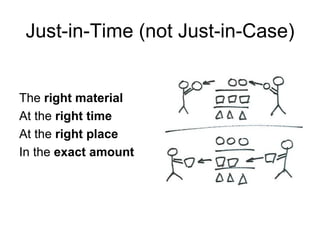
Just-in-Time (not Just-in-Case) The  right material At the  right time At the  right place In the  exact amount
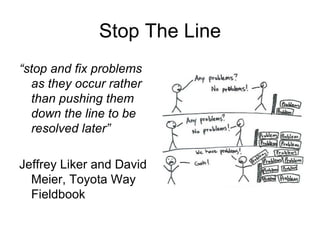
Stop The Line “ stop and fix problems as they occur rather than pushing them down the line to be resolved later” Jeffrey Liker and David Meier, Toyota Way Fieldbook
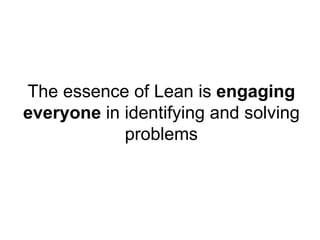
The essence of Lean is  engaging everyone  in identifying and solving problems
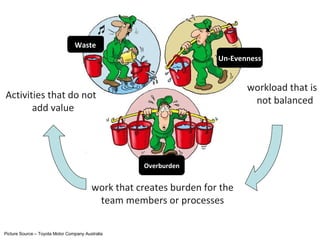
Activities that do not add value   workload that is not balanced work that creates burden for the  team members or processes   Picture Source – Toyota Motor Company Australia Waste Un-Evenness Overburden
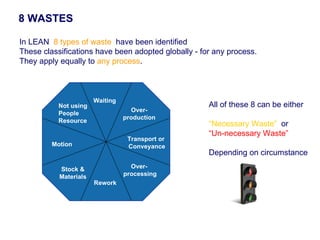
8 WASTES Over- production Waiting Transport or  Conveyance Rework  Motion Stock & Materials Over-  processing In LEAN  8 types of waste   have been identified  These classifications have been adopted globally - for any process. They apply equally to  any process . All of these 8 can be either “ Necessary Waste”  or  “ Un-necessary Waste” Depending on circumstance Not using People Resource
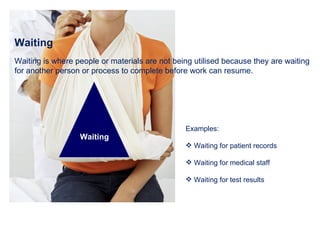
Waiting Waiting is where people or materials are not being utilised because they are waiting for another person or process to complete before work can resume. Examples: Waiting for patient records Waiting for medical staff Waiting for test results Waiting
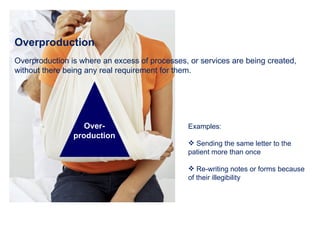
Overproduction Overproduction is where an excess of processes, or services are being created, without there being any real requirement for them.  Examples: Sending the same letter to the patient more than once Re-writing notes or forms because of their illegibility  Over- production
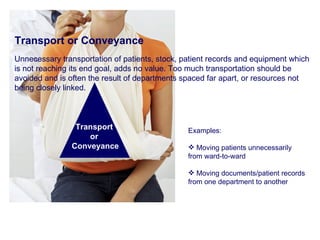
Transport or Conveyance Unnecessary transportation of patients, stock, patient records and equipment which is not reaching its end goal, adds no value. Too much transportation should be avoided and is often the result of departments spaced far apart, or resources not being closely linked. Examples: Moving patients unnecessarily from ward-to-ward Moving documents/patient records from one department to another Transport  or  Conveyance
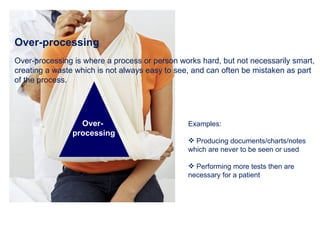
Over-processing Over-processing is where a process or person works hard, but not necessarily smart, creating a waste which is not always easy to see, and can often be mistaken as part of the process. Examples: Producing documents/charts/notes which are never to be seen or used Performing more tests then are necessary for a patient Over-  processing
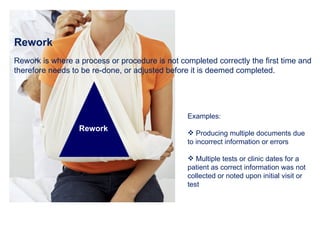
Rework Rework is where a process or procedure is not completed correctly the first time and therefore needs to be re-done, or adjusted before it is deemed completed.  Examples: Producing multiple documents due to incorrect information or errors Multiple tests or clinic dates for a patient as correct information was not collected or noted upon initial visit or test Rework
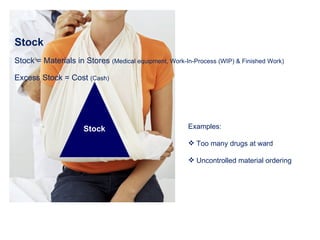
Stock Stock = Materials in Stores  (Medical equipment, Work-In-Process (WIP) & Finished Work) Excess Stock = Cost  (Cash) Examples: Too many drugs at ward Uncontrolled material ordering Stock
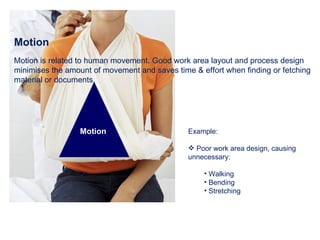
Motion Motion is related to human movement. Good work area layout and process design minimises the amount of movement and saves time & effort when finding or fetching material or documents.  Example: Poor work area design, causing unnecessary: Walking Bending Stretching Motion
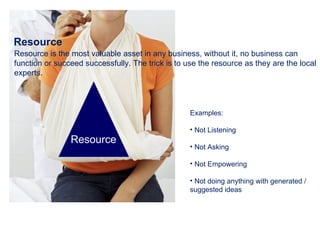
Resource Resource is the most valuable asset in any business, without it, no business can function or succeed successfully. The trick is to use the resource as they are the local experts. Examples: Not Listening Not Asking Not Empowering Not doing anything with generated / suggested ideas Resource
How does this fit with IT?
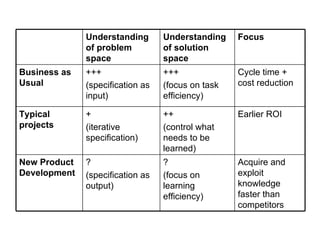
Understanding of problem space Understanding of solution space Focus Business as Usual +++ (specification as input) +++ (focus on task efficiency) Cycle time + cost reduction Typical projects + (iterative specification) ++ (control what needs to be learned) Earlier ROI New Product Development ? (specification as output) ? (focus on learning efficiency) Acquire and exploit knowledge faster than competitors
“ Put yourself in the position of the customer and ask if you would pay less for the product or be less satisfied with it if a given step and its necessary time were left out.” Mike Rother and John Shook, Learning to See
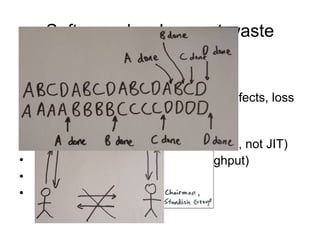
Extra features  (overproduction) Delays  (waiting) Hand-offs  (source of delays and defects, loss of information) Re-learning Partially done work  (obsolescence, not JIT) Task switching  (reduces throughput) Defects  (unnecessary rework) Unused employee creativity Software development waste
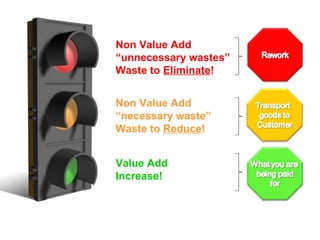
Non Value Add  “ unnecessary wastes” Waste to  Eliminate ! Non Value Add  “ necessary waste”  Waste to  Reduce ! Value Add Increase!
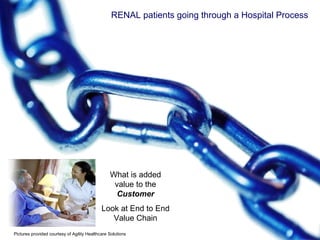
RENAL patients going through a Hospital Process Pictures provided courtesy of Agility Healthcare Solutions What is added value to the  Customer Look at End to End Value Chain
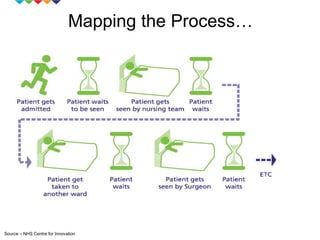
Mapping the Process… Source – NHS Centre for Innovation
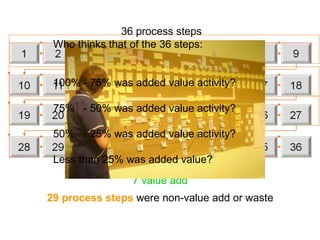
36 process steps 7 value add 29 process steps  were non-value add or waste Who thinks that of the 36 steps: 100% - 75% was added value activity? 75%  - 50% was added value activity? 50%  - 25% was added value activity? Less than 25% was added value? 1 2 3 4 5 6 7 8 9 28 29 30 31 32 33 34 35 36 19 20 21 22 23 24 25 26 27 10 11 12 13 14 15 16 17 18
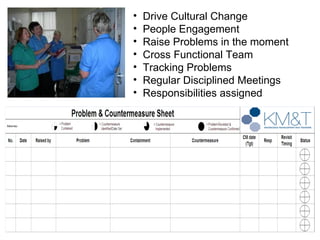
Drive Cultural Change People Engagement Raise Problems in the moment  Cross Functional Team Tracking Problems Regular Disciplined Meetings Responsibilities assigned
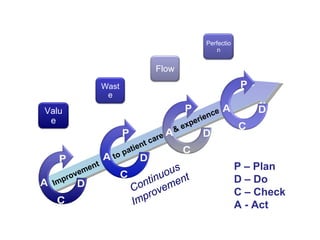
Continuous Improvement P – Plan D – Do C – Check A - Act Improvement  to patient care  & experience Value Waste Flow Perfection
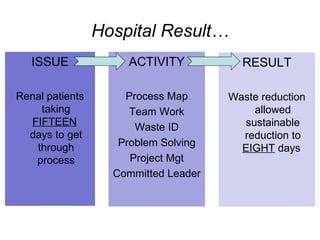
Hospital Result… ISSUE Renal patients taking  FIFTEEN   days to get through process ACTIVITY Process Map Team Work Waste ID Problem Solving Project Mgt Committed Leader RESULT Waste reduction allowed sustainable reduction to  EIGHT  days


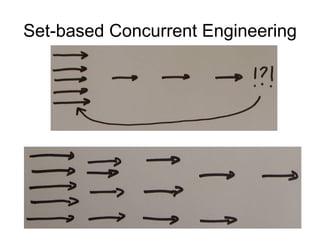
Set-based Concurrent Engineering
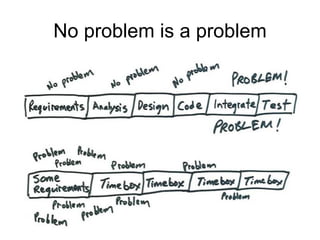
No problem is a problem
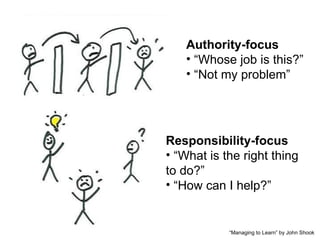
Authority-focus “ Whose job is this?” “ Not my problem” Responsibility-focus “ What is the right thing to do?” “ How can I help?” “ Managing to Learn” by John Shook
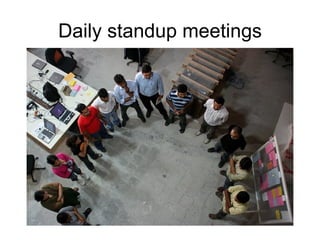
Daily standup meetings
Heartbeat retrospectives What did we do well, that if we don’t discuss we might forget? What did we learn? What should we do differently next time? What still puzzles us? http://www.retrospectives.com/pages/RetrospectiveKeyQuestions.html
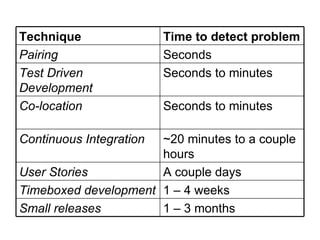
Technique Time to detect problem Pairing Seconds Test Driven Development Seconds to minutes Co-location Seconds to minutes Continuous Integration ~20 minutes to a couple hours User Stories A couple days Timeboxed development 1 – 4 weeks Small releases 1 – 3 months
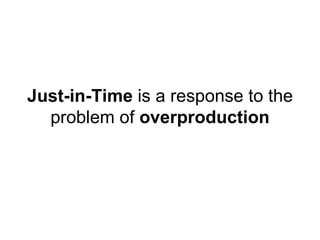
Just-in-Time  is a response to the problem of  overproduction
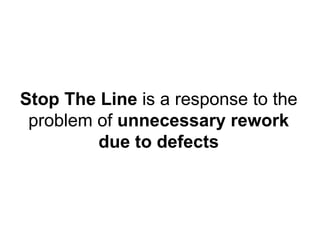
Stop The Line  is a response to the problem of  unnecessary rework due to defects
The essence of Lean is  engaging everyone  in identifying and solving problems
What type of results are we talking about?
McKinsey on Lean IT “ In our experience, applying the principles of lean manufacturing to [application development and maintenance] can  increase productivity by 20 to 40 percent while improving the quality and speed of execution .” N. Kindler, V. Krishnakanthan, R. Tinaikar, “Applying lean to application development and maintenance”, McKinsey on IT, Spring 2007
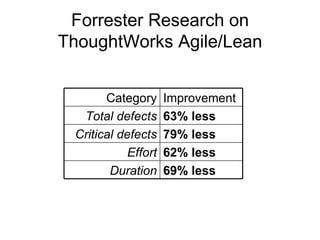
Forrester Research on ThoughtWorks Agile/Lean Category Improvement Total defects 63% less  Critical defects 79% less Effort 62% less Duration 69% less
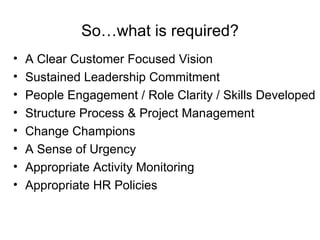
So…what is required? A Clear Customer Focused Vision Sustained Leadership Commitment  People Engagement / Role Clarity / Skills Developed Structure Process & Project Management Change Champions A Sense of Urgency Appropriate Activity Monitoring Appropriate HR Policies
 
What’s next? Start where you are Don’t shy away from your problems Go and see Think And ask for help
For Further Information please contact: ThoughtWorks  – Jason Yip Email [email_address] Web www.thoughtworks.com.au KM&T  – Paul Heaton mail [email_address] Web www.kmandt.com.au

Lean Times Require Lean Thinking

  • 1.
    Quarterly Technology Briefing“Lean Times Require Lean Thinking” presented in partnership with
  • 2.
    Lean Times RequireLean Thinking Jason Yip ThoughtWorks Paul Heaton KM&T Image from http://www.bluefountainmedia.com/blog/?p=38
  • 3.
    “ As theJapanese economy entered a steep recession in that year, the Toyota Motor Company ran out of cash , which was tied up in inventory for products customers no longer wanted. The company fell under the control of bankers who chopped the company in two, creating separate firms to divide the marketing and sale functions from the product development and production functions. (These firms were only recombined in 1982 to create the current Toyota Motor Corporation.) Founding president Kiichiro Toyoda (new president Akio Toyoda’s grandfather) was driven out in the process . The pursuit of what became the Toyota Production System , along with the product development, supplier management, and customer support systems, was the creative response to this crisis .” James Womack, Respect Science Especially in a Crisis, http://www.manufacturingnews.com/news/09/0309/womack.html
  • 4.
    Lean was bornfrom hardship and survival Free up scarce cash Reduce costs while enhancing quality And very little time to do this http://www.flickr.com/photos/jtcatbagan/2420624616/
  • 5.
  • 6.
    In 2008, Toyotasurpasses GM as the world’s largest auto maker Toyota and Honda lead in J.D Power quality ratings
  • 7.
    “ Our recurring losses from operations, stockholders' deficit and inability to generate sufficient cash flow to meet our obligations and sustain our operations raise substantial doubt about our ability to continue as a going concern ” General Motors SEC filing, 2009
  • 8.
    Who would yourather be?
  • 9.
    Is this reallyrelevant to us?
  • 10.
  • 11.
    Toyota success withthe Prius Developed within 18 months. Toyota used 150 engineers during development. A typical competitor will take 4 years A typical competitor will use 600 engineers. Source - National Center for Manufacturing Sciences report Note: this includes designing the Plant to produce it!!
  • 12.
    What message doI want to give? Lean Thinking is now becoming a recognised world wide business model in multiple sectors. It is not just all about Toyota Cars..!
  • 13.
    Agile Toyota HondaNew product development Scrum XP Lean Lean Software Development Iterative and Incremental development Kanban
  • 14.
  • 15.
    Just-in-Time (not Just-in-Case)The right material At the right time At the right place In the exact amount
  • 16.
    Stop The Line“ stop and fix problems as they occur rather than pushing them down the line to be resolved later” Jeffrey Liker and David Meier, Toyota Way Fieldbook
  • 17.
    The essence ofLean is engaging everyone in identifying and solving problems
  • 18.
    Activities that donot add value workload that is not balanced work that creates burden for the team members or processes Picture Source – Toyota Motor Company Australia Waste Un-Evenness Overburden
  • 19.
    8 WASTES Over-production Waiting Transport or Conveyance Rework Motion Stock & Materials Over- processing In LEAN 8 types of waste have been identified These classifications have been adopted globally - for any process. They apply equally to any process . All of these 8 can be either “ Necessary Waste” or “ Un-necessary Waste” Depending on circumstance Not using People Resource
  • 20.
    Waiting Waiting iswhere people or materials are not being utilised because they are waiting for another person or process to complete before work can resume. Examples: Waiting for patient records Waiting for medical staff Waiting for test results Waiting
  • 21.
    Overproduction Overproduction iswhere an excess of processes, or services are being created, without there being any real requirement for them. Examples: Sending the same letter to the patient more than once Re-writing notes or forms because of their illegibility Over- production
  • 22.
    Transport or ConveyanceUnnecessary transportation of patients, stock, patient records and equipment which is not reaching its end goal, adds no value. Too much transportation should be avoided and is often the result of departments spaced far apart, or resources not being closely linked. Examples: Moving patients unnecessarily from ward-to-ward Moving documents/patient records from one department to another Transport or Conveyance
  • 23.
    Over-processing Over-processing iswhere a process or person works hard, but not necessarily smart, creating a waste which is not always easy to see, and can often be mistaken as part of the process. Examples: Producing documents/charts/notes which are never to be seen or used Performing more tests then are necessary for a patient Over- processing
  • 24.
    Rework Rework iswhere a process or procedure is not completed correctly the first time and therefore needs to be re-done, or adjusted before it is deemed completed. Examples: Producing multiple documents due to incorrect information or errors Multiple tests or clinic dates for a patient as correct information was not collected or noted upon initial visit or test Rework
  • 25.
    Stock Stock =Materials in Stores (Medical equipment, Work-In-Process (WIP) & Finished Work) Excess Stock = Cost (Cash) Examples: Too many drugs at ward Uncontrolled material ordering Stock
  • 26.
    Motion Motion isrelated to human movement. Good work area layout and process design minimises the amount of movement and saves time & effort when finding or fetching material or documents. Example: Poor work area design, causing unnecessary: Walking Bending Stretching Motion
  • 27.
    Resource Resource isthe most valuable asset in any business, without it, no business can function or succeed successfully. The trick is to use the resource as they are the local experts. Examples: Not Listening Not Asking Not Empowering Not doing anything with generated / suggested ideas Resource
  • 28.
    How does thisfit with IT?
  • 29.
    Understanding of problemspace Understanding of solution space Focus Business as Usual +++ (specification as input) +++ (focus on task efficiency) Cycle time + cost reduction Typical projects + (iterative specification) ++ (control what needs to be learned) Earlier ROI New Product Development ? (specification as output) ? (focus on learning efficiency) Acquire and exploit knowledge faster than competitors
  • 30.
    “ Put yourselfin the position of the customer and ask if you would pay less for the product or be less satisfied with it if a given step and its necessary time were left out.” Mike Rother and John Shook, Learning to See
  • 31.
    Extra features (overproduction) Delays (waiting) Hand-offs (source of delays and defects, loss of information) Re-learning Partially done work (obsolescence, not JIT) Task switching (reduces throughput) Defects (unnecessary rework) Unused employee creativity Software development waste
  • 32.
    Non Value Add “ unnecessary wastes” Waste to Eliminate ! Non Value Add “ necessary waste” Waste to Reduce ! Value Add Increase!
  • 33.
    RENAL patients goingthrough a Hospital Process Pictures provided courtesy of Agility Healthcare Solutions What is added value to the Customer Look at End to End Value Chain
  • 34.
    Mapping the Process…Source – NHS Centre for Innovation
  • 35.
    36 process steps7 value add 29 process steps were non-value add or waste Who thinks that of the 36 steps: 100% - 75% was added value activity? 75% - 50% was added value activity? 50% - 25% was added value activity? Less than 25% was added value? 1 2 3 4 5 6 7 8 9 28 29 30 31 32 33 34 35 36 19 20 21 22 23 24 25 26 27 10 11 12 13 14 15 16 17 18
  • 36.
    Drive Cultural ChangePeople Engagement Raise Problems in the moment Cross Functional Team Tracking Problems Regular Disciplined Meetings Responsibilities assigned
  • 37.
    Continuous Improvement P– Plan D – Do C – Check A - Act Improvement to patient care & experience Value Waste Flow Perfection
  • 38.
    Hospital Result… ISSUERenal patients taking FIFTEEN days to get through process ACTIVITY Process Map Team Work Waste ID Problem Solving Project Mgt Committed Leader RESULT Waste reduction allowed sustainable reduction to EIGHT days
  • 39.
  • 40.
  • 41.
  • 42.
  • 43.
  • 44.
    No problem isa problem
  • 45.
    Authority-focus “ Whosejob is this?” “ Not my problem” Responsibility-focus “ What is the right thing to do?” “ How can I help?” “ Managing to Learn” by John Shook
  • 46.
  • 47.
    Heartbeat retrospectives Whatdid we do well, that if we don’t discuss we might forget? What did we learn? What should we do differently next time? What still puzzles us? http://www.retrospectives.com/pages/RetrospectiveKeyQuestions.html
  • 48.
    Technique Time todetect problem Pairing Seconds Test Driven Development Seconds to minutes Co-location Seconds to minutes Continuous Integration ~20 minutes to a couple hours User Stories A couple days Timeboxed development 1 – 4 weeks Small releases 1 – 3 months
  • 49.
    Just-in-Time isa response to the problem of overproduction
  • 50.
    Stop The Line is a response to the problem of unnecessary rework due to defects
  • 51.
    The essence ofLean is engaging everyone in identifying and solving problems
  • 52.
    What type ofresults are we talking about?
  • 53.
    McKinsey on LeanIT “ In our experience, applying the principles of lean manufacturing to [application development and maintenance] can increase productivity by 20 to 40 percent while improving the quality and speed of execution .” N. Kindler, V. Krishnakanthan, R. Tinaikar, “Applying lean to application development and maintenance”, McKinsey on IT, Spring 2007
  • 54.
    Forrester Research onThoughtWorks Agile/Lean Category Improvement Total defects 63% less Critical defects 79% less Effort 62% less Duration 69% less
  • 55.
    So…what is required?A Clear Customer Focused Vision Sustained Leadership Commitment People Engagement / Role Clarity / Skills Developed Structure Process & Project Management Change Champions A Sense of Urgency Appropriate Activity Monitoring Appropriate HR Policies
  • 56.
  • 57.
    What’s next? Startwhere you are Don’t shy away from your problems Go and see Think And ask for help
  • 58.
    For Further Informationplease contact: ThoughtWorks – Jason Yip Email [email_address] Web www.thoughtworks.com.au KM&T – Paul Heaton mail [email_address] Web www.kmandt.com.au