Change Management

                    www.facebook.com/EgyptianLeanStore
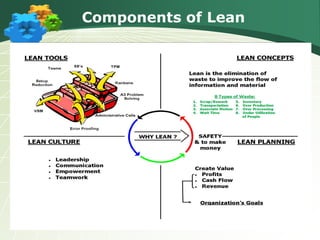
Components of Lean
Change Management

Organizational Change Management is “all of the actions
required for an organization to understand, prepare for,
implement and take full advantage of significant change”.

The goals of Change Management are:
The successful design, implementation, measurement and
maintenance of an organization’s change initiative
Enhancement of their on-going capacity for managing
change.

Enterprise Transformation is driven by an underlying
strategy that organizes and energizes People to
understand, embrace and make full use of new Process
and Technology
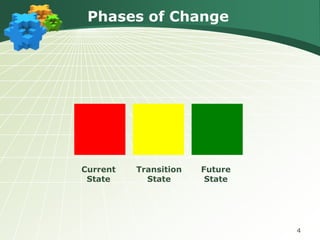
Phases of Change


Current   Transition   Future
 State      State       State


                                4
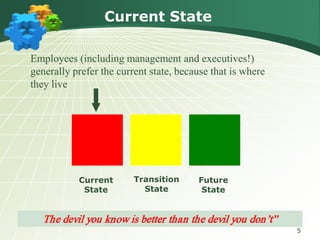
Current State

Employees (including management and executives!)
generally prefer the current state, because that is where
they live


           Current       Transition     Future
            State          State         State


  The devil you know is better than the devil you don’t”
                                                            5
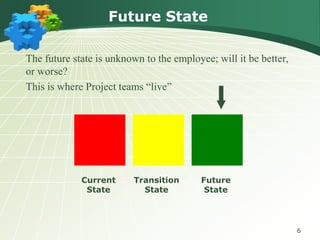
Future State

The future state is unknown to the employee; will it be better,
or worse?
This is where Project teams “live”


             Current     Transition       Future
              State        State           State


                                                                  6
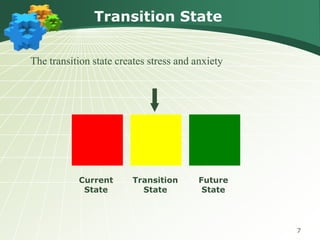
Transition State


The transition state creates stress and anxiety


           Current      Transition       Future
            State         State           State


                                                  7
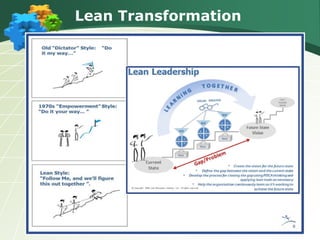
Lean Transformation


                      8
Lean Transformation


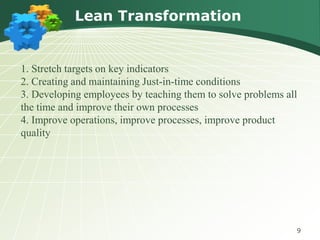
1. Stretch targets on key indicators
2. Creating and maintaining Just-in-time conditions
3. Developing employees by teaching them to solve problems all
the time and improve their own processes
4. Improve operations, improve processes, improve product
quality


                                                             9
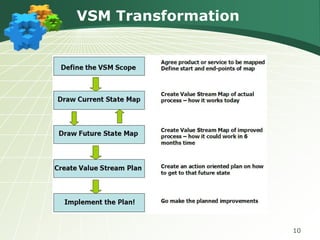
VSM Transformation


                     10
Stretch Targets


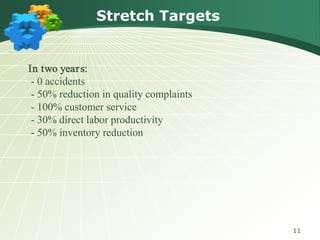
In two year s:
 - 0 accidents
 - 50% reduction in quality complaints
 - 100% customer service
 - 30% direct labor productivity
 - 50% inventory reduction


                                         11
People


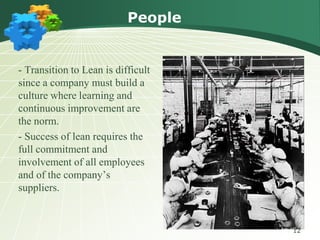
- Transition to Lean is difficult
since a company must build a
culture where learning and
continuous improvement are
the norm.
- Success of lean requires the
full commitment and
involvement of all employees
and of the company’s
suppliers.


                                    12
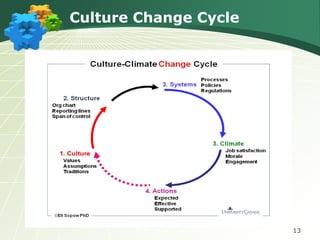
Culture Change Cycle


                       13
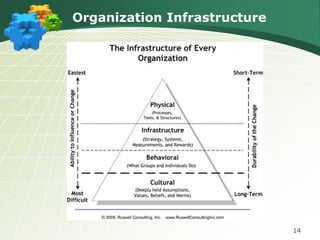
Organization Infrastructure


                              14
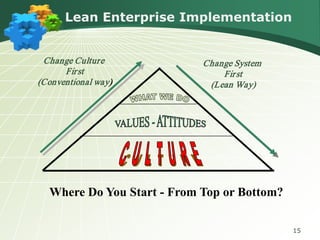
Lean Enterprise Implementation


 Change Culture             Change System
      Fir st                    Fir st
(Conventional way)           (Lean Way)


  Where Do You Start - From Top or Bottom?

                                             15
Becoming a Lean Culture


- The concept of becoming lean requires a change in the culture
and mindset of its employees to encourage them to constantly
look for and submit ideas for improvement
- In a lean culture, Lean tools can be used to leverage the
collective power of teams to solve persistent issues
- Make sure that the material or information moves smoothly
within your company to meet the customer demand without
getting stuck anywhere in the process
Becoming a Lean Culture


- Continuous flow and pull require a perfect system that has the
capacity to meet the necessary demand
- Continuous flow requires lines to be balanced so that all
portions of the process are effectively utilized
- Achieving continuous flow implies that the company has stable
standardized operations and can meet customer demand in the
least amount of time
Becoming a Lean Culture


- Lean organizations are learning organizations, a culture,
not a technique
- Lean culture needs to be implemented as a “whole
system” and sub systems of the work flow also include:
          Motivation and incentive systems
          Training systems
          Organization and management levels
          Improvement processes

- Lean is a culture and all cultures are complex
Organizational Change


It is common for an organization to choose to conduct a
project that will have impact on the organization itself.
Examples:

- New Time and Attendance System
- New email system
- Transition from paper to electronic Requisitions
- Introduction of a new technology
- Distribution of workers in new office space
Organizational Change


- Upper Management undertakes these projects because they
believe that there is sufficient gain to the organization to
warrant the expense.

- And Upper Management usually moves forward on the
basis that since it is in everyone’s best interest, those
individuals affected will of course endorse the project and
work to make it a success.

- And all too often Upper Management receives a rude shock.
Organizational Change

- It can be very difficult to introduce change to an
organization. Failure to recognize and deal with this fact
has been the cause of many project failures.

- As the Management Team, you must be aware of the extent
to which your projects may introduce organizational
change, and then you must deal with this issue.

- Nonetheless, Organizational Change Management can be of
serious concern to any organization whose projects will
require change either in its customers or within the
organization itself.
Organizational Change

What is Or ganizational Change?

- It is generally considered to be an organization-wide
change, as opposed to smaller changes such as adding a
new person.

- It includes the management of changes to the:
organizational culture, business processes, physical
environment, job design / responsibilities, staff skills /
knowledge and policies / procedures.

- When the change is fundamental and radical, one might
call it organizational transformation
Organizational Change

Take a moment to think of an example of organizational
change that you have experienced.

Was it successful? Did it go smoothly?
What wer e your feelings ear ly on? Later ?
What did the people ar ound you say about it?
Change stages

Organizations go through four stages on the way to
achieving their strategic objective:

- Denial
- Resistance
- Exploration
- Renewal

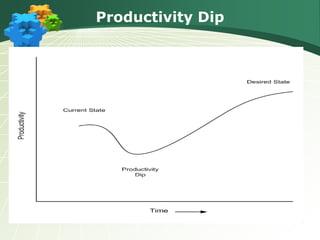
As the Organization works its way through these stages,
there can be a negative impact on Productivity. This is
referred to as the Productivity Dip and is portrayed on the
next slide.
Productivity Dip
Productivity Dip


- Minimizing the size and duration of this Productivity
Dip is dependent upon quickly creating acceptance to
the strategic plan and all that it entails.

- But gaining that acceptance is often a difficult process,
as some employees will, for various reasons, seek to
block the change
Org. Change factors


- Efforts by employees to block the intended change is
referred to as Resistance to Change.
- Resistance is a natural and inevitable reaction in an
organization. You can expect it
- Resistance is sometimes hidden, so it may be necessary
to take active steps to find it
- There are many reasons for resistance; it is important to
understand it
- We manage resistance by working with people, and
helping them deal with their concerns
- There are many ways to build acceptance. It is
important to be flexible. But persist!
Change factors


The key to successful management of organizational
change lies in the people:

1- They are the agents for successful transformation of
the organization.
2- They determine the Return on Investment from this
process

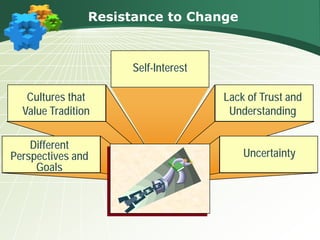
So let’s have a look at where Resistance to Change comes
from and how to best manage it
Resistance to Change


                     Self-Interest

   Cultures that                     Lack of Trust and
  Value Tradition                     Understanding

    Different
Perspectives and                         Uncertainty
     Goals
Rates of Change


  It is generally acknowledged that in an average
  organization, when the intention for change is
                    announced:

  15% of the wor kfor ce is eager to accept it
  15% of the wor kfor ce is dead set against it
70% is sitting on the fence, waiting to see what
                   happens
Steps to Change

How can I best accomplish Organization-wide Change?

Since our interest here is in Management of
Organizational-wide Change, it can be helpful to re-
define Resistance to Change as “employees are not
wholeheartedly embracing a change that management
wants to implement" (Dent & Goldberg, 1999)

This allows us to focus on gaining acceptance (a positive)
rather than on breaking down resistance (a negative).
Steps to Change


- Get senior management agreement (i.e. conflicting goals
can kill the project!)
- Identify a champion who can articulate the reasons for
and advantages of the change
- Translate the vision for change into a realistic plan and
then carry out the plan
- Involve people from every area of the organization
- Communicate. Communicate. Educate. Educate.
- Get organizational support to the change
- Modify organizational structures so that they will sustain
the change
Questions ?


              33

Lean Change Management

  • 1.
    Change Management www.facebook.com/EgyptianLeanStore
  • 2.
  • 3.
    Change Management Organizational ChangeManagement is “all of the actions required for an organization to understand, prepare for, implement and take full advantage of significant change”. The goals of Change Management are: The successful design, implementation, measurement and maintenance of an organization’s change initiative Enhancement of their on-going capacity for managing change. Enterprise Transformation is driven by an underlying strategy that organizes and energizes People to understand, embrace and make full use of new Process and Technology
  • 4.
    Phases of Change Current Transition Future State State State 4
  • 5.
    Current State Employees (includingmanagement and executives!) generally prefer the current state, because that is where they live Current Transition Future State State State The devil you know is better than the devil you don’t” 5
  • 6.
    Future State The futurestate is unknown to the employee; will it be better, or worse? This is where Project teams “live” Current Transition Future State State State 6
  • 7.
    Transition State The transitionstate creates stress and anxiety Current Transition Future State State State 7
  • 8.
  • 9.
    Lean Transformation 1. Stretchtargets on key indicators 2. Creating and maintaining Just-in-time conditions 3. Developing employees by teaching them to solve problems all the time and improve their own processes 4. Improve operations, improve processes, improve product quality 9
  • 10.
  • 11.
    Stretch Targets In twoyear s: - 0 accidents - 50% reduction in quality complaints - 100% customer service - 30% direct labor productivity - 50% inventory reduction 11
  • 12.
    People - Transition toLean is difficult since a company must build a culture where learning and continuous improvement are the norm. - Success of lean requires the full commitment and involvement of all employees and of the company’s suppliers. 12
  • 13.
  • 14.
  • 15.
    Lean Enterprise Implementation Change Culture Change System Fir st Fir st (Conventional way) (Lean Way) Where Do You Start - From Top or Bottom? 15
  • 16.
    Becoming a LeanCulture - The concept of becoming lean requires a change in the culture and mindset of its employees to encourage them to constantly look for and submit ideas for improvement - In a lean culture, Lean tools can be used to leverage the collective power of teams to solve persistent issues - Make sure that the material or information moves smoothly within your company to meet the customer demand without getting stuck anywhere in the process
  • 17.
    Becoming a LeanCulture - Continuous flow and pull require a perfect system that has the capacity to meet the necessary demand - Continuous flow requires lines to be balanced so that all portions of the process are effectively utilized - Achieving continuous flow implies that the company has stable standardized operations and can meet customer demand in the least amount of time
  • 18.
    Becoming a LeanCulture - Lean organizations are learning organizations, a culture, not a technique - Lean culture needs to be implemented as a “whole system” and sub systems of the work flow also include: Motivation and incentive systems Training systems Organization and management levels Improvement processes - Lean is a culture and all cultures are complex
  • 19.
    Organizational Change It iscommon for an organization to choose to conduct a project that will have impact on the organization itself. Examples: - New Time and Attendance System - New email system - Transition from paper to electronic Requisitions - Introduction of a new technology - Distribution of workers in new office space
  • 20.
    Organizational Change - UpperManagement undertakes these projects because they believe that there is sufficient gain to the organization to warrant the expense. - And Upper Management usually moves forward on the basis that since it is in everyone’s best interest, those individuals affected will of course endorse the project and work to make it a success. - And all too often Upper Management receives a rude shock.
  • 21.
    Organizational Change - Itcan be very difficult to introduce change to an organization. Failure to recognize and deal with this fact has been the cause of many project failures. - As the Management Team, you must be aware of the extent to which your projects may introduce organizational change, and then you must deal with this issue. - Nonetheless, Organizational Change Management can be of serious concern to any organization whose projects will require change either in its customers or within the organization itself.
  • 22.
    Organizational Change What isOr ganizational Change? - It is generally considered to be an organization-wide change, as opposed to smaller changes such as adding a new person. - It includes the management of changes to the: organizational culture, business processes, physical environment, job design / responsibilities, staff skills / knowledge and policies / procedures. - When the change is fundamental and radical, one might call it organizational transformation
  • 23.
    Organizational Change Take amoment to think of an example of organizational change that you have experienced. Was it successful? Did it go smoothly? What wer e your feelings ear ly on? Later ? What did the people ar ound you say about it?
  • 24.
    Change stages Organizations gothrough four stages on the way to achieving their strategic objective: - Denial - Resistance - Exploration - Renewal As the Organization works its way through these stages, there can be a negative impact on Productivity. This is referred to as the Productivity Dip and is portrayed on the next slide.
  • 25.
  • 26.
    Productivity Dip - Minimizingthe size and duration of this Productivity Dip is dependent upon quickly creating acceptance to the strategic plan and all that it entails. - But gaining that acceptance is often a difficult process, as some employees will, for various reasons, seek to block the change
  • 27.
    Org. Change factors -Efforts by employees to block the intended change is referred to as Resistance to Change. - Resistance is a natural and inevitable reaction in an organization. You can expect it - Resistance is sometimes hidden, so it may be necessary to take active steps to find it - There are many reasons for resistance; it is important to understand it - We manage resistance by working with people, and helping them deal with their concerns - There are many ways to build acceptance. It is important to be flexible. But persist!
  • 28.
    Change factors The keyto successful management of organizational change lies in the people: 1- They are the agents for successful transformation of the organization. 2- They determine the Return on Investment from this process So let’s have a look at where Resistance to Change comes from and how to best manage it
  • 29.
    Resistance to Change Self-Interest Cultures that Lack of Trust and Value Tradition Understanding Different Perspectives and Uncertainty Goals
  • 30.
    Rates of Change It is generally acknowledged that in an average organization, when the intention for change is announced: 15% of the wor kfor ce is eager to accept it 15% of the wor kfor ce is dead set against it 70% is sitting on the fence, waiting to see what happens
  • 31.
    Steps to Change Howcan I best accomplish Organization-wide Change? Since our interest here is in Management of Organizational-wide Change, it can be helpful to re- define Resistance to Change as “employees are not wholeheartedly embracing a change that management wants to implement" (Dent & Goldberg, 1999) This allows us to focus on gaining acceptance (a positive) rather than on breaking down resistance (a negative).
  • 32.
    Steps to Change -Get senior management agreement (i.e. conflicting goals can kill the project!) - Identify a champion who can articulate the reasons for and advantages of the change - Translate the vision for change into a realistic plan and then carry out the plan - Involve people from every area of the organization - Communicate. Communicate. Educate. Educate. - Get organizational support to the change - Modify organizational structures so that they will sustain the change
  • 33.