A New Approach for a Complex
World
A New Perspective on
Operational Excellence
Chris Seifert, Consultant
Wilson Perumal & Company
• Expertise in manufacturing, operational excellence,
and management system design and implementation
• Former Operations Leader, Owens Corning (increased
plant productivity by 25% in just 9 months)
• Former Plant Manager and Manager of Business Strategy
& Analysis, Georgia Pacific (Koch Industries)
• Top-ranked submarine officer, US Navy (ranked #1 of 9
submarine junior officers)
• MBA, Summa Cum Laude, University of Georgia; BS
Business Administration, St. Louis University
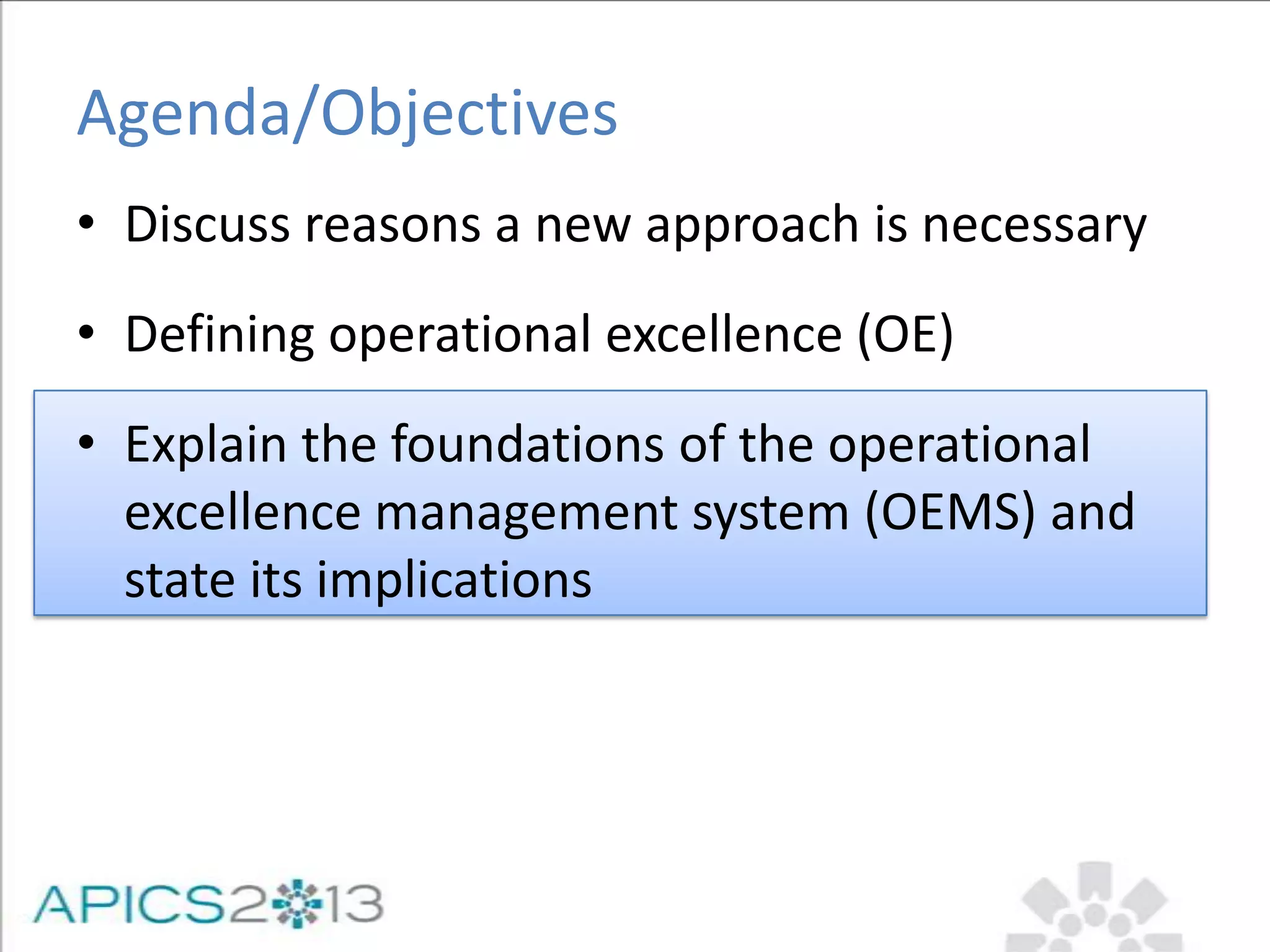
Agenda/Objectives
• Discuss reasons a new approach is necessary
• Defining operational excellence (OE)
• Explain the foundations of the operational
excellence management system (OEMS) and
state its implications
• Describe the steps in implementing an OEMS
A new approach is necessary
• Operational excellence is more
important than ever –
customers demand it!
• Traditional approaches are not
achieving expected results
• Leadership engagement is often
blamed
• A different culprit is to blame
The world has changed!
Volume
Cost
Pre-Industrial Age
“Individual productivity”
Dominated by
variable costs
Volume
Industrial Age
“Economies of Scale”
Dominated by
fixed costs
Complexity
Post-Industrial Age
“Complexity”
Dominated by
complexity
costs
The Vicious Complexity Cycle
Complexity
increases
Poor
execution
Loss of
process
control
Poor
business
results
More
people &
processes
Vicious
Complexity Cycle
Traditional approaches aren’t effective
in the face of complexity
• Address individual
processes – not
interactions between
product, process, and
organization
Traditional approaches aren’t effective
in the face of complexity
Bottom-up approach: Improving one process at a time
Top-down approach: Start with a framework
Traditional approaches aren’t effective
in the face of complexity
• Attempt to improve before establishing
control
Agenda/Objectives
• Discuss reasons a new approach is necessary
• Defining operational excellence (OE)
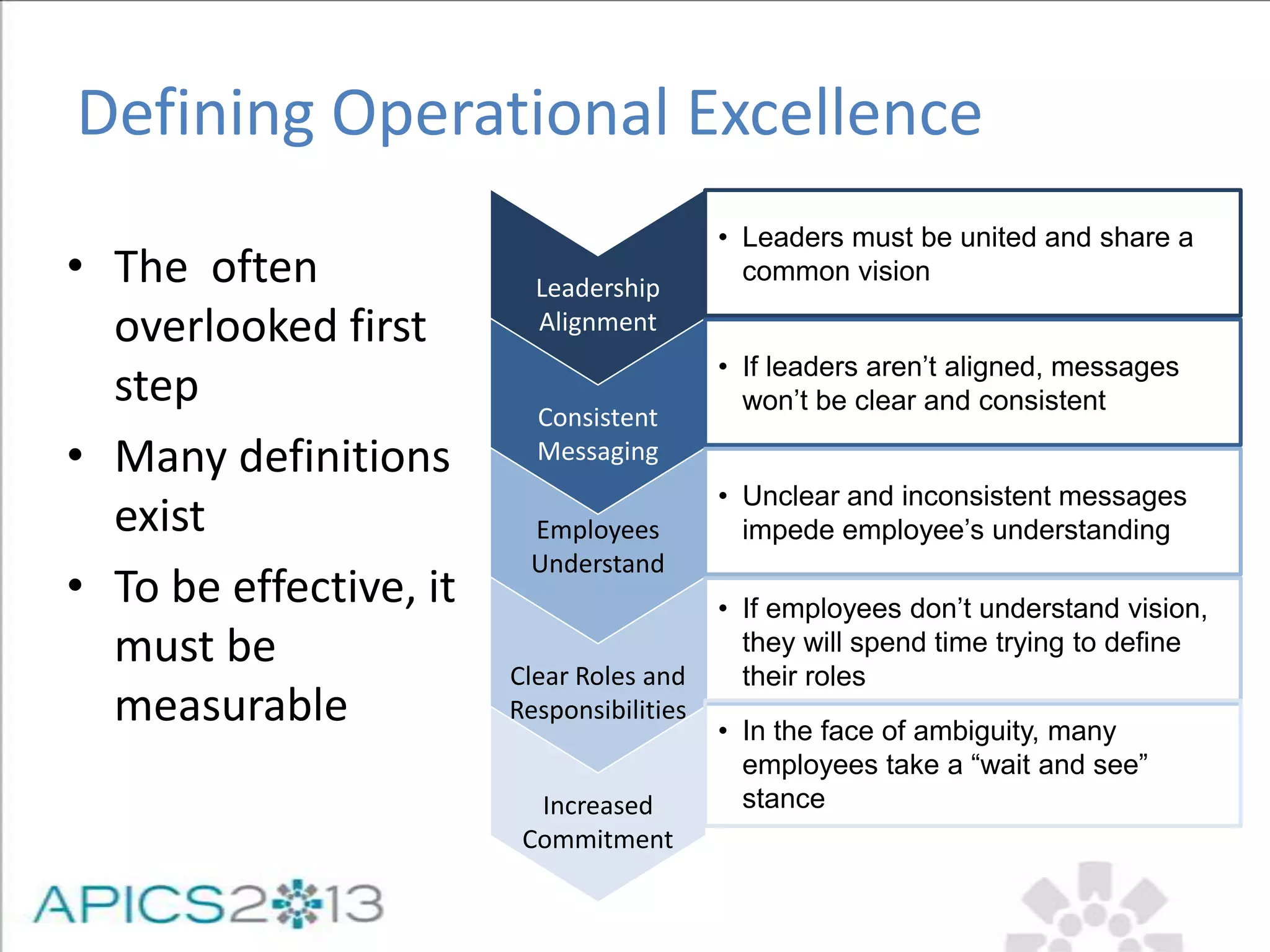
Defining Operational Excellence
• The often
overlooked first
step
• Many definitions
exist
• To be effective, it
must be
measurable
Leadership
Alignment
Consistent
Messaging
Employees
Understand
Clear Roles and
Responsibilities
Increased
Commitment
• Leaders must be united and share a
common vision
• If leaders aren’t aligned, messages
won’t be clear and consistent
• Unclear and inconsistent messages
impede employee’s understanding
• If employees don’t understand vision,
they will spend time trying to define
their roles
• In the face of ambiguity, many
employees take a “wait and see”
stance
Example - Definition of Operational
Excellence
Operational excellence is a philosophy of
leadership, teamwork and problem solving
resulting in continuous improvement throughout
the organization by focusing on the needs of the
customer, empowering employees, and
optimizing existing activities in the process. -
Wikipedia
Operational Excellence delivers
industry leading performance
Sound
Strategy
Operational
Excellence
Leading
Performance
7 Value Drivers
1. Safety
2. Environment
3. Compliance
4. Quality
5. Productivity
6. Yield
7. Cost
Strategy
1. Product portfolio
2. Markets served
3. Distribution
channels
4. Price point
5. Level of service
6. Partnerships
7. Operating model
Operational
excellence is the
execution of the
business strategy
more consistently
and reliably than
the competition.
Operational Excellence is a function
of the management system & culture
Sound
Strategy
Operational
Excellence
Leading
Performance
Effective
processes
and
procedures
Culture of
Operational
Discipline
Operational
Excellence
Understanding this relationship helps cut through complexity to
quickly identify the real problem from the “top—down”
Agenda/Objectives
• Discuss reasons a new approach is necessary
• Defining operational excellence (OE)
• Explain the foundations of the operational
excellence management system (OEMS) and
state its implications
The foundation of an Operational
Excellence Management System
Performance
Indicators
Safety
Environment
Compliance
Quality
Productivity
Yield
Cost
The 4 Sources of Risk
EquipmentProcessesPeopleInputs
Acted on
by
To
produce
Finished
Goods/
Services
The Operation
• Any failure of the operation to produce a good or service that
meets the customers requirements is a result of 1 of 4 sources:
1. A person failed to do what they were expected to do.
2. A process failed to perform as expected
3. A piece of equipment failed to perform as expected
4. Un-managed change
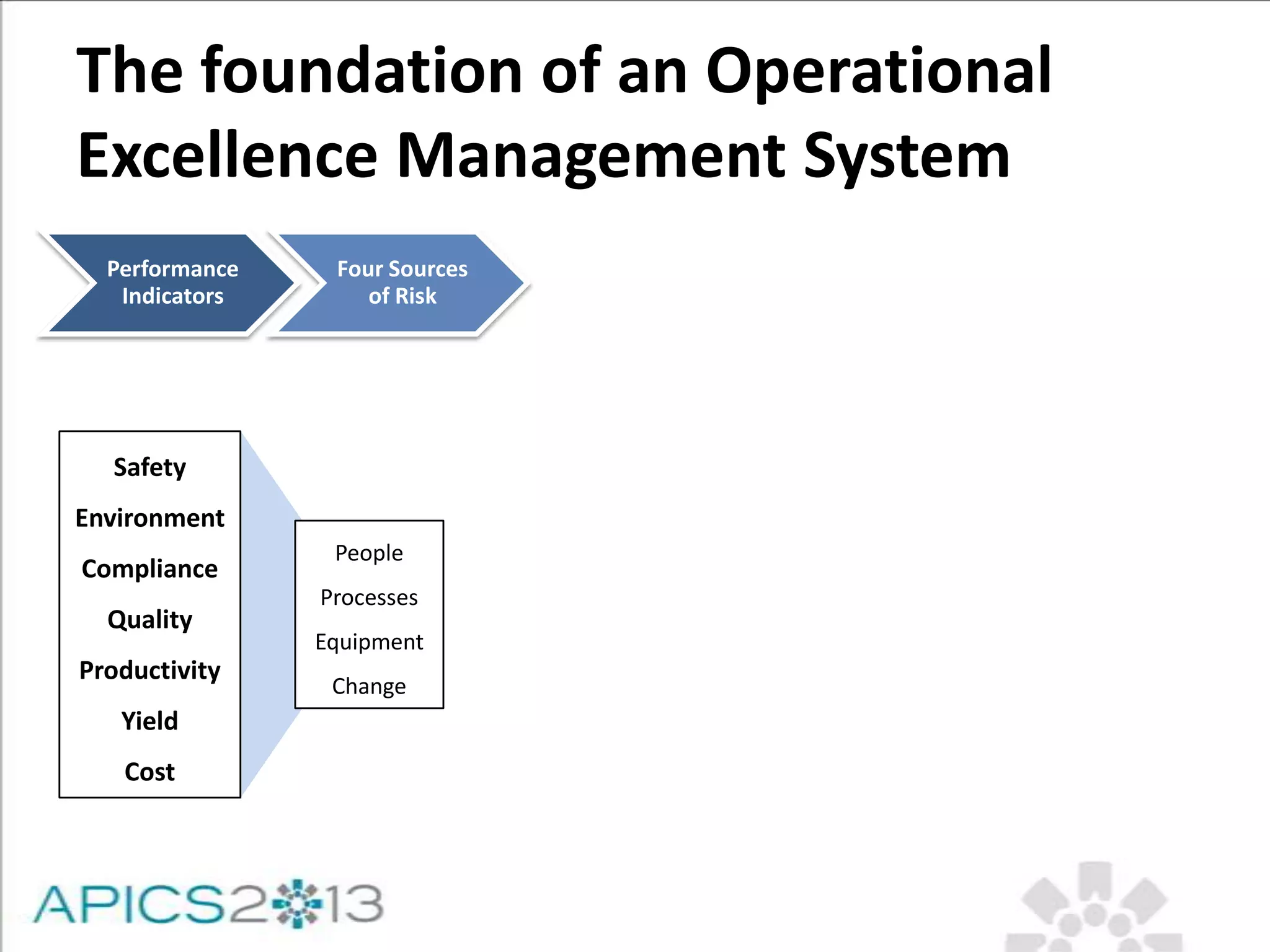
The foundation of an Operational
Excellence Management System
Performance
Indicators
Four Sources
of Risk
Safety
Environment
Compliance
Quality
Productivity
Yield
Cost
People
Processes
Equipment
Change
Each source of risk can be analyzed
for the key causes of failure
People
Unaware of
expectation
Unable to perform as
expected
Chooses not to perform
as expected
Expectations don’t exist
Expectations not
communicated
Expectations not
enforced
Lack of knowledge
Lack of talent
Lack of virtue
Wrong incentive
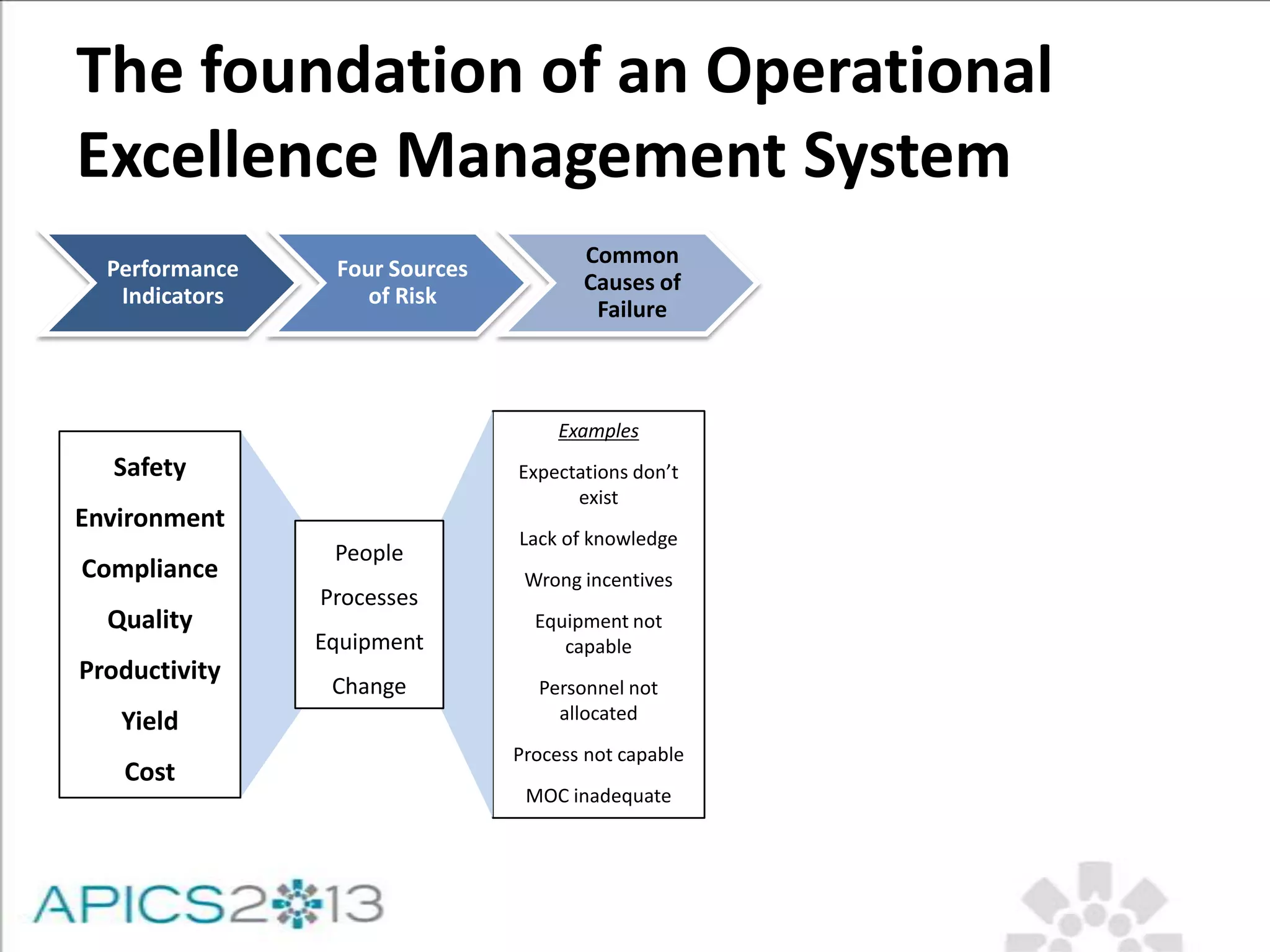
The foundation of an Operational
Excellence Management System
Performance
Indicators
Four Sources
of Risk
Common
Causes of
Failure
Examples
Expectations don’t
exist
Lack of knowledge
Wrong incentives
Equipment not
capable
Personnel not
allocated
Process not capable
MOC inadequate
Safety
Environment
Compliance
Quality
Productivity
Yield
Cost
People
Processes
Equipment
Change
For each key cause, there is a Key
Control to prevent the failure
People
Unaware of
expectation
Unable to perform as
expected
Chooses not to perform
as expected
Expectations don’t exist
Expectations not
communicated
Expectations not
enforced
Lack of knowledge
Lack of talent
Lack of virtue
Wrong incentive
Ops/maintenance
procedures/policies/standard work
Core communication strategy
Audits/assessments, org structure,
performance management
Training/certification
Selection process
Culture, selection process
Compensation strategy, performance
management
The foundation of an Operational
Excellence Management System
Performance
Indicators
Four Sources
of Risk
Finite Causes
of Failure
Specific Key
Controls
Examples
Vision/procedures
Training/certification
Performance mgmt
Engineering
disciplines
Maintenance
planning/scheduling
Design for Six Sigma
MOC process
Culture
Process control plan
FMEA
Examples
Expectations don’t
exist
Lack of knowledge
Wrong incentives
Equipment not
capable
Personnel not
allocated
Process not capable
MOC inadequate
Safety
Environment
Compliance
Quality
Productivity
Yield
Cost
People
Processes
Equipment
Change
The Key Controls can be grouped into
Elements to facilitate application
Value of the Elements
• Easier to remember
• Creates common
language that
facilitates learning
• Encourages systems
thinking
Risk
Identification
Process
Hazard
Analysis
Failure Modes
Effects
Analysis
Risk Registers
The Key Controls can be grouped into
Elements to facilitate application
Value of the Elements
• Easier to remember
• Creates common
language that
facilitates learning
• Encourages systems
thinking
Risk
Identification
Process
Hazard
Analysis
Failure Modes
Effects
Analysis
Risk Registers
The foundation of an Operational
Excellence Management System
Performance
Indicators
Four Sources
of Risk
Finite Causes
of Failure
Specific Key
Controls
OEMS
Elements
Examples
Vision/procedures
Training/certification
Performance mgmt
Engineering
disciplines
Maintenance
planning/scheduling
Design for Six Sigma
MOC process
Culture
Process control plan
FMEA
Examples
Expectations don’t
exist
Lack of knowledge
Wrong incentives
Equipment not
capable
Personnel not
allocated
Process not capable
MOC inadequate
Leadership
Employee
accountability
Risk identification
Risk mitigation
Knowledge
sharing
Management of
change
Continuous
improvement
Safety
Environment
Compliance
Quality
Productivity
Yield
Cost
People
Processes
Equipment
Change
Implications of the 7 Element OEMS
• Benchmarking is essential
• Manage the sources of risk, not the outcomes
• The OEMS is applicable across all types of
operations
• All incidents are the result of a failure of at
least one Element
• You must break the vicious complexity cycle
Agenda/Objectives
• Discuss reasons a new approach is necessary
• Defining operational excellence (OE)
• Explain the foundations of the operational
excellence management system (OEMS) and
state its implications
• Describe the steps in implementing an OEMS
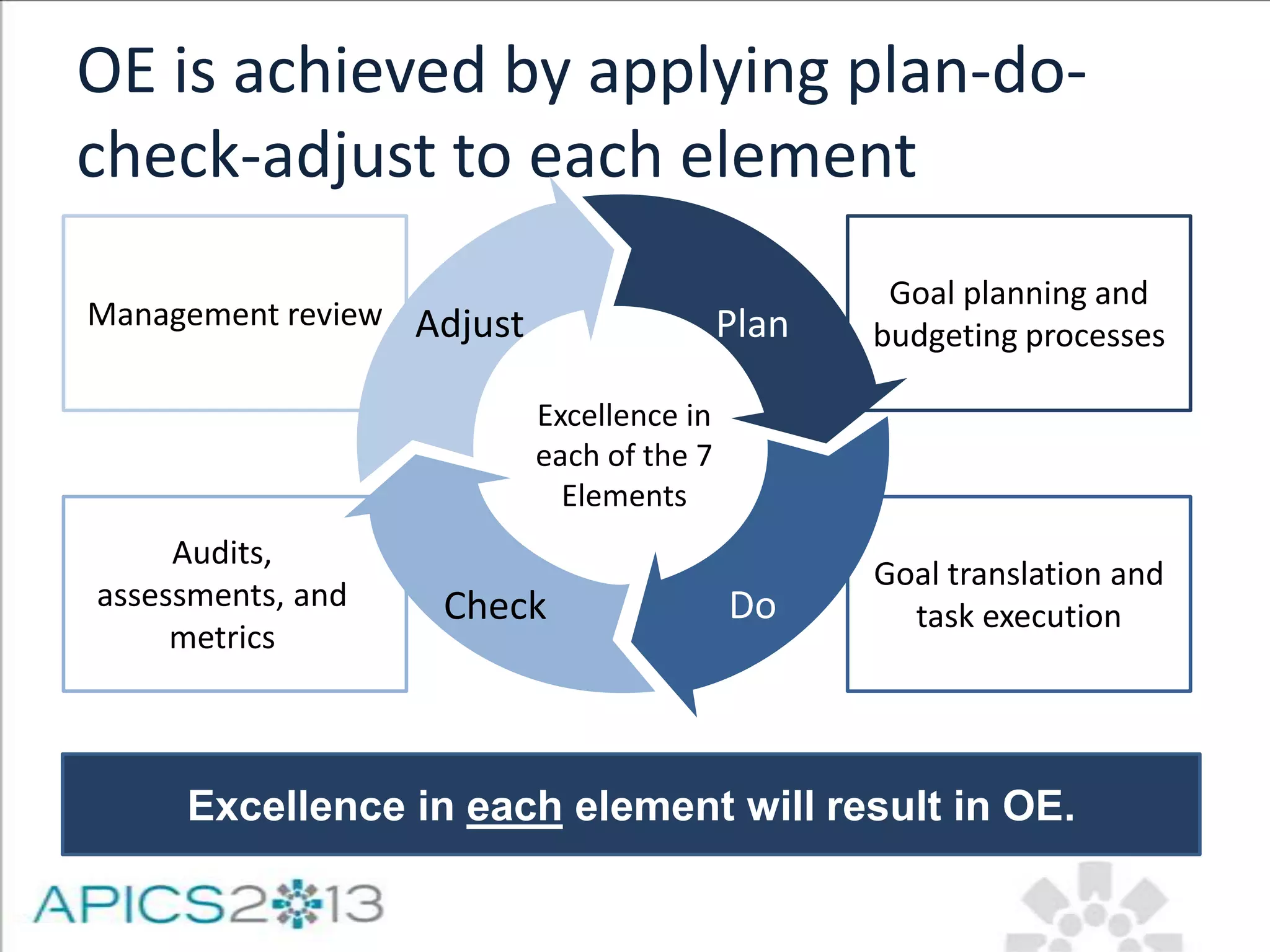
OE is achieved by applying plan-do-
check-adjust to each element
Audits,
assessments, and
metrics
Management review
Goal translation and
task execution
Goal planning and
budgeting processesPlan
Do
Adjust
Excellence in each element will result in OE.
Excellence in
each of the 7
Elements
Check
Developing the OE plan
OutputProcess Steps
Determine the
“size of the
prize”
Benchmark
excellence in
each key value
driver
Measure current
performance in
each key value
driver
Identify gaps in
OEMS elements
Benchmark
excellence in
each element
Assess current
state of each
element
Develop OE plan
Prioritize
element gaps to
close based on
potential value
Schedule, and
resource
strategies for
closing gaps
Metrics and targets
that will be used to
measure progress.
List of the systemic
breakdowns that
are causing
failures.
Prioritized action
plan.
There is an “order” to implementation
Leadership
Employee accountability
Risk identification
Risk control
Knowledge sharing
Management of change
Continuous improvement
Committed leadership is the foundation
Employees must know their accountabilities
Once leaders and employees are committed to
preventing risks, identifying them creates value
Risks must be identified and assessed before they can
be controlled
Controls must be in place before employees can be
trained on them
Processes must be clearly defined and controlled
before change can be managed
Assessing a process that is known to be out of control
often creates little value
Summary
• A new approach is required due to complexity
• First Step: Define and quantify OE
• The 7 Element OEMS breaks the vicious
complexity cycle
• Apply plan-do-check-adjust to each element
• Remember that there is an “order” to things
Questions
Email: cseifert@wilsonperumal.com
cpseifer@gmail.com
On the Web: www.wilsonperumal.com
Blog: www.wilsonperumal.com/blog
Twitter: @cpseifer
@Wilson_Perumal
LinkedIn:
http://www.linkedin.com/in/christopherseifert
http://linkd.in/10BnH1i
Phone:
(972) 800-3618
(972) 716-3930
Contact Information

A New Perspective on Operational Excellence

  • 1.
    A New Approachfor a Complex World A New Perspective on Operational Excellence
  • 2.
    Chris Seifert, Consultant WilsonPerumal & Company • Expertise in manufacturing, operational excellence, and management system design and implementation • Former Operations Leader, Owens Corning (increased plant productivity by 25% in just 9 months) • Former Plant Manager and Manager of Business Strategy & Analysis, Georgia Pacific (Koch Industries) • Top-ranked submarine officer, US Navy (ranked #1 of 9 submarine junior officers) • MBA, Summa Cum Laude, University of Georgia; BS Business Administration, St. Louis University
  • 3.
    Agenda/Objectives • Discuss reasonsa new approach is necessary • Defining operational excellence (OE) • Explain the foundations of the operational excellence management system (OEMS) and state its implications • Describe the steps in implementing an OEMS
  • 4.
    A new approachis necessary • Operational excellence is more important than ever – customers demand it! • Traditional approaches are not achieving expected results • Leadership engagement is often blamed • A different culprit is to blame
  • 5.
    The world haschanged! Volume Cost Pre-Industrial Age “Individual productivity” Dominated by variable costs Volume Industrial Age “Economies of Scale” Dominated by fixed costs Complexity Post-Industrial Age “Complexity” Dominated by complexity costs
  • 6.
    The Vicious ComplexityCycle Complexity increases Poor execution Loss of process control Poor business results More people & processes Vicious Complexity Cycle
  • 7.
    Traditional approaches aren’teffective in the face of complexity • Address individual processes – not interactions between product, process, and organization
  • 8.
    Traditional approaches aren’teffective in the face of complexity Bottom-up approach: Improving one process at a time Top-down approach: Start with a framework
  • 9.
    Traditional approaches aren’teffective in the face of complexity • Attempt to improve before establishing control
  • 10.
    Agenda/Objectives • Discuss reasonsa new approach is necessary • Defining operational excellence (OE)
  • 11.
    Defining Operational Excellence •The often overlooked first step • Many definitions exist • To be effective, it must be measurable Leadership Alignment Consistent Messaging Employees Understand Clear Roles and Responsibilities Increased Commitment • Leaders must be united and share a common vision • If leaders aren’t aligned, messages won’t be clear and consistent • Unclear and inconsistent messages impede employee’s understanding • If employees don’t understand vision, they will spend time trying to define their roles • In the face of ambiguity, many employees take a “wait and see” stance
  • 12.
    Example - Definitionof Operational Excellence Operational excellence is a philosophy of leadership, teamwork and problem solving resulting in continuous improvement throughout the organization by focusing on the needs of the customer, empowering employees, and optimizing existing activities in the process. - Wikipedia
  • 13.
    Operational Excellence delivers industryleading performance Sound Strategy Operational Excellence Leading Performance 7 Value Drivers 1. Safety 2. Environment 3. Compliance 4. Quality 5. Productivity 6. Yield 7. Cost Strategy 1. Product portfolio 2. Markets served 3. Distribution channels 4. Price point 5. Level of service 6. Partnerships 7. Operating model Operational excellence is the execution of the business strategy more consistently and reliably than the competition.
  • 14.
    Operational Excellence isa function of the management system & culture Sound Strategy Operational Excellence Leading Performance Effective processes and procedures Culture of Operational Discipline Operational Excellence Understanding this relationship helps cut through complexity to quickly identify the real problem from the “top—down”
  • 15.
    Agenda/Objectives • Discuss reasonsa new approach is necessary • Defining operational excellence (OE) • Explain the foundations of the operational excellence management system (OEMS) and state its implications
  • 16.
    The foundation ofan Operational Excellence Management System Performance Indicators Safety Environment Compliance Quality Productivity Yield Cost
  • 17.
    The 4 Sourcesof Risk EquipmentProcessesPeopleInputs Acted on by To produce Finished Goods/ Services The Operation • Any failure of the operation to produce a good or service that meets the customers requirements is a result of 1 of 4 sources: 1. A person failed to do what they were expected to do. 2. A process failed to perform as expected 3. A piece of equipment failed to perform as expected 4. Un-managed change
  • 18.
    The foundation ofan Operational Excellence Management System Performance Indicators Four Sources of Risk Safety Environment Compliance Quality Productivity Yield Cost People Processes Equipment Change
  • 19.
    Each source ofrisk can be analyzed for the key causes of failure People Unaware of expectation Unable to perform as expected Chooses not to perform as expected Expectations don’t exist Expectations not communicated Expectations not enforced Lack of knowledge Lack of talent Lack of virtue Wrong incentive
  • 20.
    The foundation ofan Operational Excellence Management System Performance Indicators Four Sources of Risk Common Causes of Failure Examples Expectations don’t exist Lack of knowledge Wrong incentives Equipment not capable Personnel not allocated Process not capable MOC inadequate Safety Environment Compliance Quality Productivity Yield Cost People Processes Equipment Change
  • 21.
    For each keycause, there is a Key Control to prevent the failure People Unaware of expectation Unable to perform as expected Chooses not to perform as expected Expectations don’t exist Expectations not communicated Expectations not enforced Lack of knowledge Lack of talent Lack of virtue Wrong incentive Ops/maintenance procedures/policies/standard work Core communication strategy Audits/assessments, org structure, performance management Training/certification Selection process Culture, selection process Compensation strategy, performance management
  • 22.
    The foundation ofan Operational Excellence Management System Performance Indicators Four Sources of Risk Finite Causes of Failure Specific Key Controls Examples Vision/procedures Training/certification Performance mgmt Engineering disciplines Maintenance planning/scheduling Design for Six Sigma MOC process Culture Process control plan FMEA Examples Expectations don’t exist Lack of knowledge Wrong incentives Equipment not capable Personnel not allocated Process not capable MOC inadequate Safety Environment Compliance Quality Productivity Yield Cost People Processes Equipment Change
  • 23.
    The Key Controlscan be grouped into Elements to facilitate application Value of the Elements • Easier to remember • Creates common language that facilitates learning • Encourages systems thinking Risk Identification Process Hazard Analysis Failure Modes Effects Analysis Risk Registers
  • 24.
    The Key Controlscan be grouped into Elements to facilitate application Value of the Elements • Easier to remember • Creates common language that facilitates learning • Encourages systems thinking Risk Identification Process Hazard Analysis Failure Modes Effects Analysis Risk Registers
  • 25.
    The foundation ofan Operational Excellence Management System Performance Indicators Four Sources of Risk Finite Causes of Failure Specific Key Controls OEMS Elements Examples Vision/procedures Training/certification Performance mgmt Engineering disciplines Maintenance planning/scheduling Design for Six Sigma MOC process Culture Process control plan FMEA Examples Expectations don’t exist Lack of knowledge Wrong incentives Equipment not capable Personnel not allocated Process not capable MOC inadequate Leadership Employee accountability Risk identification Risk mitigation Knowledge sharing Management of change Continuous improvement Safety Environment Compliance Quality Productivity Yield Cost People Processes Equipment Change
  • 26.
    Implications of the7 Element OEMS • Benchmarking is essential • Manage the sources of risk, not the outcomes • The OEMS is applicable across all types of operations • All incidents are the result of a failure of at least one Element • You must break the vicious complexity cycle
  • 27.
    Agenda/Objectives • Discuss reasonsa new approach is necessary • Defining operational excellence (OE) • Explain the foundations of the operational excellence management system (OEMS) and state its implications • Describe the steps in implementing an OEMS
  • 28.
    OE is achievedby applying plan-do- check-adjust to each element Audits, assessments, and metrics Management review Goal translation and task execution Goal planning and budgeting processesPlan Do Adjust Excellence in each element will result in OE. Excellence in each of the 7 Elements Check
  • 29.
    Developing the OEplan OutputProcess Steps Determine the “size of the prize” Benchmark excellence in each key value driver Measure current performance in each key value driver Identify gaps in OEMS elements Benchmark excellence in each element Assess current state of each element Develop OE plan Prioritize element gaps to close based on potential value Schedule, and resource strategies for closing gaps Metrics and targets that will be used to measure progress. List of the systemic breakdowns that are causing failures. Prioritized action plan.
  • 30.
    There is an“order” to implementation Leadership Employee accountability Risk identification Risk control Knowledge sharing Management of change Continuous improvement Committed leadership is the foundation Employees must know their accountabilities Once leaders and employees are committed to preventing risks, identifying them creates value Risks must be identified and assessed before they can be controlled Controls must be in place before employees can be trained on them Processes must be clearly defined and controlled before change can be managed Assessing a process that is known to be out of control often creates little value
  • 31.
    Summary • A newapproach is required due to complexity • First Step: Define and quantify OE • The 7 Element OEMS breaks the vicious complexity cycle • Apply plan-do-check-adjust to each element • Remember that there is an “order” to things
  • 32.
  • 33.
    Email: cseifert@wilsonperumal.com cpseifer@gmail.com On theWeb: www.wilsonperumal.com Blog: www.wilsonperumal.com/blog Twitter: @cpseifer @Wilson_Perumal LinkedIn: http://www.linkedin.com/in/christopherseifert http://linkd.in/10BnH1i Phone: (972) 800-3618 (972) 716-3930 Contact Information

Editor's Notes

  • #5  Achieving Operational Excellence is more important than ever Competition is greater – margins are tighter Expectations are higher – customers, shareholders, community/government News of poor performance travels fast – social media Traditional approaches are not achieving expected results 58% of executives report their continuous improvement programs produced minimal financial impact1 *2010 Accenture Survey Chevron CEO Quote about LEAN/Six SigmaOther data points Leadership Engagement is often blamed Is this really the case? They invested the money – why didn’t they get the results
  • #14 Given two companies with similar strategies, the one that executes better will have greater performance across ALL 7 Value Drivers.
  • #15 Given two companies with similar strategies, the one that executes better will have greater performance across ALL 7 Value Drivers.