Strategic Management


Summarized by: Mohamed EL-Sayed
Introduction of Concepts


   Strategic Management: The set of managerial decisions and
    actions that determines the long-run performance of an
    organization.

   Strategic Planning: The process of determining a company's
    long-term goals and then identifying the best approach for
    achieving those goals
Why is strategic management important?


   Gives everyone a role
   Makes a difference in performance levels
   Provides systematic approach to uncertainties
   Coordinates and focuses employees
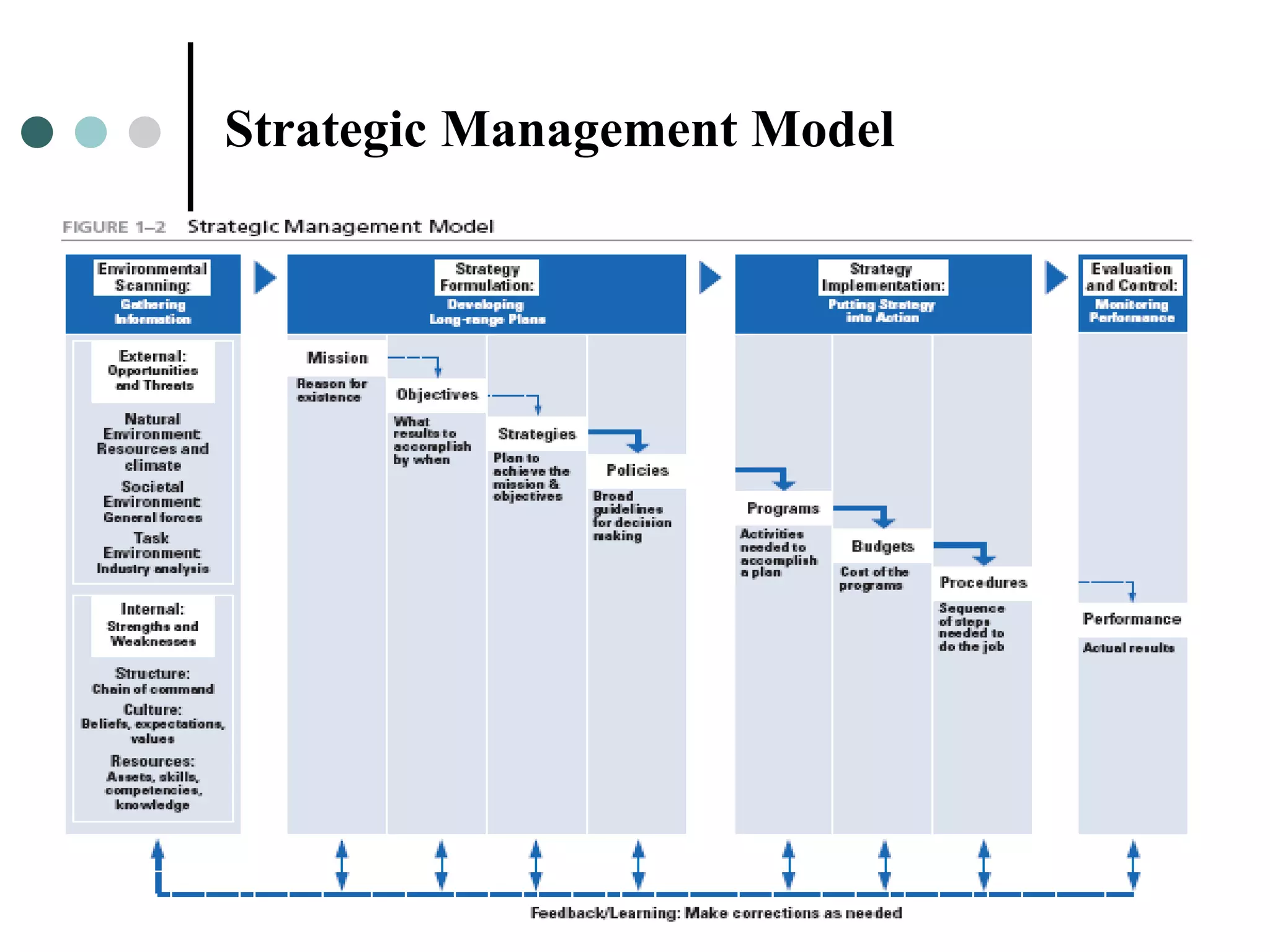
Strategic Management Model
Basic Elements of Strategic Management

A- Environmental Scanning: is the monitoring, evaluating and
    disseminating of information from the external and internal
    environments to key people within the organization

B- Strategy Formulation: is the development of long-range plans
    for the effective management of environmental opportunities
    and threats in light of organizational strengths and
    weaknesses (SWOT)
Basic Elements of Strategic Management

C- Strategy implementation: the process by which strategies and
    policies are put into action through the development of:
   Programs
   Budgets
   Procedures

D- Evaluation and control: the process in which corporate
    activities and performance results are monitored so that
    actual performance can be compared to desired performance

E- Feedback/Learning Process: revise or correct decisions based
    on performance
Strategic Management Process

   Step 1: Identifying the organization's current mission,
    objectives, and strategies
      Mission: the firm’s reason for being
        • Who we are,
        • What we do, and
        • Where we are now
      Goals: the foundation for further planning
        • Measurable performance targets

   Step 2: Conducting an external analysis
      The environmental scanning of specific and general
       environments
      Focuses on identifying opportunities and threats
Strategic Management Process (cont’d)

   Step 3: Conducting an internal analysis
      Assessing organizational resources, capabilities, activities
       and culture:
        • Strengths (core competencies) create value for the
          customer and strengthen the competitive position of
          the firm.
        • Weaknesses (things done poorly or not at all) can
          place the firm at a competitive disadvantage.

Steps 2 and 3 combined are called a SWOT analysis (Strengths,
Weaknesses, Opportunities, and Threats)
Strategic Management Process (cont’d)


   Step 4: Formulating strategies
      Develop and evaluate strategic alternatives
      Select appropriate strategies for all levels in the
       organization that provide relative advantage over
       competitors
      Match organizational strengths to environmental
       opportunities
      Correct weaknesses and guard against threats
Strategic Management Process (cont’d)

   Step 5: Implementing strategies
      Implementation: effectively fitting organizational structure
       and activities to the environment
      Effective strategy implementation requires an
       organizational structure matched to its requirements.

   Step 6: Evaluating results
      How effective have strategies been?
      What adjustments, if any, are necessary?
Key terms of Strategic Management


Mission- the purpose or reason for the organization’s existence

Vision- describes what the organization would like to become

Objectives- the end results of planned activity
Key terms of Strategic Management


Strategies- form a comprehensive master plan that states how the
   corporation will achieve its mission and objectives
     Corporate
     Business
     Functional
Policies- the broad guidelines for decision making that links the
   formulation of a strategy with its implementation
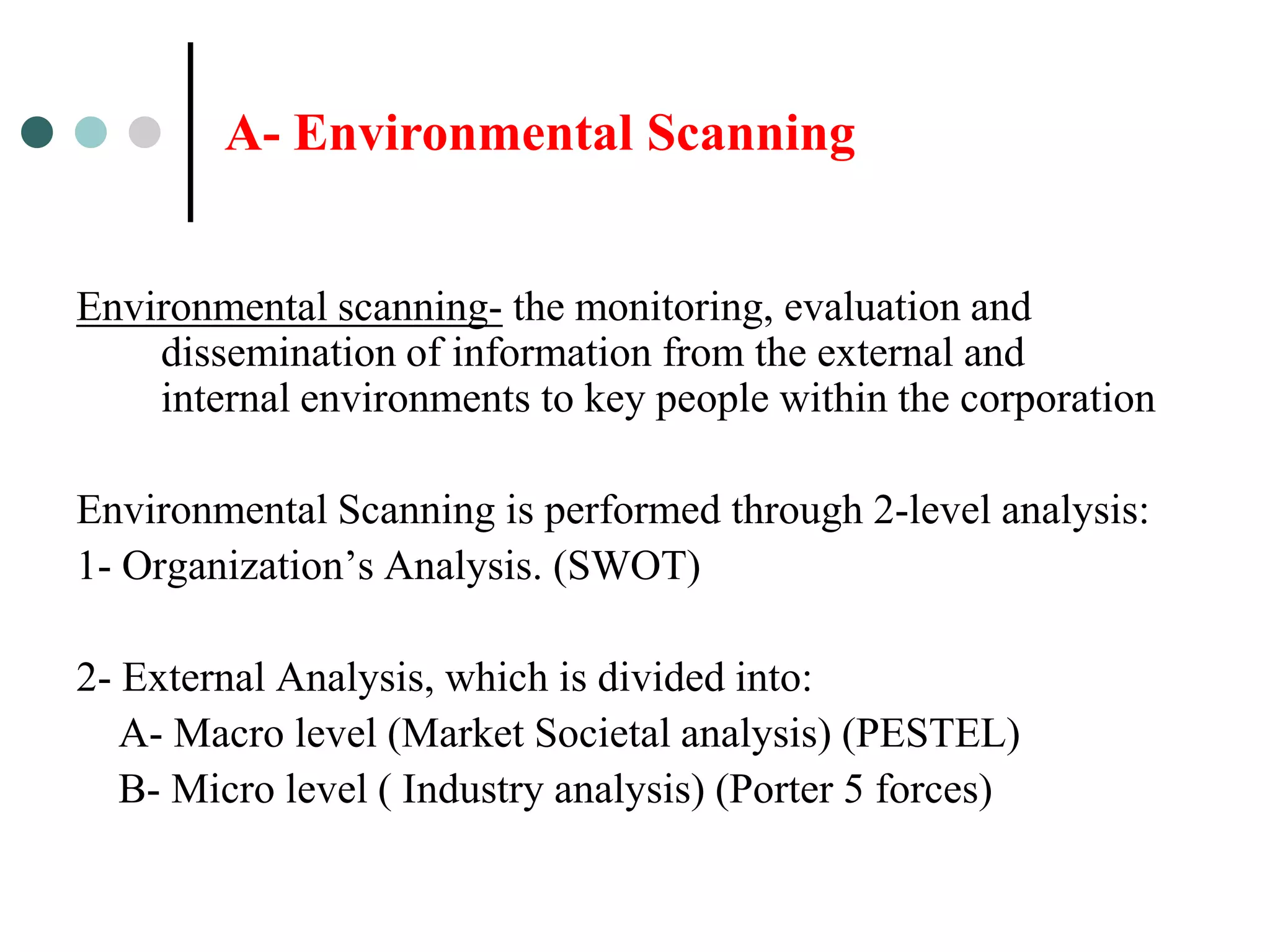
A- Environmental Scanning


Environmental scanning- the monitoring, evaluation and
    dissemination of information from the external and
    internal environments to key people within the corporation

Environmental Scanning is performed through 2-level analysis:
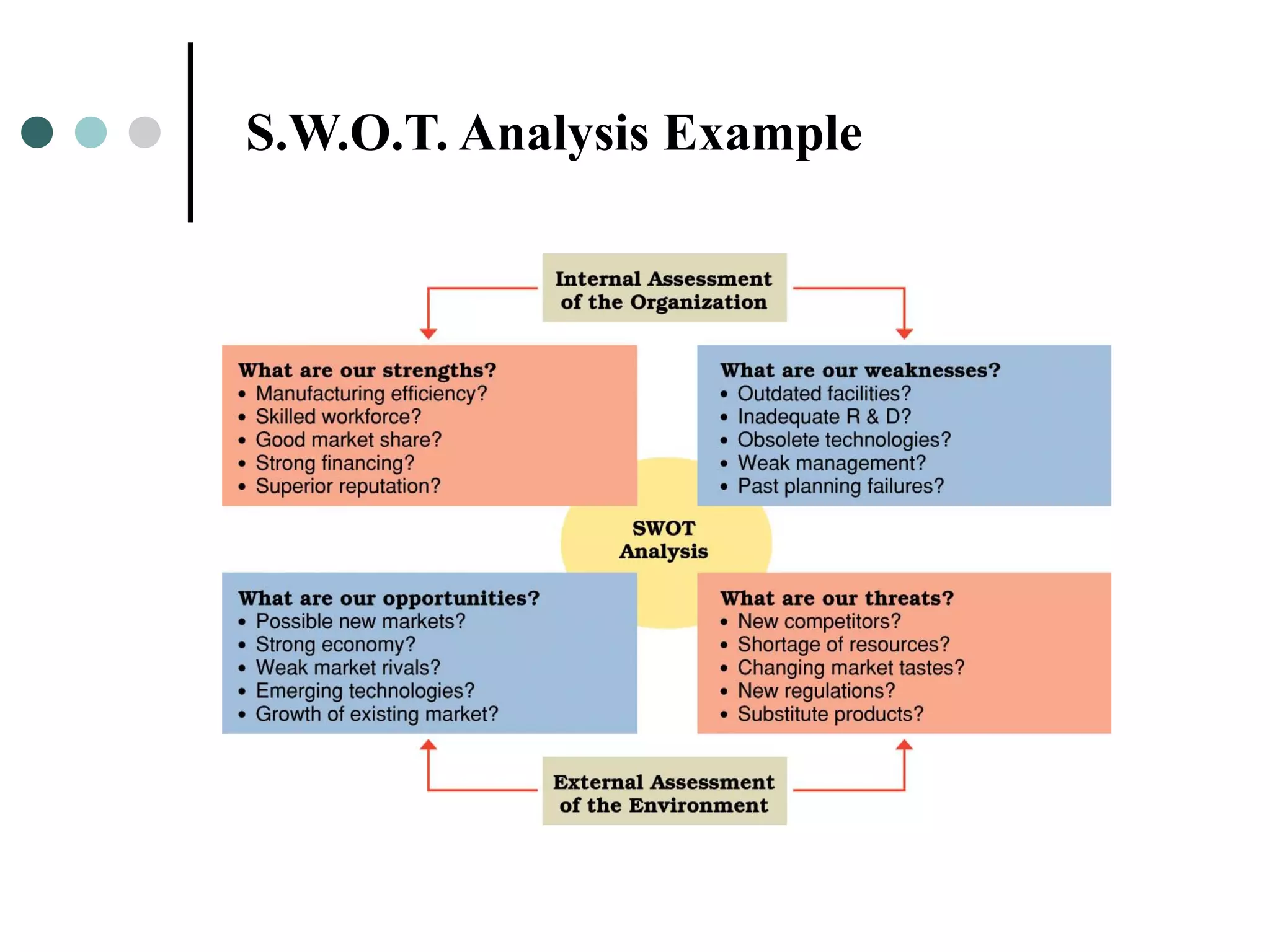
1- Organization’s Analysis. (SWOT)

2- External Analysis, which is divided into:
   A- Macro level (Market Societal analysis) (PESTEL)
   B- Micro level ( Industry analysis) (Porter 5 forces)
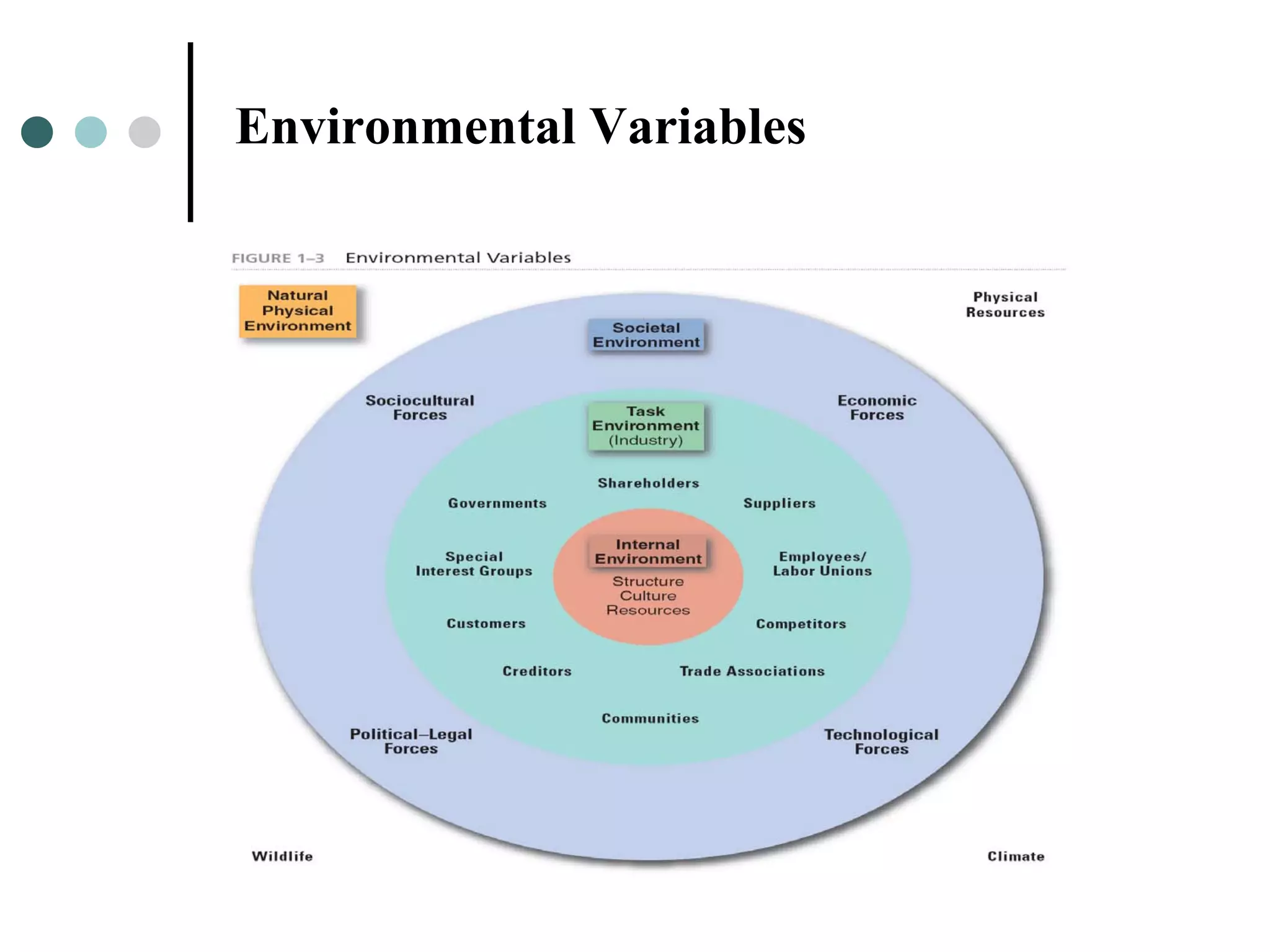
Environmental Variables
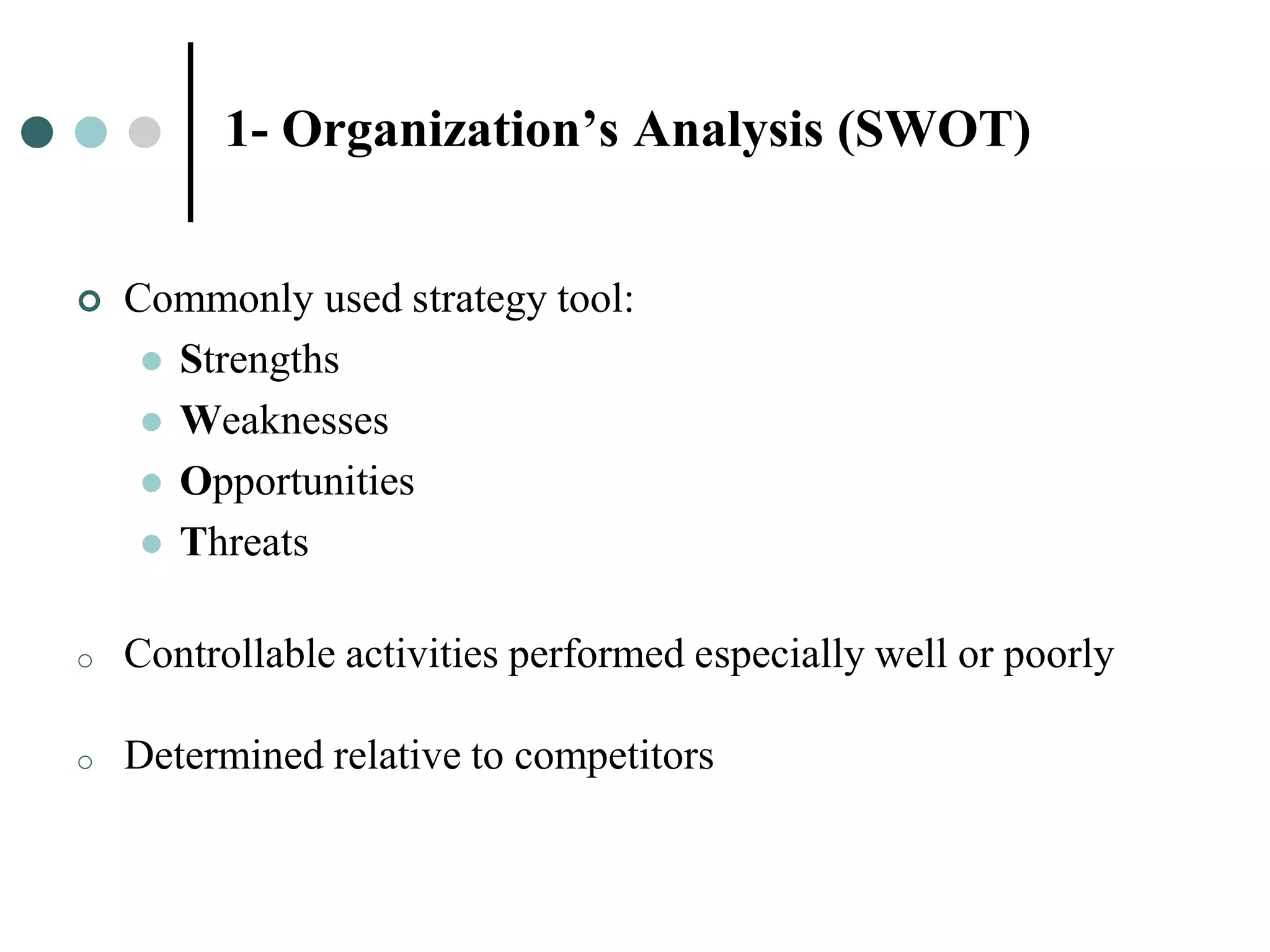
1- Organization’s Analysis (SWOT)


   Commonly used strategy tool:
      Strengths
      Weaknesses
      Opportunities
      Threats


o   Controllable activities performed especially well or poorly

o   Determined relative to competitors
1- Organization’s Analysis (SWOT)

   Step 1: Analyze the organization’s internal environment,
    identifying its strengths and weaknesses.
   Step 2: Analyze the organization’s external environment,
    identifying its opportunities and threats.
   Step 3: Cross-match
      Strengths with opportunities
      Weaknesses with threats
      Strengths with threats
      Weaknesses with opportunities
Internal Strengths and Weaknesses

   Typically located in functional areas of the firm

       Management
       Marketing
       Finance/Accounting
       Production/Operations
       Research & Development
       Management Information Systems
Internal Strengths and Weaknesses

Assessing the Internal Environment


                                       Ratios


                              Performance Measures
     Internal Factors
                                Industry Averages


                                     Survey Data
S.W.O.T. Analysis Example
2- External Analysis


    External Environmental Variables

    Natural environment

    Societal environment

    Task environment
2- External Analysis (cont’d)


Natural environment

   Physical resources
   Wildlife
   Climate
2- External Analysis (cont’d)


A- Societal environment- social systems that influence long-term
    decisions

   Economic forces
   Technological forces
   Political-legal forces
   Socio-cultural forces
Societal Environmental Variables
2- External Analysis (cont’d)


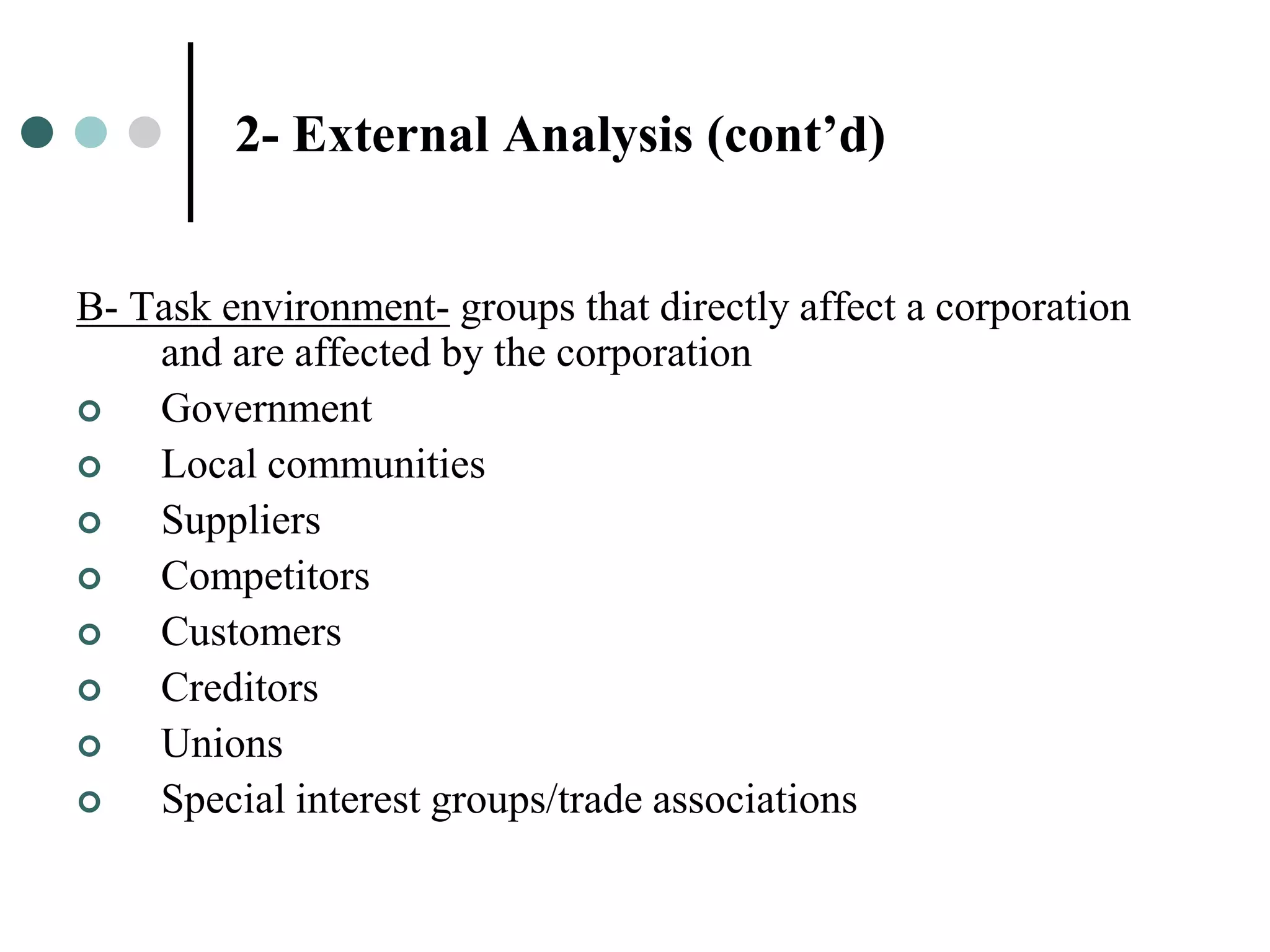
B- Task environment- groups that directly affect a corporation
    and are affected by the corporation
   Government
   Local communities
   Suppliers
   Competitors
   Customers
   Creditors
   Unions
   Special interest groups/trade associations
Industry Analysis (Task Environment)

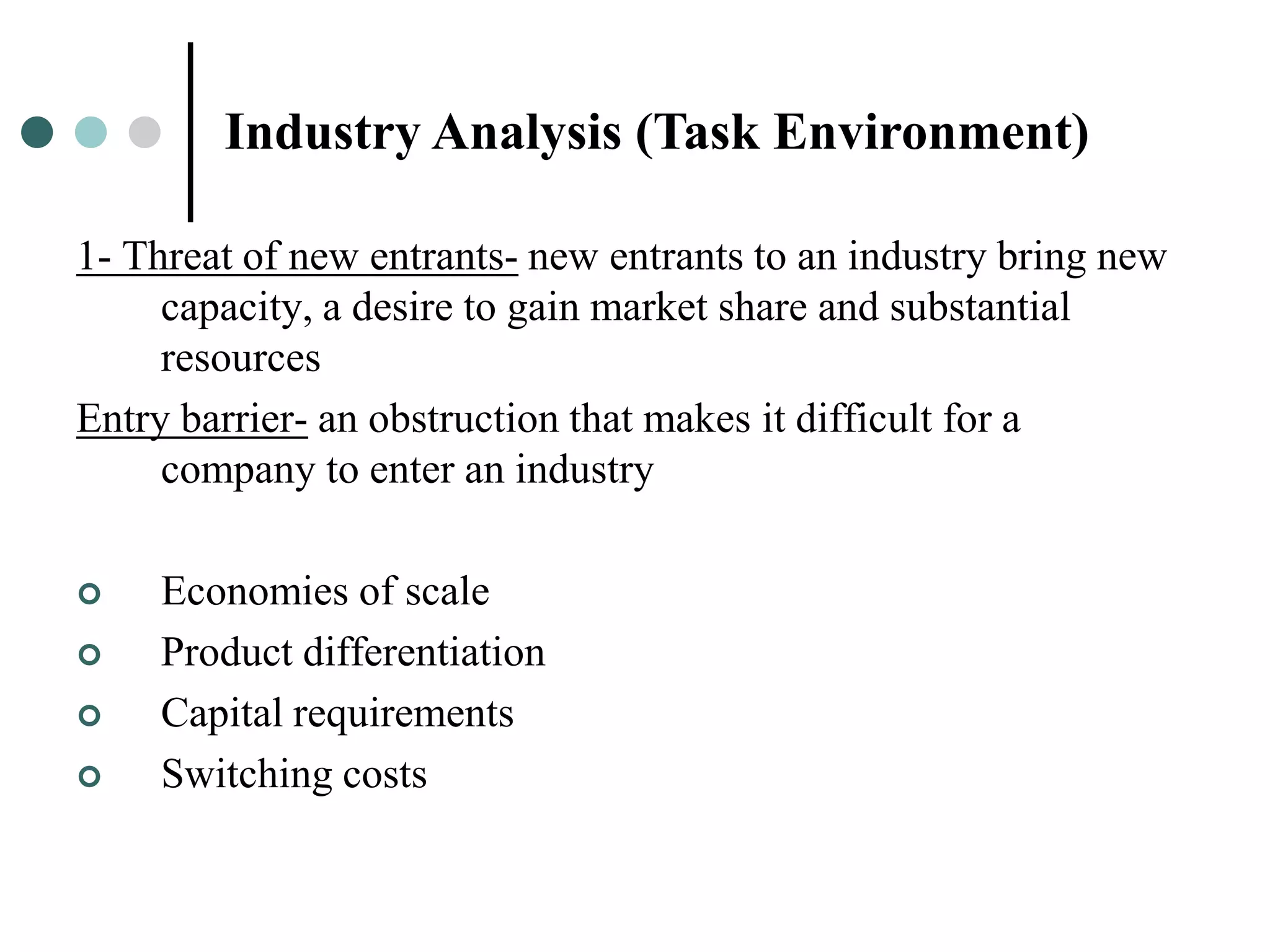
1- Threat of new entrants- new entrants to an industry bring new
     capacity, a desire to gain market share and substantial
     resources
Entry barrier- an obstruction that makes it difficult for a
     company to enter an industry

   Economies of scale
   Product differentiation
   Capital requirements
   Switching costs
Industry Analysis (Task Environment)

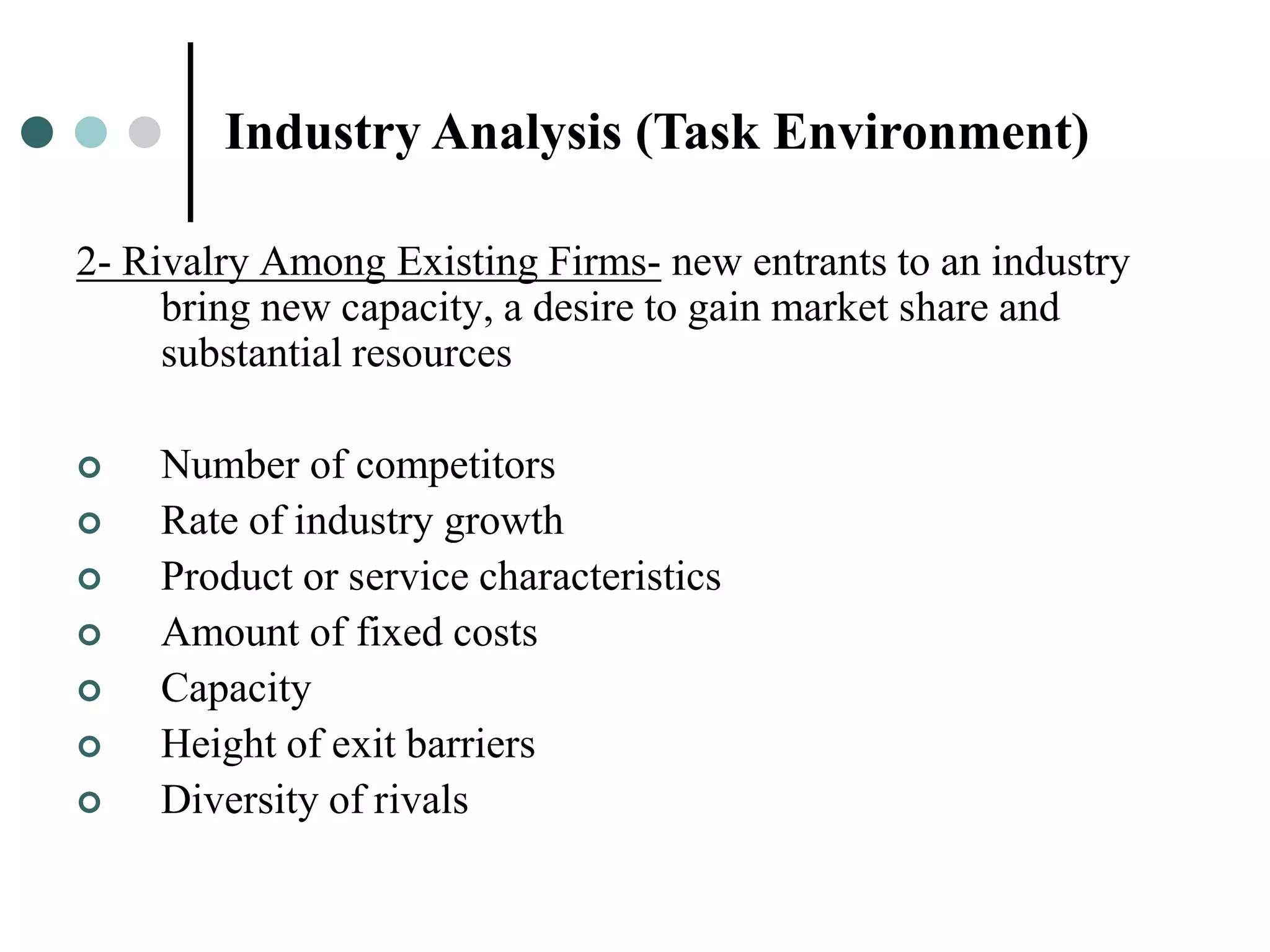
2- Rivalry Among Existing Firms- new entrants to an industry
     bring new capacity, a desire to gain market share and
     substantial resources

   Number of competitors
   Rate of industry growth
   Product or service characteristics
   Amount of fixed costs
   Capacity
   Height of exit barriers
   Diversity of rivals
Industry Analysis (Task Environment)

3- Threat of Substitute Products or Services- products that
     appear different but can satisfy the same need as another
     product
Industry Analysis (Task Environment)

4- Bargaining Power of Buyers- ability of buyers to force prices
     down, bargain for higher quality, play competitors against
     each other

    Large purchases
    Backward integration
    Alternative suppliers
    Low cost to change suppliers
    Product represents a high percentage of buyer’s cost
    Buyer earns low profits
    Product is unimportant to buyer
Industry Analysis (Task Environment)

5- Bargaining Power of Suppliers- ability of suppliers to raise
     prices or reduce quality

    Industry is dominated by a few companies
    Unique product or service
    Substitutes are not readily available
    Ability to forward integrate
    Unimportance of product or service to the industry
Industry Analysis (Task Environment)

6- Relative Power of Other Stakeholders

   Government
   Local communities
   Creditors
   Trade associations
   Special interest groups
   Unions
   Shareholders
   Complementary products that work well with a firm’s
    product
Initiating Strategy: Triggering Events


Triggering event: something that acts as a stimulus for a change
    in strategy and can include:

•   New CEO
•   External intervention
•   Threat of change of ownership
•   Performance gap
•   Strategic inflection point
B- Strategy Formulation


   Strategy is comprehensive plan that states how the company
    will achieve its mission & objectives.

  3 Levels of Business strategy:
1- Corporate Strategy
2- Business (Competitive) Strategy
3- Functional Strategy
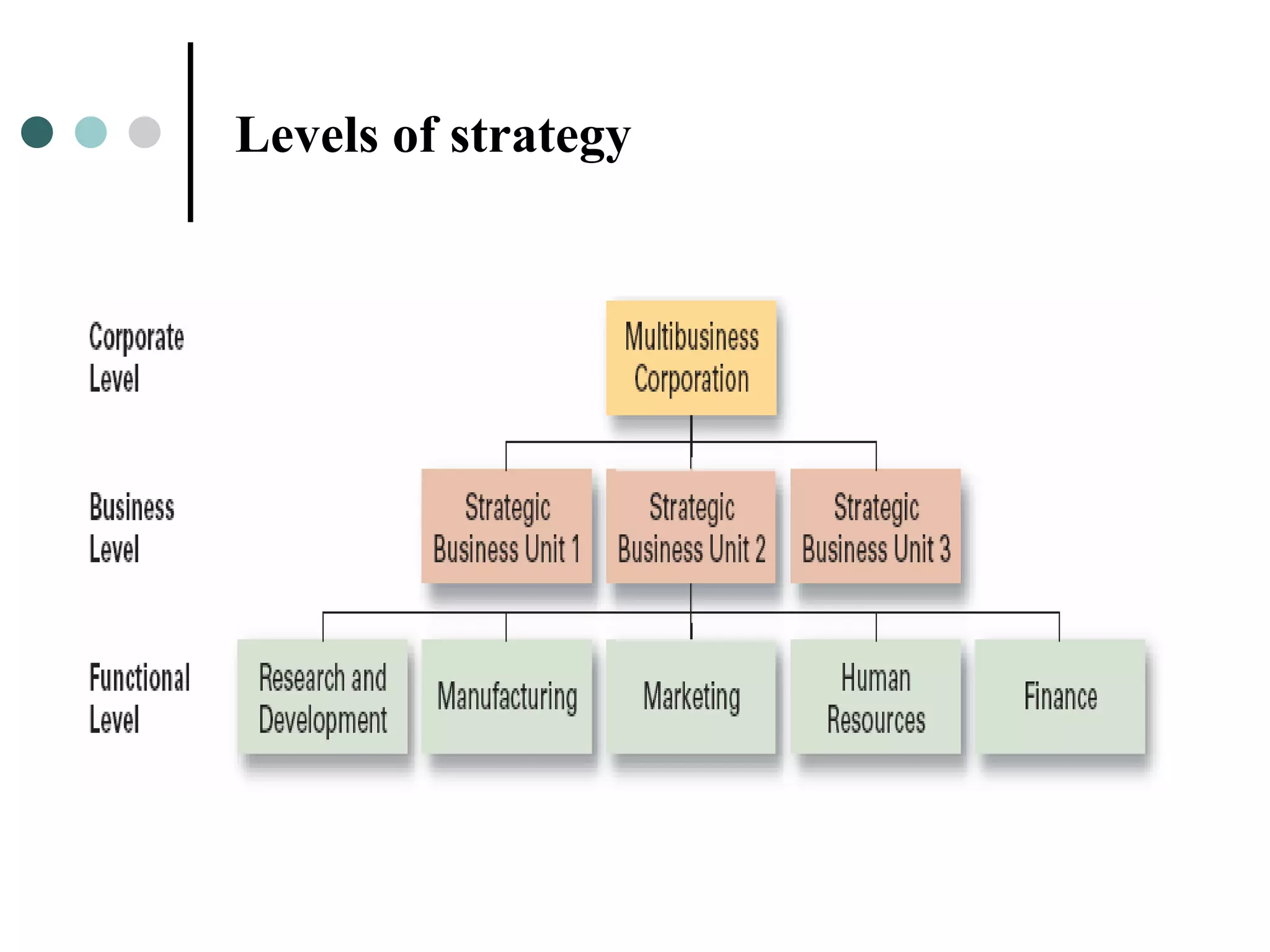
Levels of strategy
Levels of strategy


1) Corporate Strategy      2) Business Strategy        3) Functional Strategy

Attitude towards growth    Competitive Strategy        Productivity
& management of            Special Business line, It   Benchmark – Standard
various business &         has touch to Cost,
product lines, it has to                               Customer (Pull Strategy)
                           Differentiation & Focus
touch stability, growth,                               Lower Cost
retrenchment                                           Integrated Process
                                                       Quality Assurance
                                                       Supply Chain
                                                       Marketing oriented
                                                       company
1- Corporate Strategy (Directional)

Directional strategy- the firm’s overall orientation toward
    growth, stability, or retrenchment
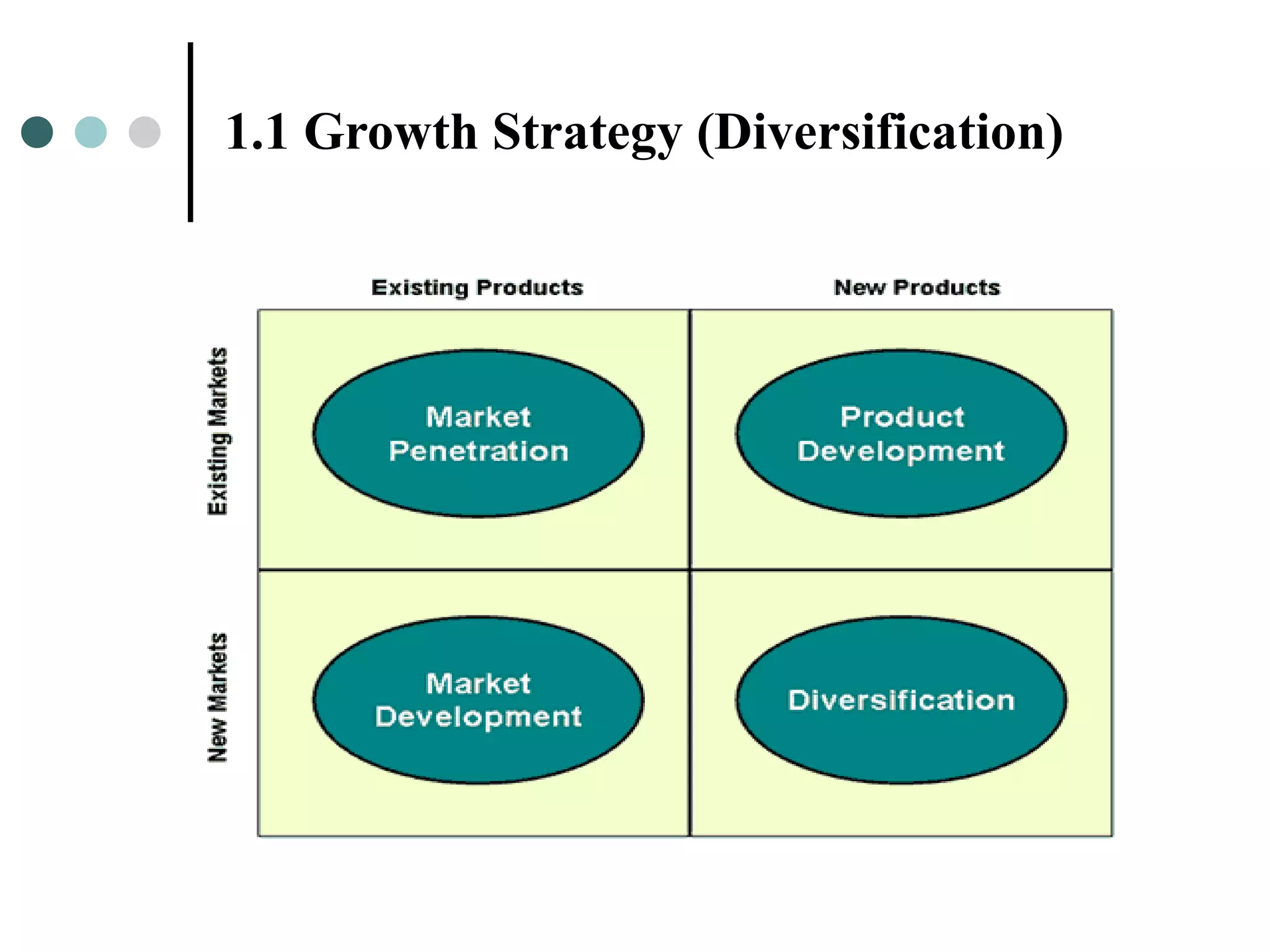
1.1 Growth Strategy

   Growth Strategy
       Seeking to increase the organization’s business by
        expansion into new products and markets.

A- Concentration (Integration)
   •   Vertical
   •   Horizontal
B- Diversification (Penetration)
   •   Concentric
   •   Conglomerate
1.1 Growth Strategy


Concentration and Diversification

   Merger- a transaction involving two or more corporations in
    which stock is exchanged but in which only one corporation
    survives

   Acquisition- the purchase of a company that is completely
    absorbed by the subsidiary or division of the acquiring
    corporation
1.1 Growth Strategy (Concentration)

A- Concentration strategies

Vertical growth- taking over the function previously provided
     by a supplier or by a distributor
    Vertical integration- the degree to which a firm operates
     vertically in multiple locations on an industry’s value
     chain from extracting raw materials to manufacturing to
     retailing
       Backward integration- assuming a function
        previously provided by a supplier
       Forward integration- assuming a function previously
        provided by a distributor
Vertical Growth
Vertical Growth

   Full integration- a firm internally makes 100% of its key
    suppliers and completely controls its distributors
   Taper integration- a firm internally produces less than half
    of its own requirements and buys the rest from outside
    suppliers
   Quasi-integration- a company does not make any of its
    key supplies but purchases most of its requirements from
    outside suppliers that are under its partial control
   Long-term contracts- agreements between 2 firms to
    provide agreed-upon goods and services to each other for
    a specific period of time
1.1 Growth Strategy (Concentration)

A- Concentration strategies

Horizontal growth- expansion of operations into other
    geographic locations and/or increasing the range of
    products and services offered to current markets
   Horizontal growth is achieved through:
      Internal development
      Acquisitions
      Strategic alliances
Horizontal integration- the degree to which a firm operates in
    multiple geographic locations at the same point on an
    industry’s value chain
Horizontal Growth

International Entry Options for Horizontal Growth
   Exporting                      Green-Field Development
   Licensing                      Production Sharing
   Franchising                     Turn-key Operations
   Joint Venture                   BOT Concept
   Acquisitions                    Management Contracts
1.1 Growth Strategy (Diversification)

B- Diversification Strategies

Concentric (Related) Diversification- growth into a related
    industry when a firm has a strong competitive position but
    attractiveness is low

Conglomerate (Unrelated) Diversification- growth into an
    unrelated industry
   Management realizes that the current industry is unattractive
   Firm lacks outstanding abilities or skills that it could easily
    transfer to related products or services in other industries
1.1 Growth Strategy (Diversification)
1.2 Stability Strategy

Stability Strategies- continuing activities without any significant
     change in direction

    Pause/Proceed with caution strategy- an opportunity to rest
     before continuing a growth or retrenchment strategy

    No change strategy- continuance of current operations and
     policies

    Profit Strategies- to do nothing new in a worsening situation
     but instead to act as though the company’s problems are
     only temporary
1.3 Retrenchment Strategy


Retrenchment Strategies- used when the firm has a weak
     competitive position in some or all of its product lines from
     poor performance
1.3 Retrenchment Strategy (Turnaround)


Turnaround strategy- emphasizes the improvement of
    operational efficiency when the corporation’s problems are
    pervasive but not critical

   Contraction- effort to quickly “stop the bleeding” across
    the board but in size and costs

   Consolidation- stabilization of the new leaner corporation
1.3 Retrenchment Strategy (cont’d)


Captive Company Strategy- company gives up independence in
    exchange for security

Sell-out strategy- management can still obtain a good price for
     its shareholders and the employees can keep their jobs by
     selling the company to another firm

Divestment- sale of a division with low growth potential
2- Business Strategy (Competitive)


   Business (or Competitive) Strategy
       A strategy focused on how an organization should
        compete in each of its SBUs (strategic business units).
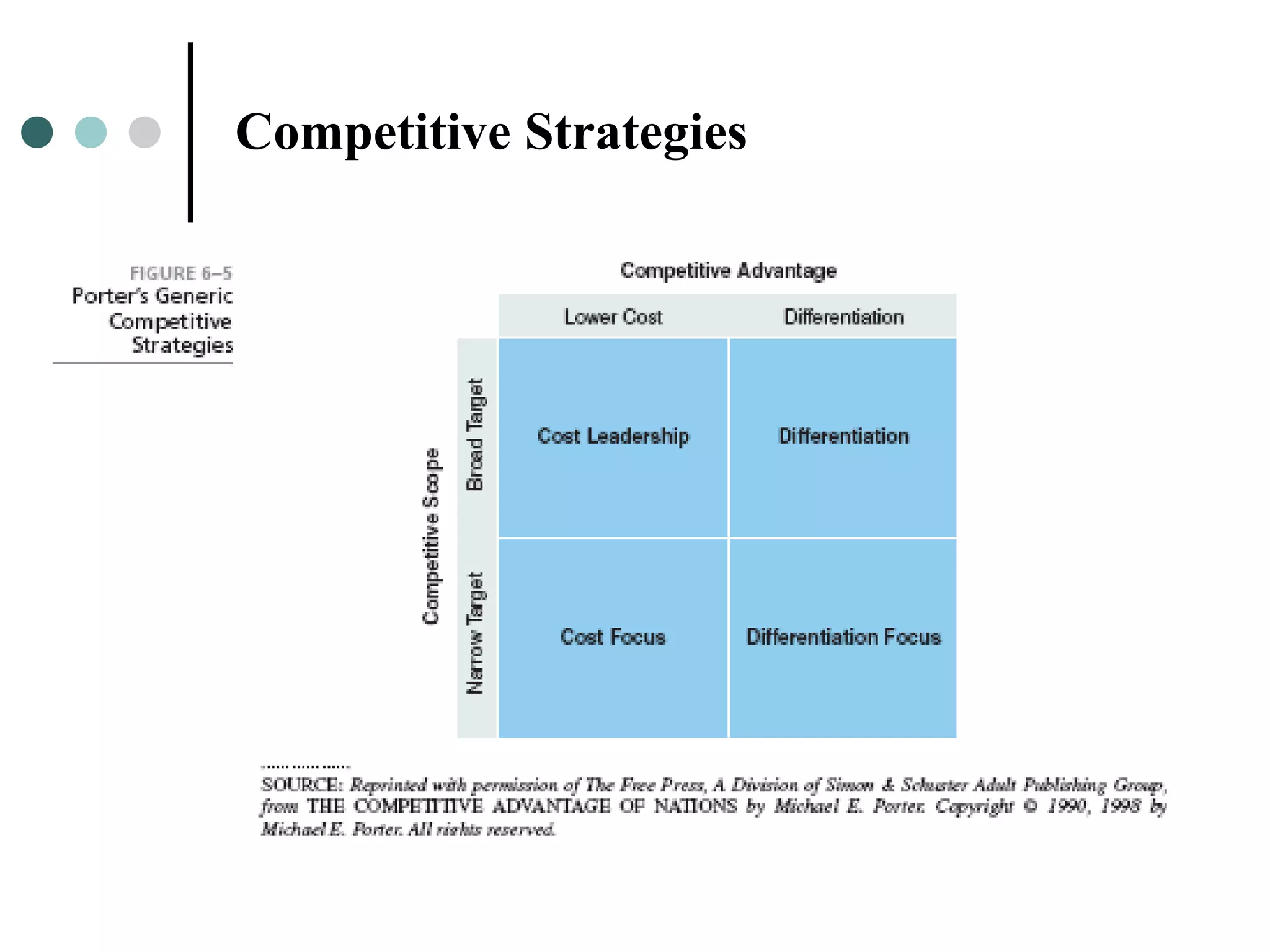
2- Business Strategy (Competitive)


   Cost Leadership Strategy
       Seeking to attain the lowest total overall costs relative to
        other industry competitors.
   Differentiation Strategy
       Attempting to create a unique and distinctive product or
        service for which customers will pay a premium.
   Focus Strategy
       Using a cost or differentiation advantage to exploit a
        particular market segment rather a larger market.
2.1 Competitive Strategy (Cost Leadership)


Cost leadership- a lower-cost competitive strategy that aims at
     the broad mass market and requires efficient scale facilities,
     cost reductions, cost and overhead control; avoids marginal
     customers, cost minimization in R&D, service, sales force
     and advertising

    Provides a defense against competitors
    Provides a barrier to entry
    Generates increased market share
2.2 Competitive Strategy (Differentiation)


Differentiation- involves the creation of a product or service that
     is perceived throughout the industry as unique. Can be
     associated with design, brand image, technology, features,
     dealer network, or customer service

    Lowers customers sensitivity to price
    Increases buyer loyalty
    Barrier to entry
    Can generate higher profits
2.3 Competitive Strategy (Focus)


Cost Focus- low-cost competitive strategy that focuses on a
     particular buyer group or geographic market and attempts to
     serve only this niche to the exclusion of others

Differentiation Focus- concentrates on a particular buyer group,
     product line segment, or geographic market to serve the
     needs of a narrow strategic market more effectively than its
     competitors
Competitive Strategies
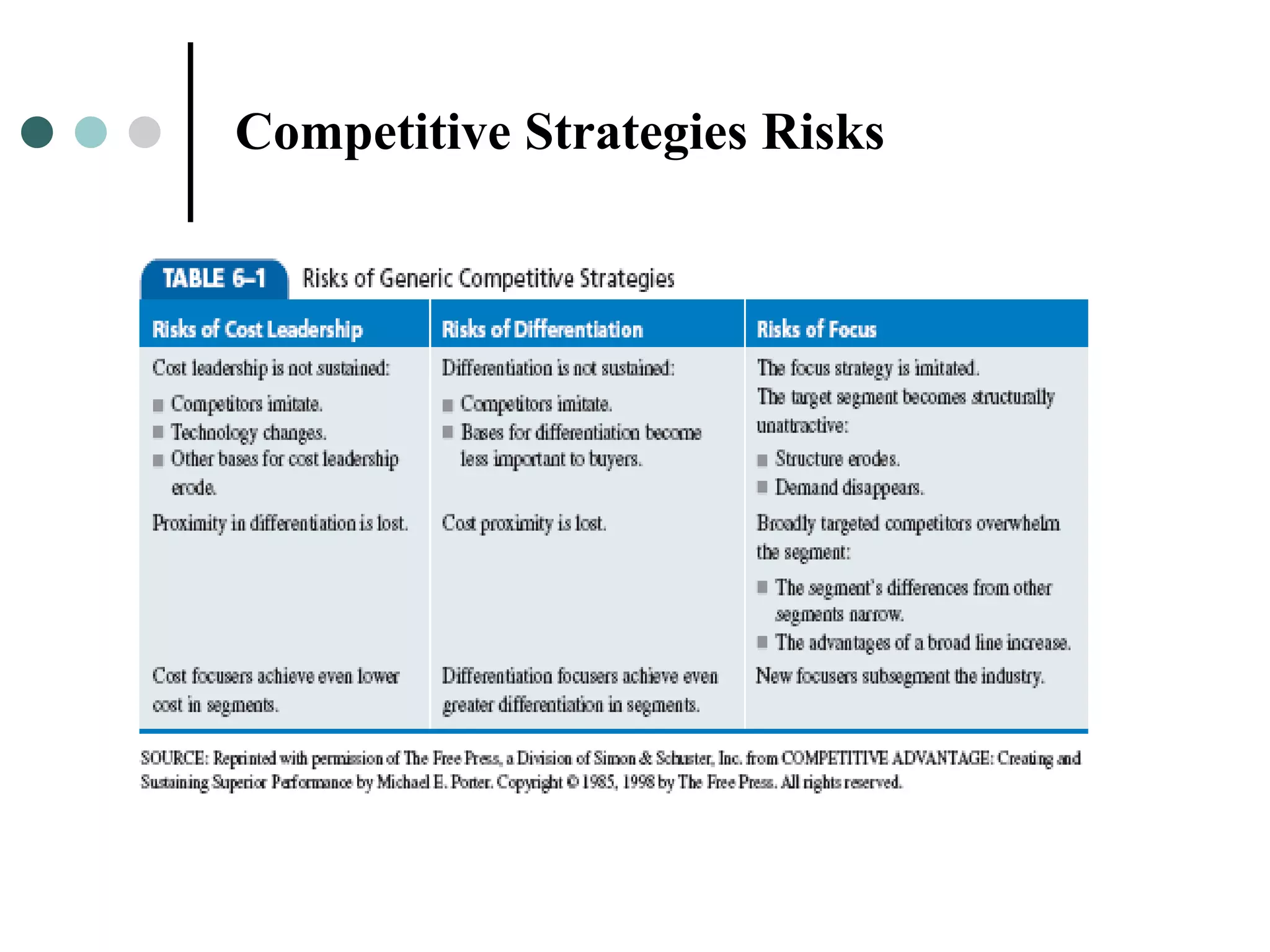
Competitive Strategies Risks
3- Functional Strategy


Functional strategy- the approach a functional area takes to
    achieve corporate and business unit objectives and
    strategies by maximizing resource productivity

o    Marketing strategy deals with pricing, selling and
     distributing a product

o    Financial Strategy- examines the financial implications of
     corporate and business-level strategic options and identifies
     the best financial course of action
3- Functional Strategy


o   Operations Strategy- determines how and where a product
    or service is to be manufactured, the level of vertical
    integration in the production process, the deployment of
    physical resources and relationships with suppliers

o   Logistics Strategy- deals with the flow of products into and
    out of the manufacturing process

o   Human Resource Strategy

o   Information Technology Strategy
C- Strategy Implementation

Strategy implementation- the sum total of all activities and
     choices required for the execution of a strategic plan

    Who are the people to carry out the strategic plan?
    What must be done to align company operations in the
     intended direction?
    How is everyone going to work together to do what is
     needed?
Strategy Implementation Steps


   Developing a strategy-supportive culture
   Creating an effective organizational structure
   Redirecting marketing efforts
   Preparing budgets
   Developing and utilizing information systems
   Linking employee compensation to organizational
    performance
Strategy Implementation (cont’d)

        Developing Programs, Budgets and Procedures
Programs- make strategies action-oriented

Matrix of Change- provides guidance on where, when and how
    fast to implement change

Budget- provides the last real check on the feasibility of the
    strategy

Procedures (organizational routines)- detail the various activities
    that must be carried out to complete a corporation’s
    programs
Strategy Implementation Programs

Reengineering- the radical redesign of business processes to
     achieve major gains in cost, service, or time
    Program to implement a turnaround strategy
Lean Six Sigma- incorporates Six Sigma with lean
     manufacturing- removes unnecessary production steps and
     fixes the remaining steps
Job Design- the study of individual tasks in an attempt to make
     them more relevant to the company and to the employees
    Job enlargement
    Job rotation
    Job enrichment model
Strategy Implementation Problems


1.    Took more time than planned
2.    Unanticipated major problems
3.    Poor coordination
4.    Competing activities and crises created distractions
5.    Employees with insufficient capabilities
6.    Poor subordinate training
7.    Uncontrollable external environmental factors
8.    Poor departmental leadership and direction
9.    Inadequately defined implementation tasks and activities
10.   Inefficient information system to monitor activities
D- Strategy Evaluation & Control

Evaluation and Control ensures that a company is achieving
    what it set out to accomplish by comparing performance
    with desired results and taking corrective action as
    needed

1.   Determine what to measure
2.   Establish standards of performance
3.   Measure actual performance
4.   Compare actual performance with the standard
5.   Take corrective action
Evaluation & Control Process
Measuring Performance

Primary Measures of Corporate Performance

   Return on Investment (ROI)
   Earnings per share (EPS)
   Return on equity (ROE)
   Operating cash flow
Measuring Performance

Shareholder Value- the present value of the anticipated future
    streams of cash flows from the business plus the value of
    the company if liquidated
Economic Value Added (EVA)- measures the difference
    between the pre-strategy and post-strategy values for the
    business
Market Value Added (MVA)- measures the difference
    between the market value of a corporation and the
    capital contributed by shareholders and lenders
Measuring Performance

Balanced score card– combines financial measures that tell results
     of actions already taken with operational measures on
     customer satisfaction, internal processes and the corporation’s
     innovation and improvement activities
    Financial
    Customer
    Internal business perspective
    Innovation and learning

Benchmarking- the continual process of measuring products,
    services and practices against the toughest competitors or
    those companies recognized as industry leaders
E- Feedback & Learning

   Periodic review of the implementation process
   Obtain feedback from staff/clients/stakeholders
   Provide regular feedback to major stakeholders, including staff
   Document and communicate the lessons learnt
   Acknowledge and share results - achievements and failures
   Continuous monitoring and review of objectives
    Remember that the Strategic Management process is a
    continuous cycle. It does not end. The real objective is
    continual improvement!
STRATEGIC ACTION PLANNING Summary
  The reason for the
  existence of the
  organization &                           MISSION
  establishes the values,
  beliefs & guidelines for
  the conduct of business                                              The long range objectives
                                           VISION                      that will drive the
                                                                       development process and
                                                                       stretch the organization to
                                                                       achieve them.
                                          SWOT Analysis


Internal Environment                                   External Environment
Strengths                                              Opportunities
Weaknesses                                             Threats
- Value systems                                        - The changing environment
- Culture                                              - The demand for new products
- Staffing                                             - The economic environment
- Support systems, operating environment               - Availability of resources

                             STRATEGIC AREAS FOR DEVELOPMENT
                                   STRATEGIC OBJECTIVES


      Strategic               Strategic             Strategic          Strategic
      Action 1                Action 2              Action 3           Action 4


                                          EVALUATION/FEEDBACK
All rights reserved. No part of this publication may be reproduced,
  stored in a retrieval system, or transmitted, in any form or by any
means, electronic, mechanical, photocopying, recording, or otherwise,
 without the prior written permission of the publisher. Printed in the
                       United States of America.

     Copyright ©2010 Pearson Education, Inc.
            publishing as Prentice Hall

Strategic Management

  • 1.
  • 2.
    Introduction of Concepts  Strategic Management: The set of managerial decisions and actions that determines the long-run performance of an organization.  Strategic Planning: The process of determining a company's long-term goals and then identifying the best approach for achieving those goals
  • 3.
    Why is strategicmanagement important?  Gives everyone a role  Makes a difference in performance levels  Provides systematic approach to uncertainties  Coordinates and focuses employees
  • 4.
  • 5.
    Basic Elements ofStrategic Management A- Environmental Scanning: is the monitoring, evaluating and disseminating of information from the external and internal environments to key people within the organization B- Strategy Formulation: is the development of long-range plans for the effective management of environmental opportunities and threats in light of organizational strengths and weaknesses (SWOT)
  • 6.
    Basic Elements ofStrategic Management C- Strategy implementation: the process by which strategies and policies are put into action through the development of:  Programs  Budgets  Procedures D- Evaluation and control: the process in which corporate activities and performance results are monitored so that actual performance can be compared to desired performance E- Feedback/Learning Process: revise or correct decisions based on performance
  • 7.
  • 8.
    Strategic Management Process  Step 1: Identifying the organization's current mission, objectives, and strategies  Mission: the firm’s reason for being • Who we are, • What we do, and • Where we are now  Goals: the foundation for further planning • Measurable performance targets  Step 2: Conducting an external analysis  The environmental scanning of specific and general environments  Focuses on identifying opportunities and threats
  • 9.
    Strategic Management Process(cont’d)  Step 3: Conducting an internal analysis  Assessing organizational resources, capabilities, activities and culture: • Strengths (core competencies) create value for the customer and strengthen the competitive position of the firm. • Weaknesses (things done poorly or not at all) can place the firm at a competitive disadvantage. Steps 2 and 3 combined are called a SWOT analysis (Strengths, Weaknesses, Opportunities, and Threats)
  • 10.
    Strategic Management Process(cont’d)  Step 4: Formulating strategies  Develop and evaluate strategic alternatives  Select appropriate strategies for all levels in the organization that provide relative advantage over competitors  Match organizational strengths to environmental opportunities  Correct weaknesses and guard against threats
  • 11.
    Strategic Management Process(cont’d)  Step 5: Implementing strategies  Implementation: effectively fitting organizational structure and activities to the environment  Effective strategy implementation requires an organizational structure matched to its requirements.  Step 6: Evaluating results  How effective have strategies been?  What adjustments, if any, are necessary?
  • 12.
    Key terms ofStrategic Management Mission- the purpose or reason for the organization’s existence Vision- describes what the organization would like to become Objectives- the end results of planned activity
  • 13.
    Key terms ofStrategic Management Strategies- form a comprehensive master plan that states how the corporation will achieve its mission and objectives  Corporate  Business  Functional Policies- the broad guidelines for decision making that links the formulation of a strategy with its implementation
  • 14.
    A- Environmental Scanning Environmentalscanning- the monitoring, evaluation and dissemination of information from the external and internal environments to key people within the corporation Environmental Scanning is performed through 2-level analysis: 1- Organization’s Analysis. (SWOT) 2- External Analysis, which is divided into: A- Macro level (Market Societal analysis) (PESTEL) B- Micro level ( Industry analysis) (Porter 5 forces)
  • 15.
  • 16.
    1- Organization’s Analysis(SWOT)  Commonly used strategy tool:  Strengths  Weaknesses  Opportunities  Threats o Controllable activities performed especially well or poorly o Determined relative to competitors
  • 17.
    1- Organization’s Analysis(SWOT)  Step 1: Analyze the organization’s internal environment, identifying its strengths and weaknesses.  Step 2: Analyze the organization’s external environment, identifying its opportunities and threats.  Step 3: Cross-match  Strengths with opportunities  Weaknesses with threats  Strengths with threats  Weaknesses with opportunities
  • 18.
    Internal Strengths andWeaknesses  Typically located in functional areas of the firm  Management  Marketing  Finance/Accounting  Production/Operations  Research & Development  Management Information Systems
  • 19.
    Internal Strengths andWeaknesses Assessing the Internal Environment Ratios Performance Measures Internal Factors Industry Averages Survey Data
  • 20.
  • 21.
    2- External Analysis External Environmental Variables  Natural environment  Societal environment  Task environment
  • 22.
    2- External Analysis(cont’d) Natural environment  Physical resources  Wildlife  Climate
  • 23.
    2- External Analysis(cont’d) A- Societal environment- social systems that influence long-term decisions  Economic forces  Technological forces  Political-legal forces  Socio-cultural forces
  • 24.
  • 25.
    2- External Analysis(cont’d) B- Task environment- groups that directly affect a corporation and are affected by the corporation  Government  Local communities  Suppliers  Competitors  Customers  Creditors  Unions  Special interest groups/trade associations
  • 26.
  • 27.
    Industry Analysis (TaskEnvironment) 1- Threat of new entrants- new entrants to an industry bring new capacity, a desire to gain market share and substantial resources Entry barrier- an obstruction that makes it difficult for a company to enter an industry  Economies of scale  Product differentiation  Capital requirements  Switching costs
  • 28.
    Industry Analysis (TaskEnvironment) 2- Rivalry Among Existing Firms- new entrants to an industry bring new capacity, a desire to gain market share and substantial resources  Number of competitors  Rate of industry growth  Product or service characteristics  Amount of fixed costs  Capacity  Height of exit barriers  Diversity of rivals
  • 29.
    Industry Analysis (TaskEnvironment) 3- Threat of Substitute Products or Services- products that appear different but can satisfy the same need as another product
  • 30.
    Industry Analysis (TaskEnvironment) 4- Bargaining Power of Buyers- ability of buyers to force prices down, bargain for higher quality, play competitors against each other  Large purchases  Backward integration  Alternative suppliers  Low cost to change suppliers  Product represents a high percentage of buyer’s cost  Buyer earns low profits  Product is unimportant to buyer
  • 31.
    Industry Analysis (TaskEnvironment) 5- Bargaining Power of Suppliers- ability of suppliers to raise prices or reduce quality  Industry is dominated by a few companies  Unique product or service  Substitutes are not readily available  Ability to forward integrate  Unimportance of product or service to the industry
  • 32.
    Industry Analysis (TaskEnvironment) 6- Relative Power of Other Stakeholders  Government  Local communities  Creditors  Trade associations  Special interest groups  Unions  Shareholders  Complementary products that work well with a firm’s product
  • 33.
    Initiating Strategy: TriggeringEvents Triggering event: something that acts as a stimulus for a change in strategy and can include: • New CEO • External intervention • Threat of change of ownership • Performance gap • Strategic inflection point
  • 34.
    B- Strategy Formulation  Strategy is comprehensive plan that states how the company will achieve its mission & objectives.  3 Levels of Business strategy: 1- Corporate Strategy 2- Business (Competitive) Strategy 3- Functional Strategy
  • 35.
  • 36.
    Levels of strategy 1)Corporate Strategy 2) Business Strategy 3) Functional Strategy Attitude towards growth Competitive Strategy Productivity & management of Special Business line, It Benchmark – Standard various business & has touch to Cost, product lines, it has to Customer (Pull Strategy) Differentiation & Focus touch stability, growth, Lower Cost retrenchment Integrated Process Quality Assurance Supply Chain Marketing oriented company
  • 37.
    1- Corporate Strategy(Directional) Directional strategy- the firm’s overall orientation toward growth, stability, or retrenchment
  • 38.
    1.1 Growth Strategy  Growth Strategy  Seeking to increase the organization’s business by expansion into new products and markets. A- Concentration (Integration) • Vertical • Horizontal B- Diversification (Penetration) • Concentric • Conglomerate
  • 39.
    1.1 Growth Strategy Concentrationand Diversification  Merger- a transaction involving two or more corporations in which stock is exchanged but in which only one corporation survives  Acquisition- the purchase of a company that is completely absorbed by the subsidiary or division of the acquiring corporation
  • 40.
    1.1 Growth Strategy(Concentration) A- Concentration strategies Vertical growth- taking over the function previously provided by a supplier or by a distributor  Vertical integration- the degree to which a firm operates vertically in multiple locations on an industry’s value chain from extracting raw materials to manufacturing to retailing  Backward integration- assuming a function previously provided by a supplier  Forward integration- assuming a function previously provided by a distributor
  • 41.
  • 42.
    Vertical Growth  Full integration- a firm internally makes 100% of its key suppliers and completely controls its distributors  Taper integration- a firm internally produces less than half of its own requirements and buys the rest from outside suppliers  Quasi-integration- a company does not make any of its key supplies but purchases most of its requirements from outside suppliers that are under its partial control  Long-term contracts- agreements between 2 firms to provide agreed-upon goods and services to each other for a specific period of time
  • 43.
    1.1 Growth Strategy(Concentration) A- Concentration strategies Horizontal growth- expansion of operations into other geographic locations and/or increasing the range of products and services offered to current markets  Horizontal growth is achieved through:  Internal development  Acquisitions  Strategic alliances Horizontal integration- the degree to which a firm operates in multiple geographic locations at the same point on an industry’s value chain
  • 44.
    Horizontal Growth International EntryOptions for Horizontal Growth  Exporting  Green-Field Development  Licensing  Production Sharing  Franchising Turn-key Operations  Joint Venture BOT Concept  Acquisitions Management Contracts
  • 45.
    1.1 Growth Strategy(Diversification) B- Diversification Strategies Concentric (Related) Diversification- growth into a related industry when a firm has a strong competitive position but attractiveness is low Conglomerate (Unrelated) Diversification- growth into an unrelated industry  Management realizes that the current industry is unattractive  Firm lacks outstanding abilities or skills that it could easily transfer to related products or services in other industries
  • 46.
    1.1 Growth Strategy(Diversification)
  • 47.
    1.2 Stability Strategy StabilityStrategies- continuing activities without any significant change in direction  Pause/Proceed with caution strategy- an opportunity to rest before continuing a growth or retrenchment strategy  No change strategy- continuance of current operations and policies  Profit Strategies- to do nothing new in a worsening situation but instead to act as though the company’s problems are only temporary
  • 48.
    1.3 Retrenchment Strategy RetrenchmentStrategies- used when the firm has a weak competitive position in some or all of its product lines from poor performance
  • 49.
    1.3 Retrenchment Strategy(Turnaround) Turnaround strategy- emphasizes the improvement of operational efficiency when the corporation’s problems are pervasive but not critical  Contraction- effort to quickly “stop the bleeding” across the board but in size and costs  Consolidation- stabilization of the new leaner corporation
  • 50.
    1.3 Retrenchment Strategy(cont’d) Captive Company Strategy- company gives up independence in exchange for security Sell-out strategy- management can still obtain a good price for its shareholders and the employees can keep their jobs by selling the company to another firm Divestment- sale of a division with low growth potential
  • 51.
    2- Business Strategy(Competitive)  Business (or Competitive) Strategy  A strategy focused on how an organization should compete in each of its SBUs (strategic business units).
  • 52.
    2- Business Strategy(Competitive)  Cost Leadership Strategy  Seeking to attain the lowest total overall costs relative to other industry competitors.  Differentiation Strategy  Attempting to create a unique and distinctive product or service for which customers will pay a premium.  Focus Strategy  Using a cost or differentiation advantage to exploit a particular market segment rather a larger market.
  • 53.
    2.1 Competitive Strategy(Cost Leadership) Cost leadership- a lower-cost competitive strategy that aims at the broad mass market and requires efficient scale facilities, cost reductions, cost and overhead control; avoids marginal customers, cost minimization in R&D, service, sales force and advertising  Provides a defense against competitors  Provides a barrier to entry  Generates increased market share
  • 54.
    2.2 Competitive Strategy(Differentiation) Differentiation- involves the creation of a product or service that is perceived throughout the industry as unique. Can be associated with design, brand image, technology, features, dealer network, or customer service  Lowers customers sensitivity to price  Increases buyer loyalty  Barrier to entry  Can generate higher profits
  • 55.
    2.3 Competitive Strategy(Focus) Cost Focus- low-cost competitive strategy that focuses on a particular buyer group or geographic market and attempts to serve only this niche to the exclusion of others Differentiation Focus- concentrates on a particular buyer group, product line segment, or geographic market to serve the needs of a narrow strategic market more effectively than its competitors
  • 56.
  • 57.
  • 58.
    3- Functional Strategy Functionalstrategy- the approach a functional area takes to achieve corporate and business unit objectives and strategies by maximizing resource productivity o Marketing strategy deals with pricing, selling and distributing a product o Financial Strategy- examines the financial implications of corporate and business-level strategic options and identifies the best financial course of action
  • 59.
    3- Functional Strategy o Operations Strategy- determines how and where a product or service is to be manufactured, the level of vertical integration in the production process, the deployment of physical resources and relationships with suppliers o Logistics Strategy- deals with the flow of products into and out of the manufacturing process o Human Resource Strategy o Information Technology Strategy
  • 60.
    C- Strategy Implementation Strategyimplementation- the sum total of all activities and choices required for the execution of a strategic plan  Who are the people to carry out the strategic plan?  What must be done to align company operations in the intended direction?  How is everyone going to work together to do what is needed?
  • 61.
    Strategy Implementation Steps  Developing a strategy-supportive culture  Creating an effective organizational structure  Redirecting marketing efforts  Preparing budgets  Developing and utilizing information systems  Linking employee compensation to organizational performance
  • 62.
    Strategy Implementation (cont’d) Developing Programs, Budgets and Procedures Programs- make strategies action-oriented Matrix of Change- provides guidance on where, when and how fast to implement change Budget- provides the last real check on the feasibility of the strategy Procedures (organizational routines)- detail the various activities that must be carried out to complete a corporation’s programs
  • 63.
    Strategy Implementation Programs Reengineering-the radical redesign of business processes to achieve major gains in cost, service, or time  Program to implement a turnaround strategy Lean Six Sigma- incorporates Six Sigma with lean manufacturing- removes unnecessary production steps and fixes the remaining steps Job Design- the study of individual tasks in an attempt to make them more relevant to the company and to the employees  Job enlargement  Job rotation  Job enrichment model
  • 64.
    Strategy Implementation Problems 1. Took more time than planned 2. Unanticipated major problems 3. Poor coordination 4. Competing activities and crises created distractions 5. Employees with insufficient capabilities 6. Poor subordinate training 7. Uncontrollable external environmental factors 8. Poor departmental leadership and direction 9. Inadequately defined implementation tasks and activities 10. Inefficient information system to monitor activities
  • 65.
    D- Strategy Evaluation& Control Evaluation and Control ensures that a company is achieving what it set out to accomplish by comparing performance with desired results and taking corrective action as needed 1. Determine what to measure 2. Establish standards of performance 3. Measure actual performance 4. Compare actual performance with the standard 5. Take corrective action
  • 66.
  • 67.
    Measuring Performance Primary Measuresof Corporate Performance  Return on Investment (ROI)  Earnings per share (EPS)  Return on equity (ROE)  Operating cash flow
  • 68.
    Measuring Performance Shareholder Value-the present value of the anticipated future streams of cash flows from the business plus the value of the company if liquidated Economic Value Added (EVA)- measures the difference between the pre-strategy and post-strategy values for the business Market Value Added (MVA)- measures the difference between the market value of a corporation and the capital contributed by shareholders and lenders
  • 69.
    Measuring Performance Balanced scorecard– combines financial measures that tell results of actions already taken with operational measures on customer satisfaction, internal processes and the corporation’s innovation and improvement activities  Financial  Customer  Internal business perspective  Innovation and learning Benchmarking- the continual process of measuring products, services and practices against the toughest competitors or those companies recognized as industry leaders
  • 70.
    E- Feedback &Learning  Periodic review of the implementation process  Obtain feedback from staff/clients/stakeholders  Provide regular feedback to major stakeholders, including staff  Document and communicate the lessons learnt  Acknowledge and share results - achievements and failures  Continuous monitoring and review of objectives Remember that the Strategic Management process is a continuous cycle. It does not end. The real objective is continual improvement!
  • 71.
    STRATEGIC ACTION PLANNINGSummary The reason for the existence of the organization & MISSION establishes the values, beliefs & guidelines for the conduct of business The long range objectives VISION that will drive the development process and stretch the organization to achieve them. SWOT Analysis Internal Environment External Environment Strengths Opportunities Weaknesses Threats - Value systems - The changing environment - Culture - The demand for new products - Staffing - The economic environment - Support systems, operating environment - Availability of resources STRATEGIC AREAS FOR DEVELOPMENT STRATEGIC OBJECTIVES Strategic Strategic Strategic Strategic Action 1 Action 2 Action 3 Action 4 EVALUATION/FEEDBACK
  • 72.
    All rights reserved.No part of this publication may be reproduced, stored in a retrieval system, or transmitted, in any form or by any means, electronic, mechanical, photocopying, recording, or otherwise, without the prior written permission of the publisher. Printed in the United States of America. Copyright ©2010 Pearson Education, Inc. publishing as Prentice Hall