Motivation
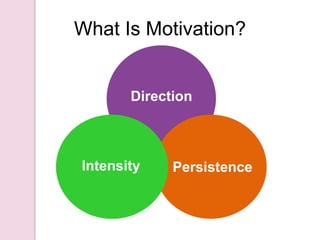
DirectionIntensityPersistenceWhat Is Motivation?
DirectionIt's better to hang out with people better than you. Pick out associates whose behavior is better than yours and you'll drift in that direction.Warren Buffett
I was saying "I'm the greatest” long beforeI believed it. Intensity
It's not that I'm so smart, it's just that I stay with problems longer.Persistence
Key ConceptsMotivation—the forces within the individual that account for the level, direction, and persistence of effort expended at work.
Reward —a work outcome of positive value to the individual
Extrinsic Rewards —valued outcomes given to someone by another person.
Intrinsic Rewards —valued outcomes that occur naturally as a person works on a task.Why Motivation?To achieve maximum motivational potential in linking rewards to performance …Respect diversity and individual differences to best understand what people want from work.Allocate rewards to satisfy the interests of both individuals and the organization.
To Motivate…having high expectations of employees, providing rewards that are valued, relating rewards to performance, treating employees as individuals, encouraging employee participation, andproviding feedback, including praise.
Relationship between Motivation and Performance Motivation:  Giving people incentives that cause them to act in desired ways.The objective of motivating employees is to lead them to perform in ways that meet the goals of the department and the organization. Because supervisors are largely evaluated on the basis of how well their group as a whole performs, motivation is an important skill for supervisors to acquire.
MotivationalTheoriesTypes of motivation theoriesContent theoriesHuman needs and how people with different needs may respond to different work situations.Process theoriesHow people give meaning to rewards and make decisions on various work-related behaviors.Reinforcement theoryHow people’s behavior is influenced by environmental consequences.
“Content theories” of motivation focus on the content of the motivator. Three researchers whose content theories of motivation are widely used are Abraham Maslow, David McClelland, and Frederick Herzberg.
Hierarchy of Needs Theory     Abraham Maslow There is a hierarchy of 5 needs---Physiological, Safety, Social, Esteem, & Self-Actualization---and as each need is sequentially satisfied, the next need becomes dominantReview:1.intuitively logical, ease of understanding, receiving wide recognition,  particularly among practicing managers.  2. little empirical support
PrinciplesHierarchy of needs theoryDeficit principleA satisfied need is not a motivator of behavior.Progression principleA need at one level does not become activated until the next lower-level need is satisfied.
ERG TheoryDeveloped by Clayton Alderfer.Three need levels:Existence needs — desires for physiological and material well-being.Relatedness needs — desires for satisfying interpersonal relationships.Growth needs — desires for continued psychological growth and development
SelfEsteemSocialSafetyPhysiological ERG Theory of Motivation
E.R.G. Theory (Cont.)Satisfaction-progression:  move up the hierarchy as needs are satisfiedFrustration-regression:  move down the hierarchy when a need is frustratedDeficiency cycle:more strongly desire existence needs when they are unsatisfiedEnrichment cycle:  more strongly desire growth needs when they are satisfied
David McClellandAcquired needs theoryDeveloped by David McClelland.People acquire needs through their life experiences.Needs that are acquired:Need for Achievement(nAch)Need for Power(nPower)Need for Affiliation(nAff)
Acquired needs theoryNeed for Achievement(nAch)Desire to do something better or more efficiently, to solve problems, or to master complex tasks.People high in (nAch)prefer work that:Involves individual responsibility for results.Involves achievable but challenging goals.Provides feedback on performance.People with achievement motives are motivated by standards of excellence, delineated roles and responsibilities and concrete, timely feedback.
Acquired needs theoryNeed for Power (nPower)Desire to control other persons, to influence their behavior, or to be responsible for other people.Personal power versus social power.People high in (nPower)prefer work that:Involves control over other persons.Has an impact on people and events.Brings public recognition and attention.Thosewithpower motive is activated when people are allowed to have an impact, impress those in power, or beat competitors.
Acquired needs theoryNeed for Affiliation (nAff)Desire to establish and maintain friendly and warm relations with other persons.People high in (nAff)prefer work that:Involves interpersonal relationships.Provides for companionshipBrings social approval.Those with affiliation motives are motivated when they can accomplish things with people they know and trust.
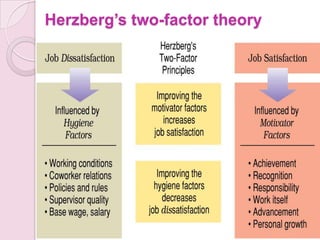
Frederick HerzbergTwo-factor theoryDeveloped by Frederick Herzberg.Hygiene factors:Elements of the job context.Sources of job dissatisfaction.Satisfier factors:Elements of the job content.Sources of job satisfaction and motivation.
Herzberg's Two Factor Theory, also known as the Motivation-Hygiene Theory, was derived from a study designed to test the concept that people have two sets of needs: Their needs as animals to avoid pain Their needs as humans to grow psychologically
Herzberg’ studyHerzberg's study consisted of a series of interviews that sought to elicit responses to the questions: Recall a time when you felt exceptionally good about your job. Why did you feel that way about the job? Did this feeling affect your job performance in any way? Did this feeling have an impact on your personal relationships or your well- being? Recall a time on the job that resulted in negative feelings? Describe the sequence of events that resulted in these negative feelings.
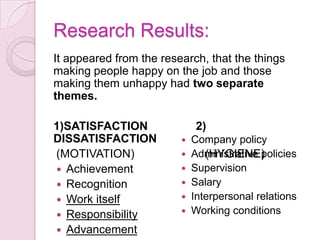
Research Results:It appeared from the research, that the things making people happy on the job and those making them unhappy had two separate themes. 1)SATISFACTION               2)DISSATISFACTION(MOTIVATION)                      (HYGIENE) AchievementRecognition WorkitselfResponsibilityAdvancementCompanypolicy
Administrative policies
Supervision
Salary
Interpersonal relations
Working conditions Herzberg’s two-factor theory
People are motivated by Hygiene factors(external) and Motivation factors (internal).Combining these factors we get 4 scenarios as,High Hygiene + High Motivation (ideal condition: highly motivated and few complaints)High Hygiene + Low Motivation (few complaints but not very motivated)Low Hygiene + High Motivation(very motivated but have complaints)Low Hygiene + Low Motivation(worst situation: very little motivation and many complaints)
McGregor's X-Y theory is a salutary and simple reminder of the natural rules for managing people, which under the pressure of day-to-day business are all too easily forgotten.McGregor's ideas suggest that there are two fundamental approaches to managing people. Many managers tend towards theory x, and generally get poor results. Enlightened managers use theory y, which produces better performance and results, and allows people to grow and develop.
McGregor: Theory X,  Theory YThere are two ways of perceiving people at work:Theory Y:Work is as natural as play or rest- not disliked..

Motivation

  • 1.
  • 2.
  • 3.
    DirectionIt's better tohang out with people better than you. Pick out associates whose behavior is better than yours and you'll drift in that direction.Warren Buffett
  • 4.
    I was saying"I'm the greatest” long beforeI believed it. Intensity
  • 5.
    It's not thatI'm so smart, it's just that I stay with problems longer.Persistence
  • 6.
    Key ConceptsMotivation—the forceswithin the individual that account for the level, direction, and persistence of effort expended at work.
  • 7.
    Reward —a workoutcome of positive value to the individual
  • 8.
    Extrinsic Rewards —valuedoutcomes given to someone by another person.
  • 9.
    Intrinsic Rewards —valuedoutcomes that occur naturally as a person works on a task.Why Motivation?To achieve maximum motivational potential in linking rewards to performance …Respect diversity and individual differences to best understand what people want from work.Allocate rewards to satisfy the interests of both individuals and the organization.
  • 10.
    To Motivate…having highexpectations of employees, providing rewards that are valued, relating rewards to performance, treating employees as individuals, encouraging employee participation, andproviding feedback, including praise.
  • 11.
    Relationship between Motivationand Performance Motivation: Giving people incentives that cause them to act in desired ways.The objective of motivating employees is to lead them to perform in ways that meet the goals of the department and the organization. Because supervisors are largely evaluated on the basis of how well their group as a whole performs, motivation is an important skill for supervisors to acquire.
  • 12.
    MotivationalTheoriesTypes of motivationtheoriesContent theoriesHuman needs and how people with different needs may respond to different work situations.Process theoriesHow people give meaning to rewards and make decisions on various work-related behaviors.Reinforcement theoryHow people’s behavior is influenced by environmental consequences.
  • 14.
    “Content theories” ofmotivation focus on the content of the motivator. Three researchers whose content theories of motivation are widely used are Abraham Maslow, David McClelland, and Frederick Herzberg.
  • 15.
    Hierarchy of NeedsTheory Abraham Maslow There is a hierarchy of 5 needs---Physiological, Safety, Social, Esteem, & Self-Actualization---and as each need is sequentially satisfied, the next need becomes dominantReview:1.intuitively logical, ease of understanding, receiving wide recognition, particularly among practicing managers. 2. little empirical support
  • 18.
    PrinciplesHierarchy of needstheoryDeficit principleA satisfied need is not a motivator of behavior.Progression principleA need at one level does not become activated until the next lower-level need is satisfied.
  • 19.
    ERG TheoryDeveloped byClayton Alderfer.Three need levels:Existence needs — desires for physiological and material well-being.Relatedness needs — desires for satisfying interpersonal relationships.Growth needs — desires for continued psychological growth and development
  • 21.
  • 22.
    E.R.G. Theory (Cont.)Satisfaction-progression: move up the hierarchy as needs are satisfiedFrustration-regression: move down the hierarchy when a need is frustratedDeficiency cycle:more strongly desire existence needs when they are unsatisfiedEnrichment cycle: more strongly desire growth needs when they are satisfied
  • 23.
    David McClellandAcquired needstheoryDeveloped by David McClelland.People acquire needs through their life experiences.Needs that are acquired:Need for Achievement(nAch)Need for Power(nPower)Need for Affiliation(nAff)
  • 24.
    Acquired needs theoryNeedfor Achievement(nAch)Desire to do something better or more efficiently, to solve problems, or to master complex tasks.People high in (nAch)prefer work that:Involves individual responsibility for results.Involves achievable but challenging goals.Provides feedback on performance.People with achievement motives are motivated by standards of excellence, delineated roles and responsibilities and concrete, timely feedback.
  • 25.
    Acquired needs theoryNeedfor Power (nPower)Desire to control other persons, to influence their behavior, or to be responsible for other people.Personal power versus social power.People high in (nPower)prefer work that:Involves control over other persons.Has an impact on people and events.Brings public recognition and attention.Thosewithpower motive is activated when people are allowed to have an impact, impress those in power, or beat competitors.
  • 26.
    Acquired needs theoryNeedfor Affiliation (nAff)Desire to establish and maintain friendly and warm relations with other persons.People high in (nAff)prefer work that:Involves interpersonal relationships.Provides for companionshipBrings social approval.Those with affiliation motives are motivated when they can accomplish things with people they know and trust.
  • 28.
    Frederick HerzbergTwo-factor theoryDevelopedby Frederick Herzberg.Hygiene factors:Elements of the job context.Sources of job dissatisfaction.Satisfier factors:Elements of the job content.Sources of job satisfaction and motivation.
  • 29.
    Herzberg's Two FactorTheory, also known as the Motivation-Hygiene Theory, was derived from a study designed to test the concept that people have two sets of needs: Their needs as animals to avoid pain Their needs as humans to grow psychologically
  • 30.
    Herzberg’ studyHerzberg's studyconsisted of a series of interviews that sought to elicit responses to the questions: Recall a time when you felt exceptionally good about your job. Why did you feel that way about the job? Did this feeling affect your job performance in any way? Did this feeling have an impact on your personal relationships or your well- being? Recall a time on the job that resulted in negative feelings? Describe the sequence of events that resulted in these negative feelings.
  • 31.
    Research Results:It appearedfrom the research, that the things making people happy on the job and those making them unhappy had two separate themes. 1)SATISFACTION 2)DISSATISFACTION(MOTIVATION) (HYGIENE) AchievementRecognition WorkitselfResponsibilityAdvancementCompanypolicy
  • 32.
  • 33.
  • 34.
  • 35.
  • 36.
  • 37.
    People are motivatedby Hygiene factors(external) and Motivation factors (internal).Combining these factors we get 4 scenarios as,High Hygiene + High Motivation (ideal condition: highly motivated and few complaints)High Hygiene + Low Motivation (few complaints but not very motivated)Low Hygiene + High Motivation(very motivated but have complaints)Low Hygiene + Low Motivation(worst situation: very little motivation and many complaints)
  • 40.
    McGregor's X-Y theoryis a salutary and simple reminder of the natural rules for managing people, which under the pressure of day-to-day business are all too easily forgotten.McGregor's ideas suggest that there are two fundamental approaches to managing people. Many managers tend towards theory x, and generally get poor results. Enlightened managers use theory y, which produces better performance and results, and allows people to grow and develop.
  • 42.
    McGregor: Theory X, Theory YThere are two ways of perceiving people at work:Theory Y:Work is as natural as play or rest- not disliked..