LEADERSHIP
Social psychology
Social psychology is about understanding individual
behavior in a social context.
“The scientific field that seeks to understand the
nature and causes of individual behavior in social
situations”
Social psychologists therefore deal with the factors
that lead us to behave in a given way in the presence
of others, and look at the conditions under which
certain behavior/actions and feelings occur.
Social psychology is to do with the way these feelings,
thoughts, beliefs, intentions and goals are
constructed and how such psychological factors, in
Leadership?
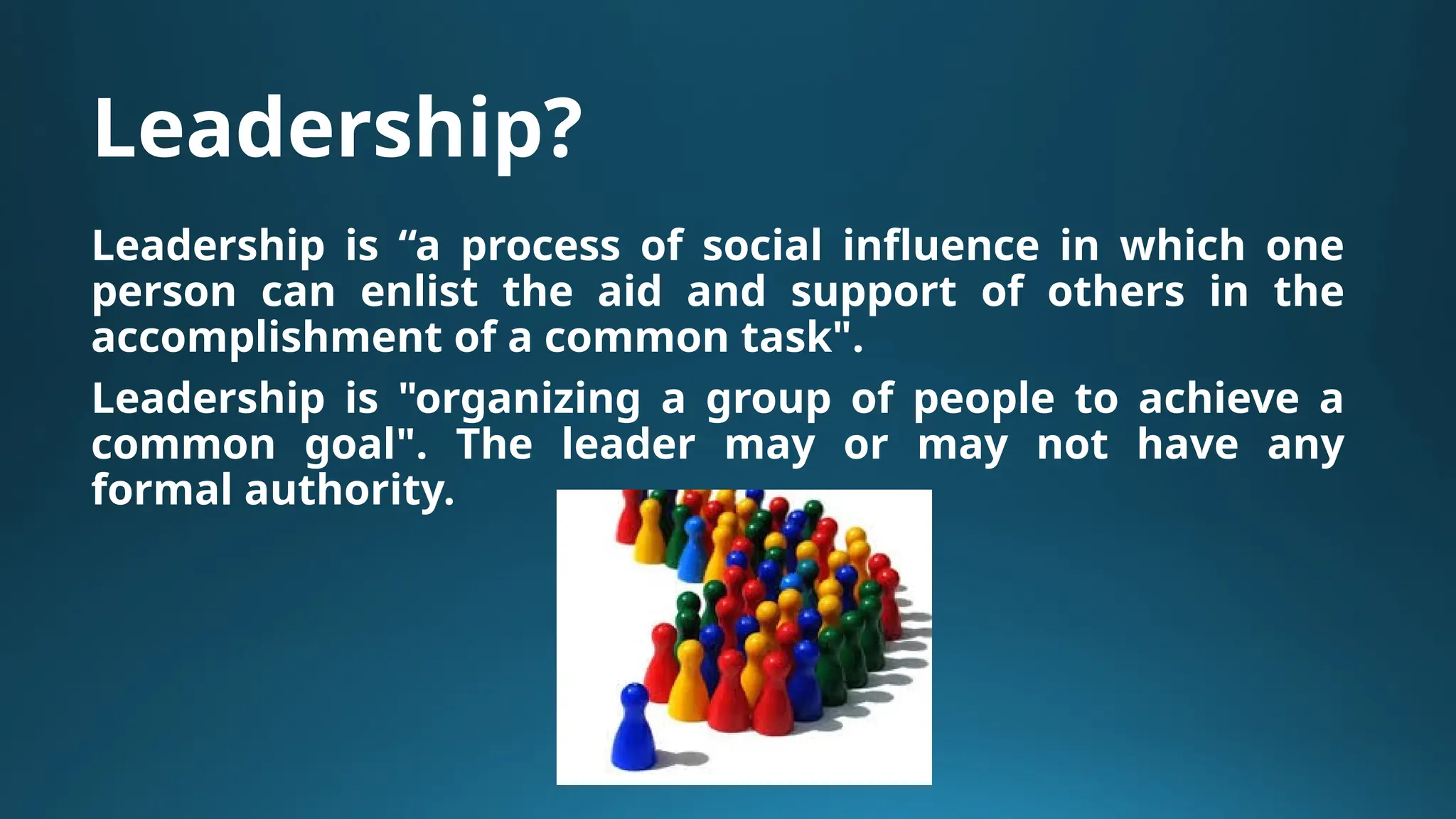
Leadership is “a process of social influence in which one
person can enlist the aid and support of others in the
accomplishment of a common task".
Leadership is "organizing a group of people to achieve a
common goal". The leader may or may not have any
formal authority.
Leader
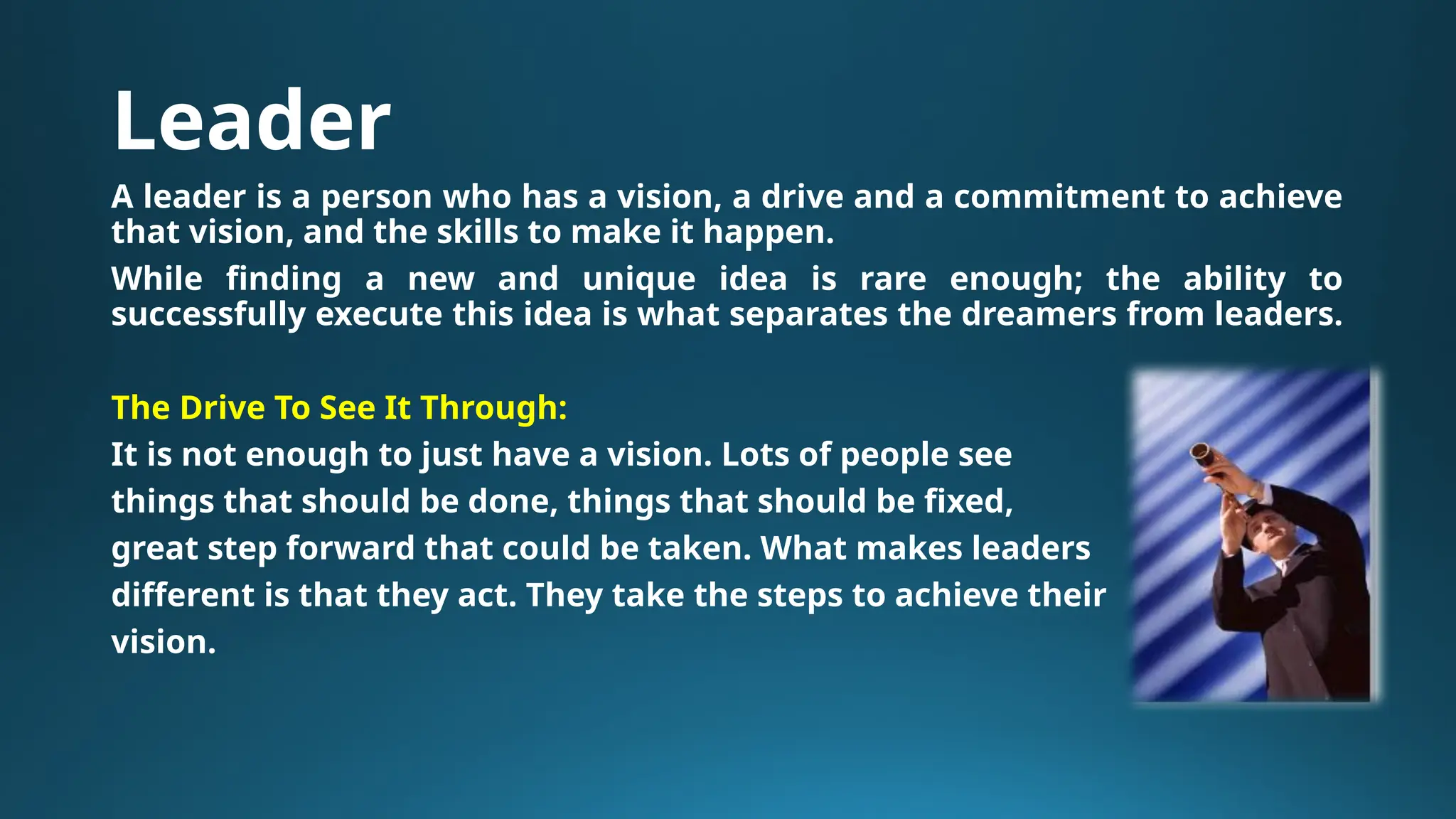
A leader is a person who has a vision, a drive and a commitment to achieve
that vision, and the skills to make it happen.
While finding a new and unique idea is rare enough; the ability to
successfully execute this idea is what separates the dreamers from leaders.
The Drive To See It Through:
It is not enough to just have a vision. Lots of people see
things that should be done, things that should be fixed,
great step forward that could be taken. What makes leaders
different is that they act. They take the steps to achieve their
vision.
Leadership begins with Self-knowledge
Self-knowledge is the basis for character...
Character is the root of integrity...
Integrity provides the foundation for leadership”.
(Lombardi, 2001)
Leadership is about:
1. Motivating
2. Inspiring
3. Taking people to greater heights
4. Working with participants on the how and helping them
figure out what and why
5. Encouraging them to push themselves to achieve the
highest possible performance
6. Action
7. Enabling, not telling
8. Talking the talk and walking the walk...walking alongside
The Leadership Role
A good leader is a person who:
1. Is a good teacher
2. Doesn’t put down those they are working with
3. Gets the most from those they are working with
4. Works within the framework of the rules
The Leadership Role (continued…)
1. Leadership style is the manner and approach of
providing direction, implementing plans, and
motivating people.
2. Positive Leaders use rewards (independence,
education) to motivate employees.
3. Negative Leaders use penalties with employees.
These leaders act domineering and superior
w/people. Negative penalties include: days off
without pay, reprimanding in front of others,
assigning unpleasant job tasks.
What are the three primary tasks of a
leader?
1. Set direction: mission, goals, vision
2. Build commitment: motivate & inspire
3. Confront challenges: innovation, deal with change,
turbulence, take risks
How people become leaders (Bass' Theory of
Leadership)
Bass' theory of leadership notes there are three basic
ways to explain how people become leaders:
1. A crisis or important event may cause a person to
rise to the occasion, which brings out extraordinary
leadership qualities in an ordinary person.
2. Some personality traits may lead people naturally
into leadership roles.
3. People can choose to become leaders. People can
learn leadership skills. This is the Transformational
Theory. It is the most widely accepted theory today
and the premise on which this guide is based.
Leadership styles
Leadership style is the manner and approach of providing
direction, implementing plans, and motivating people.
Kurt Lewin (1939) led a group of researchers to identify
different styles of leadership. This early study has been
very influential and established three major leadership
styles. The three major styles of leadership are:
• Authoritarian or autocratic
• Participative or democratic
• Delegative or Free Reign
1. Authoritarian (autocratic)
1. This style is used when leaders tell their employees
what they want done and how they want it
accomplished, without getting the advice of their
followers. Some of the appropriate conditions to
use it is when you have all the information to solve
the problem, you are short on time, and your
employees are well motivated.
2. The authoritarian style should normally only be
used on rare occasions.
2. Participative (democratic)
1. This style involves the leader including one or more
employees in the decision making process
(determining what to do and how to do it). However,
the leader maintains the final decision making
authority.
2. Using this style is not a sign of weakness, rather it is a
sign of strength that your employees will respect.
3. This is normally used when leader has one part of the
information, and employees have other parts.
4. Leader is not expected to know everything — this is
why knowledgeable and skillful employees are
employed. Using this style is of mutual benefit — it
allows them to become part of the team and allows
you to make better decisions.
3. Delegative (free reign)
1. In this style, the leader allows the employees
to make the decisions. However, the leader is
still responsible for the decisions that are
made. This is used when employees are able
to analyze the situation and determine what
needs to be done and how to do it. You
cannot do everything! You must set priorities
and delegate certain tasks.
2. This is not a style to use so that you can
blame others when things go wrong, rather
this is a style to be used when you fully trust
and confidence in the people below you.
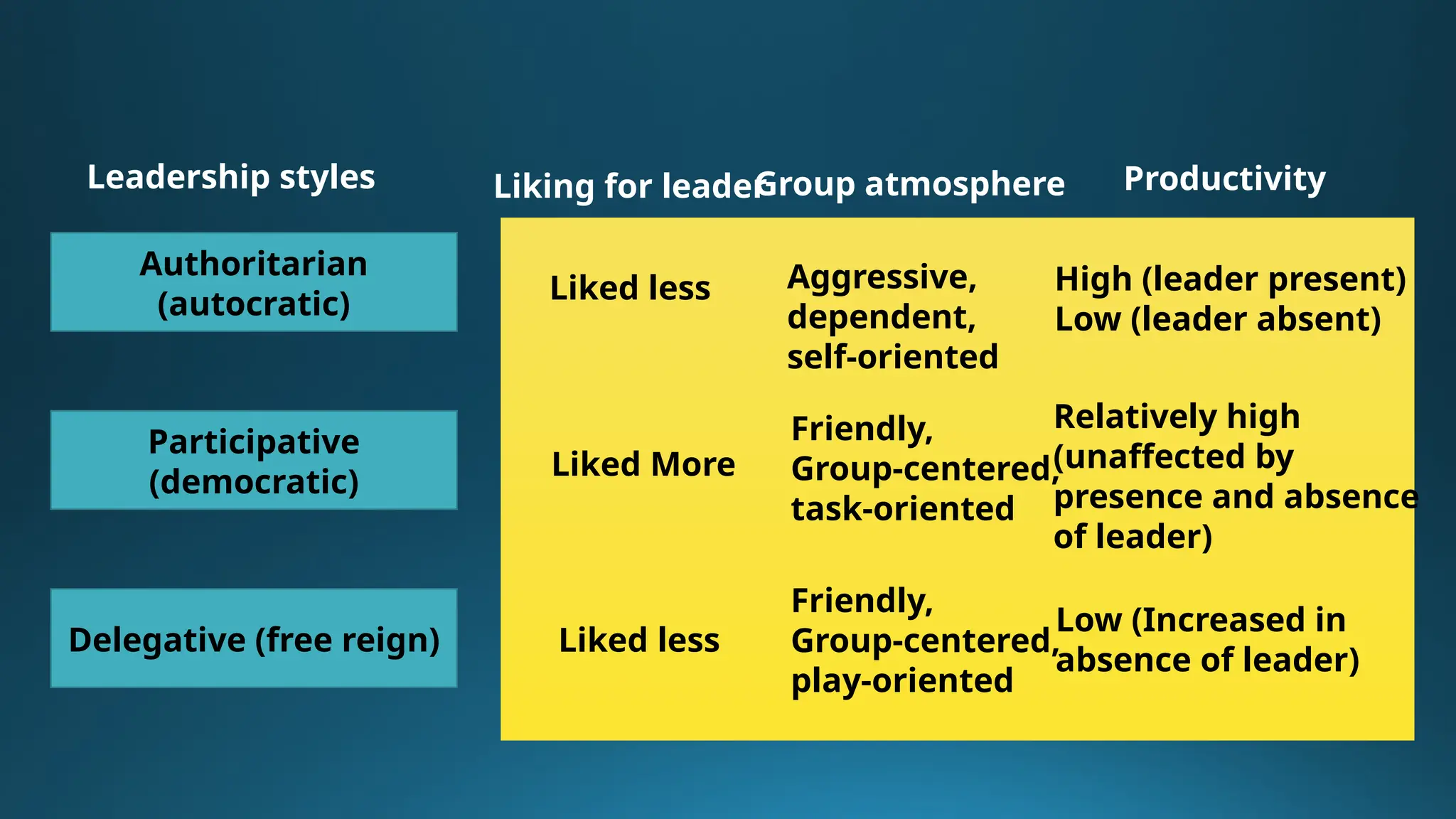
Leadership styles
Authoritarian
(autocratic)
Participative
(democratic)
Delegative (free reign)
Liking for leader
Group atmosphere Productivity
Liked less
Liked More
Liked less
Aggressive,
dependent,
self-oriented
Friendly,
Group-centered,
task-oriented
Friendly,
Group-centered,
play-oriented
High (leader present)
Low (leader absent)
Relatively high
(unaffected by
presence and absence
of leader)
Low (Increased in
absence of leader)
Leadership theories
Early leadership theories focused on what qualities
distinguished between leaders and followers, while
subsequent theories looked at other variables such as
situational factors and skill levels.
While many different leadership theories have emerged,
most can be classified as one of eight major types.
1. Trait Theory:
Trait theory assumes that people inherit certain
qualities and traits that make them better suited
to leadership.
1. Trait theory often identifies particular
personality or behavioral characteristics shared
by leaders.
2. If particular traits are key features of
leadership, then how do we explain people who
possess those qualities but are not leaders? This
question is one of the difficulties in using trait
theory to explain leadership.
2. Contingency Theory
Leaders are capable of changing their habits and
styles to benefit the situation.
Determine which particular style of leadership is
best suited for the situation.
1. According to this theory, no leadership style is
best in all situations.
2. Success depends upon a number of variables,
including the leadership style, qualities of the
followers and aspects of the situation.
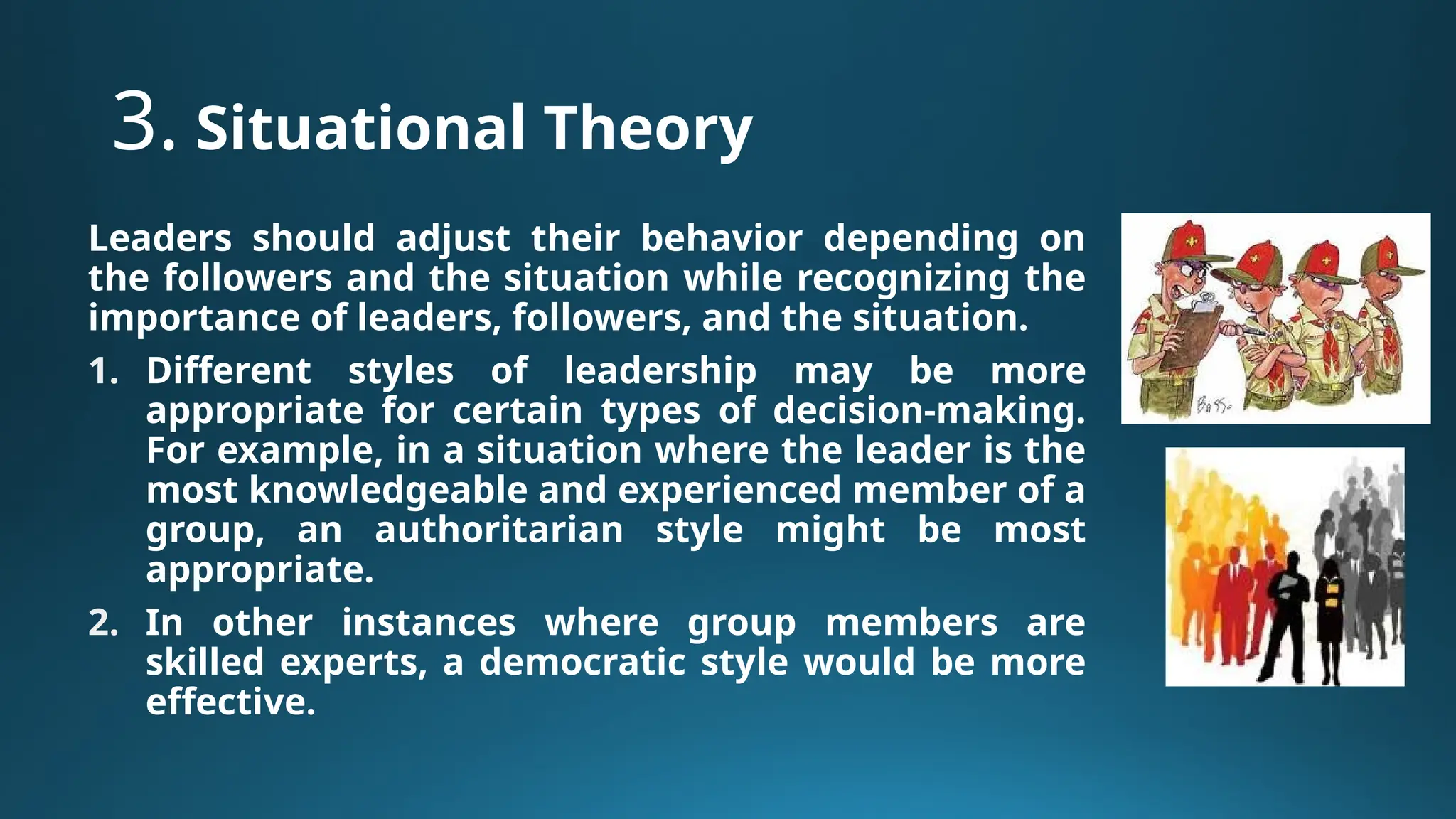
3. Situational Theory
Leaders should adjust their behavior depending on
the followers and the situation while recognizing the
importance of leaders, followers, and the situation.
1. Different styles of leadership may be more
appropriate for certain types of decision-making.
For example, in a situation where the leader is the
most knowledgeable and experienced member of a
group, an authoritarian style might be most
appropriate.
2. In other instances where group members are
skilled experts, a democratic style would be more
effective.
4. Behavioral Theory
Behavioral theories of leadership are based
upon the belief that great leaders are made,
not born.
1. Rooted in behaviorism, this leadership
theory focuses on the actions of leaders
not on mental qualities or internal states.
2. According to this theory, people can learn
to become leaders through teaching and
observation.
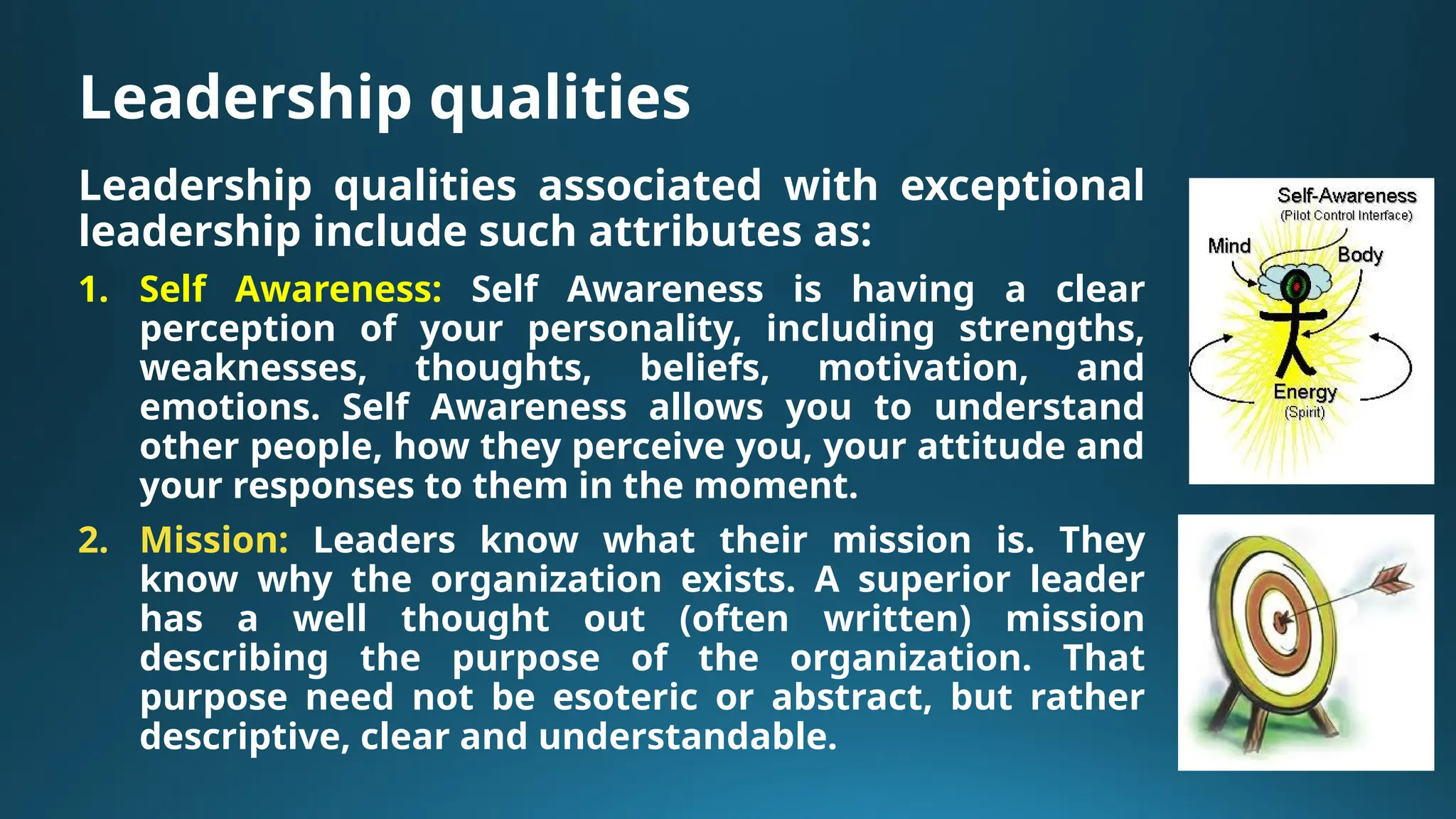
Leadership qualities
Leadership qualities associated with exceptional
leadership include such attributes as:
1. Self Awareness: Self Awareness is having a clear
perception of your personality, including strengths,
weaknesses, thoughts, beliefs, motivation, and
emotions. Self Awareness allows you to understand
other people, how they perceive you, your attitude and
your responses to them in the moment.
2. Mission: Leaders know what their mission is. They
know why the organization exists. A superior leader
has a well thought out (often written) mission
describing the purpose of the organization. That
purpose need not be esoteric or abstract, but rather
descriptive, clear and understandable.
Leadership qualities (continued…)
3. Vision: Where do you want your
group/team/organization to go? A vision needs to be
abstract enough to encourage people to imagine it but
concrete enough for followers to see it, understand it
and be willing to climb onboard to fulfill it.
4. Goal: How is the organization/team/group is going to
achieve its mission and vision and how will you
measure your progress? Like a vision, goals need to be
operational; that is specific and measurable. If your
output and results can't be readily measured, then it
will be difficult to know if you have achieved your
purpose. The leader may have wasted important
resources (time, money, people, and equipment)
pursuing a strategy or plan without knowing if it truly
succeeded.
Leadership qualities (continued…)
5. Communication skills: For leaders it is not enough to
just know what to say—but how to say it in a way that
persuades people to act.
a. Leadership communication skills help leaders covey
their principles and intelligence within all of their
business communications.
b. Developed leadership skills inspire other people and
help develop a sense of purpose surrounding business
goals.
c. Leadership communication skills often focus on the
recipient of your message.
d. Learning how to motivate and inspire action in team
members is an acquired skill.
e. Like any skill worth having, it requires an investment
of practice and coaching and the dividends are
valuable.
f. Mastering leadership communication skills can
Leadership qualities (continued…)
6. Facilitating skills: Liaise with team-members and arrive
at the best possible solution. There could be diverse
ideas and perspectives for any single agenda, but an
effective leader will work towards reaching a consensus.
a. It ensures that discussions take place in a structured
manner without losing sight of the outcome.
b. Acts as an icebreaker by engaging followers and
keeping up the momentum.
7. Mentoring skills: It involves providing constructive
guidance wisely as and when required. This helps
followers in recovering from any glitch or stumbling
block.
a. It gives the chance to know the other person well.
b. It gives a fair idea where to draw the line.
Leadership qualities (continued…)
8. Influence and Motivation skills: It is a conglomeration
of both communication skills and leadership skills.
While, through good communication one can
influence and persuade others, through leadership
skills one can demonstrate his/her motivational skills
which boost the spirits of the followers. Motivational
skills instill confidence in the mind of the follower. It
helps inspire the followers, instead of commanding
them.
9. Decision making skills: A leader has to make countless
decisions. A wrong decision may prove costly while a
right decision at a crucial time may bring favorable
results. Tackle issues as and when required without
conflict. Steer the dynamics of the team “to the next
level”.
Leadership qualities (continued…)
10. Planning: Planning involves taking certain strategic decision
about the future. Planning includes the list of activities and
the contingency plan that needs to be carried forward.
a. Proper planning is like choosing the right track to get
onto.
b. With the correct direction in mind, you can move
towards the fulfillment of the goal.
c. It also makes a leader organize his/her agenda by
arranging “first things first”.
11. Integrity: A leader builds trust and this fosters collaboration
and facilitates sharing of information. In this way, he creates
a solid team who supports each other’s views.
a. Integrity means honesty, fairness and creating good
relationships.
b. It is about personal values that cannot be
compromised.
Leadership qualities (continued…)
12. Team work: It involves co-operating with fellow
members while nurturing their aspirations. Through
team work, a leader develops a sense of collaboration
while working with his peers and subordinates.
a. It teaches the art of delegating work among
fellow members.
b. Derive the support of others by emphasizing
their good qualities.
13. Stress management: A leader manages stress
effectively.
a. It teaches a leader to develop the ability to
bounce back from setbacks without dwelling on
negative thoughts.
b. It also develops the habit of being patient in
any situation.
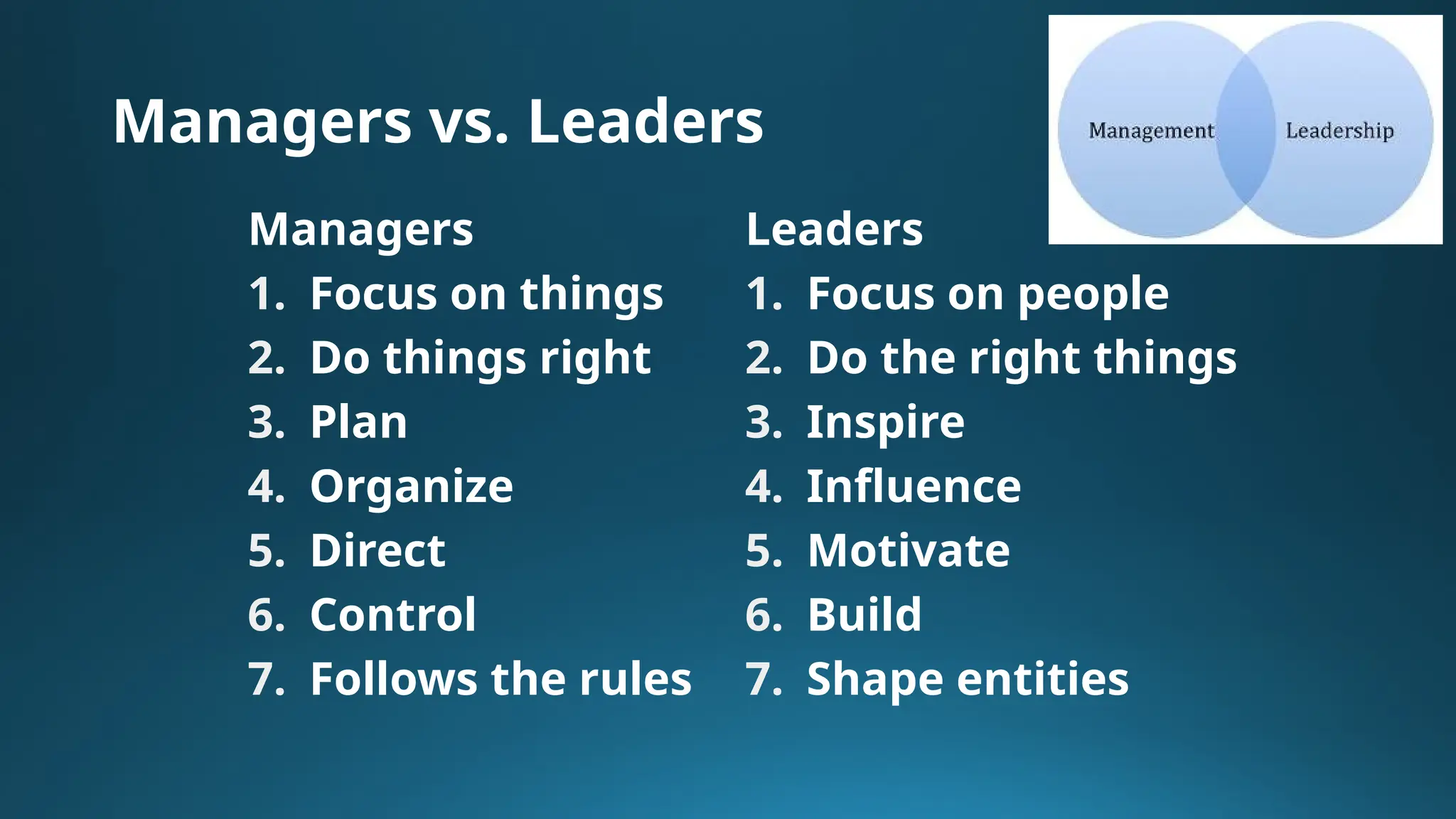
Managers vs. Leaders
Managers
1. Focus on things
2. Do things right
3. Plan
4. Organize
5. Direct
6. Control
7. Follows the rules
Leaders
1. Focus on people
2. Do the right things
3. Inspire
4. Influence
5. Motivate
6. Build
7. Shape entities

Document_from_Manahil.pptxufxtxu uf ti ig ig ig

  • 1.
  • 2.
    Social psychology Social psychologyis about understanding individual behavior in a social context. “The scientific field that seeks to understand the nature and causes of individual behavior in social situations” Social psychologists therefore deal with the factors that lead us to behave in a given way in the presence of others, and look at the conditions under which certain behavior/actions and feelings occur. Social psychology is to do with the way these feelings, thoughts, beliefs, intentions and goals are constructed and how such psychological factors, in
  • 3.
    Leadership? Leadership is “aprocess of social influence in which one person can enlist the aid and support of others in the accomplishment of a common task". Leadership is "organizing a group of people to achieve a common goal". The leader may or may not have any formal authority.
  • 4.
    Leader A leader isa person who has a vision, a drive and a commitment to achieve that vision, and the skills to make it happen. While finding a new and unique idea is rare enough; the ability to successfully execute this idea is what separates the dreamers from leaders. The Drive To See It Through: It is not enough to just have a vision. Lots of people see things that should be done, things that should be fixed, great step forward that could be taken. What makes leaders different is that they act. They take the steps to achieve their vision.
  • 5.
    Leadership begins withSelf-knowledge Self-knowledge is the basis for character... Character is the root of integrity... Integrity provides the foundation for leadership”. (Lombardi, 2001)
  • 6.
    Leadership is about: 1.Motivating 2. Inspiring 3. Taking people to greater heights 4. Working with participants on the how and helping them figure out what and why 5. Encouraging them to push themselves to achieve the highest possible performance 6. Action 7. Enabling, not telling 8. Talking the talk and walking the walk...walking alongside
  • 7.
    The Leadership Role Agood leader is a person who: 1. Is a good teacher 2. Doesn’t put down those they are working with 3. Gets the most from those they are working with 4. Works within the framework of the rules
  • 8.
    The Leadership Role(continued…) 1. Leadership style is the manner and approach of providing direction, implementing plans, and motivating people. 2. Positive Leaders use rewards (independence, education) to motivate employees. 3. Negative Leaders use penalties with employees. These leaders act domineering and superior w/people. Negative penalties include: days off without pay, reprimanding in front of others, assigning unpleasant job tasks.
  • 9.
    What are thethree primary tasks of a leader? 1. Set direction: mission, goals, vision 2. Build commitment: motivate & inspire 3. Confront challenges: innovation, deal with change, turbulence, take risks
  • 10.
    How people becomeleaders (Bass' Theory of Leadership) Bass' theory of leadership notes there are three basic ways to explain how people become leaders: 1. A crisis or important event may cause a person to rise to the occasion, which brings out extraordinary leadership qualities in an ordinary person. 2. Some personality traits may lead people naturally into leadership roles. 3. People can choose to become leaders. People can learn leadership skills. This is the Transformational Theory. It is the most widely accepted theory today and the premise on which this guide is based.
  • 11.
    Leadership styles Leadership styleis the manner and approach of providing direction, implementing plans, and motivating people. Kurt Lewin (1939) led a group of researchers to identify different styles of leadership. This early study has been very influential and established three major leadership styles. The three major styles of leadership are: • Authoritarian or autocratic • Participative or democratic • Delegative or Free Reign
  • 12.
    1. Authoritarian (autocratic) 1.This style is used when leaders tell their employees what they want done and how they want it accomplished, without getting the advice of their followers. Some of the appropriate conditions to use it is when you have all the information to solve the problem, you are short on time, and your employees are well motivated. 2. The authoritarian style should normally only be used on rare occasions.
  • 13.
    2. Participative (democratic) 1.This style involves the leader including one or more employees in the decision making process (determining what to do and how to do it). However, the leader maintains the final decision making authority. 2. Using this style is not a sign of weakness, rather it is a sign of strength that your employees will respect. 3. This is normally used when leader has one part of the information, and employees have other parts. 4. Leader is not expected to know everything — this is why knowledgeable and skillful employees are employed. Using this style is of mutual benefit — it allows them to become part of the team and allows you to make better decisions.
  • 14.
    3. Delegative (freereign) 1. In this style, the leader allows the employees to make the decisions. However, the leader is still responsible for the decisions that are made. This is used when employees are able to analyze the situation and determine what needs to be done and how to do it. You cannot do everything! You must set priorities and delegate certain tasks. 2. This is not a style to use so that you can blame others when things go wrong, rather this is a style to be used when you fully trust and confidence in the people below you.
  • 15.
    Leadership styles Authoritarian (autocratic) Participative (democratic) Delegative (freereign) Liking for leader Group atmosphere Productivity Liked less Liked More Liked less Aggressive, dependent, self-oriented Friendly, Group-centered, task-oriented Friendly, Group-centered, play-oriented High (leader present) Low (leader absent) Relatively high (unaffected by presence and absence of leader) Low (Increased in absence of leader)
  • 16.
    Leadership theories Early leadershiptheories focused on what qualities distinguished between leaders and followers, while subsequent theories looked at other variables such as situational factors and skill levels. While many different leadership theories have emerged, most can be classified as one of eight major types.
  • 17.
    1. Trait Theory: Traittheory assumes that people inherit certain qualities and traits that make them better suited to leadership. 1. Trait theory often identifies particular personality or behavioral characteristics shared by leaders. 2. If particular traits are key features of leadership, then how do we explain people who possess those qualities but are not leaders? This question is one of the difficulties in using trait theory to explain leadership.
  • 18.
    2. Contingency Theory Leadersare capable of changing their habits and styles to benefit the situation. Determine which particular style of leadership is best suited for the situation. 1. According to this theory, no leadership style is best in all situations. 2. Success depends upon a number of variables, including the leadership style, qualities of the followers and aspects of the situation.
  • 19.
    3. Situational Theory Leadersshould adjust their behavior depending on the followers and the situation while recognizing the importance of leaders, followers, and the situation. 1. Different styles of leadership may be more appropriate for certain types of decision-making. For example, in a situation where the leader is the most knowledgeable and experienced member of a group, an authoritarian style might be most appropriate. 2. In other instances where group members are skilled experts, a democratic style would be more effective.
  • 20.
    4. Behavioral Theory Behavioraltheories of leadership are based upon the belief that great leaders are made, not born. 1. Rooted in behaviorism, this leadership theory focuses on the actions of leaders not on mental qualities or internal states. 2. According to this theory, people can learn to become leaders through teaching and observation.
  • 21.
    Leadership qualities Leadership qualitiesassociated with exceptional leadership include such attributes as: 1. Self Awareness: Self Awareness is having a clear perception of your personality, including strengths, weaknesses, thoughts, beliefs, motivation, and emotions. Self Awareness allows you to understand other people, how they perceive you, your attitude and your responses to them in the moment. 2. Mission: Leaders know what their mission is. They know why the organization exists. A superior leader has a well thought out (often written) mission describing the purpose of the organization. That purpose need not be esoteric or abstract, but rather descriptive, clear and understandable.
  • 22.
    Leadership qualities (continued…) 3.Vision: Where do you want your group/team/organization to go? A vision needs to be abstract enough to encourage people to imagine it but concrete enough for followers to see it, understand it and be willing to climb onboard to fulfill it. 4. Goal: How is the organization/team/group is going to achieve its mission and vision and how will you measure your progress? Like a vision, goals need to be operational; that is specific and measurable. If your output and results can't be readily measured, then it will be difficult to know if you have achieved your purpose. The leader may have wasted important resources (time, money, people, and equipment) pursuing a strategy or plan without knowing if it truly succeeded.
  • 23.
    Leadership qualities (continued…) 5.Communication skills: For leaders it is not enough to just know what to say—but how to say it in a way that persuades people to act. a. Leadership communication skills help leaders covey their principles and intelligence within all of their business communications. b. Developed leadership skills inspire other people and help develop a sense of purpose surrounding business goals. c. Leadership communication skills often focus on the recipient of your message. d. Learning how to motivate and inspire action in team members is an acquired skill. e. Like any skill worth having, it requires an investment of practice and coaching and the dividends are valuable. f. Mastering leadership communication skills can
  • 24.
    Leadership qualities (continued…) 6.Facilitating skills: Liaise with team-members and arrive at the best possible solution. There could be diverse ideas and perspectives for any single agenda, but an effective leader will work towards reaching a consensus. a. It ensures that discussions take place in a structured manner without losing sight of the outcome. b. Acts as an icebreaker by engaging followers and keeping up the momentum. 7. Mentoring skills: It involves providing constructive guidance wisely as and when required. This helps followers in recovering from any glitch or stumbling block. a. It gives the chance to know the other person well. b. It gives a fair idea where to draw the line.
  • 25.
    Leadership qualities (continued…) 8.Influence and Motivation skills: It is a conglomeration of both communication skills and leadership skills. While, through good communication one can influence and persuade others, through leadership skills one can demonstrate his/her motivational skills which boost the spirits of the followers. Motivational skills instill confidence in the mind of the follower. It helps inspire the followers, instead of commanding them. 9. Decision making skills: A leader has to make countless decisions. A wrong decision may prove costly while a right decision at a crucial time may bring favorable results. Tackle issues as and when required without conflict. Steer the dynamics of the team “to the next level”.
  • 26.
    Leadership qualities (continued…) 10.Planning: Planning involves taking certain strategic decision about the future. Planning includes the list of activities and the contingency plan that needs to be carried forward. a. Proper planning is like choosing the right track to get onto. b. With the correct direction in mind, you can move towards the fulfillment of the goal. c. It also makes a leader organize his/her agenda by arranging “first things first”. 11. Integrity: A leader builds trust and this fosters collaboration and facilitates sharing of information. In this way, he creates a solid team who supports each other’s views. a. Integrity means honesty, fairness and creating good relationships. b. It is about personal values that cannot be compromised.
  • 27.
    Leadership qualities (continued…) 12.Team work: It involves co-operating with fellow members while nurturing their aspirations. Through team work, a leader develops a sense of collaboration while working with his peers and subordinates. a. It teaches the art of delegating work among fellow members. b. Derive the support of others by emphasizing their good qualities. 13. Stress management: A leader manages stress effectively. a. It teaches a leader to develop the ability to bounce back from setbacks without dwelling on negative thoughts. b. It also develops the habit of being patient in any situation.
  • 28.
    Managers vs. Leaders Managers 1.Focus on things 2. Do things right 3. Plan 4. Organize 5. Direct 6. Control 7. Follows the rules Leaders 1. Focus on people 2. Do the right things 3. Inspire 4. Influence 5. Motivate 6. Build 7. Shape entities