POWER AND POLITICS
Presented By-
Chhavi
Devashish
Sakshi
Sowmya
POLITICS : POWER IN ACTION
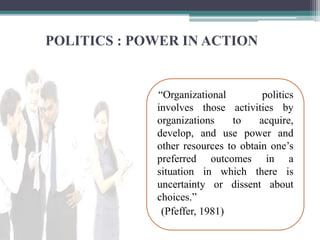
“Organizational politics
involves those activities by
organizations to acquire,
develop, and use power and
other resources to obtain one’s
preferred outcomes in a
situation in which there is
uncertainty or dissent about
choices.”
(Pfeffer, 1981)
CAUSES AND CONSEQUENCES OF
POLITICAL BEHAVIOR
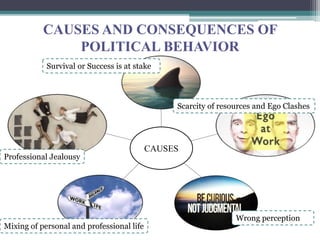
CAUSES
Survival or Success is at stake
Professional Jealousy
Scarcity of resources and Ego Clashes
Mixing of personal and professional life
Wrong perception
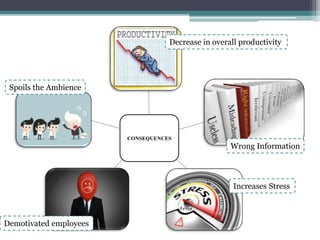
CONSEQUENCES
Decrease in overall productivity
Spoils the Ambience
Wrong Information
Demotivated employees
Increases Stress
FACTORS CONTRIBUTING TO
POLITICAL BEHAVIOR
• Individual factors
• Organizational factors
Individual Factors
•High self –monitors
•Internal locus of control
•High mach personality
• Organizational investment
•Perceived job alternatives
•Expectations of success
Organizational Factors
•Reallocation of resources
•Promotion opportunities
•Low trust
•Role ambiguity
•Unclear performance evaluation
system
•Zero sum reward practices
•Democratic decision making
•High performance pressures
•Self serving senior mangers
Political behavior
Low High
Favorable outcomes
•Reward
•Averted punishments
EMPLOYEE RESPONSES TO
ORGANIZTIONAL POLITICS
• Individuals who successfully engage in politicking are met
with favorable outcomes.
• People with modest politicking skills , or those who are
unwilling to play politics game met with not so favorable
outcomes.
• Organizational politics seen as a threat to employees.
• There is a strong evidence that relates the effect of politics on
the individuals on a personal level .
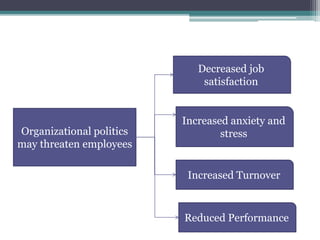
Organizational politics
may threaten employees
Decreased job
satisfaction
Increased anxiety and
stress
Increased Turnover
Reduced Performance
DEFENSIVE BEHAVIOR
• The behavior that people respond with when people perceive
politics as a threat rather than opportunity.
• Reactive and protective behaviors
• Avoid action, blame or change.
• Associated with negative feelings.
• Short run – Defensiveness protects self interest.
• Long run – Defensiveness wears one down.
• The defensiveness is the only way.
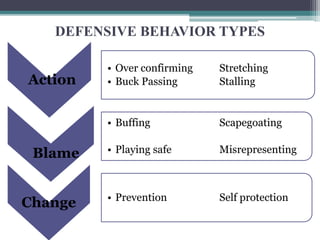
DEFENSIVE BEHAVIOR TYPES
Action
Blame
Change
• Over confirming Stretching
• Buck Passing Stalling
• Buffing Scapegoating
• Playing safe Misrepresenting
• Prevention Self protection
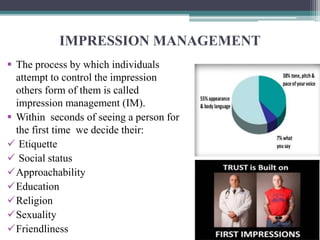
IMPRESSION MANAGEMENT
 The process by which individuals
attempt to control the impression
others form of them is called
impression management (IM).
 Within seconds of seeing a person for
the first time we decide their:
 Etiquette
 Social status
Approachability
Education
Religion
Sexuality
Friendliness
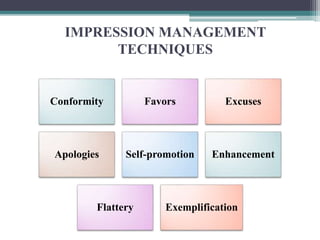
IMPRESSION MANAGEMENT
TECHNIQUES
Conformity Favors Excuses
Apologies Self-promotion Enhancement
Flattery Exemplification
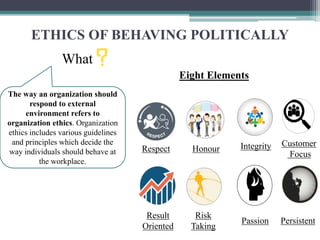
ETHICS OF BEHAVING POLITICALLY
What
The way an organization should
respond to external
environment refers to
organization ethics. Organization
ethics includes various guidelines
and principles which decide the
way individuals should behave at
the workplace.
Eight Elements
Respect Honour Integrity Customer
Focus
Result
Oriented
Risk
Taking
PersistentPassion
CASE STUDY
NITHISH KATARA MURDER
CASE
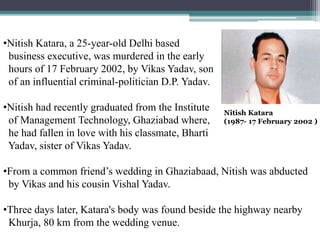
Nitish Katara
(1987- 17 February 2002 )
•Nitish Katara, a 25-year-old Delhi based
business executive, was murdered in the early
hours of 17 February 2002, by Vikas Yadav, son
of an influential criminal-politician D.P. Yadav.
•Nitish had recently graduated from the Institute
of Management Technology, Ghaziabad where,
he had fallen in love with his classmate, Bharti
Yadav, sister of Vikas Yadav.
•From a common friend’s wedding in Ghaziabaad, Nitish was abducted
by Vikas and his cousin Vishal Yadav.
•Three days later, Katara's body was found beside the highway nearby
Khurja, 80 km from the wedding venue.
• He had been battered to death with a hammer, diesel poured on him,
and set aflame.
• Arrest and confessions
• Inspector Ashok Bhadoria (a business associate of D.P. Yadav )
arrested Vikas and Vishal Yadav in MP, and in his original statement
to the court, he said that the Yadavs had confessed having kidnapped
Katara. Later on the inspector changed his stand saying the accused
persons made no confessional statements in his presence.
• After being handed over to the U.P. police, they gave a more detailed
confession, which the Police recorded on audiotape. In May 2006,
the NDTV news channel managed to obtain the tape and broadcast it.
• Bharti Yadav’s testimony took 4.5 years and in her testimony she
denied any romantic relationship with Katara.
• Of the four people at the wedding who had initially said they saw
Nitish go into the car with Vikas, three had already withdrawn their
testimony. Only Rohit Gaur was left as having seen Vikas and Vishal
taking Nitish in his car. However, on 26 September 2006, he denied
everything he had told police before.
• On 30 May 2008 New Delhi fast track court sentenced Vikas and
Vishal Yadav to life sentences for the kidnap and murder of Nitish
Katara.
• Vikas Yadav was granted bail 66 times in the first two years of
his incarceration, often with no clear reason documented.
• Even during the bail,Vikas Yadav was repeatedly involved in
criminal activities including involvement in the Jessica Lal case.
• On April 2, 2014, Delhi High Court upheld the Trial Court verdict
sentencing Life Imprisonment to Vikas Yadav, Vishal Yadav and
the contract killer Sukhdev Pehalwan.
• On February 6, 2015,Delhi HC awarded Vikas and Vishal life
terms of 25 years without remission and Sukhdev Pehalwan gets
20 years life imprisonment without remission.
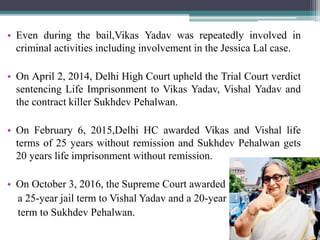
• On October 3, 2016, the Supreme Court awarded
a 25-year jail term to Vishal Yadav and a 20-year
term to Sukhdev Pehalwan.
What was the defensive behavior of
those involved in the Kataria case ?
• Inspector Ashok Bhadoria - said that the Yadavs had confessed
having kidnapped Katara from Kavi Nagar, Ghaziabad and arrested
Vikas and Vishal Yadav in MP.
• Constable Brij Mohan Mishra- said in court, "The accused persons
themselves said that they had murdered Nitish Katara after
kidnapping him.
• Inspector Bhadoria - Business associate of D P Yadav, Bhadoria
did not produce Brij Mohan before any magistrate to get his statement
recorded.
• Bharti Yadav- Daughter of D.P Yadav – changed initial verbal
sentence.
• Supreme Court, responding to an appeal from Nitish Katara's mother,
shifted the trial from Ghaziabad to Delhi because of D. P. Yadav's
considerable influence in the area, including its administration and
judiciary.
• Rohit Gaur- brother of Shivani Gaur, only witness left out of four.
• “It is incorrect to suggest that I informed the police that on the day of
the marriage, around midnight, Vishal came near Nitish Katara and
had a conversation with him and took him outside where Vikas Yadav
was present and that both Vikas and Vishal took Nitish in their
vehicle.”
• Ajay Kumar- Passerby- gave a statement- April 2007 .
• In June 2007, filed a complaint – under pressure to withdraw from
the case.
What were the political flaws in the
case?
Dealing with influential politicians- Witnesses changed their
statements.
 Failure of judicial system.
Criminals in power.
How can we determine whether a
political action is ethical?
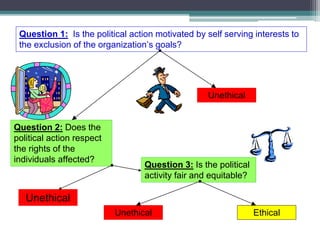
Question 1: Is the political action motivated by self serving interests to
the exclusion of the organization’s goals?
Yes
Unethical
No
Ethical
Question 3: Is the political
activity fair and equitable?
No Yes
Unethical
Question 2: Does the
political action respect
the rights of the
individuals affected?
Yes
Unethical
No
THANK YOU

Organizational Behavior-Power and politics (Case Study)

  • 1.
    POWER AND POLITICS PresentedBy- Chhavi Devashish Sakshi Sowmya
  • 2.
    POLITICS : POWERIN ACTION “Organizational politics involves those activities by organizations to acquire, develop, and use power and other resources to obtain one’s preferred outcomes in a situation in which there is uncertainty or dissent about choices.” (Pfeffer, 1981)
  • 3.
    CAUSES AND CONSEQUENCESOF POLITICAL BEHAVIOR CAUSES Survival or Success is at stake Professional Jealousy Scarcity of resources and Ego Clashes Mixing of personal and professional life Wrong perception
  • 4.
    CONSEQUENCES Decrease in overallproductivity Spoils the Ambience Wrong Information Demotivated employees Increases Stress
  • 5.
    FACTORS CONTRIBUTING TO POLITICALBEHAVIOR • Individual factors • Organizational factors
  • 6.
    Individual Factors •High self–monitors •Internal locus of control •High mach personality • Organizational investment •Perceived job alternatives •Expectations of success Organizational Factors •Reallocation of resources •Promotion opportunities •Low trust •Role ambiguity •Unclear performance evaluation system •Zero sum reward practices •Democratic decision making •High performance pressures •Self serving senior mangers Political behavior Low High Favorable outcomes •Reward •Averted punishments
  • 7.
    EMPLOYEE RESPONSES TO ORGANIZTIONALPOLITICS • Individuals who successfully engage in politicking are met with favorable outcomes. • People with modest politicking skills , or those who are unwilling to play politics game met with not so favorable outcomes. • Organizational politics seen as a threat to employees. • There is a strong evidence that relates the effect of politics on the individuals on a personal level .
  • 8.
    Organizational politics may threatenemployees Decreased job satisfaction Increased anxiety and stress Increased Turnover Reduced Performance
  • 9.
    DEFENSIVE BEHAVIOR • Thebehavior that people respond with when people perceive politics as a threat rather than opportunity. • Reactive and protective behaviors • Avoid action, blame or change. • Associated with negative feelings. • Short run – Defensiveness protects self interest. • Long run – Defensiveness wears one down. • The defensiveness is the only way.
  • 10.
    DEFENSIVE BEHAVIOR TYPES Action Blame Change •Over confirming Stretching • Buck Passing Stalling • Buffing Scapegoating • Playing safe Misrepresenting • Prevention Self protection
  • 11.
    IMPRESSION MANAGEMENT  Theprocess by which individuals attempt to control the impression others form of them is called impression management (IM).  Within seconds of seeing a person for the first time we decide their:  Etiquette  Social status Approachability Education Religion Sexuality Friendliness
  • 12.
    IMPRESSION MANAGEMENT TECHNIQUES Conformity FavorsExcuses Apologies Self-promotion Enhancement Flattery Exemplification
  • 13.
    ETHICS OF BEHAVINGPOLITICALLY What The way an organization should respond to external environment refers to organization ethics. Organization ethics includes various guidelines and principles which decide the way individuals should behave at the workplace. Eight Elements Respect Honour Integrity Customer Focus Result Oriented Risk Taking PersistentPassion
  • 14.
  • 15.
    Nitish Katara (1987- 17February 2002 ) •Nitish Katara, a 25-year-old Delhi based business executive, was murdered in the early hours of 17 February 2002, by Vikas Yadav, son of an influential criminal-politician D.P. Yadav. •Nitish had recently graduated from the Institute of Management Technology, Ghaziabad where, he had fallen in love with his classmate, Bharti Yadav, sister of Vikas Yadav. •From a common friend’s wedding in Ghaziabaad, Nitish was abducted by Vikas and his cousin Vishal Yadav. •Three days later, Katara's body was found beside the highway nearby Khurja, 80 km from the wedding venue.
  • 16.
    • He hadbeen battered to death with a hammer, diesel poured on him, and set aflame. • Arrest and confessions • Inspector Ashok Bhadoria (a business associate of D.P. Yadav ) arrested Vikas and Vishal Yadav in MP, and in his original statement to the court, he said that the Yadavs had confessed having kidnapped Katara. Later on the inspector changed his stand saying the accused persons made no confessional statements in his presence. • After being handed over to the U.P. police, they gave a more detailed confession, which the Police recorded on audiotape. In May 2006, the NDTV news channel managed to obtain the tape and broadcast it.
  • 17.
    • Bharti Yadav’stestimony took 4.5 years and in her testimony she denied any romantic relationship with Katara. • Of the four people at the wedding who had initially said they saw Nitish go into the car with Vikas, three had already withdrawn their testimony. Only Rohit Gaur was left as having seen Vikas and Vishal taking Nitish in his car. However, on 26 September 2006, he denied everything he had told police before. • On 30 May 2008 New Delhi fast track court sentenced Vikas and Vishal Yadav to life sentences for the kidnap and murder of Nitish Katara. • Vikas Yadav was granted bail 66 times in the first two years of his incarceration, often with no clear reason documented.
  • 18.
    • Even duringthe bail,Vikas Yadav was repeatedly involved in criminal activities including involvement in the Jessica Lal case. • On April 2, 2014, Delhi High Court upheld the Trial Court verdict sentencing Life Imprisonment to Vikas Yadav, Vishal Yadav and the contract killer Sukhdev Pehalwan. • On February 6, 2015,Delhi HC awarded Vikas and Vishal life terms of 25 years without remission and Sukhdev Pehalwan gets 20 years life imprisonment without remission. • On October 3, 2016, the Supreme Court awarded a 25-year jail term to Vishal Yadav and a 20-year term to Sukhdev Pehalwan.
  • 19.
    What was thedefensive behavior of those involved in the Kataria case ?
  • 20.
    • Inspector AshokBhadoria - said that the Yadavs had confessed having kidnapped Katara from Kavi Nagar, Ghaziabad and arrested Vikas and Vishal Yadav in MP. • Constable Brij Mohan Mishra- said in court, "The accused persons themselves said that they had murdered Nitish Katara after kidnapping him. • Inspector Bhadoria - Business associate of D P Yadav, Bhadoria did not produce Brij Mohan before any magistrate to get his statement recorded. • Bharti Yadav- Daughter of D.P Yadav – changed initial verbal sentence.
  • 21.
    • Supreme Court,responding to an appeal from Nitish Katara's mother, shifted the trial from Ghaziabad to Delhi because of D. P. Yadav's considerable influence in the area, including its administration and judiciary. • Rohit Gaur- brother of Shivani Gaur, only witness left out of four. • “It is incorrect to suggest that I informed the police that on the day of the marriage, around midnight, Vishal came near Nitish Katara and had a conversation with him and took him outside where Vikas Yadav was present and that both Vikas and Vishal took Nitish in their vehicle.” • Ajay Kumar- Passerby- gave a statement- April 2007 . • In June 2007, filed a complaint – under pressure to withdraw from the case.
  • 22.
    What were thepolitical flaws in the case?
  • 23.
    Dealing with influentialpoliticians- Witnesses changed their statements.  Failure of judicial system. Criminals in power.
  • 24.
    How can wedetermine whether a political action is ethical?
  • 25.
    Question 1: Isthe political action motivated by self serving interests to the exclusion of the organization’s goals? Yes Unethical No Ethical Question 3: Is the political activity fair and equitable? No Yes Unethical Question 2: Does the political action respect the rights of the individuals affected? Yes Unethical No
  • 26.

Editor's Notes

  • #17 In this confession, Yadav admitted to taking Katara from the party, murdering him, and burning the body.[14] Although this confession, which was made a week or so after the murder, was not formalised before a magistrate, and was therefore not admissible as evidence in court, the fact that the hammer and watch were found based on this deposition may have weighed with the trial court when it reached its verdict
  • #18 In danger of being declared proclaimed offender, under which circumstance she could have been arrested and deported from London, Bharti finally returned to depose before the court. Based on her convenience, 25 November 2006 was set for her testimony jay Katara, but not a relative)[37] had filed a complaint to the police that "he was under pressure to withdraw from the case" and that "his life was in danger".[38] He was then assigned four personal security officers (PSOs) on the orders of the trial court.[37] On 12 July 2007, two brothers, Manoj and Anuj Sharma, called him to the Mohan Nagar temple saying he could meet his separated wife there to sort out his domestic problems. Three more people were apparently waiting nearby in a car. But his wife never showed up and the Sharmas bought him some chaat.[37] Right after eating it, Ajay suddenly took very ill, vomiting and complaining of stomach cramps.[38] He immediately went to hospital, where he was treated for food poisoning. A case has been registered against D. P. Yadav and four others on suspicion of having poisoned Ajay Kumar.[39]
  • #19 Nitish Katara's mother accused the jail authorities of colluding with Yadav's influential family and requested a formal investigation. October 9, 2015: The Supreme Court declines plea by Neelam Katara to award death sentence to the Yadav duo.