PRACTICAL
POLITICS
SURVIVE THE OFFICE
where do you stand on the topic
of office politics?
1 2 3 4 5 6
Politics is
caused by a
bunch of
scheming, self-
serving, scam
artists that
waste energy &
time.
We need none
of it!
Corporate
politics is a
wonderful, fun,
and exciting tool
that yields better
decisions for
companies.
We need more
of it!
Politics is
annoying, but I
recognize that
it is probably
just a fact of
corporate life.
I’ll play the
game when I
have to,
hopefully not
too often
Politics is
bearable.
Politics is
bad, but I
can live
with it.
I’ll just
ignore it
Politics is
generally good &
we should all get
better at it.
There is a place
for politics in
work
most people
1 2 3 4 5 6
Politics is
caused by a
bunch of
scheming, self-
serving, scam
artists that
waste energy &
time.
We need none
of it!
Corporate
politics is a
wonderful, fun,
and exciting tool
that yields better
decisions for
companies.
We need more
of it!
Politics is
annoying, but I
recognize that
it is probably
just a fact of
corporate life.
I’ll play the
game when I
have to,
hopefully not
too often
Politics is
bearable.
Politics is
bad, but I
can live
with it.
I’ll just
ignore it
Politics is
generally good &
we should all get
better at it.
There is a place
for politics in
work
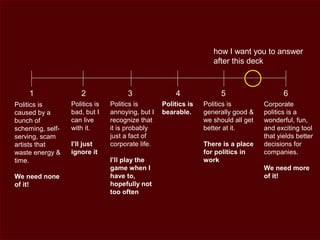
how I want you to answer
after this deck
i’ve got 3 questions i’d like you to
consider
Q1: What bad experiences have you had
with office politics that create your
assumptions?
Q2: Is an office without politics
preferable?
Q3: Is an office without politics possible?
now I’ve got 1 perspective I’d like
you to consider
politics is natural & unavoidable
because people will always have
different and legitimate beliefs,
issues, wants, needs, and
sources of power
those differences are created
biologically, environmentally, &
because of organizational
structure
so we’re all stuck with the
differences however much we
wish it were not so
there must be a process to
resolve conflicts that arise from
these natural and unavoidable
differences
that is what politics is
politics is neither good nor bad
however, how people implement
politics can be good or bad
and last but not least, politics exist
once there are two or more
people
so, don’t kid yourself,
entrepreneurs
start-ups have politics
so what do we mean by bad
politics?
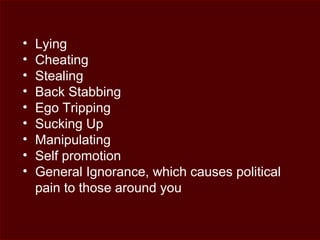
• Lying
• Cheating
• Stealing
• Back Stabbing
• Ego Tripping
• Sucking Up
• Manipulating
• Self promotion
• General Ignorance, which causes political
pain to those around you
and what do we mean by good
politics?
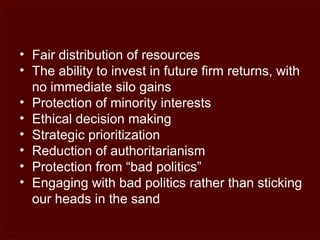
• Fair distribution of resources
• The ability to invest in future firm returns, with
no immediate silo gains
• Protection of minority interests
• Ethical decision making
• Strategic prioritization
• Reduction of authoritarianism
• Protection from “bad politics”
• Engaging with bad politics rather than sticking
our heads in the sand
and what do we get if we are good
at good politics
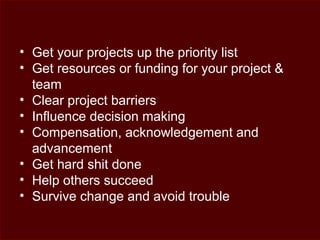
• Get your projects up the priority list
• Get resources or funding for your project &
team
• Clear project barriers
• Influence decision making
• Compensation, acknowledgement and
advancement
• Get hard shit done
• Help others succeed
• Survive change and avoid trouble
here are a few really useful
thoughts on the subject
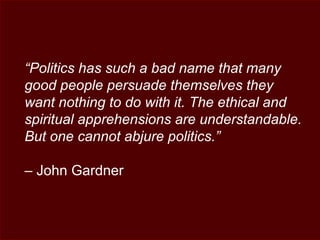
“Politics has such a bad name that many
good people persuade themselves they
want nothing to do with it. The ethical and
spiritual apprehensions are understandable.
But one cannot abjure politics.”
– John Gardner
“There is no doubt power can be used for evil
purposes. Of course most medicines can kill if
taken wrongly, thousands die in automobile
accidents each year, and nuclear power can
provide energy or mass destruction. We do not
abandon chemicals, cars or nuclear power.
Instead we consider danger an incentive to get
proper training.”
– Jeffrey Pfeffer
“Of course leaders are preoccupied with
power! The significant questions are: What
means do they use to gain it? How do they
exercise it? And to what ends do they
exercise it?”
– John Gardner
and one slightly ironic one
“It is not enough for a leader to know the
right thing. He must be able to do the right
thing. Leaders without the judgment or
perception to make the right decisions fail
for lack of vision. Those who know the right
thing, but cannot achieve it, fail because
they are ineffectual.”
- Richard Nixon
so, how good are you at getting
shit done…
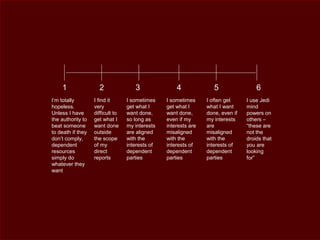
1 2 3 4 5 6
I’m totally
hopeless.
Unless I have
the authority to
beat someone
to death if they
don’t comply,
dependent
resources
simply do
whatever they
want
I use Jedi
mind
powers on
others –
“these are
not the
droids that
you are
looking
for”
I sometimes
get what I
want done,
so long as
my interests
are aligned
with the
interests of
dependent
parties
I sometimes
get what I
want done,
even if my
interests are
misaligned
with the
interests of
dependent
parties
I find it
very
difficult to
get what I
want done
outside
the scope
of my
direct
reports
I often get
what I want
done, even if
my interests
are
misaligned
with the
interests of
dependent
parties
what tools are in your ‘getting shit
done’ tool box?
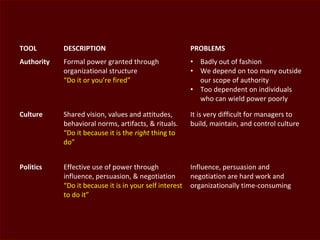
TOOL DESCRIPTION PROBLEMS
Authority Formal power granted through
organizational structure
“Do it or you’re fired”
• Badly out of fashion
• We depend on too many outside
our scope of authority
• Too dependent on individuals
who can wield power poorly
Culture Shared vision, values and attitudes,
behavioral norms, artifacts, & rituals.
“Do it because it is the right thing to
do”
It is very difficult for managers to
build, maintain, and control culture
Politics Effective use of power through
influence, persuasion, & negotiation
“Do it because it is in your self interest
to do it”
Influence, persuasion and
negotiation are hard work and
organizationally time-consuming
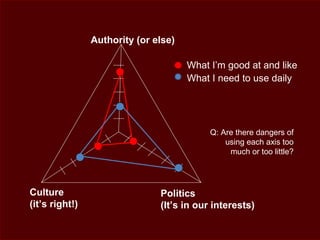
Authority (or else)
Culture
(it’s right!)
Politics
(It’s in our interests)
Q: Are there dangers of
using each axis too
much or too little?
What I need to use daily
What I’m good at and like
so with all that said, it is time to
propose the basic rule of ethical
politics
Be Political
accept that you need to be political
to get shit done
but, in the process, never advance
your own interests by harming the
business or by hurting other people
focus on building, protecting, and
using your power
not on undermining the power of
others
ok, so let’s assume that you agree
with me that you should be better at
politics
in that case, the next step is to
develop your Political Intelligence
and a plan to build and use your
power
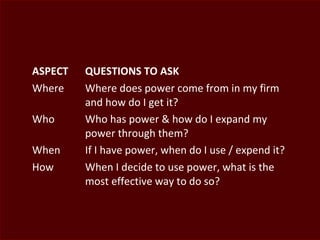
ASPECT QUESTIONS TO ASK
Where Where does power come from in my firm
and how do I get it?
Who Who has power & how do I expand my
power through them?
When If I have power, when do I use / expend it?
How When I decide to use power, what is the
most effective way to do so?
power comes from position

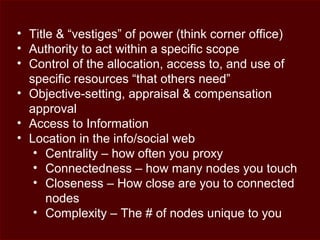
• Title & “vestiges” of power (think corner office)
• Authority to act within a specific scope
• Control of the allocation, access to, and use of
specific resources “that others need”
• Objective-setting, appraisal & compensation
approval
• Access to Information
• Location in the info/social web
• Centrality – how often you proxy
• Connectedness – how many nodes you touch
• Closeness – How close are you to connected
nodes
• Complexity – The # of nodes unique to you
political wisdom sidebar
1.Seasoned players know how to
“create” resources to control!
2.Defend your positional power from
encroachment by other managers –
But no Evil Politics!
take time to regularly update a
positional power audit
how strong is your positional
power?
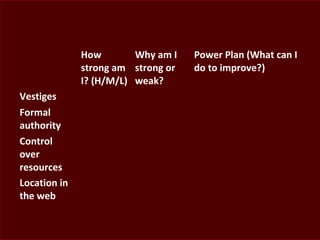
How
strong am
I? (H/M/L)
Why am I
strong or
weak?
Power Plan (What can I
do to improve?)
Vestiges
Formal
authority
Control
over
resources
Location in
the web
extra credit
who has positional power
around you? Why do they have
it?
power also comes from
relationships
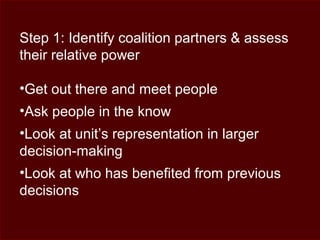
Step 1: Identify coalition partners & assess
their relative power
•Get out there and meet people
•Ask people in the know
•Look at unit’s representation in larger
decision-making
•Look at who has benefited from previous
decisions
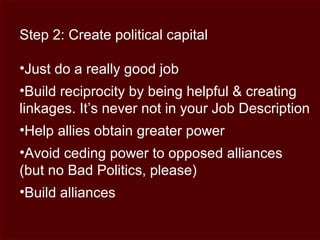
Step 2: Create political capital
•Just do a really good job
•Build reciprocity by being helpful & creating
linkages. It’s never not in your Job Description
•Help allies obtain greater power
•Avoid ceding power to opposed alliances
(but no Bad Politics, please)
•Build alliances
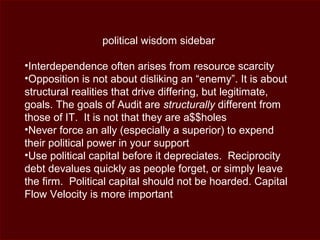
political wisdom sidebar
•Interdependence often arises from resource scarcity
•Opposition is not about disliking an “enemy”. It is about
structural realities that drive differing, but legitimate,
goals. The goals of Audit are structurally different from
those of IT. It is not that they are a$$holes
•Never force an ally (especially a superior) to expend
their political power in your support
•Use political capital before it depreciates. Reciprocity
debt devalues quickly as people forget, or simply leave
the firm. Political capital should not be hoarded. Capital
Flow Velocity is more important
take time to regularly update a
relational power audit
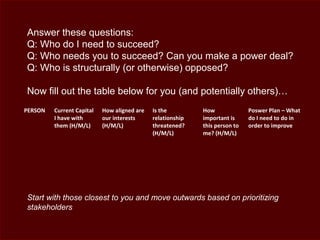
PERSON Current Capital
I have with
them (H/M/L)
How aligned are
our interests
(H/M/L)
Is the
relationship
threatened?
(H/M/L)
How
important is
this person to
me? (H/M/L)
Poswer Plan – What
do I need to do in
order to improve
Answer these questions:
Q: Who do I need to succeed?
Q: Who needs you to succeed? Can you make a power deal?
Q: Who is structurally (or otherwise) opposed?
Now fill out the table below for you (and potentially others)…
Start with those closest to you and move outwards based on prioritizing
stakeholders
power also comes from yourself
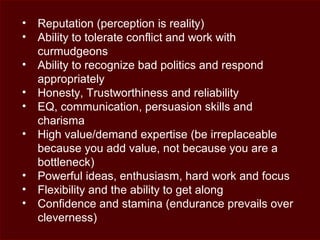
• Reputation (perception is reality)
• Ability to tolerate conflict and work with
curmudgeons
• Ability to recognize bad politics and respond
appropriately
• Honesty, Trustworthiness and reliability
• EQ, communication, persuasion skills and
charisma
• High value/demand expertise (be irreplaceable
because you add value, not because you are a
bottleneck)
• Powerful ideas, enthusiasm, hard work and focus
• Flexibility and the ability to get along
• Confidence and stamina (endurance prevails over
cleverness)
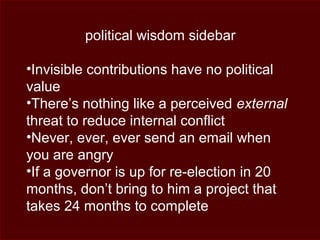
political wisdom sidebar
•Invisible contributions have no political
value
•There’s nothing like a perceived external
threat to reduce internal conflict
•Never, ever, ever send an email when
you are angry
•If a governor is up for re-election in 20
months, don’t bring to him a project that
takes 24 months to complete
SHARE THIS DECK
& FOLLOW ME(please-oh-please-oh-please-oh-please)
Selena Sol asks…..
http://www.slideshare.net/selenasol/presentations
stay up to date with my future
slideshare posts
selena@selenasol.com
http://www.linkedin.com/pub/eric-tachibana/0/33/b53
CLICK HERE FOR
MORE!!!!
CREATIVE COMMONS ATTRIBUTIONS
Title Slide: http://www.flickr.com/photos/dbuedo/
Please note that all content & opinions expressed in this deck are my own and don’t necessarily
represent the position of my current, or any previous, employers

Practical office politics

  • 1.
  • 2.
    where do youstand on the topic of office politics?
  • 3.
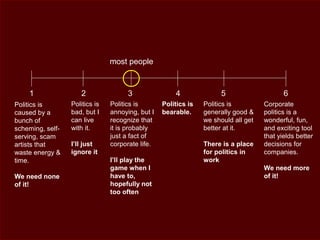
    1 2 34 5 6 Politics is caused by a bunch of scheming, self- serving, scam artists that waste energy & time. We need none of it! Corporate politics is a wonderful, fun, and exciting tool that yields better decisions for companies. We need more of it! Politics is annoying, but I recognize that it is probably just a fact of corporate life. I’ll play the game when I have to, hopefully not too often Politics is bearable. Politics is bad, but I can live with it. I’ll just ignore it Politics is generally good & we should all get better at it. There is a place for politics in work most people
  • 4.
    1 2 34 5 6 Politics is caused by a bunch of scheming, self- serving, scam artists that waste energy & time. We need none of it! Corporate politics is a wonderful, fun, and exciting tool that yields better decisions for companies. We need more of it! Politics is annoying, but I recognize that it is probably just a fact of corporate life. I’ll play the game when I have to, hopefully not too often Politics is bearable. Politics is bad, but I can live with it. I’ll just ignore it Politics is generally good & we should all get better at it. There is a place for politics in work how I want you to answer after this deck
  • 5.
    i’ve got 3questions i’d like you to consider
  • 6.
    Q1: What badexperiences have you had with office politics that create your assumptions? Q2: Is an office without politics preferable? Q3: Is an office without politics possible?
  • 7.
    now I’ve got1 perspective I’d like you to consider
  • 8.
    politics is natural& unavoidable because people will always have different and legitimate beliefs, issues, wants, needs, and sources of power
  • 9.
    those differences arecreated biologically, environmentally, & because of organizational structure
  • 10.
    so we’re allstuck with the differences however much we wish it were not so
  • 11.
    there must bea process to resolve conflicts that arise from these natural and unavoidable differences
  • 12.
    that is whatpolitics is
  • 13.
    politics is neithergood nor bad
  • 14.
    however, how peopleimplement politics can be good or bad
  • 15.
    and last butnot least, politics exist once there are two or more people
  • 16.
    so, don’t kidyourself, entrepreneurs
  • 17.
  • 18.
    so what dowe mean by bad politics?
  • 19.
    • Lying • Cheating •Stealing • Back Stabbing • Ego Tripping • Sucking Up • Manipulating • Self promotion • General Ignorance, which causes political pain to those around you
  • 20.
    and what dowe mean by good politics?
  • 21.
    • Fair distributionof resources • The ability to invest in future firm returns, with no immediate silo gains • Protection of minority interests • Ethical decision making • Strategic prioritization • Reduction of authoritarianism • Protection from “bad politics” • Engaging with bad politics rather than sticking our heads in the sand
  • 22.
    and what dowe get if we are good at good politics
  • 23.
    • Get yourprojects up the priority list • Get resources or funding for your project & team • Clear project barriers • Influence decision making • Compensation, acknowledgement and advancement • Get hard shit done • Help others succeed • Survive change and avoid trouble
  • 24.
    here are afew really useful thoughts on the subject
  • 25.
    “Politics has sucha bad name that many good people persuade themselves they want nothing to do with it. The ethical and spiritual apprehensions are understandable. But one cannot abjure politics.” – John Gardner
  • 26.
    “There is nodoubt power can be used for evil purposes. Of course most medicines can kill if taken wrongly, thousands die in automobile accidents each year, and nuclear power can provide energy or mass destruction. We do not abandon chemicals, cars or nuclear power. Instead we consider danger an incentive to get proper training.” – Jeffrey Pfeffer
  • 27.
    “Of course leadersare preoccupied with power! The significant questions are: What means do they use to gain it? How do they exercise it? And to what ends do they exercise it?” – John Gardner
  • 28.
    and one slightlyironic one
  • 29.
    “It is notenough for a leader to know the right thing. He must be able to do the right thing. Leaders without the judgment or perception to make the right decisions fail for lack of vision. Those who know the right thing, but cannot achieve it, fail because they are ineffectual.” - Richard Nixon
  • 30.
    so, how goodare you at getting shit done…
  • 31.
    1 2 34 5 6 I’m totally hopeless. Unless I have the authority to beat someone to death if they don’t comply, dependent resources simply do whatever they want I use Jedi mind powers on others – “these are not the droids that you are looking for” I sometimes get what I want done, so long as my interests are aligned with the interests of dependent parties I sometimes get what I want done, even if my interests are misaligned with the interests of dependent parties I find it very difficult to get what I want done outside the scope of my direct reports I often get what I want done, even if my interests are misaligned with the interests of dependent parties
  • 32.
    what tools arein your ‘getting shit done’ tool box?
  • 33.
    TOOL DESCRIPTION PROBLEMS AuthorityFormal power granted through organizational structure “Do it or you’re fired” • Badly out of fashion • We depend on too many outside our scope of authority • Too dependent on individuals who can wield power poorly Culture Shared vision, values and attitudes, behavioral norms, artifacts, & rituals. “Do it because it is the right thing to do” It is very difficult for managers to build, maintain, and control culture Politics Effective use of power through influence, persuasion, & negotiation “Do it because it is in your self interest to do it” Influence, persuasion and negotiation are hard work and organizationally time-consuming
  • 34.
    Authority (or else) Culture (it’sright!) Politics (It’s in our interests) Q: Are there dangers of using each axis too much or too little? What I need to use daily What I’m good at and like
  • 35.
    so with allthat said, it is time to propose the basic rule of ethical politics
  • 36.
  • 37.
    accept that youneed to be political to get shit done
  • 38.
    but, in theprocess, never advance your own interests by harming the business or by hurting other people
  • 39.
    focus on building,protecting, and using your power
  • 40.
    not on underminingthe power of others
  • 41.
    ok, so let’sassume that you agree with me that you should be better at politics
  • 42.
    in that case,the next step is to develop your Political Intelligence and a plan to build and use your power
  • 43.
    ASPECT QUESTIONS TOASK Where Where does power come from in my firm and how do I get it? Who Who has power & how do I expand my power through them? When If I have power, when do I use / expend it? How When I decide to use power, what is the most effective way to do so?
  • 44.
  • 45.
    • Title &“vestiges” of power (think corner office) • Authority to act within a specific scope • Control of the allocation, access to, and use of specific resources “that others need” • Objective-setting, appraisal & compensation approval • Access to Information • Location in the info/social web • Centrality – how often you proxy • Connectedness – how many nodes you touch • Closeness – How close are you to connected nodes • Complexity – The # of nodes unique to you
  • 46.
    political wisdom sidebar 1.Seasonedplayers know how to “create” resources to control! 2.Defend your positional power from encroachment by other managers – But no Evil Politics!
  • 47.
    take time toregularly update a positional power audit
  • 48.
    how strong isyour positional power?
  • 49.
    How strong am I? (H/M/L) Whyam I strong or weak? Power Plan (What can I do to improve?) Vestiges Formal authority Control over resources Location in the web
  • 50.
    extra credit who haspositional power around you? Why do they have it?
  • 51.
    power also comesfrom relationships
  • 52.
    Step 1: Identifycoalition partners & assess their relative power •Get out there and meet people •Ask people in the know •Look at unit’s representation in larger decision-making •Look at who has benefited from previous decisions
  • 53.
    Step 2: Createpolitical capital •Just do a really good job •Build reciprocity by being helpful & creating linkages. It’s never not in your Job Description •Help allies obtain greater power •Avoid ceding power to opposed alliances (but no Bad Politics, please) •Build alliances
  • 54.
    political wisdom sidebar •Interdependenceoften arises from resource scarcity •Opposition is not about disliking an “enemy”. It is about structural realities that drive differing, but legitimate, goals. The goals of Audit are structurally different from those of IT. It is not that they are a$$holes •Never force an ally (especially a superior) to expend their political power in your support •Use political capital before it depreciates. Reciprocity debt devalues quickly as people forget, or simply leave the firm. Political capital should not be hoarded. Capital Flow Velocity is more important
  • 55.
    take time toregularly update a relational power audit
  • 56.
    PERSON Current Capital Ihave with them (H/M/L) How aligned are our interests (H/M/L) Is the relationship threatened? (H/M/L) How important is this person to me? (H/M/L) Poswer Plan – What do I need to do in order to improve Answer these questions: Q: Who do I need to succeed? Q: Who needs you to succeed? Can you make a power deal? Q: Who is structurally (or otherwise) opposed? Now fill out the table below for you (and potentially others)… Start with those closest to you and move outwards based on prioritizing stakeholders
  • 57.
    power also comesfrom yourself
  • 58.
    • Reputation (perceptionis reality) • Ability to tolerate conflict and work with curmudgeons • Ability to recognize bad politics and respond appropriately • Honesty, Trustworthiness and reliability • EQ, communication, persuasion skills and charisma • High value/demand expertise (be irreplaceable because you add value, not because you are a bottleneck) • Powerful ideas, enthusiasm, hard work and focus • Flexibility and the ability to get along • Confidence and stamina (endurance prevails over cleverness)
  • 59.
    political wisdom sidebar •Invisiblecontributions have no political value •There’s nothing like a perceived external threat to reduce internal conflict •Never, ever, ever send an email when you are angry •If a governor is up for re-election in 20 months, don’t bring to him a project that takes 24 months to complete
  • 60.
    SHARE THIS DECK &FOLLOW ME(please-oh-please-oh-please-oh-please) Selena Sol asks….. http://www.slideshare.net/selenasol/presentations stay up to date with my future slideshare posts selena@selenasol.com http://www.linkedin.com/pub/eric-tachibana/0/33/b53
  • 61.
  • 62.
    CREATIVE COMMONS ATTRIBUTIONS TitleSlide: http://www.flickr.com/photos/dbuedo/ Please note that all content & opinions expressed in this deck are my own and don’t necessarily represent the position of my current, or any previous, employers

Editor's Notes

  • #3 On this slide, I typically read of the “bold” sentence for each of the numbers. Then, I write the numbers 1-6 on a whiteboard and go around the room very quickly polling each member of the class, and writing the results next to the numbers on the whiteboard. Generally, in sessions with middle managers, I find that you’ll see a distribution that is skewed left and fairly thin, centering around 2.5 or 3. There will be a few outliers around 5 so you’ll see a slight bump. I would not yet ask participants “why” they answered the way they did. This will come out on following slides. Audience may be interested to note that different industries seem to skew in different ways. If you do this for an investment bank crowd, for example, the distribution tends to move right and fatten, reflecting, perhaps, a greater amount of power and politics in the industry. That said, there seems to be politics everywhere from 3 man shops to 300,000 staff firms and across industries from IT to retail fashion. Whatever the case, it is important to appreciate diversity in opinion and to agree on slide one that we we recognize our personal assumptions that we bring to the table, but that we should keep an open mind for the rest of the session.
  • #4 On this slide, I typically read of the “bold” sentence for each of the numbers. Then, I write the numbers 1-6 on a whiteboard and go around the room very quickly polling each member of the class, and writing the results next to the numbers on the whiteboard. Generally, in sessions with middle managers, I find that you’ll see a distribution that is skewed left and fairly thin, centering around 2.5 or 3. There will be a few outliers around 5 so you’ll see a slight bump. I would not yet ask participants “why” they answered the way they did. This will come out on following slides. Audience may be interested to note that different industries seem to skew in different ways. If you do this for an investment bank crowd, for example, the distribution tends to move right and fatten, reflecting, perhaps, a greater amount of power and politics in the industry. That said, there seems to be politics everywhere from 3 man shops to 300,000 staff firms and across industries from IT to retail fashion. Whatever the case, it is important to appreciate diversity in opinion and to agree on slide one that we we recognize our personal assumptions that we bring to the table, but that we should keep an open mind for the rest of the session.
  • #5 On this slide, I typically read of the “bold” sentence for each of the numbers. Then, I write the numbers 1-6 on a whiteboard and go around the room very quickly polling each member of the class, and writing the results next to the numbers on the whiteboard. Generally, in sessions with middle managers, I find that you’ll see a distribution that is skewed left and fairly thin, centering around 2.5 or 3. There will be a few outliers around 5 so you’ll see a slight bump. I would not yet ask participants “why” they answered the way they did. This will come out on following slides. Audience may be interested to note that different industries seem to skew in different ways. If you do this for an investment bank crowd, for example, the distribution tends to move right and fatten, reflecting, perhaps, a greater amount of power and politics in the industry. That said, there seems to be politics everywhere from 3 man shops to 300,000 staff firms and across industries from IT to retail fashion. Whatever the case, it is important to appreciate diversity in opinion and to agree on slide one that we we recognize our personal assumptions that we bring to the table, but that we should keep an open mind for the rest of the session.
  • #6 On this slide, I typically read of the “bold” sentence for each of the numbers. Then, I write the numbers 1-6 on a whiteboard and go around the room very quickly polling each member of the class, and writing the results next to the numbers on the whiteboard. Generally, in sessions with middle managers, I find that you’ll see a distribution that is skewed left and fairly thin, centering around 2.5 or 3. There will be a few outliers around 5 so you’ll see a slight bump. I would not yet ask participants “why” they answered the way they did. This will come out on following slides. Audience may be interested to note that different industries seem to skew in different ways. If you do this for an investment bank crowd, for example, the distribution tends to move right and fatten, reflecting, perhaps, a greater amount of power and politics in the industry. That said, there seems to be politics everywhere from 3 man shops to 300,000 staff firms and across industries from IT to retail fashion. Whatever the case, it is important to appreciate diversity in opinion and to agree on slide one that we we recognize our personal assumptions that we bring to the table, but that we should keep an open mind for the rest of the session.
  • #7 On this slide, I typically read of the “bold” sentence for each of the numbers. Then, I write the numbers 1-6 on a whiteboard and go around the room very quickly polling each member of the class, and writing the results next to the numbers on the whiteboard. Generally, in sessions with middle managers, I find that you’ll see a distribution that is skewed left and fairly thin, centering around 2.5 or 3. There will be a few outliers around 5 so you’ll see a slight bump. I would not yet ask participants “why” they answered the way they did. This will come out on following slides. Audience may be interested to note that different industries seem to skew in different ways. If you do this for an investment bank crowd, for example, the distribution tends to move right and fatten, reflecting, perhaps, a greater amount of power and politics in the industry. That said, there seems to be politics everywhere from 3 man shops to 300,000 staff firms and across industries from IT to retail fashion. Whatever the case, it is important to appreciate diversity in opinion and to agree on slide one that we we recognize our personal assumptions that we bring to the table, but that we should keep an open mind for the rest of the session.
  • #8 On this slide, I typically read of the “bold” sentence for each of the numbers. Then, I write the numbers 1-6 on a whiteboard and go around the room very quickly polling each member of the class, and writing the results next to the numbers on the whiteboard. Generally, in sessions with middle managers, I find that you’ll see a distribution that is skewed left and fairly thin, centering around 2.5 or 3. There will be a few outliers around 5 so you’ll see a slight bump. I would not yet ask participants “why” they answered the way they did. This will come out on following slides. Audience may be interested to note that different industries seem to skew in different ways. If you do this for an investment bank crowd, for example, the distribution tends to move right and fatten, reflecting, perhaps, a greater amount of power and politics in the industry. That said, there seems to be politics everywhere from 3 man shops to 300,000 staff firms and across industries from IT to retail fashion. Whatever the case, it is important to appreciate diversity in opinion and to agree on slide one that we we recognize our personal assumptions that we bring to the table, but that we should keep an open mind for the rest of the session.
  • #9 On this slide, I typically read of the “bold” sentence for each of the numbers. Then, I write the numbers 1-6 on a whiteboard and go around the room very quickly polling each member of the class, and writing the results next to the numbers on the whiteboard. Generally, in sessions with middle managers, I find that you’ll see a distribution that is skewed left and fairly thin, centering around 2.5 or 3. There will be a few outliers around 5 so you’ll see a slight bump. I would not yet ask participants “why” they answered the way they did. This will come out on following slides. Audience may be interested to note that different industries seem to skew in different ways. If you do this for an investment bank crowd, for example, the distribution tends to move right and fatten, reflecting, perhaps, a greater amount of power and politics in the industry. That said, there seems to be politics everywhere from 3 man shops to 300,000 staff firms and across industries from IT to retail fashion. Whatever the case, it is important to appreciate diversity in opinion and to agree on slide one that we we recognize our personal assumptions that we bring to the table, but that we should keep an open mind for the rest of the session.
  • #10 On this slide, I typically read of the “bold” sentence for each of the numbers. Then, I write the numbers 1-6 on a whiteboard and go around the room very quickly polling each member of the class, and writing the results next to the numbers on the whiteboard. Generally, in sessions with middle managers, I find that you’ll see a distribution that is skewed left and fairly thin, centering around 2.5 or 3. There will be a few outliers around 5 so you’ll see a slight bump. I would not yet ask participants “why” they answered the way they did. This will come out on following slides. Audience may be interested to note that different industries seem to skew in different ways. If you do this for an investment bank crowd, for example, the distribution tends to move right and fatten, reflecting, perhaps, a greater amount of power and politics in the industry. That said, there seems to be politics everywhere from 3 man shops to 300,000 staff firms and across industries from IT to retail fashion. Whatever the case, it is important to appreciate diversity in opinion and to agree on slide one that we we recognize our personal assumptions that we bring to the table, but that we should keep an open mind for the rest of the session.
  • #11 On this slide, I typically read of the “bold” sentence for each of the numbers. Then, I write the numbers 1-6 on a whiteboard and go around the room very quickly polling each member of the class, and writing the results next to the numbers on the whiteboard. Generally, in sessions with middle managers, I find that you’ll see a distribution that is skewed left and fairly thin, centering around 2.5 or 3. There will be a few outliers around 5 so you’ll see a slight bump. I would not yet ask participants “why” they answered the way they did. This will come out on following slides. Audience may be interested to note that different industries seem to skew in different ways. If you do this for an investment bank crowd, for example, the distribution tends to move right and fatten, reflecting, perhaps, a greater amount of power and politics in the industry. That said, there seems to be politics everywhere from 3 man shops to 300,000 staff firms and across industries from IT to retail fashion. Whatever the case, it is important to appreciate diversity in opinion and to agree on slide one that we we recognize our personal assumptions that we bring to the table, but that we should keep an open mind for the rest of the session.
  • #12 On this slide, I typically read of the “bold” sentence for each of the numbers. Then, I write the numbers 1-6 on a whiteboard and go around the room very quickly polling each member of the class, and writing the results next to the numbers on the whiteboard. Generally, in sessions with middle managers, I find that you’ll see a distribution that is skewed left and fairly thin, centering around 2.5 or 3. There will be a few outliers around 5 so you’ll see a slight bump. I would not yet ask participants “why” they answered the way they did. This will come out on following slides. Audience may be interested to note that different industries seem to skew in different ways. If you do this for an investment bank crowd, for example, the distribution tends to move right and fatten, reflecting, perhaps, a greater amount of power and politics in the industry. That said, there seems to be politics everywhere from 3 man shops to 300,000 staff firms and across industries from IT to retail fashion. Whatever the case, it is important to appreciate diversity in opinion and to agree on slide one that we we recognize our personal assumptions that we bring to the table, but that we should keep an open mind for the rest of the session.
  • #13 On this slide, I typically read of the “bold” sentence for each of the numbers. Then, I write the numbers 1-6 on a whiteboard and go around the room very quickly polling each member of the class, and writing the results next to the numbers on the whiteboard. Generally, in sessions with middle managers, I find that you’ll see a distribution that is skewed left and fairly thin, centering around 2.5 or 3. There will be a few outliers around 5 so you’ll see a slight bump. I would not yet ask participants “why” they answered the way they did. This will come out on following slides. Audience may be interested to note that different industries seem to skew in different ways. If you do this for an investment bank crowd, for example, the distribution tends to move right and fatten, reflecting, perhaps, a greater amount of power and politics in the industry. That said, there seems to be politics everywhere from 3 man shops to 300,000 staff firms and across industries from IT to retail fashion. Whatever the case, it is important to appreciate diversity in opinion and to agree on slide one that we we recognize our personal assumptions that we bring to the table, but that we should keep an open mind for the rest of the session.
  • #14 On this slide, I typically read of the “bold” sentence for each of the numbers. Then, I write the numbers 1-6 on a whiteboard and go around the room very quickly polling each member of the class, and writing the results next to the numbers on the whiteboard. Generally, in sessions with middle managers, I find that you’ll see a distribution that is skewed left and fairly thin, centering around 2.5 or 3. There will be a few outliers around 5 so you’ll see a slight bump. I would not yet ask participants “why” they answered the way they did. This will come out on following slides. Audience may be interested to note that different industries seem to skew in different ways. If you do this for an investment bank crowd, for example, the distribution tends to move right and fatten, reflecting, perhaps, a greater amount of power and politics in the industry. That said, there seems to be politics everywhere from 3 man shops to 300,000 staff firms and across industries from IT to retail fashion. Whatever the case, it is important to appreciate diversity in opinion and to agree on slide one that we we recognize our personal assumptions that we bring to the table, but that we should keep an open mind for the rest of the session.
  • #15 On this slide, I typically read of the “bold” sentence for each of the numbers. Then, I write the numbers 1-6 on a whiteboard and go around the room very quickly polling each member of the class, and writing the results next to the numbers on the whiteboard. Generally, in sessions with middle managers, I find that you’ll see a distribution that is skewed left and fairly thin, centering around 2.5 or 3. There will be a few outliers around 5 so you’ll see a slight bump. I would not yet ask participants “why” they answered the way they did. This will come out on following slides. Audience may be interested to note that different industries seem to skew in different ways. If you do this for an investment bank crowd, for example, the distribution tends to move right and fatten, reflecting, perhaps, a greater amount of power and politics in the industry. That said, there seems to be politics everywhere from 3 man shops to 300,000 staff firms and across industries from IT to retail fashion. Whatever the case, it is important to appreciate diversity in opinion and to agree on slide one that we we recognize our personal assumptions that we bring to the table, but that we should keep an open mind for the rest of the session.
  • #16 On this slide, I typically read of the “bold” sentence for each of the numbers. Then, I write the numbers 1-6 on a whiteboard and go around the room very quickly polling each member of the class, and writing the results next to the numbers on the whiteboard. Generally, in sessions with middle managers, I find that you’ll see a distribution that is skewed left and fairly thin, centering around 2.5 or 3. There will be a few outliers around 5 so you’ll see a slight bump. I would not yet ask participants “why” they answered the way they did. This will come out on following slides. Audience may be interested to note that different industries seem to skew in different ways. If you do this for an investment bank crowd, for example, the distribution tends to move right and fatten, reflecting, perhaps, a greater amount of power and politics in the industry. That said, there seems to be politics everywhere from 3 man shops to 300,000 staff firms and across industries from IT to retail fashion. Whatever the case, it is important to appreciate diversity in opinion and to agree on slide one that we we recognize our personal assumptions that we bring to the table, but that we should keep an open mind for the rest of the session.
  • #17 On this slide, I typically read of the “bold” sentence for each of the numbers. Then, I write the numbers 1-6 on a whiteboard and go around the room very quickly polling each member of the class, and writing the results next to the numbers on the whiteboard. Generally, in sessions with middle managers, I find that you’ll see a distribution that is skewed left and fairly thin, centering around 2.5 or 3. There will be a few outliers around 5 so you’ll see a slight bump. I would not yet ask participants “why” they answered the way they did. This will come out on following slides. Audience may be interested to note that different industries seem to skew in different ways. If you do this for an investment bank crowd, for example, the distribution tends to move right and fatten, reflecting, perhaps, a greater amount of power and politics in the industry. That said, there seems to be politics everywhere from 3 man shops to 300,000 staff firms and across industries from IT to retail fashion. Whatever the case, it is important to appreciate diversity in opinion and to agree on slide one that we we recognize our personal assumptions that we bring to the table, but that we should keep an open mind for the rest of the session.
  • #18 On this slide, I typically read of the “bold” sentence for each of the numbers. Then, I write the numbers 1-6 on a whiteboard and go around the room very quickly polling each member of the class, and writing the results next to the numbers on the whiteboard. Generally, in sessions with middle managers, I find that you’ll see a distribution that is skewed left and fairly thin, centering around 2.5 or 3. There will be a few outliers around 5 so you’ll see a slight bump. I would not yet ask participants “why” they answered the way they did. This will come out on following slides. Audience may be interested to note that different industries seem to skew in different ways. If you do this for an investment bank crowd, for example, the distribution tends to move right and fatten, reflecting, perhaps, a greater amount of power and politics in the industry. That said, there seems to be politics everywhere from 3 man shops to 300,000 staff firms and across industries from IT to retail fashion. Whatever the case, it is important to appreciate diversity in opinion and to agree on slide one that we we recognize our personal assumptions that we bring to the table, but that we should keep an open mind for the rest of the session.
  • #19 On this slide, I typically read of the “bold” sentence for each of the numbers. Then, I write the numbers 1-6 on a whiteboard and go around the room very quickly polling each member of the class, and writing the results next to the numbers on the whiteboard. Generally, in sessions with middle managers, I find that you’ll see a distribution that is skewed left and fairly thin, centering around 2.5 or 3. There will be a few outliers around 5 so you’ll see a slight bump. I would not yet ask participants “why” they answered the way they did. This will come out on following slides. Audience may be interested to note that different industries seem to skew in different ways. If you do this for an investment bank crowd, for example, the distribution tends to move right and fatten, reflecting, perhaps, a greater amount of power and politics in the industry. That said, there seems to be politics everywhere from 3 man shops to 300,000 staff firms and across industries from IT to retail fashion. Whatever the case, it is important to appreciate diversity in opinion and to agree on slide one that we we recognize our personal assumptions that we bring to the table, but that we should keep an open mind for the rest of the session.
  • #20 On this slide, I typically read of the “bold” sentence for each of the numbers. Then, I write the numbers 1-6 on a whiteboard and go around the room very quickly polling each member of the class, and writing the results next to the numbers on the whiteboard. Generally, in sessions with middle managers, I find that you’ll see a distribution that is skewed left and fairly thin, centering around 2.5 or 3. There will be a few outliers around 5 so you’ll see a slight bump. I would not yet ask participants “why” they answered the way they did. This will come out on following slides. Audience may be interested to note that different industries seem to skew in different ways. If you do this for an investment bank crowd, for example, the distribution tends to move right and fatten, reflecting, perhaps, a greater amount of power and politics in the industry. That said, there seems to be politics everywhere from 3 man shops to 300,000 staff firms and across industries from IT to retail fashion. Whatever the case, it is important to appreciate diversity in opinion and to agree on slide one that we we recognize our personal assumptions that we bring to the table, but that we should keep an open mind for the rest of the session.
  • #21 On this slide, I typically read of the “bold” sentence for each of the numbers. Then, I write the numbers 1-6 on a whiteboard and go around the room very quickly polling each member of the class, and writing the results next to the numbers on the whiteboard. Generally, in sessions with middle managers, I find that you’ll see a distribution that is skewed left and fairly thin, centering around 2.5 or 3. There will be a few outliers around 5 so you’ll see a slight bump. I would not yet ask participants “why” they answered the way they did. This will come out on following slides. Audience may be interested to note that different industries seem to skew in different ways. If you do this for an investment bank crowd, for example, the distribution tends to move right and fatten, reflecting, perhaps, a greater amount of power and politics in the industry. That said, there seems to be politics everywhere from 3 man shops to 300,000 staff firms and across industries from IT to retail fashion. Whatever the case, it is important to appreciate diversity in opinion and to agree on slide one that we we recognize our personal assumptions that we bring to the table, but that we should keep an open mind for the rest of the session.
  • #22 On this slide, I typically read of the “bold” sentence for each of the numbers. Then, I write the numbers 1-6 on a whiteboard and go around the room very quickly polling each member of the class, and writing the results next to the numbers on the whiteboard. Generally, in sessions with middle managers, I find that you’ll see a distribution that is skewed left and fairly thin, centering around 2.5 or 3. There will be a few outliers around 5 so you’ll see a slight bump. I would not yet ask participants “why” they answered the way they did. This will come out on following slides. Audience may be interested to note that different industries seem to skew in different ways. If you do this for an investment bank crowd, for example, the distribution tends to move right and fatten, reflecting, perhaps, a greater amount of power and politics in the industry. That said, there seems to be politics everywhere from 3 man shops to 300,000 staff firms and across industries from IT to retail fashion. Whatever the case, it is important to appreciate diversity in opinion and to agree on slide one that we we recognize our personal assumptions that we bring to the table, but that we should keep an open mind for the rest of the session.
  • #23 On this slide, I typically read of the “bold” sentence for each of the numbers. Then, I write the numbers 1-6 on a whiteboard and go around the room very quickly polling each member of the class, and writing the results next to the numbers on the whiteboard. Generally, in sessions with middle managers, I find that you’ll see a distribution that is skewed left and fairly thin, centering around 2.5 or 3. There will be a few outliers around 5 so you’ll see a slight bump. I would not yet ask participants “why” they answered the way they did. This will come out on following slides. Audience may be interested to note that different industries seem to skew in different ways. If you do this for an investment bank crowd, for example, the distribution tends to move right and fatten, reflecting, perhaps, a greater amount of power and politics in the industry. That said, there seems to be politics everywhere from 3 man shops to 300,000 staff firms and across industries from IT to retail fashion. Whatever the case, it is important to appreciate diversity in opinion and to agree on slide one that we we recognize our personal assumptions that we bring to the table, but that we should keep an open mind for the rest of the session.
  • #24 On this slide, I typically read of the “bold” sentence for each of the numbers. Then, I write the numbers 1-6 on a whiteboard and go around the room very quickly polling each member of the class, and writing the results next to the numbers on the whiteboard. Generally, in sessions with middle managers, I find that you’ll see a distribution that is skewed left and fairly thin, centering around 2.5 or 3. There will be a few outliers around 5 so you’ll see a slight bump. I would not yet ask participants “why” they answered the way they did. This will come out on following slides. Audience may be interested to note that different industries seem to skew in different ways. If you do this for an investment bank crowd, for example, the distribution tends to move right and fatten, reflecting, perhaps, a greater amount of power and politics in the industry. That said, there seems to be politics everywhere from 3 man shops to 300,000 staff firms and across industries from IT to retail fashion. Whatever the case, it is important to appreciate diversity in opinion and to agree on slide one that we we recognize our personal assumptions that we bring to the table, but that we should keep an open mind for the rest of the session.
  • #25 On this slide, I typically read of the “bold” sentence for each of the numbers. Then, I write the numbers 1-6 on a whiteboard and go around the room very quickly polling each member of the class, and writing the results next to the numbers on the whiteboard. Generally, in sessions with middle managers, I find that you’ll see a distribution that is skewed left and fairly thin, centering around 2.5 or 3. There will be a few outliers around 5 so you’ll see a slight bump. I would not yet ask participants “why” they answered the way they did. This will come out on following slides. Audience may be interested to note that different industries seem to skew in different ways. If you do this for an investment bank crowd, for example, the distribution tends to move right and fatten, reflecting, perhaps, a greater amount of power and politics in the industry. That said, there seems to be politics everywhere from 3 man shops to 300,000 staff firms and across industries from IT to retail fashion. Whatever the case, it is important to appreciate diversity in opinion and to agree on slide one that we we recognize our personal assumptions that we bring to the table, but that we should keep an open mind for the rest of the session.
  • #26 On this slide, I typically read of the “bold” sentence for each of the numbers. Then, I write the numbers 1-6 on a whiteboard and go around the room very quickly polling each member of the class, and writing the results next to the numbers on the whiteboard. Generally, in sessions with middle managers, I find that you’ll see a distribution that is skewed left and fairly thin, centering around 2.5 or 3. There will be a few outliers around 5 so you’ll see a slight bump. I would not yet ask participants “why” they answered the way they did. This will come out on following slides. Audience may be interested to note that different industries seem to skew in different ways. If you do this for an investment bank crowd, for example, the distribution tends to move right and fatten, reflecting, perhaps, a greater amount of power and politics in the industry. That said, there seems to be politics everywhere from 3 man shops to 300,000 staff firms and across industries from IT to retail fashion. Whatever the case, it is important to appreciate diversity in opinion and to agree on slide one that we we recognize our personal assumptions that we bring to the table, but that we should keep an open mind for the rest of the session.
  • #27 On this slide, I typically read of the “bold” sentence for each of the numbers. Then, I write the numbers 1-6 on a whiteboard and go around the room very quickly polling each member of the class, and writing the results next to the numbers on the whiteboard. Generally, in sessions with middle managers, I find that you’ll see a distribution that is skewed left and fairly thin, centering around 2.5 or 3. There will be a few outliers around 5 so you’ll see a slight bump. I would not yet ask participants “why” they answered the way they did. This will come out on following slides. Audience may be interested to note that different industries seem to skew in different ways. If you do this for an investment bank crowd, for example, the distribution tends to move right and fatten, reflecting, perhaps, a greater amount of power and politics in the industry. That said, there seems to be politics everywhere from 3 man shops to 300,000 staff firms and across industries from IT to retail fashion. Whatever the case, it is important to appreciate diversity in opinion and to agree on slide one that we we recognize our personal assumptions that we bring to the table, but that we should keep an open mind for the rest of the session.
  • #28 On this slide, I typically read of the “bold” sentence for each of the numbers. Then, I write the numbers 1-6 on a whiteboard and go around the room very quickly polling each member of the class, and writing the results next to the numbers on the whiteboard. Generally, in sessions with middle managers, I find that you’ll see a distribution that is skewed left and fairly thin, centering around 2.5 or 3. There will be a few outliers around 5 so you’ll see a slight bump. I would not yet ask participants “why” they answered the way they did. This will come out on following slides. Audience may be interested to note that different industries seem to skew in different ways. If you do this for an investment bank crowd, for example, the distribution tends to move right and fatten, reflecting, perhaps, a greater amount of power and politics in the industry. That said, there seems to be politics everywhere from 3 man shops to 300,000 staff firms and across industries from IT to retail fashion. Whatever the case, it is important to appreciate diversity in opinion and to agree on slide one that we we recognize our personal assumptions that we bring to the table, but that we should keep an open mind for the rest of the session.
  • #29 On this slide, I typically read of the “bold” sentence for each of the numbers. Then, I write the numbers 1-6 on a whiteboard and go around the room very quickly polling each member of the class, and writing the results next to the numbers on the whiteboard. Generally, in sessions with middle managers, I find that you’ll see a distribution that is skewed left and fairly thin, centering around 2.5 or 3. There will be a few outliers around 5 so you’ll see a slight bump. I would not yet ask participants “why” they answered the way they did. This will come out on following slides. Audience may be interested to note that different industries seem to skew in different ways. If you do this for an investment bank crowd, for example, the distribution tends to move right and fatten, reflecting, perhaps, a greater amount of power and politics in the industry. That said, there seems to be politics everywhere from 3 man shops to 300,000 staff firms and across industries from IT to retail fashion. Whatever the case, it is important to appreciate diversity in opinion and to agree on slide one that we we recognize our personal assumptions that we bring to the table, but that we should keep an open mind for the rest of the session.
  • #30 On this slide, I typically read of the “bold” sentence for each of the numbers. Then, I write the numbers 1-6 on a whiteboard and go around the room very quickly polling each member of the class, and writing the results next to the numbers on the whiteboard. Generally, in sessions with middle managers, I find that you’ll see a distribution that is skewed left and fairly thin, centering around 2.5 or 3. There will be a few outliers around 5 so you’ll see a slight bump. I would not yet ask participants “why” they answered the way they did. This will come out on following slides. Audience may be interested to note that different industries seem to skew in different ways. If you do this for an investment bank crowd, for example, the distribution tends to move right and fatten, reflecting, perhaps, a greater amount of power and politics in the industry. That said, there seems to be politics everywhere from 3 man shops to 300,000 staff firms and across industries from IT to retail fashion. Whatever the case, it is important to appreciate diversity in opinion and to agree on slide one that we we recognize our personal assumptions that we bring to the table, but that we should keep an open mind for the rest of the session.
  • #31 On this slide, I typically read of the “bold” sentence for each of the numbers. Then, I write the numbers 1-6 on a whiteboard and go around the room very quickly polling each member of the class, and writing the results next to the numbers on the whiteboard. Generally, in sessions with middle managers, I find that you’ll see a distribution that is skewed left and fairly thin, centering around 2.5 or 3. There will be a few outliers around 5 so you’ll see a slight bump. I would not yet ask participants “why” they answered the way they did. This will come out on following slides. Audience may be interested to note that different industries seem to skew in different ways. If you do this for an investment bank crowd, for example, the distribution tends to move right and fatten, reflecting, perhaps, a greater amount of power and politics in the industry. That said, there seems to be politics everywhere from 3 man shops to 300,000 staff firms and across industries from IT to retail fashion. Whatever the case, it is important to appreciate diversity in opinion and to agree on slide one that we we recognize our personal assumptions that we bring to the table, but that we should keep an open mind for the rest of the session.
  • #32 On this slide, I typically read of the “bold” sentence for each of the numbers. Then, I write the numbers 1-6 on a whiteboard and go around the room very quickly polling each member of the class, and writing the results next to the numbers on the whiteboard. Generally, in sessions with middle managers, I find that you’ll see a distribution that is skewed left and fairly thin, centering around 2.5 or 3. There will be a few outliers around 5 so you’ll see a slight bump. I would not yet ask participants “why” they answered the way they did. This will come out on following slides. Audience may be interested to note that different industries seem to skew in different ways. If you do this for an investment bank crowd, for example, the distribution tends to move right and fatten, reflecting, perhaps, a greater amount of power and politics in the industry. That said, there seems to be politics everywhere from 3 man shops to 300,000 staff firms and across industries from IT to retail fashion. Whatever the case, it is important to appreciate diversity in opinion and to agree on slide one that we we recognize our personal assumptions that we bring to the table, but that we should keep an open mind for the rest of the session.
  • #33 On this slide, I typically read of the “bold” sentence for each of the numbers. Then, I write the numbers 1-6 on a whiteboard and go around the room very quickly polling each member of the class, and writing the results next to the numbers on the whiteboard. Generally, in sessions with middle managers, I find that you’ll see a distribution that is skewed left and fairly thin, centering around 2.5 or 3. There will be a few outliers around 5 so you’ll see a slight bump. I would not yet ask participants “why” they answered the way they did. This will come out on following slides. Audience may be interested to note that different industries seem to skew in different ways. If you do this for an investment bank crowd, for example, the distribution tends to move right and fatten, reflecting, perhaps, a greater amount of power and politics in the industry. That said, there seems to be politics everywhere from 3 man shops to 300,000 staff firms and across industries from IT to retail fashion. Whatever the case, it is important to appreciate diversity in opinion and to agree on slide one that we we recognize our personal assumptions that we bring to the table, but that we should keep an open mind for the rest of the session.
  • #34 On this slide, I typically read of the “bold” sentence for each of the numbers. Then, I write the numbers 1-6 on a whiteboard and go around the room very quickly polling each member of the class, and writing the results next to the numbers on the whiteboard. Generally, in sessions with middle managers, I find that you’ll see a distribution that is skewed left and fairly thin, centering around 2.5 or 3. There will be a few outliers around 5 so you’ll see a slight bump. I would not yet ask participants “why” they answered the way they did. This will come out on following slides. Audience may be interested to note that different industries seem to skew in different ways. If you do this for an investment bank crowd, for example, the distribution tends to move right and fatten, reflecting, perhaps, a greater amount of power and politics in the industry. That said, there seems to be politics everywhere from 3 man shops to 300,000 staff firms and across industries from IT to retail fashion. Whatever the case, it is important to appreciate diversity in opinion and to agree on slide one that we we recognize our personal assumptions that we bring to the table, but that we should keep an open mind for the rest of the session.
  • #35 On this slide, I typically read of the “bold” sentence for each of the numbers. Then, I write the numbers 1-6 on a whiteboard and go around the room very quickly polling each member of the class, and writing the results next to the numbers on the whiteboard. Generally, in sessions with middle managers, I find that you’ll see a distribution that is skewed left and fairly thin, centering around 2.5 or 3. There will be a few outliers around 5 so you’ll see a slight bump. I would not yet ask participants “why” they answered the way they did. This will come out on following slides. Audience may be interested to note that different industries seem to skew in different ways. If you do this for an investment bank crowd, for example, the distribution tends to move right and fatten, reflecting, perhaps, a greater amount of power and politics in the industry. That said, there seems to be politics everywhere from 3 man shops to 300,000 staff firms and across industries from IT to retail fashion. Whatever the case, it is important to appreciate diversity in opinion and to agree on slide one that we we recognize our personal assumptions that we bring to the table, but that we should keep an open mind for the rest of the session.
  • #36 On this slide, I typically read of the “bold” sentence for each of the numbers. Then, I write the numbers 1-6 on a whiteboard and go around the room very quickly polling each member of the class, and writing the results next to the numbers on the whiteboard. Generally, in sessions with middle managers, I find that you’ll see a distribution that is skewed left and fairly thin, centering around 2.5 or 3. There will be a few outliers around 5 so you’ll see a slight bump. I would not yet ask participants “why” they answered the way they did. This will come out on following slides. Audience may be interested to note that different industries seem to skew in different ways. If you do this for an investment bank crowd, for example, the distribution tends to move right and fatten, reflecting, perhaps, a greater amount of power and politics in the industry. That said, there seems to be politics everywhere from 3 man shops to 300,000 staff firms and across industries from IT to retail fashion. Whatever the case, it is important to appreciate diversity in opinion and to agree on slide one that we we recognize our personal assumptions that we bring to the table, but that we should keep an open mind for the rest of the session.
  • #37 On this slide, I typically read of the “bold” sentence for each of the numbers. Then, I write the numbers 1-6 on a whiteboard and go around the room very quickly polling each member of the class, and writing the results next to the numbers on the whiteboard. Generally, in sessions with middle managers, I find that you’ll see a distribution that is skewed left and fairly thin, centering around 2.5 or 3. There will be a few outliers around 5 so you’ll see a slight bump. I would not yet ask participants “why” they answered the way they did. This will come out on following slides. Audience may be interested to note that different industries seem to skew in different ways. If you do this for an investment bank crowd, for example, the distribution tends to move right and fatten, reflecting, perhaps, a greater amount of power and politics in the industry. That said, there seems to be politics everywhere from 3 man shops to 300,000 staff firms and across industries from IT to retail fashion. Whatever the case, it is important to appreciate diversity in opinion and to agree on slide one that we we recognize our personal assumptions that we bring to the table, but that we should keep an open mind for the rest of the session.
  • #38 On this slide, I typically read of the “bold” sentence for each of the numbers. Then, I write the numbers 1-6 on a whiteboard and go around the room very quickly polling each member of the class, and writing the results next to the numbers on the whiteboard. Generally, in sessions with middle managers, I find that you’ll see a distribution that is skewed left and fairly thin, centering around 2.5 or 3. There will be a few outliers around 5 so you’ll see a slight bump. I would not yet ask participants “why” they answered the way they did. This will come out on following slides. Audience may be interested to note that different industries seem to skew in different ways. If you do this for an investment bank crowd, for example, the distribution tends to move right and fatten, reflecting, perhaps, a greater amount of power and politics in the industry. That said, there seems to be politics everywhere from 3 man shops to 300,000 staff firms and across industries from IT to retail fashion. Whatever the case, it is important to appreciate diversity in opinion and to agree on slide one that we we recognize our personal assumptions that we bring to the table, but that we should keep an open mind for the rest of the session.
  • #39 On this slide, I typically read of the “bold” sentence for each of the numbers. Then, I write the numbers 1-6 on a whiteboard and go around the room very quickly polling each member of the class, and writing the results next to the numbers on the whiteboard. Generally, in sessions with middle managers, I find that you’ll see a distribution that is skewed left and fairly thin, centering around 2.5 or 3. There will be a few outliers around 5 so you’ll see a slight bump. I would not yet ask participants “why” they answered the way they did. This will come out on following slides. Audience may be interested to note that different industries seem to skew in different ways. If you do this for an investment bank crowd, for example, the distribution tends to move right and fatten, reflecting, perhaps, a greater amount of power and politics in the industry. That said, there seems to be politics everywhere from 3 man shops to 300,000 staff firms and across industries from IT to retail fashion. Whatever the case, it is important to appreciate diversity in opinion and to agree on slide one that we we recognize our personal assumptions that we bring to the table, but that we should keep an open mind for the rest of the session.
  • #40 On this slide, I typically read of the “bold” sentence for each of the numbers. Then, I write the numbers 1-6 on a whiteboard and go around the room very quickly polling each member of the class, and writing the results next to the numbers on the whiteboard. Generally, in sessions with middle managers, I find that you’ll see a distribution that is skewed left and fairly thin, centering around 2.5 or 3. There will be a few outliers around 5 so you’ll see a slight bump. I would not yet ask participants “why” they answered the way they did. This will come out on following slides. Audience may be interested to note that different industries seem to skew in different ways. If you do this for an investment bank crowd, for example, the distribution tends to move right and fatten, reflecting, perhaps, a greater amount of power and politics in the industry. That said, there seems to be politics everywhere from 3 man shops to 300,000 staff firms and across industries from IT to retail fashion. Whatever the case, it is important to appreciate diversity in opinion and to agree on slide one that we we recognize our personal assumptions that we bring to the table, but that we should keep an open mind for the rest of the session.
  • #41 On this slide, I typically read of the “bold” sentence for each of the numbers. Then, I write the numbers 1-6 on a whiteboard and go around the room very quickly polling each member of the class, and writing the results next to the numbers on the whiteboard. Generally, in sessions with middle managers, I find that you’ll see a distribution that is skewed left and fairly thin, centering around 2.5 or 3. There will be a few outliers around 5 so you’ll see a slight bump. I would not yet ask participants “why” they answered the way they did. This will come out on following slides. Audience may be interested to note that different industries seem to skew in different ways. If you do this for an investment bank crowd, for example, the distribution tends to move right and fatten, reflecting, perhaps, a greater amount of power and politics in the industry. That said, there seems to be politics everywhere from 3 man shops to 300,000 staff firms and across industries from IT to retail fashion. Whatever the case, it is important to appreciate diversity in opinion and to agree on slide one that we we recognize our personal assumptions that we bring to the table, but that we should keep an open mind for the rest of the session.
  • #42 On this slide, I typically read of the “bold” sentence for each of the numbers. Then, I write the numbers 1-6 on a whiteboard and go around the room very quickly polling each member of the class, and writing the results next to the numbers on the whiteboard. Generally, in sessions with middle managers, I find that you’ll see a distribution that is skewed left and fairly thin, centering around 2.5 or 3. There will be a few outliers around 5 so you’ll see a slight bump. I would not yet ask participants “why” they answered the way they did. This will come out on following slides. Audience may be interested to note that different industries seem to skew in different ways. If you do this for an investment bank crowd, for example, the distribution tends to move right and fatten, reflecting, perhaps, a greater amount of power and politics in the industry. That said, there seems to be politics everywhere from 3 man shops to 300,000 staff firms and across industries from IT to retail fashion. Whatever the case, it is important to appreciate diversity in opinion and to agree on slide one that we we recognize our personal assumptions that we bring to the table, but that we should keep an open mind for the rest of the session.
  • #43 On this slide, I typically read of the “bold” sentence for each of the numbers. Then, I write the numbers 1-6 on a whiteboard and go around the room very quickly polling each member of the class, and writing the results next to the numbers on the whiteboard. Generally, in sessions with middle managers, I find that you’ll see a distribution that is skewed left and fairly thin, centering around 2.5 or 3. There will be a few outliers around 5 so you’ll see a slight bump. I would not yet ask participants “why” they answered the way they did. This will come out on following slides. Audience may be interested to note that different industries seem to skew in different ways. If you do this for an investment bank crowd, for example, the distribution tends to move right and fatten, reflecting, perhaps, a greater amount of power and politics in the industry. That said, there seems to be politics everywhere from 3 man shops to 300,000 staff firms and across industries from IT to retail fashion. Whatever the case, it is important to appreciate diversity in opinion and to agree on slide one that we we recognize our personal assumptions that we bring to the table, but that we should keep an open mind for the rest of the session.
  • #44 On this slide, I typically read of the “bold” sentence for each of the numbers. Then, I write the numbers 1-6 on a whiteboard and go around the room very quickly polling each member of the class, and writing the results next to the numbers on the whiteboard. Generally, in sessions with middle managers, I find that you’ll see a distribution that is skewed left and fairly thin, centering around 2.5 or 3. There will be a few outliers around 5 so you’ll see a slight bump. I would not yet ask participants “why” they answered the way they did. This will come out on following slides. Audience may be interested to note that different industries seem to skew in different ways. If you do this for an investment bank crowd, for example, the distribution tends to move right and fatten, reflecting, perhaps, a greater amount of power and politics in the industry. That said, there seems to be politics everywhere from 3 man shops to 300,000 staff firms and across industries from IT to retail fashion. Whatever the case, it is important to appreciate diversity in opinion and to agree on slide one that we we recognize our personal assumptions that we bring to the table, but that we should keep an open mind for the rest of the session.
  • #45 On this slide, I typically read of the “bold” sentence for each of the numbers. Then, I write the numbers 1-6 on a whiteboard and go around the room very quickly polling each member of the class, and writing the results next to the numbers on the whiteboard. Generally, in sessions with middle managers, I find that you’ll see a distribution that is skewed left and fairly thin, centering around 2.5 or 3. There will be a few outliers around 5 so you’ll see a slight bump. I would not yet ask participants “why” they answered the way they did. This will come out on following slides. Audience may be interested to note that different industries seem to skew in different ways. If you do this for an investment bank crowd, for example, the distribution tends to move right and fatten, reflecting, perhaps, a greater amount of power and politics in the industry. That said, there seems to be politics everywhere from 3 man shops to 300,000 staff firms and across industries from IT to retail fashion. Whatever the case, it is important to appreciate diversity in opinion and to agree on slide one that we we recognize our personal assumptions that we bring to the table, but that we should keep an open mind for the rest of the session.
  • #46 On this slide, I typically read of the “bold” sentence for each of the numbers. Then, I write the numbers 1-6 on a whiteboard and go around the room very quickly polling each member of the class, and writing the results next to the numbers on the whiteboard. Generally, in sessions with middle managers, I find that you’ll see a distribution that is skewed left and fairly thin, centering around 2.5 or 3. There will be a few outliers around 5 so you’ll see a slight bump. I would not yet ask participants “why” they answered the way they did. This will come out on following slides. Audience may be interested to note that different industries seem to skew in different ways. If you do this for an investment bank crowd, for example, the distribution tends to move right and fatten, reflecting, perhaps, a greater amount of power and politics in the industry. That said, there seems to be politics everywhere from 3 man shops to 300,000 staff firms and across industries from IT to retail fashion. Whatever the case, it is important to appreciate diversity in opinion and to agree on slide one that we we recognize our personal assumptions that we bring to the table, but that we should keep an open mind for the rest of the session.
  • #47 On this slide, I typically read of the “bold” sentence for each of the numbers. Then, I write the numbers 1-6 on a whiteboard and go around the room very quickly polling each member of the class, and writing the results next to the numbers on the whiteboard. Generally, in sessions with middle managers, I find that you’ll see a distribution that is skewed left and fairly thin, centering around 2.5 or 3. There will be a few outliers around 5 so you’ll see a slight bump. I would not yet ask participants “why” they answered the way they did. This will come out on following slides. Audience may be interested to note that different industries seem to skew in different ways. If you do this for an investment bank crowd, for example, the distribution tends to move right and fatten, reflecting, perhaps, a greater amount of power and politics in the industry. That said, there seems to be politics everywhere from 3 man shops to 300,000 staff firms and across industries from IT to retail fashion. Whatever the case, it is important to appreciate diversity in opinion and to agree on slide one that we we recognize our personal assumptions that we bring to the table, but that we should keep an open mind for the rest of the session.
  • #48 On this slide, I typically read of the “bold” sentence for each of the numbers. Then, I write the numbers 1-6 on a whiteboard and go around the room very quickly polling each member of the class, and writing the results next to the numbers on the whiteboard. Generally, in sessions with middle managers, I find that you’ll see a distribution that is skewed left and fairly thin, centering around 2.5 or 3. There will be a few outliers around 5 so you’ll see a slight bump. I would not yet ask participants “why” they answered the way they did. This will come out on following slides. Audience may be interested to note that different industries seem to skew in different ways. If you do this for an investment bank crowd, for example, the distribution tends to move right and fatten, reflecting, perhaps, a greater amount of power and politics in the industry. That said, there seems to be politics everywhere from 3 man shops to 300,000 staff firms and across industries from IT to retail fashion. Whatever the case, it is important to appreciate diversity in opinion and to agree on slide one that we we recognize our personal assumptions that we bring to the table, but that we should keep an open mind for the rest of the session.
  • #49 On this slide, I typically read of the “bold” sentence for each of the numbers. Then, I write the numbers 1-6 on a whiteboard and go around the room very quickly polling each member of the class, and writing the results next to the numbers on the whiteboard. Generally, in sessions with middle managers, I find that you’ll see a distribution that is skewed left and fairly thin, centering around 2.5 or 3. There will be a few outliers around 5 so you’ll see a slight bump. I would not yet ask participants “why” they answered the way they did. This will come out on following slides. Audience may be interested to note that different industries seem to skew in different ways. If you do this for an investment bank crowd, for example, the distribution tends to move right and fatten, reflecting, perhaps, a greater amount of power and politics in the industry. That said, there seems to be politics everywhere from 3 man shops to 300,000 staff firms and across industries from IT to retail fashion. Whatever the case, it is important to appreciate diversity in opinion and to agree on slide one that we we recognize our personal assumptions that we bring to the table, but that we should keep an open mind for the rest of the session.
  • #50 On this slide, I typically read of the “bold” sentence for each of the numbers. Then, I write the numbers 1-6 on a whiteboard and go around the room very quickly polling each member of the class, and writing the results next to the numbers on the whiteboard. Generally, in sessions with middle managers, I find that you’ll see a distribution that is skewed left and fairly thin, centering around 2.5 or 3. There will be a few outliers around 5 so you’ll see a slight bump. I would not yet ask participants “why” they answered the way they did. This will come out on following slides. Audience may be interested to note that different industries seem to skew in different ways. If you do this for an investment bank crowd, for example, the distribution tends to move right and fatten, reflecting, perhaps, a greater amount of power and politics in the industry. That said, there seems to be politics everywhere from 3 man shops to 300,000 staff firms and across industries from IT to retail fashion. Whatever the case, it is important to appreciate diversity in opinion and to agree on slide one that we we recognize our personal assumptions that we bring to the table, but that we should keep an open mind for the rest of the session.
  • #51 On this slide, I typically read of the “bold” sentence for each of the numbers. Then, I write the numbers 1-6 on a whiteboard and go around the room very quickly polling each member of the class, and writing the results next to the numbers on the whiteboard. Generally, in sessions with middle managers, I find that you’ll see a distribution that is skewed left and fairly thin, centering around 2.5 or 3. There will be a few outliers around 5 so you’ll see a slight bump. I would not yet ask participants “why” they answered the way they did. This will come out on following slides. Audience may be interested to note that different industries seem to skew in different ways. If you do this for an investment bank crowd, for example, the distribution tends to move right and fatten, reflecting, perhaps, a greater amount of power and politics in the industry. That said, there seems to be politics everywhere from 3 man shops to 300,000 staff firms and across industries from IT to retail fashion. Whatever the case, it is important to appreciate diversity in opinion and to agree on slide one that we we recognize our personal assumptions that we bring to the table, but that we should keep an open mind for the rest of the session.
  • #52 On this slide, I typically read of the “bold” sentence for each of the numbers. Then, I write the numbers 1-6 on a whiteboard and go around the room very quickly polling each member of the class, and writing the results next to the numbers on the whiteboard. Generally, in sessions with middle managers, I find that you’ll see a distribution that is skewed left and fairly thin, centering around 2.5 or 3. There will be a few outliers around 5 so you’ll see a slight bump. I would not yet ask participants “why” they answered the way they did. This will come out on following slides. Audience may be interested to note that different industries seem to skew in different ways. If you do this for an investment bank crowd, for example, the distribution tends to move right and fatten, reflecting, perhaps, a greater amount of power and politics in the industry. That said, there seems to be politics everywhere from 3 man shops to 300,000 staff firms and across industries from IT to retail fashion. Whatever the case, it is important to appreciate diversity in opinion and to agree on slide one that we we recognize our personal assumptions that we bring to the table, but that we should keep an open mind for the rest of the session.
  • #53 On this slide, I typically read of the “bold” sentence for each of the numbers. Then, I write the numbers 1-6 on a whiteboard and go around the room very quickly polling each member of the class, and writing the results next to the numbers on the whiteboard. Generally, in sessions with middle managers, I find that you’ll see a distribution that is skewed left and fairly thin, centering around 2.5 or 3. There will be a few outliers around 5 so you’ll see a slight bump. I would not yet ask participants “why” they answered the way they did. This will come out on following slides. Audience may be interested to note that different industries seem to skew in different ways. If you do this for an investment bank crowd, for example, the distribution tends to move right and fatten, reflecting, perhaps, a greater amount of power and politics in the industry. That said, there seems to be politics everywhere from 3 man shops to 300,000 staff firms and across industries from IT to retail fashion. Whatever the case, it is important to appreciate diversity in opinion and to agree on slide one that we we recognize our personal assumptions that we bring to the table, but that we should keep an open mind for the rest of the session.
  • #54 On this slide, I typically read of the “bold” sentence for each of the numbers. Then, I write the numbers 1-6 on a whiteboard and go around the room very quickly polling each member of the class, and writing the results next to the numbers on the whiteboard. Generally, in sessions with middle managers, I find that you’ll see a distribution that is skewed left and fairly thin, centering around 2.5 or 3. There will be a few outliers around 5 so you’ll see a slight bump. I would not yet ask participants “why” they answered the way they did. This will come out on following slides. Audience may be interested to note that different industries seem to skew in different ways. If you do this for an investment bank crowd, for example, the distribution tends to move right and fatten, reflecting, perhaps, a greater amount of power and politics in the industry. That said, there seems to be politics everywhere from 3 man shops to 300,000 staff firms and across industries from IT to retail fashion. Whatever the case, it is important to appreciate diversity in opinion and to agree on slide one that we we recognize our personal assumptions that we bring to the table, but that we should keep an open mind for the rest of the session.
  • #55 On this slide, I typically read of the “bold” sentence for each of the numbers. Then, I write the numbers 1-6 on a whiteboard and go around the room very quickly polling each member of the class, and writing the results next to the numbers on the whiteboard. Generally, in sessions with middle managers, I find that you’ll see a distribution that is skewed left and fairly thin, centering around 2.5 or 3. There will be a few outliers around 5 so you’ll see a slight bump. I would not yet ask participants “why” they answered the way they did. This will come out on following slides. Audience may be interested to note that different industries seem to skew in different ways. If you do this for an investment bank crowd, for example, the distribution tends to move right and fatten, reflecting, perhaps, a greater amount of power and politics in the industry. That said, there seems to be politics everywhere from 3 man shops to 300,000 staff firms and across industries from IT to retail fashion. Whatever the case, it is important to appreciate diversity in opinion and to agree on slide one that we we recognize our personal assumptions that we bring to the table, but that we should keep an open mind for the rest of the session.
  • #56 On this slide, I typically read of the “bold” sentence for each of the numbers. Then, I write the numbers 1-6 on a whiteboard and go around the room very quickly polling each member of the class, and writing the results next to the numbers on the whiteboard. Generally, in sessions with middle managers, I find that you’ll see a distribution that is skewed left and fairly thin, centering around 2.5 or 3. There will be a few outliers around 5 so you’ll see a slight bump. I would not yet ask participants “why” they answered the way they did. This will come out on following slides. Audience may be interested to note that different industries seem to skew in different ways. If you do this for an investment bank crowd, for example, the distribution tends to move right and fatten, reflecting, perhaps, a greater amount of power and politics in the industry. That said, there seems to be politics everywhere from 3 man shops to 300,000 staff firms and across industries from IT to retail fashion. Whatever the case, it is important to appreciate diversity in opinion and to agree on slide one that we we recognize our personal assumptions that we bring to the table, but that we should keep an open mind for the rest of the session.
  • #57 On this slide, I typically read of the “bold” sentence for each of the numbers. Then, I write the numbers 1-6 on a whiteboard and go around the room very quickly polling each member of the class, and writing the results next to the numbers on the whiteboard. Generally, in sessions with middle managers, I find that you’ll see a distribution that is skewed left and fairly thin, centering around 2.5 or 3. There will be a few outliers around 5 so you’ll see a slight bump. I would not yet ask participants “why” they answered the way they did. This will come out on following slides. Audience may be interested to note that different industries seem to skew in different ways. If you do this for an investment bank crowd, for example, the distribution tends to move right and fatten, reflecting, perhaps, a greater amount of power and politics in the industry. That said, there seems to be politics everywhere from 3 man shops to 300,000 staff firms and across industries from IT to retail fashion. Whatever the case, it is important to appreciate diversity in opinion and to agree on slide one that we we recognize our personal assumptions that we bring to the table, but that we should keep an open mind for the rest of the session.
  • #58 On this slide, I typically read of the “bold” sentence for each of the numbers. Then, I write the numbers 1-6 on a whiteboard and go around the room very quickly polling each member of the class, and writing the results next to the numbers on the whiteboard. Generally, in sessions with middle managers, I find that you’ll see a distribution that is skewed left and fairly thin, centering around 2.5 or 3. There will be a few outliers around 5 so you’ll see a slight bump. I would not yet ask participants “why” they answered the way they did. This will come out on following slides. Audience may be interested to note that different industries seem to skew in different ways. If you do this for an investment bank crowd, for example, the distribution tends to move right and fatten, reflecting, perhaps, a greater amount of power and politics in the industry. That said, there seems to be politics everywhere from 3 man shops to 300,000 staff firms and across industries from IT to retail fashion. Whatever the case, it is important to appreciate diversity in opinion and to agree on slide one that we we recognize our personal assumptions that we bring to the table, but that we should keep an open mind for the rest of the session.
  • #59 On this slide, I typically read of the “bold” sentence for each of the numbers. Then, I write the numbers 1-6 on a whiteboard and go around the room very quickly polling each member of the class, and writing the results next to the numbers on the whiteboard. Generally, in sessions with middle managers, I find that you’ll see a distribution that is skewed left and fairly thin, centering around 2.5 or 3. There will be a few outliers around 5 so you’ll see a slight bump. I would not yet ask participants “why” they answered the way they did. This will come out on following slides. Audience may be interested to note that different industries seem to skew in different ways. If you do this for an investment bank crowd, for example, the distribution tends to move right and fatten, reflecting, perhaps, a greater amount of power and politics in the industry. That said, there seems to be politics everywhere from 3 man shops to 300,000 staff firms and across industries from IT to retail fashion. Whatever the case, it is important to appreciate diversity in opinion and to agree on slide one that we we recognize our personal assumptions that we bring to the table, but that we should keep an open mind for the rest of the session.
  • #60 On this slide, I typically read of the “bold” sentence for each of the numbers. Then, I write the numbers 1-6 on a whiteboard and go around the room very quickly polling each member of the class, and writing the results next to the numbers on the whiteboard. Generally, in sessions with middle managers, I find that you’ll see a distribution that is skewed left and fairly thin, centering around 2.5 or 3. There will be a few outliers around 5 so you’ll see a slight bump. I would not yet ask participants “why” they answered the way they did. This will come out on following slides. Audience may be interested to note that different industries seem to skew in different ways. If you do this for an investment bank crowd, for example, the distribution tends to move right and fatten, reflecting, perhaps, a greater amount of power and politics in the industry. That said, there seems to be politics everywhere from 3 man shops to 300,000 staff firms and across industries from IT to retail fashion. Whatever the case, it is important to appreciate diversity in opinion and to agree on slide one that we we recognize our personal assumptions that we bring to the table, but that we should keep an open mind for the rest of the session.