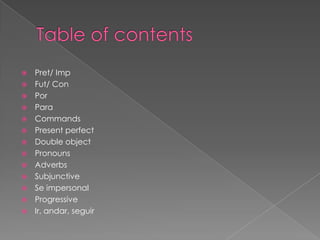
 Pret/ Imp
 Fut/ Con
 Por
 Para
 Commands
 Present perfect
 Double object
 Pronouns
 Adverbs
 Subjunctive
 Se impersonal
 Progressive
 Ir, andar, seguir
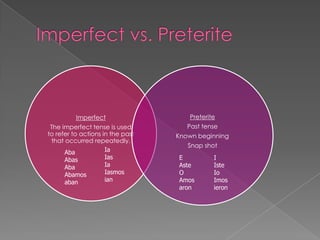
Imperfect                  Preterite
 The imperfect tense is used         Past tense
to refer to actions in the past   Known beginning
 that occurred repeatedly.
                                     Snap shot
      Aba            Ia
      Abas           Ias          E          I
      Aba            Ia           Aste       Iste
      Abamos         Iasmos       O          Io
      aban           ian          Amos       Imos
                                  aron       ieron
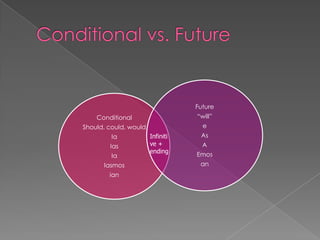
Future
    Conditional                   “will”
Should, could, would                e
         Ia            Infiniti    As
        Ias            ve +         A
                       ending
         Ia                       Emos
      Iasmos                       an
        ian
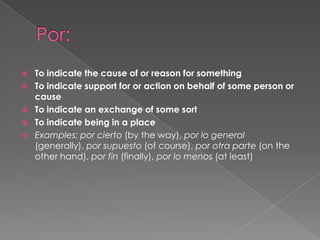
   To indicate the cause of or reason for something
   To indicate support for or action on behalf of some person or
    cause
   To indicate an exchange of some sort
   To indicate being in a place
   Examples: por cierto (by the way), por lo general
    (generally), por supuesto (of course), por otra parte (on the
    other hand), por fin (finally), por lo menos (at least)
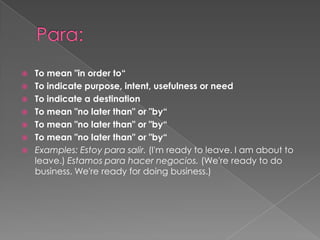
   To mean "in order to“
   To indicate purpose, intent, usefulness or need
   To indicate a destination
   To mean "no later than" or "by“
   Examples: Estoy para salir. (I'm ready to leave. I am about to
    leave.) Estamos para hacer negocios. (We're ready to do
    business. We're ready for doing business.)
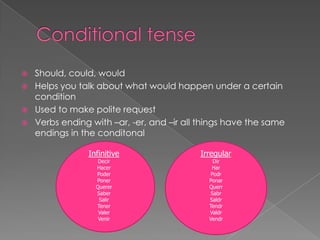
   Should, could, would
   Helps you talk about what would happen under a certain
    condition
   Used to make polite request
   Verbs ending with –ar, -er, and –ir all things have the same
    endings in the conditonal

                Infinitive                 Irregular
                   Decir                       Dir
                  Hacer                       Har
                  Poder                       Podr
                  Poner                      Ponar
                  Querer                     Querr
                  Saber                       Sabr
                   Salir                     Saldr
                  Tener                      Tendr
                   Valer                     Valdr
                   Venir                     Vendr
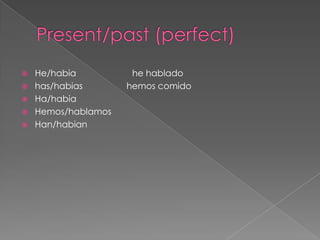
   He/habia          he hablado
   has/habias       hemos comido
   Ha/habia
   Hemos/hablamos
   Han/habian
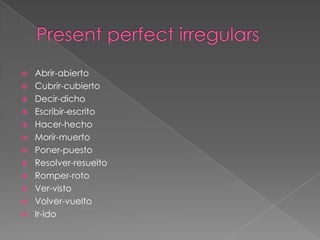
   Abrir-abierto
   Cubrir-cubierto
   Decir-dicho
   Escribir-escrito
   Hacer-hecho
   Morir-muerto
   Poner-puesto
   Resolver-resuelto
   Romper-roto
   Ver-visto
   Volver-vuelto
   Ir-ido
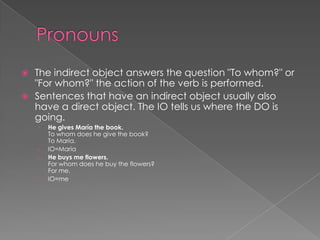
 The indirect object answers the question "To whom?" or
  "For whom?" the action of the verb is performed.
 Sentences that have an indirect object usually also
  have a direct object. The IO tells us where the DO is
  going.
    ›   He gives María the book.
        To whom does he give the book?
        To María.
    ›   IO=María
    ›   He buys me flowers.
        For whom does he buy the flowers?
        For me.
    ›   IO=me
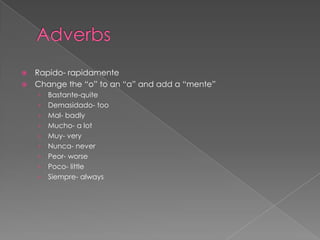
   Rapido- rapidamente
   Change the “o” to an “a” and add a “mente”
    ›   Bastante-quite
    ›   Demasidado- too
    ›   Mal- badly
    ›   Mucho- a lot
    ›   Muy- very
    ›   Nunca- never
    ›   Peor- worse
    ›   Poco- little
    ›   Siempre- always
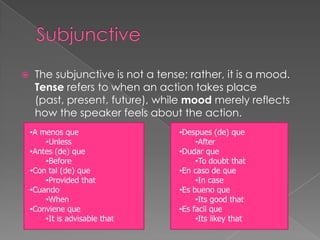
    The subjunctive is not a tense; rather, it is a mood.
     Tense refers to when an action takes place
     (past, present, future), while mood merely reflects
     how the speaker feels about the action.
    •A menos que                   •Despues (de) que
        •Unless                         •After
    •Antes (de) que                •Dudar que
        •Before                         •To doubt that
    •Con tal (de) que              •En caso de que
        •Provided that                  •In case
    •Cuando                        •Es bueno que
        •When                           •Its good that
    •Conviene que                  •Es facil que
        •It is advisable that           •Its likey that
   The impersonal "se" is used with a third person singular verb to
    express the impersonal English subjects, one, you, people, or
    they.
    ›   Examples:
         se puede nadar en el lago?
         Se dice que hay brujos que viven en la sierra
         Se como muy bien en mexico
   The passive "se" is very similar to the impersonal "se". The
    agent of the action is either unknown or unimportant and the
    influence is placed on the action and not the doer/actor.
    ›   Examples:
         No se habla espanol en ese pueblo
         Se gasta mucho dinero en el mercado
   The Present Progressive has two components: A conjugation of Estar and a
    present participle.
   The Present Progressive uses Estar since the Present Progressive describes a
    "state" that you are in.
   The participle is the "-ing" form of a verb; for example
    "running", "talking", "playing“.
   We form the participle by dropping the -ar, -er, or -ir from the infinitive of a
    verb and adding one of two endings, -ando or -iendo.

   to all -Ar verbs, add -ando
    ›   1) Hablar [to talk] 2) Habl-ar = habl- 3) Habl+ando = hablando [talking]

   to -Er and -Ir verbs, add -iendo
    ›   1) Comer [to eat] 2) Com-er = com- 3) Com+iendo = comiendo [eating]
        1) Escribir [to write] 2) Escrib-ir = escrib- 3) Escrib+iendo = escribiendo (writing)
   Ir
    › + ando/iendo/ yendo
    › Is slowly but surely_____ing
   Andar
    › + ando/ iendo/ yendo
    › Is going around_____ing
   Seguir (e>I )
    › + ando/ iendo/ yendo
    › Is still____ing

Grammar book

  • 2.
     Pret/ Imp Fut/ Con  Por  Para  Commands  Present perfect  Double object  Pronouns  Adverbs  Subjunctive  Se impersonal  Progressive  Ir, andar, seguir
  • 3.
    Imperfect Preterite The imperfect tense is used Past tense to refer to actions in the past Known beginning that occurred repeatedly. Snap shot Aba Ia Abas Ias E I Aba Ia Aste Iste Abamos Iasmos O Io aban ian Amos Imos aron ieron
  • 4.
    Future Conditional “will” Should, could, would e Ia Infiniti As Ias ve + A ending Ia Emos Iasmos an ian
  • 5.
    To indicate the cause of or reason for something  To indicate support for or action on behalf of some person or cause  To indicate an exchange of some sort  To indicate being in a place  Examples: por cierto (by the way), por lo general (generally), por supuesto (of course), por otra parte (on the other hand), por fin (finally), por lo menos (at least)
  • 6.
    To mean "in order to“  To indicate purpose, intent, usefulness or need  To indicate a destination  To mean "no later than" or "by“  To mean "no later than" or "by“  To mean "no later than" or "by“  Examples: Estoy para salir. (I'm ready to leave. I am about to leave.) Estamos para hacer negocios. (We're ready to do business. We're ready for doing business.)
  • 7.
    Should, could, would  Helps you talk about what would happen under a certain condition  Used to make polite request  Verbs ending with –ar, -er, and –ir all things have the same endings in the conditonal Infinitive Irregular Decir Dir Hacer Har Poder Podr Poner Ponar Querer Querr Saber Sabr Salir Saldr Tener Tendr Valer Valdr Venir Vendr
  • 8.
    He/habia he hablado  has/habias hemos comido  Ha/habia  Hemos/hablamos  Han/habian
  • 9.
    Abrir-abierto  Cubrir-cubierto  Decir-dicho  Escribir-escrito  Hacer-hecho  Morir-muerto  Poner-puesto  Resolver-resuelto  Romper-roto  Ver-visto  Volver-vuelto  Ir-ido
  • 10.
     The indirectobject answers the question "To whom?" or "For whom?" the action of the verb is performed.  Sentences that have an indirect object usually also have a direct object. The IO tells us where the DO is going. › He gives María the book. To whom does he give the book? To María. › IO=María › He buys me flowers. For whom does he buy the flowers? For me. › IO=me
  • 11.
    Rapido- rapidamente  Change the “o” to an “a” and add a “mente” › Bastante-quite › Demasidado- too › Mal- badly › Mucho- a lot › Muy- very › Nunca- never › Peor- worse › Poco- little › Siempre- always
  • 12.
    The subjunctive is not a tense; rather, it is a mood. Tense refers to when an action takes place (past, present, future), while mood merely reflects how the speaker feels about the action. •A menos que •Despues (de) que •Unless •After •Antes (de) que •Dudar que •Before •To doubt that •Con tal (de) que •En caso de que •Provided that •In case •Cuando •Es bueno que •When •Its good that •Conviene que •Es facil que •It is advisable that •Its likey that
  • 13.
    The impersonal "se" is used with a third person singular verb to express the impersonal English subjects, one, you, people, or they. › Examples:  se puede nadar en el lago?  Se dice que hay brujos que viven en la sierra  Se como muy bien en mexico  The passive "se" is very similar to the impersonal "se". The agent of the action is either unknown or unimportant and the influence is placed on the action and not the doer/actor. › Examples:  No se habla espanol en ese pueblo  Se gasta mucho dinero en el mercado
  • 14.
    The Present Progressive has two components: A conjugation of Estar and a present participle.  The Present Progressive uses Estar since the Present Progressive describes a "state" that you are in.  The participle is the "-ing" form of a verb; for example "running", "talking", "playing“.  We form the participle by dropping the -ar, -er, or -ir from the infinitive of a verb and adding one of two endings, -ando or -iendo.  to all -Ar verbs, add -ando › 1) Hablar [to talk] 2) Habl-ar = habl- 3) Habl+ando = hablando [talking]  to -Er and -Ir verbs, add -iendo › 1) Comer [to eat] 2) Com-er = com- 3) Com+iendo = comiendo [eating] 1) Escribir [to write] 2) Escrib-ir = escrib- 3) Escrib+iendo = escribiendo (writing)
  • 15.
    Ir › + ando/iendo/ yendo › Is slowly but surely_____ing  Andar › + ando/ iendo/ yendo › Is going around_____ing  Seguir (e>I ) › + ando/ iendo/ yendo › Is still____ing