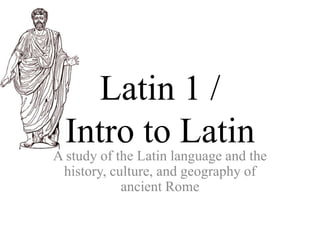
Latin 1 /
  Intro to Latin
A study of the Latin language and the
 history, culture, and geography of
            ancient Rome
Verb formation
• Latin verbs:
  stem + tense sign + personal ending
• Present tense: tense sign = n/a
              +
  stem + tense sign + personal ending
• Imperfect tense: tense sign = ba
  stem + tense sign + personal ending
             ba
• Future tense: tense sign = bi
  stem + tense sign + personal ending
             bi
Verb formation – Future
             Singular
1st Person   ama + bi + o     amabo      I will love/be loving
2nd Person   ama + bi + s     amabis     You will be loving
3rd Person   ama + bi + t     amabit     He/she/it will love

             Plural
1st Person   ama + bi + mus   amabimus We will be loving
2nd Person   ama + bi + tis   amabitis   Y’all will love
3rd Person   ama + bi + nt    amabunt    They will be loving
Second Declension – Endings
            Singular           Plural
            M         N        M        N
  Nom       -us       -um      -ī       -a
  Gen       -ī        -ī       -ōrum    -ōrum
  Dat       -ō        -ō       -īs      -īs
  Acc       -um       -um      -ōs      -a
  Abl       -ō        -ō       -īs      -īs
• For neuter, Nominative = Accusative
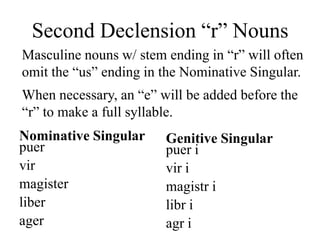
Second Declension “r” Nouns
Masculine nouns w/ stem ending in “r” will often
omit the “us” ending in the Nominative Singular.
When necessary, an “e” will be added before the
“r” to make a full syllable.
Nominative Singular     Genitive Singular
puer                    puer i
vir                     vir i
magister                magistr i
liber                   libr i
ager                    agr i
Second Declension “r” Nouns
Notes:
• Does not apply to all nouns whose stem ends
  in “r” – primarily those ending in “er” or a
  consonant + “r”.
  e.g., taurus, tauri, M: bull is regular.
• “vir” is the only “ir” noun; the rest end in “er”
  for Nom Sg.
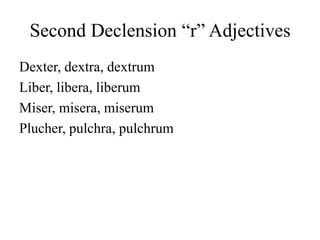
Second Declension “r” Adjectives
Dexter, dextra, dextrum
Liber, libera, liberum
Miser, misera, miserum
Plucher, pulchra, pulchrum
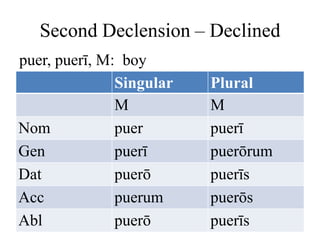
Second Declension – Declined
puer, puerī, M: boy
               Singular   Plural
               M          M
Nom            puer       puerī
Gen            puerī      puerōrum
Dat            puerō      puerīs
Acc            puerum     puerōs
Abl            puerō      puerīs
Second Declension – Declined
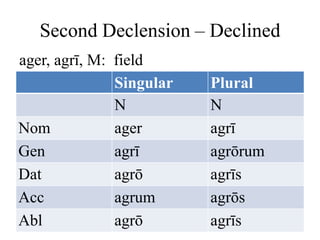
ager, agrī, M: field
               Singular   Plural
               N          N
Nom            ager       agrī
Gen            agrī       agrōrum
Dat            agrō       agrīs
Acc            agrum      agrōs
Abl            agrō       agrīs
Adjective/Noun Agreement
• The good boy (nominative)
   – Boy
      • Puer, puerī, M
      • Nominative Sing Masculine
      • Puer
   – Good
      • Bonus, bona, bonum
      • Nominative Sing Masculine
      • bon + us = bonus
• Puer bonus
Adjectives without Nouns
With a be verb to describe the subject.
• The girl is beautiful.
• Puella est pulchra.
• Must match the noun it describes in C,N,G
Where the noun is assumed. (generic or context)
• The good (man) was praising the queen.
• Bonus laudabat reginam.
• Must match C,N,G of the assumed noun
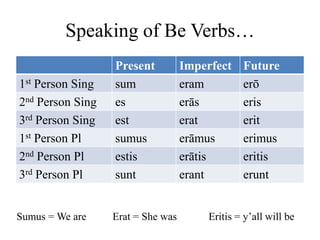
Speaking of Be Verbs…
                  Present          Imperfect    Future
1st Person Sing   sum              eram         erō
2nd Person Sing   es               erās         eris
3rd Person Sing   est              erat         erit
1st Person Pl     sumus            erāmus       erimus
2nd Person Pl     estis            erātis       eritis
3rd Person Pl     sunt             erant        erunt


Sumus = We are    Erat = She was        Eritis = y’all will be

Latin I Lesson 07

  • 1.
    Latin 1 / Intro to Latin A study of the Latin language and the history, culture, and geography of ancient Rome
  • 2.
    Verb formation • Latinverbs: stem + tense sign + personal ending • Present tense: tense sign = n/a + stem + tense sign + personal ending • Imperfect tense: tense sign = ba stem + tense sign + personal ending ba • Future tense: tense sign = bi stem + tense sign + personal ending bi
  • 3.
    Verb formation –Future Singular 1st Person ama + bi + o amabo I will love/be loving 2nd Person ama + bi + s amabis You will be loving 3rd Person ama + bi + t amabit He/she/it will love Plural 1st Person ama + bi + mus amabimus We will be loving 2nd Person ama + bi + tis amabitis Y’all will love 3rd Person ama + bi + nt amabunt They will be loving
  • 4.
    Second Declension –Endings Singular Plural M N M N Nom -us -um -ī -a Gen -ī -ī -ōrum -ōrum Dat -ō -ō -īs -īs Acc -um -um -ōs -a Abl -ō -ō -īs -īs • For neuter, Nominative = Accusative
  • 5.
    Second Declension “r”Nouns Masculine nouns w/ stem ending in “r” will often omit the “us” ending in the Nominative Singular. When necessary, an “e” will be added before the “r” to make a full syllable. Nominative Singular Genitive Singular puer puer i vir vir i magister magistr i liber libr i ager agr i
  • 6.
    Second Declension “r”Nouns Notes: • Does not apply to all nouns whose stem ends in “r” – primarily those ending in “er” or a consonant + “r”. e.g., taurus, tauri, M: bull is regular. • “vir” is the only “ir” noun; the rest end in “er” for Nom Sg.
  • 7.
    Second Declension “r”Adjectives Dexter, dextra, dextrum Liber, libera, liberum Miser, misera, miserum Plucher, pulchra, pulchrum
  • 8.
    Second Declension –Declined puer, puerī, M: boy Singular Plural M M Nom puer puerī Gen puerī puerōrum Dat puerō puerīs Acc puerum puerōs Abl puerō puerīs
  • 9.
    Second Declension –Declined ager, agrī, M: field Singular Plural N N Nom ager agrī Gen agrī agrōrum Dat agrō agrīs Acc agrum agrōs Abl agrō agrīs
  • 10.
    Adjective/Noun Agreement • Thegood boy (nominative) – Boy • Puer, puerī, M • Nominative Sing Masculine • Puer – Good • Bonus, bona, bonum • Nominative Sing Masculine • bon + us = bonus • Puer bonus
  • 11.
    Adjectives without Nouns Witha be verb to describe the subject. • The girl is beautiful. • Puella est pulchra. • Must match the noun it describes in C,N,G Where the noun is assumed. (generic or context) • The good (man) was praising the queen. • Bonus laudabat reginam. • Must match C,N,G of the assumed noun
  • 12.
    Speaking of BeVerbs… Present Imperfect Future 1st Person Sing sum eram erō 2nd Person Sing es erās eris 3rd Person Sing est erat erit 1st Person Pl sumus erāmus erimus 2nd Person Pl estis erātis eritis 3rd Person Pl sunt erant erunt Sumus = We are Erat = She was Eritis = y’all will be