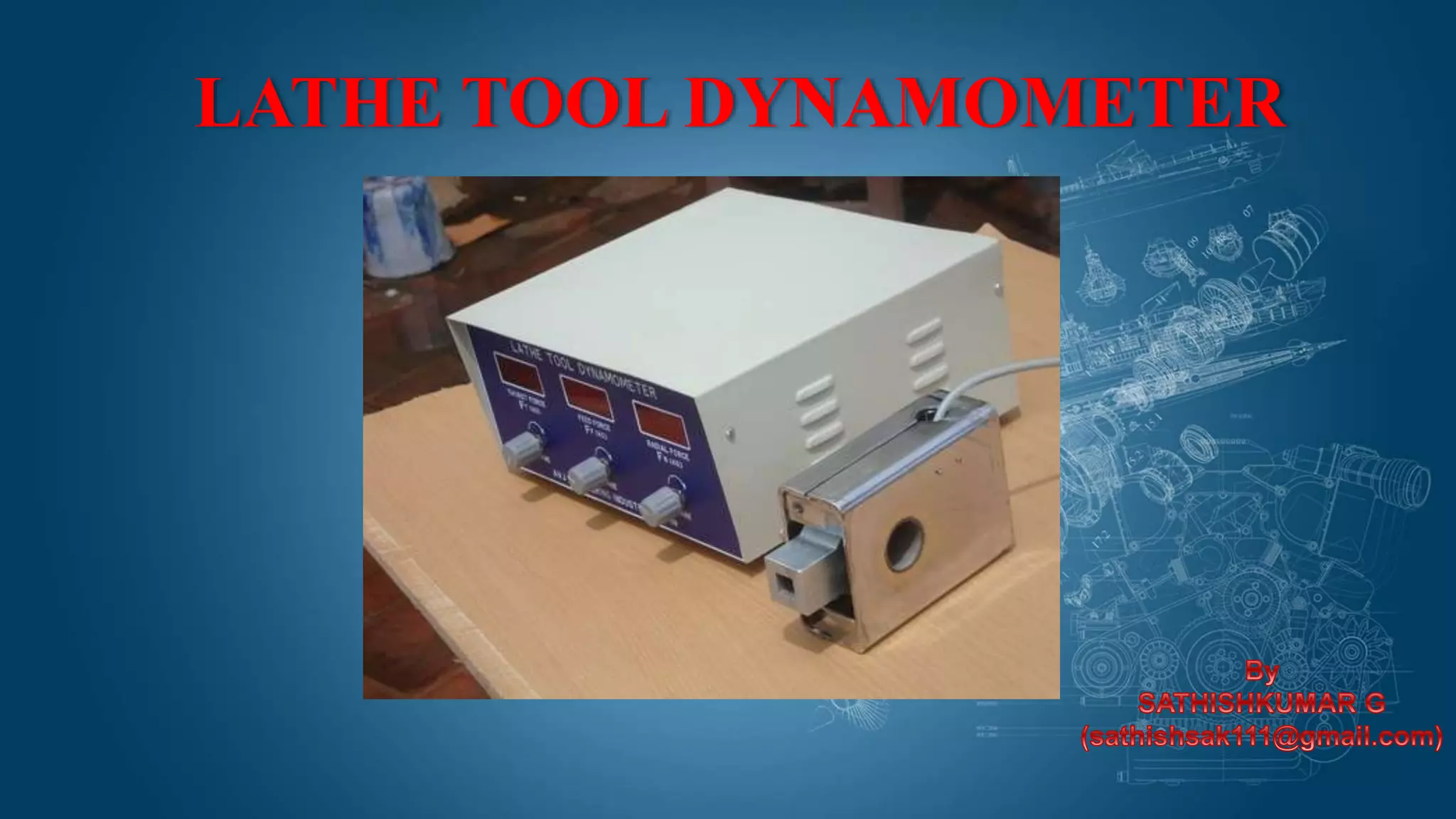
LATHE TOOL DYNAMOMETER
INTRODUCTION
Dynamo meters are the electronic devices that
are widely used to the purpose of force analysis
in various field of operations. There is various
types of dynamometers such as
 Lathe tool dynamometer
 Milling tool dynamometer
 Drilling tool dynamometer
contents
 Abstract
 Objectives
 Working principle
 Methodology
 Problem identification
 Problem definition
 Results and discussion
 conclusion
ABSTRACT
 A lathe tool dynamometer that can evaluate fixed cutting
forces using level of strain gauges has been designed and
developed. The designed lathe tool dynamometer is
capable for computing the forces on cutting tool during
operations such as facing, turning.
 The sensing system measures the deflection In strain
gauges and these signals are modified into other quantity
and computed in the form of forces on the display system.
Objectives
The purpose of the tool is
 save the time
 cost of production
 to get the better output which cannot be obtained
with hand tools.
Working principle of lathe tool dynamo
meter?
Lathe tool dynamo meter is a equipment which
used for observing the amount of load acting
on the tool while operation by using strain
gauges.
sensor
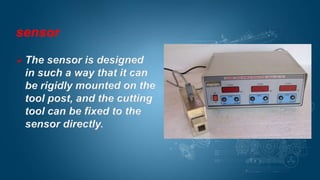
 The sensor is designed
in such a way that it can
be rigidly mounted on the
tool post, and the cutting
tool can be fixed to the
sensor directly.
METHODOLOGY
 Measurement of cutting force by using
electrical strain gauge is the best technique
available.
 The natural frequency of the tool holder of
lathe tool dynamometer will be calculated.
 Stress calculation will be carried out for the
safe design of lathe tool dynamometer.
PROBLEM
IDENTIFICATION
 Difficulty was that differences caused by changes
of the sensitivity among the measuring bridges by
changing the balance points of the circuits.
 Relatively high variation in the accuracy of
horizontal and vertical force components
developed due to large effect of cross sensitivity,
zero drift, and variations in voltage supply and
temperatures
RESULTS AND DISCUSSION
 The feed forces and depth of cut is directly
proportional to cutting forces.
 Cutting forces depend upon feed rate of tool
 cutting forces increase as feed rate increases.
conclusion
 The cutting forces are measured by using
electrical strain gauge is the best technique
available.
 As per cutting analysis of forces, it has
concluded that the cutting & feed forces is
directly proportional to depth of cut & feed rate
of tool and inversely proportional to feed/rev.
Thank you

LATHE TOOL DYNAMOMETER

  • 1.
  • 2.
    INTRODUCTION Dynamo meters arethe electronic devices that are widely used to the purpose of force analysis in various field of operations. There is various types of dynamometers such as  Lathe tool dynamometer  Milling tool dynamometer  Drilling tool dynamometer
  • 3.
    contents  Abstract  Objectives Working principle  Methodology  Problem identification  Problem definition  Results and discussion  conclusion
  • 4.
    ABSTRACT  A lathetool dynamometer that can evaluate fixed cutting forces using level of strain gauges has been designed and developed. The designed lathe tool dynamometer is capable for computing the forces on cutting tool during operations such as facing, turning.  The sensing system measures the deflection In strain gauges and these signals are modified into other quantity and computed in the form of forces on the display system.
  • 5.
    Objectives The purpose ofthe tool is  save the time  cost of production  to get the better output which cannot be obtained with hand tools.
  • 6.
    Working principle oflathe tool dynamo meter? Lathe tool dynamo meter is a equipment which used for observing the amount of load acting on the tool while operation by using strain gauges.
  • 7.
    sensor  The sensoris designed in such a way that it can be rigidly mounted on the tool post, and the cutting tool can be fixed to the sensor directly.
  • 8.
    METHODOLOGY  Measurement ofcutting force by using electrical strain gauge is the best technique available.  The natural frequency of the tool holder of lathe tool dynamometer will be calculated.  Stress calculation will be carried out for the safe design of lathe tool dynamometer.
  • 9.
    PROBLEM IDENTIFICATION  Difficulty wasthat differences caused by changes of the sensitivity among the measuring bridges by changing the balance points of the circuits.  Relatively high variation in the accuracy of horizontal and vertical force components developed due to large effect of cross sensitivity, zero drift, and variations in voltage supply and temperatures
  • 10.
    RESULTS AND DISCUSSION The feed forces and depth of cut is directly proportional to cutting forces.  Cutting forces depend upon feed rate of tool  cutting forces increase as feed rate increases.
  • 11.
    conclusion  The cuttingforces are measured by using electrical strain gauge is the best technique available.  As per cutting analysis of forces, it has concluded that the cutting & feed forces is directly proportional to depth of cut & feed rate of tool and inversely proportional to feed/rev.
  • 12.