TOOL WEAR MEASUREMENT
Tool wear is the most undesirable
characteristics of machining process.
 It affect the tool life,
 which also has impact on dimensional
accuracy, surface quality etc.
Hence, tool wear measurement is
necessary.
•With effective monitoring system, warn tool can be
change in time to avoid production time and scrapped
components
• Measurement of tool wear is extremely important to
predict the useful life of tool inserts.
• This will be helpful to monitor and to study the
effects of the tool wear on quality of machined
work piece and economy of manufacturing process.
• Methods to measure tool wear:
I. Direct methods
II. Indirect methods
I. Direct methods
• Measurement takes over the tool wear
zone.
• Based on the change of the tool geometry
• It is impossible in the presence of coolant
fluids.
• Reliable but difficult to implement
II. Indirect methods
• Based on parameters measured during the cutting
operation that can be correlated to wear state
• Tool condition is not captured directly but
achieved from the measurable parameters
• Use the effects the tool edge wear and not the
tool wear themselves.
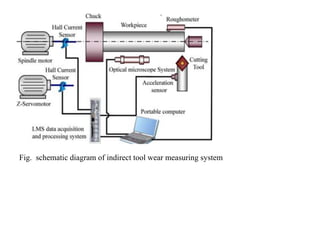
• Tool wear is estimated with the signals coming
from different types of sensors .
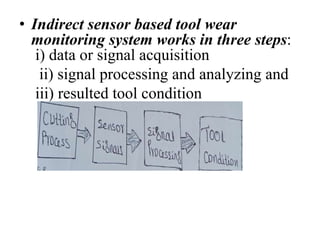
• Indirect sensor based tool wear
monitoring system works in three steps:
i) data or signal acquisition
ii) signal processing and analyzing and
iii) resulted tool condition
Fig. schematic diagram of indirect tool wear measuring system
To estimate tool wear by indirect method the
following physical quantities can be measured:
cutting force
vibration
acoustic emission
motor current
cutting temperature
Surface roughness etc.
Cutting Force Measurement
• Variation in the cutting force can be correlated to
tool wear.
• Gradual increase in tool wear during the cutting
process causes the cutting forces to increase
• Therefore the cutting forces is generally
considered
one of the most significant indicators of tool wear
in the metal cutting process.
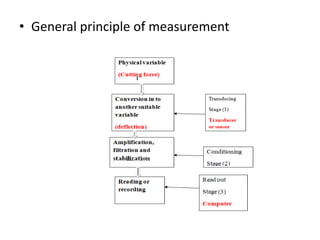
• Dynamometer is used for the measurement of
cutting forces.
• The basic principles of measuring cutting
force from its effects:
Monitoring elastic deflection of body caused
by forces
Monitoring elastic deformation i.e. strain
induced by force
Monitoring the pressure develops
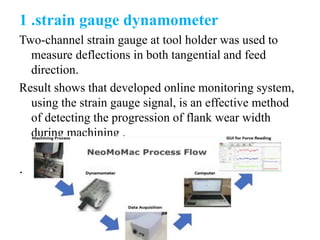
1 .strain gauge dynamometer
Two-channel strain gauge at tool holder was used to
measure deflections in both tangential and feed
direction.
Result shows that developed online monitoring system,
using the strain gauge signal, is an effective method
of detecting the progression of flank wear width
during machining .
.
Why do we need measure cutting
force??
 We want to know in witch direction how much
force is being acted and it can minimized or not.
 By minimizing cutting force we can increase the
efficiency of process
 The resultant force mostly passes through the tool
,otherwise the tool will not able takes of the force
eventually fail.
 If the orientation of the tool is not suitable to the
direction of the resultant force then the tool tend
to buckle up and bends results to tool breakage or
improper finishing in the work piece.
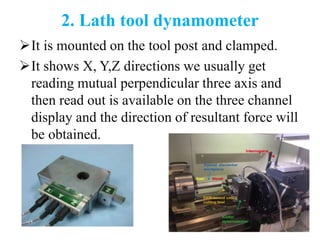
2. Lath tool dynamometer
It is mounted on the tool post and clamped.
It shows X, Y,Z directions we usually get
reading mutual perpendicular three axis and
then read out is available on the three channel
display and the direction of resultant force will
be obtained.
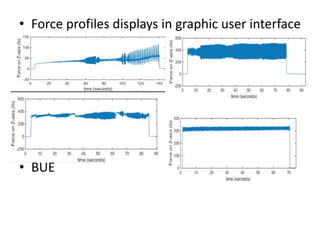
• Force profiles displays in graphic user interface
•
• BUE
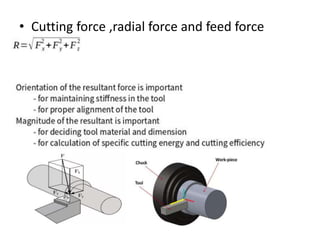
• Cutting force ,radial force and feed force
• General principle of measurement
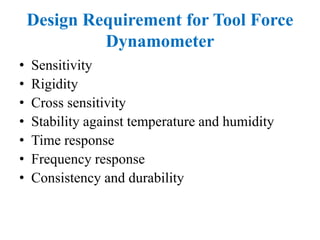
Design Requirement for Tool Force
Dynamometer
• Sensitivity
• Rigidity
• Cross sensitivity
• Stability against temperature and humidity
• Time response
• Frequency response
• Consistency and durability

Tool wear measurement

  • 1.
    TOOL WEAR MEASUREMENT Toolwear is the most undesirable characteristics of machining process.  It affect the tool life,  which also has impact on dimensional accuracy, surface quality etc. Hence, tool wear measurement is necessary. •With effective monitoring system, warn tool can be change in time to avoid production time and scrapped components
  • 2.
    • Measurement oftool wear is extremely important to predict the useful life of tool inserts. • This will be helpful to monitor and to study the effects of the tool wear on quality of machined work piece and economy of manufacturing process. • Methods to measure tool wear: I. Direct methods II. Indirect methods
  • 3.
    I. Direct methods •Measurement takes over the tool wear zone. • Based on the change of the tool geometry • It is impossible in the presence of coolant fluids. • Reliable but difficult to implement
  • 4.
    II. Indirect methods •Based on parameters measured during the cutting operation that can be correlated to wear state • Tool condition is not captured directly but achieved from the measurable parameters • Use the effects the tool edge wear and not the tool wear themselves. • Tool wear is estimated with the signals coming from different types of sensors .
  • 5.
    • Indirect sensorbased tool wear monitoring system works in three steps: i) data or signal acquisition ii) signal processing and analyzing and iii) resulted tool condition
  • 6.
    Fig. schematic diagramof indirect tool wear measuring system
  • 7.
    To estimate toolwear by indirect method the following physical quantities can be measured: cutting force vibration acoustic emission motor current cutting temperature Surface roughness etc.
  • 8.
    Cutting Force Measurement •Variation in the cutting force can be correlated to tool wear. • Gradual increase in tool wear during the cutting process causes the cutting forces to increase • Therefore the cutting forces is generally considered one of the most significant indicators of tool wear in the metal cutting process. • Dynamometer is used for the measurement of cutting forces.
  • 9.
    • The basicprinciples of measuring cutting force from its effects: Monitoring elastic deflection of body caused by forces Monitoring elastic deformation i.e. strain induced by force Monitoring the pressure develops
  • 10.
    1 .strain gaugedynamometer Two-channel strain gauge at tool holder was used to measure deflections in both tangential and feed direction. Result shows that developed online monitoring system, using the strain gauge signal, is an effective method of detecting the progression of flank wear width during machining . .
  • 11.
    Why do weneed measure cutting force??  We want to know in witch direction how much force is being acted and it can minimized or not.  By minimizing cutting force we can increase the efficiency of process  The resultant force mostly passes through the tool ,otherwise the tool will not able takes of the force eventually fail.  If the orientation of the tool is not suitable to the direction of the resultant force then the tool tend to buckle up and bends results to tool breakage or improper finishing in the work piece.
  • 12.
    2. Lath tooldynamometer It is mounted on the tool post and clamped. It shows X, Y,Z directions we usually get reading mutual perpendicular three axis and then read out is available on the three channel display and the direction of resultant force will be obtained.
  • 13.
    • Force profilesdisplays in graphic user interface • • BUE
  • 14.
    • Cutting force,radial force and feed force
  • 15.
    • General principleof measurement
  • 16.
    Design Requirement forTool Force Dynamometer • Sensitivity • Rigidity • Cross sensitivity • Stability against temperature and humidity • Time response • Frequency response • Consistency and durability