Force Measurement
Instructor
Mr. Gaurav Bharadwaj
Assistant Prof.
Department of ME
GLA University
Introduction
Force:
• Force is defined as an influence that causes an object to change its rate or direction of
movement or rotation.
• A force can accelerate objects by pulling or pushing them.
• The relationship between force, mass, and acceleration was defined by Isaac Newton in his
second law of motion, which states that an object's force is the product of its mass and
acceleration.
Force = Mass x Acceleration
N = kg x m/s2
Force Measurement Methods
• Balancing the unknown force against known gravitational force due to standard mass. Scales
and balances works based on this principle.
• Applying unknown force to an elastic member (spring, Beam, Cantilever, etc.) and measuring
the resulting deflection on calibrated force scale or the deflection may be measured by using a
secondary transducers. i.e. Elastic force meter, providing ring.
• Translating the force to a fluid pressure and then measuring the resultant pressure. Hydraulic
and Pneumatic load cells works on this principle.
Scale and Balances
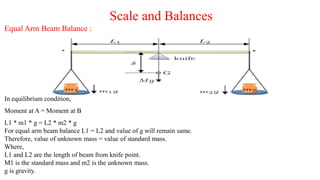
Equal Arm Beam Balance :
In equilibrium condition,
Moment at A = Moment at B
L1 * m1 * g = L2 * m2 * g
For equal arm beam balance L1 = L2 and value of g will remain same.
Therefore, value of unknown mass = value of standard mass.
Where,
L1 and L2 are the length of beam from knife point.
M1 is the standard mass and m2 is the unknown mass.
g is gravity.
Scale and Balances
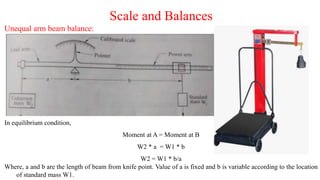
Unequal arm beam balance:
In equilibrium condition,
Moment at A = Moment at B
W2 * a = W1 * b
W2 = W1 * b/a
Where, a and b are the length of beam from knife point. Value of a is fixed and b is variable according to the location
of standard mass W1.
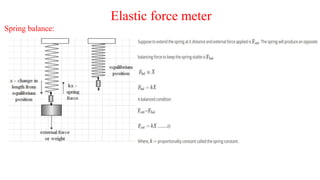
Elastic force meter
Spring balance:
Load Cells
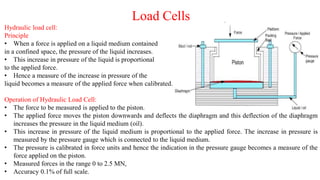
Hydraulic load cell:
Principle
• When a force is applied on a liquid medium contained
in a confined space, the pressure of the liquid increases.
• This increase in pressure of the liquid is proportional
to the applied force.
• Hence a measure of the increase in pressure of the
liquid becomes a measure of the applied force when calibrated.
Operation of Hydraulic Load Cell:
• The force to be measured is applied to the piston.
• The applied force moves the piston downwards and deflects the diaphragm and this deflection of the diaphragm
increases the pressure in the liquid medium (oil).
• This increase in pressure of the liquid medium is proportional to the applied force. The increase in pressure is
measured by the pressure gauge which is connected to the liquid medium.
• The pressure is calibrated in force units and hence the indication in the pressure gauge becomes a measure of the
force applied on the piston.
• Measured forces in the range 0 to 2.5 MN,
• Accuracy 0.1% of full scale.
Load Cells
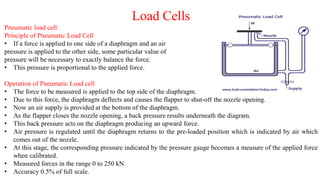
Pneumatic load cell:
Principle of Pneumatic Load Cell
• If a force is applied to one side of a diaphragm and an air
pressure is applied to the other side, some particular value of
pressure will be necessary to exactly balance the force.
• This pressure is proportional to the applied force.
Operation of Pneumatic Load cell
• The force to be measured is applied to the top side of the diaphragm.
• Due to this force, the diaphragm deflects and causes the flapper to shut-off the nozzle opening.
• Now an air supply is provided at the bottom of the diaphragm.
• As the flapper closes the nozzle opening, a back pressure results underneath the diagram.
• This back pressure acts on the diaphragm producing an upward force.
• Air pressure is regulated until the diaphragm returns to the pre-loaded position which is indicated by air which
comes out of the nozzle.
• At this stage, the corresponding pressure indicated by the pressure gauge becomes a measure of the applied force
when calibrated.
• Measured forces in the range 0 to 250 kN.
• Accuracy 0.5% of full scale.
Proving Ring
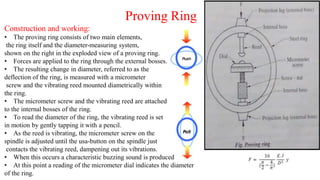
Construction and working:
• The proving ring consists of two main elements,
the ring itself and the diameter-measuring system,
shown on the right in the exploded view of a proving ring.
• Forces are applied to the ring through the external bosses.
• The resulting change in diameter, referred to as the
deflection of the ring, is measured with a micrometer
screw and the vibrating reed mounted diametrically within
the ring.
• The micrometer screw and the vibrating reed are attached
to the internal bosses of the ring.
• To read the diameter of the ring, the vibrating reed is set
in motion by gently tapping it with a pencil.
• As the reed is vibrating, the micrometer screw on the
spindle is adjusted until the usa-button on the spindle just
contacts the vibrating reed, dampening out its vibrations.
• When this occurs a characteristic buzzing sound is produced.
• At this point a reading of the micrometer dial indicates the diameter
of the ring.
Torque Measurement
Measurement of torque is important for the following reasons:
1. It is necessary to obtain load information for the analysis of stress or deflection. In this case,
torque T is determined by the measurement force F at a known radius r using the following
relationship:
T = Fr (in N m)
2. Measurement of torque is essential in the determination of mechanical power. Mechanical
power is nothing but the power required to operate a machine or the power developed by the
machine, and is computed using the following relation:
P = 2πNT
Here, N is the angular speed in resolution per second.
• Torque-measuring devices employed for this purpose are popularly known as dynamometers.
Dynamometers are used to measure torque in internal combustion machines, small steam
turbines, pumps, compressors, etc.
Prony Brake Dynamometer
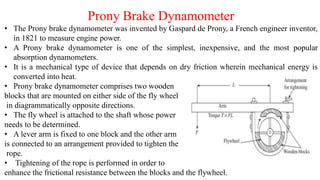
• The Prony brake dynamometer was invented by Gaspard de Prony, a French engineer inventor,
in 1821 to measure engine power.
• A Prony brake dynamometer is one of the simplest, inexpensive, and the most popular
absorption dynamometers.
• It is a mechanical type of device that depends on dry friction wherein mechanical energy is
converted into heat.
• Prony brake dynamometer comprises two wooden
blocks that are mounted on either side of the fly wheel
in diagrammatically opposite directions.
• The fly wheel is attached to the shaft whose power
needs to be determined.
• A lever arm is fixed to one block and the other arm
is connected to an arrangement provided to tighten the
rope.
• Tightening of the rope is performed in order to
enhance the frictional resistance between the blocks and the flywheel.
Prony Brake Dynamometer
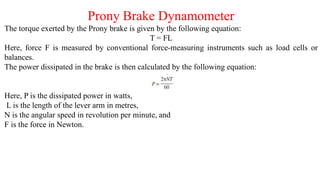
The torque exerted by the Prony brake is given by the following equation:
T = FL
Here, force F is measured by conventional force-measuring instruments such as load cells or
balances.
The power dissipated in the brake is then calculated by the following equation:
Here, P is the dissipated power in watts,
L is the length of the lever arm in metres,
N is the angular speed in revolution per minute, and
F is the force in Newton.
Prony Brake Dynamometer
The following are certain limitations associated with a Prony brake dynamometer:
1. Due to wear of the wooden blocks, there will be variations in the coefficients of friction
between the blocks and the flywheel. This necessitates tightening of the clamp. This makes
the system unstable, and large powers cannot be measured particularly when used for longer
periods.
2. The coefficients of friction decrease due to excessive rise in temperature, which may result in
brake failure. Therefore, cooling is required in order to limit the temperature rise. Water is
supplied into the hollow channel of the flywheel to provide cooling.
3. Due to variations in coefficients of friction, there may be some difficulty in taking readings of
force F. The measuring arrangement may be subjected to oscillations, especially when the
machine torque is not constant.
Thank you

Force and torque measurement

  • 1.
    Force Measurement Instructor Mr. GauravBharadwaj Assistant Prof. Department of ME GLA University
  • 2.
    Introduction Force: • Force isdefined as an influence that causes an object to change its rate or direction of movement or rotation. • A force can accelerate objects by pulling or pushing them. • The relationship between force, mass, and acceleration was defined by Isaac Newton in his second law of motion, which states that an object's force is the product of its mass and acceleration. Force = Mass x Acceleration N = kg x m/s2
  • 3.
    Force Measurement Methods •Balancing the unknown force against known gravitational force due to standard mass. Scales and balances works based on this principle. • Applying unknown force to an elastic member (spring, Beam, Cantilever, etc.) and measuring the resulting deflection on calibrated force scale or the deflection may be measured by using a secondary transducers. i.e. Elastic force meter, providing ring. • Translating the force to a fluid pressure and then measuring the resultant pressure. Hydraulic and Pneumatic load cells works on this principle.
  • 4.
    Scale and Balances EqualArm Beam Balance : In equilibrium condition, Moment at A = Moment at B L1 * m1 * g = L2 * m2 * g For equal arm beam balance L1 = L2 and value of g will remain same. Therefore, value of unknown mass = value of standard mass. Where, L1 and L2 are the length of beam from knife point. M1 is the standard mass and m2 is the unknown mass. g is gravity.
  • 5.
    Scale and Balances Unequalarm beam balance: In equilibrium condition, Moment at A = Moment at B W2 * a = W1 * b W2 = W1 * b/a Where, a and b are the length of beam from knife point. Value of a is fixed and b is variable according to the location of standard mass W1.
  • 6.
  • 7.
    Load Cells Hydraulic loadcell: Principle • When a force is applied on a liquid medium contained in a confined space, the pressure of the liquid increases. • This increase in pressure of the liquid is proportional to the applied force. • Hence a measure of the increase in pressure of the liquid becomes a measure of the applied force when calibrated. Operation of Hydraulic Load Cell: • The force to be measured is applied to the piston. • The applied force moves the piston downwards and deflects the diaphragm and this deflection of the diaphragm increases the pressure in the liquid medium (oil). • This increase in pressure of the liquid medium is proportional to the applied force. The increase in pressure is measured by the pressure gauge which is connected to the liquid medium. • The pressure is calibrated in force units and hence the indication in the pressure gauge becomes a measure of the force applied on the piston. • Measured forces in the range 0 to 2.5 MN, • Accuracy 0.1% of full scale.
  • 8.
    Load Cells Pneumatic loadcell: Principle of Pneumatic Load Cell • If a force is applied to one side of a diaphragm and an air pressure is applied to the other side, some particular value of pressure will be necessary to exactly balance the force. • This pressure is proportional to the applied force. Operation of Pneumatic Load cell • The force to be measured is applied to the top side of the diaphragm. • Due to this force, the diaphragm deflects and causes the flapper to shut-off the nozzle opening. • Now an air supply is provided at the bottom of the diaphragm. • As the flapper closes the nozzle opening, a back pressure results underneath the diagram. • This back pressure acts on the diaphragm producing an upward force. • Air pressure is regulated until the diaphragm returns to the pre-loaded position which is indicated by air which comes out of the nozzle. • At this stage, the corresponding pressure indicated by the pressure gauge becomes a measure of the applied force when calibrated. • Measured forces in the range 0 to 250 kN. • Accuracy 0.5% of full scale.
  • 9.
    Proving Ring Construction andworking: • The proving ring consists of two main elements, the ring itself and the diameter-measuring system, shown on the right in the exploded view of a proving ring. • Forces are applied to the ring through the external bosses. • The resulting change in diameter, referred to as the deflection of the ring, is measured with a micrometer screw and the vibrating reed mounted diametrically within the ring. • The micrometer screw and the vibrating reed are attached to the internal bosses of the ring. • To read the diameter of the ring, the vibrating reed is set in motion by gently tapping it with a pencil. • As the reed is vibrating, the micrometer screw on the spindle is adjusted until the usa-button on the spindle just contacts the vibrating reed, dampening out its vibrations. • When this occurs a characteristic buzzing sound is produced. • At this point a reading of the micrometer dial indicates the diameter of the ring.
  • 10.
    Torque Measurement Measurement oftorque is important for the following reasons: 1. It is necessary to obtain load information for the analysis of stress or deflection. In this case, torque T is determined by the measurement force F at a known radius r using the following relationship: T = Fr (in N m) 2. Measurement of torque is essential in the determination of mechanical power. Mechanical power is nothing but the power required to operate a machine or the power developed by the machine, and is computed using the following relation: P = 2πNT Here, N is the angular speed in resolution per second. • Torque-measuring devices employed for this purpose are popularly known as dynamometers. Dynamometers are used to measure torque in internal combustion machines, small steam turbines, pumps, compressors, etc.
  • 11.
    Prony Brake Dynamometer •The Prony brake dynamometer was invented by Gaspard de Prony, a French engineer inventor, in 1821 to measure engine power. • A Prony brake dynamometer is one of the simplest, inexpensive, and the most popular absorption dynamometers. • It is a mechanical type of device that depends on dry friction wherein mechanical energy is converted into heat. • Prony brake dynamometer comprises two wooden blocks that are mounted on either side of the fly wheel in diagrammatically opposite directions. • The fly wheel is attached to the shaft whose power needs to be determined. • A lever arm is fixed to one block and the other arm is connected to an arrangement provided to tighten the rope. • Tightening of the rope is performed in order to enhance the frictional resistance between the blocks and the flywheel.
  • 12.
    Prony Brake Dynamometer Thetorque exerted by the Prony brake is given by the following equation: T = FL Here, force F is measured by conventional force-measuring instruments such as load cells or balances. The power dissipated in the brake is then calculated by the following equation: Here, P is the dissipated power in watts, L is the length of the lever arm in metres, N is the angular speed in revolution per minute, and F is the force in Newton.
  • 13.
    Prony Brake Dynamometer Thefollowing are certain limitations associated with a Prony brake dynamometer: 1. Due to wear of the wooden blocks, there will be variations in the coefficients of friction between the blocks and the flywheel. This necessitates tightening of the clamp. This makes the system unstable, and large powers cannot be measured particularly when used for longer periods. 2. The coefficients of friction decrease due to excessive rise in temperature, which may result in brake failure. Therefore, cooling is required in order to limit the temperature rise. Water is supplied into the hollow channel of the flywheel to provide cooling. 3. Due to variations in coefficients of friction, there may be some difficulty in taking readings of force F. The measuring arrangement may be subjected to oscillations, especially when the machine torque is not constant.
  • 14.