METROLOGY AND MEASUREMENTS
OBJECTIVE
To Provide knowledge on various
metrological equipments.
To utilize various techniques used to
measure the dimension of the
components.
Knowledge to adopt correct
procedure to measure the dimension
of the components.
To study about advances in
metrology.
( UNIT-5) SYLLABUS
MEASUREMENT OF POWER, FLOW AND
TEMPERATURE
Force, torque, power - mechanical ,
Pneumatic, Hydraulic and Electrical
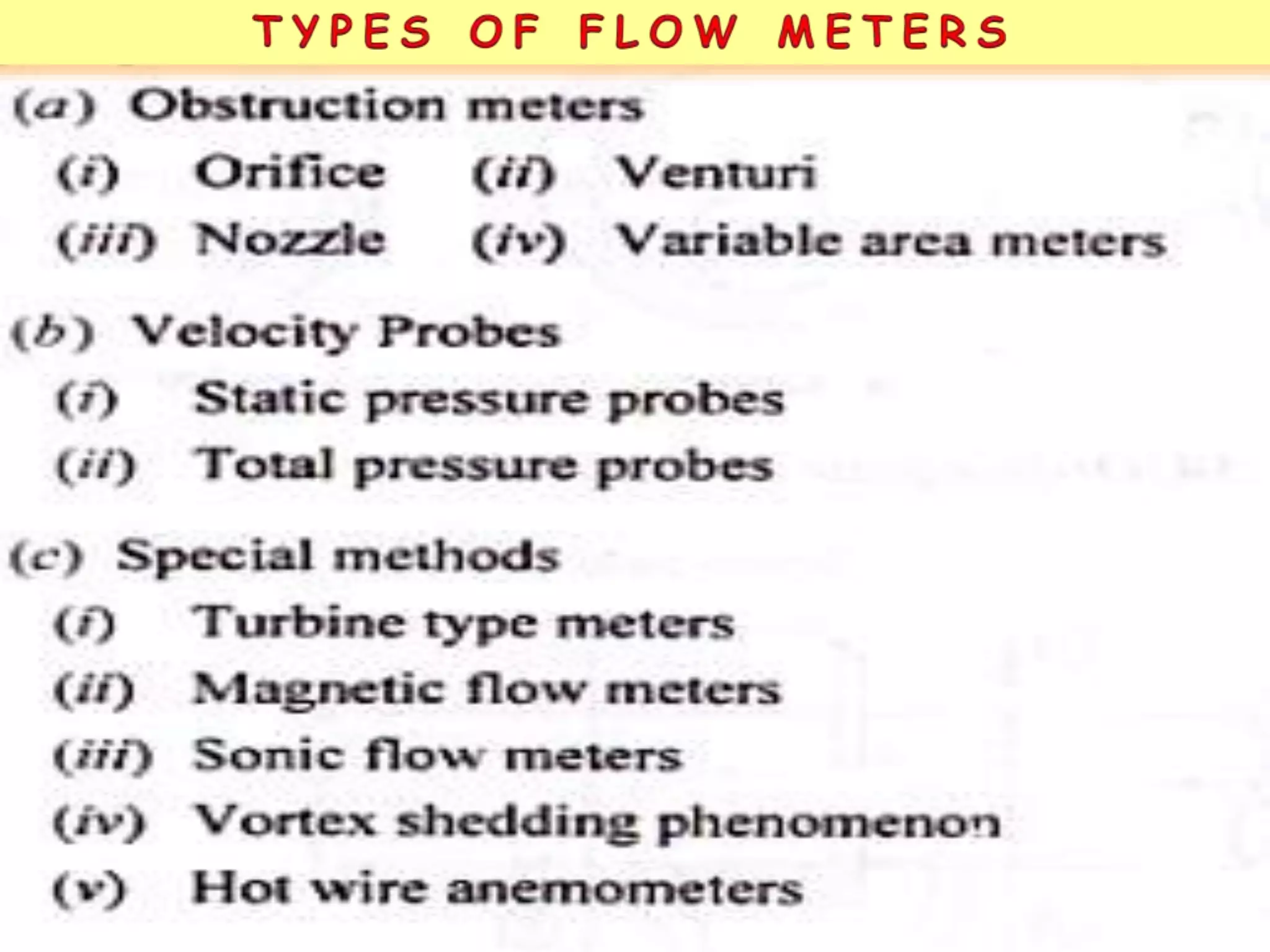
type. Flow measurement: Venturimeter,
Orifice meter, rotameter, pitot tube –
Temperature: bimetallic strip,
thermocouples, electrical resistance
thermometer – Reliability and
Calibration – Readability and Reliability.
Compiled by P.Sathish kumar - UIT
Measurement of force is done by
Direct methods: Involves direct
comparison with a known gravitational
force on a standard mass, e.g., by a
balance
Indirect methods: It involves
measurement of effect of force on a
body, such as acceleration of a body of
known mass subjected to force.
Compiled by P.Sathish kumar - UIT
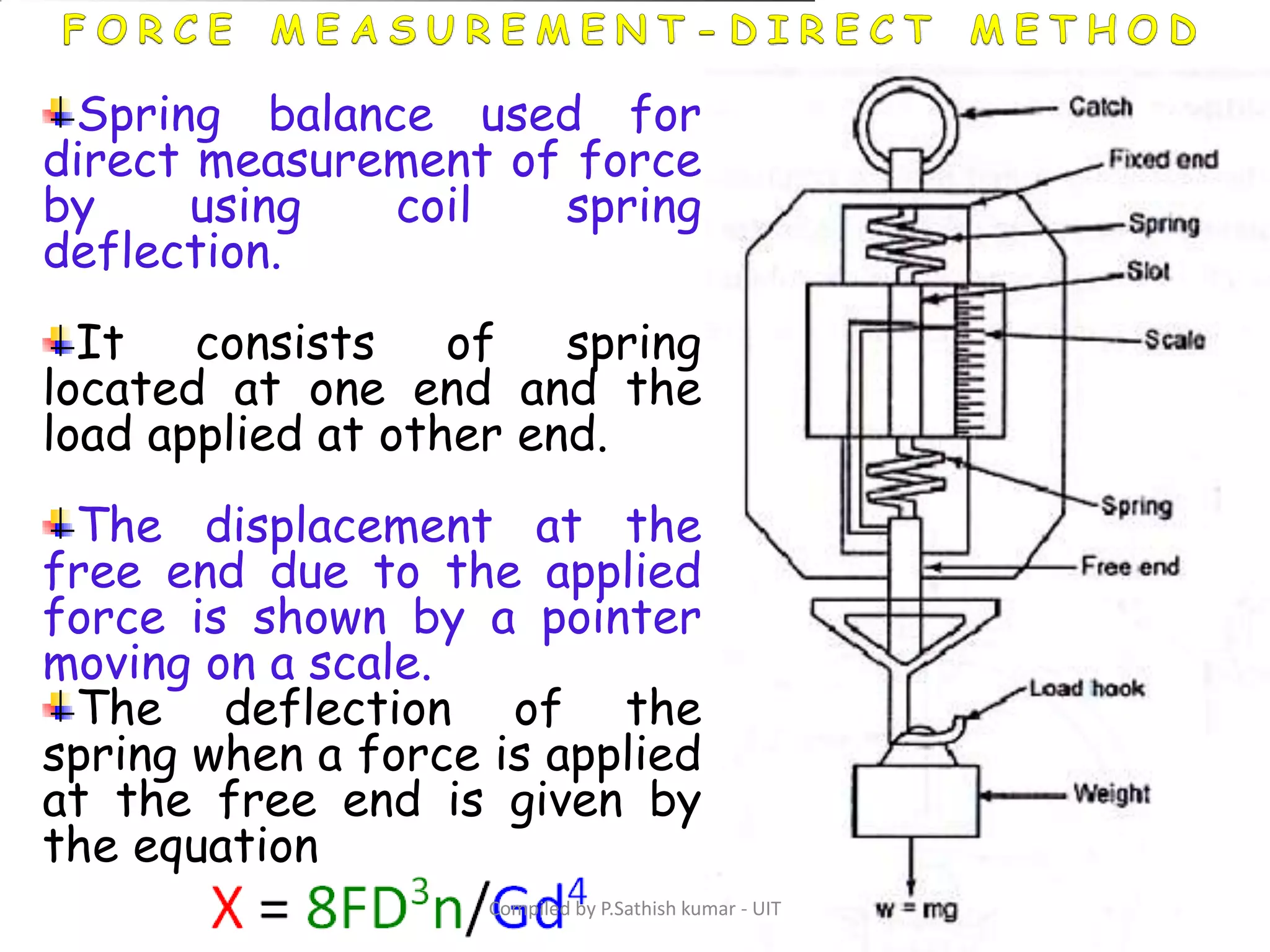
Spring balance used for
direct measurement of force
by using coil spring
deflection.
It consists of spring
located at one end and the
load applied at other end.
The displacement at the
free end due to the applied
force is shown by a pointer
moving on a scale.
The deflection of the
spring when a force is applied
at the free end is given by
the equation
Compiled by P.Sathish kumar - UIT
INDIRECT METHOD
FORCE MEASUREMENT BY ACCELEROMETER
Acceleration is defined as the rate of change
of velocity; and velocity is defined as the rate
of change of position. Velocity is commonly
called speed, so the definition of acceleration
could also be the rate of change of speed.
Accelerometers are sensors that convert the
motion that represents the aspect of
acceleration into an electrical signal.
These devices are typically used to measure
vibration on machines and structures and other
related acceleration detectors and motion
detectors for mines, highways, and bridges that
are located in areas subject to earthquakes.Compiled by P.Sathish kumar - UIT
The most recent application for
accelerometers is to measure vibration on
large machines with pumps or motors with
bearings that tend to wear out.
When these devices wear out
unexpectedly, they cause downtime that is
very expensive.
If the vibration is monitored, the amount
of wear on bearings and gears can be
calculated and the parts can be changed
during scheduled maintenance so that
failure will not cause downtime.
INDIRECT METHOD
FORCE MEASUREMENT BY ACCELEROMETER
Compiled by P.Sathish kumar - UIT
INDIRECT METHOD
FORCE MEASUREMENT BY ACCELEROMETER
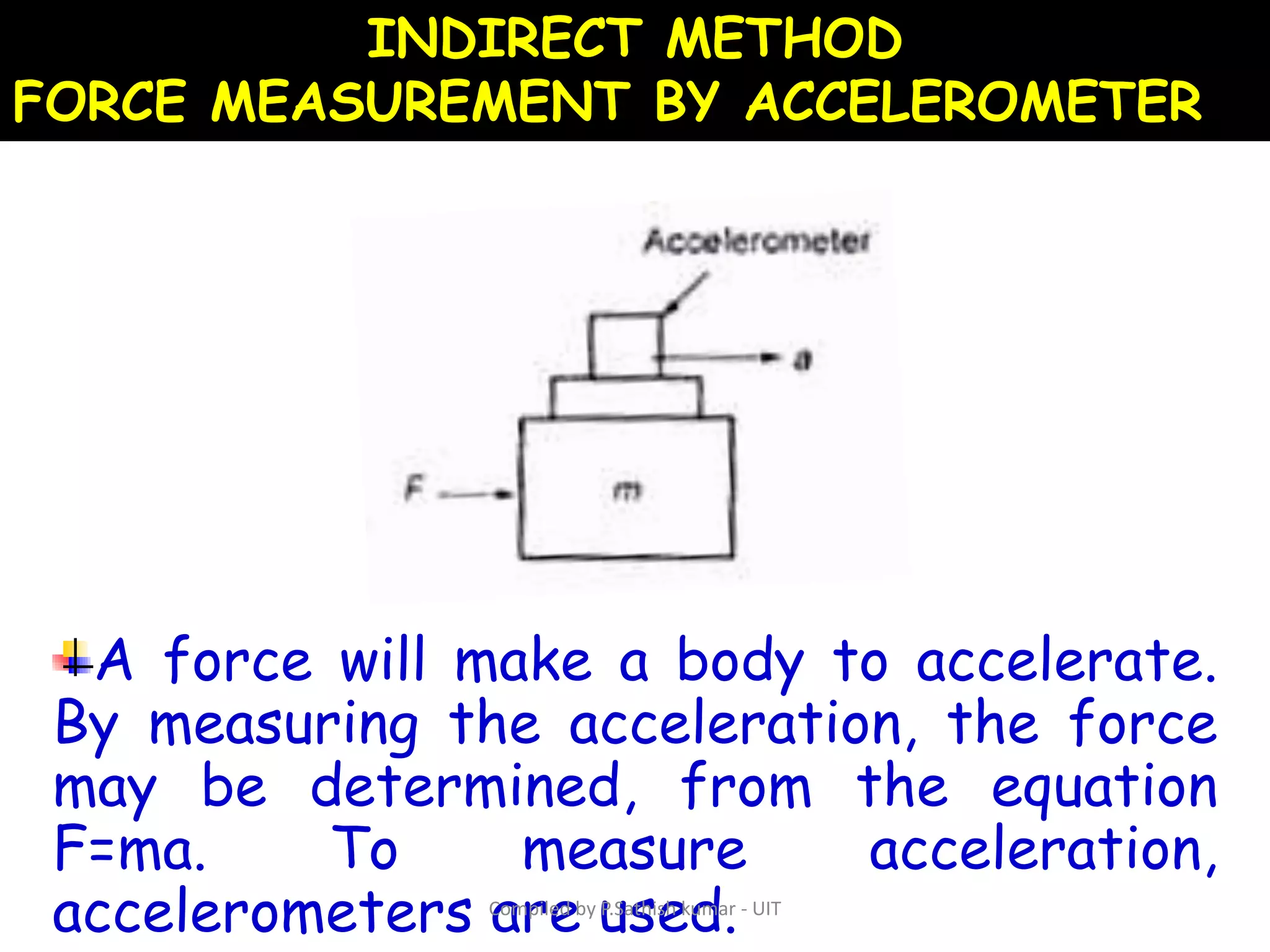
A force will make a body to accelerate.
By measuring the acceleration, the force
may be determined, from the equation
F=ma. To measure acceleration,
accelerometers are used.Compiled by P.Sathish kumar - UIT
INDIRECT METHOD
FORCE MEASUREMENT BY HYDRAULIC LOAD CELL
Compiled by P.Sathish kumar - UIT
INDIRECT METHOD
FORCE MEASUREMENT BY HYDRAULIC LOAD CELL
Basic Principle of Hydraulic Load cell
When a force is applied on a liquid
medium contained in a confined space,
the pressure of the liquid increases.
This increase in pressure of the
liquid is proportional to the applied
force.
Hence a measure of the increase in
pressure of the liquid becomes a
measure of the applied force when
calibrated. Compiled by P.Sathish kumar - UIT
INDIRECT METHOD
FORCE MEASUREMENT BY HYDRAULIC LOAD CELL
Operation of Hydraulic Load Cell
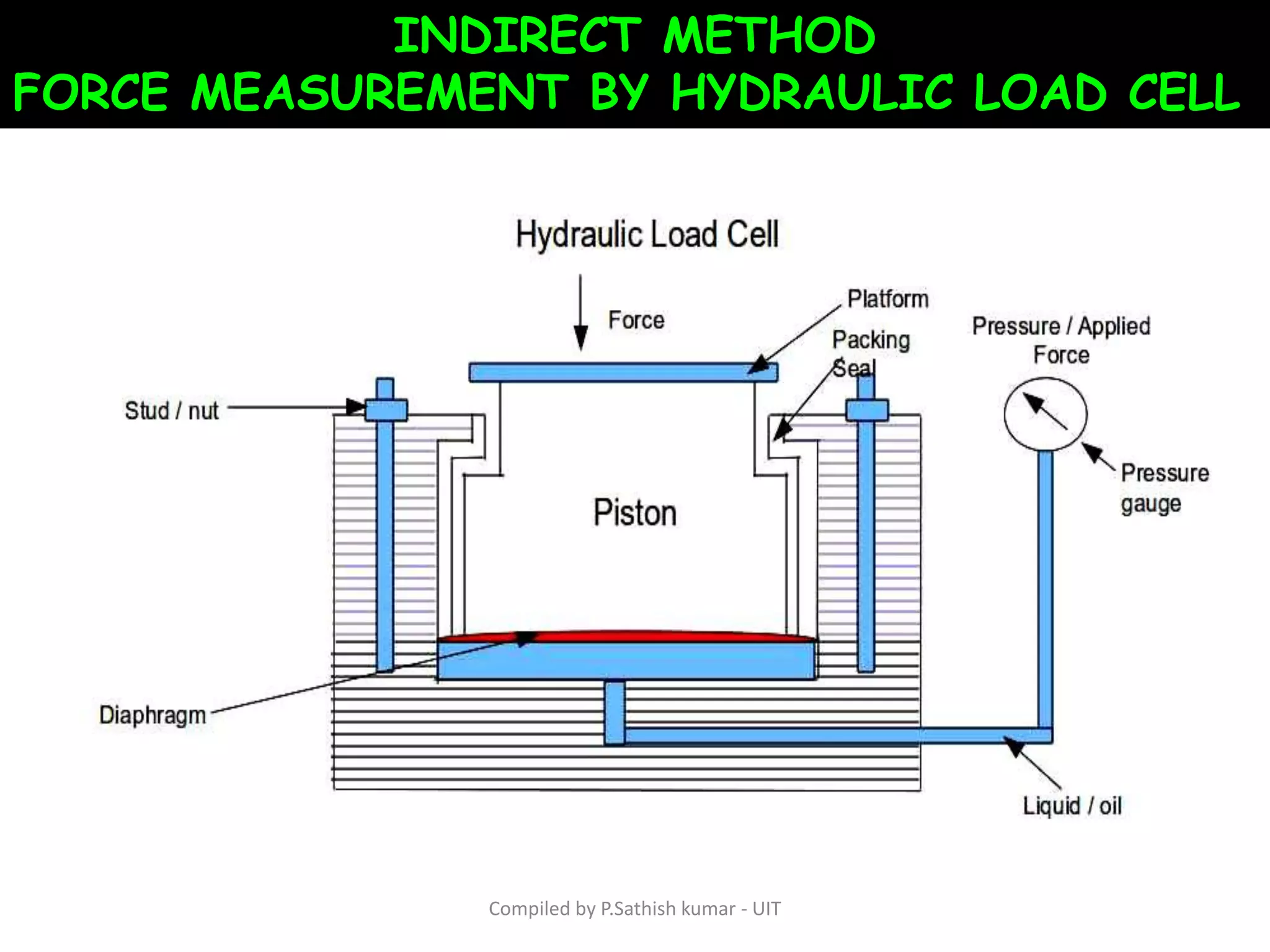
The force to be measured is applied to the
piston.
The applied force moves the piston downwards
and deflects the diaphragm and this deflection of
the diaphragm increases the pressure in the liquid
medium (oil).
This increase in pressure of the liquid medium is
proportional to the applied force.
The increase in pressure is measured by the
pressure gauge which is connected to the liquid
medium.
The pressure is calibrated in force units and
hence the indication in the pressure gauge
becomes a measure of force applied on the piston.Compiled by P.Sathish kumar - UIT
Compiled by P.Sathish kumar - UIT
INDIRECT METHOD
FORCE MEASUREMENT BY PNEUMATIC LOAD CELL
INDIRECT METHOD
FORCE MEASUREMENT BY PNEUMATIC LOAD CELL
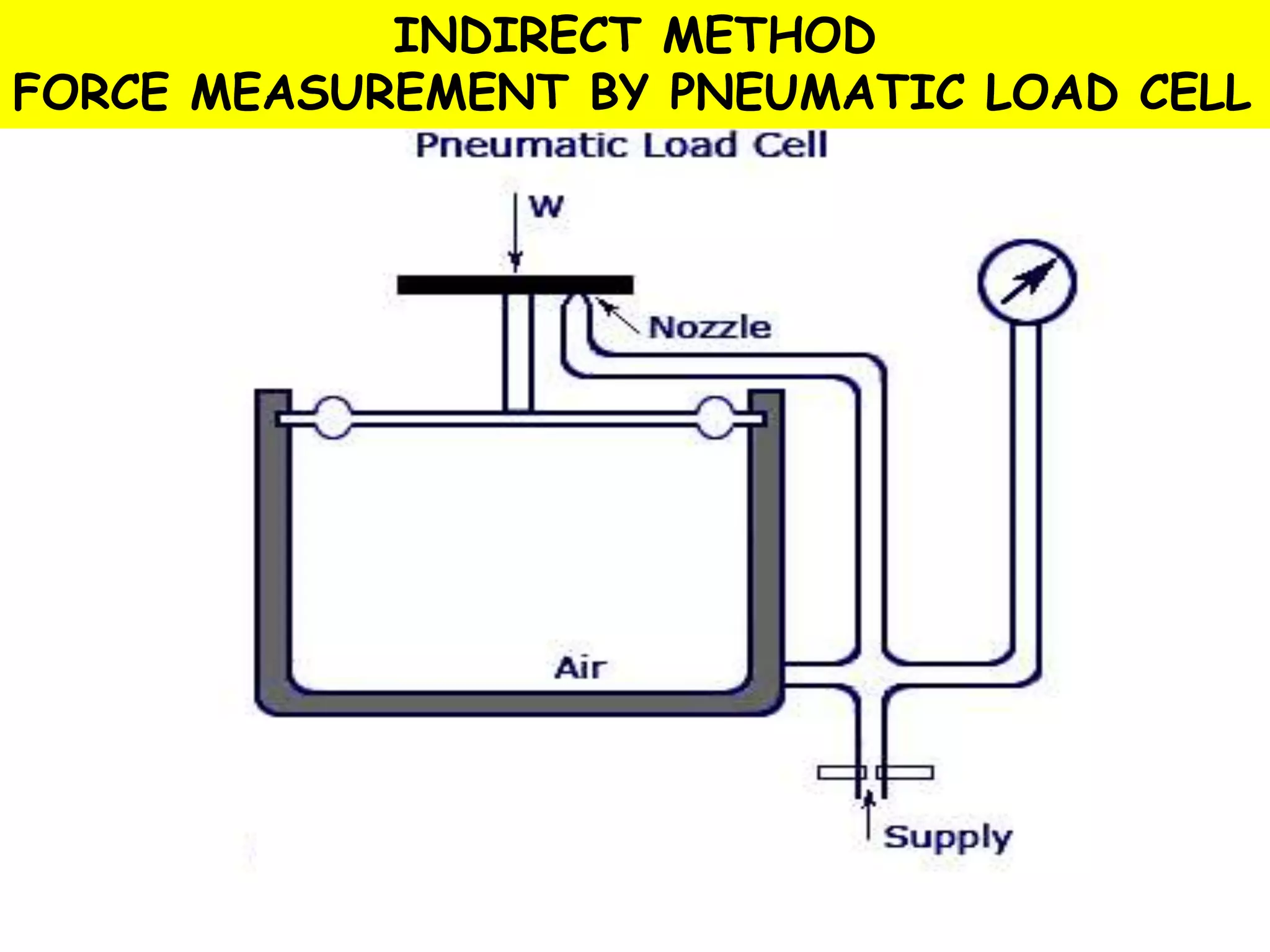
Operation of Pneumatic Load cell
The force to be measured is applied to
the top side of the diaphragm. Due to
this force, the diaphragm deflects and
causes the flapper to shut-off the nozzle
opening.
Now an air supply is provided at the bottom
of the diaphragm. As the flapper closes the
nozzle opening, a back pressure results
underneath the diagram applied force when
calibrated. Compiled by P.Sathish kumar - UIT
INDIRECT METHOD
FORCE MEASUREMENT BY PNEUMATIC LOAD CELL
Operation of Pneumatic Load cell
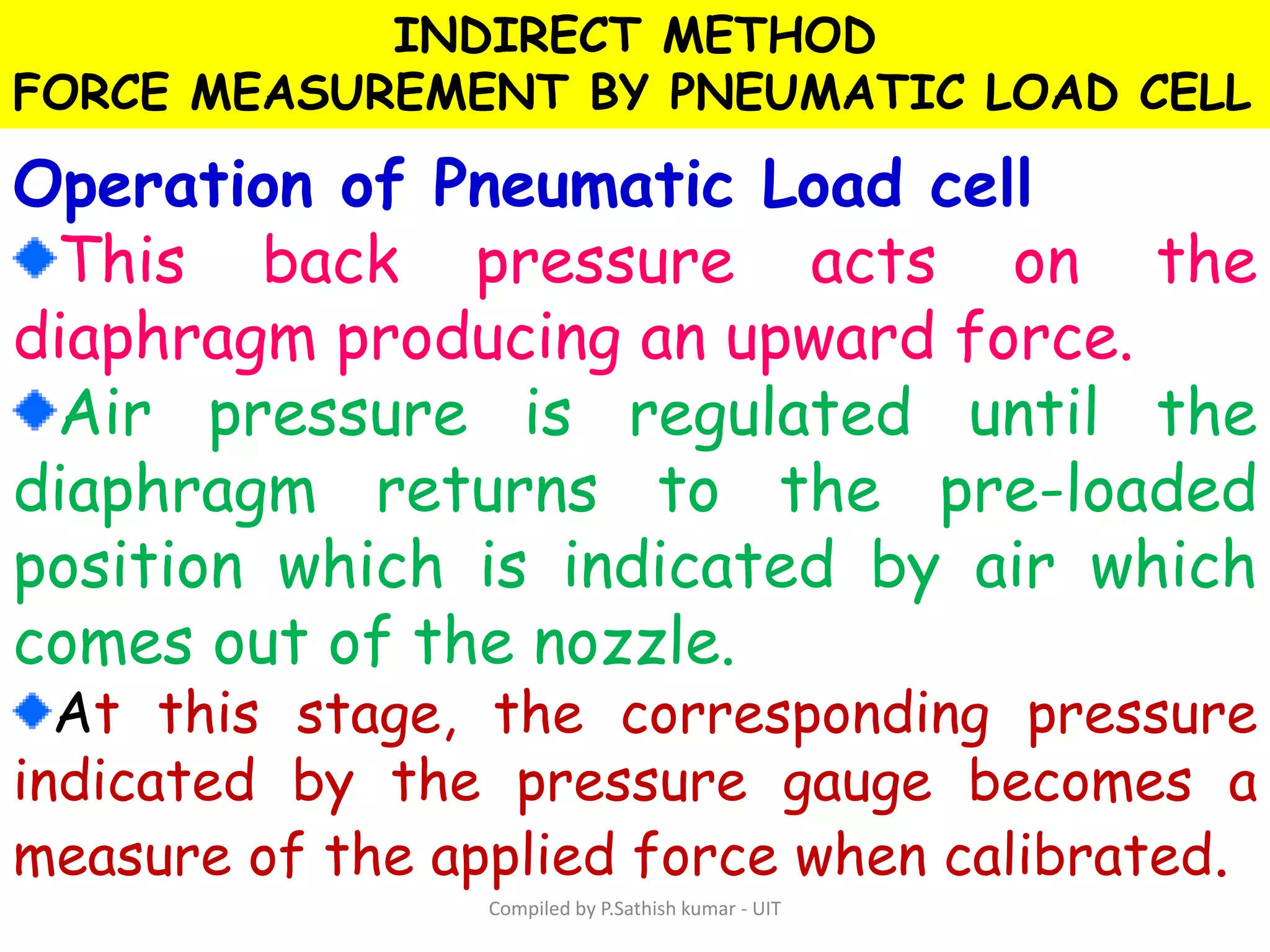
This back pressure acts on the
diaphragm producing an upward force.
Air pressure is regulated until the
diaphragm returns to the pre-loaded
position which is indicated by air which
comes out of the nozzle.
At this stage, the corresponding pressure
indicated by the pressure gauge becomes a
measure of the applied force when calibrated.
Compiled by P.Sathish kumar - UIT
A load cell is a device that is used to
convert a force into electrical signal.
Strain gauge load cells are the most
common types of load cells.
Load cells are used for quick and precise
measurements. Compared with other
sensors, load cells are relatively more
affordable and have a longer life span.
The principle of operation is that the
resistance of the electrical conductor
changes when its length changes due to
stress.
Compiled by P.Sathish kumar - UIT
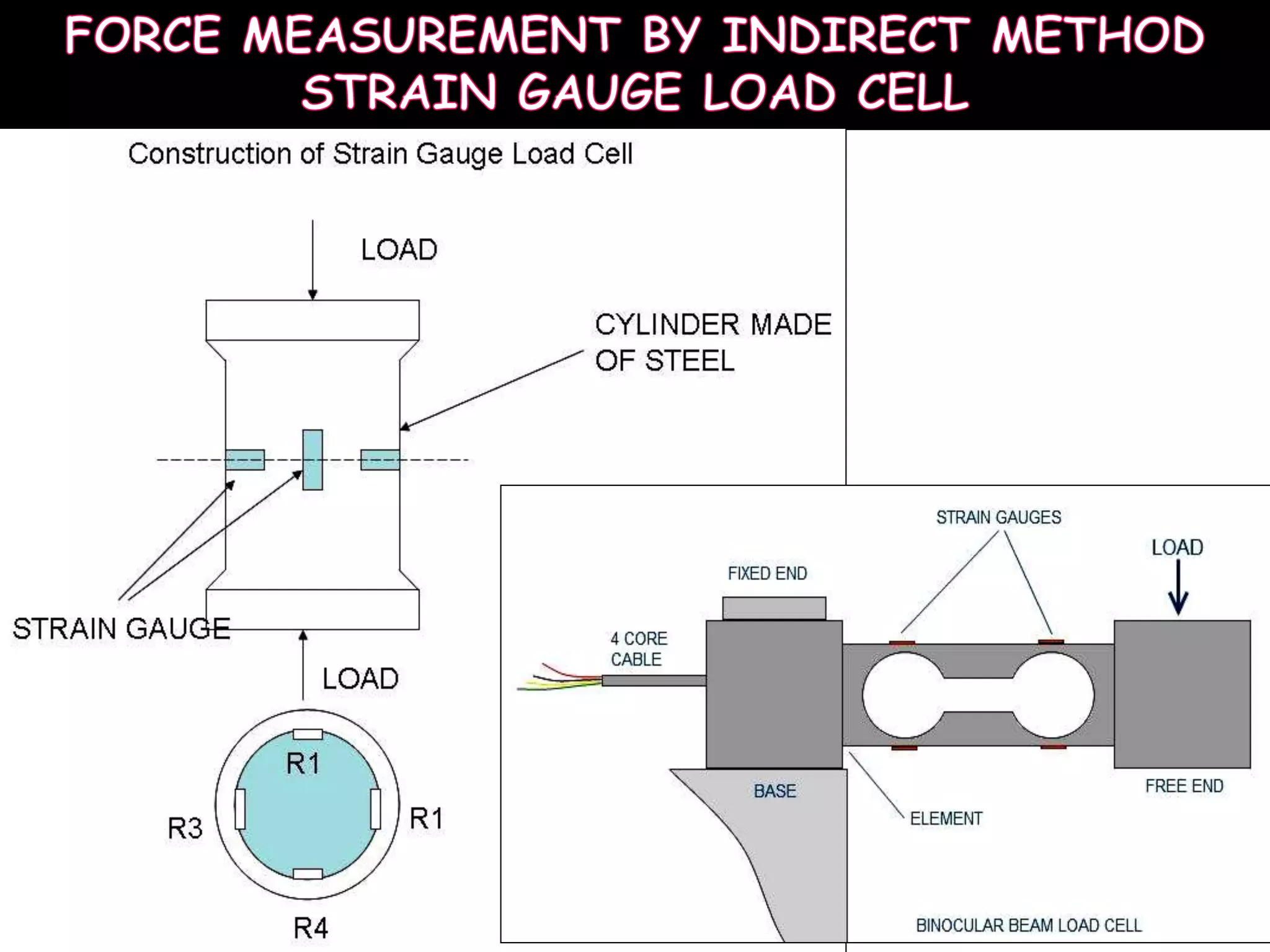
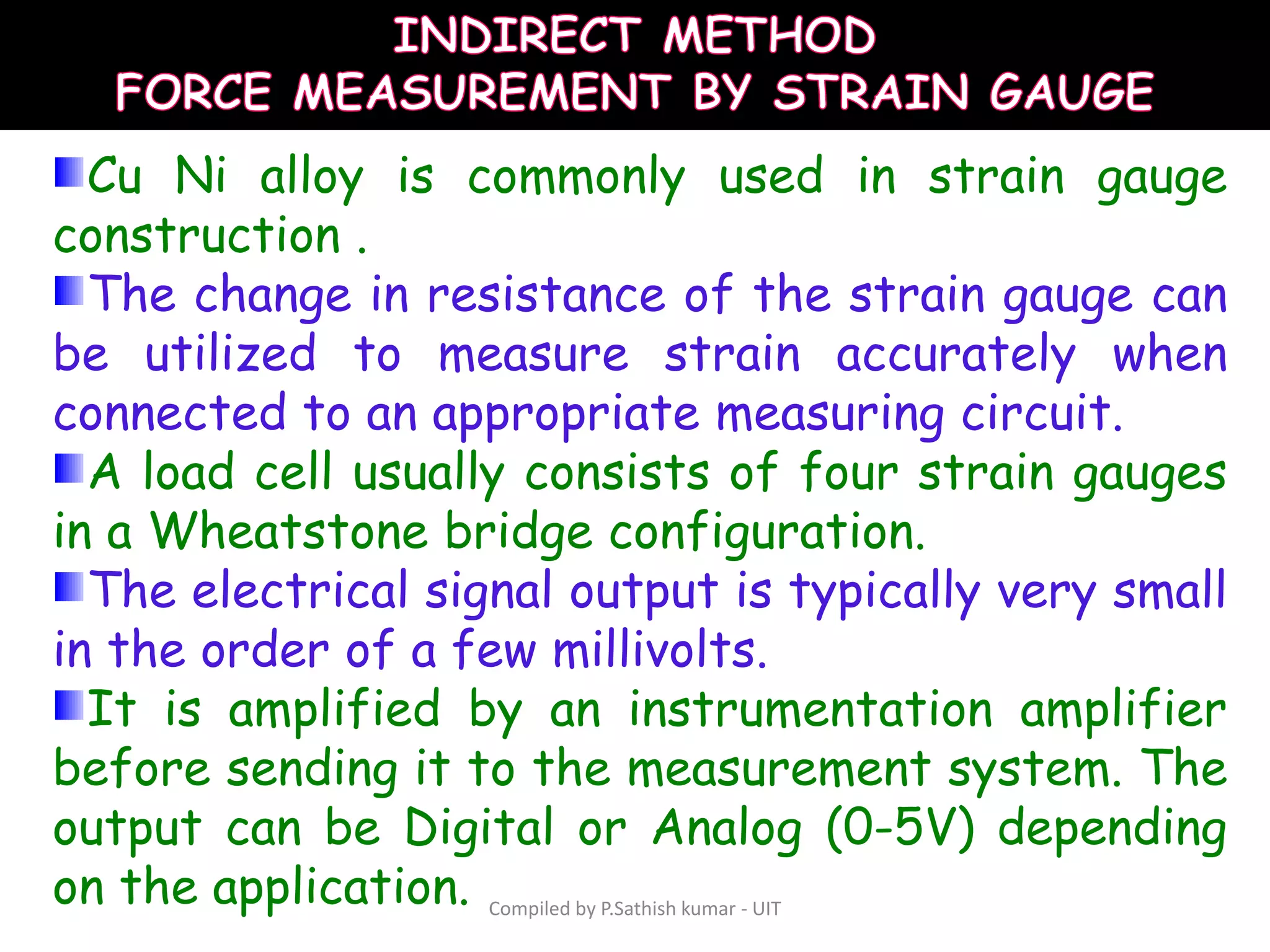
Cu Ni alloy is commonly used in strain gauge
construction .
The change in resistance of the strain gauge can
be utilized to measure strain accurately when
connected to an appropriate measuring circuit.
A load cell usually consists of four strain gauges
in a Wheatstone bridge configuration.
The electrical signal output is typically very small
in the order of a few millivolts.
It is amplified by an instrumentation amplifier
before sending it to the measurement system. The
output can be Digital or Analog (0-5V) depending
on the application.
Compiled by P.Sathish kumar - UIT
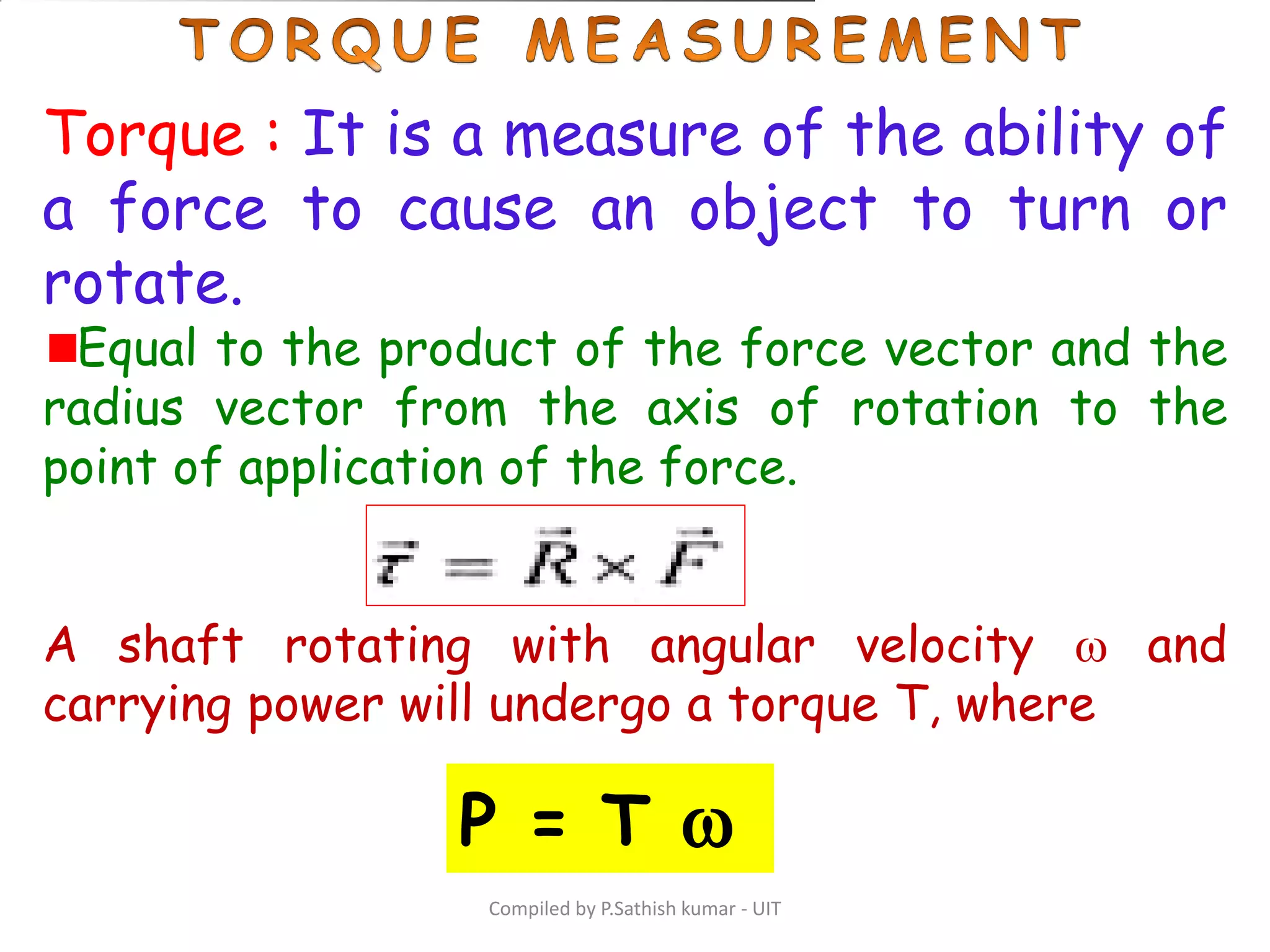
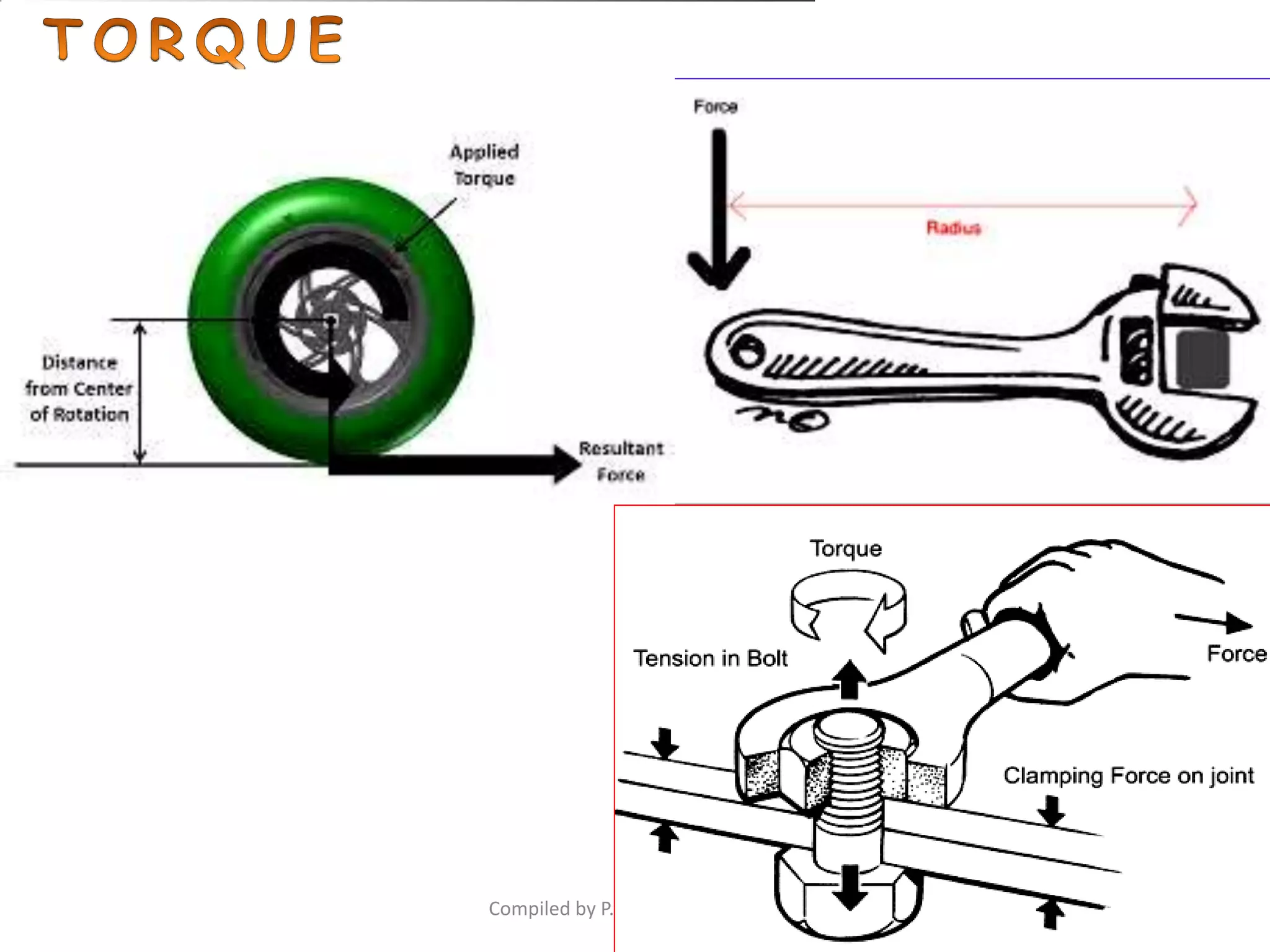
Torque : It is a measure of the ability of
a force to cause an object to turn or
rotate.
Equal to the product of the force vector and the
radius vector from the axis of rotation to the
point of application of the force.
A shaft rotating with angular velocity  and
carrying power will undergo a torque T, where
P = T 
Compiled by P.Sathish kumar - UIT
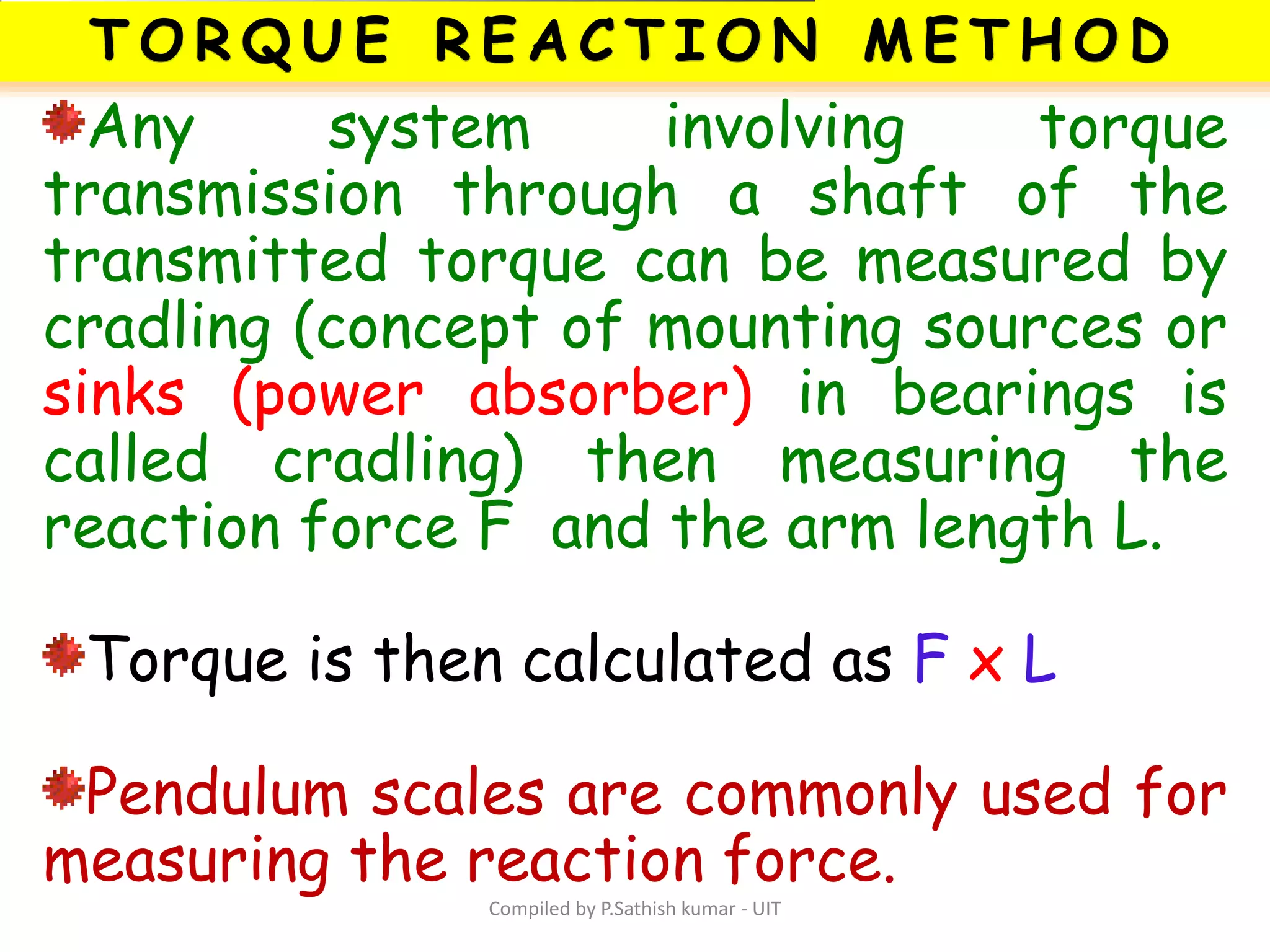
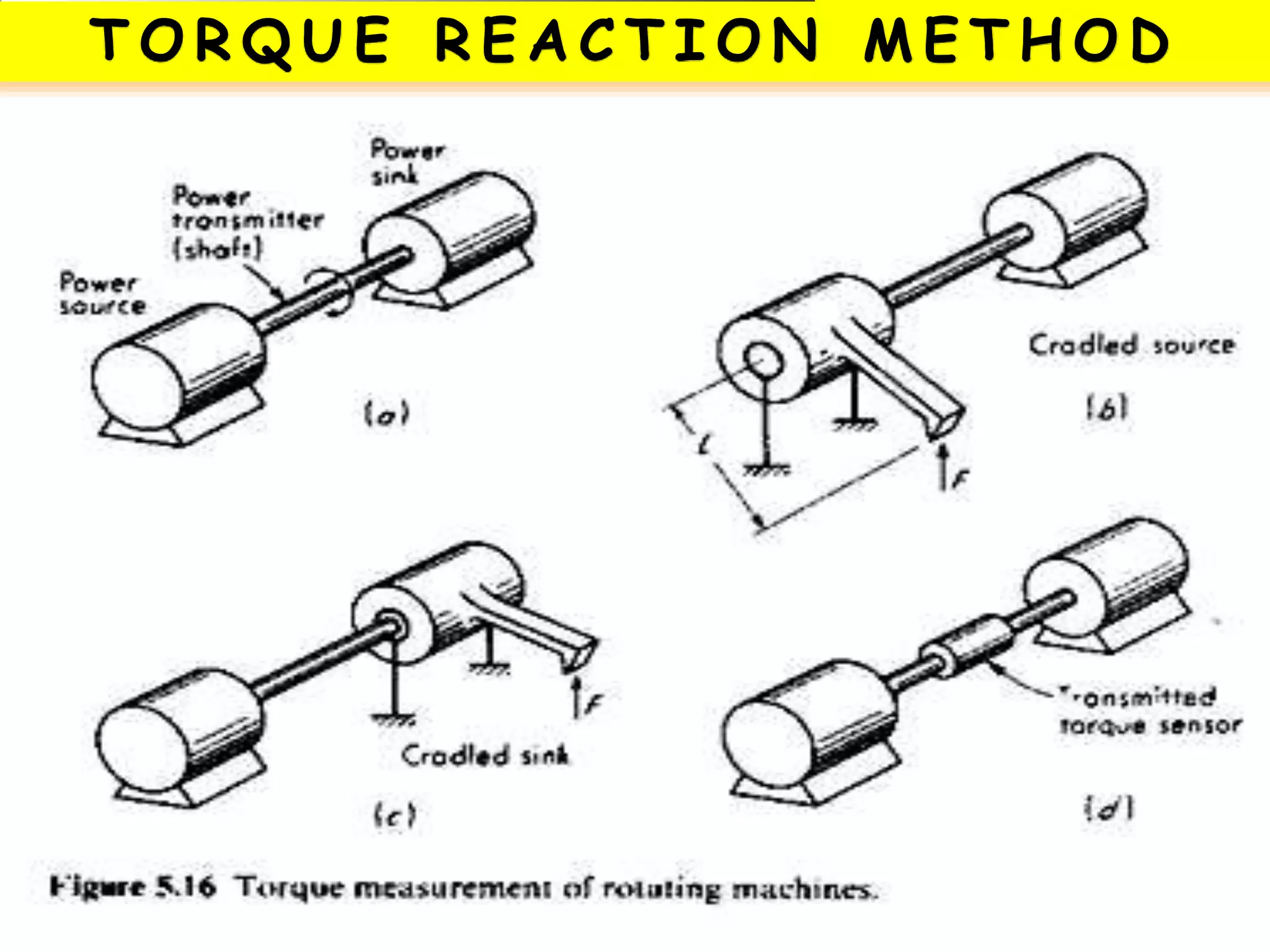
Any system involving torque
transmission through a shaft of the
transmitted torque can be measured by
cradling (concept of mounting sources or
sinks (power absorber) in bearings is
called cradling) then measuring the
reaction force F and the arm length L.
Torque is then calculated as F x L
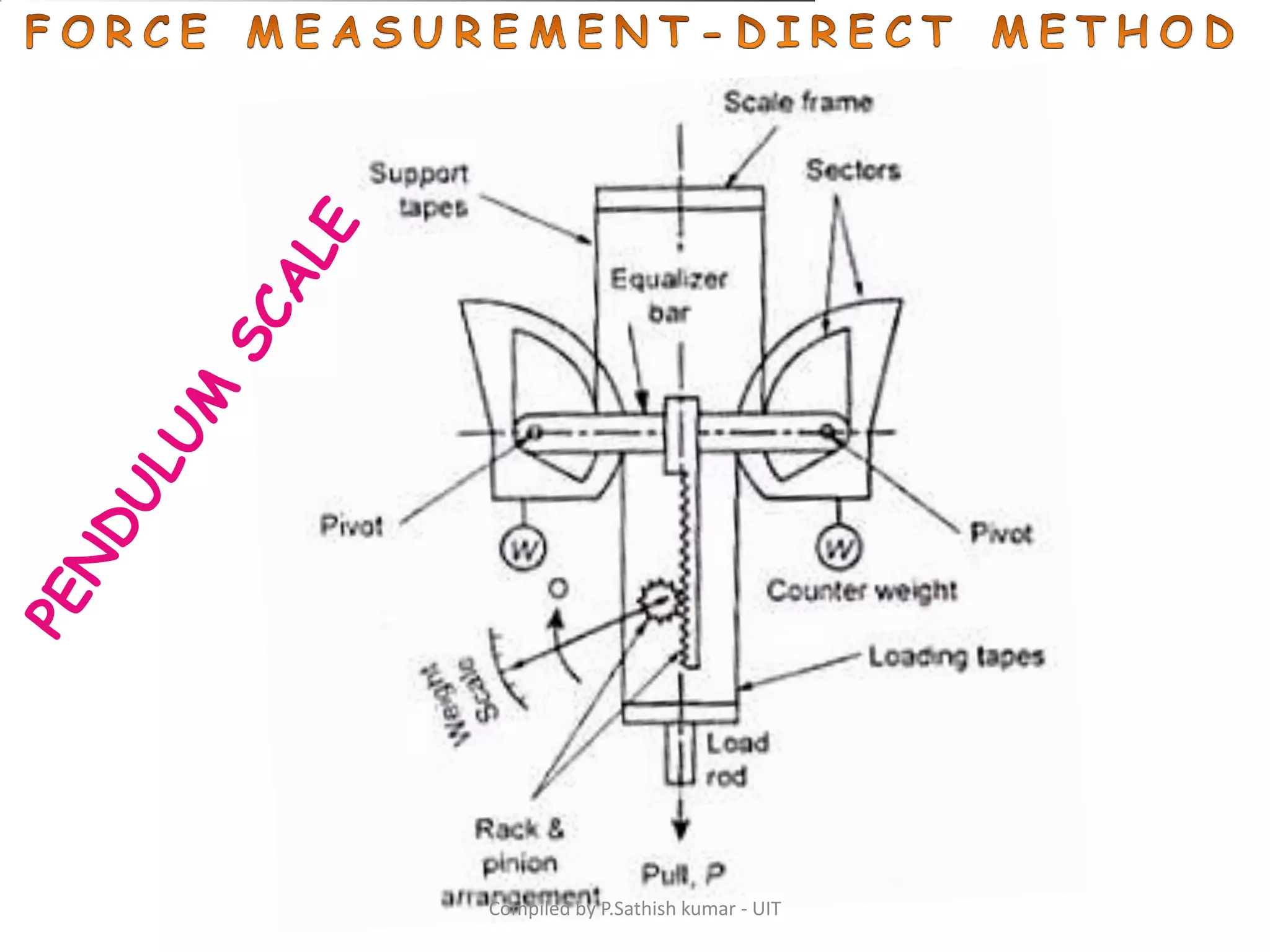
Pendulum scales are commonly used for
measuring the reaction force.
Compiled by P.Sathish kumar - UIT
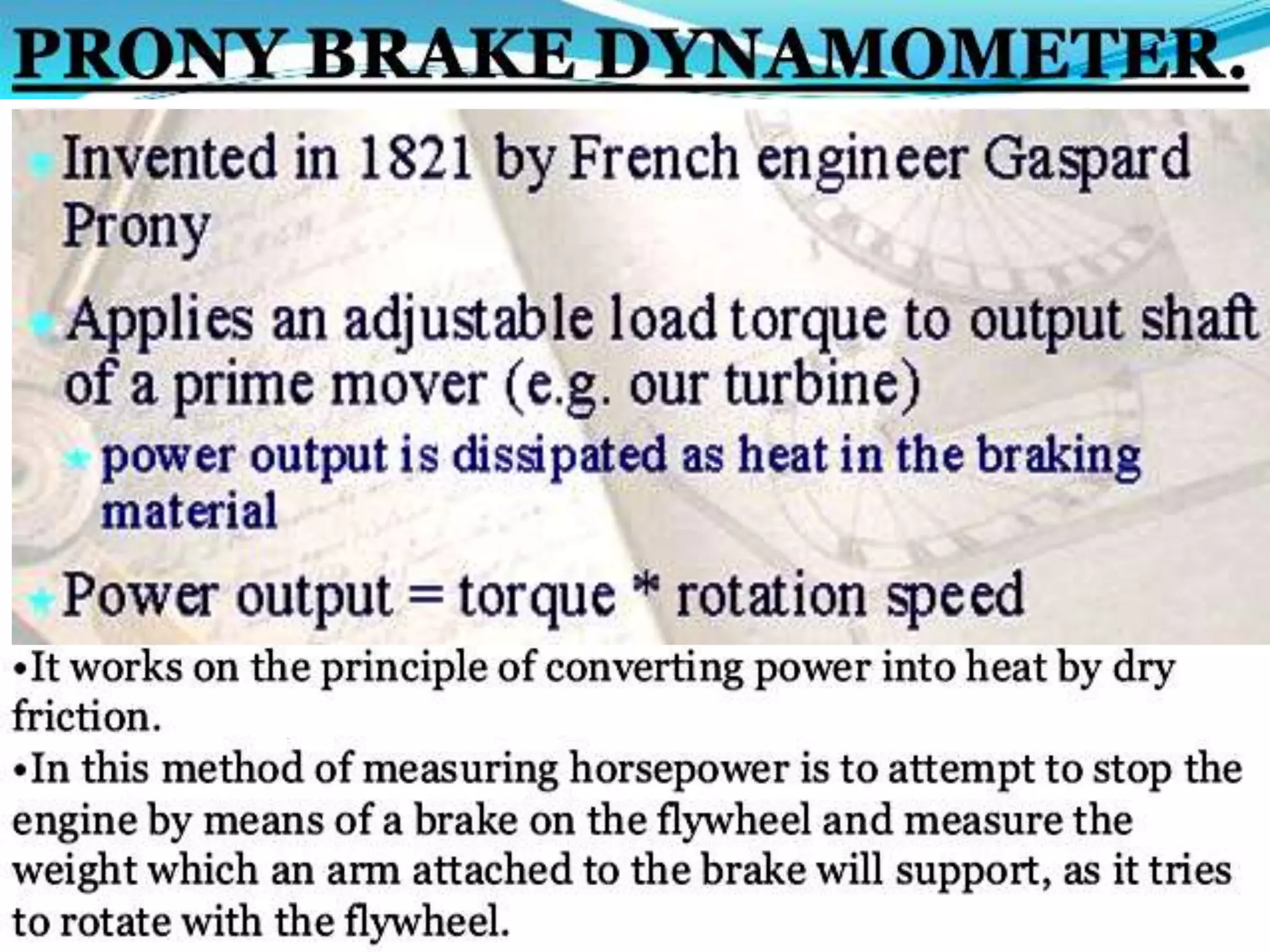
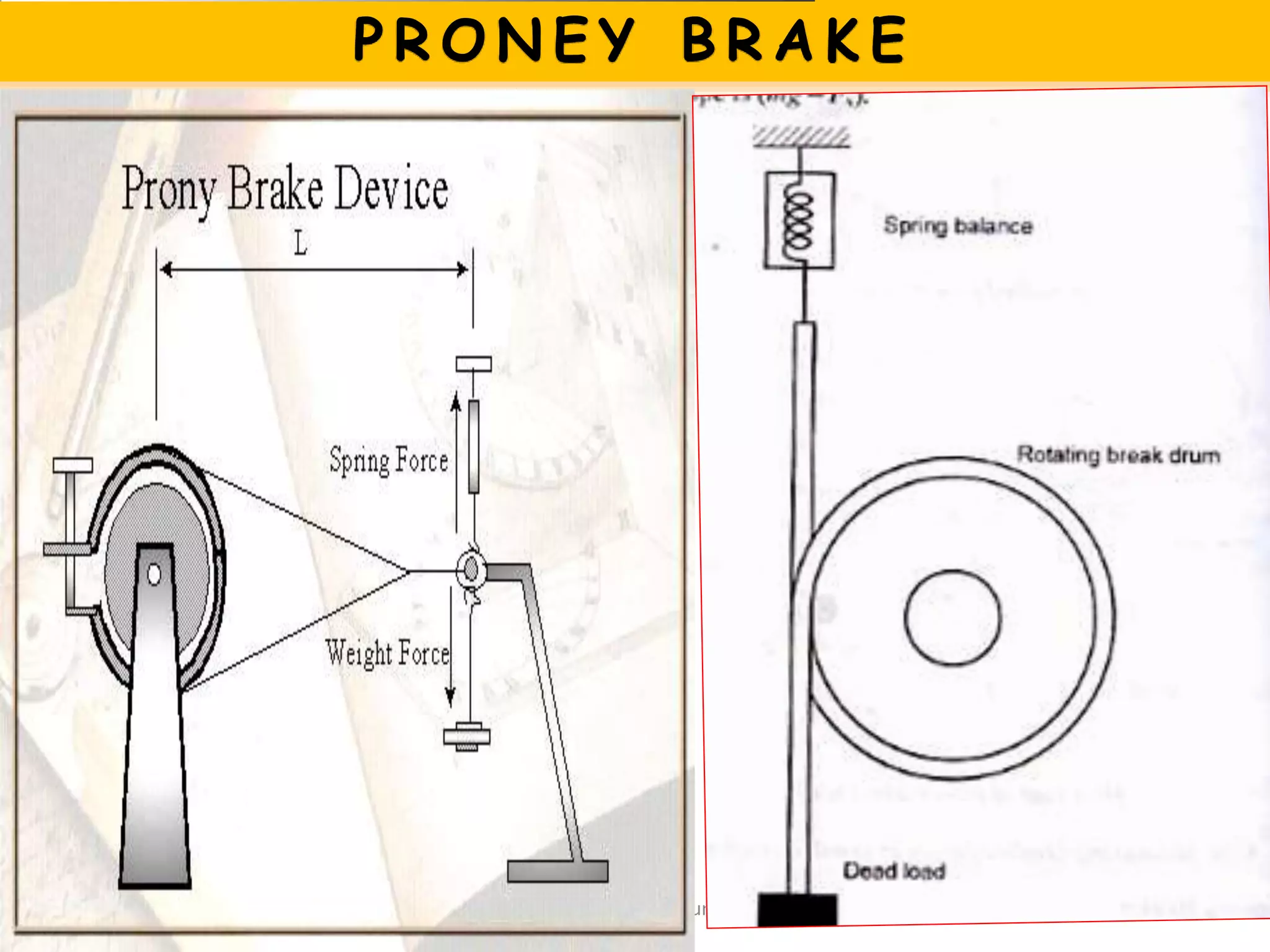
It is one of the earliest methods of
measuring the torque in a rotating shaft.
In this system, all the power produced
is absorbed by friction in a brake.
A rope or belt brake is wrapped around
a flywheel carried by the shaft.
The rope passes once around the
flywheel and is attached to a mass, m at
the bottom.
The other end of the rope is connected
to a spring balance which measures the
tension in the rope, Fs.
Compiled by P.Sathish kumar - UIT
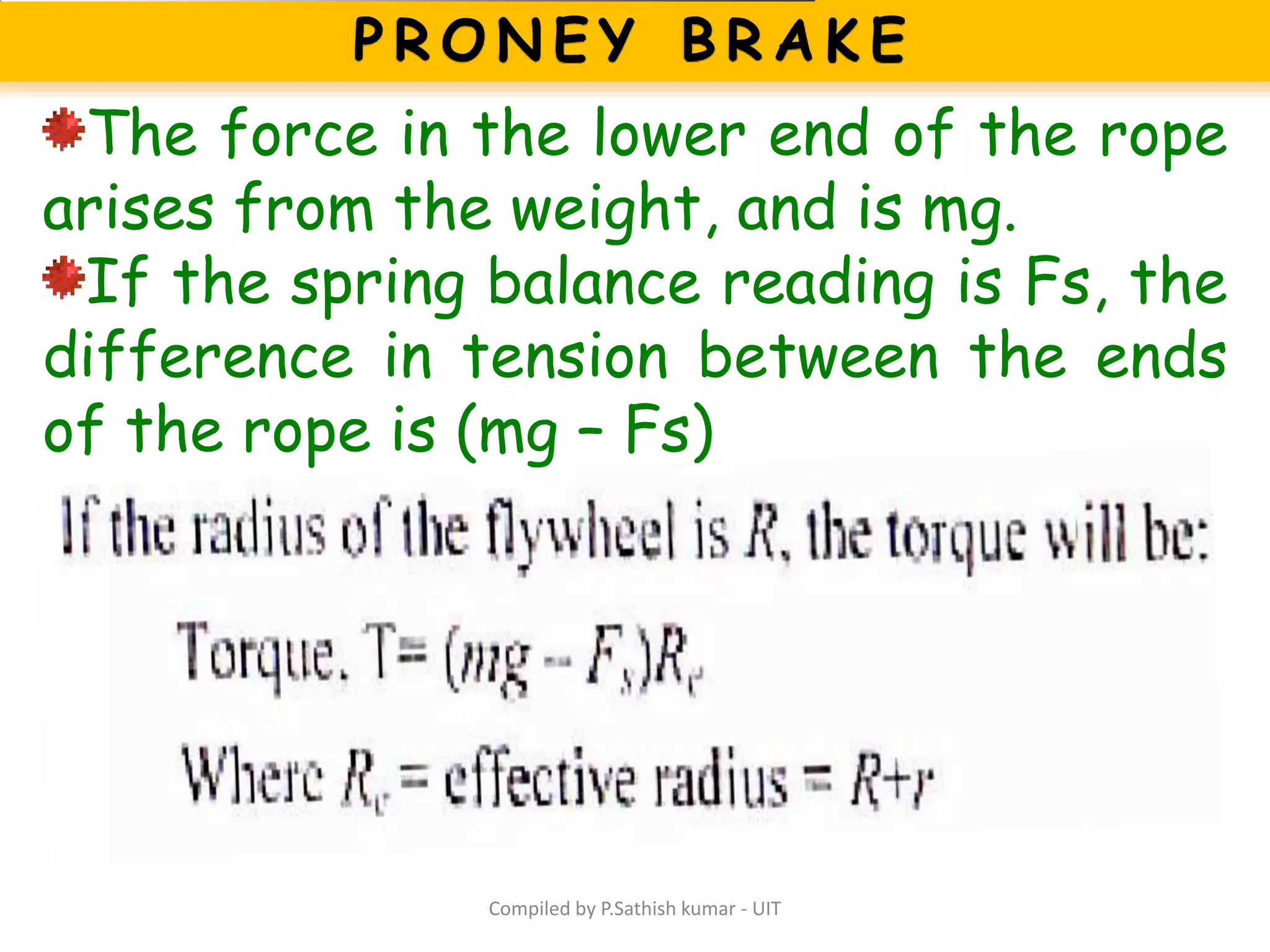
The force in the lower end of the rope
arises from the weight, and is mg.
If the spring balance reading is Fs, the
difference in tension between the ends
of the rope is (mg – Fs)
Compiled by P.Sathish kumar - UIT
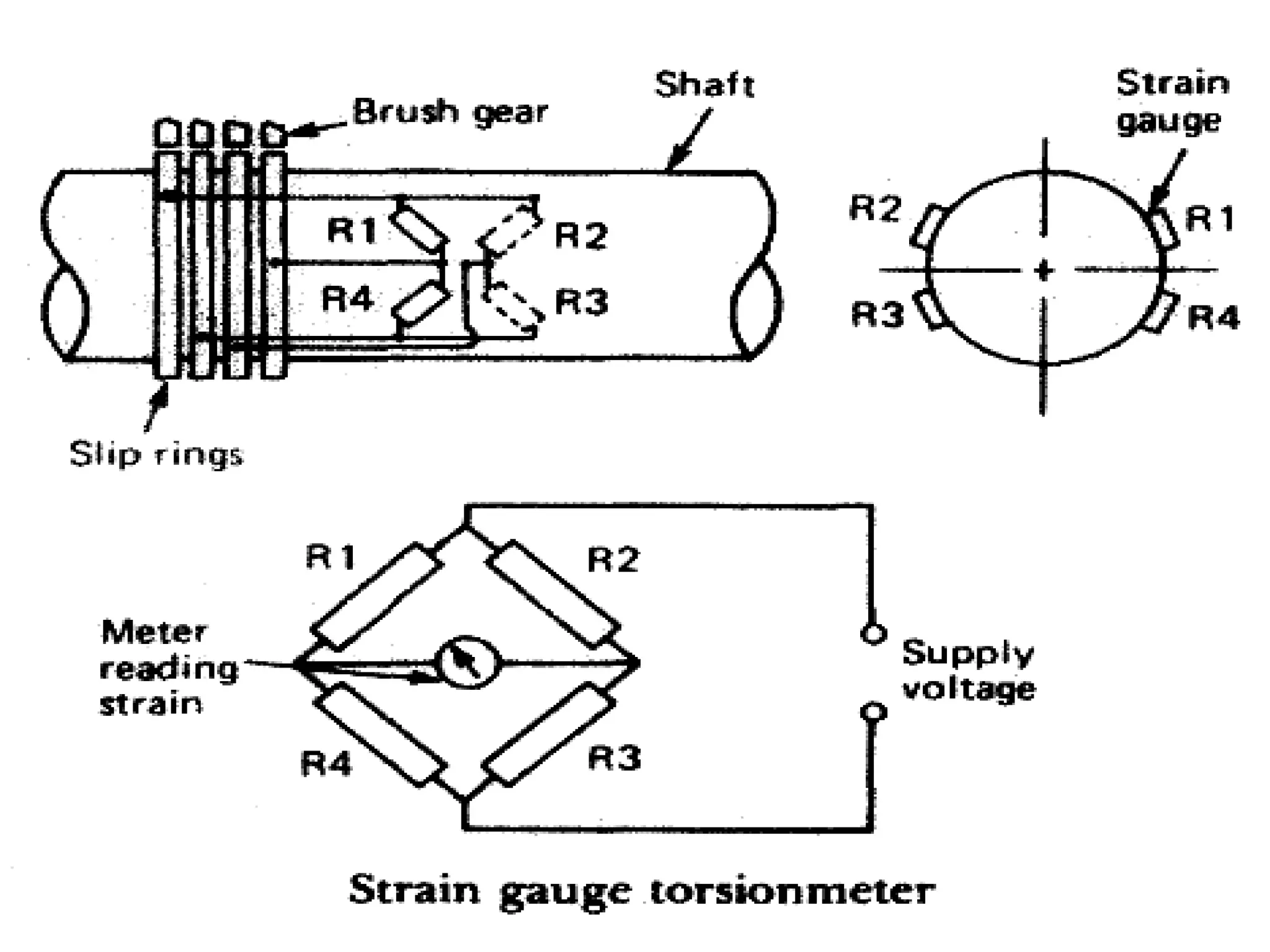
Strain gauge transducer converts torque into
electrical signal.
The strain gauge is bonded to a beam or
structural member that deforms when a torque or
force is applied.
 Deflection induces a stress that changes its
resistance.
A Wheatstone bridge converts the resistance
change into a calibrated output signal.
The sensor's output is a function of force and
distance.
Two common ways to obtain torque measurements are by
strain-gauging the shaft and by using in-line torque cells.
Compiled by P.Sathish kumar - UIT
A dynamometer is a machine used to measure torque and
rotational speed from which power produced by a motor can
be measured.
Compiled by P.Sathish kumar - UIT
.
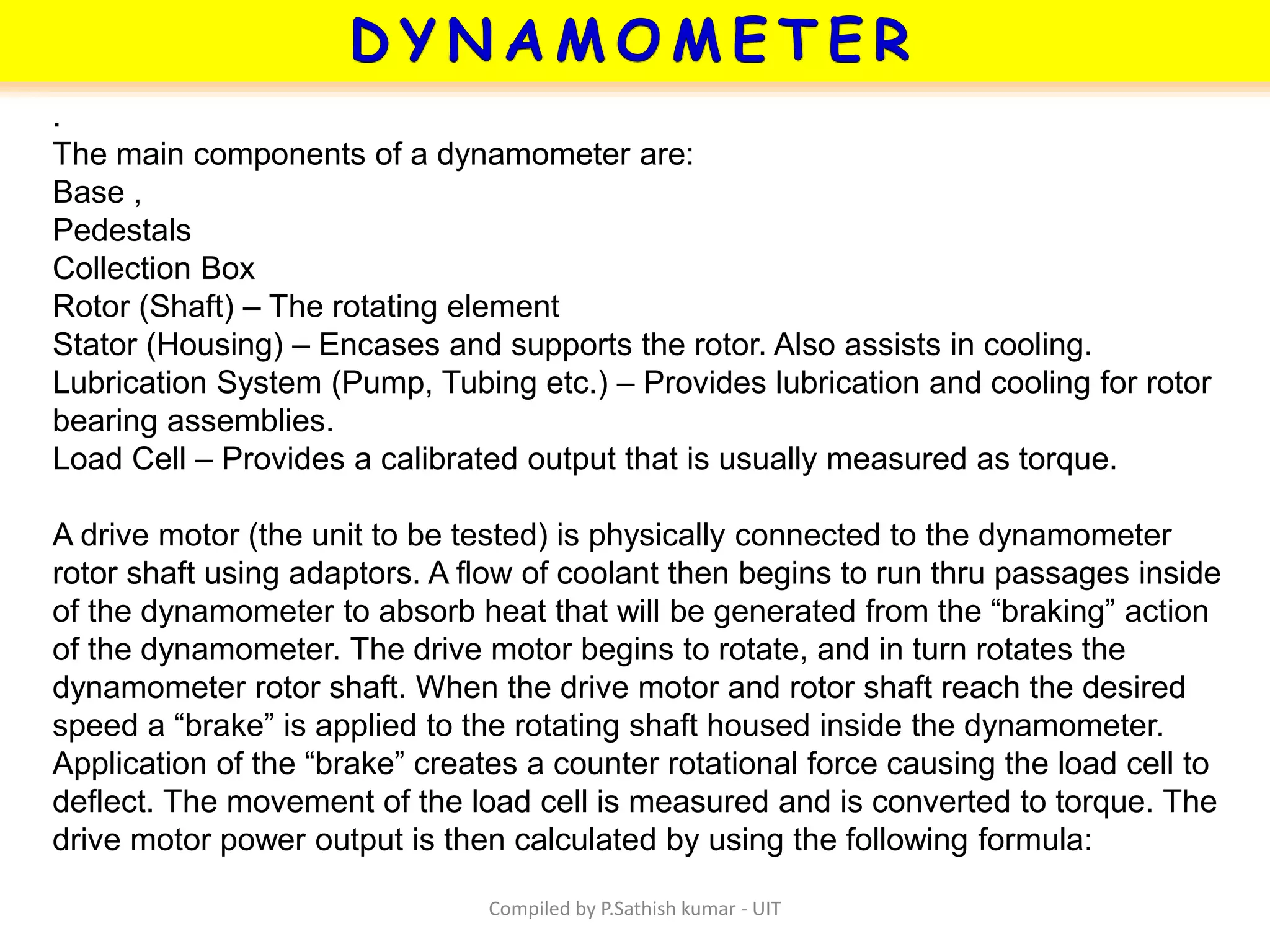
The main components of a dynamometer are:
Base ,
Pedestals
Collection Box
Rotor (Shaft) – The rotating element
Stator (Housing) – Encases and supports the rotor. Also assists in cooling.
Lubrication System (Pump, Tubing etc.) – Provides lubrication and cooling for rotor
bearing assemblies.
Load Cell – Provides a calibrated output that is usually measured as torque.
A drive motor (the unit to be tested) is physically connected to the dynamometer
rotor shaft using adaptors. A flow of coolant then begins to run thru passages inside
of the dynamometer to absorb heat that will be generated from the “braking” action
of the dynamometer. The drive motor begins to rotate, and in turn rotates the
dynamometer rotor shaft. When the drive motor and rotor shaft reach the desired
speed a “brake” is applied to the rotating shaft housed inside the dynamometer.
Application of the “brake” creates a counter rotational force causing the load cell to
deflect. The movement of the load cell is measured and is converted to torque. The
drive motor power output is then calculated by using the following formula:
Compiled by P.Sathish kumar - UIT
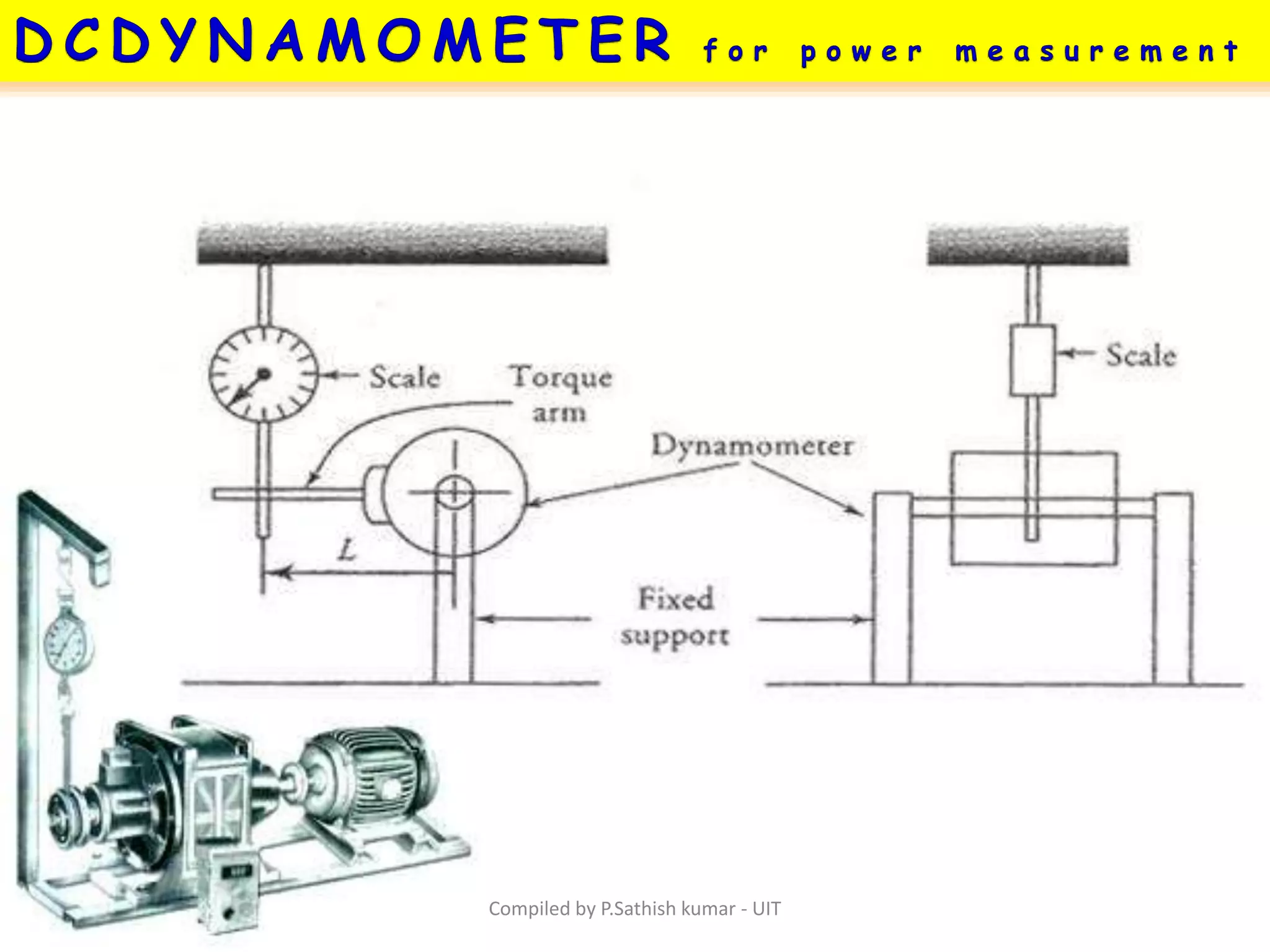
• The armature of the dynamometer is rotated by coupling it
to the shaft of the motor under test. The rotation of the
armature coils in a uniform magnetic field results in an
induced emf in them (generator action). If the armature
circuit is completed by connecting the armature coils to a
resistive load, a current will flow in the armature winding.
The magnitude of the current depends upon the induced
emf and the load resistance. The current-carrying conductors
in a uniform magnetic field now experience a force acting on
them (motor action). The direction of the force is such that it
tends to resist the rotation of the armature. Because the
stator, which houses the field windings, is free to rotate, it is
pulled around equally by the motor action. The only
restraining force acting on the stator is provided by the
spring, very much like the prony brake test. By controlling
the flux in the motor, we can control the speed of the motor
and make it run at any desired speed.
• A 5-hp motor rated at 1200 rpm is tested on a dynamometer
whose torque arm is 40 cm in length.Compiled by P.Sathish kumar - UIT
Compiled by P.Sathish kumar - UIT
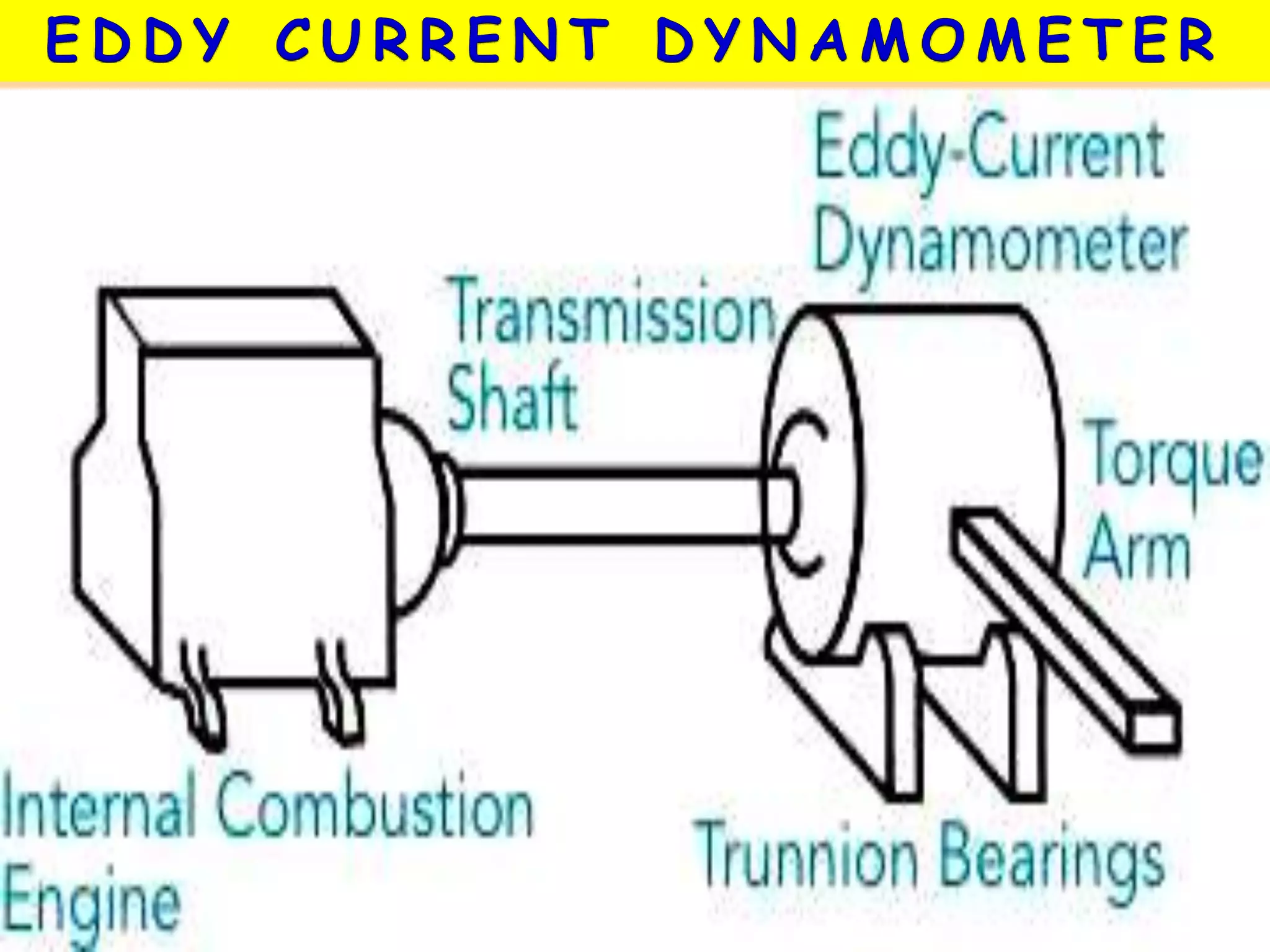
• an internal combustion engine connected to an
eddy-current dynamometer. The engine is
considered a nonlinear angular velocity source
(ϖE) modulated by the throttle setting θ(t). The
main energy storage is associated with the
rotating inertia JE, lumped at the output of the
engine shaft. The torque transmission shaft has
compliance and energy dissipation, and is
modeled with a rotational spring KS and
rotational damper BS. The shaft inertia is
neglected.
Compiled by P.Sathish kumar - UIT
• The dynamometer consists of a toothed rotor
JR that rotates (ϖR) in the magnetic field
created by passing current (t) through the
stator windings. A voltage is induced in the
conductive rotor rotating in the stator magnetic
field (Faraday’s Law). This induced voltage
creates eddy currents in the rotor that generate
a magnetic field (Ampere’s Law), which
opposes the stator magnetic field (Lenz’s Law).
• The stator inertia JS, mounted in trunnion
bearings, is free to rotate, but is restrained by a
torque arm to measure the torque developed.Compiled by P.Sathish kumar - UIT
Compiled by P.Sathish kumar - UIT
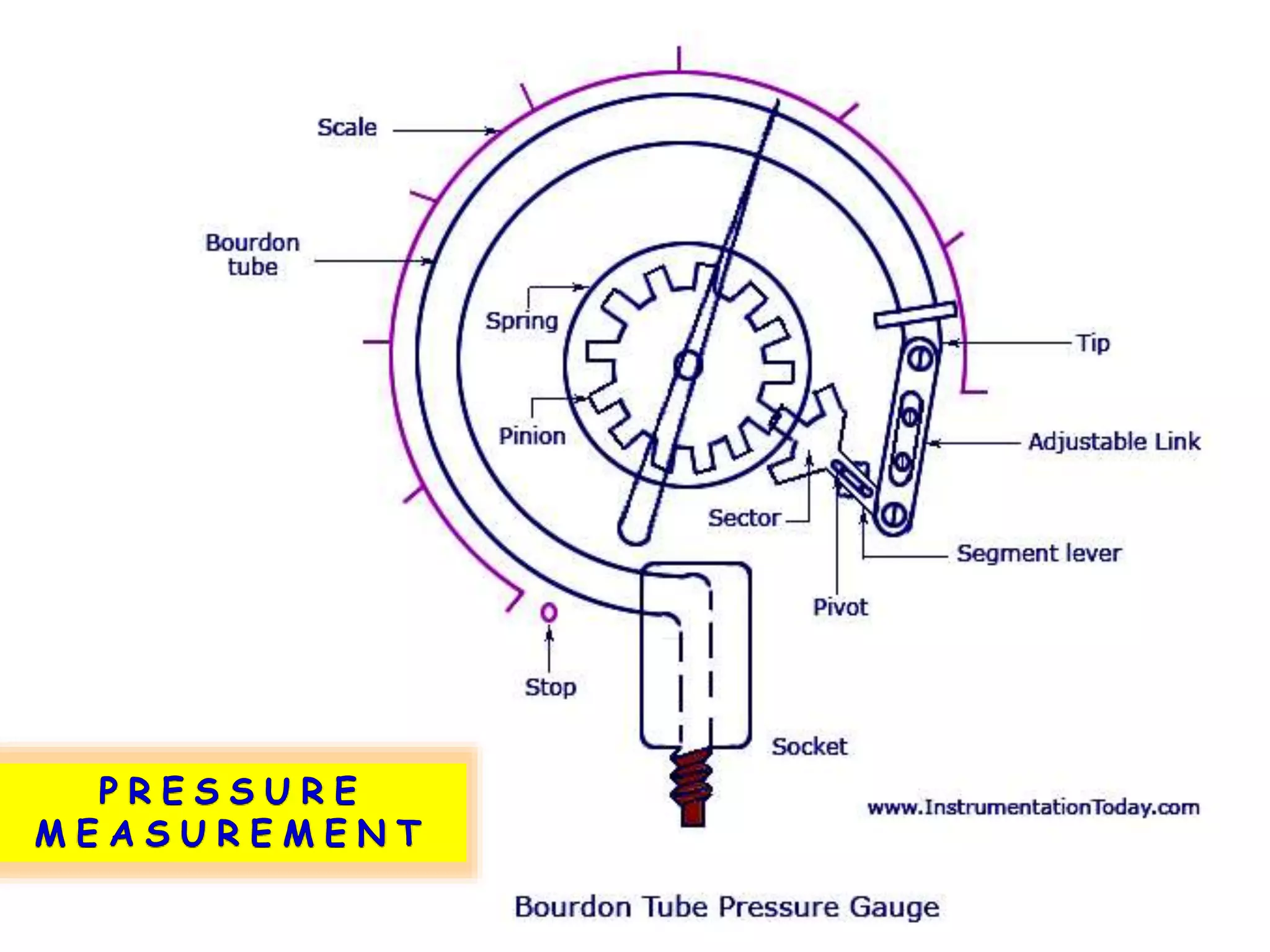
• Bourdon Tubes are known for its very high range
of differential pressure measurement in the range
of almost 100,000 psi (700 MPa). It is an elastic
type pressure transducer.
• the pressure input is given to a socket which is
soldered to the tube at the base. The other end or
free end of the device is sealed by a tip. This tip is
connected to a segmental lever through an
adjustable length link. The lever length may also
be adjustable. The segmental lever is suitably
pivoted and the spindle holds the pointer as
shown in the figure. A hair spring is sometimes
used to fasten the spindle of the frame of the
instrument to provide necessary tension for
proper meshing of the gear teeth and thereby
freeing the system from the backlashCompiled by P.Sathish kumar - UIT
• As the fluid pressure enters the bourdon tube,
it tries to be reformed and because of a free tip
available, this action causes the tip to travel in
free space and the tube unwinds. The
simultaneous actions of bending and tension
due to the internal pressure make a non-linear
movement of the free tip. This travel is suitable
guided and amplified for the measurement of
the internal pressure.
Compiled by P.Sathish kumar - UIT
Measurement of FLOW is done by
Mechanical flow meters: Flow is measured
by placing an obstruction in the flow pipe,
which results in development of torque on
vanes due to pressure difference.
Electrical flow meters: The
electromagnetic field will be produced in a
coil corresponding to the amount of fluid
flowing in the pipe.
But in recent days, flow sensors are found
in many consumer products or electro-
mechanical transducers are used to find out
the flow rate of pipe fluid.
Compiled by P.Sathish kumar - UIT
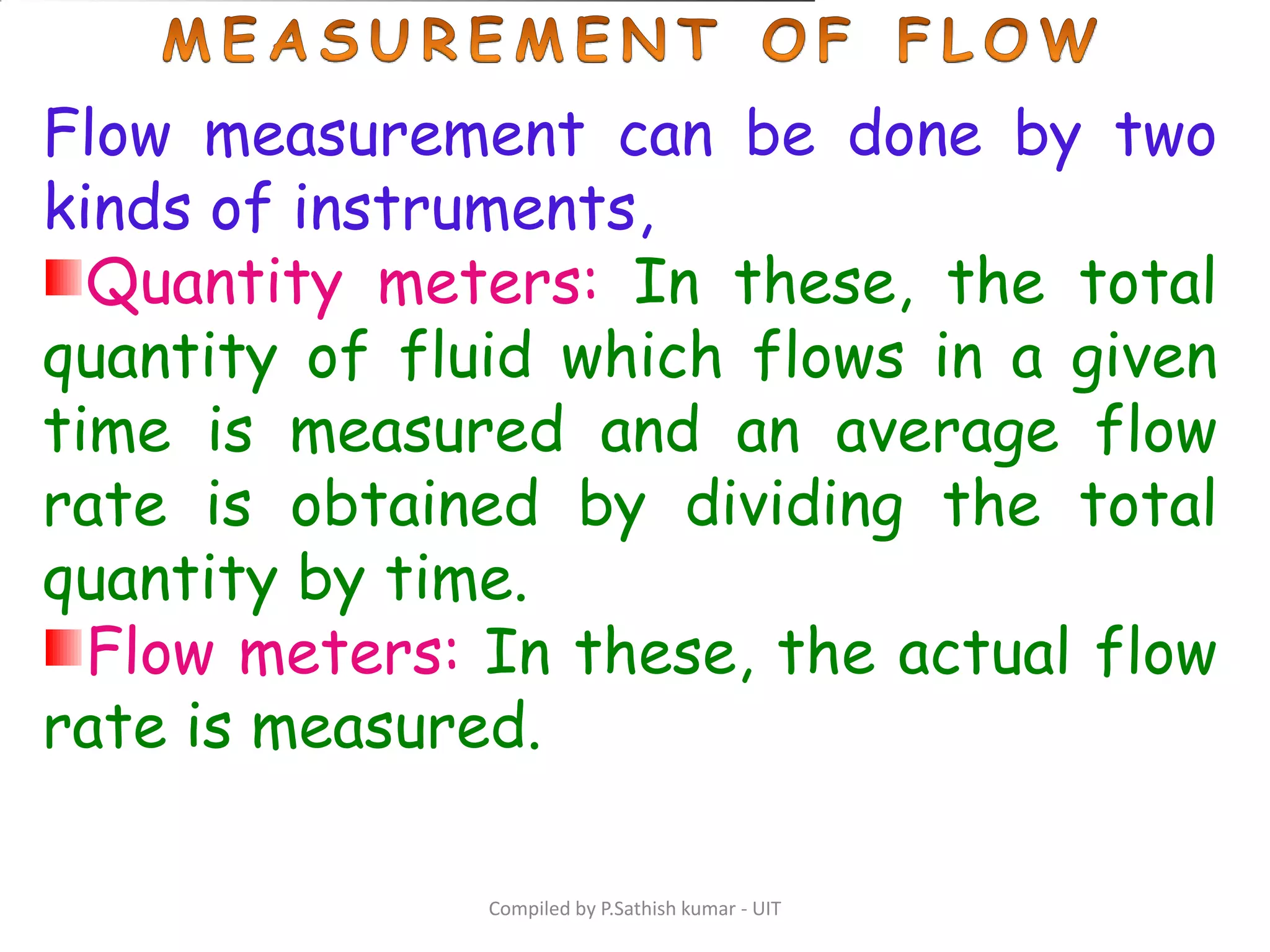
Flow measurement can be done by two
kinds of instruments,
Quantity meters: In these, the total
quantity of fluid which flows in a given
time is measured and an average flow
rate is obtained by dividing the total
quantity by time.
Flow meters: In these, the actual flow
rate is measured.
Compiled by P.Sathish kumar - UIT
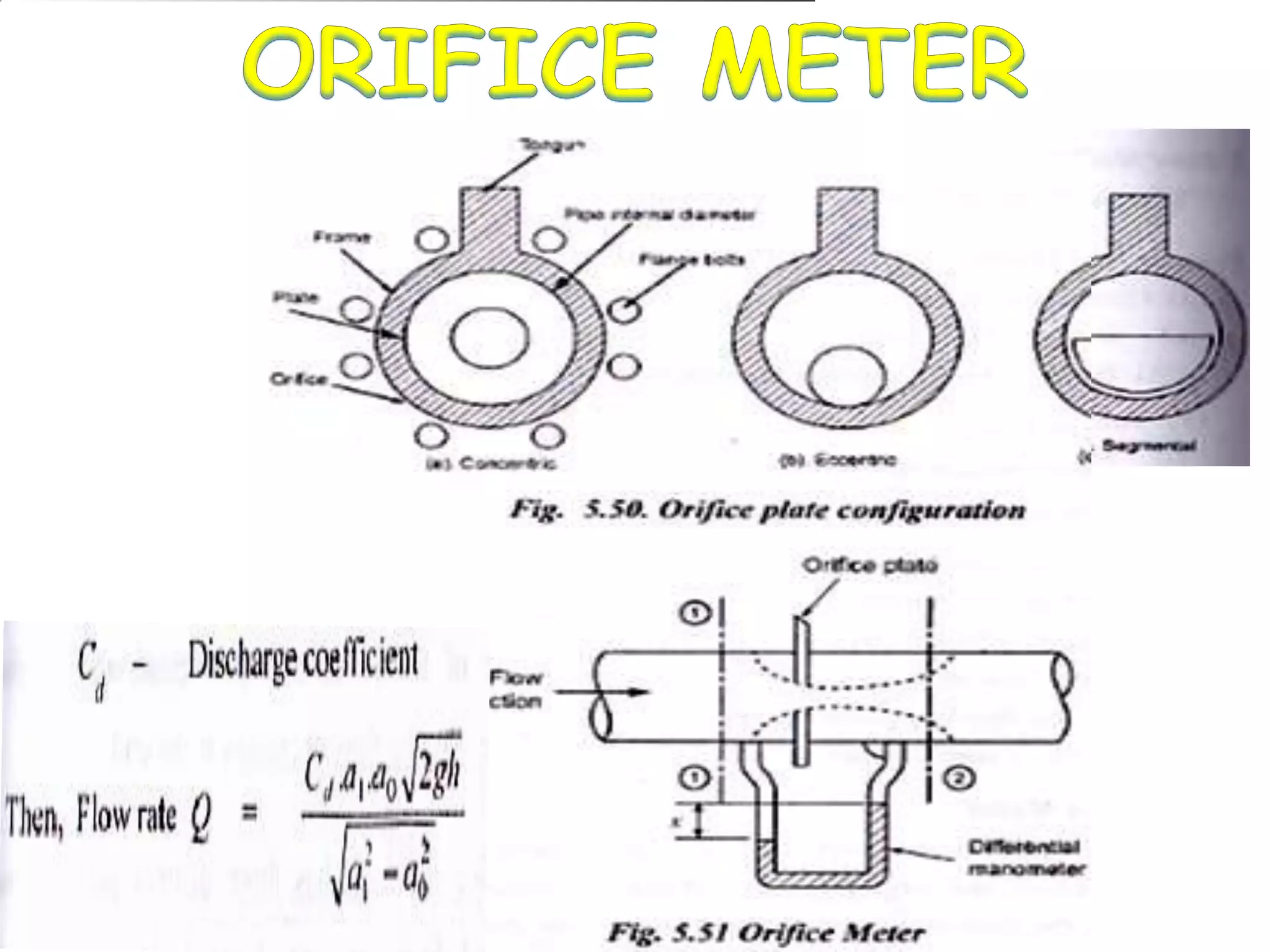
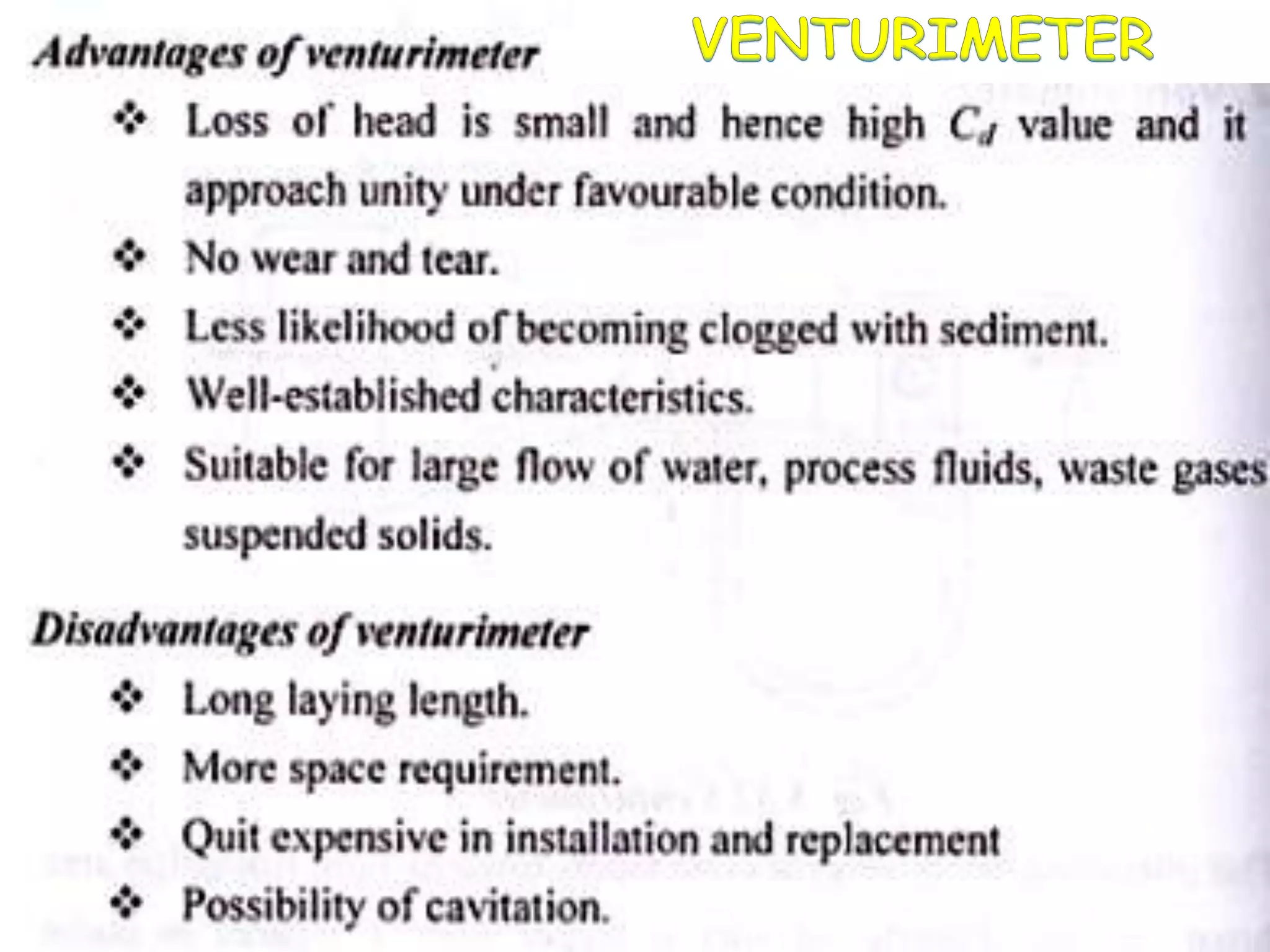
ADVANTAGES OF ORIFICE METER
DIS-ADVANTAGES OF ORIFICE METER
Compiled by P.Sathish kumar - UIT
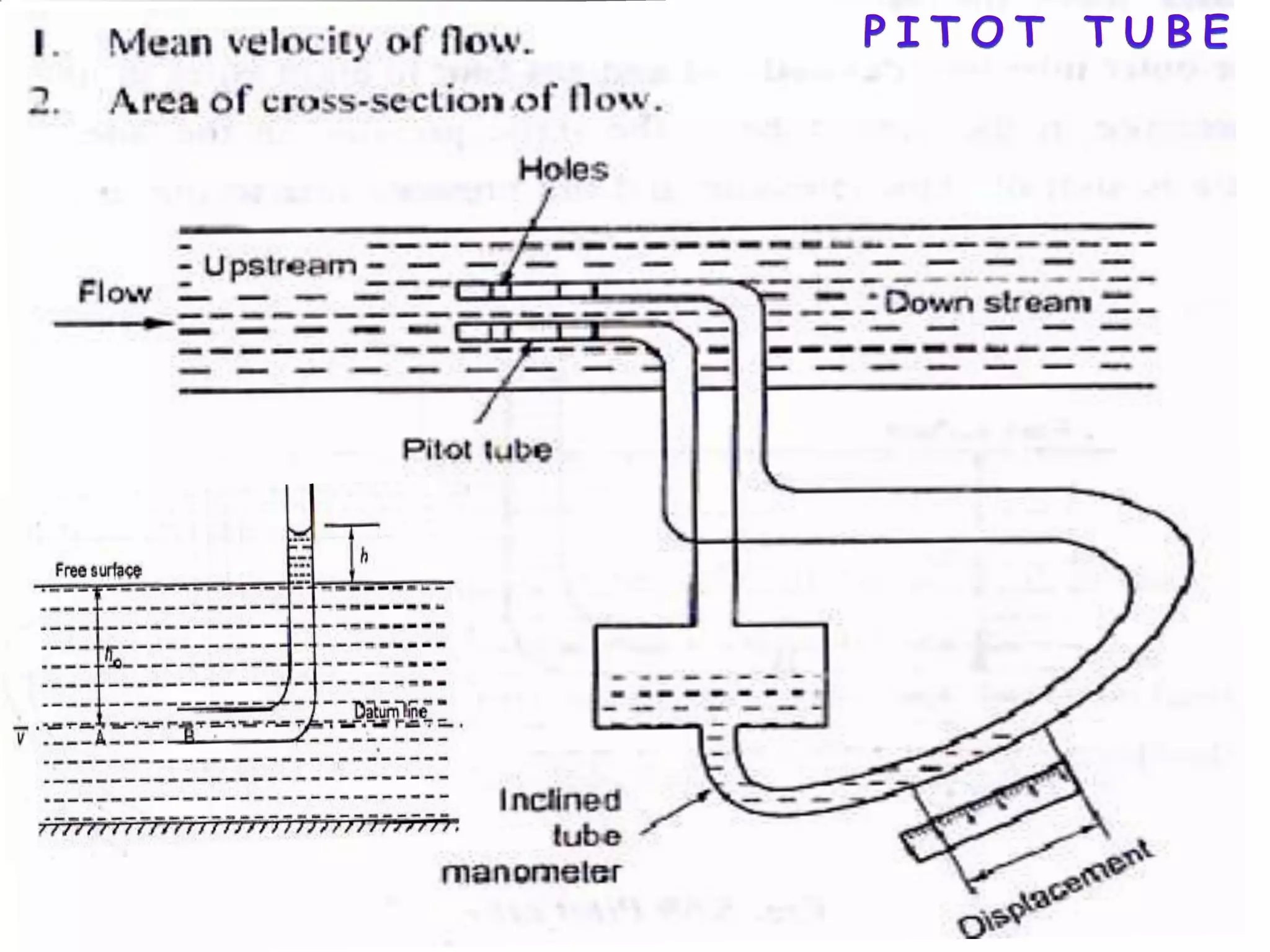
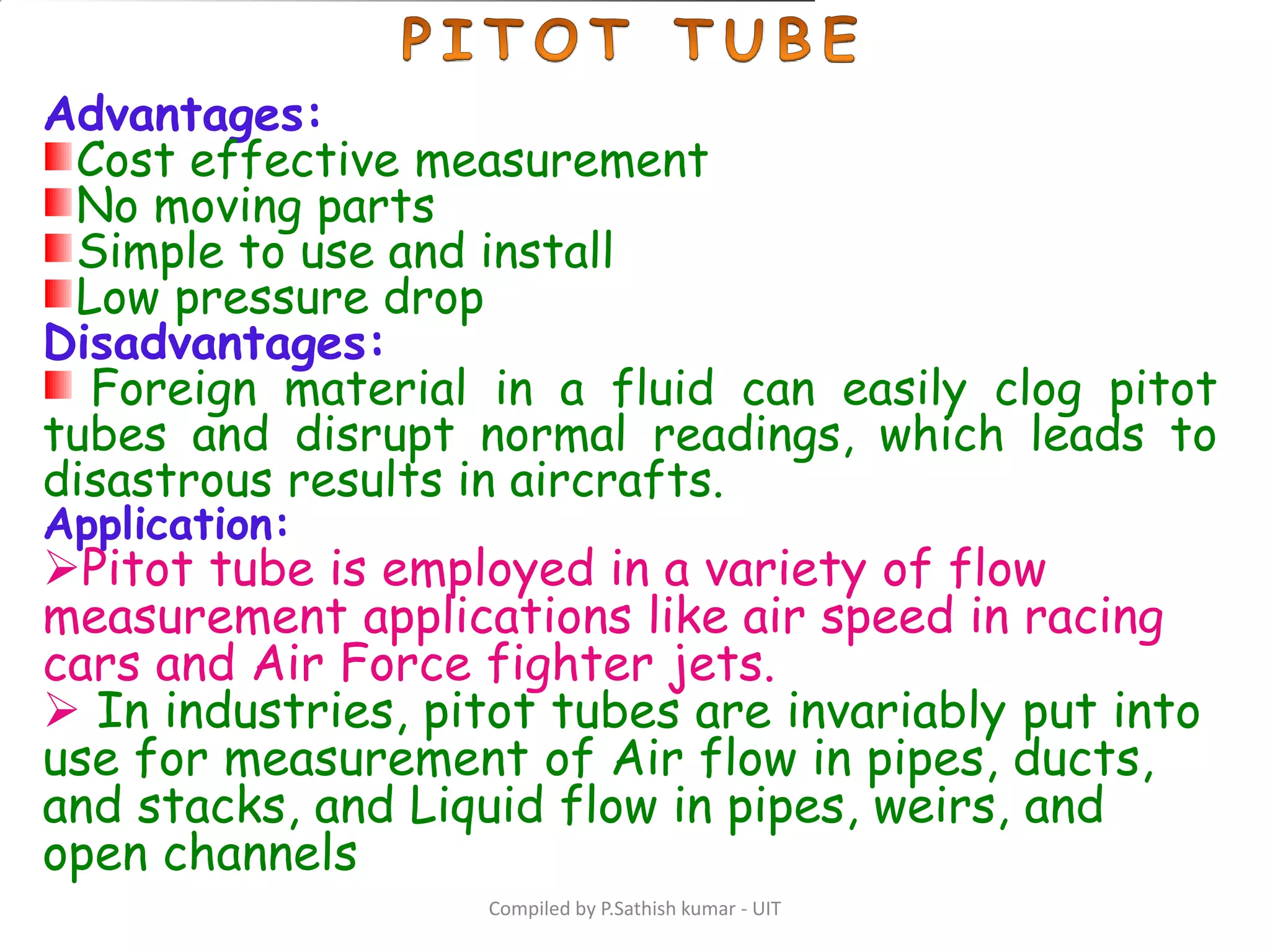
Advantages:
Cost effective measurement
No moving parts
Simple to use and install
Low pressure drop
Disadvantages:
Foreign material in a fluid can easily clog pitot
tubes and disrupt normal readings, which leads to
disastrous results in aircrafts.
Application:
Pitot tube is employed in a variety of flow
measurement applications like air speed in racing
cars and Air Force fighter jets.
 In industries, pitot tubes are invariably put into
use for measurement of Air flow in pipes, ducts,
and stacks, and Liquid flow in pipes, weirs, and
open channels
Compiled by P.Sathish kumar - UIT
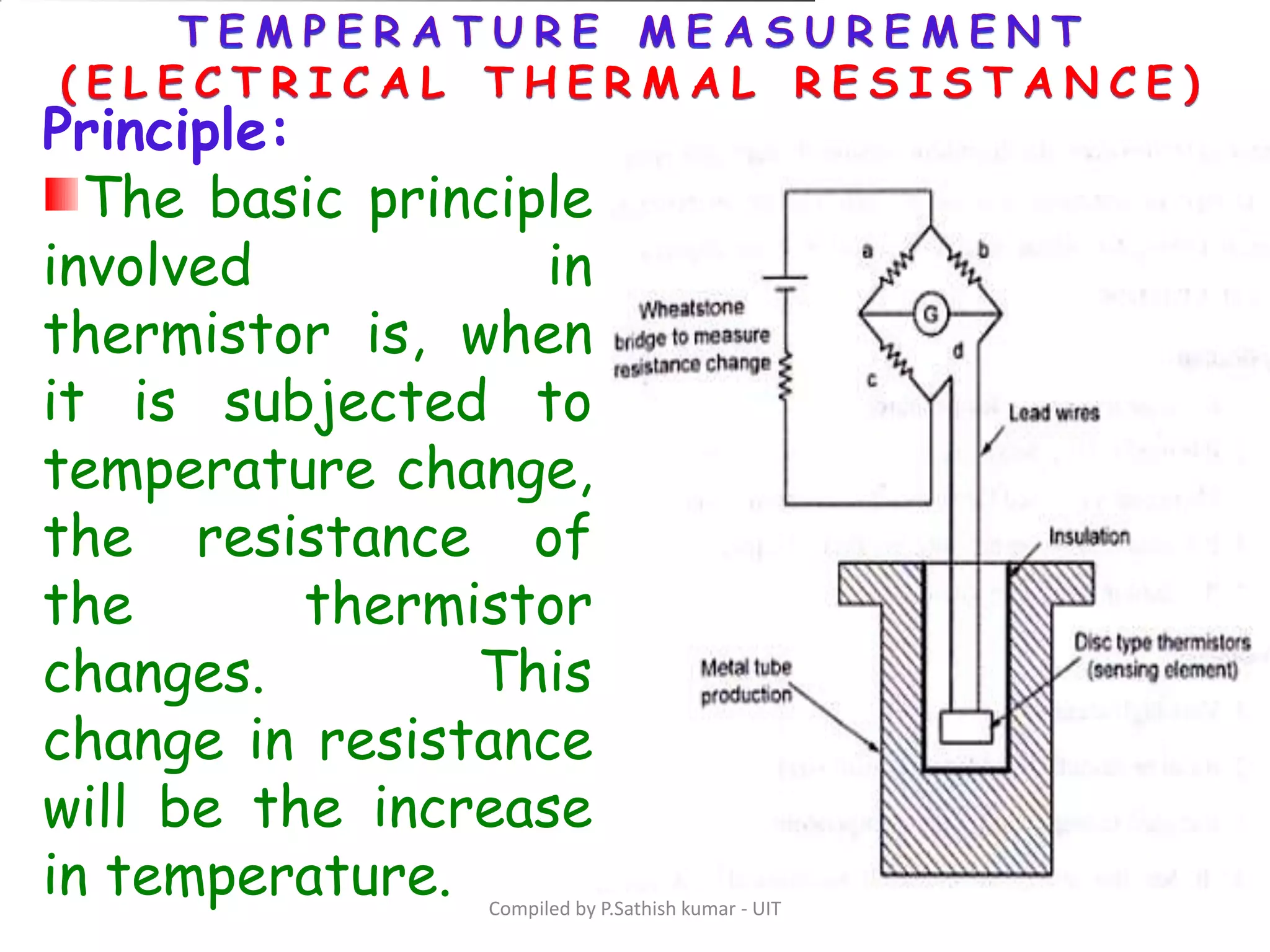
Principle:
The basic principle
involved in
thermistor is, when
it is subjected to
temperature change,
the resistance of
the thermistor
changes. This
change in resistance
will be the increase
in temperature.
Compiled by P.Sathish kumar - UIT
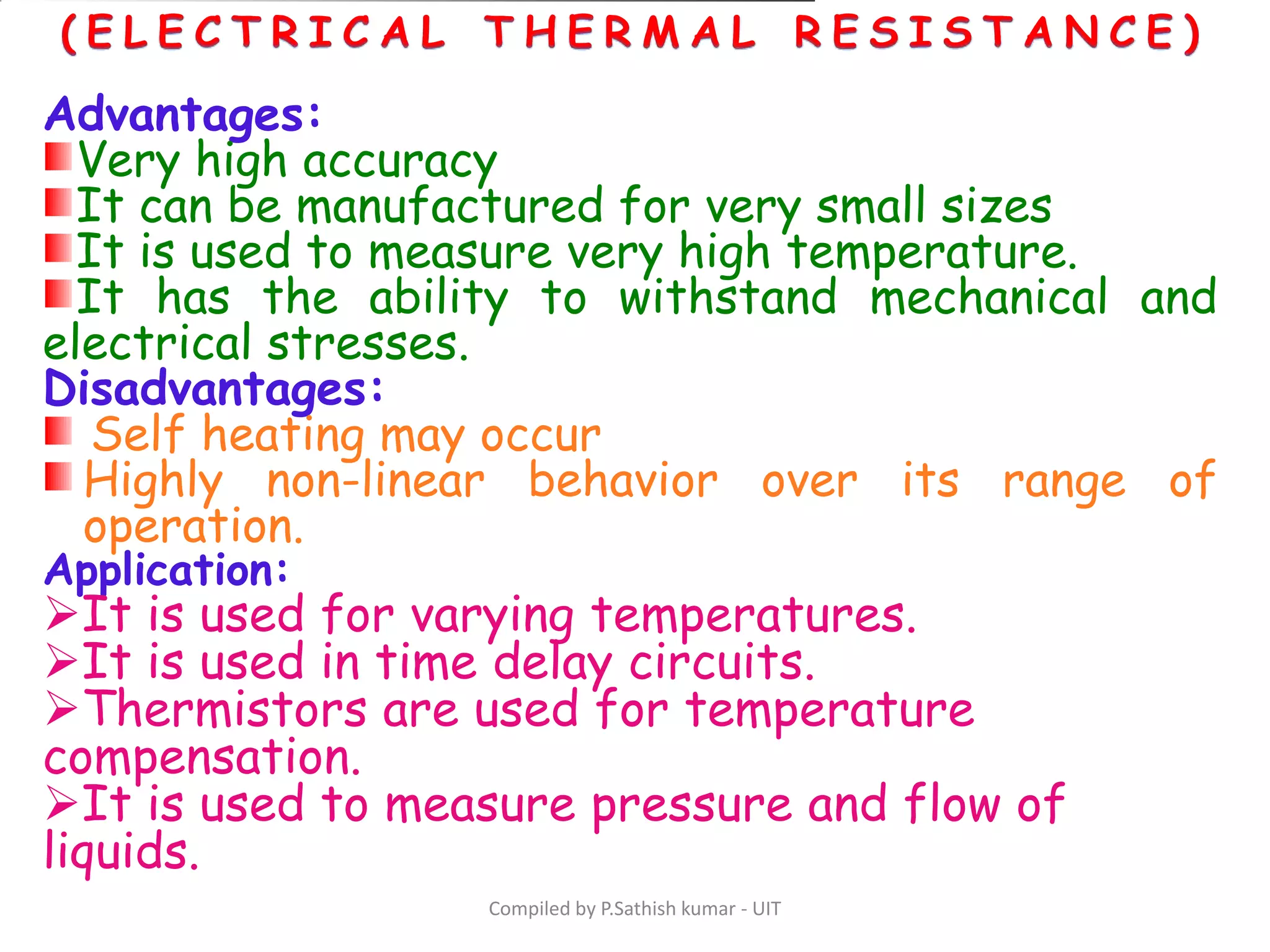
Advantages:
Very high accuracy
It can be manufactured for very small sizes
It is used to measure very high temperature.
It has the ability to withstand mechanical and
electrical stresses.
Disadvantages:
Self heating may occur
Highly non-linear behavior over its range of
operation.
Application:
It is used for varying temperatures.
It is used in time delay circuits.
Thermistors are used for temperature
compensation.
It is used to measure pressure and flow of
liquids.
Compiled by P.Sathish kumar - UIT
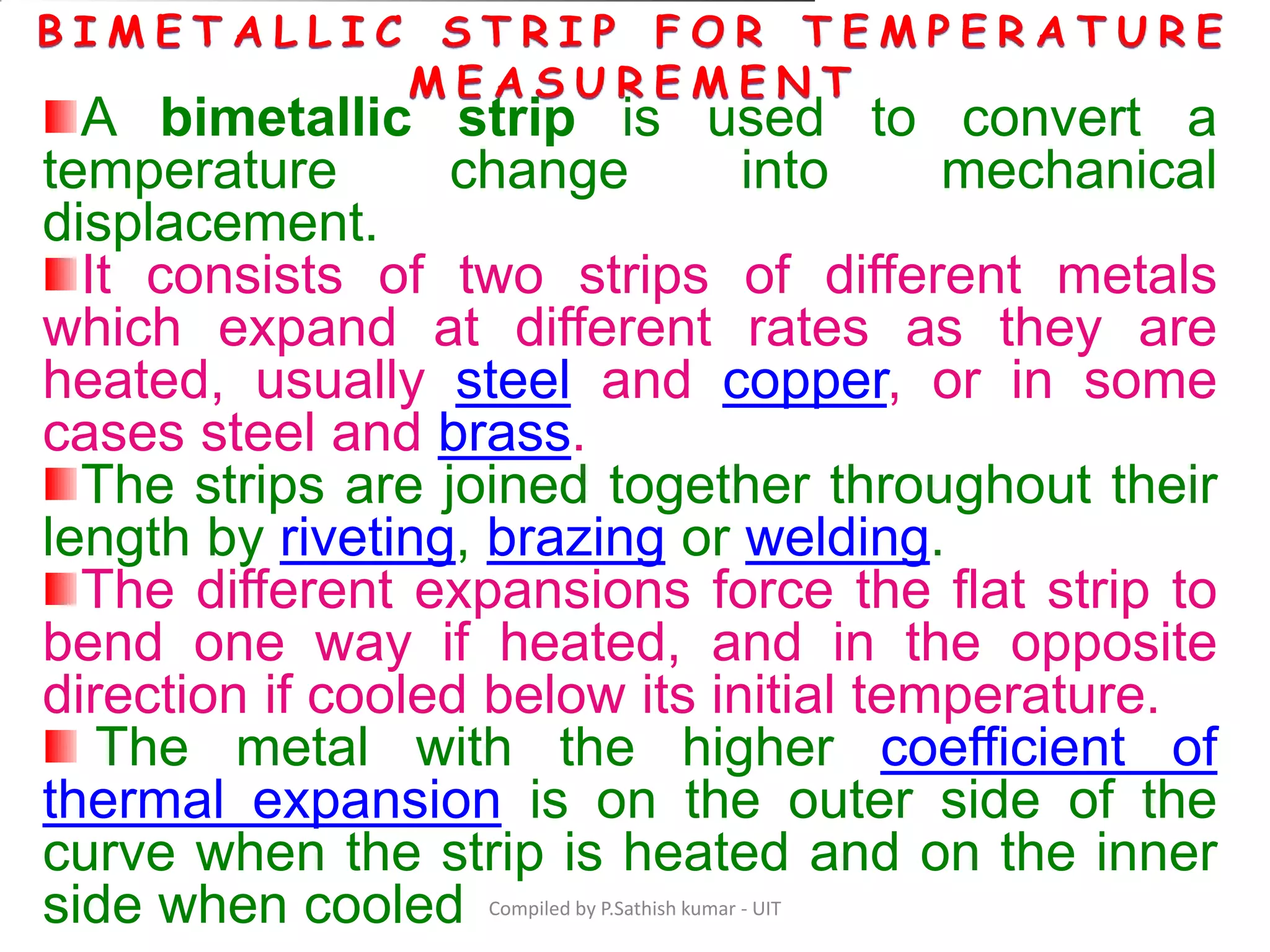
A bimetallic strip is used to convert a
temperature change into mechanical
displacement.
It consists of two strips of different metals
which expand at different rates as they are
heated, usually steel and copper, or in some
cases steel and brass.
The strips are joined together throughout their
length by riveting, brazing or welding.
The different expansions force the flat strip to
bend one way if heated, and in the opposite
direction if cooled below its initial temperature.
The metal with the higher coefficient of
thermal expansion is on the outer side of the
curve when the strip is heated and on the inner
side when cooled
Compiled by P.Sathish kumar - UIT
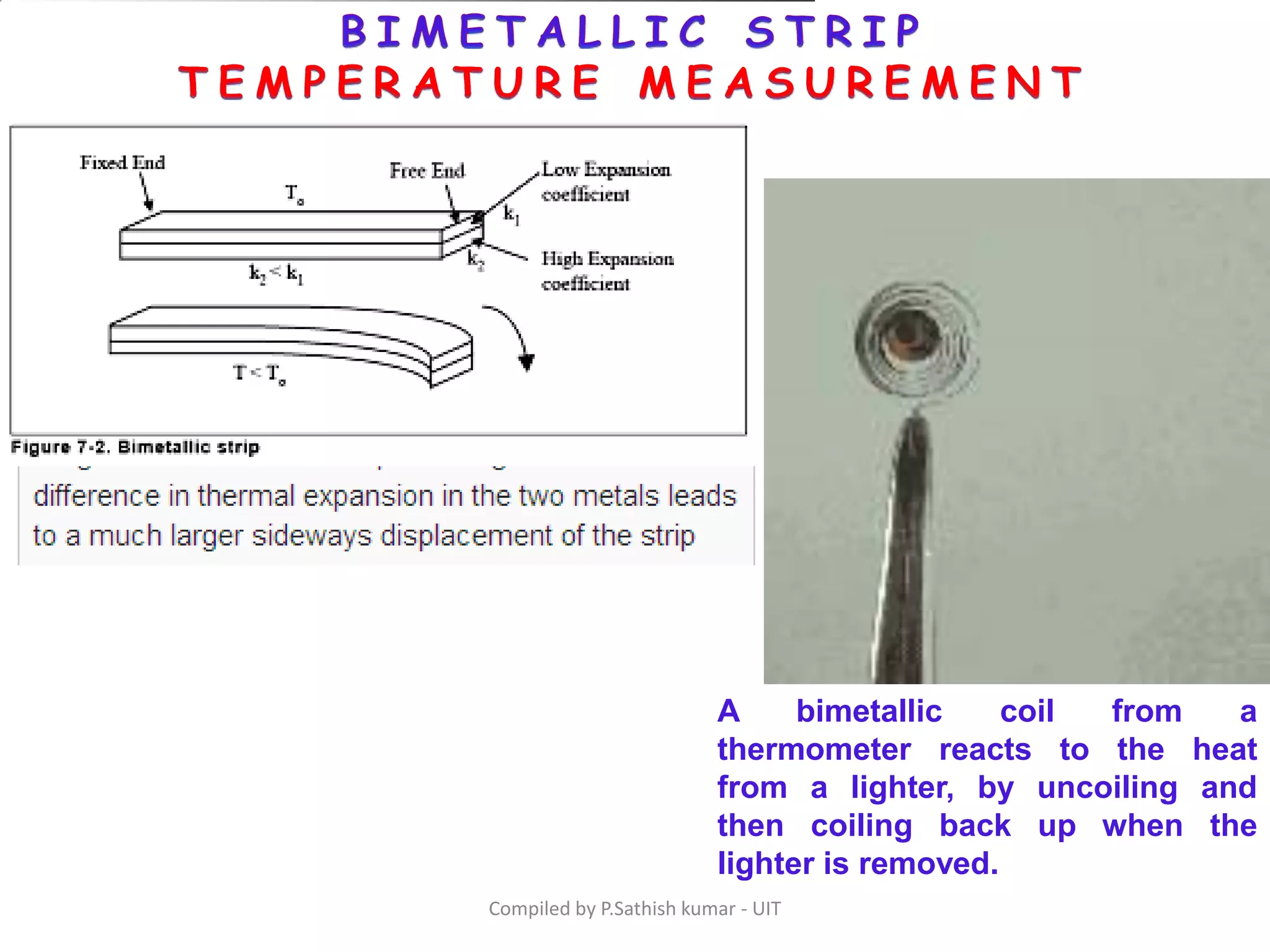
A bimetallic coil from a
thermometer reacts to the heat
from a lighter, by uncoiling and
then coiling back up when the
lighter is removed.
Compiled by P.Sathish kumar - UIT
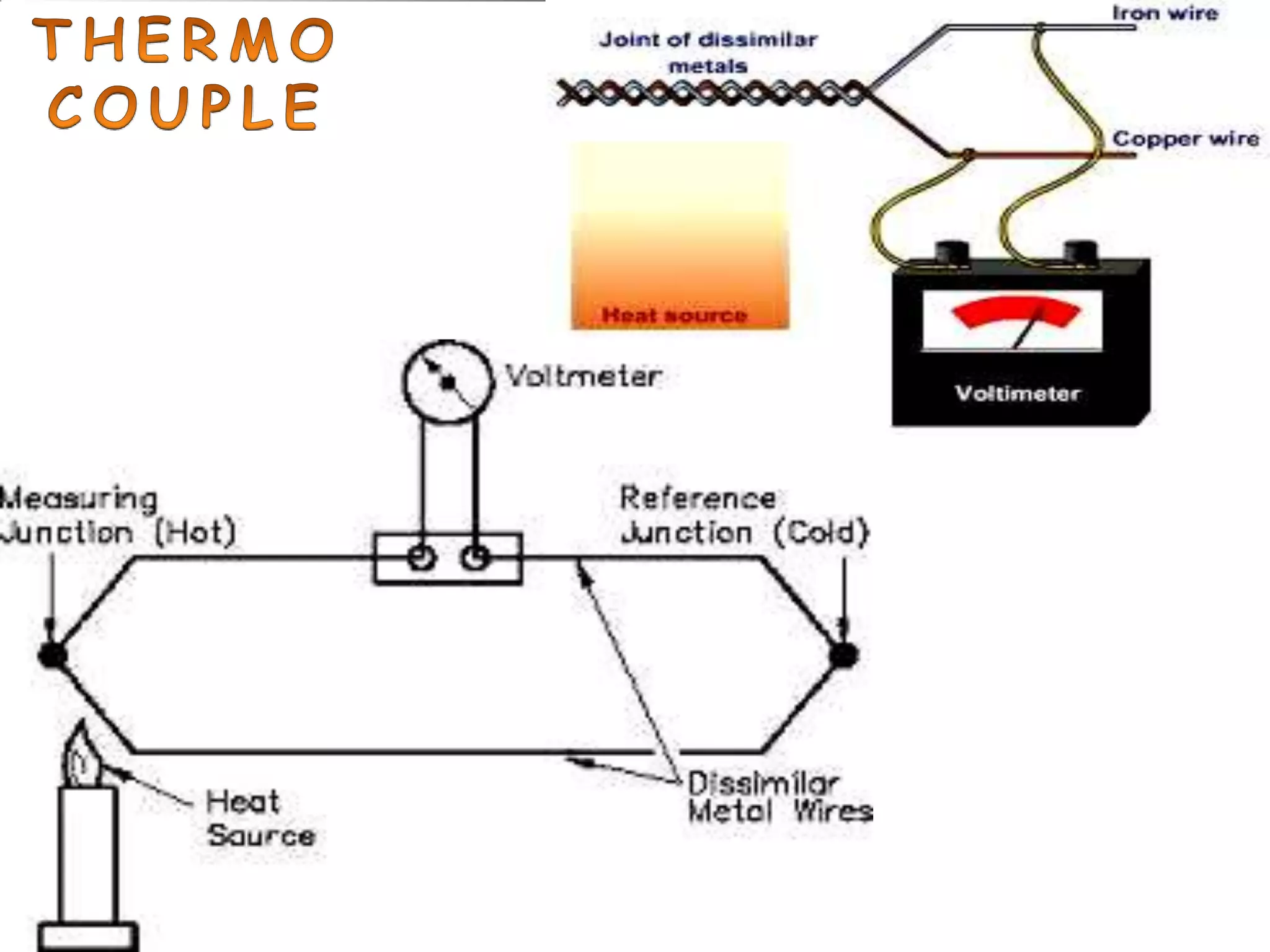
A Thermocouple is a sensor used to measure
temperature.
Thermocouples consist of two wire legs made from
different metals.
The wires legs are welded together at one end, creating a
junction.
This junction is where the temperature is measured.
A thermocouple is a device consisting of two
dissimilar conductors or semiconductors that
contact each other at one or more points. A
thermocouple produces a voltage when the
temperature of one of the contact points differs
from the temperature of another, in a process
known as the thermoelectric effect or seeback
effect
Compiled by P.Sathish kumar - UIT
A Thermocouple is a sensor used to measure
temperature.
Thermocouples consist of two wire legs made from
different metals.
The wires legs are welded together at one end, creating a
junction.
This junction is where the temperature is measured.
A thermocouple is a device consisting of two
dissimilar conductors or semiconductors that
contact each other at one or more points. A
thermocouple produces a voltage when the
temperature of one of the contact points differs
from the temperature of another, in a process
known as the thermoelectric effect or seeback
effect

Metrology unit-v (7-10-2015)

  • 1.
    METROLOGY AND MEASUREMENTS OBJECTIVE ToProvide knowledge on various metrological equipments. To utilize various techniques used to measure the dimension of the components. Knowledge to adopt correct procedure to measure the dimension of the components. To study about advances in metrology.
  • 2.
    ( UNIT-5) SYLLABUS MEASUREMENTOF POWER, FLOW AND TEMPERATURE Force, torque, power - mechanical , Pneumatic, Hydraulic and Electrical type. Flow measurement: Venturimeter, Orifice meter, rotameter, pitot tube – Temperature: bimetallic strip, thermocouples, electrical resistance thermometer – Reliability and Calibration – Readability and Reliability.
  • 3.
    Compiled by P.Sathishkumar - UIT Measurement of force is done by Direct methods: Involves direct comparison with a known gravitational force on a standard mass, e.g., by a balance Indirect methods: It involves measurement of effect of force on a body, such as acceleration of a body of known mass subjected to force.
  • 4.
  • 5.
    Spring balance usedfor direct measurement of force by using coil spring deflection. It consists of spring located at one end and the load applied at other end. The displacement at the free end due to the applied force is shown by a pointer moving on a scale. The deflection of the spring when a force is applied at the free end is given by the equation Compiled by P.Sathish kumar - UIT
  • 6.
    INDIRECT METHOD FORCE MEASUREMENTBY ACCELEROMETER Acceleration is defined as the rate of change of velocity; and velocity is defined as the rate of change of position. Velocity is commonly called speed, so the definition of acceleration could also be the rate of change of speed. Accelerometers are sensors that convert the motion that represents the aspect of acceleration into an electrical signal. These devices are typically used to measure vibration on machines and structures and other related acceleration detectors and motion detectors for mines, highways, and bridges that are located in areas subject to earthquakes.Compiled by P.Sathish kumar - UIT
  • 7.
    The most recentapplication for accelerometers is to measure vibration on large machines with pumps or motors with bearings that tend to wear out. When these devices wear out unexpectedly, they cause downtime that is very expensive. If the vibration is monitored, the amount of wear on bearings and gears can be calculated and the parts can be changed during scheduled maintenance so that failure will not cause downtime. INDIRECT METHOD FORCE MEASUREMENT BY ACCELEROMETER Compiled by P.Sathish kumar - UIT
  • 8.
    INDIRECT METHOD FORCE MEASUREMENTBY ACCELEROMETER A force will make a body to accelerate. By measuring the acceleration, the force may be determined, from the equation F=ma. To measure acceleration, accelerometers are used.Compiled by P.Sathish kumar - UIT
  • 9.
    INDIRECT METHOD FORCE MEASUREMENTBY HYDRAULIC LOAD CELL Compiled by P.Sathish kumar - UIT
  • 10.
    INDIRECT METHOD FORCE MEASUREMENTBY HYDRAULIC LOAD CELL Basic Principle of Hydraulic Load cell When a force is applied on a liquid medium contained in a confined space, the pressure of the liquid increases. This increase in pressure of the liquid is proportional to the applied force. Hence a measure of the increase in pressure of the liquid becomes a measure of the applied force when calibrated. Compiled by P.Sathish kumar - UIT
  • 11.
    INDIRECT METHOD FORCE MEASUREMENTBY HYDRAULIC LOAD CELL Operation of Hydraulic Load Cell The force to be measured is applied to the piston. The applied force moves the piston downwards and deflects the diaphragm and this deflection of the diaphragm increases the pressure in the liquid medium (oil). This increase in pressure of the liquid medium is proportional to the applied force. The increase in pressure is measured by the pressure gauge which is connected to the liquid medium. The pressure is calibrated in force units and hence the indication in the pressure gauge becomes a measure of force applied on the piston.Compiled by P.Sathish kumar - UIT
  • 12.
    Compiled by P.Sathishkumar - UIT INDIRECT METHOD FORCE MEASUREMENT BY PNEUMATIC LOAD CELL
  • 13.
    INDIRECT METHOD FORCE MEASUREMENTBY PNEUMATIC LOAD CELL Operation of Pneumatic Load cell The force to be measured is applied to the top side of the diaphragm. Due to this force, the diaphragm deflects and causes the flapper to shut-off the nozzle opening. Now an air supply is provided at the bottom of the diaphragm. As the flapper closes the nozzle opening, a back pressure results underneath the diagram applied force when calibrated. Compiled by P.Sathish kumar - UIT
  • 14.
    INDIRECT METHOD FORCE MEASUREMENTBY PNEUMATIC LOAD CELL Operation of Pneumatic Load cell This back pressure acts on the diaphragm producing an upward force. Air pressure is regulated until the diaphragm returns to the pre-loaded position which is indicated by air which comes out of the nozzle. At this stage, the corresponding pressure indicated by the pressure gauge becomes a measure of the applied force when calibrated. Compiled by P.Sathish kumar - UIT
  • 15.
  • 16.
    Compiled by P.Sathishkumar - UIT A load cell is a device that is used to convert a force into electrical signal. Strain gauge load cells are the most common types of load cells. Load cells are used for quick and precise measurements. Compared with other sensors, load cells are relatively more affordable and have a longer life span. The principle of operation is that the resistance of the electrical conductor changes when its length changes due to stress.
  • 17.
    Compiled by P.Sathishkumar - UIT Cu Ni alloy is commonly used in strain gauge construction . The change in resistance of the strain gauge can be utilized to measure strain accurately when connected to an appropriate measuring circuit. A load cell usually consists of four strain gauges in a Wheatstone bridge configuration. The electrical signal output is typically very small in the order of a few millivolts. It is amplified by an instrumentation amplifier before sending it to the measurement system. The output can be Digital or Analog (0-5V) depending on the application.
  • 18.
    Compiled by P.Sathishkumar - UIT Torque : It is a measure of the ability of a force to cause an object to turn or rotate. Equal to the product of the force vector and the radius vector from the axis of rotation to the point of application of the force. A shaft rotating with angular velocity  and carrying power will undergo a torque T, where P = T 
  • 19.
  • 20.
    Compiled by P.Sathishkumar - UIT Any system involving torque transmission through a shaft of the transmitted torque can be measured by cradling (concept of mounting sources or sinks (power absorber) in bearings is called cradling) then measuring the reaction force F and the arm length L. Torque is then calculated as F x L Pendulum scales are commonly used for measuring the reaction force.
  • 21.
  • 22.
  • 23.
    Compiled by P.Sathishkumar - UIT It is one of the earliest methods of measuring the torque in a rotating shaft. In this system, all the power produced is absorbed by friction in a brake. A rope or belt brake is wrapped around a flywheel carried by the shaft. The rope passes once around the flywheel and is attached to a mass, m at the bottom. The other end of the rope is connected to a spring balance which measures the tension in the rope, Fs.
  • 24.
    Compiled by P.Sathishkumar - UIT The force in the lower end of the rope arises from the weight, and is mg. If the spring balance reading is Fs, the difference in tension between the ends of the rope is (mg – Fs)
  • 25.
  • 26.
  • 27.
  • 28.
    Strain gauge transducerconverts torque into electrical signal. The strain gauge is bonded to a beam or structural member that deforms when a torque or force is applied.  Deflection induces a stress that changes its resistance. A Wheatstone bridge converts the resistance change into a calibrated output signal. The sensor's output is a function of force and distance. Two common ways to obtain torque measurements are by strain-gauging the shaft and by using in-line torque cells. Compiled by P.Sathish kumar - UIT
  • 29.
    Compiled by P.Sathishkumar - UIT A dynamometer is a machine used to measure torque and rotational speed from which power produced by a motor can be measured.
  • 30.
    Compiled by P.Sathishkumar - UIT . The main components of a dynamometer are: Base , Pedestals Collection Box Rotor (Shaft) – The rotating element Stator (Housing) – Encases and supports the rotor. Also assists in cooling. Lubrication System (Pump, Tubing etc.) – Provides lubrication and cooling for rotor bearing assemblies. Load Cell – Provides a calibrated output that is usually measured as torque. A drive motor (the unit to be tested) is physically connected to the dynamometer rotor shaft using adaptors. A flow of coolant then begins to run thru passages inside of the dynamometer to absorb heat that will be generated from the “braking” action of the dynamometer. The drive motor begins to rotate, and in turn rotates the dynamometer rotor shaft. When the drive motor and rotor shaft reach the desired speed a “brake” is applied to the rotating shaft housed inside the dynamometer. Application of the “brake” creates a counter rotational force causing the load cell to deflect. The movement of the load cell is measured and is converted to torque. The drive motor power output is then calculated by using the following formula:
  • 31.
  • 32.
    • The armatureof the dynamometer is rotated by coupling it to the shaft of the motor under test. The rotation of the armature coils in a uniform magnetic field results in an induced emf in them (generator action). If the armature circuit is completed by connecting the armature coils to a resistive load, a current will flow in the armature winding. The magnitude of the current depends upon the induced emf and the load resistance. The current-carrying conductors in a uniform magnetic field now experience a force acting on them (motor action). The direction of the force is such that it tends to resist the rotation of the armature. Because the stator, which houses the field windings, is free to rotate, it is pulled around equally by the motor action. The only restraining force acting on the stator is provided by the spring, very much like the prony brake test. By controlling the flux in the motor, we can control the speed of the motor and make it run at any desired speed. • A 5-hp motor rated at 1200 rpm is tested on a dynamometer whose torque arm is 40 cm in length.Compiled by P.Sathish kumar - UIT
  • 33.
  • 34.
    • an internalcombustion engine connected to an eddy-current dynamometer. The engine is considered a nonlinear angular velocity source (ϖE) modulated by the throttle setting θ(t). The main energy storage is associated with the rotating inertia JE, lumped at the output of the engine shaft. The torque transmission shaft has compliance and energy dissipation, and is modeled with a rotational spring KS and rotational damper BS. The shaft inertia is neglected. Compiled by P.Sathish kumar - UIT
  • 35.
    • The dynamometerconsists of a toothed rotor JR that rotates (ϖR) in the magnetic field created by passing current (t) through the stator windings. A voltage is induced in the conductive rotor rotating in the stator magnetic field (Faraday’s Law). This induced voltage creates eddy currents in the rotor that generate a magnetic field (Ampere’s Law), which opposes the stator magnetic field (Lenz’s Law). • The stator inertia JS, mounted in trunnion bearings, is free to rotate, but is restrained by a torque arm to measure the torque developed.Compiled by P.Sathish kumar - UIT
  • 36.
  • 37.
    • Bourdon Tubesare known for its very high range of differential pressure measurement in the range of almost 100,000 psi (700 MPa). It is an elastic type pressure transducer. • the pressure input is given to a socket which is soldered to the tube at the base. The other end or free end of the device is sealed by a tip. This tip is connected to a segmental lever through an adjustable length link. The lever length may also be adjustable. The segmental lever is suitably pivoted and the spindle holds the pointer as shown in the figure. A hair spring is sometimes used to fasten the spindle of the frame of the instrument to provide necessary tension for proper meshing of the gear teeth and thereby freeing the system from the backlashCompiled by P.Sathish kumar - UIT
  • 38.
    • As thefluid pressure enters the bourdon tube, it tries to be reformed and because of a free tip available, this action causes the tip to travel in free space and the tube unwinds. The simultaneous actions of bending and tension due to the internal pressure make a non-linear movement of the free tip. This travel is suitable guided and amplified for the measurement of the internal pressure. Compiled by P.Sathish kumar - UIT
  • 39.
    Compiled by P.Sathishkumar - UIT Measurement of FLOW is done by Mechanical flow meters: Flow is measured by placing an obstruction in the flow pipe, which results in development of torque on vanes due to pressure difference. Electrical flow meters: The electromagnetic field will be produced in a coil corresponding to the amount of fluid flowing in the pipe. But in recent days, flow sensors are found in many consumer products or electro- mechanical transducers are used to find out the flow rate of pipe fluid.
  • 40.
    Compiled by P.Sathishkumar - UIT Flow measurement can be done by two kinds of instruments, Quantity meters: In these, the total quantity of fluid which flows in a given time is measured and an average flow rate is obtained by dividing the total quantity by time. Flow meters: In these, the actual flow rate is measured.
  • 41.
  • 42.
  • 43.
    Compiled by P.Sathishkumar - UIT ADVANTAGES OF ORIFICE METER DIS-ADVANTAGES OF ORIFICE METER
  • 44.
  • 45.
  • 46.
  • 47.
  • 48.
    Compiled by P.Sathishkumar - UIT Advantages: Cost effective measurement No moving parts Simple to use and install Low pressure drop Disadvantages: Foreign material in a fluid can easily clog pitot tubes and disrupt normal readings, which leads to disastrous results in aircrafts. Application: Pitot tube is employed in a variety of flow measurement applications like air speed in racing cars and Air Force fighter jets.  In industries, pitot tubes are invariably put into use for measurement of Air flow in pipes, ducts, and stacks, and Liquid flow in pipes, weirs, and open channels
  • 49.
    Compiled by P.Sathishkumar - UIT Principle: The basic principle involved in thermistor is, when it is subjected to temperature change, the resistance of the thermistor changes. This change in resistance will be the increase in temperature.
  • 50.
    Compiled by P.Sathishkumar - UIT Advantages: Very high accuracy It can be manufactured for very small sizes It is used to measure very high temperature. It has the ability to withstand mechanical and electrical stresses. Disadvantages: Self heating may occur Highly non-linear behavior over its range of operation. Application: It is used for varying temperatures. It is used in time delay circuits. Thermistors are used for temperature compensation. It is used to measure pressure and flow of liquids.
  • 51.
    Compiled by P.Sathishkumar - UIT A bimetallic strip is used to convert a temperature change into mechanical displacement. It consists of two strips of different metals which expand at different rates as they are heated, usually steel and copper, or in some cases steel and brass. The strips are joined together throughout their length by riveting, brazing or welding. The different expansions force the flat strip to bend one way if heated, and in the opposite direction if cooled below its initial temperature. The metal with the higher coefficient of thermal expansion is on the outer side of the curve when the strip is heated and on the inner side when cooled
  • 52.
    Compiled by P.Sathishkumar - UIT A bimetallic coil from a thermometer reacts to the heat from a lighter, by uncoiling and then coiling back up when the lighter is removed.
  • 53.
  • 54.
    Compiled by P.Sathishkumar - UIT A Thermocouple is a sensor used to measure temperature. Thermocouples consist of two wire legs made from different metals. The wires legs are welded together at one end, creating a junction. This junction is where the temperature is measured. A thermocouple is a device consisting of two dissimilar conductors or semiconductors that contact each other at one or more points. A thermocouple produces a voltage when the temperature of one of the contact points differs from the temperature of another, in a process known as the thermoelectric effect or seeback effect
  • 55.
    Compiled by P.Sathishkumar - UIT A Thermocouple is a sensor used to measure temperature. Thermocouples consist of two wire legs made from different metals. The wires legs are welded together at one end, creating a junction. This junction is where the temperature is measured. A thermocouple is a device consisting of two dissimilar conductors or semiconductors that contact each other at one or more points. A thermocouple produces a voltage when the temperature of one of the contact points differs from the temperature of another, in a process known as the thermoelectric effect or seeback effect