Module-5
Force, Torque and Pressure
Measurement
† A force can be a push or a pull.
† It is represented as a vector and has a point of
application.
† The unit of force is called the Newton. Symbol N.
† The measurement of force involves the determination of
its magnitude as well as its direction.
3
4
1) Direct comparison
2) Indirect comparison – through the use of calibrated
transducers.
† Direct comparison – Uses some form of beam balance
with a null-balance technique. The beam neither
amplifies nor attenuates the force. Example: Analytical
Balance.
† Indirect comparison – In this case, the force is
attenuated through a system of levers so that a smaller
weight is used to balance the force. This method
requires calibration of the system. Example: Platform
Balance.
5
6
7
† The direction of force is parallel to that of
gravitational force and only its magnitude needs to be
determined.
† O – balance arm rotates about this point.
† W1 & W2 - two forces applied at the end of the arm
† W1 is unknown force and W2 is known force due to a
standard weight.
† G - Center of gravity of the balance arm.
† WB - weight of balance arm and the pointer acting at
G.
† Sensitivity “S”: Sensitivity is defined as the angular
deflection per unit unbalance between the two
weights W1 and W2.
8
9
† Sensitivity can be calculated by writing the moment
equation at equilibrium as follows.
Where
dB, dG and L are the distances
For small deflection angles
sin  ≈  and cos  ≈ 1
Thus the above equation becomes
10
11
12
† The sensitivity of the balance will be independent of
the weight W provided. It is designed such that dB = 0,
then
† The sensitivity depends on the construction
parameters of the balance arm and is independent of
the weights being compared.
† The sensitivity of balance increases by decreasing
both dG and WB and increasing L.
13
14
15
† Mass ‘m’ acts as power on the beam and exerts a force of
Fg due to gravity where Fg = m x g.
† This force acts as counterposing force against the load
which may be a test force Ft.
† The beam is pivoted on knife edge ‘q’.
† The test force Ft is applied by a screw or a lever through a
knife edge ‘p’ until the pointer indicates that the beam is
horizontal.
16
† For balance of moments,
Ft x a = Fg x b
Test Force, Ft = Fg x b/a
Ft = m x g x b/a
Ft = constant x b
Thus, the test force is proportional to the distance ‘b’ of
the mass from the knife edge ‘p’.
17
18
19
20
21
In these systems, a large weight W is measured in terms of
two smaller weights Wp and Ws
where, Wp = weight of poise
and Ws = Weight of pan
Before the unknown load W is applied to the platform, the
poise weight Wp is set at zero beam scale and adjustable
counter piece is adjusted to obtain initial zero balance.
The weight W can be replaced by two weights W1 and W2
and it is entirely balanced by the weight Ws in the pan.
22
23
† Suppose the scale has a multiplication ratio of 1000.
† It means that a weight of 1 kg put in the pan can balance a
weight of 1000 kg put on the platform.
† The beam scale is so divided that a movement of poise
weight Wp by 1 scale division represents a force of x kg,
then a poise movement of y scale divisions should produce
the same result as a weight Wp placed on the pan at the
end of the beam.
† Hence,
† This represents a relationship that determines the required
scale divisions on the beam for any poise weight Wp.
24
25
26
† It is used for calibrating tensile machine.
† High accurate measurement of large static loads may
be obtained.
† A proving ring is a circular ring of rectangular cross
section, which may be subjected to tensile or
compressive forces across its diameter.
27
The force deflection relation for a thin ring is given by
Where
F – Force
E – Young’s Modulus
I – moment of inertia of the section
D – outer diameter of the ring
Y - deflection
28
Working :
† The deflection obtained is very small and is used to measure
of applied loads .
† Deflection is measured with help of precision micrometer.
† Micrometer reading are obtained by with the help of
vibrating reed.
† To obtain precise measurements one edge of the micrometer
is mounted on a vibrating reed device which is plucked to
obtain a vibratory motion.
† The micrometer spindle is advanced until contact is
indicated by marked damping of vibration.
† Use: For force measurement within a range of 1.5 KN to 1.5
MN.
29
30
† Torque is a measure of how much a
force acting on an object causes that
object to rotate.
† The object rotates about an axis, which
we will call the pivot point.
† Torque is associated with the
determination of mechanical power.
† The power developed by the machine,
Torque T = F x R, N-m
31
† Torque measuring devices are known as dynamometers.
There are basically three type
1. Absorption dynamometers: They absorb the mechanical
energy as torque is measured, and hence are used
measure torque developed at the source such as
engines or electric motors.
2. Driving dynamometers : These dynamometers measure
power or torque and as well provide energy to operate
the devices to be tested. They are useful in determining
performance characteristics of devices such as pumps,
compressors etc.
32
3. Transmission dynamometers: These are passive devices
placed at an appropriate location within a machine or
in between machines to sense the torque at that
location. They neither add nor subtract the transmitted
energy or power and are sometimes referred to as
torque meters.
33
34
† Construction:
† Two wooden blocks are mounted diametrically opposite
on a flywheel attached to the rotating shaft whose
power has to be measured .
† One block carries a lever arm and an arrangement is
provided to tighten the rope which is connected to the
arm .
† The rope is tightened so as to increase the frictional
resistance between the blocks and the flywheel.
35
† Torque exerted by the prony brake is
† The power dissipated in the brake is calculated by
equation
36
Limitation:
† It is difficult to adjust and maintain a specific load.
† Requires continues tightening of clamp, therefore the
system becomes unsuitable for measurement of large
power .
† Results in excessive temperature rise which decreases the
coefficient leading to failure of brake.
† If machine torque is not constant the measuring
arrangement is subjected to oscillations .
37
38
† It is the simplest form of which acts as water brake.
† The capacity of hydraulic dynamometer is a function of
two factors, speed and water level.
† The torque is measured with help of a reaction arm.
† The power absorption at a given speed may be controlled
by adjusting the water level in the housing.
† This type of dynamometer may be made in considerably
larger capacities.
39
† Trunnian bearings support the dynamometer housing,
allowing it to rotate freely except for the restraint
imposed by the reaction arm.
† Power absorbing element is the housing which tends to
rotate with input shaft of the driving machine.
† The rotation is constrained by a force measuring device,
such as some forms of load cell or scales, placed at the
end of the reaction arm.
40
† In hydraulic dynamometer constant supply of water
running through the breaking medium acts a coolant.
† The brake power of very large and speed engine can
be measured.
† In hydraulic dynamometer there is a flexibility in
controlling the operation.
41
† Pressure is represented as force / unit area exerted by
a fluid on a container.
42
Atmospheric Pressure: The atmospheric air exerts a
normal pressure upon all surfaces with which it is in
contact, and it is known as atmospheric pressure.
It is also known as Barometric pressure.
Gauge Pressure: It is pressure, measured with the help
of a pressure measuring instrument, in which
atmospheric pressure is taken as datum.
The atmospheric pressure on the scale is marked as
zero.
Absolute Pressure: Any pressure measured above the
“zero absolute pressure” is termed as ‘absolute
pressure’.
43
44
45
46
† It is independent of the gas composition.
† It serves as a reference standard to calibrate other
low pressure gauges.
† There is no need to apply corrections to the McLeod
Gauge readings.
47
† The gas whose pressure is to be measured should obey
the Boyle’s law
† Moisture traps must be provided to avoid any
considerable vapor into the gauge.
† It measure only on a sampling basis.
† It cannot give a continuous output.
48
49
50
† When electric current is made to flow through a
conducting wire, it gets heated.
† The rate at which heat is dissipated from this wire
depends on the conductivity of the wire and the
surrounding pressure.
† At low pressure less amount of heat is dissipated and
at high pressure higher heat dissipates.
51
The main parts of the arrangement are –
† A Pirani gauge chamber which encloses a platinum
filament.
† A compensating cell to minimize variation caused due
to ambient temperature changes.
† The Pirani gauge chamber and the compensating cell is
housed on a wheat stone bridge circuit as shown in
diagram.
52
Working of Pirani gauge
† A constant current is passed through the filament in the
Pirani gauge chamber. Due to this current, the filament
gets heated and assumes a resistance which is measured
using the bridge.
† Now the pressure to be measured is connected to the
Pirani gauge chamber. Due to the change in pressure, the
conductivity and the temperature of the filament will
changes.
53
† When the temperature of the filament changes, the
resistance of the filament also changes.
† Now the change in resistance of the filament is
determined using the bridge.
† This change in resistance of the pirani gauge filament
becomes a measure of the applied pressure when
calibrated.
Strain
What is Strain?
• Strain is the amount of deformation of a body due to an applied
force. More specifically, strain (e) is defined as the fractional
change in length, as shown in Figure below.
• Strain can be positive (tensile) or negative (compressive).
Although dimensionless, strain is sometimes expressed in
units such as in./in. or mm/mm. In practice, the magnitude of
measured strain is very small.
• Therefore, strain is often expressed as microstrain (με),
which is ε = 10–6.
• When a bar is strained with a uniaxial force, as in
Figure, a phenomenon known as Poisson Strain causes
the girth of the bar, D, to contract in the transverse, or
perpendicular, direction.
• The magnitude of this transverse contraction is a
material property indicated by its Poisson's ratio.
• The Poisson's Ratio ‘ν’ of a material is defined as the
negative ratio of the strain in the transverse direction
(perpendicular to the force) to the strain in the axial
direction (parallel to the force), or
n = –εT/ε. Poisson's Ratio for steel, for example, ranges
from 0.25 to 0.3.
Strain gauges
While there are several methods of measuring strain, the most
common is with a strain gauge, a device whose electrical resistance
varies in proportion to the amount of strain in the device.
The change in length over a small gauge length is very small , a high
magnification system is required and based upon this strain
gauges are classified as .
1. Mechanical strain gauges.
2. Optical strain gauges .
3. Electrical strain gauges
Mechanical strain gauges
• Involves mechanical means for magnification
(extensometer ).
• Most commonly used mechanical strain gauge are
Berry type and Huggen Berger type
Optical strain gauge
• Commonly used optical strain gauge was developed
by Tuckerman .
• It is a combination of both mechanical system and
optical system.
• Ie., extensometer and auto collimator.
• Can be used to measure 2 um/m and gauge length
up to 250 mm.
• The nominal length of gauge is the distance from
knife edge to the point of contact of lozenge.
• The lozenge acts as a mirror .
• The distance between the fixed edge and lozenge
changes , due to loading .
• The lozenge rotates and any light falling on it , will
be deflected ..
• The function of auto collimator is to send the parallel
rays of light and receive back the reflected light beam
from the lozenge on the optical system .
Electrical strain gauge
• A change in strain produces some change in electrical
characteristic .
• This change can be magnified with some electronic
equipment.
Types :
• Capacitance , inductance , piezoelectric ,and
resistance gauges .
Materials
• Alloys of nickel and copper , nickel , alloys of
chromium and iron with other element in small
percentages other elements .
• Gauge resistance varies from 60 Ω to 5000 Ω.
• Current carried gauges for long periods is around
25mA to 50 mA
Electrical resistance strain gauge
• Resistance of a conductor is given by
R=ρ x L/A.
• Types :
un bonded type , bonded , (wire , foil ) & semi
conductor or piezo resistive strain gauge
Unbonded type resistance strain gauge
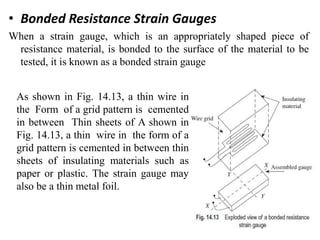
• Bonded Resistance Strain Gauges
When a strain gauge, which is an appropriately shaped piece of
resistance material, is bonded to the surface of the material to be
tested, it is known as a bonded strain gauge
As shown in Fig. 14.13, a thin wire in
the Form of a grid pattern is cemented
in between Thin sheets of A shown in
Fig. 14.13, a thin wire in the form of a
grid pattern is cemented in between thin
sheets of insulating materials such as
paper or plastic. The strain gauge may
also be a thin metal foil.
The gauges are bonded to the surface under study using a thin layer of
adhesive, and waterproofing is provided by applying a layer of wax
or lacquer on the gauge.
The strain experienced by the grid and the surface under study to
which the grid is bonded will be the same. The gauge is highly
sensitive in the axial direction, and in the transverse direction strain
occurs due to the Poisson’s ratio effect.
Some small error may be present in the measurement of strain.
However, cross-sensitivity can be completely eliminated by making
the ends of the foil gauges thick.
A cluster of three or more strain gauges, known as rosette gauges, can
be employed if the direction of the principal strain is unknown.
The resistance type of electric strain gauges is the most popular device
used for measuring strain. In this case, electrical resistance of the
gauge proportionately changes with the strain it is subjected to.
These gauges exist in the following forms:
1. Wire-type strain gauge
2. Foil-type strain gauge
3. Semiconductor or piezoresistive strain gauge
Wire-type strain gauge It is made up of a very thin wire having a
diameter of 0.025 mm wound into a grid shape, as illustrated in
Fig. The grid is cemented in between two pieces of thin paper with
ceramic or plastic backing.
This will facilitate easy handling of the strain gauge. This gauge is
further bonded securely to the surface of the member on which the
strain is to be measured using a suitable cement.
Foil-type resistance strain gauge A foil-type resistance strain gauge
has a thickness of about 0.005 mm. It comprises a metal foil grid
element on an epoxy support.
For high-temperature applications, epoxy filled with fibre glass is
employed. These gauges are manufactured by printing them on a
thin sheet of metal alloy with an acid-resistant ink and the
unprinted portion is etched away.
They offer advantages such as improved hysteresis, better fatigue life,
and lateral strain sensitivity. They can be fixed on fillets and
sharply curved surfaces because they are thin and have higher
flexibility. These are also known as metallic gauges. A foil-type
resistance strain gauge is shown in Fig.
Semiconductor or piezoresistive strain gauge
Semiconductor gauges are cut from single crystals of
silicon or germanium. This type of gauge contains precise
amounts of impurities like boron, which impart certain
desirable characteristics.
The backing, bonding materials, and mounting techniques
used for metallic gauges are also employed here.
When the material onto which semiconductor gauges are
bonded is strained, the current in the semiconductor material
changes correspondingly.
When the electrical resistance of the gauge increases due to
the tensile strain, it is known as a positive or p-type
semiconductor gauge.
Semiconductor gauges also possess certain disadvantages:
1. The output obtained in a semiconductor gauge is non-linear in
nature.
2. The strain sensitivity of the gauge is temperature dependent.
3. It is more fragile when compared to a wire or foil element.
4. It is more expensive than an ordinary metallic gauge.
BONDING OF GAUGES
The following are the steps to be followed while bonding
the gauge to the specimen:
1.Wash hands with soap and water. The working desk area
should be kept clean and all related tools should be
washed with a solvent or degreasing agent.
2. The folder containing the gauge should be opened
carefully. Bare hands should not be used to grasp the
gauge. Tweezers can be used to hold the gauge. Do not
touch the grid.
3. Place the gauge on a clean working area with the bonding
side down.
4. Use a proper length, say, about 15 cm, of cellophane tape to pick
up the strain gauge and transfer it to the gauging area of the
specimen. Align the gauge with the layout lines. Press one end of
the tape to the specimen, and then smoothly and gently apply the
whole tape and gauge into position
5. Lift one end of the tape such that the gauge does not contact the
gauging area and the bonding site is exposed. Apply the catalyst
evenly and gently on the gauge.
6. Apply enough adhesive to provide sufficient coverage under the
gauge for proper adhesion.
Some iteration may be required in determining ‘sufficient’ coverage.
Place the tape and gauge back onto the specimen smoothly and
gently. Immediately place the thumb over the gauge and apply
firm and steady pressure on it for at least one minute.
Gauge factor or strain sensitivity
R=ρL/A.
The gauge factor is the most important parameter of strain gauges. It is
a measure of the amount of resistance change for a given strain and
therefore serves as an index of the strain sensitivity of the gauge.
Mathematically, it is expressed as follows:
The gauge factor Gf is the ratio of change of resistance dR/R to the
change in gauge length dL/L.
A higher gauge factor makes the gauge more sensitive, and the
electrical output obtained for indication and recording purposes will
be greater.
The gauge factor is supplied by the manufacturer and may vary from
1.7 to 4 depending on the length of gauge.
Basic Wheatstone resistance Bridge and methods of strain
measurement
• Electrical resistance type of strain gauges uses highly
sensitive Wheatstone bridge circuit for the
measurement of strain .
• Consists of four resistance arms with a source of
energy and a detector as shown .
• The basic principle of the bridge may be applied in
two different ways null and the deflection method .
R1/R3 =R2/R4 .
• Suppose if any resistance change ,it will unbalance
the bridge and the voltage will appear across BD
causing a meter reading to change.
• The meter reading is an indication of a change in
resistance and actually can be utilized to compute this
change Known as deflection method
Resistance Bridge arrangement for strain
measurement
Temperature compensation
• Gauge factor of the strain gauge is affected by the
temperature owing to creep.
• The resistance of the strain gauge element varies with
a change in the temperature.
• Strains may be induced in the gauge due to
differential expansion between the test member and
the strain gauge bonding material .
Methods :
• Adjacent arm compensating gauge .
• Self temperature compensating gauge .
• If the strain gauges in arms 1 and 2 are alike and
mounted on similar materials, and if both gauges
experience the same resistance shift ΔRt, caused by
temperature change, then
• It is clear that any changes in the resistance of gauge 1
due to temperature is cancelled by similar changes in the
resistance of gauge 2 and the bridge remains in balance
and the output is unaffected by the change in
temperature.
Self-temperature Compensation
A completely self-compensated gauge should exhibit zero change of
resistance with change of temperature when bonded to a specified
material.
Consider a conventional advance gauge bonded to a steel base. The
coefficient of linear expansion of this alloy is 15 μmº c/m. while
the coefficient of steel is 12 μmº c/m; thus under rising
temperature the free expansion of the gauge is prevented and as a
result the gauge is in compression and dR/R from this source is
negative.
Conversely, the thermal coefficient of resistance of the gauge itself is
positive, thus dR/R from this source is positive.
• If these resistance changes are equal and opposite then change of
resistance due to temperature is zero from these sources. It is of
interest to note that a similar gauge bonded to aluminum,
coefficient 12 μmº c/m, would be in tension. The most widely used
self-compensated gauges are made from specially prepared
“selected melt” alloys for use on specified materials.
• The temperature coefficient of resistance of the gauge is, by
suitable heat treatment during manufacture, matched to the
coefficient of linear expansion of the material on which it is to be
used. For physical reasons such matching. can only be ensured
over a limited range of temperature
Temperature
• Is change usually measured by observing the change in a
temperature –dependent physical property .
• The direct comparison is difficult in case of temperature.
• In practical thermometry , temperature is instead
gauged by its effect on the quantities such as volume
,pressure, electrical resistance ,or radiated energy
Common temperature sensing techniques .
• Change in physical dimensions .
1. liquid –in glass thermometers .
2. Bimetallic elements.
• Changes in gas pressure or vapor pressure
1. Constant –volume gas thermometers.
2. Pressure thermometers(gas vapor and liquid filled ).
• Changes in electrical properties .
1. resistance thermometers (RTD, PRT).
2. Thermistors .
3. Thermocouples .
4. semiconductor –junction sensors.
• Changes in emitted thermal radiation .
1. thermal and photon sensors .
2. total –radiation pyrometers .
3. Optical and two color pyrometers .
4. infrared pyrometers
• Changes in chemical phase.
1. Fusible indicators.
2. Liquid crystals.
3. Temperature –reference (fixed –point )cells
Temperature measurement by electrical
effects
• Are very convenient method of temperature
measurement .
• They provide a signal that can be easily detected
,amplified or used for control purposes .
• Accurate result when calibrated and compensated .
Resistance thermometers (RTD)
• Electrical resistance of material varies with
temperature
• Resistance elements sensitive to temperature were
first made of metals .(nickel , copper , platinum and
silver).
• A temperature –measuring device using an element
of this type is referred as resistance thermometer or
resistance temperature detector .j
Requirements
• Material should permit fabrication .
• Thermal coefficient or resistivity should be high and
constant .
• Corrosion resistant and should undergo phase
change with in the temperature ranges .
• Provide reproducible and consistent results.
Relation between the resistance and
temperature
Construction
• The resistance wire is wrapped around the a mica
strip and sandwiched between two additional mica
strip .
• The RTD may be used directly but with permanent
installation with corrosion and mechanical protection
is required.
Instrumentation
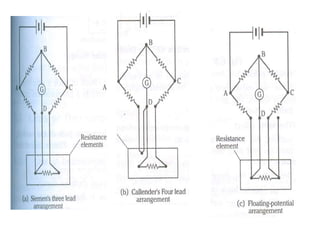
• Bridge circuit is normally used to measure resistance
change in the thermometers.
• Leads of appropriate length is required to measure
the change in resistance .
• Lead resistance must be as low as possible when
compared with that of element resistance.
Methods of compensating lead resistance
Siemens 3 lead arrangement :
• Simplest corrective circuit.
• At balance condition, the centre lead carries no
current .
• And the resistance of other two leads is cancelled out.
Floating potential arrangement :the extra lead is used
to check the equality of lead resistance .
Thermoelectric effect
• Seeback effect
when two dissimilar metal are joined together , an
electromotive force (emf) will exits b/w the points
A& B (say), which primarily a function of the junction
temperature
• Peltier effect :
If the two metals are connected to an external circuit
in a such a way that a current is drawn , the emf may
be altered slightly owing to a phenomenon .
• Thomson effect :
Further if a temperature gradient exists along either
or both of the metals , the junction emf undergo an
additional slight alteration .
Thermocouple
Principle :
• If two dissimilar metals are joined an emf exists which is a function
of several factors including the temperature. When junctions of this
type are used to measure temperature, they are called
thermocouples
• The principle of a thermocouple is that if two dissimilar metals A
and B are joined to form a circuit as shown in the Fig. It is found
that when the two junctions J1 and J2 are at two different
temperatures T1 and T2, small emf's e1 and e2 are generated at the
junctions.
• The resultant of the two emf's causes a current to flow in the
circuit. If the temperatures T1 and T2 are equal, the two emf's will
be equal but opposed, and no current will flow.
• The net emf is a function of the two materials used to form the
circuit and the temperatures of the two junctions. The actual
relations, however, are empirical and the temperature-emf data
must be based on experiment.
• It is important that the results are reproducible and therefore
provide a reliable method for measuring temperature.
Basic Thermocouple Circuit
• It should be noted that two junctions are always required, one
which senses the desired or unknown temperature is called the hot
or measuring junction. The other junction maintained at a known
fixed temperature is called the cold or reference junction.
Laws of thermocouple
1. Law of intermediate metals.
2. Law of intermediate temperatures.
Law of intermediate metals.
States that “insertion of an intermediate metal into
thermocouple circuit will not effect the net effect emf,
provided the two junction introduced by the third
metal are at identical temperature”.
• Law of intermediate temperatures
States that if a simple thermocouple circuit develops
an emf , e1 when its junction are at T1 and T2 ,an
emf e2 ,when its junction are at temp T2 and T3. then
same circiut will develop an emf e3= e1+e2 ,when its
junction are at T1 and T3
Materials and construction
Properties
1. Linear temperature –emf relationship.
2. High output emf
3. Resistance to chemical change .
4. Stability of emf.
5. Mechanical strength.
Types :
1. Rare metal types using platnium ,rhodium iridium.
2. Base metal types.
Different types of thermocouple
Thermocouple construction
Thermocouple insulation
Measurement of thermal Emf
• The magnitude of Emf generated by
thermocouple is 0.01 to 0.07 millivolts/oC
Advantages and limitations
• Less expensive when compared with RTD.
• Convenient for. measuring temp at a particular point.
Limits
• Inaccuracy .
• Protection against contamination.
• Should be placed at a particular place.
Pyrometers
• When the temp. to be measured are very high and
physical contact with the medium to be measured is
impossible , then thermal radiation methods or optical
pyrometers are necessary .
• Used when corrosive vapors or liquids would destroy
thermocouples and RTD.
• Measures the heat emitted or reflected by a hot
object.
• Thermal radiation is the electromagnetic radiation as
a result of temperature.
• The operation of thermal radiation pyrometers are
based on black body concept.
• The total thermal radiation emitted by a black body
/unit area is given by Stefen –Boltzman law
Principles used for radiation temperature
measuring devices
Total radiation pyrometry:
1. The total radiant energy from a heated body is
measured .
2. The radiation pyrometer is intended to receive max.
Amount of radiant energy at wide range of
wavelengths possible.
Selective radiation pyrometry.
1. This involves the measurement of spectral radiant
intensity of the radiated energy from a heated body
at a given wavelength .
2. The optical pyrometer uses this principle.
• Receives all the radiations from the hot body and
focuses it on a sensitive temperature transducer like
thermocouple resistance thermometer .
• It consists of a radiation receiving element and a
measuring devices to indicate the temperature .
• A lens is to concentrate the total radiant energy from
the source on to temperature sensing devices .
Optical pyrometery
• It uses the method of matching the temperature as
the measure of measurement .
• A reference temperature is provided in the form of of
electrically heated lamp filament. (visual radiation is
compared).
• 2 methods are followed .
• The current through the filament may be controlled
electrically with help of resistance adjust ment
• The radiation received by the pyrometer from the
unknown source may be adjusted optically by means of
some absorbing devices.
Total Radiation Pyrometers
The total radiation pyrometers receives all the radiations from a hot
body and focuses it on to a sensitive temperature transducer like
thermocouple, resistance thermometer etc. It consists of a
radiation-receiving element and a measuring device to indicate the
temperature.
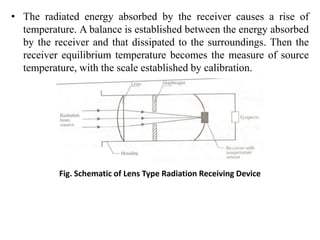
A lens is used to concentrate the total radiant energy from the source
on to the temperature sensing element. The diaphragms are used to
prevent reflections. When lenses are used, the transmissibility of
the glass determines the range of frequencies passing through. The
transmission bands of some of the lens materials are shown in the
Fig.
• The radiated energy absorbed by the receiver causes a rise of
temperature. A balance is established between the energy absorbed
by the receiver and that dissipated to the surroundings. Then the
receiver equilibrium temperature becomes the measure of source
temperature, with the scale established by calibration.
Fig. Schematic of Lens Type Radiation Receiving Device
• The mirror type radiation receiver is another type of radiation
pyrometer as shown in the Fig. Here the diaphragm unit along
with a mirror is used to focus the radiation onto a receiver.
• The distance between the mirror and the receiver may be adjusted
for proper focus. Since there is no lens, the mirror arrangement
has an advantage a absorption and reflection effects are absent.
Although radiation pyrometers may theoretically be used at any
reasonable distance from a temperature source, there are practical
limitations.
i) The size of target will largely determine the degree of
temperature averaging, and in general, the greater the distance
from the source, the greater the averaging.
ii) The nature of the intervening atmosphere will have a decided
effect on the pyrometer indication. If smoke, dust or certain gases
present considerable energy absorption may occur. This will have
a particular problem when such absorbents are not constant, but
varying with time. For these reasons, minimum practical distance
is recommended

MMM Module - 5.pptx

  • 1.
  • 2.
    Force, Torque andPressure Measurement
  • 3.
    † A forcecan be a push or a pull. † It is represented as a vector and has a point of application. † The unit of force is called the Newton. Symbol N. † The measurement of force involves the determination of its magnitude as well as its direction. 3
  • 4.
    4 1) Direct comparison 2)Indirect comparison – through the use of calibrated transducers. † Direct comparison – Uses some form of beam balance with a null-balance technique. The beam neither amplifies nor attenuates the force. Example: Analytical Balance. † Indirect comparison – In this case, the force is attenuated through a system of levers so that a smaller weight is used to balance the force. This method requires calibration of the system. Example: Platform Balance.
  • 5.
  • 6.
  • 7.
    7 † The directionof force is parallel to that of gravitational force and only its magnitude needs to be determined. † O – balance arm rotates about this point. † W1 & W2 - two forces applied at the end of the arm † W1 is unknown force and W2 is known force due to a standard weight. † G - Center of gravity of the balance arm. † WB - weight of balance arm and the pointer acting at G.
  • 8.
    † Sensitivity “S”:Sensitivity is defined as the angular deflection per unit unbalance between the two weights W1 and W2. 8
  • 9.
    9 † Sensitivity canbe calculated by writing the moment equation at equilibrium as follows. Where dB, dG and L are the distances For small deflection angles sin  ≈  and cos  ≈ 1 Thus the above equation becomes
  • 10.
  • 11.
  • 12.
    12 † The sensitivityof the balance will be independent of the weight W provided. It is designed such that dB = 0, then † The sensitivity depends on the construction parameters of the balance arm and is independent of the weights being compared. † The sensitivity of balance increases by decreasing both dG and WB and increasing L.
  • 13.
  • 14.
  • 15.
    15 † Mass ‘m’acts as power on the beam and exerts a force of Fg due to gravity where Fg = m x g. † This force acts as counterposing force against the load which may be a test force Ft. † The beam is pivoted on knife edge ‘q’. † The test force Ft is applied by a screw or a lever through a knife edge ‘p’ until the pointer indicates that the beam is horizontal.
  • 16.
    16 † For balanceof moments, Ft x a = Fg x b Test Force, Ft = Fg x b/a Ft = m x g x b/a Ft = constant x b Thus, the test force is proportional to the distance ‘b’ of the mass from the knife edge ‘p’.
  • 17.
  • 18.
  • 19.
  • 20.
  • 21.
    21 In these systems,a large weight W is measured in terms of two smaller weights Wp and Ws where, Wp = weight of poise and Ws = Weight of pan Before the unknown load W is applied to the platform, the poise weight Wp is set at zero beam scale and adjustable counter piece is adjusted to obtain initial zero balance. The weight W can be replaced by two weights W1 and W2 and it is entirely balanced by the weight Ws in the pan.
  • 22.
  • 23.
    23 † Suppose thescale has a multiplication ratio of 1000. † It means that a weight of 1 kg put in the pan can balance a weight of 1000 kg put on the platform. † The beam scale is so divided that a movement of poise weight Wp by 1 scale division represents a force of x kg, then a poise movement of y scale divisions should produce the same result as a weight Wp placed on the pan at the end of the beam. † Hence, † This represents a relationship that determines the required scale divisions on the beam for any poise weight Wp.
  • 24.
  • 25.
  • 26.
    26 † It isused for calibrating tensile machine. † High accurate measurement of large static loads may be obtained. † A proving ring is a circular ring of rectangular cross section, which may be subjected to tensile or compressive forces across its diameter.
  • 27.
    27 The force deflectionrelation for a thin ring is given by Where F – Force E – Young’s Modulus I – moment of inertia of the section D – outer diameter of the ring Y - deflection
  • 28.
    28 Working : † Thedeflection obtained is very small and is used to measure of applied loads . † Deflection is measured with help of precision micrometer. † Micrometer reading are obtained by with the help of vibrating reed. † To obtain precise measurements one edge of the micrometer is mounted on a vibrating reed device which is plucked to obtain a vibratory motion. † The micrometer spindle is advanced until contact is indicated by marked damping of vibration. † Use: For force measurement within a range of 1.5 KN to 1.5 MN.
  • 29.
  • 30.
    30 † Torque isa measure of how much a force acting on an object causes that object to rotate. † The object rotates about an axis, which we will call the pivot point. † Torque is associated with the determination of mechanical power. † The power developed by the machine, Torque T = F x R, N-m
  • 31.
    31 † Torque measuringdevices are known as dynamometers. There are basically three type 1. Absorption dynamometers: They absorb the mechanical energy as torque is measured, and hence are used measure torque developed at the source such as engines or electric motors. 2. Driving dynamometers : These dynamometers measure power or torque and as well provide energy to operate the devices to be tested. They are useful in determining performance characteristics of devices such as pumps, compressors etc.
  • 32.
    32 3. Transmission dynamometers:These are passive devices placed at an appropriate location within a machine or in between machines to sense the torque at that location. They neither add nor subtract the transmitted energy or power and are sometimes referred to as torque meters.
  • 33.
  • 34.
    34 † Construction: † Twowooden blocks are mounted diametrically opposite on a flywheel attached to the rotating shaft whose power has to be measured . † One block carries a lever arm and an arrangement is provided to tighten the rope which is connected to the arm . † The rope is tightened so as to increase the frictional resistance between the blocks and the flywheel.
  • 35.
    35 † Torque exertedby the prony brake is † The power dissipated in the brake is calculated by equation
  • 36.
    36 Limitation: † It isdifficult to adjust and maintain a specific load. † Requires continues tightening of clamp, therefore the system becomes unsuitable for measurement of large power . † Results in excessive temperature rise which decreases the coefficient leading to failure of brake. † If machine torque is not constant the measuring arrangement is subjected to oscillations .
  • 37.
  • 38.
    38 † It isthe simplest form of which acts as water brake. † The capacity of hydraulic dynamometer is a function of two factors, speed and water level. † The torque is measured with help of a reaction arm. † The power absorption at a given speed may be controlled by adjusting the water level in the housing. † This type of dynamometer may be made in considerably larger capacities.
  • 39.
    39 † Trunnian bearingssupport the dynamometer housing, allowing it to rotate freely except for the restraint imposed by the reaction arm. † Power absorbing element is the housing which tends to rotate with input shaft of the driving machine. † The rotation is constrained by a force measuring device, such as some forms of load cell or scales, placed at the end of the reaction arm.
  • 40.
    40 † In hydraulicdynamometer constant supply of water running through the breaking medium acts a coolant. † The brake power of very large and speed engine can be measured. † In hydraulic dynamometer there is a flexibility in controlling the operation.
  • 41.
    41 † Pressure isrepresented as force / unit area exerted by a fluid on a container.
  • 42.
    42 Atmospheric Pressure: Theatmospheric air exerts a normal pressure upon all surfaces with which it is in contact, and it is known as atmospheric pressure. It is also known as Barometric pressure. Gauge Pressure: It is pressure, measured with the help of a pressure measuring instrument, in which atmospheric pressure is taken as datum. The atmospheric pressure on the scale is marked as zero. Absolute Pressure: Any pressure measured above the “zero absolute pressure” is termed as ‘absolute pressure’.
  • 43.
  • 44.
  • 45.
  • 46.
    46 † It isindependent of the gas composition. † It serves as a reference standard to calibrate other low pressure gauges. † There is no need to apply corrections to the McLeod Gauge readings.
  • 47.
    47 † The gaswhose pressure is to be measured should obey the Boyle’s law † Moisture traps must be provided to avoid any considerable vapor into the gauge. † It measure only on a sampling basis. † It cannot give a continuous output.
  • 48.
  • 49.
  • 50.
    50 † When electriccurrent is made to flow through a conducting wire, it gets heated. † The rate at which heat is dissipated from this wire depends on the conductivity of the wire and the surrounding pressure. † At low pressure less amount of heat is dissipated and at high pressure higher heat dissipates.
  • 51.
    51 The main partsof the arrangement are – † A Pirani gauge chamber which encloses a platinum filament. † A compensating cell to minimize variation caused due to ambient temperature changes. † The Pirani gauge chamber and the compensating cell is housed on a wheat stone bridge circuit as shown in diagram.
  • 52.
    52 Working of Piranigauge † A constant current is passed through the filament in the Pirani gauge chamber. Due to this current, the filament gets heated and assumes a resistance which is measured using the bridge. † Now the pressure to be measured is connected to the Pirani gauge chamber. Due to the change in pressure, the conductivity and the temperature of the filament will changes.
  • 53.
    53 † When thetemperature of the filament changes, the resistance of the filament also changes. † Now the change in resistance of the filament is determined using the bridge. † This change in resistance of the pirani gauge filament becomes a measure of the applied pressure when calibrated.
  • 54.
    Strain What is Strain? •Strain is the amount of deformation of a body due to an applied force. More specifically, strain (e) is defined as the fractional change in length, as shown in Figure below. • Strain can be positive (tensile) or negative (compressive). Although dimensionless, strain is sometimes expressed in units such as in./in. or mm/mm. In practice, the magnitude of measured strain is very small. • Therefore, strain is often expressed as microstrain (με), which is ε = 10–6.
  • 55.
    • When abar is strained with a uniaxial force, as in Figure, a phenomenon known as Poisson Strain causes the girth of the bar, D, to contract in the transverse, or perpendicular, direction. • The magnitude of this transverse contraction is a material property indicated by its Poisson's ratio. • The Poisson's Ratio ‘ν’ of a material is defined as the negative ratio of the strain in the transverse direction (perpendicular to the force) to the strain in the axial direction (parallel to the force), or n = –εT/ε. Poisson's Ratio for steel, for example, ranges from 0.25 to 0.3.
  • 56.
    Strain gauges While thereare several methods of measuring strain, the most common is with a strain gauge, a device whose electrical resistance varies in proportion to the amount of strain in the device. The change in length over a small gauge length is very small , a high magnification system is required and based upon this strain gauges are classified as . 1. Mechanical strain gauges. 2. Optical strain gauges . 3. Electrical strain gauges
  • 57.
    Mechanical strain gauges •Involves mechanical means for magnification (extensometer ). • Most commonly used mechanical strain gauge are Berry type and Huggen Berger type
  • 59.
    Optical strain gauge •Commonly used optical strain gauge was developed by Tuckerman . • It is a combination of both mechanical system and optical system. • Ie., extensometer and auto collimator. • Can be used to measure 2 um/m and gauge length up to 250 mm.
  • 61.
    • The nominallength of gauge is the distance from knife edge to the point of contact of lozenge. • The lozenge acts as a mirror . • The distance between the fixed edge and lozenge changes , due to loading . • The lozenge rotates and any light falling on it , will be deflected .. • The function of auto collimator is to send the parallel rays of light and receive back the reflected light beam from the lozenge on the optical system .
  • 62.
    Electrical strain gauge •A change in strain produces some change in electrical characteristic . • This change can be magnified with some electronic equipment. Types : • Capacitance , inductance , piezoelectric ,and resistance gauges .
  • 63.
    Materials • Alloys ofnickel and copper , nickel , alloys of chromium and iron with other element in small percentages other elements . • Gauge resistance varies from 60 Ω to 5000 Ω. • Current carried gauges for long periods is around 25mA to 50 mA
  • 64.
    Electrical resistance straingauge • Resistance of a conductor is given by R=ρ x L/A. • Types : un bonded type , bonded , (wire , foil ) & semi conductor or piezo resistive strain gauge
  • 65.
  • 67.
    • Bonded ResistanceStrain Gauges When a strain gauge, which is an appropriately shaped piece of resistance material, is bonded to the surface of the material to be tested, it is known as a bonded strain gauge As shown in Fig. 14.13, a thin wire in the Form of a grid pattern is cemented in between Thin sheets of A shown in Fig. 14.13, a thin wire in the form of a grid pattern is cemented in between thin sheets of insulating materials such as paper or plastic. The strain gauge may also be a thin metal foil.
  • 68.
    The gauges arebonded to the surface under study using a thin layer of adhesive, and waterproofing is provided by applying a layer of wax or lacquer on the gauge. The strain experienced by the grid and the surface under study to which the grid is bonded will be the same. The gauge is highly sensitive in the axial direction, and in the transverse direction strain occurs due to the Poisson’s ratio effect. Some small error may be present in the measurement of strain. However, cross-sensitivity can be completely eliminated by making the ends of the foil gauges thick. A cluster of three or more strain gauges, known as rosette gauges, can be employed if the direction of the principal strain is unknown.
  • 69.
    The resistance typeof electric strain gauges is the most popular device used for measuring strain. In this case, electrical resistance of the gauge proportionately changes with the strain it is subjected to. These gauges exist in the following forms: 1. Wire-type strain gauge 2. Foil-type strain gauge 3. Semiconductor or piezoresistive strain gauge
  • 70.
    Wire-type strain gaugeIt is made up of a very thin wire having a diameter of 0.025 mm wound into a grid shape, as illustrated in Fig. The grid is cemented in between two pieces of thin paper with ceramic or plastic backing. This will facilitate easy handling of the strain gauge. This gauge is further bonded securely to the surface of the member on which the strain is to be measured using a suitable cement.
  • 71.
    Foil-type resistance straingauge A foil-type resistance strain gauge has a thickness of about 0.005 mm. It comprises a metal foil grid element on an epoxy support. For high-temperature applications, epoxy filled with fibre glass is employed. These gauges are manufactured by printing them on a thin sheet of metal alloy with an acid-resistant ink and the unprinted portion is etched away. They offer advantages such as improved hysteresis, better fatigue life, and lateral strain sensitivity. They can be fixed on fillets and sharply curved surfaces because they are thin and have higher flexibility. These are also known as metallic gauges. A foil-type resistance strain gauge is shown in Fig.
  • 72.
    Semiconductor or piezoresistivestrain gauge Semiconductor gauges are cut from single crystals of silicon or germanium. This type of gauge contains precise amounts of impurities like boron, which impart certain desirable characteristics. The backing, bonding materials, and mounting techniques used for metallic gauges are also employed here. When the material onto which semiconductor gauges are bonded is strained, the current in the semiconductor material changes correspondingly. When the electrical resistance of the gauge increases due to the tensile strain, it is known as a positive or p-type semiconductor gauge.
  • 73.
    Semiconductor gauges alsopossess certain disadvantages: 1. The output obtained in a semiconductor gauge is non-linear in nature. 2. The strain sensitivity of the gauge is temperature dependent. 3. It is more fragile when compared to a wire or foil element. 4. It is more expensive than an ordinary metallic gauge.
  • 74.
    BONDING OF GAUGES Thefollowing are the steps to be followed while bonding the gauge to the specimen: 1.Wash hands with soap and water. The working desk area should be kept clean and all related tools should be washed with a solvent or degreasing agent. 2. The folder containing the gauge should be opened carefully. Bare hands should not be used to grasp the gauge. Tweezers can be used to hold the gauge. Do not touch the grid. 3. Place the gauge on a clean working area with the bonding side down.
  • 75.
    4. Use aproper length, say, about 15 cm, of cellophane tape to pick up the strain gauge and transfer it to the gauging area of the specimen. Align the gauge with the layout lines. Press one end of the tape to the specimen, and then smoothly and gently apply the whole tape and gauge into position 5. Lift one end of the tape such that the gauge does not contact the gauging area and the bonding site is exposed. Apply the catalyst evenly and gently on the gauge. 6. Apply enough adhesive to provide sufficient coverage under the gauge for proper adhesion. Some iteration may be required in determining ‘sufficient’ coverage. Place the tape and gauge back onto the specimen smoothly and gently. Immediately place the thumb over the gauge and apply firm and steady pressure on it for at least one minute.
  • 76.
    Gauge factor orstrain sensitivity R=ρL/A. The gauge factor is the most important parameter of strain gauges. It is a measure of the amount of resistance change for a given strain and therefore serves as an index of the strain sensitivity of the gauge. Mathematically, it is expressed as follows: The gauge factor Gf is the ratio of change of resistance dR/R to the change in gauge length dL/L. A higher gauge factor makes the gauge more sensitive, and the electrical output obtained for indication and recording purposes will be greater. The gauge factor is supplied by the manufacturer and may vary from 1.7 to 4 depending on the length of gauge.
  • 77.
    Basic Wheatstone resistanceBridge and methods of strain measurement • Electrical resistance type of strain gauges uses highly sensitive Wheatstone bridge circuit for the measurement of strain . • Consists of four resistance arms with a source of energy and a detector as shown . • The basic principle of the bridge may be applied in two different ways null and the deflection method .
  • 79.
    R1/R3 =R2/R4 . •Suppose if any resistance change ,it will unbalance the bridge and the voltage will appear across BD causing a meter reading to change. • The meter reading is an indication of a change in resistance and actually can be utilized to compute this change Known as deflection method
  • 80.
    Resistance Bridge arrangementfor strain measurement
  • 81.
    Temperature compensation • Gaugefactor of the strain gauge is affected by the temperature owing to creep. • The resistance of the strain gauge element varies with a change in the temperature. • Strains may be induced in the gauge due to differential expansion between the test member and the strain gauge bonding material .
  • 82.
    Methods : • Adjacentarm compensating gauge . • Self temperature compensating gauge .
  • 84.
    • If thestrain gauges in arms 1 and 2 are alike and mounted on similar materials, and if both gauges experience the same resistance shift ΔRt, caused by temperature change, then • It is clear that any changes in the resistance of gauge 1 due to temperature is cancelled by similar changes in the resistance of gauge 2 and the bridge remains in balance and the output is unaffected by the change in temperature.
  • 85.
    Self-temperature Compensation A completelyself-compensated gauge should exhibit zero change of resistance with change of temperature when bonded to a specified material. Consider a conventional advance gauge bonded to a steel base. The coefficient of linear expansion of this alloy is 15 μmº c/m. while the coefficient of steel is 12 μmº c/m; thus under rising temperature the free expansion of the gauge is prevented and as a result the gauge is in compression and dR/R from this source is negative. Conversely, the thermal coefficient of resistance of the gauge itself is positive, thus dR/R from this source is positive.
  • 86.
    • If theseresistance changes are equal and opposite then change of resistance due to temperature is zero from these sources. It is of interest to note that a similar gauge bonded to aluminum, coefficient 12 μmº c/m, would be in tension. The most widely used self-compensated gauges are made from specially prepared “selected melt” alloys for use on specified materials. • The temperature coefficient of resistance of the gauge is, by suitable heat treatment during manufacture, matched to the coefficient of linear expansion of the material on which it is to be used. For physical reasons such matching. can only be ensured over a limited range of temperature
  • 87.
    Temperature • Is changeusually measured by observing the change in a temperature –dependent physical property . • The direct comparison is difficult in case of temperature. • In practical thermometry , temperature is instead gauged by its effect on the quantities such as volume ,pressure, electrical resistance ,or radiated energy
  • 88.
    Common temperature sensingtechniques . • Change in physical dimensions . 1. liquid –in glass thermometers . 2. Bimetallic elements. • Changes in gas pressure or vapor pressure 1. Constant –volume gas thermometers. 2. Pressure thermometers(gas vapor and liquid filled ).
  • 89.
    • Changes inelectrical properties . 1. resistance thermometers (RTD, PRT). 2. Thermistors . 3. Thermocouples . 4. semiconductor –junction sensors. • Changes in emitted thermal radiation . 1. thermal and photon sensors . 2. total –radiation pyrometers . 3. Optical and two color pyrometers . 4. infrared pyrometers
  • 90.
    • Changes inchemical phase. 1. Fusible indicators. 2. Liquid crystals. 3. Temperature –reference (fixed –point )cells
  • 91.
    Temperature measurement byelectrical effects • Are very convenient method of temperature measurement . • They provide a signal that can be easily detected ,amplified or used for control purposes . • Accurate result when calibrated and compensated .
  • 92.
    Resistance thermometers (RTD) •Electrical resistance of material varies with temperature • Resistance elements sensitive to temperature were first made of metals .(nickel , copper , platinum and silver). • A temperature –measuring device using an element of this type is referred as resistance thermometer or resistance temperature detector .j
  • 93.
    Requirements • Material shouldpermit fabrication . • Thermal coefficient or resistivity should be high and constant . • Corrosion resistant and should undergo phase change with in the temperature ranges . • Provide reproducible and consistent results.
  • 94.
    Relation between theresistance and temperature
  • 95.
  • 96.
    • The resistancewire is wrapped around the a mica strip and sandwiched between two additional mica strip . • The RTD may be used directly but with permanent installation with corrosion and mechanical protection is required.
  • 97.
    Instrumentation • Bridge circuitis normally used to measure resistance change in the thermometers. • Leads of appropriate length is required to measure the change in resistance . • Lead resistance must be as low as possible when compared with that of element resistance.
  • 99.
    Methods of compensatinglead resistance Siemens 3 lead arrangement : • Simplest corrective circuit. • At balance condition, the centre lead carries no current . • And the resistance of other two leads is cancelled out.
  • 100.
    Floating potential arrangement:the extra lead is used to check the equality of lead resistance .
  • 101.
    Thermoelectric effect • Seebackeffect when two dissimilar metal are joined together , an electromotive force (emf) will exits b/w the points A& B (say), which primarily a function of the junction temperature
  • 102.
    • Peltier effect: If the two metals are connected to an external circuit in a such a way that a current is drawn , the emf may be altered slightly owing to a phenomenon . • Thomson effect : Further if a temperature gradient exists along either or both of the metals , the junction emf undergo an additional slight alteration .
  • 103.
  • 104.
    • If twodissimilar metals are joined an emf exists which is a function of several factors including the temperature. When junctions of this type are used to measure temperature, they are called thermocouples • The principle of a thermocouple is that if two dissimilar metals A and B are joined to form a circuit as shown in the Fig. It is found that when the two junctions J1 and J2 are at two different temperatures T1 and T2, small emf's e1 and e2 are generated at the junctions.
  • 105.
    • The resultantof the two emf's causes a current to flow in the circuit. If the temperatures T1 and T2 are equal, the two emf's will be equal but opposed, and no current will flow. • The net emf is a function of the two materials used to form the circuit and the temperatures of the two junctions. The actual relations, however, are empirical and the temperature-emf data must be based on experiment. • It is important that the results are reproducible and therefore provide a reliable method for measuring temperature. Basic Thermocouple Circuit
  • 106.
    • It shouldbe noted that two junctions are always required, one which senses the desired or unknown temperature is called the hot or measuring junction. The other junction maintained at a known fixed temperature is called the cold or reference junction.
  • 107.
    Laws of thermocouple 1.Law of intermediate metals. 2. Law of intermediate temperatures.
  • 108.
    Law of intermediatemetals. States that “insertion of an intermediate metal into thermocouple circuit will not effect the net effect emf, provided the two junction introduced by the third metal are at identical temperature”.
  • 109.
    • Law ofintermediate temperatures States that if a simple thermocouple circuit develops an emf , e1 when its junction are at T1 and T2 ,an emf e2 ,when its junction are at temp T2 and T3. then same circiut will develop an emf e3= e1+e2 ,when its junction are at T1 and T3
  • 110.
    Materials and construction Properties 1.Linear temperature –emf relationship. 2. High output emf 3. Resistance to chemical change . 4. Stability of emf. 5. Mechanical strength.
  • 111.
    Types : 1. Raremetal types using platnium ,rhodium iridium. 2. Base metal types.
  • 112.
    Different types ofthermocouple Thermocouple construction
  • 113.
  • 114.
  • 115.
    • The magnitudeof Emf generated by thermocouple is 0.01 to 0.07 millivolts/oC
  • 116.
    Advantages and limitations •Less expensive when compared with RTD. • Convenient for. measuring temp at a particular point. Limits • Inaccuracy . • Protection against contamination. • Should be placed at a particular place.
  • 117.
    Pyrometers • When thetemp. to be measured are very high and physical contact with the medium to be measured is impossible , then thermal radiation methods or optical pyrometers are necessary . • Used when corrosive vapors or liquids would destroy thermocouples and RTD.
  • 118.
    • Measures theheat emitted or reflected by a hot object. • Thermal radiation is the electromagnetic radiation as a result of temperature. • The operation of thermal radiation pyrometers are based on black body concept. • The total thermal radiation emitted by a black body /unit area is given by Stefen –Boltzman law
  • 119.
    Principles used forradiation temperature measuring devices Total radiation pyrometry: 1. The total radiant energy from a heated body is measured . 2. The radiation pyrometer is intended to receive max. Amount of radiant energy at wide range of wavelengths possible.
  • 120.
    Selective radiation pyrometry. 1.This involves the measurement of spectral radiant intensity of the radiated energy from a heated body at a given wavelength . 2. The optical pyrometer uses this principle.
  • 121.
    • Receives allthe radiations from the hot body and focuses it on a sensitive temperature transducer like thermocouple resistance thermometer . • It consists of a radiation receiving element and a measuring devices to indicate the temperature . • A lens is to concentrate the total radiant energy from the source on to temperature sensing devices .
  • 122.
    Optical pyrometery • Ituses the method of matching the temperature as the measure of measurement . • A reference temperature is provided in the form of of electrically heated lamp filament. (visual radiation is compared). • 2 methods are followed . • The current through the filament may be controlled electrically with help of resistance adjust ment
  • 123.
    • The radiationreceived by the pyrometer from the unknown source may be adjusted optically by means of some absorbing devices.
  • 126.
    Total Radiation Pyrometers Thetotal radiation pyrometers receives all the radiations from a hot body and focuses it on to a sensitive temperature transducer like thermocouple, resistance thermometer etc. It consists of a radiation-receiving element and a measuring device to indicate the temperature. A lens is used to concentrate the total radiant energy from the source on to the temperature sensing element. The diaphragms are used to prevent reflections. When lenses are used, the transmissibility of the glass determines the range of frequencies passing through. The transmission bands of some of the lens materials are shown in the Fig.
  • 127.
    • The radiatedenergy absorbed by the receiver causes a rise of temperature. A balance is established between the energy absorbed by the receiver and that dissipated to the surroundings. Then the receiver equilibrium temperature becomes the measure of source temperature, with the scale established by calibration. Fig. Schematic of Lens Type Radiation Receiving Device
  • 128.
    • The mirrortype radiation receiver is another type of radiation pyrometer as shown in the Fig. Here the diaphragm unit along with a mirror is used to focus the radiation onto a receiver. • The distance between the mirror and the receiver may be adjusted for proper focus. Since there is no lens, the mirror arrangement has an advantage a absorption and reflection effects are absent.
  • 129.
    Although radiation pyrometersmay theoretically be used at any reasonable distance from a temperature source, there are practical limitations. i) The size of target will largely determine the degree of temperature averaging, and in general, the greater the distance from the source, the greater the averaging. ii) The nature of the intervening atmosphere will have a decided effect on the pyrometer indication. If smoke, dust or certain gases present considerable energy absorption may occur. This will have a particular problem when such absorbents are not constant, but varying with time. For these reasons, minimum practical distance is recommended