Latent Semantic Indexing Sudarsun. S.,  M.Tech Checktronix India Pvt Ltd, Chennai 600034 [email_address]
What is NLP ? What is Natural Language ?  Can a machine understand NL ? How are we understanding NL ? How can we make a machine understand NL ? What are the limitations ?
Major Entities … What is Syntactic Analysis ? Deal Synonymy  Deal Polysemy ? What is Semantics ? Represent meanings as a Semantic Net What is Knowledge ? How to represent knowledge ? What are Inferences and Reasoning  ? How to use the accumulated knowledge ?
LSA for Information Retrieval What is LSA? Singular Value Decomposition Method of LSA Computation of Similarity using Cosine Measuring Similarities Construction of Pseudo-document Limitations of LSA Alternatives to LSA
What is LSA A Statistical Method that provides a way to describe the underlying structure of  texts Used in author recognition, search engines, detecting plagiarism, and comparing texts for similarities The contexts in which a certain word exists or does not exist determine the similarity of the documents Closely models human learning, especially the manner in which people learn a language and acquire a vocabulary
Multivariate Data Reduction technique. Reduces large dataset to a concentrated dataset containing only the significant information from the original data . Singular Value Decomposition
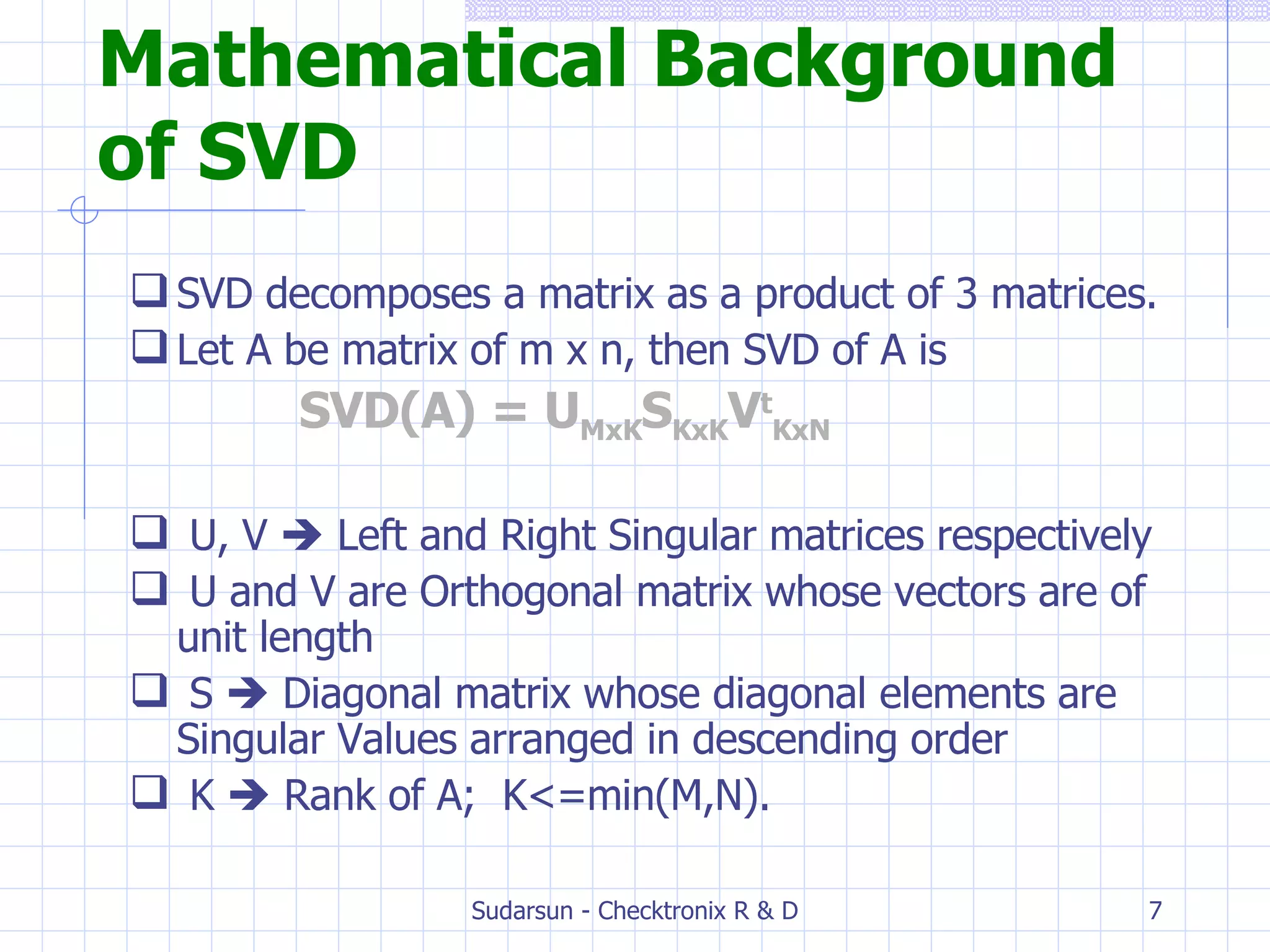
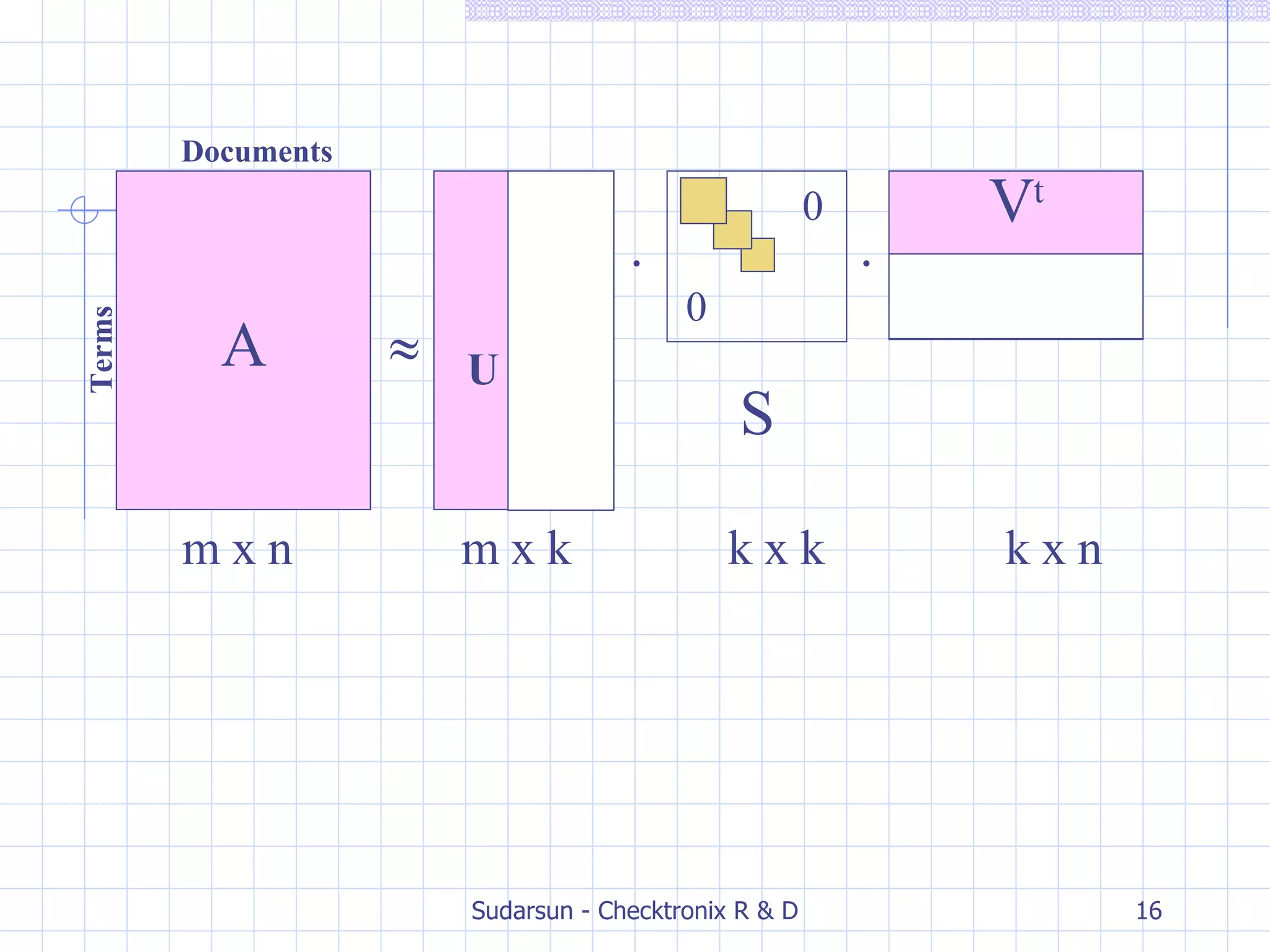
Mathematical Background of SVD SVD decomposes a matrix as a product of 3 matrices. Let A be matrix of m x n, then SVD of A is  SVD(A) = U MxK S KxK V t KxN U, V    Left and Right Singular matrices respectively U and V are Orthogonal matrix whose vectors are of unit length S    Diagonal matrix whose diagonal elements are Singular Values arranged in descending order K    Rank of A;  K<=min(M,N).
Computation of SVD To Find U,S and V matrices Find Eigen Values and their corresponding Eigen Vectors of the matrix  AA t Singular values = Square root of Eigen Values. These Singular values arranged in descending order forms the diagonal elements of the diagonal matrix  S . Divide each Eigen vector by its length. These Eigen vectors forms the columns of the matrix  U . Similarly Eigen Vectors of the matrix  A t A  forms the columns of matrix  V. [ Note : Eigen Values of  AA t  and   A t A  are equal.]
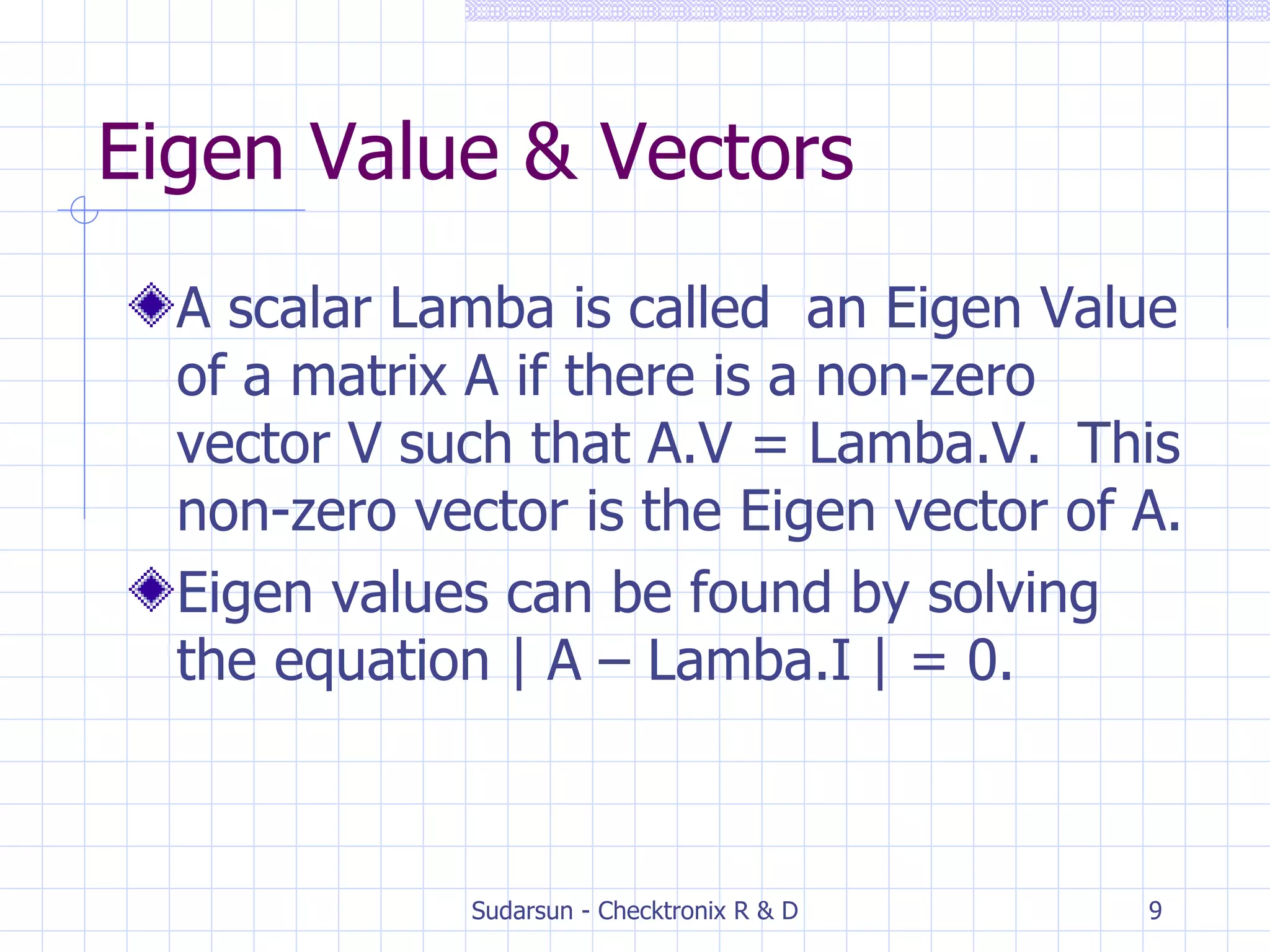
Eigen Value & Vectors A scalar Lamba is called  an Eigen Value of a matrix A if there is a non-zero vector V such that A.V = Lamba.V.  This non-zero vector is the Eigen vector of A. Eigen values can be found by solving the equation | A – Lamba.I | = 0.
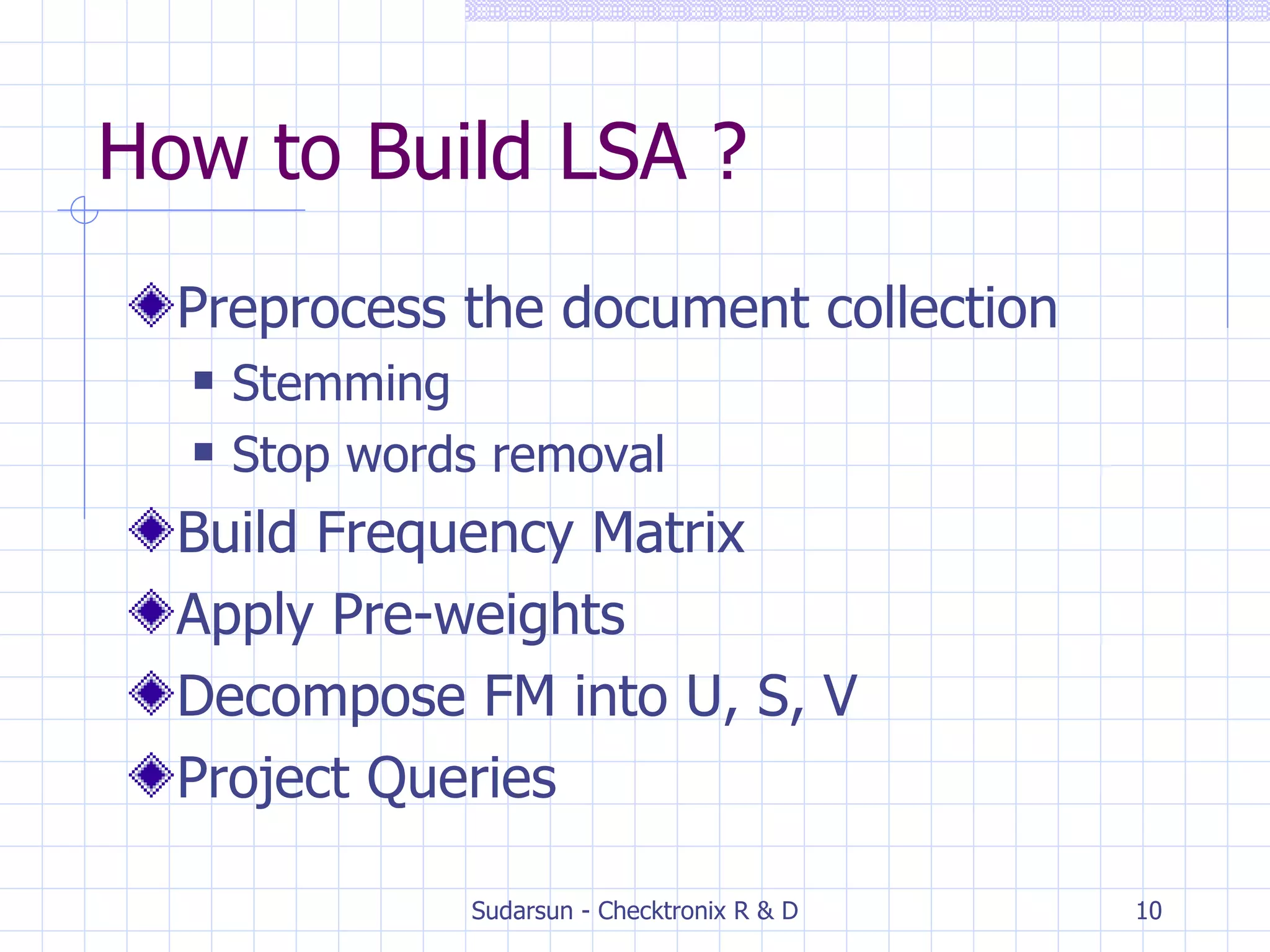
How to Build LSA ? Preprocess the document collection Stemming  Stop words removal Build Frequency Matrix Apply Pre-weights Decompose FM into U, S, V Project Queries
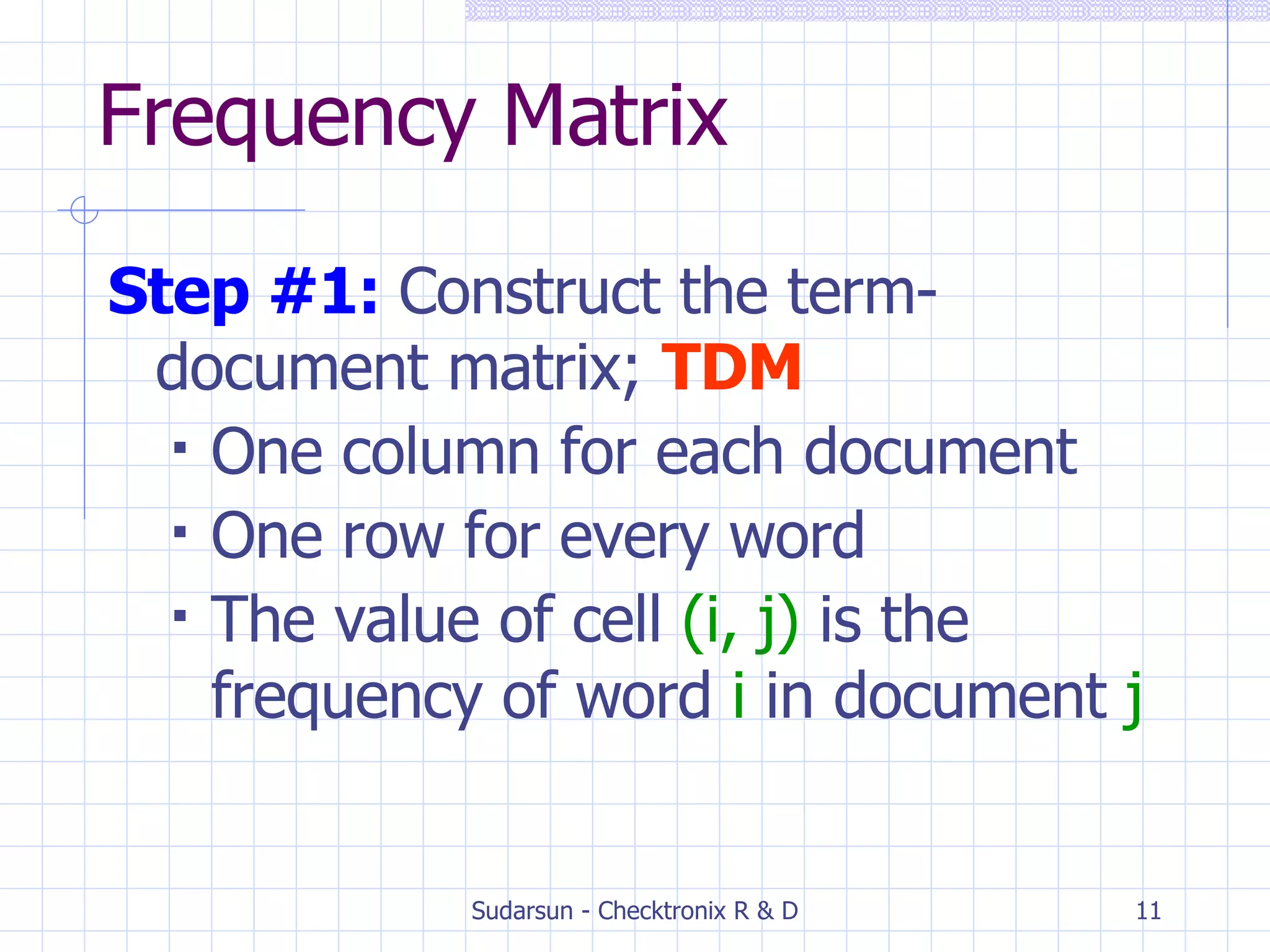
Step #1:   Construct the term-document matrix;  TDM One column for each document One row for every word The value of cell  (i, j)  is the frequency of word  i  in document  j Frequency Matrix
 
 
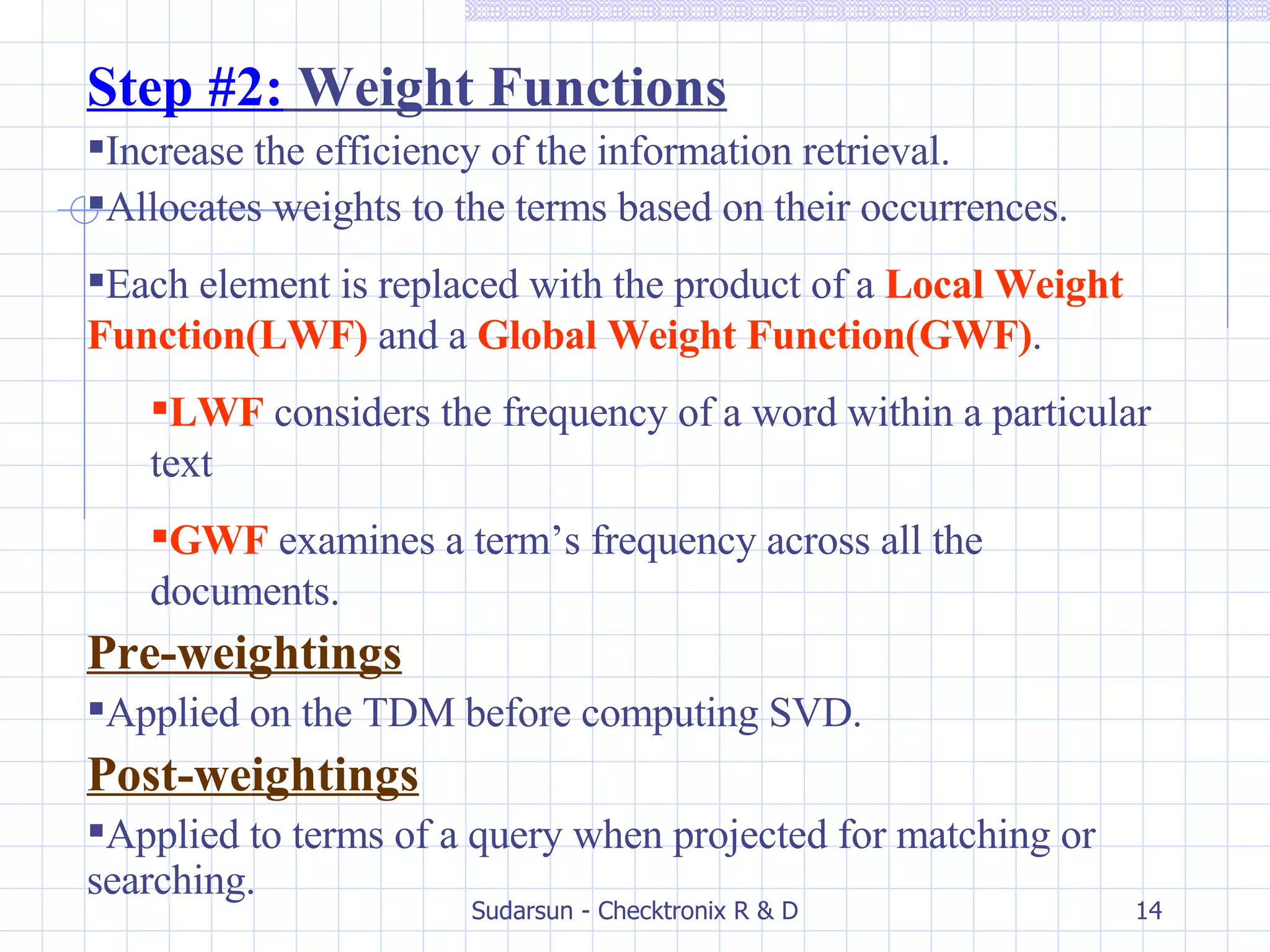
Step #2:  Weight Functions Increase the efficiency of the information retrieval. Allocates weights to the terms based on their occurrences. Each element is replaced with the product of a  Local Weight Function(LWF)  and a   Global Weight Function(GWF) . LWF  considers the frequency of a word within a particular text GWF   examines a term’s frequency across all the documents. Pre-weightings Applied on the TDM before computing SVD. Post-weightings Applied to terms of a query when projected for matching or searching.
Step #3:   SVD Perform SVD on term-document matrix X. SVD removes noise or infrequent words that do not help to classify a document. Octave/Mat lab can be used [u, s, v] = svd(A);
A U   S V t m x n  m x k  k x k  k x n · ·  Terms Documents  0 0
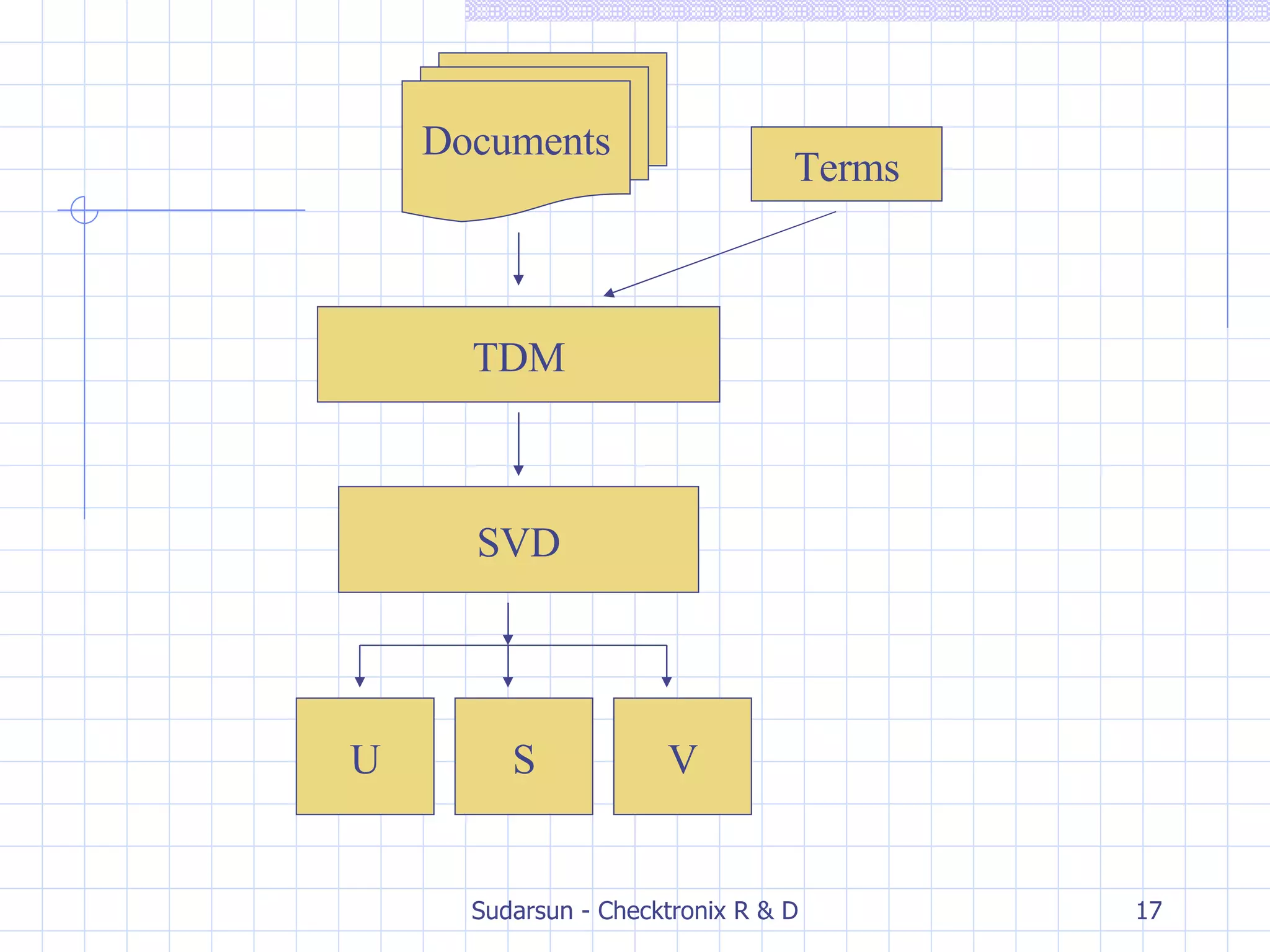
Documents TDM SVD Terms U S V
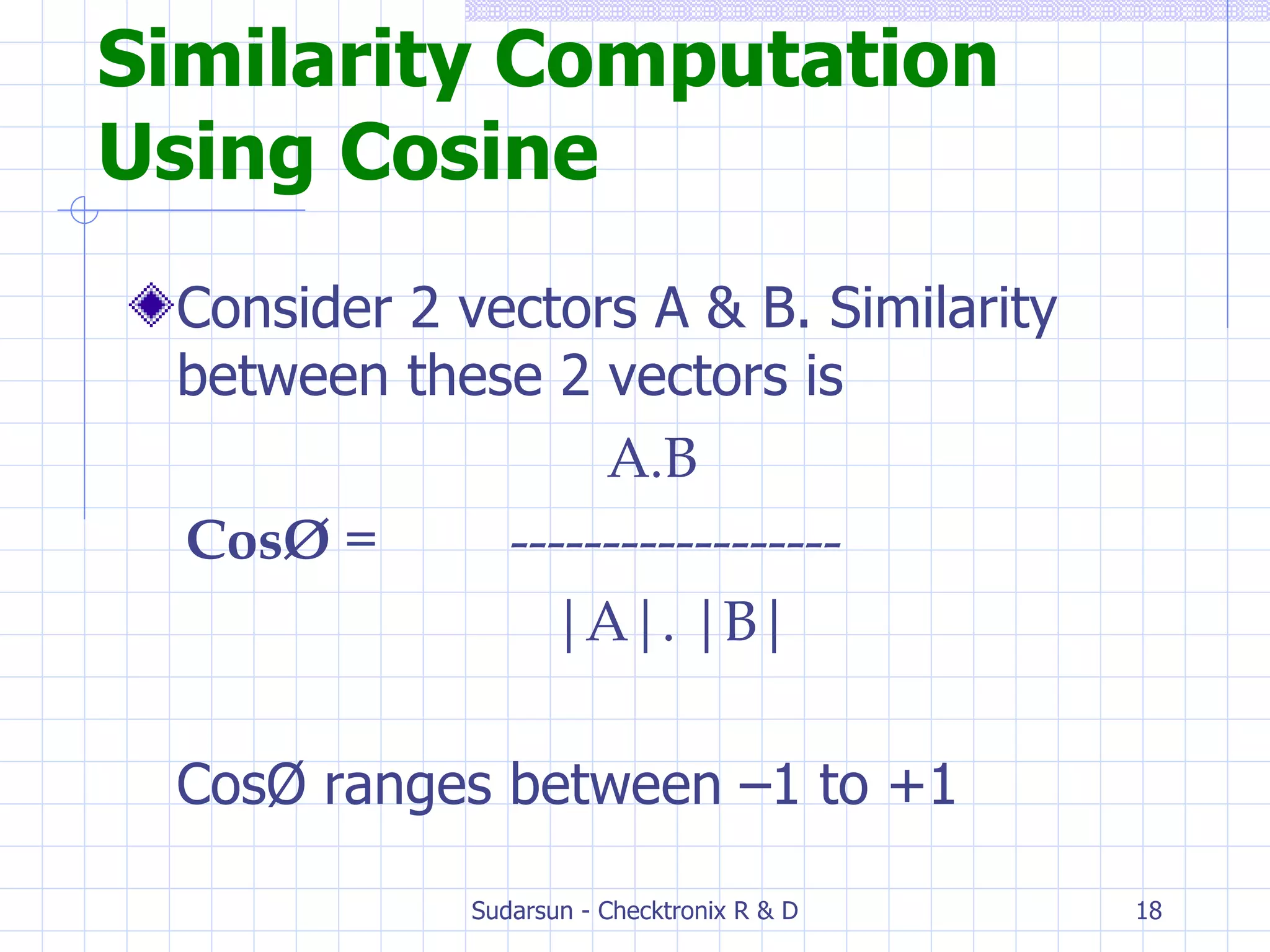
Similarity Computation Using Cosine Consider 2 vectors A & B. Similarity between these 2 vectors is    A.B CosØ  =  ------------------   |A|. |B|   CosØ ranges between –1 to +1
Similarity Computations in LSA
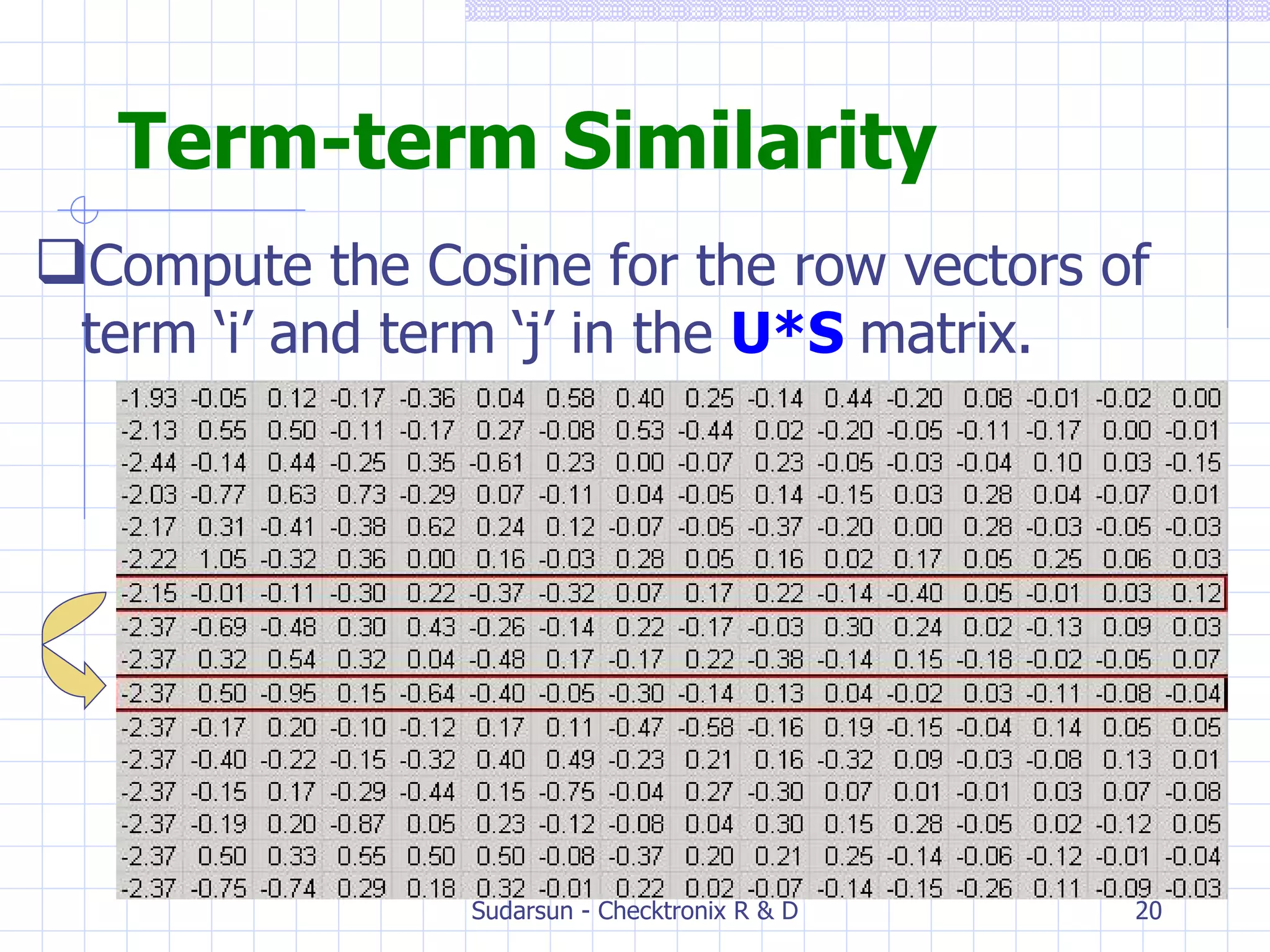
Term-term Similarity Compute the Cosine for the row vectors of term ‘i’ and term ‘j’ in the  U*S  matrix. US
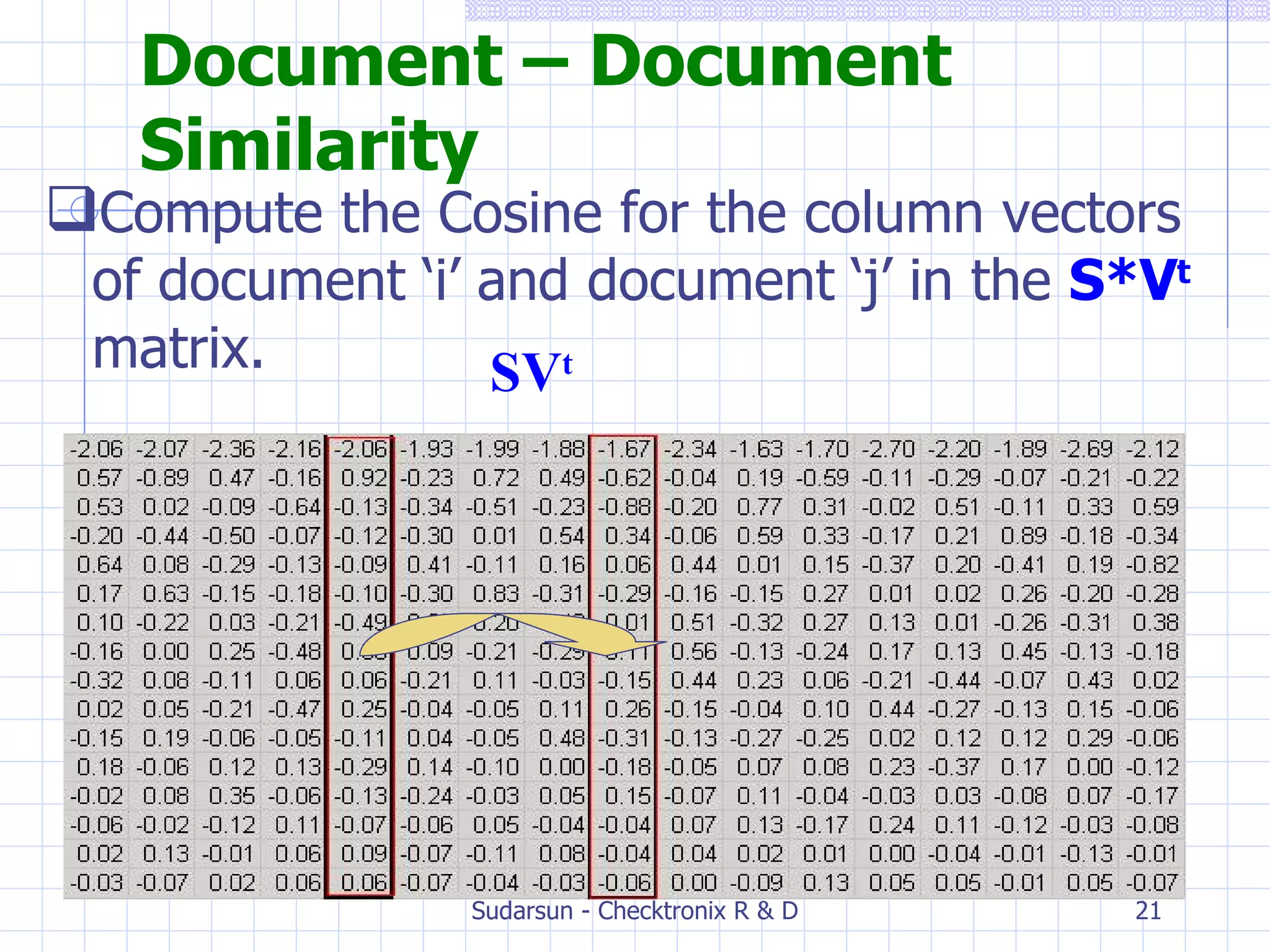
Document – Document Similarity Compute the Cosine for the column vectors of document ‘i’ and document ‘j’ in the  S*V t  matrix. SV t
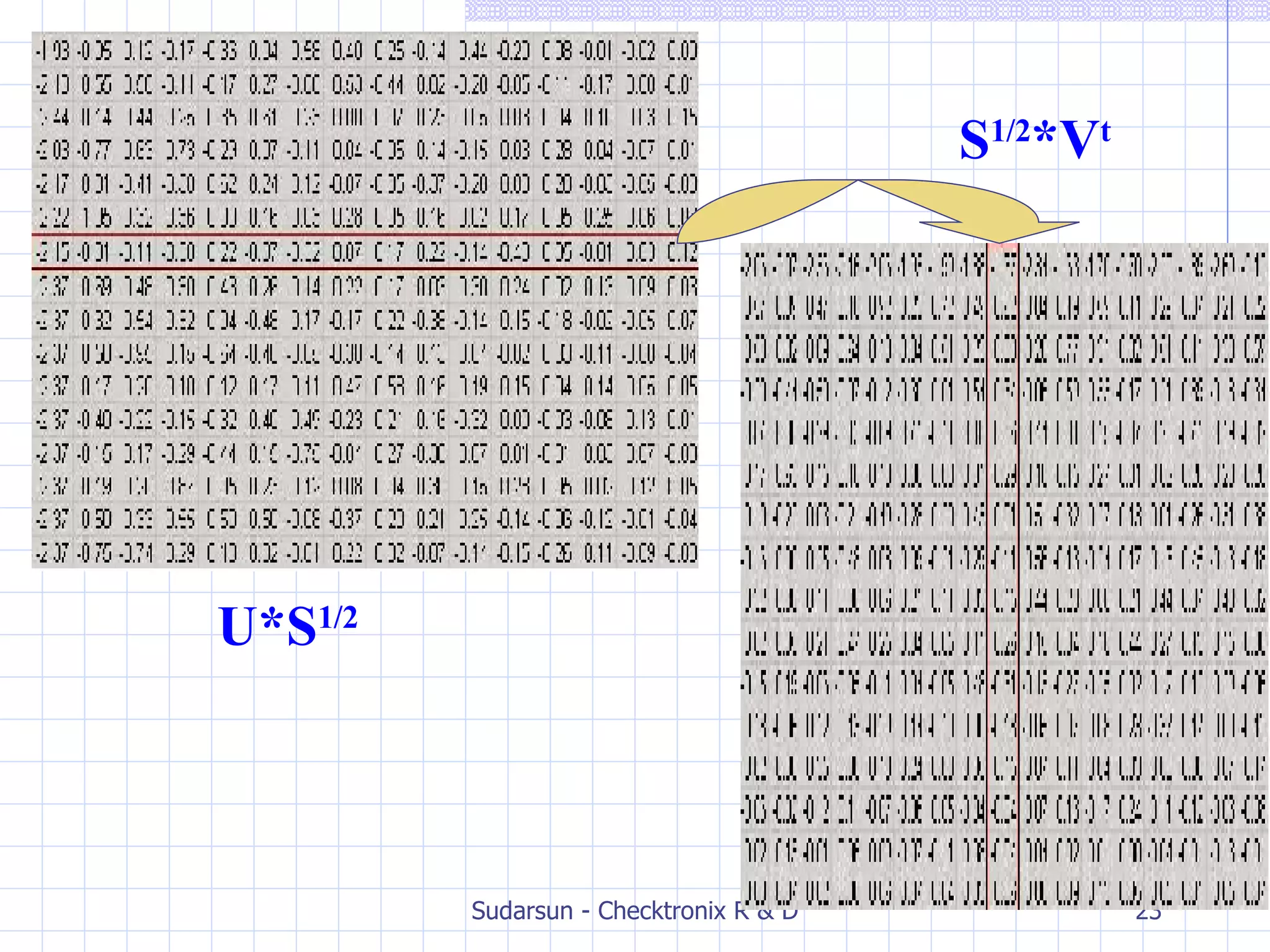
Term – Document Similarity Compute Cosine between row vector of term ‘i’ in  U*S 1/2  matrix and column vector of document ‘j’ in  S 1/2 *V t  matrix.
U*S 1/2 S 1/2 *V t
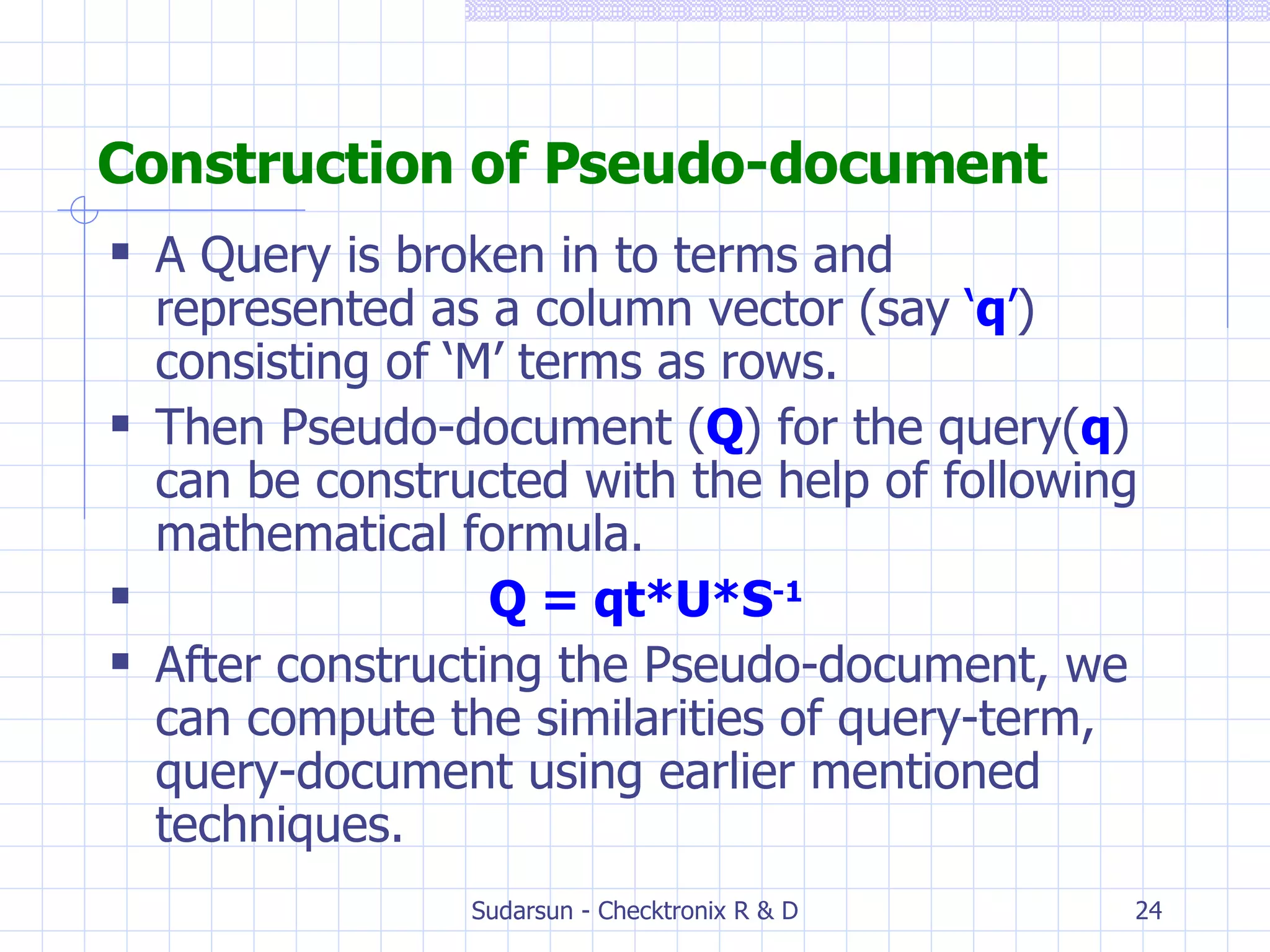
Construction of Pseudo-document A Query is broken in to terms and represented as a column vector (say  ‘ q ’ ) consisting of ‘M’ terms as rows. Then Pseudo-document ( Q ) for the query( q ) can be constructed with the help of following mathematical formula. Q = qt*U*S -1 After constructing the Pseudo-document, we can compute the similarities of query-term, query-document using earlier mentioned techniques.
Alternatives to LSA LSA is limited to Synonymy problem PLSA – Probabilistic Latent Semantic Analysis to handle Polysemy. LDA – Latent Dirichlet Allocation.
References http://www.cs.utk.edu/~lsi/papers/ http://www.cs.utk.edu/~berry/lsi++ http://people.csail.mit.edu/fergus/iccv2005/bagwords.html http://research.nitle.org/lsi/lsa_explanation.htm http://en.wikipedia.org/wiki/Latent_semantic_analysis http://www-psych.nmsu.edu/~pfoltz/reprints/BRMIC96.html http://www.pcug.org.au/~jdowling/ http://www.ucl.ac.uk/oncology/MicroCore/HTML_resource/PCA_1.htm http://public.lanl.gov/mewall/kluwer2002.html http://www.cs.utexas.edu/users/suvrit/work/progs/ssvd.html
Thanks.. You may send in your queries to sudar@burning-glass.com

Latent Semantic Indexing For Information Retrieval

  • 1.
    Latent Semantic IndexingSudarsun. S., M.Tech Checktronix India Pvt Ltd, Chennai 600034 [email_address]
  • 2.
    What is NLP? What is Natural Language ? Can a machine understand NL ? How are we understanding NL ? How can we make a machine understand NL ? What are the limitations ?
  • 3.
    Major Entities …What is Syntactic Analysis ? Deal Synonymy Deal Polysemy ? What is Semantics ? Represent meanings as a Semantic Net What is Knowledge ? How to represent knowledge ? What are Inferences and Reasoning ? How to use the accumulated knowledge ?
  • 4.
    LSA for InformationRetrieval What is LSA? Singular Value Decomposition Method of LSA Computation of Similarity using Cosine Measuring Similarities Construction of Pseudo-document Limitations of LSA Alternatives to LSA
  • 5.
    What is LSAA Statistical Method that provides a way to describe the underlying structure of texts Used in author recognition, search engines, detecting plagiarism, and comparing texts for similarities The contexts in which a certain word exists or does not exist determine the similarity of the documents Closely models human learning, especially the manner in which people learn a language and acquire a vocabulary
  • 6.
    Multivariate Data Reductiontechnique. Reduces large dataset to a concentrated dataset containing only the significant information from the original data . Singular Value Decomposition
  • 7.
    Mathematical Background ofSVD SVD decomposes a matrix as a product of 3 matrices. Let A be matrix of m x n, then SVD of A is SVD(A) = U MxK S KxK V t KxN U, V  Left and Right Singular matrices respectively U and V are Orthogonal matrix whose vectors are of unit length S  Diagonal matrix whose diagonal elements are Singular Values arranged in descending order K  Rank of A; K<=min(M,N).
  • 8.
    Computation of SVDTo Find U,S and V matrices Find Eigen Values and their corresponding Eigen Vectors of the matrix AA t Singular values = Square root of Eigen Values. These Singular values arranged in descending order forms the diagonal elements of the diagonal matrix S . Divide each Eigen vector by its length. These Eigen vectors forms the columns of the matrix U . Similarly Eigen Vectors of the matrix A t A forms the columns of matrix V. [ Note : Eigen Values of AA t and A t A are equal.]
  • 9.
    Eigen Value &Vectors A scalar Lamba is called an Eigen Value of a matrix A if there is a non-zero vector V such that A.V = Lamba.V. This non-zero vector is the Eigen vector of A. Eigen values can be found by solving the equation | A – Lamba.I | = 0.
  • 10.
    How to BuildLSA ? Preprocess the document collection Stemming Stop words removal Build Frequency Matrix Apply Pre-weights Decompose FM into U, S, V Project Queries
  • 11.
    Step #1: Construct the term-document matrix; TDM One column for each document One row for every word The value of cell (i, j) is the frequency of word i in document j Frequency Matrix
  • 12.
  • 13.
  • 14.
    Step #2: Weight Functions Increase the efficiency of the information retrieval. Allocates weights to the terms based on their occurrences. Each element is replaced with the product of a Local Weight Function(LWF) and a Global Weight Function(GWF) . LWF considers the frequency of a word within a particular text GWF examines a term’s frequency across all the documents. Pre-weightings Applied on the TDM before computing SVD. Post-weightings Applied to terms of a query when projected for matching or searching.
  • 15.
    Step #3: SVD Perform SVD on term-document matrix X. SVD removes noise or infrequent words that do not help to classify a document. Octave/Mat lab can be used [u, s, v] = svd(A);
  • 16.
    A U S V t m x n m x k k x k k x n · ·  Terms Documents 0 0
  • 17.
    Documents TDM SVDTerms U S V
  • 18.
    Similarity Computation UsingCosine Consider 2 vectors A & B. Similarity between these 2 vectors is A.B CosØ = ------------------ |A|. |B| CosØ ranges between –1 to +1
  • 19.
  • 20.
    Term-term Similarity Computethe Cosine for the row vectors of term ‘i’ and term ‘j’ in the U*S matrix. US
  • 21.
    Document – DocumentSimilarity Compute the Cosine for the column vectors of document ‘i’ and document ‘j’ in the S*V t matrix. SV t
  • 22.
    Term – DocumentSimilarity Compute Cosine between row vector of term ‘i’ in U*S 1/2 matrix and column vector of document ‘j’ in S 1/2 *V t matrix.
  • 23.
    U*S 1/2 S1/2 *V t
  • 24.
    Construction of Pseudo-documentA Query is broken in to terms and represented as a column vector (say ‘ q ’ ) consisting of ‘M’ terms as rows. Then Pseudo-document ( Q ) for the query( q ) can be constructed with the help of following mathematical formula. Q = qt*U*S -1 After constructing the Pseudo-document, we can compute the similarities of query-term, query-document using earlier mentioned techniques.
  • 25.
    Alternatives to LSALSA is limited to Synonymy problem PLSA – Probabilistic Latent Semantic Analysis to handle Polysemy. LDA – Latent Dirichlet Allocation.
  • 26.
    References http://www.cs.utk.edu/~lsi/papers/ http://www.cs.utk.edu/~berry/lsi++http://people.csail.mit.edu/fergus/iccv2005/bagwords.html http://research.nitle.org/lsi/lsa_explanation.htm http://en.wikipedia.org/wiki/Latent_semantic_analysis http://www-psych.nmsu.edu/~pfoltz/reprints/BRMIC96.html http://www.pcug.org.au/~jdowling/ http://www.ucl.ac.uk/oncology/MicroCore/HTML_resource/PCA_1.htm http://public.lanl.gov/mewall/kluwer2002.html http://www.cs.utexas.edu/users/suvrit/work/progs/ssvd.html
  • 27.
    Thanks.. You maysend in your queries to sudar@burning-glass.com