DATA MINING
LECTURE 6
Dimensionality Reduction
PCA – SVD
(Thanks to Jure Leskovec, Evimaria Terzi)
The curse of dimensionality
• Real data usually have thousands, or millions of
dimensions
• E.g., web documents, where the dimensionality is the
vocabulary of words
• Facebook graph, where the dimensionality is the
number of users
• Huge number of dimensions causes problems
• Data becomes very sparse, some algorithms become
meaningless (e.g. density based clustering)
• The complexity of several algorithms depends on the
dimensionality and they become infeasible (e.g. nearest
neighbor search).
Dimensionality Reduction
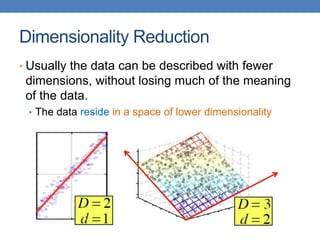
• Usually the data can be described with fewer
dimensions, without losing much of the meaning
of the data.
• The data reside in a space of lower dimensionality
Example
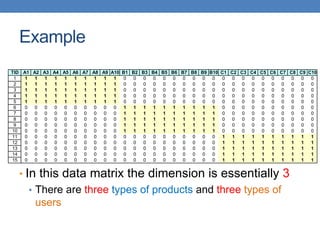
• In this data matrix the dimension is essentially 3
• There are three types of products and three types of
users
TID A1 A2 A3 A4 A5 A6 A7 A8 A9 A10 B1 B2 B3 B4 B5 B6 B7 B8 B9 B10 C1 C2 C3 C4 C5 C6 C7 C8 C9 C10
1 1 1 1 1 1 1 1 1 1 1 0 0 0 0 0 0 0 0 0 0 0 0 0 0 0 0 0 0 0 0
2 1 1 1 1 1 1 1 1 1 1 0 0 0 0 0 0 0 0 0 0 0 0 0 0 0 0 0 0 0 0
3 1 1 1 1 1 1 1 1 1 1 0 0 0 0 0 0 0 0 0 0 0 0 0 0 0 0 0 0 0 0
4 1 1 1 1 1 1 1 1 1 1 0 0 0 0 0 0 0 0 0 0 0 0 0 0 0 0 0 0 0 0
5 1 1 1 1 1 1 1 1 1 1 0 0 0 0 0 0 0 0 0 0 0 0 0 0 0 0 0 0 0 0
6 0 0 0 0 0 0 0 0 0 0 1 1 1 1 1 1 1 1 1 1 0 0 0 0 0 0 0 0 0 0
7 0 0 0 0 0 0 0 0 0 0 1 1 1 1 1 1 1 1 1 1 0 0 0 0 0 0 0 0 0 0
8 0 0 0 0 0 0 0 0 0 0 1 1 1 1 1 1 1 1 1 1 0 0 0 0 0 0 0 0 0 0
9 0 0 0 0 0 0 0 0 0 0 1 1 1 1 1 1 1 1 1 1 0 0 0 0 0 0 0 0 0 0
10 0 0 0 0 0 0 0 0 0 0 1 1 1 1 1 1 1 1 1 1 0 0 0 0 0 0 0 0 0 0
11 0 0 0 0 0 0 0 0 0 0 0 0 0 0 0 0 0 0 0 0 1 1 1 1 1 1 1 1 1 1
12 0 0 0 0 0 0 0 0 0 0 0 0 0 0 0 0 0 0 0 0 1 1 1 1 1 1 1 1 1 1
13 0 0 0 0 0 0 0 0 0 0 0 0 0 0 0 0 0 0 0 0 1 1 1 1 1 1 1 1 1 1
14 0 0 0 0 0 0 0 0 0 0 0 0 0 0 0 0 0 0 0 0 1 1 1 1 1 1 1 1 1 1
15 0 0 0 0 0 0 0 0 0 0 0 0 0 0 0 0 0 0 0 0 1 1 1 1 1 1 1 1 1 1
Example
• Cloud of points 3D space:
• Think of point positions
as a matrix:
• We can rewrite coordinates more efficiently!
• Old basis vectors: [1 0 0] [0 1 0] [0 0 1]
• New basis vectors: [1 2 1] [-2 -3 1]
• Then A has new coordinates: [1 0]. B: [0 1], C: [1 -1]
• Notice: We reduced the number of coordinates!
1 row per point:
A
B
C
A
J. Leskovec, A. Rajaraman, J. Ullman: Mining of Massive
Datasets, http://www.mmds.org
5
Dimensionality Reduction
• Find the “true dimension” of the data
• In reality things are never as clear and simple as in this
example, but we can still reduce the dimension.
• Essentially, we assume that some of the data is
useful signal and some data is noise, and that we
can approximate the useful part with a lower
dimensionality space.
• Dimensionality reduction does not just reduce the
amount of data, it often brings out the useful part of the
data
Dimensionality Reduction
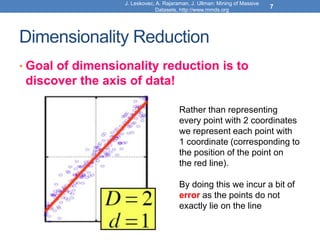
• Goal of dimensionality reduction is to
discover the axis of data!
Rather than representing
every point with 2 coordinates
we represent each point with
1 coordinate (corresponding to
the position of the point on
the red line).
By doing this we incur a bit of
error as the points do not
exactly lie on the line
J. Leskovec, A. Rajaraman, J. Ullman: Mining of Massive
Datasets, http://www.mmds.org
7
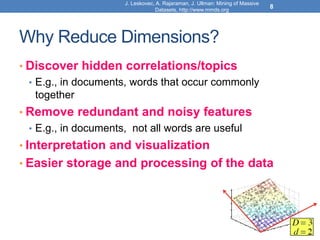
Why Reduce Dimensions?
• Discover hidden correlations/topics
• E.g., in documents, words that occur commonly
together
• Remove redundant and noisy features
• E.g., in documents, not all words are useful
• Interpretation and visualization
• Easier storage and processing of the data
J. Leskovec, A. Rajaraman, J. Ullman: Mining of Massive
Datasets, http://www.mmds.org
8
Dimensionality Reduction
• We have already seen a form of dimensionality
reduction
• LSH, and random projections reduce the
dimension while preserving the distances
Data in the form of a matrix
• We are given 𝑛 objects and 𝑑 attributes describing
the objects. Each object has 𝑑 numeric values
describing it.
• We will represent the data as a 𝑛 × 𝑑 real matrix A.
• We can now use tools from linear algebra to process the
data matrix
• Our goal is to produce a new 𝑛 × 𝑘 matrix B such that
• It preserves as much of the information in the original matrix
A as possible
• It reveals something about the structure of the data in A
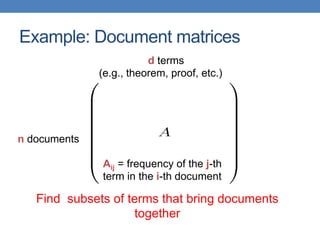
Example: Document matrices
n documents
d terms
(e.g., theorem, proof, etc.)
Aij = frequency of the j-th
term in the i-th document
Find subsets of terms that bring documents
together
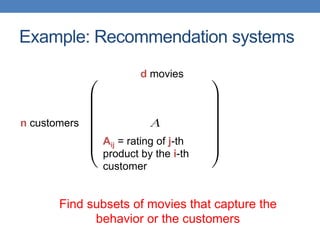
Example: Recommendation systems
n customers
d movies
Aij = rating of j-th
product by the i-th
customer
Find subsets of movies that capture the
behavior or the customers
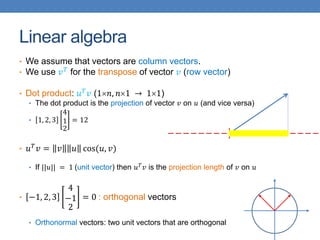
Linear algebra
• We assume that vectors are column vectors.
• We use 𝑣𝑇 for the transpose of vector 𝑣 (row vector)
• Dot product: 𝑢𝑇𝑣 (1𝑛, 𝑛1 → 11)
• The dot product is the projection of vector 𝑣 on 𝑢 (and vice versa)
• 1, 2, 3
4
1
2
= 12
• 𝑢𝑇𝑣 = 𝑣 𝑢 cos(𝑢, 𝑣)
• If ||𝑢|| = 1 (unit vector) then 𝑢𝑇𝑣 is the projection length of 𝑣 on 𝑢
• −1, 2, 3
4
−1
2
= 0 : orthogonal vectors
• Orthonormal vectors: two unit vectors that are orthogonal
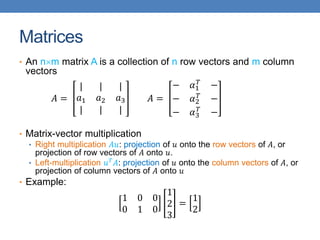
Matrices
• An nm matrix A is a collection of n row vectors and m column
vectors
𝐴 =
| | |
𝑎1 𝑎2 𝑎3
| | |
𝐴 =
− 𝛼1
𝑇
−
− 𝛼2
𝑇
−
− 𝛼3
𝑇
−
• Matrix-vector multiplication
• Right multiplication 𝐴𝑢: projection of 𝑢 onto the row vectors of 𝐴, or
projection of row vectors of 𝐴 onto 𝑢.
• Left-multiplication 𝑢𝑇
𝐴: projection of 𝑢 onto the column vectors of 𝐴, or
projection of column vectors of 𝐴 onto 𝑢
• Example:
1 0 0
0 1 0
1
2
3
=
1
2
Change of basis
• By default a vector is expressed in the axis-aligned basis.
• For example, for vector [-1,2] we have:
•
−1
2
= −1
1
0
+ 2
0
1
• With a projection we can change the basis over which a
vector is expressed.
√2
2
√2
2
−
√2
2
√2
2
−1
2
=
3√2
2
√2
2
Rank
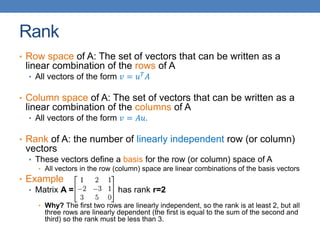
• Row space of A: The set of vectors that can be written as a
linear combination of the rows of A
• All vectors of the form 𝑣 = 𝑢𝑇
𝐴
• Column space of A: The set of vectors that can be written as a
linear combination of the columns of A
• All vectors of the form 𝑣 = 𝐴𝑢.
• Rank of A: the number of linearly independent row (or column)
vectors
• These vectors define a basis for the row (or column) space of A
• All vectors in the row (column) space are linear combinations of the basis vectors
• Example
• Matrix A = has rank r=2
• Why? The first two rows are linearly independent, so the rank is at least 2, but all
three rows are linearly dependent (the first is equal to the sum of the second and
third) so the rank must be less than 3.
Rank-1 matrices
• In a rank-1 matrix, all columns (or rows) are multiples
of the same column (or row) vector
𝐴 =
1 2 −1
2 4 −2
3 6 −3
• All rows are multiples of 𝑟𝑇
= [1,2, −1]
• All columns are multiples of 𝑐 =
1
2
3
• External product: 𝑢𝑣𝑇
(𝑛1 , 1𝑚 → 𝑛𝑚)
• The resulting 𝑛𝑚 has rank 1: all rows (or columns) are
linearly dependent
• 𝐴 = 𝑐𝑟𝑇
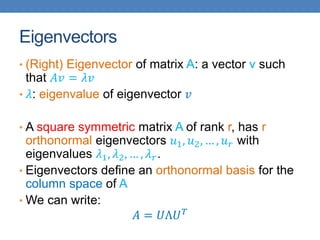
Eigenvectors
• (Right) Eigenvector of matrix A: a vector v such
that 𝐴𝑣 = 𝜆𝑣
• 𝜆: eigenvalue of eigenvector 𝑣
• A square symmetric matrix A of rank r, has r
orthonormal eigenvectors 𝑢1, 𝑢2, … , 𝑢𝑟 with
eigenvalues 𝜆1, 𝜆2, … , 𝜆𝑟.
• Eigenvectors define an orthonormal basis for the
column space of A
• We can write:
𝐴 = 𝑈Λ𝑈𝑇
Singular Value Decomposition
𝐴 = 𝑈 Σ 𝑉𝑇 = 𝑢1, 𝑢2, ⋯ , 𝑢𝑟
𝜎1
𝜎2
0
0
⋱
𝜎𝑟
𝑣1
𝑇
𝑣2
𝑇
⋮
𝑣𝑟
𝑇
• 𝜎1, ≥ 𝜎2 ≥ ⋯ ≥ 𝜎𝑟: singular values of matrix 𝐴
• 𝑢1, 𝑢2, … , 𝑢𝑟: left singular vectors of 𝐴
• 𝑣1, 𝑣2, … , 𝑣𝑟: right singular vectors of 𝐴
𝐴 = 𝜎1𝑢1𝑣1
𝑇
+ 𝜎2𝑢2𝑣2
𝑇
+ ⋯ + 𝜎𝑟𝑢𝑟𝑣𝑟
𝑇
[n×r] [r×r] [r×m]
r: rank of matrix A
[n×m] =
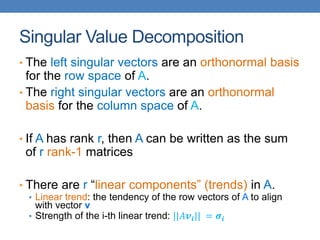
Singular Value Decomposition
• The left singular vectors are an orthonormal basis
for the row space of A.
• The right singular vectors are an orthonormal
basis for the column space of A.
• If A has rank r, then A can be written as the sum
of r rank-1 matrices
• There are r “linear components” (trends) in A.
• Linear trend: the tendency of the row vectors of A to align
with vector v
• Strength of the i-th linear trend: ||𝐴𝒗𝒊|| = 𝝈𝒊
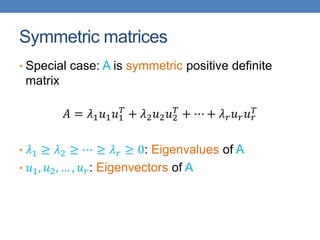
Symmetric matrices
• Special case: A is symmetric positive definite
matrix
𝐴 = 𝜆1𝑢1𝑢1
𝑇
+ 𝜆2𝑢2𝑢2
𝑇
+ ⋯ + 𝜆𝑟𝑢𝑟𝑢𝑟
𝑇
• 𝜆1 ≥ 𝜆2 ≥ ⋯ ≥ 𝜆𝑟 ≥ 0: Eigenvalues of A
• 𝑢1, 𝑢2, … , 𝑢𝑟: Eigenvectors of A
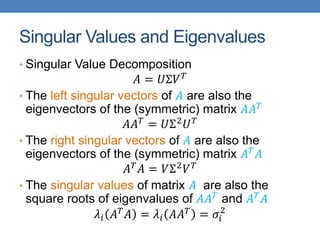
Singular Values and Eigenvalues
• Singular Value Decomposition
𝐴 = 𝑈Σ𝑉𝑇
• The left singular vectors of 𝐴 are also the
eigenvectors of the (symmetric) matrix 𝐴𝐴𝑇
𝐴𝐴𝑇 = 𝑈Σ2𝑈𝑇
• The right singular vectors of 𝐴 are also the
eigenvectors of the (symmetric) matrix 𝐴𝑇𝐴
𝐴𝑇
𝐴 = 𝑉Σ2
𝑉𝑇
• The singular values of matrix 𝐴 are also the
square roots of eigenvalues of 𝐴𝐴𝑇 and 𝐴𝑇𝐴
𝜆𝑖 𝐴𝑇𝐴 = 𝜆𝑖 𝐴𝐴𝑇 = 𝜎𝑖
2
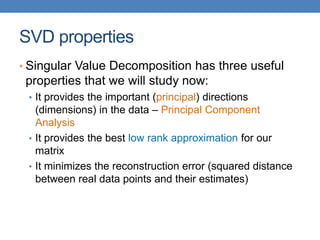
SVD properties
• Singular Value Decomposition has three useful
properties that we will study now:
• It provides the important (principal) directions
(dimensions) in the data – Principal Component
Analysis
• It provides the best low rank approximation for our
matrix
• It minimizes the reconstruction error (squared distance
between real data points and their estimates)
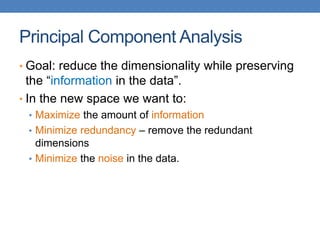
Principal Component Analysis
• Goal: reduce the dimensionality while preserving
the “information in the data”.
• In the new space we want to:
• Maximize the amount of information
• Minimize redundancy – remove the redundant
dimensions
• Minimize the noise in the data.
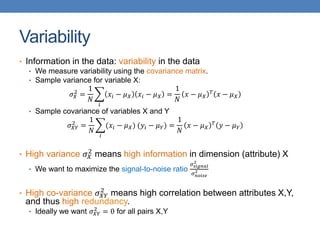
Variability
• Information in the data: variability in the data
• We measure variability using the covariance matrix.
• Sample variance for variable X:
𝜎𝑋
2
=
1
𝑁
𝑖
𝑥𝑖 − 𝜇𝑋 𝑥𝑖 − 𝜇𝑋 =
1
𝑁
𝑥 − 𝜇𝑋
𝑇
𝑥 − 𝜇𝑋
• Sample covariance of variables X and Y
𝜎𝑋𝑌
2
=
1
𝑁
𝑖
(𝑥𝑖 − 𝜇𝑋) (𝑦𝑖 − 𝜇𝑌) =
1
𝑁
𝑥 − 𝜇𝑋
𝑇
𝑦 − 𝜇𝑌
• High variance 𝜎𝑋
2
means high information in dimension (attribute) X
• We want to maximize the signal-to-noise ratio
𝜎𝑠𝑖𝑔𝑛𝑎𝑙
2
𝜎𝑛𝑜𝑖𝑠𝑒
2
• High co-variance 𝜎𝑋𝑌
2
means high correlation between attributes X,Y,
and thus high redundancy.
• Ideally we want 𝜎𝑋𝑌
2
= 0 for all pairs X,Y
Example
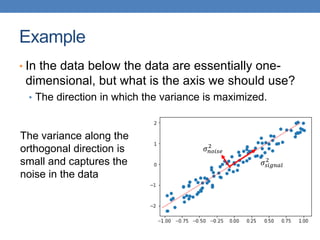
• In the data below the data are essentially one-
dimensional, but what is the axis we should use?
• The direction in which the variance is maximized.
𝜎𝑠𝑖𝑔𝑛𝑎𝑙
2
𝜎𝑛𝑜𝑖𝑠𝑒
2
The variance along the
orthogonal direction is
small and captures the
noise in the data
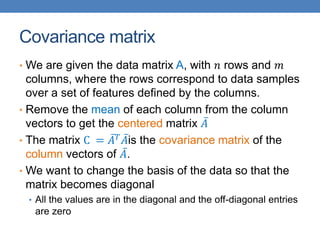
Covariance matrix
• We are given the data matrix A, with 𝑛 rows and 𝑚
columns, where the rows correspond to data samples
over a set of features defined by the columns.
• Remove the mean of each column from the column
vectors to get the centered matrix 𝐴
• The matrix C = 𝐴𝑇
𝐴is the covariance matrix of the
column vectors of 𝐴.
• We want to change the basis of the data so that the
matrix becomes diagonal
• All the values are in the diagonal and the off-diagonal entries
are zero
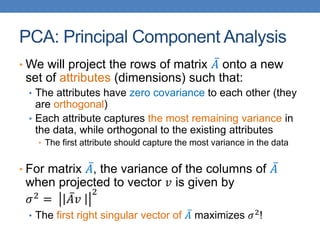
PCA: Principal Component Analysis
• We will project the rows of matrix 𝐴 onto a new
set of attributes (dimensions) such that:
• The attributes have zero covariance to each other (they
are orthogonal)
• Each attribute captures the most remaining variance in
the data, while orthogonal to the existing attributes
• The first attribute should capture the most variance in the data
• For matrix 𝐴, the variance of the columns of 𝐴
when projected to vector 𝑣 is given by
𝜎2
= 𝐴𝑣
2
• The first right singular vector of 𝐴 maximizes 𝜎2!
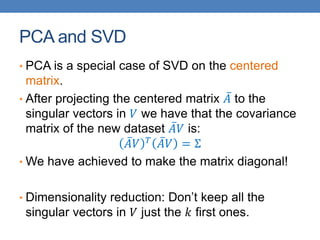
PCA and SVD
• PCA is a special case of SVD on the centered
matrix.
• After projecting the centered matrix 𝐴 to the
singular vectors in 𝑉 we have that the covariance
matrix of the new dataset 𝐴𝑉 is:
𝐴𝑉 𝑇
𝐴𝑉 = Σ
• We have achieved to make the matrix diagonal!
• Dimensionality reduction: Don’t keep all the
singular vectors in 𝑉 just the 𝑘 first ones.
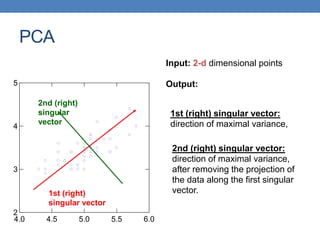
4.0 4.5 5.0 5.5 6.0
2
3
4
5
PCA
Input: 2-d dimensional points
Output:
1st (right)
singular vector
1st (right) singular vector:
direction of maximal variance,
2nd (right)
singular
vector
2nd (right) singular vector:
direction of maximal variance,
after removing the projection of
the data along the first singular
vector.
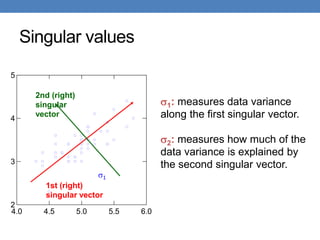
Singular values
1: measures data variance
along the first singular vector.
2: measures how much of the
data variance is explained by
the second singular vector.
1
4.0 4.5 5.0 5.5 6.0
2
3
4
5
1st (right)
singular vector
2nd (right)
singular
vector
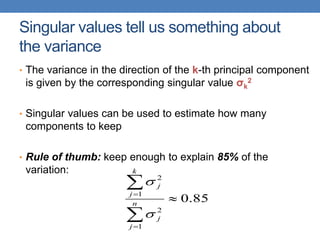
Singular values tell us something about
the variance
• The variance in the direction of the k-th principal component
is given by the corresponding singular value σk
2
• Singular values can be used to estimate how many
components to keep
• Rule of thumb: keep enough to explain 85% of the
variation:
85
.
0
1
2
1
2





n
j
j
k
j
j


A VT

U
=
objects
features
significant
noise
noise
noise
significant
sig.
=
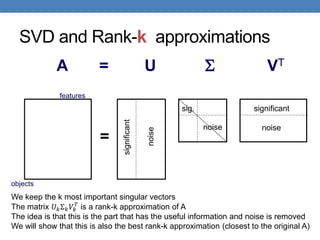
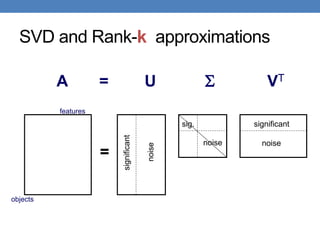
SVD and Rank-k approximations
We keep the k most important singular vectors
The matrix 𝑈𝑘Σ𝑘𝑉𝑘
𝑇
is a rank-k approximation of A
The idea is that this is the part that has the useful information and noise is removed
We will show that this is also the best rank-k approximation (closest to the original A)
Example
𝐴 =
𝑎11 ⋯ 𝑎1𝑛
⋮ ⋱ ⋮
𝑎𝑛1 ⋯ 𝑎𝑛𝑛
𝐴 = 𝑈Σ𝑉𝑇
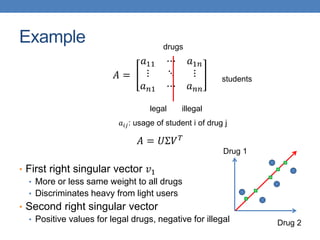
• First right singular vector 𝑣1
• More or less same weight to all drugs
• Discriminates heavy from light users
• Second right singular vector
• Positive values for legal drugs, negative for illegal
students
drugs
legal illegal
𝑎𝑖𝑗: usage of student i of drug j
Drug 2
Drug 1
SVD for matrix reconstruction
• We will now see how we can use the fact that
SVD gives the best rank-k approximation for a
data matrix A.
• The idea is that we assume that the “true” matrix
is rank-k, and rank is increased due to noise
• We use SVD to find the best rank-k
approximation for A, and thus the best
approximation of the “true” matrix
An (extreme) example
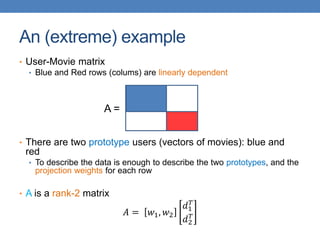
• User-Movie matrix
• Blue and Red rows (colums) are linearly dependent
• There are two prototype users (vectors of movies): blue and
red
• To describe the data is enough to describe the two prototypes, and the
projection weights for each row
• A is a rank-2 matrix
𝐴 = 𝑤1, 𝑤2
𝑑1
𝑇
𝑑2
𝑇
A =
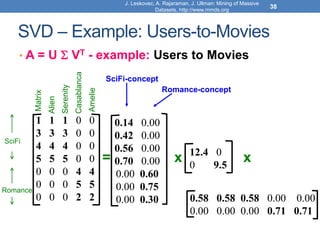
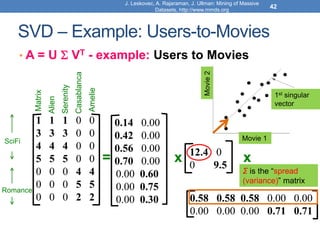
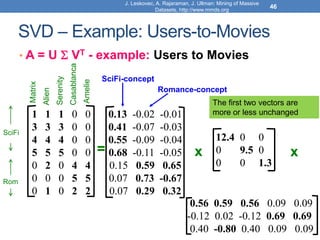
SVD – Example: Users-to-Movies
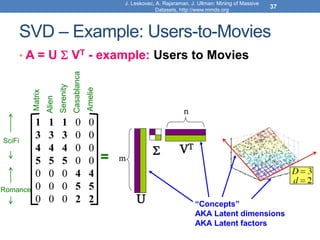
• A = U  VT - example: Users to Movies
J. Leskovec, A. Rajaraman, J. Ullman: Mining of Massive
Datasets, http://www.mmds.org
37
=
SciFi
Romance
Matrix
Alien
Serenity
Casablanca
Amelie
1 1 1 0 0
3 3 3 0 0
4 4 4 0 0
5 5 5 0 0
0 0 0 4 4
0 0 0 5 5
0 0 0 2 2

m
n
U
VT
“Concepts”
AKA Latent dimensions
AKA Latent factors
SVD – Example: Users-to-Movies
• A = U  VT - example: Users to Movies
J. Leskovec, A. Rajaraman, J. Ullman: Mining of Massive
Datasets, http://www.mmds.org
38
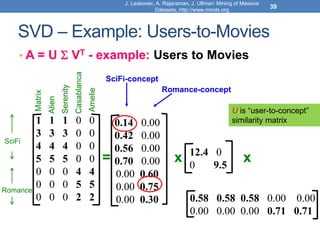
SciFi-concept
Romance-concept
=
SciFi
Romance
x x
Matrix
Alien
Serenity
Casablanca
Amelie
0.14 0.00
0.42 0.00
0.56 0.00
0.70 0.00
0.00 0.60
0.00 0.75
0.00 0.30
12.4 0
0 9.5
0.58 0.58 0.58 0.00 0.00
0.00 0.00 0.00 0.71 0.71
1 1 1 0 0
3 3 3 0 0
4 4 4 0 0
5 5 5 0 0
0 0 0 4 4
0 0 0 5 5
0 0 0 2 2
SVD – Example: Users-to-Movies
• A = U  VT - example: Users to Movies
J. Leskovec, A. Rajaraman, J. Ullman: Mining of Massive
Datasets, http://www.mmds.org
39
SciFi-concept
Romance-concept
=
SciFi
Romance
x x
Matrix
Alien
Serenity
Casablanca
Amelie
0.14 0.00
0.42 0.00
0.56 0.00
0.70 0.00
0.00 0.60
0.00 0.75
0.00 0.30
12.4 0
0 9.5
0.58 0.58 0.58 0.00 0.00
0.00 0.00 0.00 0.71 0.71
1 1 1 0 0
3 3 3 0 0
4 4 4 0 0
5 5 5 0 0
0 0 0 4 4
0 0 0 5 5
0 0 0 2 2
U is “user-to-concept”
similarity matrix
SVD – Example: Users-to-Movies
• A = U  VT - example: Users to Movies
J. Leskovec, A. Rajaraman, J. Ullman: Mining of Massive
Datasets, http://www.mmds.org
40
SciFi-concept
Romance-concept
=
SciFi
Romance
x x
Matrix
Alien
Serenity
Casablanca
Amelie
0.14 0.00
0.42 0.00
0.56 0.00
0.70 0.00
0.00 0.60
0.00 0.75
0.00 0.30
12.4 0
0 9.5
0.58 0.58 0.58 0.00 0.00
0.00 0.00 0.00 0.71 0.71
1 1 1 0 0
3 3 3 0 0
4 4 4 0 0
5 5 5 0 0
0 0 0 4 4
0 0 0 5 5
0 0 0 2 2
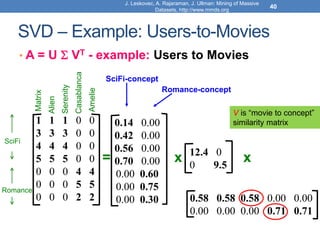
V is “movie to concept”
similarity matrix
SVD – Example: Users-to-Movies
• A = U  VT - example: Users to Movies
J. Leskovec, A. Rajaraman, J. Ullman: Mining of Massive
Datasets, http://www.mmds.org
41
SciFi-concept
Romance-concept
=
SciFi
Romance
x x
Matrix
Alien
Serenity
Casablanca
Amelie
0.14 0.00
0.42 0.00
0.56 0.00
0.70 0.00
0.00 0.60
0.00 0.75
0.00 0.30
12.4 0
0 9.5
0.58 0.58 0.58 0.00 0.00
0.00 0.00 0.00 0.71 0.71
1 1 1 0 0
3 3 3 0 0
4 4 4 0 0
5 5 5 0 0
0 0 0 4 4
0 0 0 5 5
0 0 0 2 2
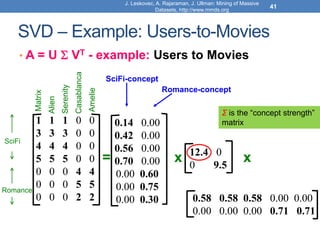
Σ is the “concept strength”
matrix
SVD – Example: Users-to-Movies
• A = U  VT - example: Users to Movies
J. Leskovec, A. Rajaraman, J. Ullman: Mining of Massive
Datasets, http://www.mmds.org
42
=
SciFi
Romance
x x
Matrix
Alien
Serenity
Casablanca
Amelie
0.14 0.00
0.42 0.00
0.56 0.00
0.70 0.00
0.00 0.60
0.00 0.75
0.00 0.30
12.4 0
0 9.5
0.58 0.58 0.58 0.00 0.00
0.00 0.00 0.00 0.71 0.71
1 1 1 0 0
3 3 3 0 0
4 4 4 0 0
5 5 5 0 0
0 0 0 4 4
0 0 0 5 5
0 0 0 2 2
Movie 1
Movie
2
1st singular
vector
Σ is the “spread
(variance)” matrix
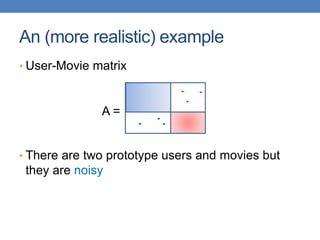
An (more realistic) example
• User-Movie matrix
• There are two prototype users and movies but
they are noisy
A =
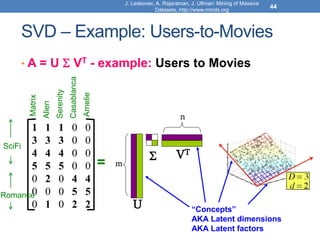
SVD – Example: Users-to-Movies
• A = U  VT - example: Users to Movies
J. Leskovec, A. Rajaraman, J. Ullman: Mining of Massive
Datasets, http://www.mmds.org
44
=
SciFi
Romance
Matrix
Alien
Serenity
Casablanca
Amelie
1 1 1 0 0
3 3 3 0 0
4 4 4 0 0
5 5 5 0 0
0 2 0 4 4
0 0 0 5 5
0 1 0 2 2

m
n
U
VT
“Concepts”
AKA Latent dimensions
AKA Latent factors
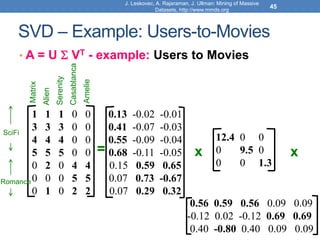
SVD – Example: Users-to-Movies
• A = U  VT - example: Users to Movies
J. Leskovec, A. Rajaraman, J. Ullman: Mining of Massive
Datasets, http://www.mmds.org
45
=
SciFi
Romance
x x
Matrix
Alien
Serenity
Casablanca
Amelie
1 1 1 0 0
3 3 3 0 0
4 4 4 0 0
5 5 5 0 0
0 2 0 4 4
0 0 0 5 5
0 1 0 2 2
0.13 -0.02 -0.01
0.41 -0.07 -0.03
0.55 -0.09 -0.04
0.68 -0.11 -0.05
0.15 0.59 0.65
0.07 0.73 -0.67
0.07 0.29 0.32
12.4 0 0
0 9.5 0
0 0 1.3
0.56 0.59 0.56 0.09 0.09
-0.12 0.02 -0.12 0.69 0.69
0.40 -0.80 0.40 0.09 0.09
SVD – Example: Users-to-Movies
• A = U  VT - example: Users to Movies
J. Leskovec, A. Rajaraman, J. Ullman: Mining of Massive
Datasets, http://www.mmds.org
46
=
SciFi
Rom
x x
Matrix
Alien
Serenity
Casablanca
Amelie
1 1 1 0 0
3 3 3 0 0
4 4 4 0 0
5 5 5 0 0
0 2 0 4 4
0 0 0 5 5
0 1 0 2 2
0.13 -0.02 -0.01
0.41 -0.07 -0.03
0.55 -0.09 -0.04
0.68 -0.11 -0.05
0.15 0.59 0.65
0.07 0.73 -0.67
0.07 0.29 0.32
12.4 0 0
0 9.5 0
0 0 1.3
0.56 0.59 0.56 0.09 0.09
-0.12 0.02 -0.12 0.69 0.69
0.40 -0.80 0.40 0.09 0.09
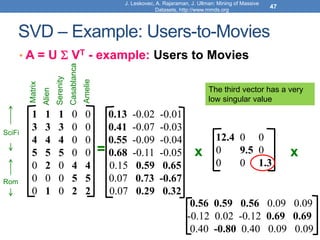
SciFi-concept
Romance-concept
The first two vectors are
more or less unchanged
SVD – Example: Users-to-Movies
• A = U  VT - example: Users to Movies
J. Leskovec, A. Rajaraman, J. Ullman: Mining of Massive
Datasets, http://www.mmds.org
47
=
SciFi
Rom
x x
Matrix
Alien
Serenity
Casablanca
Amelie
1 1 1 0 0
3 3 3 0 0
4 4 4 0 0
5 5 5 0 0
0 2 0 4 4
0 0 0 5 5
0 1 0 2 2
0.13 -0.02 -0.01
0.41 -0.07 -0.03
0.55 -0.09 -0.04
0.68 -0.11 -0.05
0.15 0.59 0.65
0.07 0.73 -0.67
0.07 0.29 0.32
12.4 0 0
0 9.5 0
0 0 1.3
0.56 0.59 0.56 0.09 0.09
-0.12 0.02 -0.12 0.69 0.69
0.40 -0.80 0.40 0.09 0.09
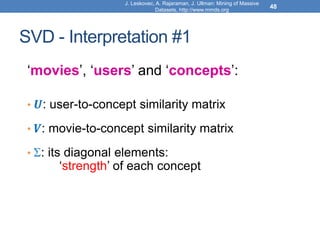
The third vector has a very
low singular value
J. Leskovec, A. Rajaraman, J. Ullman: Mining of Massive
Datasets, http://www.mmds.org
48
SVD - Interpretation #1
‘movies’, ‘users’ and ‘concepts’:
• 𝑼: user-to-concept similarity matrix
• 𝑽: movie-to-concept similarity matrix
• : its diagonal elements:
‘strength’ of each concept
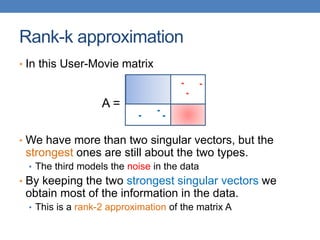
Rank-k approximation
• In this User-Movie matrix
• We have more than two singular vectors, but the
strongest ones are still about the two types.
• The third models the noise in the data
• By keeping the two strongest singular vectors we
obtain most of the information in the data.
• This is a rank-2 approximation of the matrix A
A =
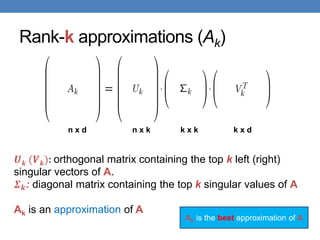
Rank-k approximations (Ak)
𝑼𝒌 (𝑽𝒌): orthogonal matrix containing the top k left (right)
singular vectors of A.
𝜮𝒌: diagonal matrix containing the top k singular values of A
Ak is an approximation of A
n x d n x k k x k k x d
Ak is the best approximation of A
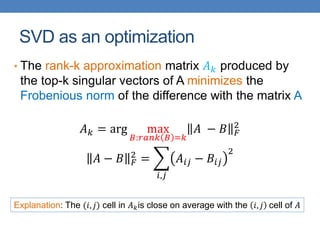
SVD as an optimization
• The rank-k approximation matrix 𝐴𝑘 produced by
the top-k singular vectors of A minimizes the
Frobenious norm of the difference with the matrix A
𝐴𝑘 = arg max
𝐵:𝑟𝑎𝑛𝑘 𝐵 =𝑘
𝐴 − 𝐵 𝐹
2
𝐴 − 𝐵 𝐹
2
=
𝑖,𝑗
𝐴𝑖𝑗 − 𝐵𝑖𝑗
2
Explanation: The (𝑖, 𝑗) cell in 𝐴𝑘is close on average with the 𝑖, 𝑗 cell of 𝐴
What does this mean?
• We can project the row (and column) vectors of
the matrix A into a k-dimensional space and
preserve most of the information
• (Ideally) The k dimensions reveal latent
features/aspects/topics of the term (document)
space.
• (Ideally) The 𝐴𝑘 approximation of matrix A,
contains all the useful information, and what is
discarded is noise
Latent factor model
• Rows (columns) are linear combinations of k
latent factors
• E.g., in our extreme document example there are two
factors
• Some noise is added to this rank-k matrix
resulting in higher rank
• SVD retrieves the latent factors (hopefully).
A VT

U
=
objects
features
significant
noise
noise
noise
significant sig.
=
SVD and Rank-k approximations
Example
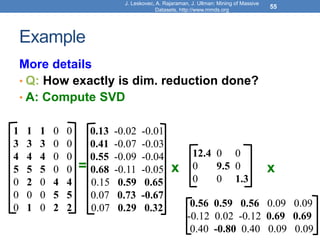
More details
• Q: How exactly is dim. reduction done?
• A: Compute SVD
J. Leskovec, A. Rajaraman, J. Ullman: Mining of Massive
Datasets, http://www.mmds.org
55
= x x
1 1 1 0 0
3 3 3 0 0
4 4 4 0 0
5 5 5 0 0
0 2 0 4 4
0 0 0 5 5
0 1 0 2 2
12.4 0 0
0 9.5 0
0 0 1.3
0.13 -0.02 -0.01
0.41 -0.07 -0.03
0.55 -0.09 -0.04
0.68 -0.11 -0.05
0.15 0.59 0.65
0.07 0.73 -0.67
0.07 0.29 0.32 0.56 0.59 0.56 0.09 0.09
-0.12 0.02 -0.12 0.69 0.69
0.40 -0.80 0.40 0.09 0.09
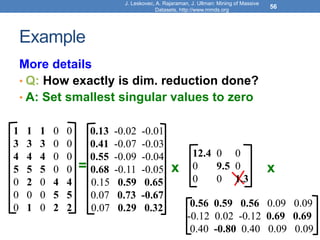
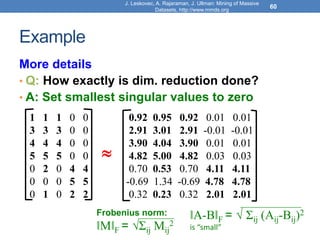
Example
More details
• Q: How exactly is dim. reduction done?
• A: Set smallest singular values to zero
J. Leskovec, A. Rajaraman, J. Ullman: Mining of Massive
Datasets, http://www.mmds.org
56
= x x
1 1 1 0 0
3 3 3 0 0
4 4 4 0 0
5 5 5 0 0
0 2 0 4 4
0 0 0 5 5
0 1 0 2 2
12.4 0 0
0 9.5 0
0 0 1.3
0.13 -0.02 -0.01
0.41 -0.07 -0.03
0.55 -0.09 -0.04
0.68 -0.11 -0.05
0.15 0.59 0.65
0.07 0.73 -0.67
0.07 0.29 0.32 0.56 0.59 0.56 0.09 0.09
-0.12 0.02 -0.12 0.69 0.69
0.40 -0.80 0.40 0.09 0.09
Example
More details
• Q: How exactly is dim. reduction done?
• A: Set smallest singular values to zero
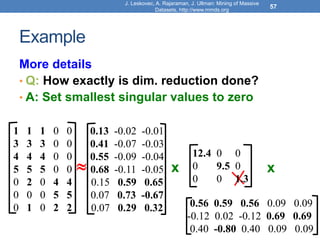
J. Leskovec, A. Rajaraman, J. Ullman: Mining of Massive
Datasets, http://www.mmds.org
57
x x
1 1 1 0 0
3 3 3 0 0
4 4 4 0 0
5 5 5 0 0
0 2 0 4 4
0 0 0 5 5
0 1 0 2 2
12.4 0 0
0 9.5 0
0 0 1.3

0.13 -0.02 -0.01
0.41 -0.07 -0.03
0.55 -0.09 -0.04
0.68 -0.11 -0.05
0.15 0.59 0.65
0.07 0.73 -0.67
0.07 0.29 0.32 0.56 0.59 0.56 0.09 0.09
-0.12 0.02 -0.12 0.69 0.69
0.40 -0.80 0.40 0.09 0.09
Example
More details
• Q: How exactly is dim. reduction done?
• A: Set smallest singular values to zero
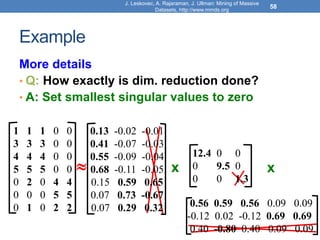
J. Leskovec, A. Rajaraman, J. Ullman: Mining of Massive
Datasets, http://www.mmds.org
58
x x
1 1 1 0 0
3 3 3 0 0
4 4 4 0 0
5 5 5 0 0
0 2 0 4 4
0 0 0 5 5
0 1 0 2 2
12.4 0 0
0 9.5 0
0 0 1.3

0.13 -0.02 -0.01
0.41 -0.07 -0.03
0.55 -0.09 -0.04
0.68 -0.11 -0.05
0.15 0.59 0.65
0.07 0.73 -0.67
0.07 0.29 0.32 0.56 0.59 0.56 0.09 0.09
-0.12 0.02 -0.12 0.69 0.69
0.40 -0.80 0.40 0.09 0.09
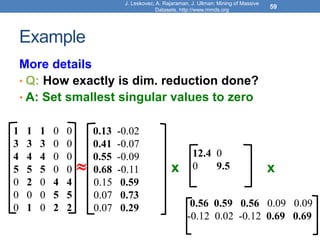
Example
More details
• Q: How exactly is dim. reduction done?
• A: Set smallest singular values to zero
J. Leskovec, A. Rajaraman, J. Ullman: Mining of Massive
Datasets, http://www.mmds.org
59
 x x
1 1 1 0 0
3 3 3 0 0
4 4 4 0 0
5 5 5 0 0
0 2 0 4 4
0 0 0 5 5
0 1 0 2 2
12.4 0
0 9.5
0.13 -0.02
0.41 -0.07
0.55 -0.09
0.68 -0.11
0.15 0.59
0.07 0.73
0.07 0.29 0.56 0.59 0.56 0.09 0.09
-0.12 0.02 -0.12 0.69 0.69
Example
More details
• Q: How exactly is dim. reduction done?
• A: Set smallest singular values to zero
J. Leskovec, A. Rajaraman, J. Ullman: Mining of Massive
Datasets, http://www.mmds.org
60

1 1 1 0 0
3 3 3 0 0
4 4 4 0 0
5 5 5 0 0
0 2 0 4 4
0 0 0 5 5
0 1 0 2 2
0.92 0.95 0.92 0.01 0.01
2.91 3.01 2.91 -0.01 -0.01
3.90 4.04 3.90 0.01 0.01
4.82 5.00 4.82 0.03 0.03
0.70 0.53 0.70 4.11 4.11
-0.69 1.34 -0.69 4.78 4.78
0.32 0.23 0.32 2.01 2.01
Frobenius norm:
ǁMǁF = Σij Mij
2
ǁA-BǁF =  Σij (Aij-Bij)2
is “small”
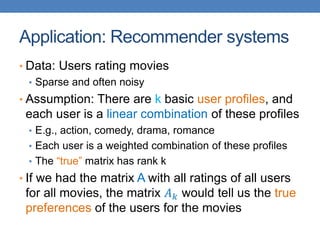
Application: Recommender systems
• Data: Users rating movies
• Sparse and often noisy
• Assumption: There are k basic user profiles, and
each user is a linear combination of these profiles
• E.g., action, comedy, drama, romance
• Each user is a weighted combination of these profiles
• The “true” matrix has rank k
• If we had the matrix A with all ratings of all users
for all movies, the matrix 𝐴𝑘 would tell us the true
preferences of the users for the movies
Model-based Recommendation Systems
• What we observe is a noisy, and incomplete
version of this matrix 𝐴 ̃
• Given matrix 𝐴 and we would like to get the
missing ratings that 𝐴𝑘 would produce
• Algorithm: compute the rank-k approximation 𝐴𝑘
of and matrix 𝐴 predict for user 𝑢 and movie 𝑚,
the value 𝐴𝑘[𝑚, 𝑢].
• The rank-k approximation 𝐴𝑘 is provably close to 𝐴𝑘
• Model-based collaborative filtering
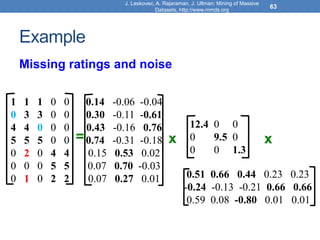
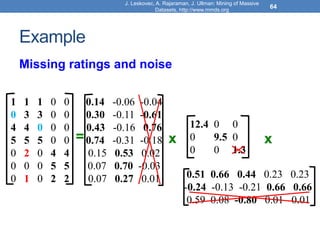
Example
Missing ratings and noise
J. Leskovec, A. Rajaraman, J. Ullman: Mining of Massive
Datasets, http://www.mmds.org
63
= x x
1 1 1 0 0
0 3 3 0 0
4 4 0 0 0
5 5 5 0 0
0 2 0 4 4
0 0 0 5 5
0 1 0 2 2
0.14 -0.06 -0.04
0.30 -0.11 -0.61
0.43 -0.16 0.76
0.74 -0.31 -0.18
0.15 0.53 0.02
0.07 0.70 -0.03
0.07 0.27 0.01
12.4 0 0
0 9.5 0
0 0 1.3
0.51 0.66 0.44 0.23 0.23
-0.24 -0.13 -0.21 0.66 0.66
0.59 0.08 -0.80 0.01 0.01
Example
Missing ratings and noise
J. Leskovec, A. Rajaraman, J. Ullman: Mining of Massive
Datasets, http://www.mmds.org
64
= x x
1 1 1 0 0
0 3 3 0 0
4 4 0 0 0
5 5 5 0 0
0 2 0 4 4
0 0 0 5 5
0 1 0 2 2
0.14 -0.06 -0.04
0.30 -0.11 -0.61
0.43 -0.16 0.76
0.74 -0.31 -0.18
0.15 0.53 0.02
0.07 0.70 -0.03
0.07 0.27 0.01
12.4 0 0
0 9.5 0
0 0 1.3
0.51 0.66 0.44 0.23 0.23
-0.24 -0.13 -0.21 0.66 0.66
0.59 0.08 -0.80 0.01 0.01
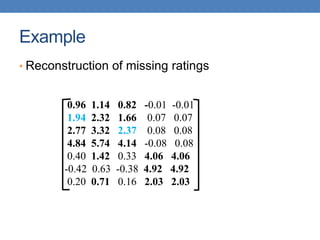
Example
• Reconstruction of missing ratings
0.96 1.14 0.82 -0.01 -0.01
1.94 2.32 1.66 0.07 0.07
2.77 3.32 2.37 0.08 0.08
4.84 5.74 4.14 -0.08 0.08
0.40 1.42 0.33 4.06 4.06
-0.42 0.63 -0.38 4.92 4.92
0.20 0.71 0.16 2.03 2.03
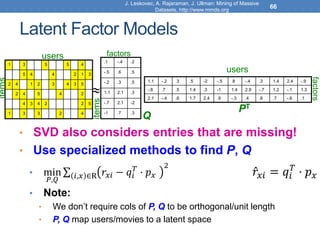
Latent Factor Models
• SVD also considers entries that are missing!
• Use specialized methods to find P, Q
• min
𝑃,𝑄 𝑖,𝑥 ∈R 𝑟𝑥𝑖 − 𝑞𝑖
𝑇
⋅ 𝑝𝑥
2
• Note:
• We don’t require cols of P, Q to be orthogonal/unit length
• P, Q map users/movies to a latent space
J. Leskovec, A. Rajaraman, J. Ullman: Mining of Massive
Datasets, http://www.mmds.org
66
4
5
5
3
1
3
1
2
4
4
5
5
3
4
3
2
1
4
2
2
4
5
4
2
5
2
2
4
3
4
4
2
3
3
1
.2
-.4
.1
.5
.6
-.5
.5
.3
-.2
.3
2.1
1.1
-2
2.1
-.7
.3
.7
-1
-.9
2.4
1.4
.3
-.4
.8
-.5
-2
.5
.3
-.2
1.1
1.3
-.1
1.2
-.7
2.9
1.4
-1
.3
1.4
.5
.7
-.8
.1
-.6
.7
.8
.4
-.3
.9
2.4
1.7
.6
-.4
2.1

PT
Q
users
items
𝑟𝑥𝑖 = 𝑞𝑖
𝑇
⋅ 𝑝𝑥
factors
factors
items
users
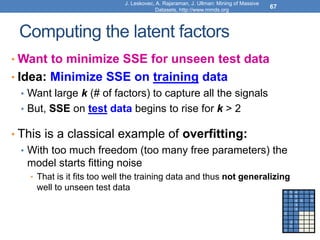
Computing the latent factors
• Want to minimize SSE for unseen test data
• Idea: Minimize SSE on training data
• Want large k (# of factors) to capture all the signals
• But, SSE on test data begins to rise for k > 2
• This is a classical example of overfitting:
• With too much freedom (too many free parameters) the
model starts fitting noise
• That is it fits too well the training data and thus not generalizing
well to unseen test data
67
1 3 4
3 5 5
4 5 5
3
3
2 ? ?
?
2 1 ?
3 ?
1
J. Leskovec, A. Rajaraman, J. Ullman: Mining of Massive
Datasets, http://www.mmds.org
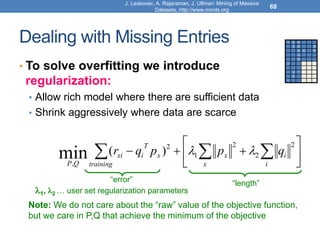
Dealing with Missing Entries
• To solve overfitting we introduce
regularization:
• Allow rich model where there are sufficient data
• Shrink aggressively where data are scarce
68








 

 i
i
x
x
training
x
T
i
xi
Q
P
q
p
p
q
r
2
2
2
1
2
,
)
(
min 

1 3 4
3 5 5
4 5 5
3
3
2 ? ?
?
2 1 ?
3 ?
1
1, 2 … user set regularization parameters
“error” “length”
Note: We do not care about the “raw” value of the objective function,
but we care in P,Q that achieve the minimum of the objective
J. Leskovec, A. Rajaraman, J. Ullman: Mining of Massive
Datasets, http://www.mmds.org
Geared
towards
females
Geared
towards
males
serious
funny
The Effect of Regularization
69
J. Leskovec, A. Rajaraman, J. Ullman: Mining of Massive
Datasets, http://www.mmds.org
The Princess
Diaries
The Lion King
Braveheart
Lethal Weapon
Independence
Day
Amadeus
The Color
Purple
Dumb and
Dumber
Ocean’s 11
Sense and
Sensibility
Factor 1
Factor
2
minfactors “error” +  “length”








 

 i
i
x
x
training
x
i
xi
Q
P
q
p
p
q
r
2
2
2
,
)
(
min 
Geared
towards
females
Geared
towards
males
serious
funny
The Effect of Regularization
70
J. Leskovec, A. Rajaraman, J. Ullman: Mining of Massive
Datasets, http://www.mmds.org
The Lion King
Braveheart
Lethal Weapon
Independence
Day
Amadeus
The Color
Purple
Dumb and
Dumber
Ocean’s 11
Sense and
Sensibility
Factor 1
Factor
2
The Princess
Diaries
minfactors “error” +  “length”








 

 i
i
x
x
training
x
i
xi
Q
P
q
p
p
q
r
2
2
2
,
)
(
min 
Geared
towards
females
Geared
towards
males
serious
funny
The Effect of Regularization
71
J. Leskovec, A. Rajaraman, J. Ullman: Mining of Massive
Datasets, http://www.mmds.org
The Lion King
Braveheart
Lethal Weapon
Independence
Day
Amadeus
The Color
Purple
Dumb and
Dumber
Ocean’s 11
Sense and
Sensibility
Factor 1
Factor
2
minfactors “error” +  “length”
The Princess
Diaries








 

 i
i
x
x
training
x
i
xi
Q
P
q
p
p
q
r
2
2
2
,
)
(
min 
Geared
towards
females
Geared
towards
males
serious
funny
The Effect of Regularization
72
J. Leskovec, A. Rajaraman, J. Ullman: Mining of Massive
Datasets, http://www.mmds.org
The Lion King
Braveheart
Lethal Weapon
Independence
Day
Amadeus
The Color
Purple
Dumb and
Dumber
Ocean’s 11
Sense and
Sensibility
Factor 1
Factor
2
The Princess
Diaries
minfactors “error” +  “length”








 

 i
i
x
x
training
x
i
xi
Q
P
q
p
p
q
r
2
2
2
,
)
(
min 
Latent factors
• To find the P,Q that minimize the error function we
can use (stochastic) gradient descent
• We can define different latent factor models that
apply the same idea in different ways
• Probabilistic/Generative models.
• The latent factor methods work well in practice,
and they are employed by most sophisticated
recommendation systems
Another Application
• Latent Semantic Indexing (LSI):
• Apply PCA on the document-term matrix, and index the
k-dimensional vectors
• When a query comes, project it onto the k-dimensional
space and compute cosine similarity in this space
• Principal components capture main topics, and enrich
the document representation
Another property of PCA/SVD
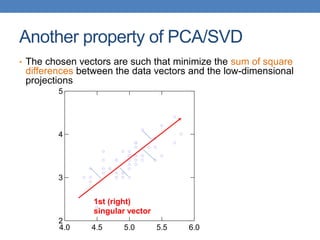
• The chosen vectors are such that minimize the sum of square
differences between the data vectors and the low-dimensional
projections
4.0 4.5 5.0 5.5 6.0
2
3
4
5
1st (right)
singular vector
SVD is “the Rolls-Royce and the Swiss
Army Knife of Numerical Linear
Algebra.”*
*Dianne O’Leary, MMDS ’06
Computation of eigenvectors
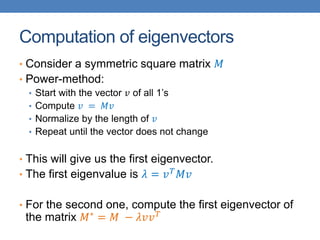
• Consider a symmetric square matrix 𝑀
• Power-method:
• Start with the vector 𝑣 of all 1’s
• Compute 𝑣 = 𝑀𝑣
• Normalize by the length of 𝑣
• Repeat until the vector does not change
• This will give us the first eigenvector.
• The first eigenvalue is 𝜆 = 𝑣𝑇
𝑀𝑣
• For the second one, compute the first eigenvector of
the matrix 𝑀∗
= 𝑀 − 𝜆𝑣𝑣𝑇
Singular Values and Eigenvalues
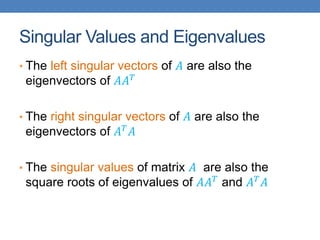
• The left singular vectors of 𝐴 are also the
eigenvectors of 𝐴𝐴𝑇
• The right singular vectors of 𝐴 are also the
eigenvectors of 𝐴𝑇
𝐴
• The singular values of matrix 𝐴 are also the
square roots of eigenvalues of 𝐴𝐴𝑇 and 𝐴𝑇𝐴
Computing singular vectors
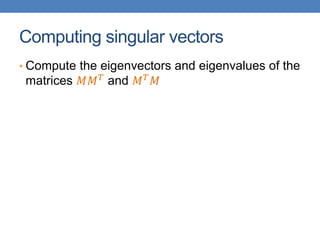
• Compute the eigenvectors and eigenvalues of the
matrices 𝑀𝑀𝑇 and 𝑀𝑇𝑀

SVD.ppt

  • 1.
    DATA MINING LECTURE 6 DimensionalityReduction PCA – SVD (Thanks to Jure Leskovec, Evimaria Terzi)
  • 2.
    The curse ofdimensionality • Real data usually have thousands, or millions of dimensions • E.g., web documents, where the dimensionality is the vocabulary of words • Facebook graph, where the dimensionality is the number of users • Huge number of dimensions causes problems • Data becomes very sparse, some algorithms become meaningless (e.g. density based clustering) • The complexity of several algorithms depends on the dimensionality and they become infeasible (e.g. nearest neighbor search).
  • 3.
    Dimensionality Reduction • Usuallythe data can be described with fewer dimensions, without losing much of the meaning of the data. • The data reside in a space of lower dimensionality
  • 4.
    Example • In thisdata matrix the dimension is essentially 3 • There are three types of products and three types of users TID A1 A2 A3 A4 A5 A6 A7 A8 A9 A10 B1 B2 B3 B4 B5 B6 B7 B8 B9 B10 C1 C2 C3 C4 C5 C6 C7 C8 C9 C10 1 1 1 1 1 1 1 1 1 1 1 0 0 0 0 0 0 0 0 0 0 0 0 0 0 0 0 0 0 0 0 2 1 1 1 1 1 1 1 1 1 1 0 0 0 0 0 0 0 0 0 0 0 0 0 0 0 0 0 0 0 0 3 1 1 1 1 1 1 1 1 1 1 0 0 0 0 0 0 0 0 0 0 0 0 0 0 0 0 0 0 0 0 4 1 1 1 1 1 1 1 1 1 1 0 0 0 0 0 0 0 0 0 0 0 0 0 0 0 0 0 0 0 0 5 1 1 1 1 1 1 1 1 1 1 0 0 0 0 0 0 0 0 0 0 0 0 0 0 0 0 0 0 0 0 6 0 0 0 0 0 0 0 0 0 0 1 1 1 1 1 1 1 1 1 1 0 0 0 0 0 0 0 0 0 0 7 0 0 0 0 0 0 0 0 0 0 1 1 1 1 1 1 1 1 1 1 0 0 0 0 0 0 0 0 0 0 8 0 0 0 0 0 0 0 0 0 0 1 1 1 1 1 1 1 1 1 1 0 0 0 0 0 0 0 0 0 0 9 0 0 0 0 0 0 0 0 0 0 1 1 1 1 1 1 1 1 1 1 0 0 0 0 0 0 0 0 0 0 10 0 0 0 0 0 0 0 0 0 0 1 1 1 1 1 1 1 1 1 1 0 0 0 0 0 0 0 0 0 0 11 0 0 0 0 0 0 0 0 0 0 0 0 0 0 0 0 0 0 0 0 1 1 1 1 1 1 1 1 1 1 12 0 0 0 0 0 0 0 0 0 0 0 0 0 0 0 0 0 0 0 0 1 1 1 1 1 1 1 1 1 1 13 0 0 0 0 0 0 0 0 0 0 0 0 0 0 0 0 0 0 0 0 1 1 1 1 1 1 1 1 1 1 14 0 0 0 0 0 0 0 0 0 0 0 0 0 0 0 0 0 0 0 0 1 1 1 1 1 1 1 1 1 1 15 0 0 0 0 0 0 0 0 0 0 0 0 0 0 0 0 0 0 0 0 1 1 1 1 1 1 1 1 1 1
  • 5.
    Example • Cloud ofpoints 3D space: • Think of point positions as a matrix: • We can rewrite coordinates more efficiently! • Old basis vectors: [1 0 0] [0 1 0] [0 0 1] • New basis vectors: [1 2 1] [-2 -3 1] • Then A has new coordinates: [1 0]. B: [0 1], C: [1 -1] • Notice: We reduced the number of coordinates! 1 row per point: A B C A J. Leskovec, A. Rajaraman, J. Ullman: Mining of Massive Datasets, http://www.mmds.org 5
  • 6.
    Dimensionality Reduction • Findthe “true dimension” of the data • In reality things are never as clear and simple as in this example, but we can still reduce the dimension. • Essentially, we assume that some of the data is useful signal and some data is noise, and that we can approximate the useful part with a lower dimensionality space. • Dimensionality reduction does not just reduce the amount of data, it often brings out the useful part of the data
  • 7.
    Dimensionality Reduction • Goalof dimensionality reduction is to discover the axis of data! Rather than representing every point with 2 coordinates we represent each point with 1 coordinate (corresponding to the position of the point on the red line). By doing this we incur a bit of error as the points do not exactly lie on the line J. Leskovec, A. Rajaraman, J. Ullman: Mining of Massive Datasets, http://www.mmds.org 7
  • 8.
    Why Reduce Dimensions? •Discover hidden correlations/topics • E.g., in documents, words that occur commonly together • Remove redundant and noisy features • E.g., in documents, not all words are useful • Interpretation and visualization • Easier storage and processing of the data J. Leskovec, A. Rajaraman, J. Ullman: Mining of Massive Datasets, http://www.mmds.org 8
  • 9.
    Dimensionality Reduction • Wehave already seen a form of dimensionality reduction • LSH, and random projections reduce the dimension while preserving the distances
  • 10.
    Data in theform of a matrix • We are given 𝑛 objects and 𝑑 attributes describing the objects. Each object has 𝑑 numeric values describing it. • We will represent the data as a 𝑛 × 𝑑 real matrix A. • We can now use tools from linear algebra to process the data matrix • Our goal is to produce a new 𝑛 × 𝑘 matrix B such that • It preserves as much of the information in the original matrix A as possible • It reveals something about the structure of the data in A
  • 11.
    Example: Document matrices ndocuments d terms (e.g., theorem, proof, etc.) Aij = frequency of the j-th term in the i-th document Find subsets of terms that bring documents together
  • 12.
    Example: Recommendation systems ncustomers d movies Aij = rating of j-th product by the i-th customer Find subsets of movies that capture the behavior or the customers
  • 13.
    Linear algebra • Weassume that vectors are column vectors. • We use 𝑣𝑇 for the transpose of vector 𝑣 (row vector) • Dot product: 𝑢𝑇𝑣 (1𝑛, 𝑛1 → 11) • The dot product is the projection of vector 𝑣 on 𝑢 (and vice versa) • 1, 2, 3 4 1 2 = 12 • 𝑢𝑇𝑣 = 𝑣 𝑢 cos(𝑢, 𝑣) • If ||𝑢|| = 1 (unit vector) then 𝑢𝑇𝑣 is the projection length of 𝑣 on 𝑢 • −1, 2, 3 4 −1 2 = 0 : orthogonal vectors • Orthonormal vectors: two unit vectors that are orthogonal
  • 14.
    Matrices • An nmmatrix A is a collection of n row vectors and m column vectors 𝐴 = | | | 𝑎1 𝑎2 𝑎3 | | | 𝐴 = − 𝛼1 𝑇 − − 𝛼2 𝑇 − − 𝛼3 𝑇 − • Matrix-vector multiplication • Right multiplication 𝐴𝑢: projection of 𝑢 onto the row vectors of 𝐴, or projection of row vectors of 𝐴 onto 𝑢. • Left-multiplication 𝑢𝑇 𝐴: projection of 𝑢 onto the column vectors of 𝐴, or projection of column vectors of 𝐴 onto 𝑢 • Example: 1 0 0 0 1 0 1 2 3 = 1 2
  • 15.
    Change of basis •By default a vector is expressed in the axis-aligned basis. • For example, for vector [-1,2] we have: • −1 2 = −1 1 0 + 2 0 1 • With a projection we can change the basis over which a vector is expressed. √2 2 √2 2 − √2 2 √2 2 −1 2 = 3√2 2 √2 2
  • 16.
    Rank • Row spaceof A: The set of vectors that can be written as a linear combination of the rows of A • All vectors of the form 𝑣 = 𝑢𝑇 𝐴 • Column space of A: The set of vectors that can be written as a linear combination of the columns of A • All vectors of the form 𝑣 = 𝐴𝑢. • Rank of A: the number of linearly independent row (or column) vectors • These vectors define a basis for the row (or column) space of A • All vectors in the row (column) space are linear combinations of the basis vectors • Example • Matrix A = has rank r=2 • Why? The first two rows are linearly independent, so the rank is at least 2, but all three rows are linearly dependent (the first is equal to the sum of the second and third) so the rank must be less than 3.
  • 17.
    Rank-1 matrices • Ina rank-1 matrix, all columns (or rows) are multiples of the same column (or row) vector 𝐴 = 1 2 −1 2 4 −2 3 6 −3 • All rows are multiples of 𝑟𝑇 = [1,2, −1] • All columns are multiples of 𝑐 = 1 2 3 • External product: 𝑢𝑣𝑇 (𝑛1 , 1𝑚 → 𝑛𝑚) • The resulting 𝑛𝑚 has rank 1: all rows (or columns) are linearly dependent • 𝐴 = 𝑐𝑟𝑇
  • 18.
    Eigenvectors • (Right) Eigenvectorof matrix A: a vector v such that 𝐴𝑣 = 𝜆𝑣 • 𝜆: eigenvalue of eigenvector 𝑣 • A square symmetric matrix A of rank r, has r orthonormal eigenvectors 𝑢1, 𝑢2, … , 𝑢𝑟 with eigenvalues 𝜆1, 𝜆2, … , 𝜆𝑟. • Eigenvectors define an orthonormal basis for the column space of A • We can write: 𝐴 = 𝑈Λ𝑈𝑇
  • 19.
    Singular Value Decomposition 𝐴= 𝑈 Σ 𝑉𝑇 = 𝑢1, 𝑢2, ⋯ , 𝑢𝑟 𝜎1 𝜎2 0 0 ⋱ 𝜎𝑟 𝑣1 𝑇 𝑣2 𝑇 ⋮ 𝑣𝑟 𝑇 • 𝜎1, ≥ 𝜎2 ≥ ⋯ ≥ 𝜎𝑟: singular values of matrix 𝐴 • 𝑢1, 𝑢2, … , 𝑢𝑟: left singular vectors of 𝐴 • 𝑣1, 𝑣2, … , 𝑣𝑟: right singular vectors of 𝐴 𝐴 = 𝜎1𝑢1𝑣1 𝑇 + 𝜎2𝑢2𝑣2 𝑇 + ⋯ + 𝜎𝑟𝑢𝑟𝑣𝑟 𝑇 [n×r] [r×r] [r×m] r: rank of matrix A [n×m] =
  • 20.
    Singular Value Decomposition •The left singular vectors are an orthonormal basis for the row space of A. • The right singular vectors are an orthonormal basis for the column space of A. • If A has rank r, then A can be written as the sum of r rank-1 matrices • There are r “linear components” (trends) in A. • Linear trend: the tendency of the row vectors of A to align with vector v • Strength of the i-th linear trend: ||𝐴𝒗𝒊|| = 𝝈𝒊
  • 21.
    Symmetric matrices • Specialcase: A is symmetric positive definite matrix 𝐴 = 𝜆1𝑢1𝑢1 𝑇 + 𝜆2𝑢2𝑢2 𝑇 + ⋯ + 𝜆𝑟𝑢𝑟𝑢𝑟 𝑇 • 𝜆1 ≥ 𝜆2 ≥ ⋯ ≥ 𝜆𝑟 ≥ 0: Eigenvalues of A • 𝑢1, 𝑢2, … , 𝑢𝑟: Eigenvectors of A
  • 22.
    Singular Values andEigenvalues • Singular Value Decomposition 𝐴 = 𝑈Σ𝑉𝑇 • The left singular vectors of 𝐴 are also the eigenvectors of the (symmetric) matrix 𝐴𝐴𝑇 𝐴𝐴𝑇 = 𝑈Σ2𝑈𝑇 • The right singular vectors of 𝐴 are also the eigenvectors of the (symmetric) matrix 𝐴𝑇𝐴 𝐴𝑇 𝐴 = 𝑉Σ2 𝑉𝑇 • The singular values of matrix 𝐴 are also the square roots of eigenvalues of 𝐴𝐴𝑇 and 𝐴𝑇𝐴 𝜆𝑖 𝐴𝑇𝐴 = 𝜆𝑖 𝐴𝐴𝑇 = 𝜎𝑖 2
  • 23.
    SVD properties • SingularValue Decomposition has three useful properties that we will study now: • It provides the important (principal) directions (dimensions) in the data – Principal Component Analysis • It provides the best low rank approximation for our matrix • It minimizes the reconstruction error (squared distance between real data points and their estimates)
  • 24.
    Principal Component Analysis •Goal: reduce the dimensionality while preserving the “information in the data”. • In the new space we want to: • Maximize the amount of information • Minimize redundancy – remove the redundant dimensions • Minimize the noise in the data.
  • 25.
    Variability • Information inthe data: variability in the data • We measure variability using the covariance matrix. • Sample variance for variable X: 𝜎𝑋 2 = 1 𝑁 𝑖 𝑥𝑖 − 𝜇𝑋 𝑥𝑖 − 𝜇𝑋 = 1 𝑁 𝑥 − 𝜇𝑋 𝑇 𝑥 − 𝜇𝑋 • Sample covariance of variables X and Y 𝜎𝑋𝑌 2 = 1 𝑁 𝑖 (𝑥𝑖 − 𝜇𝑋) (𝑦𝑖 − 𝜇𝑌) = 1 𝑁 𝑥 − 𝜇𝑋 𝑇 𝑦 − 𝜇𝑌 • High variance 𝜎𝑋 2 means high information in dimension (attribute) X • We want to maximize the signal-to-noise ratio 𝜎𝑠𝑖𝑔𝑛𝑎𝑙 2 𝜎𝑛𝑜𝑖𝑠𝑒 2 • High co-variance 𝜎𝑋𝑌 2 means high correlation between attributes X,Y, and thus high redundancy. • Ideally we want 𝜎𝑋𝑌 2 = 0 for all pairs X,Y
  • 26.
    Example • In thedata below the data are essentially one- dimensional, but what is the axis we should use? • The direction in which the variance is maximized. 𝜎𝑠𝑖𝑔𝑛𝑎𝑙 2 𝜎𝑛𝑜𝑖𝑠𝑒 2 The variance along the orthogonal direction is small and captures the noise in the data
  • 27.
    Covariance matrix • Weare given the data matrix A, with 𝑛 rows and 𝑚 columns, where the rows correspond to data samples over a set of features defined by the columns. • Remove the mean of each column from the column vectors to get the centered matrix 𝐴 • The matrix C = 𝐴𝑇 𝐴is the covariance matrix of the column vectors of 𝐴. • We want to change the basis of the data so that the matrix becomes diagonal • All the values are in the diagonal and the off-diagonal entries are zero
  • 28.
    PCA: Principal ComponentAnalysis • We will project the rows of matrix 𝐴 onto a new set of attributes (dimensions) such that: • The attributes have zero covariance to each other (they are orthogonal) • Each attribute captures the most remaining variance in the data, while orthogonal to the existing attributes • The first attribute should capture the most variance in the data • For matrix 𝐴, the variance of the columns of 𝐴 when projected to vector 𝑣 is given by 𝜎2 = 𝐴𝑣 2 • The first right singular vector of 𝐴 maximizes 𝜎2!
  • 29.
    PCA and SVD •PCA is a special case of SVD on the centered matrix. • After projecting the centered matrix 𝐴 to the singular vectors in 𝑉 we have that the covariance matrix of the new dataset 𝐴𝑉 is: 𝐴𝑉 𝑇 𝐴𝑉 = Σ • We have achieved to make the matrix diagonal! • Dimensionality reduction: Don’t keep all the singular vectors in 𝑉 just the 𝑘 first ones.
  • 30.
    4.0 4.5 5.05.5 6.0 2 3 4 5 PCA Input: 2-d dimensional points Output: 1st (right) singular vector 1st (right) singular vector: direction of maximal variance, 2nd (right) singular vector 2nd (right) singular vector: direction of maximal variance, after removing the projection of the data along the first singular vector.
  • 31.
    Singular values 1: measuresdata variance along the first singular vector. 2: measures how much of the data variance is explained by the second singular vector. 1 4.0 4.5 5.0 5.5 6.0 2 3 4 5 1st (right) singular vector 2nd (right) singular vector
  • 32.
    Singular values tellus something about the variance • The variance in the direction of the k-th principal component is given by the corresponding singular value σk 2 • Singular values can be used to estimate how many components to keep • Rule of thumb: keep enough to explain 85% of the variation: 85 . 0 1 2 1 2      n j j k j j  
  • 33.
    A VT  U = objects features significant noise noise noise significant sig. = SVD andRank-k approximations We keep the k most important singular vectors The matrix 𝑈𝑘Σ𝑘𝑉𝑘 𝑇 is a rank-k approximation of A The idea is that this is the part that has the useful information and noise is removed We will show that this is also the best rank-k approximation (closest to the original A)
  • 34.
    Example 𝐴 = 𝑎11 ⋯𝑎1𝑛 ⋮ ⋱ ⋮ 𝑎𝑛1 ⋯ 𝑎𝑛𝑛 𝐴 = 𝑈Σ𝑉𝑇 • First right singular vector 𝑣1 • More or less same weight to all drugs • Discriminates heavy from light users • Second right singular vector • Positive values for legal drugs, negative for illegal students drugs legal illegal 𝑎𝑖𝑗: usage of student i of drug j Drug 2 Drug 1
  • 35.
    SVD for matrixreconstruction • We will now see how we can use the fact that SVD gives the best rank-k approximation for a data matrix A. • The idea is that we assume that the “true” matrix is rank-k, and rank is increased due to noise • We use SVD to find the best rank-k approximation for A, and thus the best approximation of the “true” matrix
  • 36.
    An (extreme) example •User-Movie matrix • Blue and Red rows (colums) are linearly dependent • There are two prototype users (vectors of movies): blue and red • To describe the data is enough to describe the two prototypes, and the projection weights for each row • A is a rank-2 matrix 𝐴 = 𝑤1, 𝑤2 𝑑1 𝑇 𝑑2 𝑇 A =
  • 37.
    SVD – Example:Users-to-Movies • A = U  VT - example: Users to Movies J. Leskovec, A. Rajaraman, J. Ullman: Mining of Massive Datasets, http://www.mmds.org 37 = SciFi Romance Matrix Alien Serenity Casablanca Amelie 1 1 1 0 0 3 3 3 0 0 4 4 4 0 0 5 5 5 0 0 0 0 0 4 4 0 0 0 5 5 0 0 0 2 2  m n U VT “Concepts” AKA Latent dimensions AKA Latent factors
  • 38.
    SVD – Example:Users-to-Movies • A = U  VT - example: Users to Movies J. Leskovec, A. Rajaraman, J. Ullman: Mining of Massive Datasets, http://www.mmds.org 38 SciFi-concept Romance-concept = SciFi Romance x x Matrix Alien Serenity Casablanca Amelie 0.14 0.00 0.42 0.00 0.56 0.00 0.70 0.00 0.00 0.60 0.00 0.75 0.00 0.30 12.4 0 0 9.5 0.58 0.58 0.58 0.00 0.00 0.00 0.00 0.00 0.71 0.71 1 1 1 0 0 3 3 3 0 0 4 4 4 0 0 5 5 5 0 0 0 0 0 4 4 0 0 0 5 5 0 0 0 2 2
  • 39.
    SVD – Example:Users-to-Movies • A = U  VT - example: Users to Movies J. Leskovec, A. Rajaraman, J. Ullman: Mining of Massive Datasets, http://www.mmds.org 39 SciFi-concept Romance-concept = SciFi Romance x x Matrix Alien Serenity Casablanca Amelie 0.14 0.00 0.42 0.00 0.56 0.00 0.70 0.00 0.00 0.60 0.00 0.75 0.00 0.30 12.4 0 0 9.5 0.58 0.58 0.58 0.00 0.00 0.00 0.00 0.00 0.71 0.71 1 1 1 0 0 3 3 3 0 0 4 4 4 0 0 5 5 5 0 0 0 0 0 4 4 0 0 0 5 5 0 0 0 2 2 U is “user-to-concept” similarity matrix
  • 40.
    SVD – Example:Users-to-Movies • A = U  VT - example: Users to Movies J. Leskovec, A. Rajaraman, J. Ullman: Mining of Massive Datasets, http://www.mmds.org 40 SciFi-concept Romance-concept = SciFi Romance x x Matrix Alien Serenity Casablanca Amelie 0.14 0.00 0.42 0.00 0.56 0.00 0.70 0.00 0.00 0.60 0.00 0.75 0.00 0.30 12.4 0 0 9.5 0.58 0.58 0.58 0.00 0.00 0.00 0.00 0.00 0.71 0.71 1 1 1 0 0 3 3 3 0 0 4 4 4 0 0 5 5 5 0 0 0 0 0 4 4 0 0 0 5 5 0 0 0 2 2 V is “movie to concept” similarity matrix
  • 41.
    SVD – Example:Users-to-Movies • A = U  VT - example: Users to Movies J. Leskovec, A. Rajaraman, J. Ullman: Mining of Massive Datasets, http://www.mmds.org 41 SciFi-concept Romance-concept = SciFi Romance x x Matrix Alien Serenity Casablanca Amelie 0.14 0.00 0.42 0.00 0.56 0.00 0.70 0.00 0.00 0.60 0.00 0.75 0.00 0.30 12.4 0 0 9.5 0.58 0.58 0.58 0.00 0.00 0.00 0.00 0.00 0.71 0.71 1 1 1 0 0 3 3 3 0 0 4 4 4 0 0 5 5 5 0 0 0 0 0 4 4 0 0 0 5 5 0 0 0 2 2 Σ is the “concept strength” matrix
  • 42.
    SVD – Example:Users-to-Movies • A = U  VT - example: Users to Movies J. Leskovec, A. Rajaraman, J. Ullman: Mining of Massive Datasets, http://www.mmds.org 42 = SciFi Romance x x Matrix Alien Serenity Casablanca Amelie 0.14 0.00 0.42 0.00 0.56 0.00 0.70 0.00 0.00 0.60 0.00 0.75 0.00 0.30 12.4 0 0 9.5 0.58 0.58 0.58 0.00 0.00 0.00 0.00 0.00 0.71 0.71 1 1 1 0 0 3 3 3 0 0 4 4 4 0 0 5 5 5 0 0 0 0 0 4 4 0 0 0 5 5 0 0 0 2 2 Movie 1 Movie 2 1st singular vector Σ is the “spread (variance)” matrix
  • 43.
    An (more realistic)example • User-Movie matrix • There are two prototype users and movies but they are noisy A =
  • 44.
    SVD – Example:Users-to-Movies • A = U  VT - example: Users to Movies J. Leskovec, A. Rajaraman, J. Ullman: Mining of Massive Datasets, http://www.mmds.org 44 = SciFi Romance Matrix Alien Serenity Casablanca Amelie 1 1 1 0 0 3 3 3 0 0 4 4 4 0 0 5 5 5 0 0 0 2 0 4 4 0 0 0 5 5 0 1 0 2 2  m n U VT “Concepts” AKA Latent dimensions AKA Latent factors
  • 45.
    SVD – Example:Users-to-Movies • A = U  VT - example: Users to Movies J. Leskovec, A. Rajaraman, J. Ullman: Mining of Massive Datasets, http://www.mmds.org 45 = SciFi Romance x x Matrix Alien Serenity Casablanca Amelie 1 1 1 0 0 3 3 3 0 0 4 4 4 0 0 5 5 5 0 0 0 2 0 4 4 0 0 0 5 5 0 1 0 2 2 0.13 -0.02 -0.01 0.41 -0.07 -0.03 0.55 -0.09 -0.04 0.68 -0.11 -0.05 0.15 0.59 0.65 0.07 0.73 -0.67 0.07 0.29 0.32 12.4 0 0 0 9.5 0 0 0 1.3 0.56 0.59 0.56 0.09 0.09 -0.12 0.02 -0.12 0.69 0.69 0.40 -0.80 0.40 0.09 0.09
  • 46.
    SVD – Example:Users-to-Movies • A = U  VT - example: Users to Movies J. Leskovec, A. Rajaraman, J. Ullman: Mining of Massive Datasets, http://www.mmds.org 46 = SciFi Rom x x Matrix Alien Serenity Casablanca Amelie 1 1 1 0 0 3 3 3 0 0 4 4 4 0 0 5 5 5 0 0 0 2 0 4 4 0 0 0 5 5 0 1 0 2 2 0.13 -0.02 -0.01 0.41 -0.07 -0.03 0.55 -0.09 -0.04 0.68 -0.11 -0.05 0.15 0.59 0.65 0.07 0.73 -0.67 0.07 0.29 0.32 12.4 0 0 0 9.5 0 0 0 1.3 0.56 0.59 0.56 0.09 0.09 -0.12 0.02 -0.12 0.69 0.69 0.40 -0.80 0.40 0.09 0.09 SciFi-concept Romance-concept The first two vectors are more or less unchanged
  • 47.
    SVD – Example:Users-to-Movies • A = U  VT - example: Users to Movies J. Leskovec, A. Rajaraman, J. Ullman: Mining of Massive Datasets, http://www.mmds.org 47 = SciFi Rom x x Matrix Alien Serenity Casablanca Amelie 1 1 1 0 0 3 3 3 0 0 4 4 4 0 0 5 5 5 0 0 0 2 0 4 4 0 0 0 5 5 0 1 0 2 2 0.13 -0.02 -0.01 0.41 -0.07 -0.03 0.55 -0.09 -0.04 0.68 -0.11 -0.05 0.15 0.59 0.65 0.07 0.73 -0.67 0.07 0.29 0.32 12.4 0 0 0 9.5 0 0 0 1.3 0.56 0.59 0.56 0.09 0.09 -0.12 0.02 -0.12 0.69 0.69 0.40 -0.80 0.40 0.09 0.09 The third vector has a very low singular value
  • 48.
    J. Leskovec, A.Rajaraman, J. Ullman: Mining of Massive Datasets, http://www.mmds.org 48 SVD - Interpretation #1 ‘movies’, ‘users’ and ‘concepts’: • 𝑼: user-to-concept similarity matrix • 𝑽: movie-to-concept similarity matrix • : its diagonal elements: ‘strength’ of each concept
  • 49.
    Rank-k approximation • Inthis User-Movie matrix • We have more than two singular vectors, but the strongest ones are still about the two types. • The third models the noise in the data • By keeping the two strongest singular vectors we obtain most of the information in the data. • This is a rank-2 approximation of the matrix A A =
  • 50.
    Rank-k approximations (Ak) 𝑼𝒌(𝑽𝒌): orthogonal matrix containing the top k left (right) singular vectors of A. 𝜮𝒌: diagonal matrix containing the top k singular values of A Ak is an approximation of A n x d n x k k x k k x d Ak is the best approximation of A
  • 51.
    SVD as anoptimization • The rank-k approximation matrix 𝐴𝑘 produced by the top-k singular vectors of A minimizes the Frobenious norm of the difference with the matrix A 𝐴𝑘 = arg max 𝐵:𝑟𝑎𝑛𝑘 𝐵 =𝑘 𝐴 − 𝐵 𝐹 2 𝐴 − 𝐵 𝐹 2 = 𝑖,𝑗 𝐴𝑖𝑗 − 𝐵𝑖𝑗 2 Explanation: The (𝑖, 𝑗) cell in 𝐴𝑘is close on average with the 𝑖, 𝑗 cell of 𝐴
  • 52.
    What does thismean? • We can project the row (and column) vectors of the matrix A into a k-dimensional space and preserve most of the information • (Ideally) The k dimensions reveal latent features/aspects/topics of the term (document) space. • (Ideally) The 𝐴𝑘 approximation of matrix A, contains all the useful information, and what is discarded is noise
  • 53.
    Latent factor model •Rows (columns) are linear combinations of k latent factors • E.g., in our extreme document example there are two factors • Some noise is added to this rank-k matrix resulting in higher rank • SVD retrieves the latent factors (hopefully).
  • 54.
  • 55.
    Example More details • Q:How exactly is dim. reduction done? • A: Compute SVD J. Leskovec, A. Rajaraman, J. Ullman: Mining of Massive Datasets, http://www.mmds.org 55 = x x 1 1 1 0 0 3 3 3 0 0 4 4 4 0 0 5 5 5 0 0 0 2 0 4 4 0 0 0 5 5 0 1 0 2 2 12.4 0 0 0 9.5 0 0 0 1.3 0.13 -0.02 -0.01 0.41 -0.07 -0.03 0.55 -0.09 -0.04 0.68 -0.11 -0.05 0.15 0.59 0.65 0.07 0.73 -0.67 0.07 0.29 0.32 0.56 0.59 0.56 0.09 0.09 -0.12 0.02 -0.12 0.69 0.69 0.40 -0.80 0.40 0.09 0.09
  • 56.
    Example More details • Q:How exactly is dim. reduction done? • A: Set smallest singular values to zero J. Leskovec, A. Rajaraman, J. Ullman: Mining of Massive Datasets, http://www.mmds.org 56 = x x 1 1 1 0 0 3 3 3 0 0 4 4 4 0 0 5 5 5 0 0 0 2 0 4 4 0 0 0 5 5 0 1 0 2 2 12.4 0 0 0 9.5 0 0 0 1.3 0.13 -0.02 -0.01 0.41 -0.07 -0.03 0.55 -0.09 -0.04 0.68 -0.11 -0.05 0.15 0.59 0.65 0.07 0.73 -0.67 0.07 0.29 0.32 0.56 0.59 0.56 0.09 0.09 -0.12 0.02 -0.12 0.69 0.69 0.40 -0.80 0.40 0.09 0.09
  • 57.
    Example More details • Q:How exactly is dim. reduction done? • A: Set smallest singular values to zero J. Leskovec, A. Rajaraman, J. Ullman: Mining of Massive Datasets, http://www.mmds.org 57 x x 1 1 1 0 0 3 3 3 0 0 4 4 4 0 0 5 5 5 0 0 0 2 0 4 4 0 0 0 5 5 0 1 0 2 2 12.4 0 0 0 9.5 0 0 0 1.3  0.13 -0.02 -0.01 0.41 -0.07 -0.03 0.55 -0.09 -0.04 0.68 -0.11 -0.05 0.15 0.59 0.65 0.07 0.73 -0.67 0.07 0.29 0.32 0.56 0.59 0.56 0.09 0.09 -0.12 0.02 -0.12 0.69 0.69 0.40 -0.80 0.40 0.09 0.09
  • 58.
    Example More details • Q:How exactly is dim. reduction done? • A: Set smallest singular values to zero J. Leskovec, A. Rajaraman, J. Ullman: Mining of Massive Datasets, http://www.mmds.org 58 x x 1 1 1 0 0 3 3 3 0 0 4 4 4 0 0 5 5 5 0 0 0 2 0 4 4 0 0 0 5 5 0 1 0 2 2 12.4 0 0 0 9.5 0 0 0 1.3  0.13 -0.02 -0.01 0.41 -0.07 -0.03 0.55 -0.09 -0.04 0.68 -0.11 -0.05 0.15 0.59 0.65 0.07 0.73 -0.67 0.07 0.29 0.32 0.56 0.59 0.56 0.09 0.09 -0.12 0.02 -0.12 0.69 0.69 0.40 -0.80 0.40 0.09 0.09
  • 59.
    Example More details • Q:How exactly is dim. reduction done? • A: Set smallest singular values to zero J. Leskovec, A. Rajaraman, J. Ullman: Mining of Massive Datasets, http://www.mmds.org 59  x x 1 1 1 0 0 3 3 3 0 0 4 4 4 0 0 5 5 5 0 0 0 2 0 4 4 0 0 0 5 5 0 1 0 2 2 12.4 0 0 9.5 0.13 -0.02 0.41 -0.07 0.55 -0.09 0.68 -0.11 0.15 0.59 0.07 0.73 0.07 0.29 0.56 0.59 0.56 0.09 0.09 -0.12 0.02 -0.12 0.69 0.69
  • 60.
    Example More details • Q:How exactly is dim. reduction done? • A: Set smallest singular values to zero J. Leskovec, A. Rajaraman, J. Ullman: Mining of Massive Datasets, http://www.mmds.org 60  1 1 1 0 0 3 3 3 0 0 4 4 4 0 0 5 5 5 0 0 0 2 0 4 4 0 0 0 5 5 0 1 0 2 2 0.92 0.95 0.92 0.01 0.01 2.91 3.01 2.91 -0.01 -0.01 3.90 4.04 3.90 0.01 0.01 4.82 5.00 4.82 0.03 0.03 0.70 0.53 0.70 4.11 4.11 -0.69 1.34 -0.69 4.78 4.78 0.32 0.23 0.32 2.01 2.01 Frobenius norm: ǁMǁF = Σij Mij 2 ǁA-BǁF =  Σij (Aij-Bij)2 is “small”
  • 61.
    Application: Recommender systems •Data: Users rating movies • Sparse and often noisy • Assumption: There are k basic user profiles, and each user is a linear combination of these profiles • E.g., action, comedy, drama, romance • Each user is a weighted combination of these profiles • The “true” matrix has rank k • If we had the matrix A with all ratings of all users for all movies, the matrix 𝐴𝑘 would tell us the true preferences of the users for the movies
  • 62.
    Model-based Recommendation Systems •What we observe is a noisy, and incomplete version of this matrix 𝐴 ̃ • Given matrix 𝐴 and we would like to get the missing ratings that 𝐴𝑘 would produce • Algorithm: compute the rank-k approximation 𝐴𝑘 of and matrix 𝐴 predict for user 𝑢 and movie 𝑚, the value 𝐴𝑘[𝑚, 𝑢]. • The rank-k approximation 𝐴𝑘 is provably close to 𝐴𝑘 • Model-based collaborative filtering
  • 63.
    Example Missing ratings andnoise J. Leskovec, A. Rajaraman, J. Ullman: Mining of Massive Datasets, http://www.mmds.org 63 = x x 1 1 1 0 0 0 3 3 0 0 4 4 0 0 0 5 5 5 0 0 0 2 0 4 4 0 0 0 5 5 0 1 0 2 2 0.14 -0.06 -0.04 0.30 -0.11 -0.61 0.43 -0.16 0.76 0.74 -0.31 -0.18 0.15 0.53 0.02 0.07 0.70 -0.03 0.07 0.27 0.01 12.4 0 0 0 9.5 0 0 0 1.3 0.51 0.66 0.44 0.23 0.23 -0.24 -0.13 -0.21 0.66 0.66 0.59 0.08 -0.80 0.01 0.01
  • 64.
    Example Missing ratings andnoise J. Leskovec, A. Rajaraman, J. Ullman: Mining of Massive Datasets, http://www.mmds.org 64 = x x 1 1 1 0 0 0 3 3 0 0 4 4 0 0 0 5 5 5 0 0 0 2 0 4 4 0 0 0 5 5 0 1 0 2 2 0.14 -0.06 -0.04 0.30 -0.11 -0.61 0.43 -0.16 0.76 0.74 -0.31 -0.18 0.15 0.53 0.02 0.07 0.70 -0.03 0.07 0.27 0.01 12.4 0 0 0 9.5 0 0 0 1.3 0.51 0.66 0.44 0.23 0.23 -0.24 -0.13 -0.21 0.66 0.66 0.59 0.08 -0.80 0.01 0.01
  • 65.
    Example • Reconstruction ofmissing ratings 0.96 1.14 0.82 -0.01 -0.01 1.94 2.32 1.66 0.07 0.07 2.77 3.32 2.37 0.08 0.08 4.84 5.74 4.14 -0.08 0.08 0.40 1.42 0.33 4.06 4.06 -0.42 0.63 -0.38 4.92 4.92 0.20 0.71 0.16 2.03 2.03
  • 66.
    Latent Factor Models •SVD also considers entries that are missing! • Use specialized methods to find P, Q • min 𝑃,𝑄 𝑖,𝑥 ∈R 𝑟𝑥𝑖 − 𝑞𝑖 𝑇 ⋅ 𝑝𝑥 2 • Note: • We don’t require cols of P, Q to be orthogonal/unit length • P, Q map users/movies to a latent space J. Leskovec, A. Rajaraman, J. Ullman: Mining of Massive Datasets, http://www.mmds.org 66 4 5 5 3 1 3 1 2 4 4 5 5 3 4 3 2 1 4 2 2 4 5 4 2 5 2 2 4 3 4 4 2 3 3 1 .2 -.4 .1 .5 .6 -.5 .5 .3 -.2 .3 2.1 1.1 -2 2.1 -.7 .3 .7 -1 -.9 2.4 1.4 .3 -.4 .8 -.5 -2 .5 .3 -.2 1.1 1.3 -.1 1.2 -.7 2.9 1.4 -1 .3 1.4 .5 .7 -.8 .1 -.6 .7 .8 .4 -.3 .9 2.4 1.7 .6 -.4 2.1  PT Q users items 𝑟𝑥𝑖 = 𝑞𝑖 𝑇 ⋅ 𝑝𝑥 factors factors items users
  • 67.
    Computing the latentfactors • Want to minimize SSE for unseen test data • Idea: Minimize SSE on training data • Want large k (# of factors) to capture all the signals • But, SSE on test data begins to rise for k > 2 • This is a classical example of overfitting: • With too much freedom (too many free parameters) the model starts fitting noise • That is it fits too well the training data and thus not generalizing well to unseen test data 67 1 3 4 3 5 5 4 5 5 3 3 2 ? ? ? 2 1 ? 3 ? 1 J. Leskovec, A. Rajaraman, J. Ullman: Mining of Massive Datasets, http://www.mmds.org
  • 68.
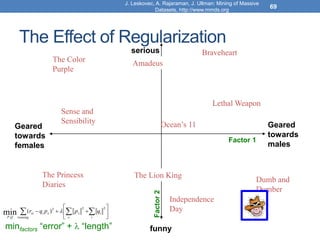
    Dealing with MissingEntries • To solve overfitting we introduce regularization: • Allow rich model where there are sufficient data • Shrink aggressively where data are scarce 68             i i x x training x T i xi Q P q p p q r 2 2 2 1 2 , ) ( min   1 3 4 3 5 5 4 5 5 3 3 2 ? ? ? 2 1 ? 3 ? 1 1, 2 … user set regularization parameters “error” “length” Note: We do not care about the “raw” value of the objective function, but we care in P,Q that achieve the minimum of the objective J. Leskovec, A. Rajaraman, J. Ullman: Mining of Massive Datasets, http://www.mmds.org
  • 69.
    Geared towards females Geared towards males serious funny The Effect ofRegularization 69 J. Leskovec, A. Rajaraman, J. Ullman: Mining of Massive Datasets, http://www.mmds.org The Princess Diaries The Lion King Braveheart Lethal Weapon Independence Day Amadeus The Color Purple Dumb and Dumber Ocean’s 11 Sense and Sensibility Factor 1 Factor 2 minfactors “error” +  “length”             i i x x training x i xi Q P q p p q r 2 2 2 , ) ( min 
  • 70.
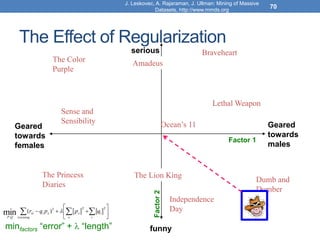
    Geared towards females Geared towards males serious funny The Effect ofRegularization 70 J. Leskovec, A. Rajaraman, J. Ullman: Mining of Massive Datasets, http://www.mmds.org The Lion King Braveheart Lethal Weapon Independence Day Amadeus The Color Purple Dumb and Dumber Ocean’s 11 Sense and Sensibility Factor 1 Factor 2 The Princess Diaries minfactors “error” +  “length”             i i x x training x i xi Q P q p p q r 2 2 2 , ) ( min 
  • 71.
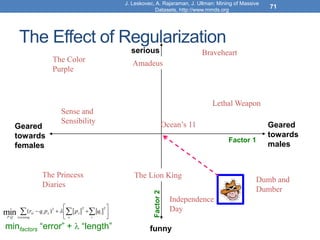
    Geared towards females Geared towards males serious funny The Effect ofRegularization 71 J. Leskovec, A. Rajaraman, J. Ullman: Mining of Massive Datasets, http://www.mmds.org The Lion King Braveheart Lethal Weapon Independence Day Amadeus The Color Purple Dumb and Dumber Ocean’s 11 Sense and Sensibility Factor 1 Factor 2 minfactors “error” +  “length” The Princess Diaries             i i x x training x i xi Q P q p p q r 2 2 2 , ) ( min 
  • 72.
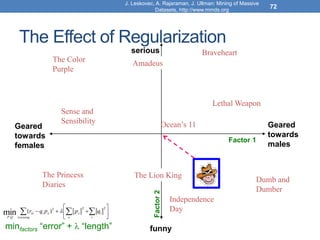
    Geared towards females Geared towards males serious funny The Effect ofRegularization 72 J. Leskovec, A. Rajaraman, J. Ullman: Mining of Massive Datasets, http://www.mmds.org The Lion King Braveheart Lethal Weapon Independence Day Amadeus The Color Purple Dumb and Dumber Ocean’s 11 Sense and Sensibility Factor 1 Factor 2 The Princess Diaries minfactors “error” +  “length”             i i x x training x i xi Q P q p p q r 2 2 2 , ) ( min 
  • 73.
    Latent factors • Tofind the P,Q that minimize the error function we can use (stochastic) gradient descent • We can define different latent factor models that apply the same idea in different ways • Probabilistic/Generative models. • The latent factor methods work well in practice, and they are employed by most sophisticated recommendation systems
  • 74.
    Another Application • LatentSemantic Indexing (LSI): • Apply PCA on the document-term matrix, and index the k-dimensional vectors • When a query comes, project it onto the k-dimensional space and compute cosine similarity in this space • Principal components capture main topics, and enrich the document representation
  • 75.
    Another property ofPCA/SVD • The chosen vectors are such that minimize the sum of square differences between the data vectors and the low-dimensional projections 4.0 4.5 5.0 5.5 6.0 2 3 4 5 1st (right) singular vector
  • 76.
    SVD is “theRolls-Royce and the Swiss Army Knife of Numerical Linear Algebra.”* *Dianne O’Leary, MMDS ’06
  • 77.
    Computation of eigenvectors •Consider a symmetric square matrix 𝑀 • Power-method: • Start with the vector 𝑣 of all 1’s • Compute 𝑣 = 𝑀𝑣 • Normalize by the length of 𝑣 • Repeat until the vector does not change • This will give us the first eigenvector. • The first eigenvalue is 𝜆 = 𝑣𝑇 𝑀𝑣 • For the second one, compute the first eigenvector of the matrix 𝑀∗ = 𝑀 − 𝜆𝑣𝑣𝑇
  • 78.
    Singular Values andEigenvalues • The left singular vectors of 𝐴 are also the eigenvectors of 𝐴𝐴𝑇 • The right singular vectors of 𝐴 are also the eigenvectors of 𝐴𝑇 𝐴 • The singular values of matrix 𝐴 are also the square roots of eigenvalues of 𝐴𝐴𝑇 and 𝐴𝑇𝐴
  • 79.
    Computing singular vectors •Compute the eigenvectors and eigenvalues of the matrices 𝑀𝑀𝑇 and 𝑀𝑇𝑀

Editor's Notes

  • #6 Write each row as a linear combination of the two new basis vectors
  • #8 If I have the equation y = ax+b, then given the point x I can compute the value y
  • #31 The key observation is that the mean of a column after the projection of the centered matrix remains zero.
  • #39 Explain what are the values in the columns and the rows of the new matrices, and what are the values in the Sigma matrix
  • #70 Consider Gus. This slide shows the position for Gus that best explains his ratings for the Training data—i.e., that minimizes his sum of squared errors. If Gus has rated hundreds of movies, we could probably be confident of that we have estimated his true preferences accurately. But what if Gus has only rated a few movies—say the ten on this slide? We should not be so confident.
  • #71 We hedge our bet by tethering Gus to origin with an elastic cord that tries to pull Gus back towards the origin. If Gus has rated hundreds of movies, he stays about where the data places him.
  • #72 But if he has hated only a few dozen, he is pulled back towards the origin.
  • #73 And if he has rated only a handful, he is pulled even further.