Audio and Video over Internet Sudarsun S.,  M.Tech Checktronix India Pvt Ltd Chennai 600034 [email_address]
Introduction  What is Audio/Video over Internet? What are the benefits of AV on Internet? Cost of traditional communication Availability/Mobility with Wireless Entertainment Industry On demand Movie, Songs Duplication Protection Distance does not matter! Decentralization What is and Why Streaming data? Real-time Communication Protocols
Agenda Learn the fundamentals of streaming TCP, UDP and their limitations RTP, RTSP to overcome TCP limitations Error Correction and Detection Low Quality Piggybacking Interleaving Understand “On demand” multimedia data On demand cinema Video conferencing
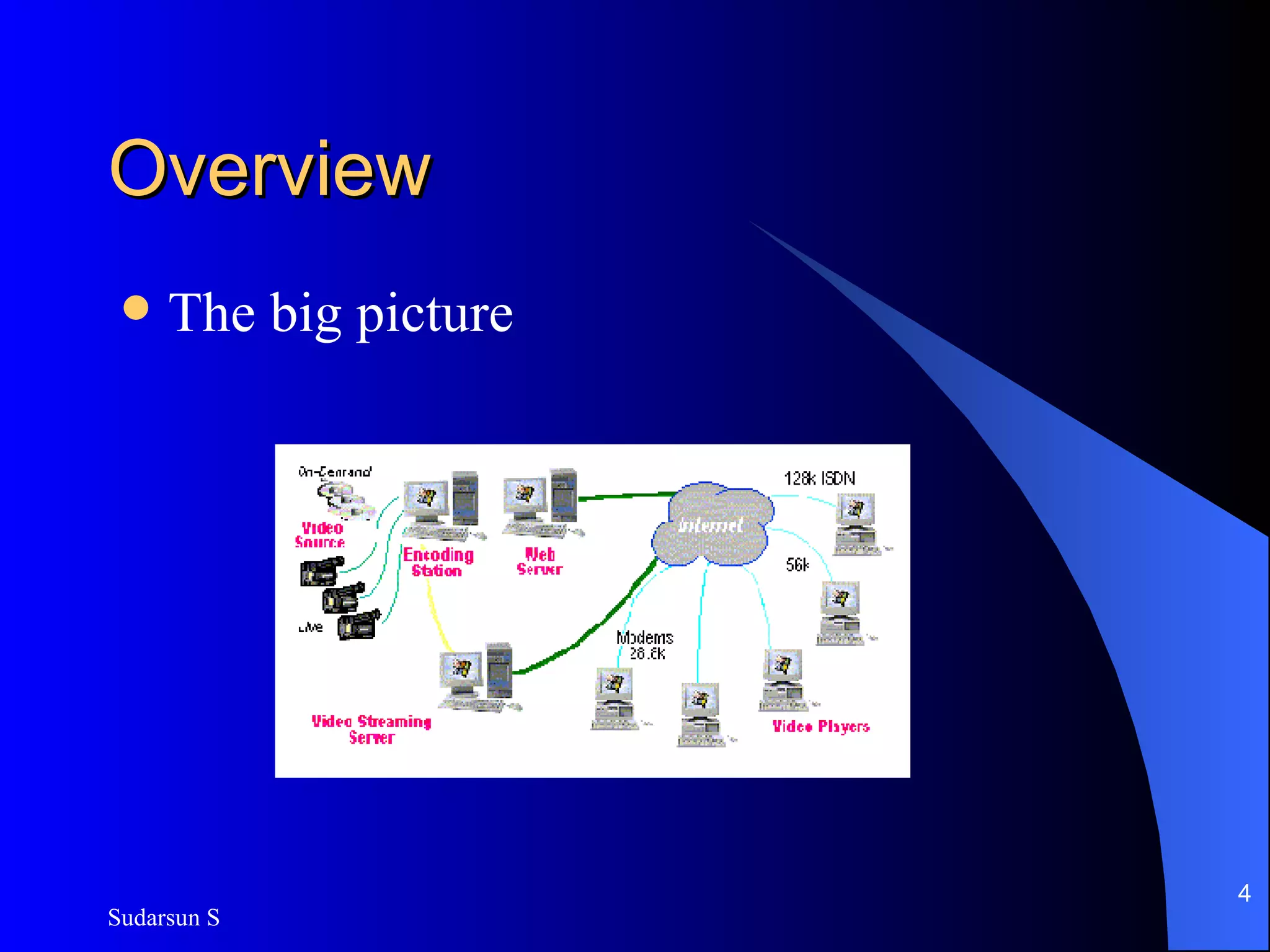
Overview  The big picture
Media Data types Audio : WAV, MP3, RM Video: AVI, MPG, MOV, RM Bandwidth calculation 3GPP, 3GPP2 3rd generation, high-speed wireless networks MPEG4  Professional-quality audio and video streams H264 formats MPEG-4 standard (Part 10) used across 3G for mobile devices to iChat AV for video conferencing to HD for broadcast and DVD
TCP & UDP Connection Oriented – Is that a Overhead ? Connectionless – Will that guarantee timely delivery? Maximum Effort Reliability vs Just In Time with permissible error rate Packet Sequence – Is that an Advantage ? Summary of general deficiencies
RTP (RFC 3550) Real-time Transport Protocol on UDP Uses RTCP (special set of messages) to exchange periodic reports One RTP session per media flow 16 bit sequence numbers to detect packet loss 32 bit time stamp to handle jitter due to network
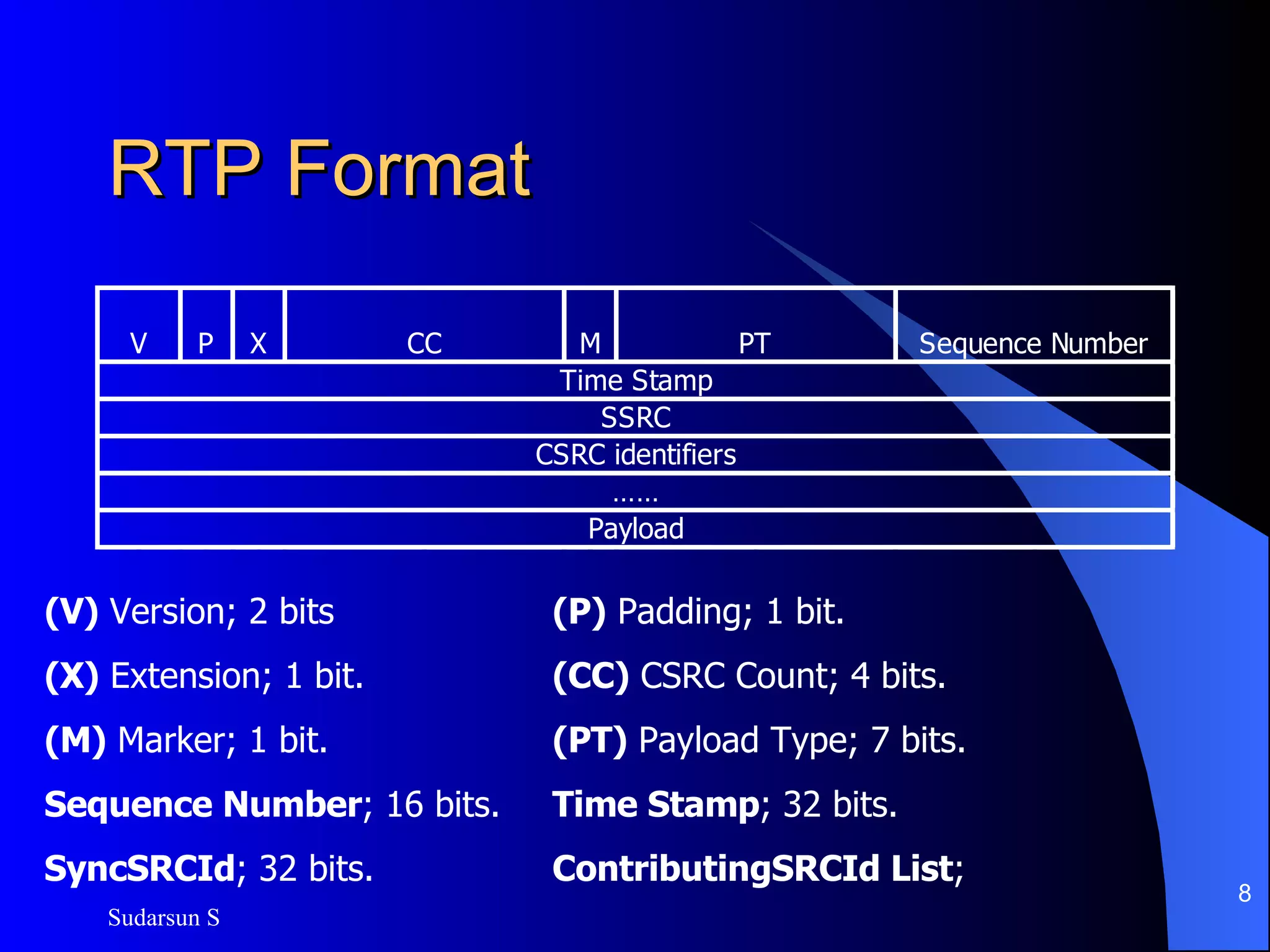
RTP Format (V)  Version; 2 bits (P)  Padding; 1 bit. (X)  Extension; 1 bit. (CC)  CSRC Count; 4 bits. (M)  Marker; 1 bit. (PT)  Payload Type; 7 bits. Sequence Number ; 16 bits. Time Stamp ; 32 bits. SyncSRCId ; 32 bits. ContributingSRCId List ;
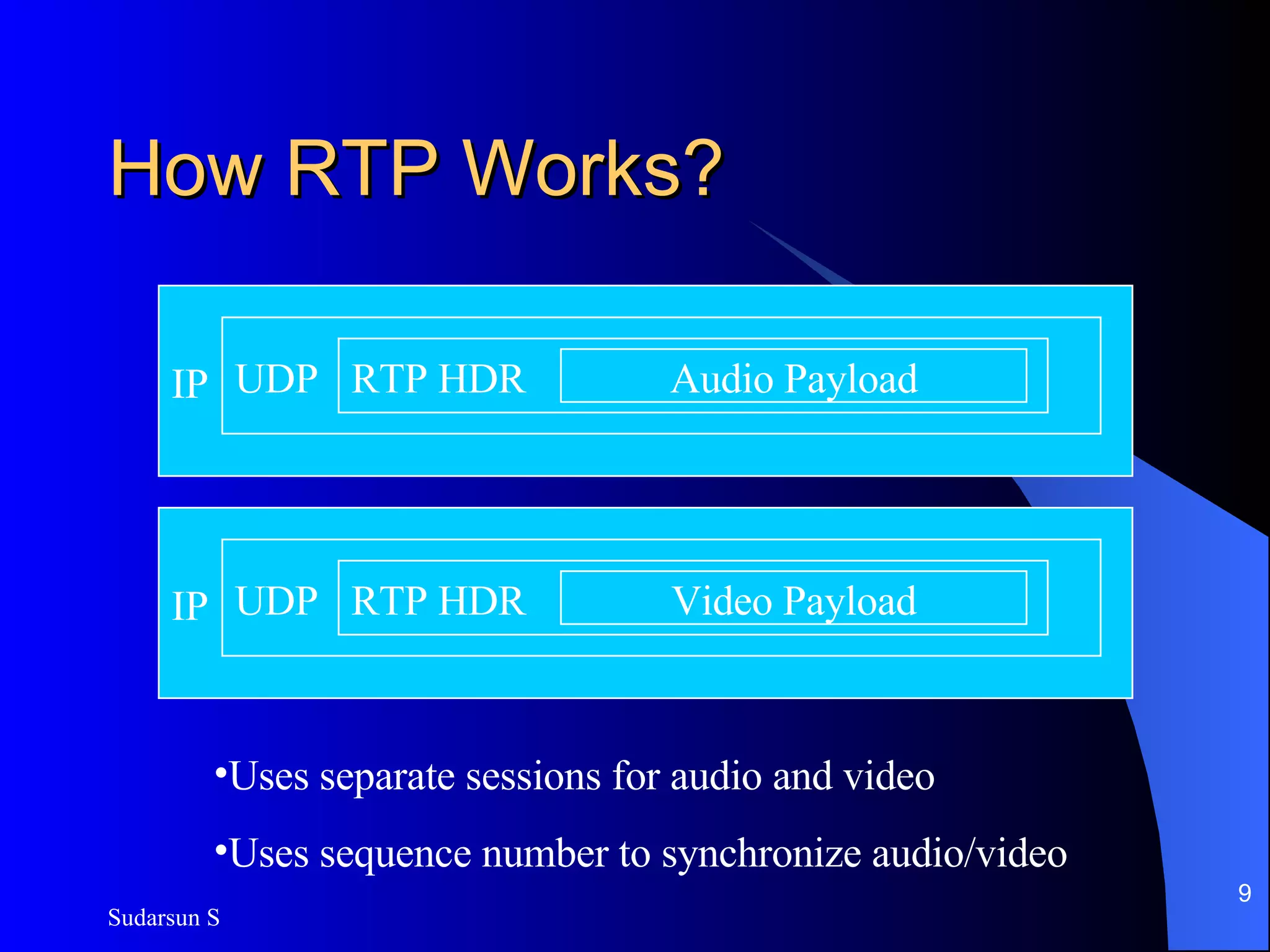
How RTP Works? IP UDP RTP HDR Audio Payload IP UDP RTP HDR Video Payload Uses separate sessions for audio and video Uses sequence number to synchronize audio/video
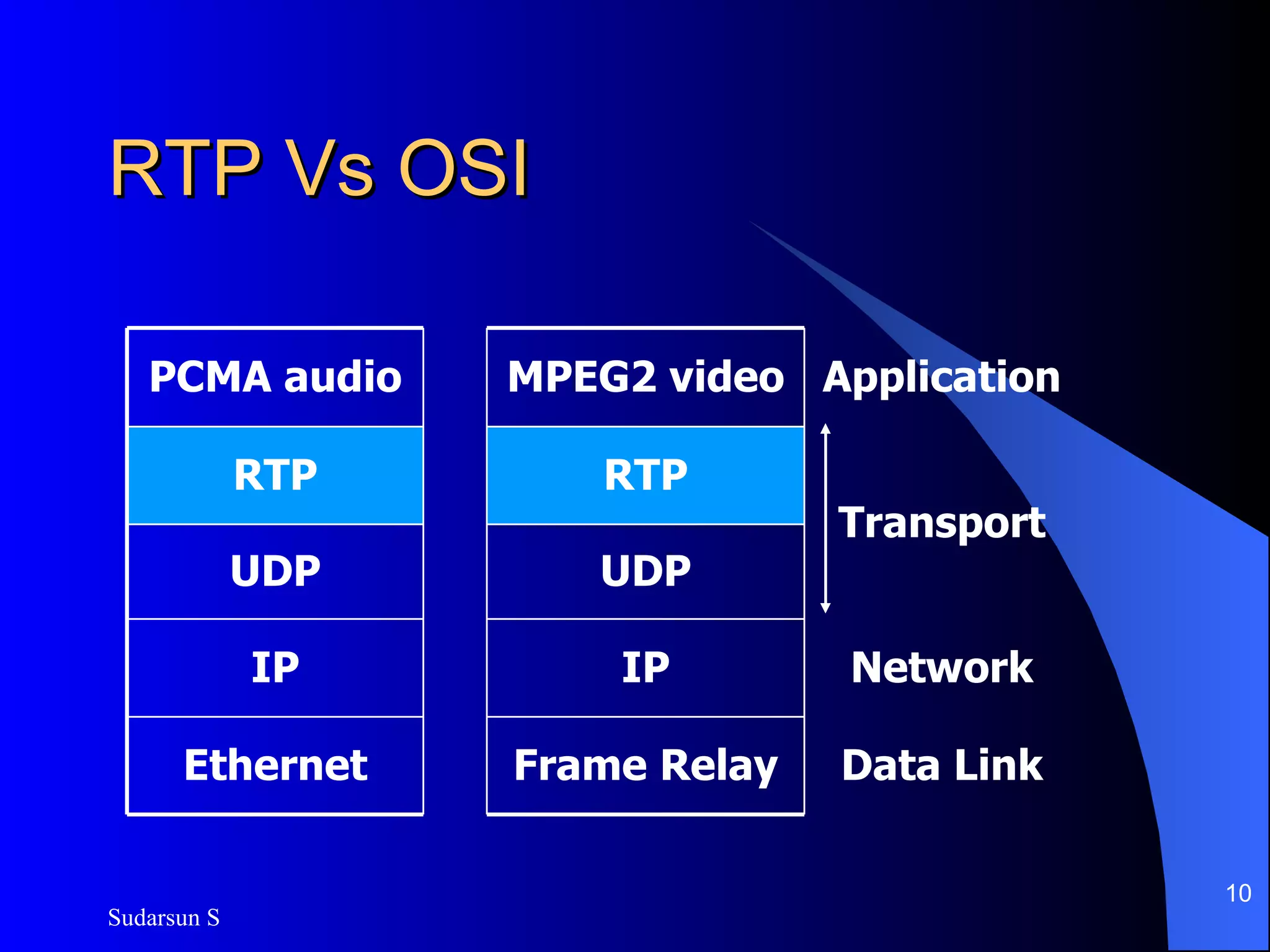
RTP Vs OSI Data Link Frame Relay Ethernet Network IP IP UDP UDP Transport RTP RTP Application MPEG2 video PCMA audio
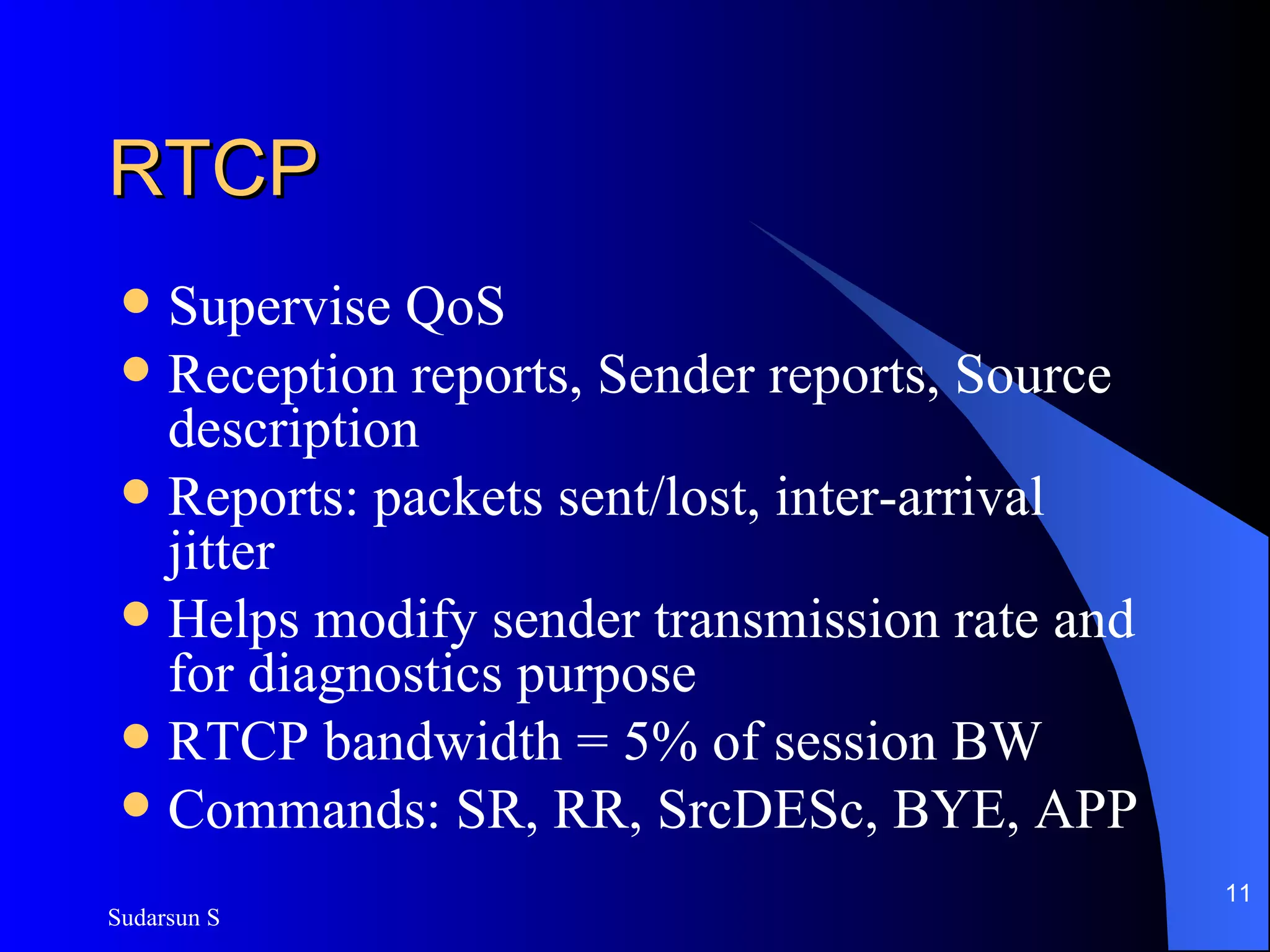
RTCP Supervise QoS Reception reports, Sender reports, Source description Reports: packets sent/lost, inter-arrival jitter Helps modify sender transmission rate and for diagnostics purpose RTCP bandwidth = 5% of session BW Commands: SR, RR, SrcDESc, BYE, APP
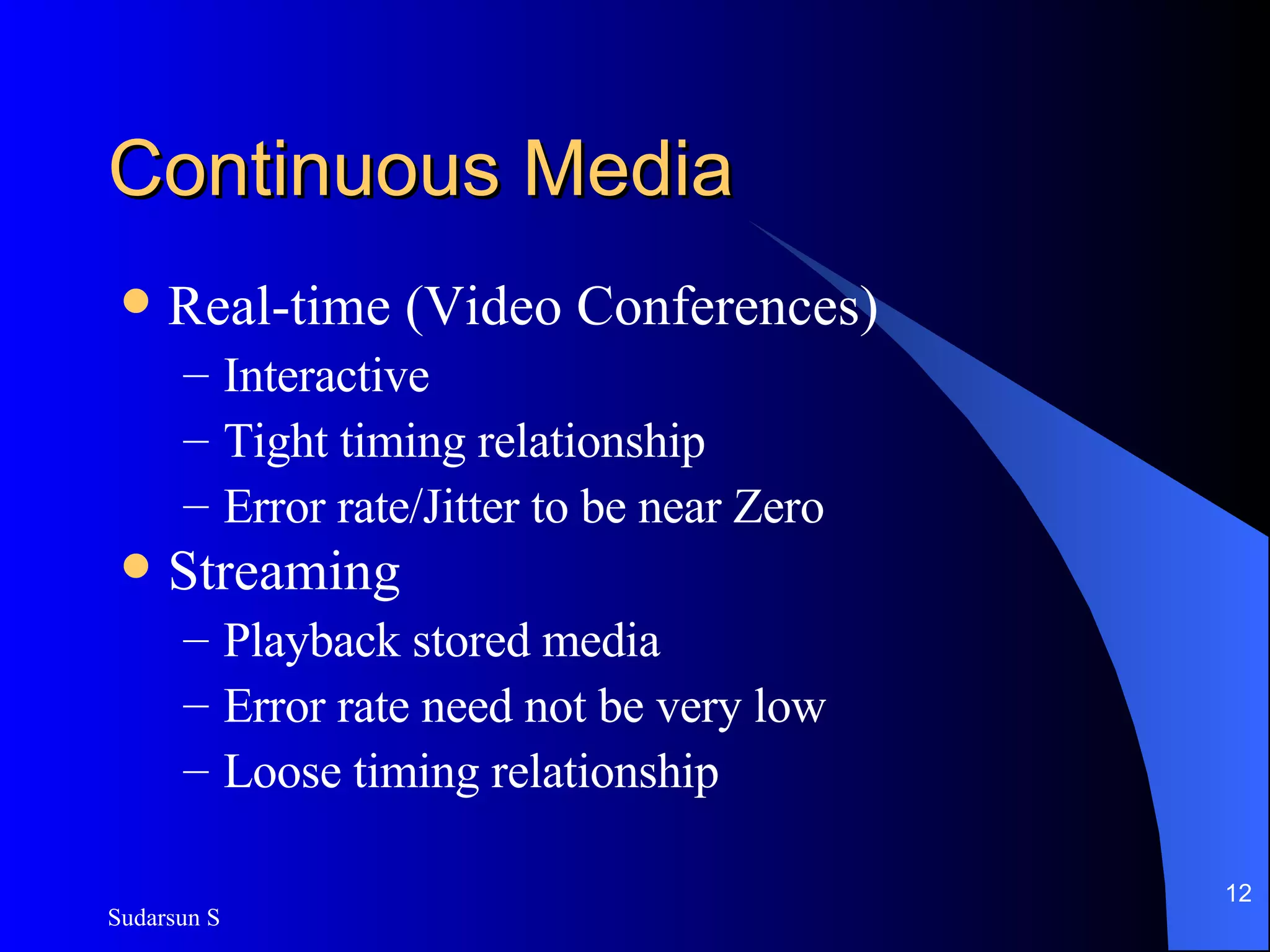
Continuous Media Real-time (Video Conferences) Interactive Tight timing relationship Error rate/Jitter to be near Zero Streaming Playback stored media Error rate need not be very low Loose timing relationship
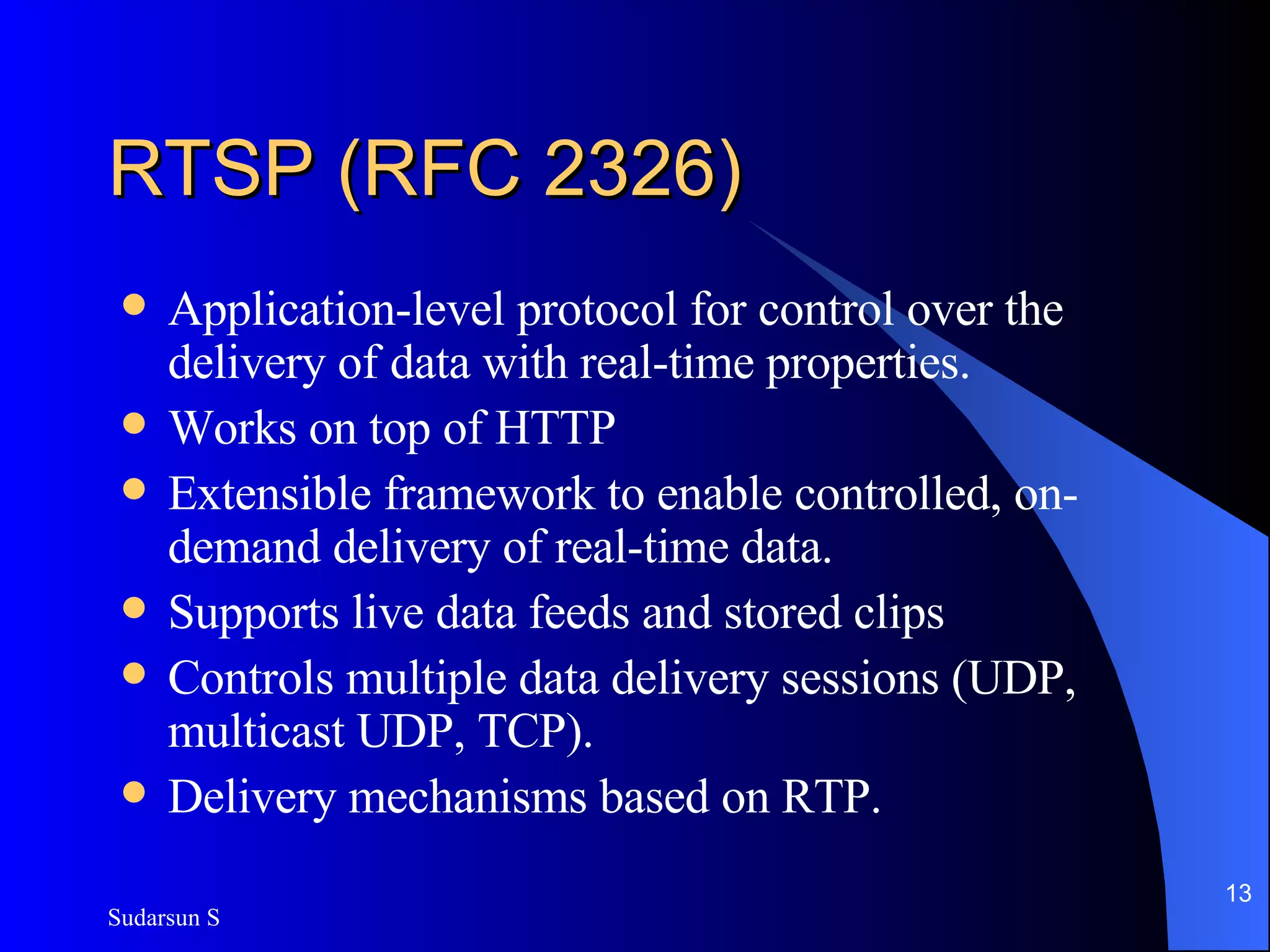
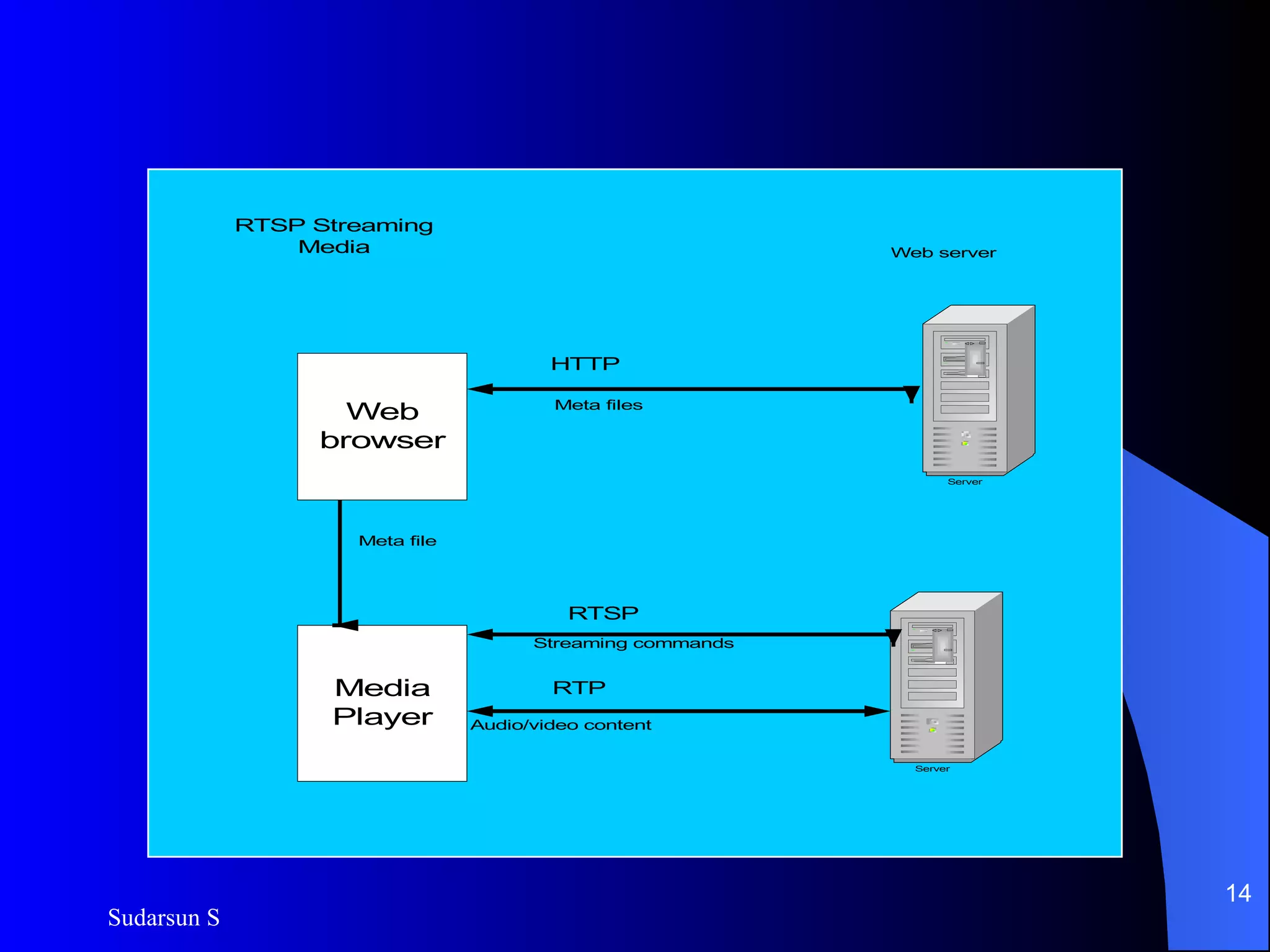
RTSP (RFC 2326) Application-level protocol for control over the delivery of data with real-time properties.  Works on top of HTTP Extensible framework to enable controlled, on-demand delivery of real-time data.  Supports live data feeds and stored clips Controls multiple data delivery sessions (UDP, multicast UDP, TCP). Delivery mechanisms based on RTP.
 
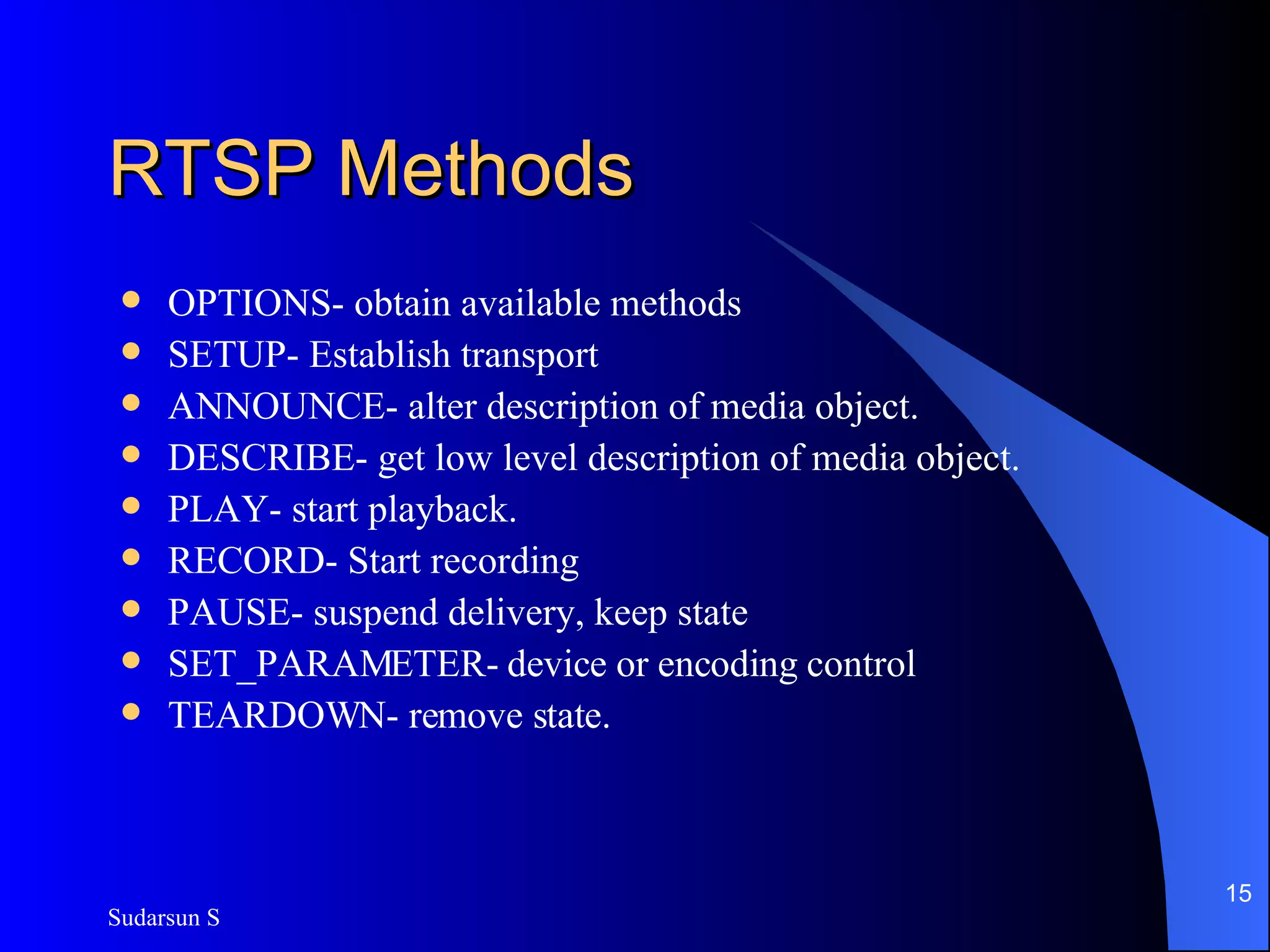
RTSP Methods OPTIONS- obtain available methods SETUP- Establish transport ANNOUNCE- alter description of media object. DESCRIBE- get low level description of media object. PLAY- start playback. RECORD- Start recording PAUSE- suspend delivery, keep state SET_PARAMETER- device or encoding control TEARDOWN- remove state.
Error Correction Piggy backing (FEC) Interleaving Combine both
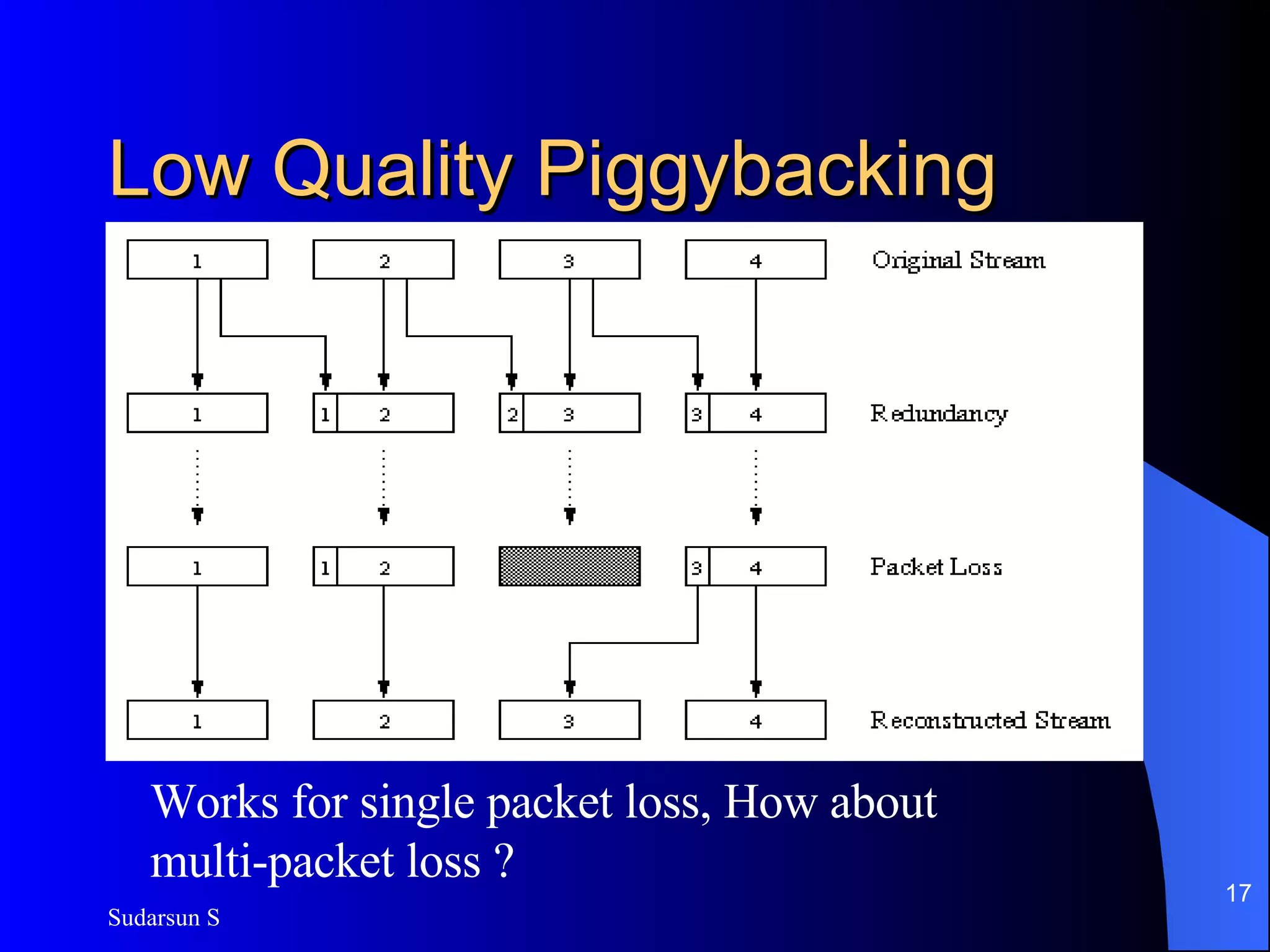
Low Quality Piggybacking Works for single packet loss, How about multi-packet loss ?
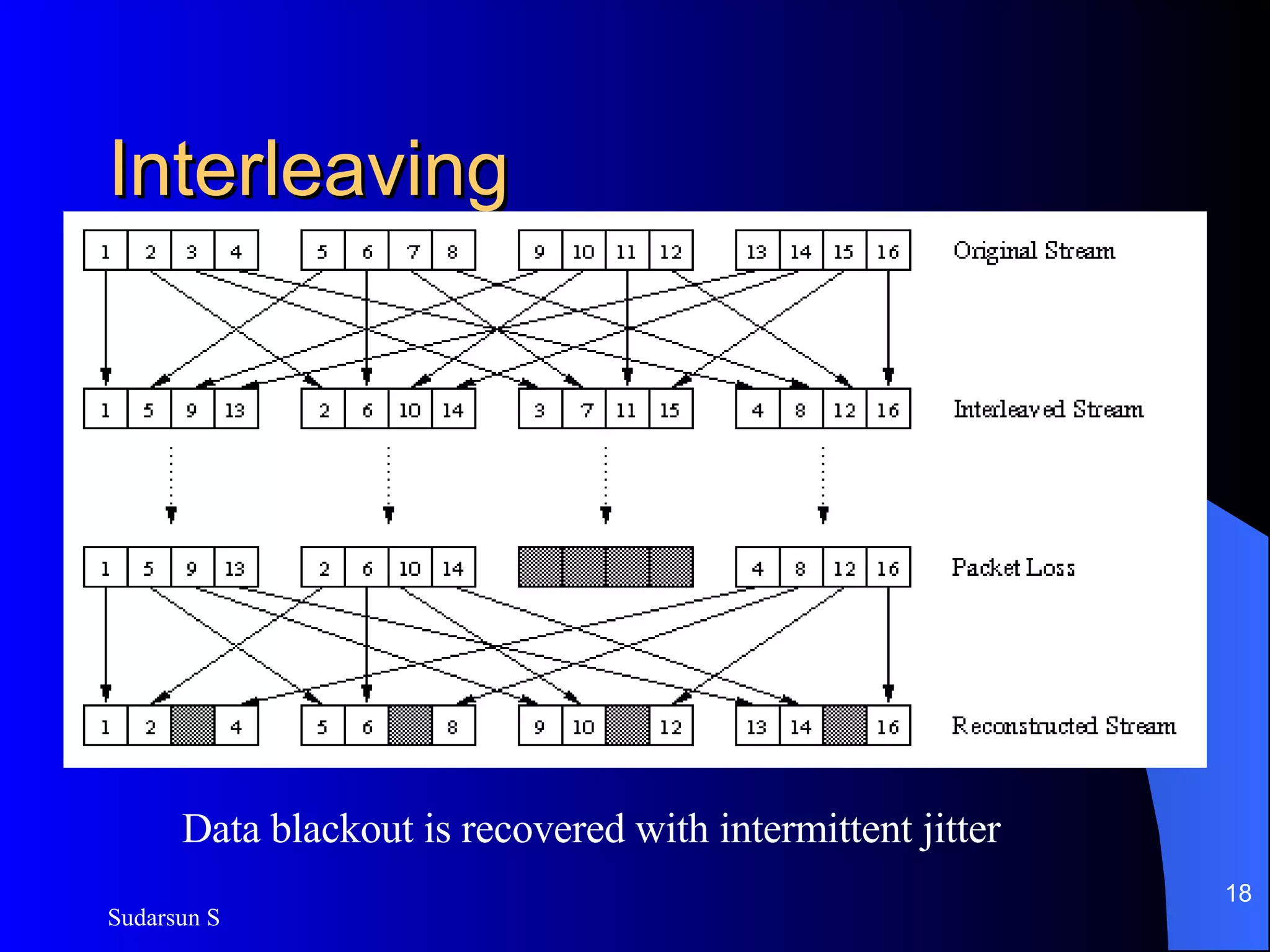
Interleaving Data blackout is recovered with intermittent jitter
Network Strategies Multicasting reduces amount of redundant data transferred Streaming media delivery networks allow for multiple, geographically scattered servers (achieved either by  splitting  or  caching ) Dedicated networks guarantee bandwidth Multiple-access transmissions over Internet—requested info sent from several different locations simultaneously
Streaming Media Three modes in which video information can be streamed: Live broadcasting On-demand streaming Conferencing
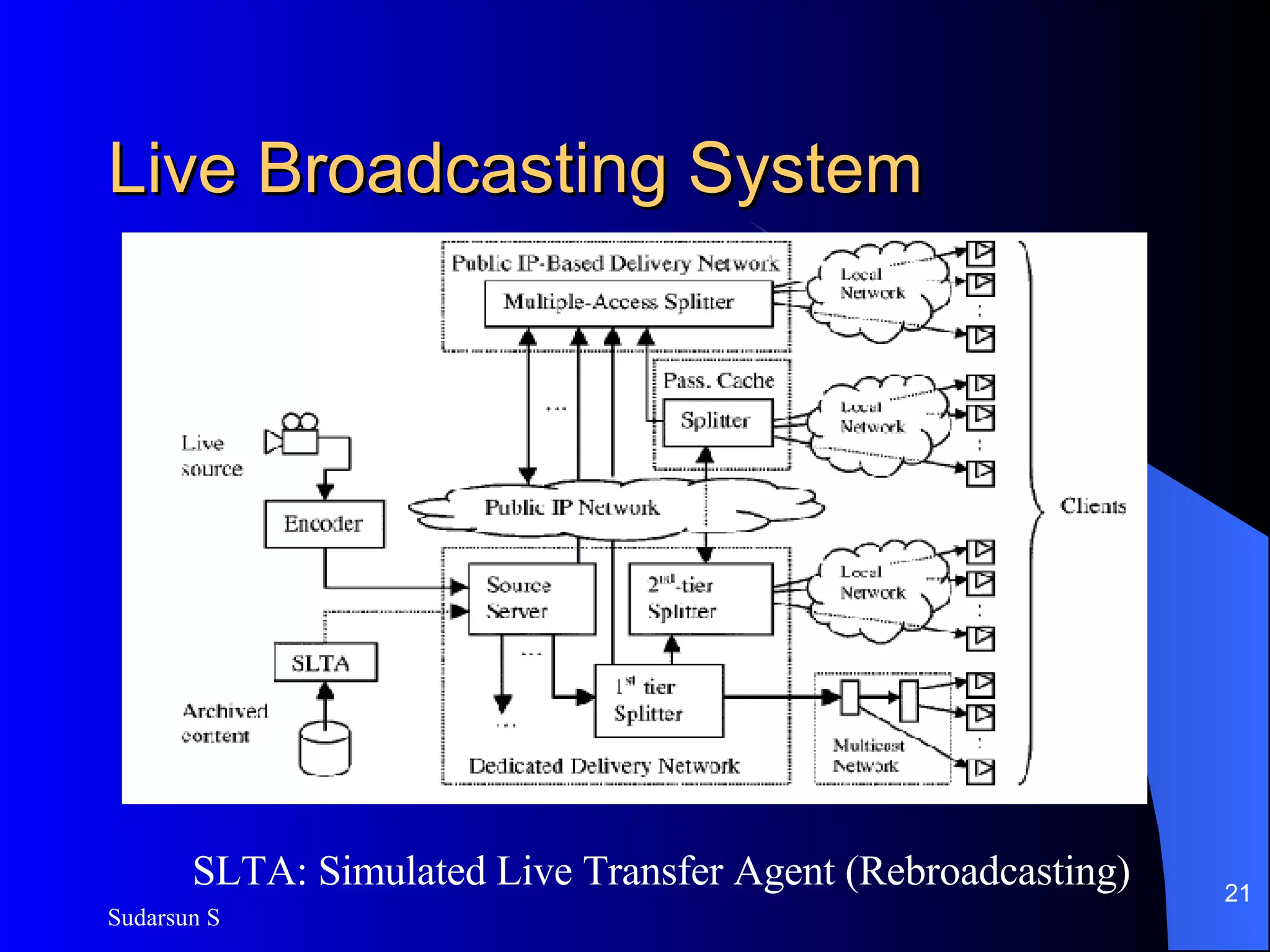
Live Broadcasting System SLTA: Simulated Live Transfer Agent (Rebroadcasting)
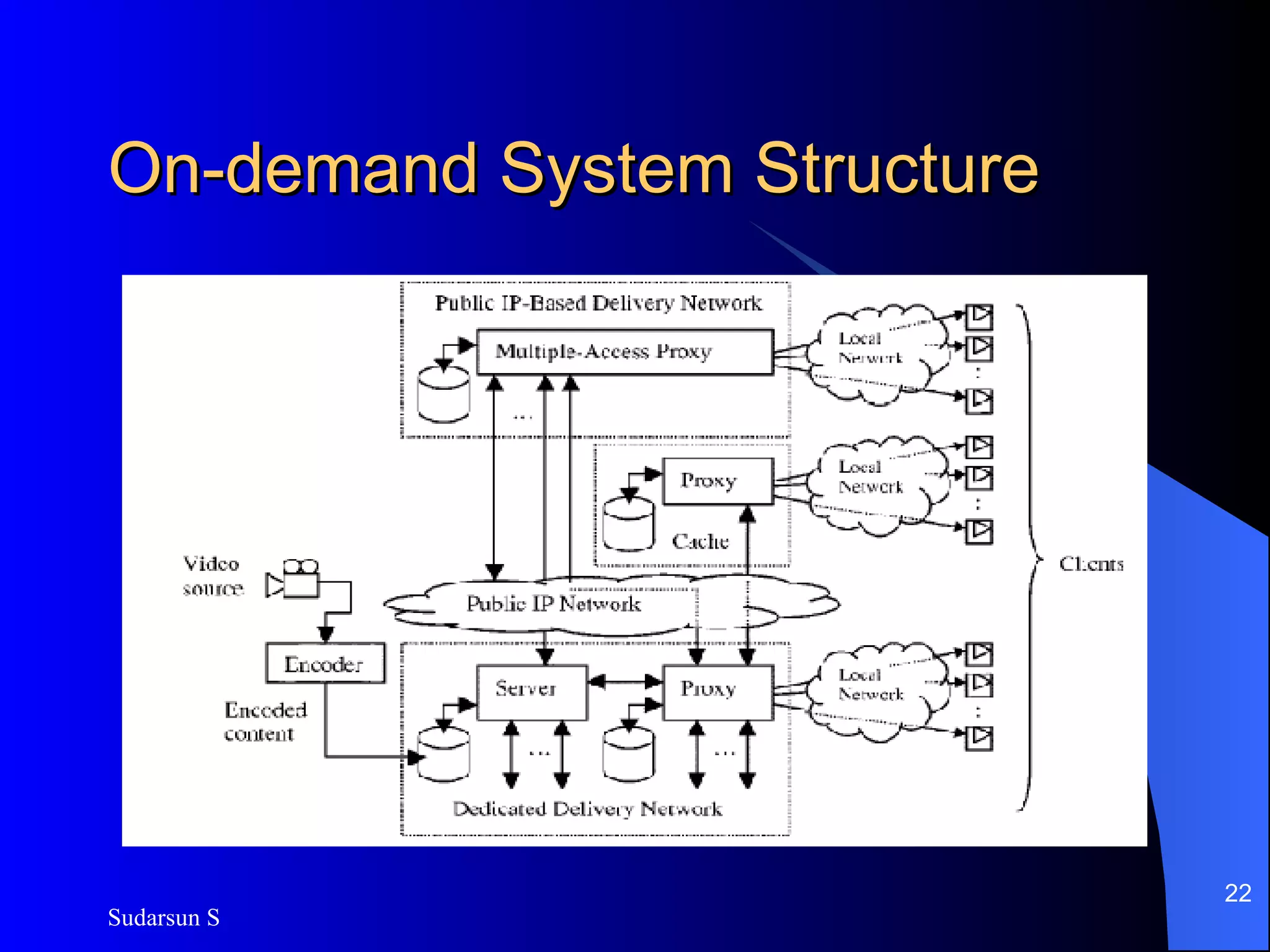
On-demand System Structure
Streaming Media – On demand Distribution system similar to live broadcasting system, except: No direct connection between encoder and server Remote proxy servers can cache popular files Clients allowed to rewind, fast forward, etc. Server proxy transfers only initiated by client
Where to Get More Information http://www.mediacollege.com/video/streaming/overview.html http://www.apple.com/quicktime/technologies/ http://www.teamsolutions.co.uk/streaming.html http://archive.dstc.edu.au/RDU/staff/jane-hunter/video-streaming.html http://www2.umist.ac.uk/isd/lwt/clickgo/the_guide/the_guide.htm http://emoney.al.ru/capture-streaming-video-and-audio/ http://www.cit.cornell.edu/atc/itsupport/streaming.shtml http://www.yolinux.com/TUTORIALS/LinuxTutorialRealVideoStreaming.html http://nms.csail.mit.edu/projects/oxygentv/
Limitations Bandwidth limitation Congestion and Quality of network Buffer Overhead in Portable devices Compression and Decompression overhead Security issues  Eavesdropping Duplication by Data Augmentation
Some Servers Audio Winamp’s Shoutcast Server Streamsicle Broadcast server RealMedia Stream server Video Quicktime Server Helix universal server Macromedia communication server Ffmpeg ( http:// sourceforge .net/projects/ ffmpeg / )
Conclusion Streaming multimedia poses many challenges to video encoders Variability of channel performance High server workloads Need to adapt coded bit rate to match channel capacities; must be done efficiently and on the fly
Thank You Sudarsun S.,  M.Tech Director – Research and Development Checktronix India Pvt Ltd [email_address] November 2005

Audio And Video Over Internet

  • 1.
    Audio and Videoover Internet Sudarsun S., M.Tech Checktronix India Pvt Ltd Chennai 600034 [email_address]
  • 2.
    Introduction Whatis Audio/Video over Internet? What are the benefits of AV on Internet? Cost of traditional communication Availability/Mobility with Wireless Entertainment Industry On demand Movie, Songs Duplication Protection Distance does not matter! Decentralization What is and Why Streaming data? Real-time Communication Protocols
  • 3.
    Agenda Learn thefundamentals of streaming TCP, UDP and their limitations RTP, RTSP to overcome TCP limitations Error Correction and Detection Low Quality Piggybacking Interleaving Understand “On demand” multimedia data On demand cinema Video conferencing
  • 4.
    Overview Thebig picture
  • 5.
    Media Data typesAudio : WAV, MP3, RM Video: AVI, MPG, MOV, RM Bandwidth calculation 3GPP, 3GPP2 3rd generation, high-speed wireless networks MPEG4 Professional-quality audio and video streams H264 formats MPEG-4 standard (Part 10) used across 3G for mobile devices to iChat AV for video conferencing to HD for broadcast and DVD
  • 6.
    TCP & UDPConnection Oriented – Is that a Overhead ? Connectionless – Will that guarantee timely delivery? Maximum Effort Reliability vs Just In Time with permissible error rate Packet Sequence – Is that an Advantage ? Summary of general deficiencies
  • 7.
    RTP (RFC 3550)Real-time Transport Protocol on UDP Uses RTCP (special set of messages) to exchange periodic reports One RTP session per media flow 16 bit sequence numbers to detect packet loss 32 bit time stamp to handle jitter due to network
  • 8.
    RTP Format (V) Version; 2 bits (P) Padding; 1 bit. (X) Extension; 1 bit. (CC) CSRC Count; 4 bits. (M) Marker; 1 bit. (PT) Payload Type; 7 bits. Sequence Number ; 16 bits. Time Stamp ; 32 bits. SyncSRCId ; 32 bits. ContributingSRCId List ;
  • 9.
    How RTP Works?IP UDP RTP HDR Audio Payload IP UDP RTP HDR Video Payload Uses separate sessions for audio and video Uses sequence number to synchronize audio/video
  • 10.
    RTP Vs OSIData Link Frame Relay Ethernet Network IP IP UDP UDP Transport RTP RTP Application MPEG2 video PCMA audio
  • 11.
    RTCP Supervise QoSReception reports, Sender reports, Source description Reports: packets sent/lost, inter-arrival jitter Helps modify sender transmission rate and for diagnostics purpose RTCP bandwidth = 5% of session BW Commands: SR, RR, SrcDESc, BYE, APP
  • 12.
    Continuous Media Real-time(Video Conferences) Interactive Tight timing relationship Error rate/Jitter to be near Zero Streaming Playback stored media Error rate need not be very low Loose timing relationship
  • 13.
    RTSP (RFC 2326)Application-level protocol for control over the delivery of data with real-time properties. Works on top of HTTP Extensible framework to enable controlled, on-demand delivery of real-time data. Supports live data feeds and stored clips Controls multiple data delivery sessions (UDP, multicast UDP, TCP). Delivery mechanisms based on RTP.
  • 14.
  • 15.
    RTSP Methods OPTIONS-obtain available methods SETUP- Establish transport ANNOUNCE- alter description of media object. DESCRIBE- get low level description of media object. PLAY- start playback. RECORD- Start recording PAUSE- suspend delivery, keep state SET_PARAMETER- device or encoding control TEARDOWN- remove state.
  • 16.
    Error Correction Piggybacking (FEC) Interleaving Combine both
  • 17.
    Low Quality PiggybackingWorks for single packet loss, How about multi-packet loss ?
  • 18.
    Interleaving Data blackoutis recovered with intermittent jitter
  • 19.
    Network Strategies Multicastingreduces amount of redundant data transferred Streaming media delivery networks allow for multiple, geographically scattered servers (achieved either by splitting or caching ) Dedicated networks guarantee bandwidth Multiple-access transmissions over Internet—requested info sent from several different locations simultaneously
  • 20.
    Streaming Media Threemodes in which video information can be streamed: Live broadcasting On-demand streaming Conferencing
  • 21.
    Live Broadcasting SystemSLTA: Simulated Live Transfer Agent (Rebroadcasting)
  • 22.
  • 23.
    Streaming Media –On demand Distribution system similar to live broadcasting system, except: No direct connection between encoder and server Remote proxy servers can cache popular files Clients allowed to rewind, fast forward, etc. Server proxy transfers only initiated by client
  • 24.
    Where to GetMore Information http://www.mediacollege.com/video/streaming/overview.html http://www.apple.com/quicktime/technologies/ http://www.teamsolutions.co.uk/streaming.html http://archive.dstc.edu.au/RDU/staff/jane-hunter/video-streaming.html http://www2.umist.ac.uk/isd/lwt/clickgo/the_guide/the_guide.htm http://emoney.al.ru/capture-streaming-video-and-audio/ http://www.cit.cornell.edu/atc/itsupport/streaming.shtml http://www.yolinux.com/TUTORIALS/LinuxTutorialRealVideoStreaming.html http://nms.csail.mit.edu/projects/oxygentv/
  • 25.
    Limitations Bandwidth limitationCongestion and Quality of network Buffer Overhead in Portable devices Compression and Decompression overhead Security issues Eavesdropping Duplication by Data Augmentation
  • 26.
    Some Servers AudioWinamp’s Shoutcast Server Streamsicle Broadcast server RealMedia Stream server Video Quicktime Server Helix universal server Macromedia communication server Ffmpeg ( http:// sourceforge .net/projects/ ffmpeg / )
  • 27.
    Conclusion Streaming multimediaposes many challenges to video encoders Variability of channel performance High server workloads Need to adapt coded bit rate to match channel capacities; must be done efficiently and on the fly
  • 28.
    Thank You SudarsunS., M.Tech Director – Research and Development Checktronix India Pvt Ltd [email_address] November 2005