Information Retrieval : 7
Boolean Model
Prof Neeraj Bhargava
Vaibhav Khanna
Department of Computer Science
School of Engineering and Systems Sciences
Maharshi Dayanand Saraswati University Ajmer
The Boolean Model
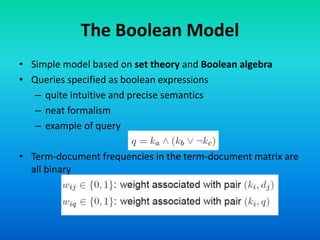
• Simple model based on set theory and Boolean algebra
• Queries specified as boolean expressions
– quite intuitive and precise semantics
– neat formalism
– example of query
• Term-document frequencies in the term-document matrix are
all binary
• The (standard) Boolean model of information retrieval (BIR)
is a classical information retrieval (IR) model and, at the same
time, the first and most-adopted one. ...
• The BIR is based on Boolean logic and classical set theory in
that both the documents to be searched and the user's query
are conceived as sets of terms
• Retrieval is based on whether the documents contain the
query terms or not .
The Boolean Model
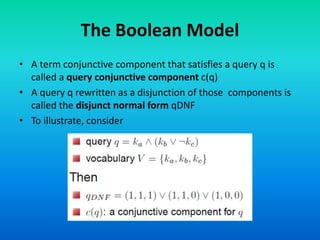
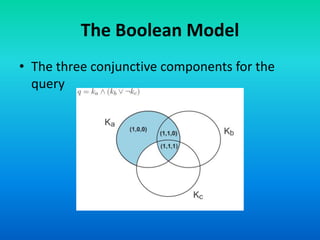
• A term conjunctive component that satisfies a query q is
called a query conjunctive component c(q)
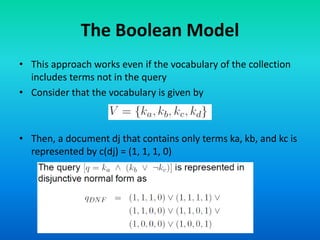
• A query q rewritten as a disjunction of those components is
called the disjunct normal form qDNF
• To illustrate, consider
The Boolean Model
• The three conjunctive components for the
query
The Boolean Model
• This approach works even if the vocabulary of the collection
includes terms not in the query
• Consider that the vocabulary is given by
• Then, a document dj that contains only terms ka, kb, and kc is
represented by c(dj) = (1, 1, 1, 0)
The Boolean Model
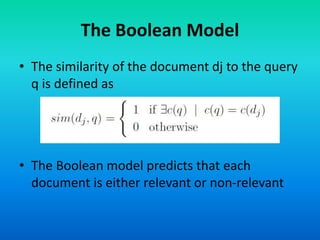
• The similarity of the document dj to the query
q is defined as
• The Boolean model predicts that each
document is either relevant or non-relevant
Advantages of Boolean Model
• Clean formalism
• Easy to implement
• Intuitive concept
Disadvantages of Boolean Model
• Exact matching may retrieve too few or too
many documents
• Hard to translate a query into a Boolean
expression
• All terms are equally weighted
• More like data retrieval than information
retrieval
Drawbacks of the Boolean Model
• Retrieval based on binary decision criteria with no
notion of partial matching
• No ranking of the documents is provided (absence of
a grading scale)
• Information need has to be translated into a Boolean
expression, which most users find awkward
• The Boolean queries formulated by the users are
most often too simplistic
• The model frequently returns either too few or too
many documents in response to a user query
Assignment
• Explain the Boolean Model of Information
Retrieval.

Information retrieval 7 boolean model

  • 1.
    Information Retrieval :7 Boolean Model Prof Neeraj Bhargava Vaibhav Khanna Department of Computer Science School of Engineering and Systems Sciences Maharshi Dayanand Saraswati University Ajmer
  • 2.
    The Boolean Model •Simple model based on set theory and Boolean algebra • Queries specified as boolean expressions – quite intuitive and precise semantics – neat formalism – example of query • Term-document frequencies in the term-document matrix are all binary
  • 3.
    • The (standard)Boolean model of information retrieval (BIR) is a classical information retrieval (IR) model and, at the same time, the first and most-adopted one. ... • The BIR is based on Boolean logic and classical set theory in that both the documents to be searched and the user's query are conceived as sets of terms • Retrieval is based on whether the documents contain the query terms or not .
  • 4.
    The Boolean Model •A term conjunctive component that satisfies a query q is called a query conjunctive component c(q) • A query q rewritten as a disjunction of those components is called the disjunct normal form qDNF • To illustrate, consider
  • 5.
    The Boolean Model •The three conjunctive components for the query
  • 6.
    The Boolean Model •This approach works even if the vocabulary of the collection includes terms not in the query • Consider that the vocabulary is given by • Then, a document dj that contains only terms ka, kb, and kc is represented by c(dj) = (1, 1, 1, 0)
  • 7.
    The Boolean Model •The similarity of the document dj to the query q is defined as • The Boolean model predicts that each document is either relevant or non-relevant
  • 8.
    Advantages of BooleanModel • Clean formalism • Easy to implement • Intuitive concept
  • 9.
    Disadvantages of BooleanModel • Exact matching may retrieve too few or too many documents • Hard to translate a query into a Boolean expression • All terms are equally weighted • More like data retrieval than information retrieval
  • 10.
    Drawbacks of theBoolean Model • Retrieval based on binary decision criteria with no notion of partial matching • No ranking of the documents is provided (absence of a grading scale) • Information need has to be translated into a Boolean expression, which most users find awkward • The Boolean queries formulated by the users are most often too simplistic • The model frequently returns either too few or too many documents in response to a user query
  • 11.
    Assignment • Explain theBoolean Model of Information Retrieval.