Dimensionality Reduction:
SVD and its applications
Viet-Trung Tran
Credits
• Mining of Massive Datasets
– Jure Leskovec, Anand Rajaraman, Jeff Ullman Stanford
University
– http://www.mmds.org
• Data mining coursera
2
Motivation
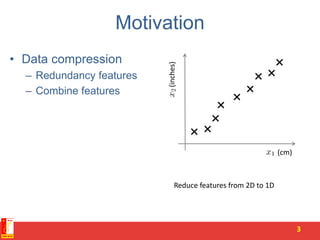
• Data compression
– Redundancy features
– Combine features
3
(inches)
(cm)
Reduce features from 2D to 1D
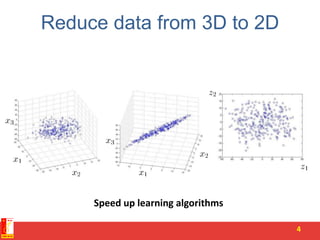
Reduce data from 3D to 2D
4
Speed up learning algorithms
Better data visualization
5
[resources from en.wikipedia.org]
Country
GDP
(trillions of
US$)
Per capita
GDP
(thousands
of intl. $)
Human
Develop-
ment Index
Life
expectancy
Poverty
Index
(Gini as
percentage)
Mean
household
income
(thousands
of US$) …
Canada 1.577 39.17 0.908 80.7 32.6 67.293 …
China 5.878 7.54 0.687 73 46.9 10.22 …
India 1.632 3.41 0.547 64.7 36.8 0.735 …
Russia 1.48 19.84 0.755 65.5 39.9 0.72 …
Singapore 0.223 56.69 0.866 80 42.5 67.1 …
USA 14.527 46.86 0.91 78.3 40.8 84.3 …
… … … … … … …
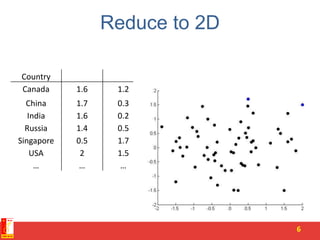
Reduce to 2D
6
Country
Canada 1.6 1.2
China 1.7 0.3
India 1.6 0.2
Russia 1.4 0.5
Singapore 0.5 1.7
USA 2 1.5
… … …
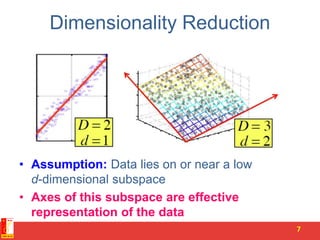
Dimensionality Reduction
• Assumption: Data lies on or near a low
d-dimensional subspace
• Axes of this subspace are effective
representation of the data
7
Rank of a Matrix
• Q: What is rank of a matrix A?
• A: Number of linearly independent columns of A
• For example:
– Matrix A = has rank r=2
• Why? The first two rows are linearly independent, so the rank is at least
2, but all three rows are linearly dependent (the first is equal to the sum of
the second and third) so the rank must be less than 3.
• Why do we care about low rank?
– We can write A as two “basis” vectors: [1 2 1] [-2 -3 1]
– And new coordinates of : [1 0] [0 1] [1 1]
8
Rank is “Dimensionality”
• Cloud of points 3D space:
– Think of point positions
as a matrix:
• We can rewrite coordinates more efficiently!
– Old basis vectors: [1 0 0] [0 1 0] [0 0 1]
– New basis vectors: [1 2 1] [-2 -3 1]
– Then A has new coordinates: [1 0]. B: [0 1], C: [1 1]
• Notice: We reduced the number of coordinates!
9
1 row per point:
A
B
C
A
Dimensionality Reduction
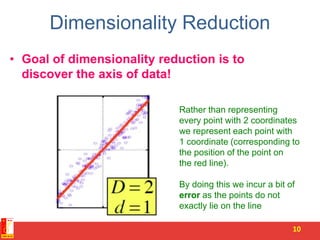
• Goal of dimensionality reduction is to
discover the axis of data!
10
Rather than representing
every point with 2 coordinates
we represent each point with
1 coordinate (corresponding to
the position of the point on
the red line).
By doing this we incur a bit of
error as the points do not
exactly lie on the line
Sum up
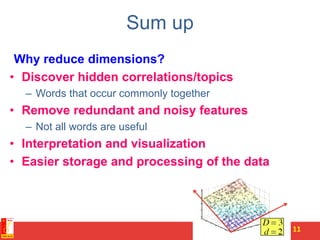
Why reduce dimensions?
• Discover hidden correlations/topics
– Words that occur commonly together
• Remove redundant and noisy features
– Not all words are useful
• Interpretation and visualization
• Easier storage and processing of the data
11
SVD - Definition
A[m x n] = U[m x r]  [ r x r] (V[n x r])T
• A: Input data matrix
– m x n matrix (e.g., m documents, n terms)
• U: Left singular vectors
– m x r matrix (m documents, r concepts)
• : Singular values
– r x r diagonal matrix (strength of each ‘concept’)
(r : rank of the matrix A)
• V: Right singular vectors
– n x r matrix (n terms, r concepts)
12
SVD - Properties
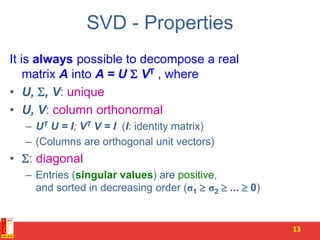
It is always possible to decompose a real
matrix A into A = U  VT , where
• U, , V: unique
• U, V: column orthonormal
– UT U = I; VT V = I (I: identity matrix)
– (Columns are orthogonal unit vectors)
• : diagonal
– Entries (singular values) are positive,
and sorted in decreasing order (σ1  σ2  ...  0)
13
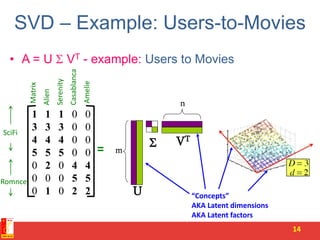
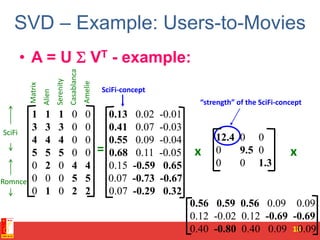
SVD – Example: Users-to-Movies
• A = U  VT - example: Users to Movies
14
=
SciFi
Romnce
Matrix
Alien
Serenity
Casablanca
Amelie
1 1 1 0 0
3 3 3 0 0
4 4 4 0 0
5 5 5 0 0
0 2 0 4 4
0 0 0 5 5
0 1 0 2 2

m
n
U
VT
“Concepts”
AKA Latent dimensions
AKA Latent factors
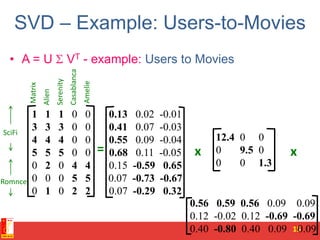
SVD – Example: Users-to-Movies
• A = U  VT - example: Users to Movies
15
=
SciFi
Romnce
x x
Matrix
Alien
Serenity
Casablanca
Amelie
1 1 1 0 0
3 3 3 0 0
4 4 4 0 0
5 5 5 0 0
0 2 0 4 4
0 0 0 5 5
0 1 0 2 2
0.13 0.02 -0.01
0.41 0.07 -0.03
0.55 0.09 -0.04
0.68 0.11 -0.05
0.15 -0.59 0.65
0.07 -0.73 -0.67
0.07 -0.29 0.32
12.4 0 0
0 9.5 0
0 0 1.3
0.56 0.59 0.56 0.09 0.09
0.12 -0.02 0.12 -0.69 -0.69
0.40 -0.80 0.40 0.09 0.09
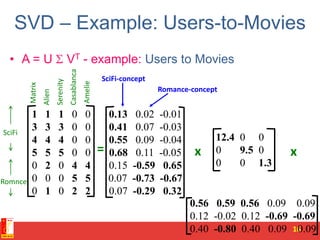
SVD – Example: Users-to-Movies
• A = U  VT - example: Users to Movies
16
SciFi-concept
Romance-concept
=
SciFi
Romnce
x x
Matrix
Alien
Serenity
Casablanca
Amelie
1 1 1 0 0
3 3 3 0 0
4 4 4 0 0
5 5 5 0 0
0 2 0 4 4
0 0 0 5 5
0 1 0 2 2
0.13 0.02 -0.01
0.41 0.07 -0.03
0.55 0.09 -0.04
0.68 0.11 -0.05
0.15 -0.59 0.65
0.07 -0.73 -0.67
0.07 -0.29 0.32
12.4 0 0
0 9.5 0
0 0 1.3
0.56 0.59 0.56 0.09 0.09
0.12 -0.02 0.12 -0.69 -0.69
0.40 -0.80 0.40 0.09 0.09
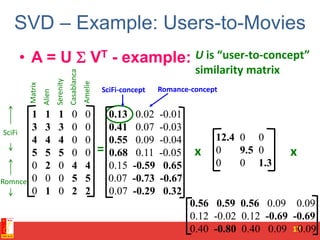
SVD – Example: Users-to-Movies
• A = U  VT - example:
17
Romance-concept
U is “user-to-concept”
similarity matrix
SciFi-concept
=
SciFi
Romnce
x x
Matrix
Alien
Serenity
Casablanca
Amelie
1 1 1 0 0
3 3 3 0 0
4 4 4 0 0
5 5 5 0 0
0 2 0 4 4
0 0 0 5 5
0 1 0 2 2
0.13 0.02 -0.01
0.41 0.07 -0.03
0.55 0.09 -0.04
0.68 0.11 -0.05
0.15 -0.59 0.65
0.07 -0.73 -0.67
0.07 -0.29 0.32
12.4 0 0
0 9.5 0
0 0 1.3
0.56 0.59 0.56 0.09 0.09
0.12 -0.02 0.12 -0.69 -0.69
0.40 -0.80 0.40 0.09 0.09
SVD – Example: Users-to-Movies
• A = U  VT - example:
18
SciFi
Romnce
SciFi-concept
“strength” of the SciFi-concept
=
SciFi
Romnce
x x
Matrix
Alien
Serenity
Casablanca
Amelie
1 1 1 0 0
3 3 3 0 0
4 4 4 0 0
5 5 5 0 0
0 2 0 4 4
0 0 0 5 5
0 1 0 2 2
0.13 0.02 -0.01
0.41 0.07 -0.03
0.55 0.09 -0.04
0.68 0.11 -0.05
0.15 -0.59 0.65
0.07 -0.73 -0.67
0.07 -0.29 0.32
12.4 0 0
0 9.5 0
0 0 1.3
0.56 0.59 0.56 0.09 0.09
0.12 -0.02 0.12 -0.69 -0.69
0.40 -0.80 0.40 0.09 0.09
SVD – Example: Users-to-Movies
• A = U  VT - example:
19
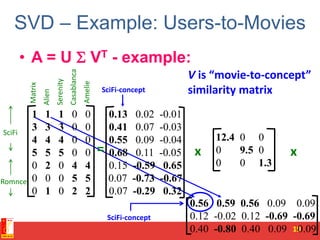
SciFi-concept
V is “movie-to-concept”
similarity matrix
SciFi-concept
=
SciFi
Romnce
x x
Matrix
Alien
Serenity
Casablanca
Amelie
1 1 1 0 0
3 3 3 0 0
4 4 4 0 0
5 5 5 0 0
0 2 0 4 4
0 0 0 5 5
0 1 0 2 2
0.13 0.02 -0.01
0.41 0.07 -0.03
0.55 0.09 -0.04
0.68 0.11 -0.05
0.15 -0.59 0.65
0.07 -0.73 -0.67
0.07 -0.29 0.32
12.4 0 0
0 9.5 0
0 0 1.3
0.56 0.59 0.56 0.09 0.09
0.12 -0.02 0.12 -0.69 -0.69
0.40 -0.80 0.40 0.09 0.09
SVD - Interpretation #1
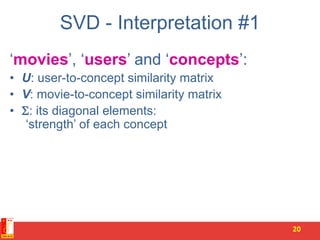
‘movies’, ‘users’ and ‘concepts’:
• U: user-to-concept similarity matrix
• V: movie-to-concept similarity matrix
• : its diagonal elements:
‘strength’ of each concept
20
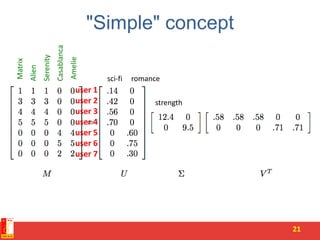
"Simple" concept
21
sci-fi romance
Matrix
Alien
Serenity
Casablanca
Amelie
user 1
user 2
user 3
user 4
user 5
user 6
user 7
strength
Dimensionality Reduction with
SVD
SVD – Dimensionality Reduction
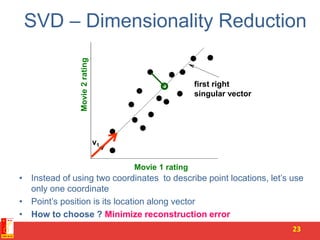
• Instead of using two coordinates to describe point locations, let’s use
only one coordinate
• Point’s position is its location along vector
• How to choose ? Minimize reconstruction error
23
v1
first right
singular vector
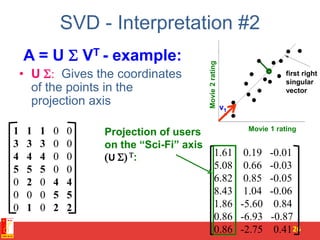
Movie 1 rating
Movie2rating
SVD - Interpretation #2
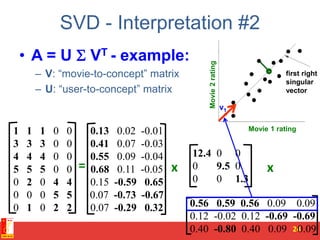
• A = U  VT - example:
– V: “movie-to-concept” matrix
– U: “user-to-concept” matrix
24
v1
first right
singular
vector
Movie 1 rating
Movie2rating
= x x
1 1 1 0 0
3 3 3 0 0
4 4 4 0 0
5 5 5 0 0
0 2 0 4 4
0 0 0 5 5
0 1 0 2 2
0.13 0.02 -0.01
0.41 0.07 -0.03
0.55 0.09 -0.04
0.68 0.11 -0.05
0.15 -0.59 0.65
0.07 -0.73 -0.67
0.07 -0.29 0.32
12.4 0 0
0 9.5 0
0 0 1.3
0.56 0.59 0.56 0.09 0.09
0.12 -0.02 0.12 -0.69 -0.69
0.40 -0.80 0.40 0.09 0.09
SVD - Interpretation #2
• A = U  VT - example:
25
v1
first right
singular
vector
Movie 1 rating
Movie2rating
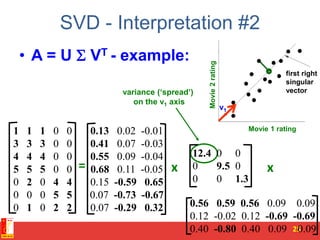
variance (‘spread’)
on the v1 axis
= x x
1 1 1 0 0
3 3 3 0 0
4 4 4 0 0
5 5 5 0 0
0 2 0 4 4
0 0 0 5 5
0 1 0 2 2
0.13 0.02 -0.01
0.41 0.07 -0.03
0.55 0.09 -0.04
0.68 0.11 -0.05
0.15 -0.59 0.65
0.07 -0.73 -0.67
0.07 -0.29 0.32
12.4 0 0
0 9.5 0
0 0 1.3
0.56 0.59 0.56 0.09 0.09
0.12 -0.02 0.12 -0.69 -0.69
0.40 -0.80 0.40 0.09 0.09
SVD - Interpretation #2
A = U  VT - example:
• U : Gives the coordinates
of the points in the
projection axis
26
v1
first right
singular
vector
Movie 1 rating
Movie2rating
1 1 1 0 0
3 3 3 0 0
4 4 4 0 0
5 5 5 0 0
0 2 0 4 4
0 0 0 5 5
0 1 0 2 2
1.61 0.19 -0.01
5.08 0.66 -0.03
6.82 0.85 -0.05
8.43 1.04 -0.06
1.86 -5.60 0.84
0.86 -6.93 -0.87
0.86 -2.75 0.41
Projection of users
on the “Sci-Fi” axis
(U ) T:
SVD - Interpretation #2
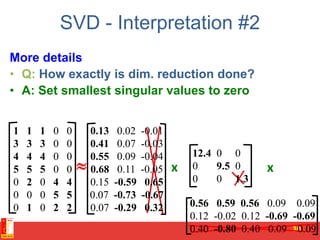
More details
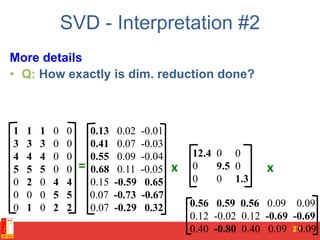
• Q: How exactly is dim. reduction done?
27
= x x
1 1 1 0 0
3 3 3 0 0
4 4 4 0 0
5 5 5 0 0
0 2 0 4 4
0 0 0 5 5
0 1 0 2 2
0.13 0.02 -0.01
0.41 0.07 -0.03
0.55 0.09 -0.04
0.68 0.11 -0.05
0.15 -0.59 0.65
0.07 -0.73 -0.67
0.07 -0.29 0.32
12.4 0 0
0 9.5 0
0 0 1.3
0.56 0.59 0.56 0.09 0.09
0.12 -0.02 0.12 -0.69 -0.69
0.40 -0.80 0.40 0.09 0.09
SVD - Interpretation #2
More details
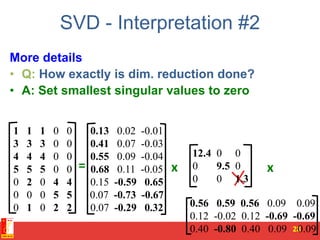
• Q: How exactly is dim. reduction done?
• A: Set smallest singular values to zero
28
= x x
1 1 1 0 0
3 3 3 0 0
4 4 4 0 0
5 5 5 0 0
0 2 0 4 4
0 0 0 5 5
0 1 0 2 2
0.13 0.02 -0.01
0.41 0.07 -0.03
0.55 0.09 -0.04
0.68 0.11 -0.05
0.15 -0.59 0.65
0.07 -0.73 -0.67
0.07 -0.29 0.32
12.4 0 0
0 9.5 0
0 0 1.3
0.56 0.59 0.56 0.09 0.09
0.12 -0.02 0.12 -0.69 -0.69
0.40 -0.80 0.40 0.09 0.09
SVD - Interpretation #2
More details
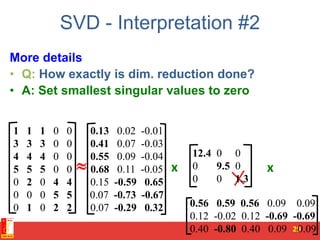
• Q: How exactly is dim. reduction done?
• A: Set smallest singular values to zero
29
x x
1 1 1 0 0
3 3 3 0 0
4 4 4 0 0
5 5 5 0 0
0 2 0 4 4
0 0 0 5 5
0 1 0 2 2
0.13 0.02 -0.01
0.41 0.07 -0.03
0.55 0.09 -0.04
0.68 0.11 -0.05
0.15 -0.59 0.65
0.07 -0.73 -0.67
0.07 -0.29 0.32
12.4 0 0
0 9.5 0
0 0 1.3
0.56 0.59 0.56 0.09 0.09
0.12 -0.02 0.12 -0.69 -0.69
0.40 -0.80 0.40 0.09 0.09

SVD - Interpretation #2
More details
• Q: How exactly is dim. reduction done?
• A: Set smallest singular values to zero
30
x x
1 1 1 0 0
3 3 3 0 0
4 4 4 0 0
5 5 5 0 0
0 2 0 4 4
0 0 0 5 5
0 1 0 2 2
0.13 0.02 -0.01
0.41 0.07 -0.03
0.55 0.09 -0.04
0.68 0.11 -0.05
0.15 -0.59 0.65
0.07 -0.73 -0.67
0.07 -0.29 0.32
12.4 0 0
0 9.5 0
0 0 1.3
0.56 0.59 0.56 0.09 0.09
0.12 -0.02 0.12 -0.69 -0.69
0.40 -0.80 0.40 0.09 0.09

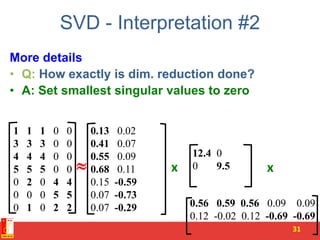
SVD - Interpretation #2
More details
• Q: How exactly is dim. reduction done?
• A: Set smallest singular values to zero
31
 x x
1 1 1 0 0
3 3 3 0 0
4 4 4 0 0
5 5 5 0 0
0 2 0 4 4
0 0 0 5 5
0 1 0 2 2
0.13 0.02
0.41 0.07
0.55 0.09
0.68 0.11
0.15 -0.59
0.07 -0.73
0.07 -0.29
12.4 0
0 9.5
0.56 0.59 0.56 0.09 0.09
0.12 -0.02 0.12 -0.69 -0.69
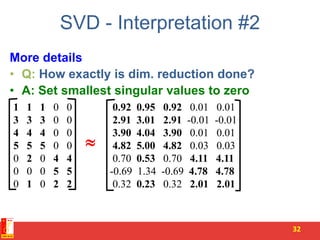
SVD - Interpretation #2
More details
• Q: How exactly is dim. reduction done?
• A: Set smallest singular values to zero
32

1 1 1 0 0
3 3 3 0 0
4 4 4 0 0
5 5 5 0 0
0 2 0 4 4
0 0 0 5 5
0 1 0 2 2
0.92 0.95 0.92 0.01 0.01
2.91 3.01 2.91 -0.01 -0.01
3.90 4.04 3.90 0.01 0.01
4.82 5.00 4.82 0.03 0.03
0.70 0.53 0.70 4.11 4.11
-0.69 1.34 -0.69 4.78 4.78
0.32 0.23 0.32 2.01 2.01
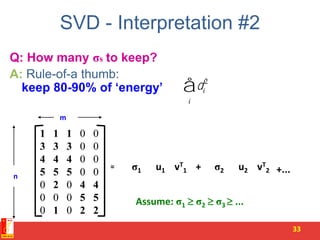
SVD - Interpretation #2
Q: How many σs to keep?
A: Rule-of-a thumb:
keep 80-90% of ‘energy’
33
= u1σ1 vT
1 u2σ2 vT
2+ +...
n
m
Assume: σ1  σ2  σ3  ...
1 1 1 0 0
3 3 3 0 0
4 4 4 0 0
5 5 5 0 0
0 2 0 4 4
0 0 0 5 5
0 1 0 2 2
di
2
i
å
SVD - Conclusions so far
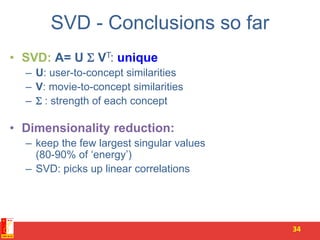
• SVD: A= U  VT: unique
– U: user-to-concept similarities
– V: movie-to-concept similarities
–  : strength of each concept
• Dimensionality reduction:
– keep the few largest singular values
(80-90% of ‘energy’)
– SVD: picks up linear correlations
34
Example of SVD &
Conclusion
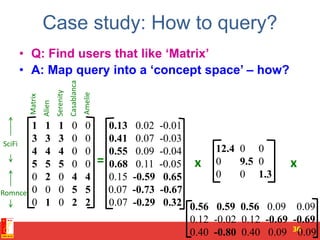
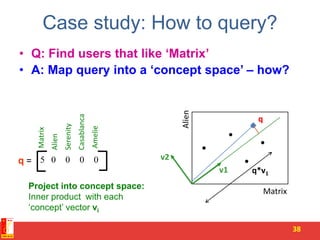
Case study: How to query?
• Q: Find users that like ‘Matrix’
• A: Map query into a ‘concept space’ – how?
36
=
SciFi
Romnce
x x
Matrix
Alien
Serenity
Casablanca
Amelie
1 1 1 0 0
3 3 3 0 0
4 4 4 0 0
5 5 5 0 0
0 2 0 4 4
0 0 0 5 5
0 1 0 2 2
0.13 0.02 -0.01
0.41 0.07 -0.03
0.55 0.09 -0.04
0.68 0.11 -0.05
0.15 -0.59 0.65
0.07 -0.73 -0.67
0.07 -0.29 0.32
12.4 0 0
0 9.5 0
0 0 1.3
0.56 0.59 0.56 0.09 0.09
0.12 -0.02 0.12 -0.69 -0.69
0.40 -0.80 0.40 0.09 0.09
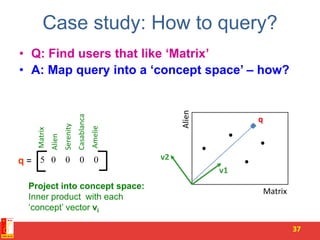
Case study: How to query?
• Q: Find users that like ‘Matrix’
• A: Map query into a ‘concept space’ – how?
37
5 0 0 0 0q =
Matrix
Alien
v1
q
v2
Matrix
Alien
Serenity
Casablanca
Amelie
Project into concept space:
Inner product with each
‘concept’ vector vi
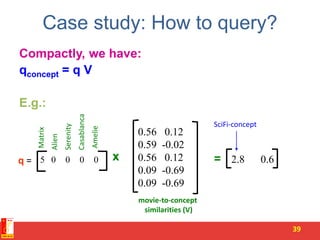
Case study: How to query?
• Q: Find users that like ‘Matrix’
• A: Map query into a ‘concept space’ – how?
38
v1
q
q*v1
5 0 0 0 0
Matrix
Alien
Serenity
Casablanca
Amelie
v2
Matrix
Alien
q =
Project into concept space:
Inner product with each
‘concept’ vector vi
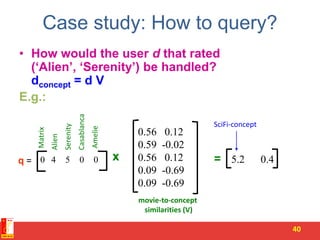
Case study: How to query?
Compactly, we have:
qconcept = q V
E.g.:
39
movie-to-concept
similarities (V)
=
SciFi-concept
5 0 0 0 0
Matrix
Alien
Serenity
Casablanca
Amelie
q =
0.56 0.12
0.59 -0.02
0.56 0.12
0.09 -0.69
0.09 -0.69
x 2.8 0.6
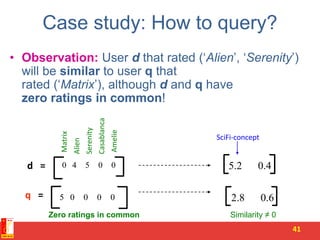
Case study: How to query?
• How would the user d that rated
(‘Alien’, ‘Serenity’) be handled?
dconcept = d V
E.g.:
40
movie-to-concept
similarities (V)
=
SciFi-concept
0 4 5 0 0
Matrix
Alien
Serenity
Casablanca
Amelie
q =
0.56 0.12
0.59 -0.02
0.56 0.12
0.09 -0.69
0.09 -0.69
x 5.2 0.4
Case study: How to query?
• Observation: User d that rated (‘Alien’, ‘Serenity’)
will be similar to user q that
rated (‘Matrix’), although d and q have
zero ratings in common!
41
0 4 5 0 0d =
SciFi-concept
5 0 0 0 0q =
Matrix
Alien
Serenity
Casablanca
Amelie
Zero ratings in common Similarity ≠ 0
2.8 0.6
5.2 0.4
SVD in Latent semantic
indexing and analysis
42
Latent Semantic Indexing
• Term-document matrices are very large
• But the number of topics that people talk
about is small (in some sense)
–Clothes, movies, politics, …
• Can we represent the term-document space
by a lower dimensional latent space?
43
Idea
• From term-doc matrix A, we compute the
approximation Ak.
• There is a row for each term and a column for
each doc in Ak
• Thus docs live in a space of k<<r dimensions
–These dimensions are not the original axes
• But why?
44
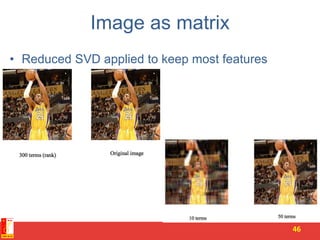
Image compression using
SVD
45
Image as matrix
• Reduced SVD applied to keep most features
46
Principle component analysis
47
Problem formulation
48
Problem formulation
49
Reduce from 2-dimension to 1-dimension: Find a direction (a vector )
onto which to project the data so as to minimize the projection error.
Reduce from n-dimension to k-dimension: Find vectors
onto which to project the data, so as to minimize the projection error.
PCA algorithm
50
Reduce data from -dimensions to -dimensions
Compute “covariance matrix”:
Compute “eigenvectors” of matrix :
[U,S,V] = svd(Sigma);
51
From , we get:[U,S,V] = svd(Sigma)

Dimensionality reduction: SVD and its applications

  • 1.
    Dimensionality Reduction: SVD andits applications Viet-Trung Tran
  • 2.
    Credits • Mining ofMassive Datasets – Jure Leskovec, Anand Rajaraman, Jeff Ullman Stanford University – http://www.mmds.org • Data mining coursera 2
  • 3.
    Motivation • Data compression –Redundancy features – Combine features 3 (inches) (cm) Reduce features from 2D to 1D
  • 4.
    Reduce data from3D to 2D 4 Speed up learning algorithms
  • 5.
    Better data visualization 5 [resourcesfrom en.wikipedia.org] Country GDP (trillions of US$) Per capita GDP (thousands of intl. $) Human Develop- ment Index Life expectancy Poverty Index (Gini as percentage) Mean household income (thousands of US$) … Canada 1.577 39.17 0.908 80.7 32.6 67.293 … China 5.878 7.54 0.687 73 46.9 10.22 … India 1.632 3.41 0.547 64.7 36.8 0.735 … Russia 1.48 19.84 0.755 65.5 39.9 0.72 … Singapore 0.223 56.69 0.866 80 42.5 67.1 … USA 14.527 46.86 0.91 78.3 40.8 84.3 … … … … … … … …
  • 6.
    Reduce to 2D 6 Country Canada1.6 1.2 China 1.7 0.3 India 1.6 0.2 Russia 1.4 0.5 Singapore 0.5 1.7 USA 2 1.5 … … …
  • 7.
    Dimensionality Reduction • Assumption:Data lies on or near a low d-dimensional subspace • Axes of this subspace are effective representation of the data 7
  • 8.
    Rank of aMatrix • Q: What is rank of a matrix A? • A: Number of linearly independent columns of A • For example: – Matrix A = has rank r=2 • Why? The first two rows are linearly independent, so the rank is at least 2, but all three rows are linearly dependent (the first is equal to the sum of the second and third) so the rank must be less than 3. • Why do we care about low rank? – We can write A as two “basis” vectors: [1 2 1] [-2 -3 1] – And new coordinates of : [1 0] [0 1] [1 1] 8
  • 9.
    Rank is “Dimensionality” •Cloud of points 3D space: – Think of point positions as a matrix: • We can rewrite coordinates more efficiently! – Old basis vectors: [1 0 0] [0 1 0] [0 0 1] – New basis vectors: [1 2 1] [-2 -3 1] – Then A has new coordinates: [1 0]. B: [0 1], C: [1 1] • Notice: We reduced the number of coordinates! 9 1 row per point: A B C A
  • 10.
    Dimensionality Reduction • Goalof dimensionality reduction is to discover the axis of data! 10 Rather than representing every point with 2 coordinates we represent each point with 1 coordinate (corresponding to the position of the point on the red line). By doing this we incur a bit of error as the points do not exactly lie on the line
  • 11.
    Sum up Why reducedimensions? • Discover hidden correlations/topics – Words that occur commonly together • Remove redundant and noisy features – Not all words are useful • Interpretation and visualization • Easier storage and processing of the data 11
  • 12.
    SVD - Definition A[mx n] = U[m x r]  [ r x r] (V[n x r])T • A: Input data matrix – m x n matrix (e.g., m documents, n terms) • U: Left singular vectors – m x r matrix (m documents, r concepts) • : Singular values – r x r diagonal matrix (strength of each ‘concept’) (r : rank of the matrix A) • V: Right singular vectors – n x r matrix (n terms, r concepts) 12
  • 13.
    SVD - Properties Itis always possible to decompose a real matrix A into A = U  VT , where • U, , V: unique • U, V: column orthonormal – UT U = I; VT V = I (I: identity matrix) – (Columns are orthogonal unit vectors) • : diagonal – Entries (singular values) are positive, and sorted in decreasing order (σ1  σ2  ...  0) 13
  • 14.
    SVD – Example:Users-to-Movies • A = U  VT - example: Users to Movies 14 = SciFi Romnce Matrix Alien Serenity Casablanca Amelie 1 1 1 0 0 3 3 3 0 0 4 4 4 0 0 5 5 5 0 0 0 2 0 4 4 0 0 0 5 5 0 1 0 2 2  m n U VT “Concepts” AKA Latent dimensions AKA Latent factors
  • 15.
    SVD – Example:Users-to-Movies • A = U  VT - example: Users to Movies 15 = SciFi Romnce x x Matrix Alien Serenity Casablanca Amelie 1 1 1 0 0 3 3 3 0 0 4 4 4 0 0 5 5 5 0 0 0 2 0 4 4 0 0 0 5 5 0 1 0 2 2 0.13 0.02 -0.01 0.41 0.07 -0.03 0.55 0.09 -0.04 0.68 0.11 -0.05 0.15 -0.59 0.65 0.07 -0.73 -0.67 0.07 -0.29 0.32 12.4 0 0 0 9.5 0 0 0 1.3 0.56 0.59 0.56 0.09 0.09 0.12 -0.02 0.12 -0.69 -0.69 0.40 -0.80 0.40 0.09 0.09
  • 16.
    SVD – Example:Users-to-Movies • A = U  VT - example: Users to Movies 16 SciFi-concept Romance-concept = SciFi Romnce x x Matrix Alien Serenity Casablanca Amelie 1 1 1 0 0 3 3 3 0 0 4 4 4 0 0 5 5 5 0 0 0 2 0 4 4 0 0 0 5 5 0 1 0 2 2 0.13 0.02 -0.01 0.41 0.07 -0.03 0.55 0.09 -0.04 0.68 0.11 -0.05 0.15 -0.59 0.65 0.07 -0.73 -0.67 0.07 -0.29 0.32 12.4 0 0 0 9.5 0 0 0 1.3 0.56 0.59 0.56 0.09 0.09 0.12 -0.02 0.12 -0.69 -0.69 0.40 -0.80 0.40 0.09 0.09
  • 17.
    SVD – Example:Users-to-Movies • A = U  VT - example: 17 Romance-concept U is “user-to-concept” similarity matrix SciFi-concept = SciFi Romnce x x Matrix Alien Serenity Casablanca Amelie 1 1 1 0 0 3 3 3 0 0 4 4 4 0 0 5 5 5 0 0 0 2 0 4 4 0 0 0 5 5 0 1 0 2 2 0.13 0.02 -0.01 0.41 0.07 -0.03 0.55 0.09 -0.04 0.68 0.11 -0.05 0.15 -0.59 0.65 0.07 -0.73 -0.67 0.07 -0.29 0.32 12.4 0 0 0 9.5 0 0 0 1.3 0.56 0.59 0.56 0.09 0.09 0.12 -0.02 0.12 -0.69 -0.69 0.40 -0.80 0.40 0.09 0.09
  • 18.
    SVD – Example:Users-to-Movies • A = U  VT - example: 18 SciFi Romnce SciFi-concept “strength” of the SciFi-concept = SciFi Romnce x x Matrix Alien Serenity Casablanca Amelie 1 1 1 0 0 3 3 3 0 0 4 4 4 0 0 5 5 5 0 0 0 2 0 4 4 0 0 0 5 5 0 1 0 2 2 0.13 0.02 -0.01 0.41 0.07 -0.03 0.55 0.09 -0.04 0.68 0.11 -0.05 0.15 -0.59 0.65 0.07 -0.73 -0.67 0.07 -0.29 0.32 12.4 0 0 0 9.5 0 0 0 1.3 0.56 0.59 0.56 0.09 0.09 0.12 -0.02 0.12 -0.69 -0.69 0.40 -0.80 0.40 0.09 0.09
  • 19.
    SVD – Example:Users-to-Movies • A = U  VT - example: 19 SciFi-concept V is “movie-to-concept” similarity matrix SciFi-concept = SciFi Romnce x x Matrix Alien Serenity Casablanca Amelie 1 1 1 0 0 3 3 3 0 0 4 4 4 0 0 5 5 5 0 0 0 2 0 4 4 0 0 0 5 5 0 1 0 2 2 0.13 0.02 -0.01 0.41 0.07 -0.03 0.55 0.09 -0.04 0.68 0.11 -0.05 0.15 -0.59 0.65 0.07 -0.73 -0.67 0.07 -0.29 0.32 12.4 0 0 0 9.5 0 0 0 1.3 0.56 0.59 0.56 0.09 0.09 0.12 -0.02 0.12 -0.69 -0.69 0.40 -0.80 0.40 0.09 0.09
  • 20.
    SVD - Interpretation#1 ‘movies’, ‘users’ and ‘concepts’: • U: user-to-concept similarity matrix • V: movie-to-concept similarity matrix • : its diagonal elements: ‘strength’ of each concept 20
  • 21.
    "Simple" concept 21 sci-fi romance Matrix Alien Serenity Casablanca Amelie user1 user 2 user 3 user 4 user 5 user 6 user 7 strength
  • 22.
  • 23.
    SVD – DimensionalityReduction • Instead of using two coordinates to describe point locations, let’s use only one coordinate • Point’s position is its location along vector • How to choose ? Minimize reconstruction error 23 v1 first right singular vector Movie 1 rating Movie2rating
  • 24.
    SVD - Interpretation#2 • A = U  VT - example: – V: “movie-to-concept” matrix – U: “user-to-concept” matrix 24 v1 first right singular vector Movie 1 rating Movie2rating = x x 1 1 1 0 0 3 3 3 0 0 4 4 4 0 0 5 5 5 0 0 0 2 0 4 4 0 0 0 5 5 0 1 0 2 2 0.13 0.02 -0.01 0.41 0.07 -0.03 0.55 0.09 -0.04 0.68 0.11 -0.05 0.15 -0.59 0.65 0.07 -0.73 -0.67 0.07 -0.29 0.32 12.4 0 0 0 9.5 0 0 0 1.3 0.56 0.59 0.56 0.09 0.09 0.12 -0.02 0.12 -0.69 -0.69 0.40 -0.80 0.40 0.09 0.09
  • 25.
    SVD - Interpretation#2 • A = U  VT - example: 25 v1 first right singular vector Movie 1 rating Movie2rating variance (‘spread’) on the v1 axis = x x 1 1 1 0 0 3 3 3 0 0 4 4 4 0 0 5 5 5 0 0 0 2 0 4 4 0 0 0 5 5 0 1 0 2 2 0.13 0.02 -0.01 0.41 0.07 -0.03 0.55 0.09 -0.04 0.68 0.11 -0.05 0.15 -0.59 0.65 0.07 -0.73 -0.67 0.07 -0.29 0.32 12.4 0 0 0 9.5 0 0 0 1.3 0.56 0.59 0.56 0.09 0.09 0.12 -0.02 0.12 -0.69 -0.69 0.40 -0.80 0.40 0.09 0.09
  • 26.
    SVD - Interpretation#2 A = U  VT - example: • U : Gives the coordinates of the points in the projection axis 26 v1 first right singular vector Movie 1 rating Movie2rating 1 1 1 0 0 3 3 3 0 0 4 4 4 0 0 5 5 5 0 0 0 2 0 4 4 0 0 0 5 5 0 1 0 2 2 1.61 0.19 -0.01 5.08 0.66 -0.03 6.82 0.85 -0.05 8.43 1.04 -0.06 1.86 -5.60 0.84 0.86 -6.93 -0.87 0.86 -2.75 0.41 Projection of users on the “Sci-Fi” axis (U ) T:
  • 27.
    SVD - Interpretation#2 More details • Q: How exactly is dim. reduction done? 27 = x x 1 1 1 0 0 3 3 3 0 0 4 4 4 0 0 5 5 5 0 0 0 2 0 4 4 0 0 0 5 5 0 1 0 2 2 0.13 0.02 -0.01 0.41 0.07 -0.03 0.55 0.09 -0.04 0.68 0.11 -0.05 0.15 -0.59 0.65 0.07 -0.73 -0.67 0.07 -0.29 0.32 12.4 0 0 0 9.5 0 0 0 1.3 0.56 0.59 0.56 0.09 0.09 0.12 -0.02 0.12 -0.69 -0.69 0.40 -0.80 0.40 0.09 0.09
  • 28.
    SVD - Interpretation#2 More details • Q: How exactly is dim. reduction done? • A: Set smallest singular values to zero 28 = x x 1 1 1 0 0 3 3 3 0 0 4 4 4 0 0 5 5 5 0 0 0 2 0 4 4 0 0 0 5 5 0 1 0 2 2 0.13 0.02 -0.01 0.41 0.07 -0.03 0.55 0.09 -0.04 0.68 0.11 -0.05 0.15 -0.59 0.65 0.07 -0.73 -0.67 0.07 -0.29 0.32 12.4 0 0 0 9.5 0 0 0 1.3 0.56 0.59 0.56 0.09 0.09 0.12 -0.02 0.12 -0.69 -0.69 0.40 -0.80 0.40 0.09 0.09
  • 29.
    SVD - Interpretation#2 More details • Q: How exactly is dim. reduction done? • A: Set smallest singular values to zero 29 x x 1 1 1 0 0 3 3 3 0 0 4 4 4 0 0 5 5 5 0 0 0 2 0 4 4 0 0 0 5 5 0 1 0 2 2 0.13 0.02 -0.01 0.41 0.07 -0.03 0.55 0.09 -0.04 0.68 0.11 -0.05 0.15 -0.59 0.65 0.07 -0.73 -0.67 0.07 -0.29 0.32 12.4 0 0 0 9.5 0 0 0 1.3 0.56 0.59 0.56 0.09 0.09 0.12 -0.02 0.12 -0.69 -0.69 0.40 -0.80 0.40 0.09 0.09 
  • 30.
    SVD - Interpretation#2 More details • Q: How exactly is dim. reduction done? • A: Set smallest singular values to zero 30 x x 1 1 1 0 0 3 3 3 0 0 4 4 4 0 0 5 5 5 0 0 0 2 0 4 4 0 0 0 5 5 0 1 0 2 2 0.13 0.02 -0.01 0.41 0.07 -0.03 0.55 0.09 -0.04 0.68 0.11 -0.05 0.15 -0.59 0.65 0.07 -0.73 -0.67 0.07 -0.29 0.32 12.4 0 0 0 9.5 0 0 0 1.3 0.56 0.59 0.56 0.09 0.09 0.12 -0.02 0.12 -0.69 -0.69 0.40 -0.80 0.40 0.09 0.09 
  • 31.
    SVD - Interpretation#2 More details • Q: How exactly is dim. reduction done? • A: Set smallest singular values to zero 31  x x 1 1 1 0 0 3 3 3 0 0 4 4 4 0 0 5 5 5 0 0 0 2 0 4 4 0 0 0 5 5 0 1 0 2 2 0.13 0.02 0.41 0.07 0.55 0.09 0.68 0.11 0.15 -0.59 0.07 -0.73 0.07 -0.29 12.4 0 0 9.5 0.56 0.59 0.56 0.09 0.09 0.12 -0.02 0.12 -0.69 -0.69
  • 32.
    SVD - Interpretation#2 More details • Q: How exactly is dim. reduction done? • A: Set smallest singular values to zero 32  1 1 1 0 0 3 3 3 0 0 4 4 4 0 0 5 5 5 0 0 0 2 0 4 4 0 0 0 5 5 0 1 0 2 2 0.92 0.95 0.92 0.01 0.01 2.91 3.01 2.91 -0.01 -0.01 3.90 4.04 3.90 0.01 0.01 4.82 5.00 4.82 0.03 0.03 0.70 0.53 0.70 4.11 4.11 -0.69 1.34 -0.69 4.78 4.78 0.32 0.23 0.32 2.01 2.01
  • 33.
    SVD - Interpretation#2 Q: How many σs to keep? A: Rule-of-a thumb: keep 80-90% of ‘energy’ 33 = u1σ1 vT 1 u2σ2 vT 2+ +... n m Assume: σ1  σ2  σ3  ... 1 1 1 0 0 3 3 3 0 0 4 4 4 0 0 5 5 5 0 0 0 2 0 4 4 0 0 0 5 5 0 1 0 2 2 di 2 i å
  • 34.
    SVD - Conclusionsso far • SVD: A= U  VT: unique – U: user-to-concept similarities – V: movie-to-concept similarities –  : strength of each concept • Dimensionality reduction: – keep the few largest singular values (80-90% of ‘energy’) – SVD: picks up linear correlations 34
  • 35.
    Example of SVD& Conclusion
  • 36.
    Case study: Howto query? • Q: Find users that like ‘Matrix’ • A: Map query into a ‘concept space’ – how? 36 = SciFi Romnce x x Matrix Alien Serenity Casablanca Amelie 1 1 1 0 0 3 3 3 0 0 4 4 4 0 0 5 5 5 0 0 0 2 0 4 4 0 0 0 5 5 0 1 0 2 2 0.13 0.02 -0.01 0.41 0.07 -0.03 0.55 0.09 -0.04 0.68 0.11 -0.05 0.15 -0.59 0.65 0.07 -0.73 -0.67 0.07 -0.29 0.32 12.4 0 0 0 9.5 0 0 0 1.3 0.56 0.59 0.56 0.09 0.09 0.12 -0.02 0.12 -0.69 -0.69 0.40 -0.80 0.40 0.09 0.09
  • 37.
    Case study: Howto query? • Q: Find users that like ‘Matrix’ • A: Map query into a ‘concept space’ – how? 37 5 0 0 0 0q = Matrix Alien v1 q v2 Matrix Alien Serenity Casablanca Amelie Project into concept space: Inner product with each ‘concept’ vector vi
  • 38.
    Case study: Howto query? • Q: Find users that like ‘Matrix’ • A: Map query into a ‘concept space’ – how? 38 v1 q q*v1 5 0 0 0 0 Matrix Alien Serenity Casablanca Amelie v2 Matrix Alien q = Project into concept space: Inner product with each ‘concept’ vector vi
  • 39.
    Case study: Howto query? Compactly, we have: qconcept = q V E.g.: 39 movie-to-concept similarities (V) = SciFi-concept 5 0 0 0 0 Matrix Alien Serenity Casablanca Amelie q = 0.56 0.12 0.59 -0.02 0.56 0.12 0.09 -0.69 0.09 -0.69 x 2.8 0.6
  • 40.
    Case study: Howto query? • How would the user d that rated (‘Alien’, ‘Serenity’) be handled? dconcept = d V E.g.: 40 movie-to-concept similarities (V) = SciFi-concept 0 4 5 0 0 Matrix Alien Serenity Casablanca Amelie q = 0.56 0.12 0.59 -0.02 0.56 0.12 0.09 -0.69 0.09 -0.69 x 5.2 0.4
  • 41.
    Case study: Howto query? • Observation: User d that rated (‘Alien’, ‘Serenity’) will be similar to user q that rated (‘Matrix’), although d and q have zero ratings in common! 41 0 4 5 0 0d = SciFi-concept 5 0 0 0 0q = Matrix Alien Serenity Casablanca Amelie Zero ratings in common Similarity ≠ 0 2.8 0.6 5.2 0.4
  • 42.
    SVD in Latentsemantic indexing and analysis 42
  • 43.
    Latent Semantic Indexing •Term-document matrices are very large • But the number of topics that people talk about is small (in some sense) –Clothes, movies, politics, … • Can we represent the term-document space by a lower dimensional latent space? 43
  • 44.
    Idea • From term-docmatrix A, we compute the approximation Ak. • There is a row for each term and a column for each doc in Ak • Thus docs live in a space of k<<r dimensions –These dimensions are not the original axes • But why? 44
  • 45.
  • 46.
    Image as matrix •Reduced SVD applied to keep most features 46
  • 47.
  • 48.
  • 49.
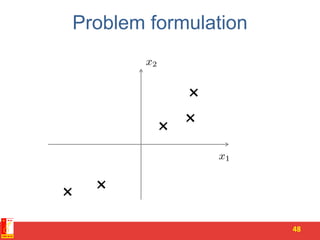
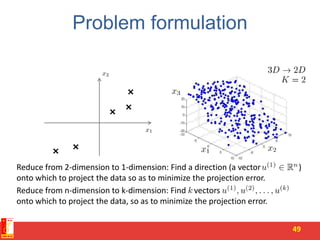
    Problem formulation 49 Reduce from2-dimension to 1-dimension: Find a direction (a vector ) onto which to project the data so as to minimize the projection error. Reduce from n-dimension to k-dimension: Find vectors onto which to project the data, so as to minimize the projection error.
  • 50.
    PCA algorithm 50 Reduce datafrom -dimensions to -dimensions Compute “covariance matrix”: Compute “eigenvectors” of matrix : [U,S,V] = svd(Sigma);
  • 51.
    51 From , weget:[U,S,V] = svd(Sigma)

Editor's Notes

  • #4 get feature from several team ( inch cm)
  • #13 orthogonal ma tran truc giao column-orthonormal matrix ; that is, each of its columns is a unit vector and the dot product of any two columns is 0.
  • #22 Finally, the matrix Σ gives the strength of each of the concepts. In our example, the strength of the science-fiction concept is 12.4, while the strength of the romance concept is 9.5. Intuitively, the science-fiction concept is stronger because the data provides more movies of that genre and more people who like them.
  • #42 True since ratings are correlated and SVD uncovered this correlation