DATA MINING
LECTURE 8
Dimensionality Reduction
PCA -- SVD
Subrata Kumer Paul
Assistant Professor, Dept. of CSE, BAUET
sksubrata96@gmail.com
The curse of dimensionality
• Real data usually have thousands, or millions of
dimensions
• E.g., web documents, where the dimensionality is the
vocabulary of words
• Facebook graph, where the dimensionality is the
number of users
• Huge number of dimensions causes problems
• Data becomes very sparse, some algorithms become
meaningless (e.g. density based clustering)
• The complexity of several algorithms depends on the
dimensionality and they become infeasible.
Dimensionality Reduction
• Usually the data can be described with fewer
dimensions, without losing much of the meaning
of the data.
• The data reside in a space of lower dimensionality
• Essentially, we assume that some of the data is
noise, and we can approximate the useful part
with a lower dimensionality space.
• Dimensionality reduction does not just reduce the
amount of data, it often brings out the useful part of the
data
Dimensionality Reduction
• We have already seen a form of dimensionality
reduction
• LSH, and random projections reduce the
dimension while preserving the distances
Data in the form of a matrix
• We are given n objects and d attributes describing
the objects. Each object has d numeric values
describing it.
• We will represent the data as a nd real matrix A.
• We can now use tools from linear algebra to process the
data matrix
• Our goal is to produce a new nk matrix B such that
• It preserves as much of the information in the original matrix
A as possible
• It reveals something about the structure of the data in A
Example: Document matrices
n
documents
d terms
(e.g., theorem, proof, etc.)
Aij = frequency of the j-th
term in the i-th document
Find subsets of terms that bring documents
together
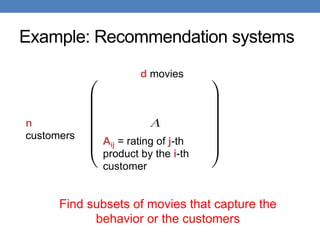
Example: Recommendation systems
n
customers
d movies
Aij = rating of j-th
product by the i-th
customer
Find subsets of movies that capture the
behavior or the customers
Linear algebra
• We assume that vectors are column vectors.
• We use 𝑣𝑇 for the transpose of vector 𝑣 (row vector)
• Dot product: 𝑢𝑇𝑣 (1𝑛, 𝑛1 → 11)
• The dot product is the projection of vector 𝑣 on 𝑢 (and vice versa)
• 1, 2, 3
4
1
2
= 12
• 𝑢𝑇𝑣 = 𝑣 𝑢 cos(𝑢, 𝑣)
• If ||𝑢|| = 1 (unit vector) then 𝑢𝑇𝑣 is the projection length of 𝑣 on 𝑢
• −1, 2, 3
4
−1
2
= 0 orthogonal vectors
• Orthonormal vectors: two unit vectors that are orthogonal
Matrices
• An nm matrix A is a collection of n row vectors and m column
vectors
𝐴 =
| | |
𝑎1 𝑎2 𝑎3
| | |
𝐴 =
− 𝛼1
𝑇
−
− 𝛼2
𝑇
−
− 𝛼3
𝑇
−
• Matrix-vector multiplication
• Right multiplication 𝐴𝑢: projection of u onto the row vectors of 𝐴, or
projection of row vectors of 𝐴 onto 𝑢.
• Left-multiplication 𝑢𝑇
𝐴: projection of 𝑢 onto the column vectors of 𝐴, or
projection of column vectors of 𝐴 onto 𝑢
• Example:
1,2,3
1 0
0 1
0 0
= [1,2]
Rank
• Row space of A: The set of vectors that can be
written as a linear combination of the rows of A
• All vectors of the form 𝑣 = 𝑢𝑇𝐴
• Column space of A: The set of vectors that can be
written as a linear combination of the columns of A
• All vectors of the form 𝑣 = 𝐴𝑢.
• Rank of A: the number of linearly independent row (or
column) vectors
• These vectors define a basis for the row (or column) space
of A
Rank-1 matrices
• In a rank-1 matrix, all columns (or rows) are
multiples of the same column (or row) vector
𝐴 =
1 2 −1
2 4 −2
3 6 −3
• All rows are multiples of 𝑟 = [1,2, −1]
• All columns are multiples of 𝑐 = 1,2,3 𝑇
• External product: 𝑢𝑣𝑇 (𝑛1 , 1𝑚 → 𝑛𝑚)
• The resulting 𝑛𝑚 has rank 1: all rows (or columns) are
linearly dependent
• 𝐴 = 𝑟𝑐𝑇
Eigenvectors
• (Right) Eigenvector of matrix A: a vector v such
that 𝐴𝑣 = 𝜆𝑣
• 𝜆: eigenvalue of eigenvector 𝑣
• A square matrix A of rank r, has r orthonormal
eigenvectors 𝑢1, 𝑢2, … , 𝑢𝑟 with eigenvalues
𝜆1, 𝜆2, … , 𝜆𝑟.
• Eigenvectors define an orthonormal basis for the
column space of A
Singular Value Decomposition
𝐴 = 𝑈 Σ 𝑉𝑇 = 𝑢1, 𝑢2, ⋯ , 𝑢𝑟
𝜎1
𝜎2
0
0
⋱
𝜎𝑟
𝑣1
𝑇
𝑣2
𝑇
⋮
𝑣𝑟
𝑇
• 𝜎1, ≥ 𝜎2 ≥ ⋯ ≥ 𝜎𝑟: singular values of matrix 𝐴 (also, the square roots
of eigenvalues of 𝐴𝐴𝑇 and 𝐴𝑇𝐴)
• 𝑢1, 𝑢2, … , 𝑢𝑟: left singular vectors of 𝐴 (also eigenvectors of 𝐴𝐴𝑇
)
• 𝑣1, 𝑣2, … , 𝑣𝑟: right singular vectors of 𝐴 (also, eigenvectors of 𝐴𝑇
𝐴)
𝐴 = 𝜎1𝑢1𝑣1
𝑇
+ 𝜎2𝑢2𝑣2
𝑇
+ ⋯ + 𝜎𝑟𝑢𝑟𝑣𝑟
𝑇
[n×r] [r×r] [r×m]
r: rank of matrix A
[n×m] =
Symmetric matrices
• Special case: A is symmetric positive definite
matrix
𝐴 = 𝜆1𝑢1𝑢1
𝑇
+ 𝜆2𝑢2𝑢2
𝑇
+ ⋯ + 𝜆𝑟𝑢𝑟𝑢𝑟
𝑇
• 𝜆1 ≥ 𝜆2 ≥ ⋯ ≥ 𝜆𝑟 ≥ 0: Eigenvalues of A
• 𝑢1, 𝑢2, … , 𝑢𝑟: Eigenvectors of A
Singular Value Decomposition
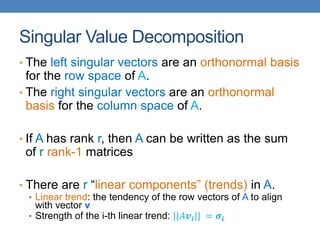
• The left singular vectors are an orthonormal basis
for the row space of A.
• The right singular vectors are an orthonormal
basis for the column space of A.
• If A has rank r, then A can be written as the sum
of r rank-1 matrices
• There are r “linear components” (trends) in A.
• Linear trend: the tendency of the row vectors of A to align
with vector v
• Strength of the i-th linear trend: ||𝐴𝒗𝒊|| = 𝝈𝒊
An (extreme) example
• Document-term matrix
• Blue and Red rows (colums) are linearly dependent
• There are two prototype documents (vectors of words): blue
and red
• To describe the data is enough to describe the two prototypes, and the
projection weights for each row
• A is a rank-2 matrix
𝐴 = 𝑤1, 𝑤2
𝑑1
𝑇
𝑑2
𝑇
A =
An (more realistic) example
• Document-term matrix
• There are two prototype documents and words but
they are noisy
• We now have more than two singular vectors, but the
strongest ones are still about the two types.
• By keeping the two strongest singular vectors we obtain most
of the information in the data.
• This is a rank-2 approximation of the matrix A
A =
Rank-k approximations (Ak)
Uk (Vk): orthogonal matrix containing the top k left (right)
singular vectors of A.
k: diagonal matrix containing the top k singular values of A
Ak is an approximation of A
n x d n x k k x k k x d
Ak is the best approximation of A
SVD as an optimization
• The rank-k approximation matrix 𝐴𝑘 produced by
the top-k singular vectors of A minimizes the
Frobenious norm of the difference with the matrix
A
𝐴𝑘 = arg max
𝐵:𝑟𝑎𝑛𝑘 𝐵 =𝑘
𝐴 − 𝐵 𝐹
2
𝐴 − 𝐵 𝐹
2
=
𝑖,𝑗
𝐴𝑖𝑗 − 𝐵𝑖𝑗
2
What does this mean?
• We can project the row (and column) vectors of
the matrix A into a k-dimensional space and
preserve most of the information
• (Ideally) The k dimensions reveal latent
features/aspects/topics of the term (document)
space.
• (Ideally) The 𝐴𝑘 approximation of matrix A,
contains all the useful information, and what is
discarded is noise
Latent factor model
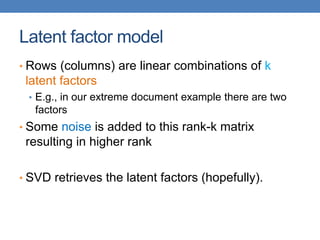
• Rows (columns) are linear combinations of k
latent factors
• E.g., in our extreme document example there are two
factors
• Some noise is added to this rank-k matrix
resulting in higher rank
• SVD retrieves the latent factors (hopefully).
A VT

U
=
objects
features
significant
noise
noise
noise
significant sig.
=
SVD and Rank-k approximations
Application: Recommender systems
• Data: Users rating movies
• Sparse and often noisy
• Assumption: There are k basic user profiles, and
each user is a linear combination of these profiles
• E.g., action, comedy, drama, romance
• Each user is a weighted cobination of these profiles
• The “true” matrix has rank k
• What we observe is a noisy, and incomplete version
of this matrix 𝐴
• The rank-k approximation 𝐴𝑘 is provably close to 𝐴𝑘
• Algorithm: compute 𝐴𝑘 and predict for user 𝑢 and
movie 𝑚, the value 𝐴𝑘[𝑚, 𝑢].
• Model-based collaborative filtering
SVD and PCA
• PCA is a special case of SVD on the centered
covariance matrix.
Covariance matrix
• Goal: reduce the dimensionality while preserving the
“information in the data”
• Information in the data: variability in the data
• We measure variability using the covariance matrix.
• Sample covariance of variables X and Y
𝑖
𝑥𝑖 − 𝜇𝑋
𝑇(𝑦𝑖 − 𝜇𝑌)
• Given matrix A, remove the mean of each column
from the column vectors to get the centered matrix C
• The matrix 𝑉 = 𝐶𝑇𝐶 is the covariance matrix of the
row vectors of A.
PCA: Principal Component Analysis
• We will project the rows of matrix A into a new set
of attributes (dimensions) such that:
• The attributes have zero covariance to each other (they
are orthogonal)
• Each attribute captures the most remaining variance in
the data, while orthogonal to the existing attributes
• The first attribute should capture the most variance in the data
• For matrix C, the variance of the rows of C when
projected to vector x is given by 𝜎2 = 𝐶𝑥
2
• The right singular vector of C maximizes 𝜎2!
4.0 4.5 5.0 5.5 6.0
2
3
4
5
PCA
Input: 2-d dimensional points
Output:
1st (right)
singular vector
1st (right) singular vector:
direction of maximal variance,
2nd (right)
singular
vector
2nd (right) singular vector:
direction of maximal variance,
after removing the projection of
the data along the first singular
vector.
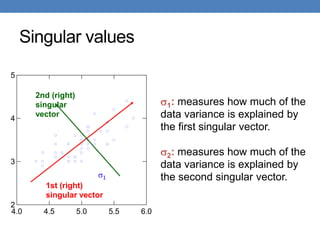
Singular values
1: measures how much of the
data variance is explained by
the first singular vector.
2: measures how much of the
data variance is explained by
the second singular vector.
1
4.0 4.5 5.0 5.5 6.0
2
3
4
5
1st (right)
singular vector
2nd (right)
singular
vector
Singular values tell us something about
the variance
• The variance in the direction of the k-th principal
component is given by the corresponding singular value
σk
2
• Singular values can be used to estimate how many
components to keep
• Rule of thumb: keep enough to explain 85% of the
variation:
85
.
0
1
2
1
2





n
j
j
k
j
j


Example
𝐴 =
𝑎11 ⋯ 𝑎1𝑛
⋮ ⋱ ⋮
𝑎𝑛1 ⋯ 𝑎𝑛𝑛
𝐴 = 𝑈Σ𝑉𝑇
• First right singular vector 𝑣1
• More or less same weight to all drugs
• Discriminates heavy from light users
• Second right singular vector
• Positive values for legal drugs, negative for illegal
students
drugs
legal illegal
𝑎𝑖𝑗: usage of student i of drug j
Drug 2
Drug 1
Another property of PCA/SVD
• The chosen vectors are such that minimize the sum of square
differences between the data vectors and the low-dimensional
projections
4.0 4.5 5.0 5.5 6.0
2
3
4
5
1st (right)
singular vector
Application
• Latent Semantic Indexing (LSI):
• Apply PCA on the document-term matrix, and index the
k-dimensional vectors
• When a query comes, project it onto the k-dimensional
space and compute cosine similarity in this space
• Principal components capture main topics, and enrich
the document representation
SVD is “the Rolls-Royce and the Swiss
Army Knife of Numerical Linear
Algebra.”*
*Dianne O’Leary, MMDS ’06

Data Mining Lecture_9.pptx

  • 1.
    DATA MINING LECTURE 8 DimensionalityReduction PCA -- SVD Subrata Kumer Paul Assistant Professor, Dept. of CSE, BAUET sksubrata96@gmail.com
  • 2.
    The curse ofdimensionality • Real data usually have thousands, or millions of dimensions • E.g., web documents, where the dimensionality is the vocabulary of words • Facebook graph, where the dimensionality is the number of users • Huge number of dimensions causes problems • Data becomes very sparse, some algorithms become meaningless (e.g. density based clustering) • The complexity of several algorithms depends on the dimensionality and they become infeasible.
  • 3.
    Dimensionality Reduction • Usuallythe data can be described with fewer dimensions, without losing much of the meaning of the data. • The data reside in a space of lower dimensionality • Essentially, we assume that some of the data is noise, and we can approximate the useful part with a lower dimensionality space. • Dimensionality reduction does not just reduce the amount of data, it often brings out the useful part of the data
  • 4.
    Dimensionality Reduction • Wehave already seen a form of dimensionality reduction • LSH, and random projections reduce the dimension while preserving the distances
  • 5.
    Data in theform of a matrix • We are given n objects and d attributes describing the objects. Each object has d numeric values describing it. • We will represent the data as a nd real matrix A. • We can now use tools from linear algebra to process the data matrix • Our goal is to produce a new nk matrix B such that • It preserves as much of the information in the original matrix A as possible • It reveals something about the structure of the data in A
  • 6.
    Example: Document matrices n documents dterms (e.g., theorem, proof, etc.) Aij = frequency of the j-th term in the i-th document Find subsets of terms that bring documents together
  • 7.
    Example: Recommendation systems n customers dmovies Aij = rating of j-th product by the i-th customer Find subsets of movies that capture the behavior or the customers
  • 8.
    Linear algebra • Weassume that vectors are column vectors. • We use 𝑣𝑇 for the transpose of vector 𝑣 (row vector) • Dot product: 𝑢𝑇𝑣 (1𝑛, 𝑛1 → 11) • The dot product is the projection of vector 𝑣 on 𝑢 (and vice versa) • 1, 2, 3 4 1 2 = 12 • 𝑢𝑇𝑣 = 𝑣 𝑢 cos(𝑢, 𝑣) • If ||𝑢|| = 1 (unit vector) then 𝑢𝑇𝑣 is the projection length of 𝑣 on 𝑢 • −1, 2, 3 4 −1 2 = 0 orthogonal vectors • Orthonormal vectors: two unit vectors that are orthogonal
  • 9.
    Matrices • An nmmatrix A is a collection of n row vectors and m column vectors 𝐴 = | | | 𝑎1 𝑎2 𝑎3 | | | 𝐴 = − 𝛼1 𝑇 − − 𝛼2 𝑇 − − 𝛼3 𝑇 − • Matrix-vector multiplication • Right multiplication 𝐴𝑢: projection of u onto the row vectors of 𝐴, or projection of row vectors of 𝐴 onto 𝑢. • Left-multiplication 𝑢𝑇 𝐴: projection of 𝑢 onto the column vectors of 𝐴, or projection of column vectors of 𝐴 onto 𝑢 • Example: 1,2,3 1 0 0 1 0 0 = [1,2]
  • 10.
    Rank • Row spaceof A: The set of vectors that can be written as a linear combination of the rows of A • All vectors of the form 𝑣 = 𝑢𝑇𝐴 • Column space of A: The set of vectors that can be written as a linear combination of the columns of A • All vectors of the form 𝑣 = 𝐴𝑢. • Rank of A: the number of linearly independent row (or column) vectors • These vectors define a basis for the row (or column) space of A
  • 11.
    Rank-1 matrices • Ina rank-1 matrix, all columns (or rows) are multiples of the same column (or row) vector 𝐴 = 1 2 −1 2 4 −2 3 6 −3 • All rows are multiples of 𝑟 = [1,2, −1] • All columns are multiples of 𝑐 = 1,2,3 𝑇 • External product: 𝑢𝑣𝑇 (𝑛1 , 1𝑚 → 𝑛𝑚) • The resulting 𝑛𝑚 has rank 1: all rows (or columns) are linearly dependent • 𝐴 = 𝑟𝑐𝑇
  • 12.
    Eigenvectors • (Right) Eigenvectorof matrix A: a vector v such that 𝐴𝑣 = 𝜆𝑣 • 𝜆: eigenvalue of eigenvector 𝑣 • A square matrix A of rank r, has r orthonormal eigenvectors 𝑢1, 𝑢2, … , 𝑢𝑟 with eigenvalues 𝜆1, 𝜆2, … , 𝜆𝑟. • Eigenvectors define an orthonormal basis for the column space of A
  • 13.
    Singular Value Decomposition 𝐴= 𝑈 Σ 𝑉𝑇 = 𝑢1, 𝑢2, ⋯ , 𝑢𝑟 𝜎1 𝜎2 0 0 ⋱ 𝜎𝑟 𝑣1 𝑇 𝑣2 𝑇 ⋮ 𝑣𝑟 𝑇 • 𝜎1, ≥ 𝜎2 ≥ ⋯ ≥ 𝜎𝑟: singular values of matrix 𝐴 (also, the square roots of eigenvalues of 𝐴𝐴𝑇 and 𝐴𝑇𝐴) • 𝑢1, 𝑢2, … , 𝑢𝑟: left singular vectors of 𝐴 (also eigenvectors of 𝐴𝐴𝑇 ) • 𝑣1, 𝑣2, … , 𝑣𝑟: right singular vectors of 𝐴 (also, eigenvectors of 𝐴𝑇 𝐴) 𝐴 = 𝜎1𝑢1𝑣1 𝑇 + 𝜎2𝑢2𝑣2 𝑇 + ⋯ + 𝜎𝑟𝑢𝑟𝑣𝑟 𝑇 [n×r] [r×r] [r×m] r: rank of matrix A [n×m] =
  • 14.
    Symmetric matrices • Specialcase: A is symmetric positive definite matrix 𝐴 = 𝜆1𝑢1𝑢1 𝑇 + 𝜆2𝑢2𝑢2 𝑇 + ⋯ + 𝜆𝑟𝑢𝑟𝑢𝑟 𝑇 • 𝜆1 ≥ 𝜆2 ≥ ⋯ ≥ 𝜆𝑟 ≥ 0: Eigenvalues of A • 𝑢1, 𝑢2, … , 𝑢𝑟: Eigenvectors of A
  • 15.
    Singular Value Decomposition •The left singular vectors are an orthonormal basis for the row space of A. • The right singular vectors are an orthonormal basis for the column space of A. • If A has rank r, then A can be written as the sum of r rank-1 matrices • There are r “linear components” (trends) in A. • Linear trend: the tendency of the row vectors of A to align with vector v • Strength of the i-th linear trend: ||𝐴𝒗𝒊|| = 𝝈𝒊
  • 16.
    An (extreme) example •Document-term matrix • Blue and Red rows (colums) are linearly dependent • There are two prototype documents (vectors of words): blue and red • To describe the data is enough to describe the two prototypes, and the projection weights for each row • A is a rank-2 matrix 𝐴 = 𝑤1, 𝑤2 𝑑1 𝑇 𝑑2 𝑇 A =
  • 17.
    An (more realistic)example • Document-term matrix • There are two prototype documents and words but they are noisy • We now have more than two singular vectors, but the strongest ones are still about the two types. • By keeping the two strongest singular vectors we obtain most of the information in the data. • This is a rank-2 approximation of the matrix A A =
  • 18.
    Rank-k approximations (Ak) Uk(Vk): orthogonal matrix containing the top k left (right) singular vectors of A. k: diagonal matrix containing the top k singular values of A Ak is an approximation of A n x d n x k k x k k x d Ak is the best approximation of A
  • 19.
    SVD as anoptimization • The rank-k approximation matrix 𝐴𝑘 produced by the top-k singular vectors of A minimizes the Frobenious norm of the difference with the matrix A 𝐴𝑘 = arg max 𝐵:𝑟𝑎𝑛𝑘 𝐵 =𝑘 𝐴 − 𝐵 𝐹 2 𝐴 − 𝐵 𝐹 2 = 𝑖,𝑗 𝐴𝑖𝑗 − 𝐵𝑖𝑗 2
  • 20.
    What does thismean? • We can project the row (and column) vectors of the matrix A into a k-dimensional space and preserve most of the information • (Ideally) The k dimensions reveal latent features/aspects/topics of the term (document) space. • (Ideally) The 𝐴𝑘 approximation of matrix A, contains all the useful information, and what is discarded is noise
  • 21.
    Latent factor model •Rows (columns) are linear combinations of k latent factors • E.g., in our extreme document example there are two factors • Some noise is added to this rank-k matrix resulting in higher rank • SVD retrieves the latent factors (hopefully).
  • 22.
  • 23.
    Application: Recommender systems •Data: Users rating movies • Sparse and often noisy • Assumption: There are k basic user profiles, and each user is a linear combination of these profiles • E.g., action, comedy, drama, romance • Each user is a weighted cobination of these profiles • The “true” matrix has rank k • What we observe is a noisy, and incomplete version of this matrix 𝐴 • The rank-k approximation 𝐴𝑘 is provably close to 𝐴𝑘 • Algorithm: compute 𝐴𝑘 and predict for user 𝑢 and movie 𝑚, the value 𝐴𝑘[𝑚, 𝑢]. • Model-based collaborative filtering
  • 24.
    SVD and PCA •PCA is a special case of SVD on the centered covariance matrix.
  • 25.
    Covariance matrix • Goal:reduce the dimensionality while preserving the “information in the data” • Information in the data: variability in the data • We measure variability using the covariance matrix. • Sample covariance of variables X and Y 𝑖 𝑥𝑖 − 𝜇𝑋 𝑇(𝑦𝑖 − 𝜇𝑌) • Given matrix A, remove the mean of each column from the column vectors to get the centered matrix C • The matrix 𝑉 = 𝐶𝑇𝐶 is the covariance matrix of the row vectors of A.
  • 26.
    PCA: Principal ComponentAnalysis • We will project the rows of matrix A into a new set of attributes (dimensions) such that: • The attributes have zero covariance to each other (they are orthogonal) • Each attribute captures the most remaining variance in the data, while orthogonal to the existing attributes • The first attribute should capture the most variance in the data • For matrix C, the variance of the rows of C when projected to vector x is given by 𝜎2 = 𝐶𝑥 2 • The right singular vector of C maximizes 𝜎2!
  • 27.
    4.0 4.5 5.05.5 6.0 2 3 4 5 PCA Input: 2-d dimensional points Output: 1st (right) singular vector 1st (right) singular vector: direction of maximal variance, 2nd (right) singular vector 2nd (right) singular vector: direction of maximal variance, after removing the projection of the data along the first singular vector.
  • 28.
    Singular values 1: measureshow much of the data variance is explained by the first singular vector. 2: measures how much of the data variance is explained by the second singular vector. 1 4.0 4.5 5.0 5.5 6.0 2 3 4 5 1st (right) singular vector 2nd (right) singular vector
  • 29.
    Singular values tellus something about the variance • The variance in the direction of the k-th principal component is given by the corresponding singular value σk 2 • Singular values can be used to estimate how many components to keep • Rule of thumb: keep enough to explain 85% of the variation: 85 . 0 1 2 1 2      n j j k j j  
  • 30.
    Example 𝐴 = 𝑎11 ⋯𝑎1𝑛 ⋮ ⋱ ⋮ 𝑎𝑛1 ⋯ 𝑎𝑛𝑛 𝐴 = 𝑈Σ𝑉𝑇 • First right singular vector 𝑣1 • More or less same weight to all drugs • Discriminates heavy from light users • Second right singular vector • Positive values for legal drugs, negative for illegal students drugs legal illegal 𝑎𝑖𝑗: usage of student i of drug j Drug 2 Drug 1
  • 31.
    Another property ofPCA/SVD • The chosen vectors are such that minimize the sum of square differences between the data vectors and the low-dimensional projections 4.0 4.5 5.0 5.5 6.0 2 3 4 5 1st (right) singular vector
  • 32.
    Application • Latent SemanticIndexing (LSI): • Apply PCA on the document-term matrix, and index the k-dimensional vectors • When a query comes, project it onto the k-dimensional space and compute cosine similarity in this space • Principal components capture main topics, and enrich the document representation
  • 33.
    SVD is “theRolls-Royce and the Swiss Army Knife of Numerical Linear Algebra.”* *Dianne O’Leary, MMDS ’06