Downloaded 277 times





![Mathematicalstepsto calculate SVD of a matrix
1. Given an input image matrix A.
2. First, calculate AA
T
and A
T
A.
3. Use AA
T
to find the eigenvalues and eigenvectors to form
the columns of U: (AA
T
- ƛI) ẍ = 0.
4. Use A
T
A to find the eigenvalues and eigenvectors to form
the columns of V: (A
T
A - ƛI) ẍ =0.
5. Divide each eigenvector by its magnitude to form the
columns of U and V.
6. Take the square root of the eigenvalues to find the singular
values, and arrange them in the diagonal matrix S in
descending order: σ1 ≥ σ2 ≥ … ≥ σr ≥ 0
In MATLAB: [U,W,V]=svd(A,0)](https://image.slidesharecdn.com/svdppt-160102093357/85/Singular-Value-Decomposition-Image-Compression-8-320.jpg)
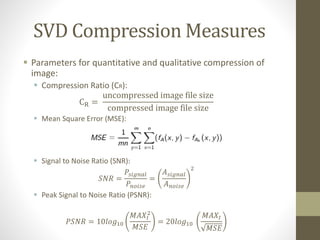
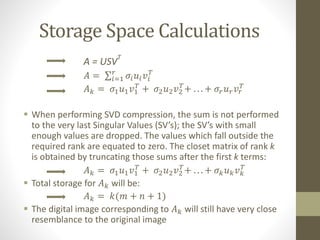
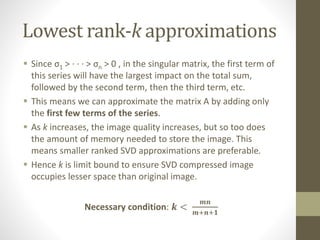
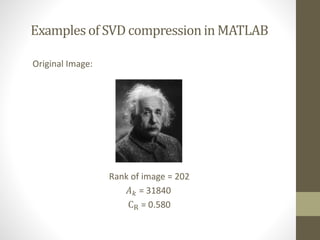
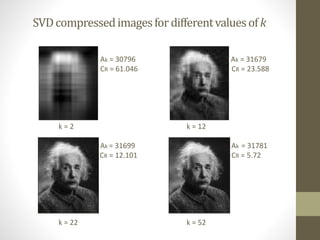


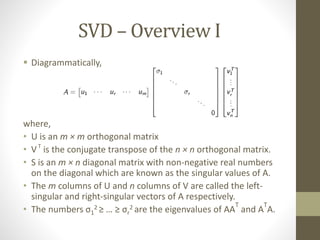
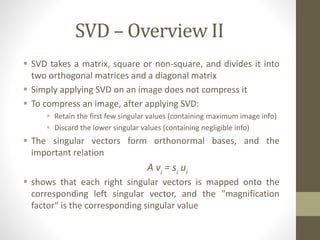
- SVD image compression works by decomposing an image matrix into three matrices - two orthogonal matrices containing singular vectors and a diagonal matrix containing singular values. The singular values are ordered from highest to lowest. - Compression is achieved by only keeping the first few singular values, which contain most of the image information, and discarding the smaller values. This approximates the original matrix while reducing storage needs. - The tradeoff is between compression ratio/file size and image quality - smaller values of k retain fewer singular values and compress more but quality deteriorates, while larger k improves quality at the cost of file size. An optimal k value balances these factors.


